Needing His Cross Daily

We live in this place.

I confess that peace has never been really high on my list. Love, joy, kindness, and even goodness are clear priorities. Peace… not so much. Until I find out it’s not there. And then I get frantic by its absence and scrambling look for it with bewilderment.

Sometimes I don’t understand why God still loves me. At times like this anxiety eats at me. I beat myself up by my last failure. The guilt of my latest sin grows until it looms larger than the blood that saved me. Sometimes I suppose, religious people seem to have the most neurosis.

I’m afraid that we are taking the ‘present tense’ out of the Gospel.

The past tense is preferable to us as we find it easier to ‘manage’ our Christian life. We like to make check marks on our list. [Church attendance– check. Baptism– check. Bible study– check.] I think it gives me a definite feeling of ‘maturity.’

But these things matter little without intimacy with Jesus Christ.

I certainly haven’t arrived, and it seems at times I’m still the hideous sinner I always was. I cannot pretend otherwise, even with a spiritual truckload of cosmetics at my disposal. I know, I’ve tried. And I’m still ‘ugly.’ I do know forgiveness, and I do walk in its wonderful light (by grace).

I read Luther 30 years ago. (And Bonhoeffer would say something similar.)

“When our Lord and Master Jesus Christ said, ‘Repent,’ he willed the entire life of believers to be one of repentance.”

Martin Luther

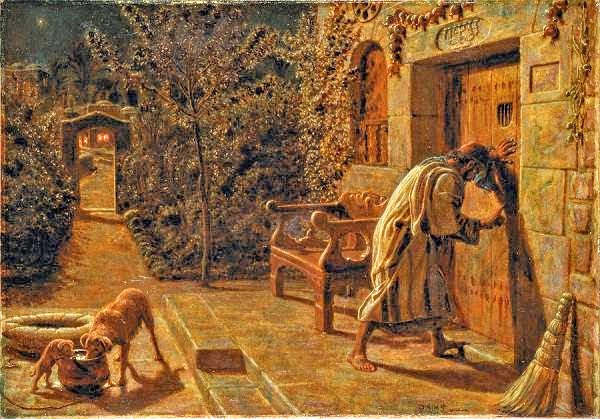
This is the first of his 95 Theses nailed to the door of the Castle Church in Wittenberg, Germany. And there is a present tense here we can’t ignore about these declarations. I don’t just repent over smoking, beer drinking, fornication, or hypocrisy, once and done. But my entire way of living is to be one of repenting. To repent everyday opens the door to a true grace-filled discipleship.

“All of the Christian life is repentance. Turning from sin and trusting in the good news that Jesus saves sinners aren’t merely a one-time inaugural experience but the daily substance of Christianity. The gospel is for every day and every moment. Repentance is to be the Christian’s continual posture.”

John Piper

Luther’s last words, on his deathbed, was found written on a scrap of paper stuck in his coat, “We are beggars! This is true.” Even after thirty years, he was only echoing his first thesis.

It seems dear ones, we are to live at the foot of the cross.

The Absolute Danger in Exalting Yourself

Now he told a parable to those who were invited, when he noticed how they chose the places of honor, saying to them, “When you are invited by someone to a wedding feast, do not sit down in a place of honor, lest someone more distinguished than you be invited by him, and he who invited you both will come and say to you, ‘Give your place to this person,’ and then you will begin with shame to take the lowest place. 

10 But when you are invited, go and sit in the lowest place, so that when your host comes he may say to you, ‘Friend, move up higher.’ Then you will be honored in the presence of all who sit at table with you. 11 For everyone who exalts himself will be humbled, and he who humbles himself will be exalted.”

Luke 14:7-11, ESV

Choose your seat carefully. In Jesus’ day, there was a definite seating order to a wedding feast. It wasn’t first come, first served. There was a strict protocol, where one’s importance mattered.

Honored people got honorable seats–close to the front as possible. Average people got average spots; but no one wanted be at the bottom, having to sit at the “kids table.”

Jesus was watching, and he what he saw was a spiritual principle of his Kingdom.

Jesus often teaches us out of the things we encounter.

Truth often hits us from those things we actually see. If you want to know what God is doing in your life, all you need to do is look around at the practical things, and start to see the spiritual lessons inside them. We learn from real-life. That’s how he often teaches us, he combines the Word with what we’re experiencing.

Our natural inclination is to move higher up.

We think that we’re deserving, and so we take our rightful positions. That’s the way humans think. We all want to sit in the best possible place, and so we end up wheedling our way up front. We can fall into the subtle trap of self-promotion. But that’s not how discipleship works.

Jesus corrects, advising us to take the lowest place.

I think verse 11 is the key to figuring out this seating arrangement. We’re starting to see a physical situation become a spiritual lesson. There’s much to learn. Here’s verse 11 in the Amplified version:

For everyone who exalts himself will be humbled [before others], and he who habitually humbles himself (keeps a realistic self-view) will be exalted.”

Luke 14:11

This particular translation injects some realism into our lives, especially in how we see ourselves. It’s quite foundational. It lays down a principle that is always true in his Kingdom (1 Peter 5:6). If we don’t accept and implement this, we’ll suffer a definite weakness in our discipleship. It stunts the growth of many believers. And that is tragic.

The whole scene lays out how life in the spirit really works, and it seems paradoxical.

Our human logic asserts that deliberately choosing the lesser is foolish, things really don’t work that way. We think, (falsely,) that we’ll only advance by asserting ourselves. But Jesus, quite aptly, clarifies the ways of the Kingdom.

True maturity will only come if we decide to take the lowest place.

James 4:10

alaskabibleteacher.com

Ponder the Word

“But his delight is in the law of the Lord, and on his law he meditates day and night.”

Psalm 1:2

In Psalm 1:2 the Hebrew word for meditation is hagah. In this Psalm we have a contrast between the blessed and the “not-so-blessed,” and it commands that as Jesus’ followers that we process the reality of this to become blessed by our Father.

In Psalm 1:1 the word blessed is used, and actually just in the book is Psalms alone blessed is used 51 times. The word has a very simple and concise meaning: “to be happy.” I really don’t think we can minimize how important it is to be happy.

In 1:2 we read hagah or meditate. That Hebrew word is a little bit more complicated and it seems more nuanced than “blessed.”

Hagah, or meditate means:

  • to chew a cud like a cow
  • to growl like a lion who is eating an antelope
  • to moan or groan
  • to talk to oneself, or mutter or whisper
  • finally, it can mean to muse or imagine

Yeah, it’s an interesting word and I suppose all of these meanings are to be factored into meditation [hagah]. It seems that these five definitions shape the different meanings that go into our understanding.

Using the above definitions, this is how it might look:

  1. sometimes I regurgitate the word like a cow chewing its cud
  2. at times I attack it like a lion
  3. I moan and groan as I wrestle with it, seeking for a handhold
  4. thinking about the passage I talk to myself about its meaning
  5. I imagine being there, sometimes it’s like I’m a “fly-on-the-wall”

When we come to God’s words, the Bible, we are required to assimilate all that the Holy Spirit graciously gives. When He gives us something from the Word we must apply it to ourselves. You can do this through any of the 5 definitions I’ve given.

The Holy Spirit is the One who ignites His Word into our hearts.

Joshua 1:8, ESV

alaskabibleteacher.com

The Seed Must Grow

26 And he said, “The kingdom of God is as if a man should scatter seed on the ground. 27 He sleeps and rises night and day, and the seed sprouts and grows; he knows not how. 28 The earth produces by itself, first the blade, then the ear, then the full grain in the ear. 29 But when the grain is ripe, at once he puts in the sickle, because the harvest has come.”

Mark 4:26-29

From a seed to a plant. We have no idea how this happens, it just does. This is a “kingdom” parable, one of several that explain what God’s realm is, and how it happens. In this particular story, we’re told how the Holy Spirit works. It also explains our role in this (which isn’t a whole lot).

The farmer puts the seed in the ground—and that’s it.

He’s done his work, there’s nothing more he can do. He doesn’t do anything else from this point, and honestly he can’t. And yet the soil needs to be prepared—plowed, fertilized and tilled again. You might say he creates the conditions (that’s what makes a good farmer, I guess) for something to happen.

He doesn’t massage the seed, coaxing it to grow.

He doesn’t sing to it, or tell it about the wonders of being lush and green. He does zero. The seed grows on its own. He goes to bed, and gets up. After several days, bingo! That seed turns into a plant—something green and alive. He doesn’t do a thing. Life occurs without his work.

The point is this. God’s work is done invisibly within us (and that’s a relief)!

Robertson’s Commentary

God’s kingdom works pretty much like this. The farmer doesn’t cause the seed growth, all he does is go to bed! He sleeps and waits and watches. It grows and he hasn’t the slightest. It’s a complete mystery. He has done everything he can, and God has done the rest. He “shares” in this amazing transformation, but the father has done it all.

We trust in a process we cannot see, or really understand.

We don’t dig the seed up every morning to see what’s happening. We just let the (super)natural happen. And it does!

The farmer has faith in the process (after all, he did plant the seed), but that’s it. There’s a verse in 1 Corinthians that should be considered. It gives us confidence and a definite trust in this process of growth. The Apostle Paul understands this “principle of growth.”

“So neither he who plants nor he who waters is anything, but only God who gives the growth.”

1 Cor. 3:7

We must trust God completely to grow. We’re responsible for tilling and planting. But you need to understand what happens after that is up to him. The kingdom of God is supernatural. It’s exactly how the kingdom happens—and we must be very patient and incredibly wise.

“There is nothing more important to learn about Christian growth than this: Growing in grace means becoming like Christ.”

     Sinclair B. Ferguson

alaskabibleteacher.com

You Need to Understand This

Finally, be strong in the Lord and in the strength of his might. 11 Put on the whole armor of God, that you may be able to stand against the schemes of the devil. 

For we do not wrestle against flesh and blood, but against the rulers, against the authorities, against the cosmic powers over this present darkness, against the spiritual forces of evil in the heavenly places.

Eph. 6:10-12, ESV 

Often in Scripture we’ll understand something which will shake us. Dismissing its truth as optional would be a grave oversight. Instead of perceiving it as a mere emphasis reserved for those more inclined towards “charisma,” we must insist on its relevance for each and every believer.

We face a battle. Every one of us.

We look around and see others whose ‘reality’ is different from ours. We see politics, psychology, biology or cosmology, religion or philosophy, entertainment or science that are blind to reality. But Ephesians 6 tells us what we’re up against. We’re starting to realize that humans have a terrible knack for being manipulated by evil powers.

1 John 5:19, Amplified

Ephesians 6 declares that we’re in a world where every individual is in a war.

This passage clearly tells us that the only place of safety is to be strong in God and to find that the only safety is pressing into His presence. To survive we must push everything else aside to be in His presence. He gives us His strength to overcome all evil.

The above passage stresses that there is an organized force of darkness focused on us. These verses in Ephesians 6 unveil a government of wickedness that’s everywhere. Without the humble intimacy that needs prayer and Bible reading, we will be spiritually destroyed.

C.S. Lewis

We need protection. Our only hope is Jesus’ strength. But we must actively step into this spiritual intensity.

We’re only strong through our intimacy with Him. He shields us from the spiritual corruption that swirls all around us. As we draw to Him we become mighty, as we listen closely to the Holy Spirit, we will walk in true discipleship with Jesus.

Watchman Nee

alaskabibleteacher.com

Abide.

The repetition of this should be obvious. Our discipleship must hang on that simple (yet profound) word. We are clearly called to “abide.” It’s a small word, and yet the thought it carries is deep and heartfelt. Jesus calls His disciples to rest and obey Him.

To abide means to “dwell,” “remain,” “be present,” and to “be connected.” Abiding addresses our posture and place. How connected are we to our source? Where are we in proximity to Christ? A disciple must ask these questions.

The issue is “sap.” Am I connected in such a way that His presence flows through me?

A branch must be attached in order to bear fruit. If, somehow, it isn’t connected, it dries up and needs to be cut off the vine. Many believers are in danger, they’re not producing fruit and they are not growing. Somehow they aren’t affixed to the Lord Jesus.

This doesn’t mean they have lost their salvation, it just means that their discipleship has little meaning. They have no purpose, the sap of Jesus becomes a trickle and fruit is never really produced. It is a sad and difficult place to be.

Often the real issue comes down to obedience/disobedience.

I must learn that “abide” is now my life, my sap, my fruitfulness.

“Abide in Me says Jesus. Cling to Me. Stick fast to Me. Live the life of close and intimate communion with Me. Get nearer to Me. Roll every burden on Me. Cast your whole weight on Me. Never let go your hold on Me for a moment. Be, as it were, rooted and planted in Me. Do this and I will never fail you. I will ever abide in you.”

     J.C. Ryle

alaskabibleteacher.com

The Children Are Our Examples

 Now they were bringing even infants to him that he might touch them. And when the disciples saw it, they rebuked them. 16 But Jesus called them to him, saying, “Let the children come to me, and do not hinder them, for to such belongs the kingdom of God. 17 

Truly, I say to you, whoever does not receive the kingdom of God like a child shall not enter it.”

Luke 18:15-17

Again we were wrong (like usual it seems). I guess that we were trying to maximize Jesus’ ministry. We meant well, but He needed organization. So that was now our “ministry.” We simply felt that Jesus’ time was our concern, and as His disciples we wanted Him to connect with those who really mattered.

The parents were bringing their children to be blessed by Jesus.

“It was the custom for mothers to bring their children to some distinguished Rabbi on the first birthday that he might bless them.”

William Barclay

Jesus made it clear that these children needed to be the focus of our ministry. Our efforts were not to be centered on adults, rather it was misguided thinking that we direct Jesus’ work to be focused and redirected. These little ones were in the way.

Up to now, Jesus’ work was for adults. Or so we thought.

There were lepers, demon-possessed, paralyzed, tax-collectors all waiting for His ministry. Somehow we overlooked the needs of little children. Again, we were wrong, misguided, and ignorant of the walk we were called to.

Trust me on this–we believed otherwise. Up to now, we assumed that maturity meant sophistication. It was all about right thinking and good theology–it was these things God was looking for. We assumed that being simple wasn’t quite what Jesus wanted from us. Rather we believed the opposite.

And sure enough, Jesus explained what we were missing.

Children were to become our focus. They were the ones who we were to emulate and esteem. The radical thing to us was understanding that these ‘little ones’ were that significant.

“Let these children alone. Don’t get between them and me. These children are the kingdom’s pride and joy. Mark this: Unless you accept God’s kingdom in the simplicity of a child, you’ll never get in.”

Luke 18:16-17, The Message

This was like a 2×4 across the head! It was nothing less than another radical thought from our Teacher. And trust me, this wasn’t easy, but Jesus was crystal clear. We dare not think otherwise, but believing this was against all we thought the Kingdom was.

Jesus explained that childlikeness was the only way we could enter His Kingdom.

Children were now to be our examples. Their simplicity was to be our guide. Their simple innocence was how we were to see ourselves. You have no idea how extreme this was to us.

This was the Kingdom of God’s doorway into true discipleship. We carried this lesson for the rest of our lives. It was something we passed on to our disciples.

“Part of the exquisite beauty of salvation is its simplicity. Any man, woman, or child can come to Christ with absolutely nothing to offer Him but simple faith-just as they are. Salvation requires nothing more than childlike faith–believing that Jesus Christ died for my sins and accepting His gift of Salvation.”

Beth Moore

alaskabibleteacher.com

Maximum Servanthood

“He came to Simon Peter, who said to him, “Lord, do you wash my feet?” Jesus answered him, “What I am doing you do not understand now, but afterward you will understand.” Peter said to him, “You shall never wash my feet.” Jesus answered him, “If I do not wash you, you have no share with me.”

John 13:6-8 (context vv. 3-17)

Chapter 13 always rocks my world. I visualize this, like a fly on-the-wall, watching it happen–and then I replay it over, and over in my mind. It always unravels me. Why does this have to happen? What does this passage tell me about Jesus, and his kingdom? (John 13).

Why can’t I just walk away from it, and leave it be?

Jesus made himself a slave, (or perhaps he was always a slave all along, and we just didn’t realize it?) Foot-washers were pretty much regarded as sub-human, mindless drones who mechanically performed a necessary duty. The lowest of the low, the very least of the least.

But Jesus took that role on himself, he laid aside his garments, and his Godhood. (They landed in a pile in the corner of the room). When he knelt down to scrub feet (making sure he got between the toes), it was deity serving man. This God/rabbi intentionally did this, not reluctantly or halfheartedly–but carefully.

He was their teacher.

Custom demanded he enjoy the prerogatives of that position. But he wouldn’t, and didn’t. He mustn’t. As I stress over this, I must conclude he really was their “teacher,” but not in the way I expect. What he was doing on his knees, was instructing them in the art of loving each other. He showed us a leader in action.

Real disciples function best when they wash between the toes.

There was a point in Jewish history when the people actually demanded that God would give them a king, instead of a judge (1 Samuel 8:5-9). God warned them that this wasn’t in his plans–but they insisted. They had to have one, everyone else did. We still must have celebrities, and then we wonder why they short circuit on us. Who can resist the privilege, and the limelight?

Peter of course was classic Peter.

It seems that whenever he resists, he gets rebuked. He makes it quite clear that Jesus will never wash feet–that Jesus will never use a basin or towel and serve him like this. It was outrageous. It didn’t fit in Peter’s personal theology. He had no room for Jesus the slave. Perhaps Peter knew that to follow meant he would have to do the same thing?

Jesus still washes feet.

He sits us down and takes off our shoes and socks, and scrubs us clean. And we hate it. But to be washed by him is a condition of our discipleship. Every follower must be clean, and he continues his work to this day. We sin daily, even as his own, and he cleans us up–and yet somehow that really bothers us.

“Does God ask us to do what is beneath us? This question will never trouble us again if we consider the Lord of heaven taking a towel and washing feet.

 Elisabeth Elliot

alaskabibleteacher.com

Our Work is Our Worship, “Avad”

It’s interesting–the Hebrew word for worship is also used for work. I think that is pretty significant. Seeing and understanding this is a life-altering experience. It completely changes the way we look at discipleship. Worship and work/serve go together, and God sees them as one and the same.

To work [avad] as a “farmer”and serve as a worshiper [avad] overlap.

  • “The LORD God took the man and put him in the garden of Eden to work it [avad] and keep it.”
  • Serve [Avad] the Lord with gladness! Come into his presence with singing!”

Genesis 2:15 and Psalm 100:2

Notice that both work and worship use the same Hebrew word.

  • “Six days you shall labor, and do all your work, [avad].”
  • “When peoples gather together, and kingdoms, to worship [avad] the Lord.”

And wow! There are dozens of verses that link our work with our worship. The implications are profound–we’re to see our Sunday worship and our jobs as one and the same. Typically we don’t see it that way. Our Monday through Friday are in a separate category than what we do on Sunday.

Our work and our worship overlap. God intends it that way, and we grow in obedience if we also accept the fact that they’re not separate. Our occupation, whether we’re flipping burgers or being a brain surgeon, is to be an act of worship.

One small Hebrew word can mean so much.

Our whole paradigm shifts when we understand that our worship is far more than 20 minutes on a Sunday morning. It’s to extend to all we do throughout our week. Our Monday job is just as significant to God as our shared time with our brothers on Sunday.

This understanding gets used in the New Testament as we see our work and worship are connected.

“Whatever you do, work heartily, as for the Lord and not for men, 24 knowing that from the Lord you will receive the inheritance as your reward. You are serving the Lord Christ.”

Colossians 3: 23-24

“Not by the way of eye-service, as people-pleasers, but as bondservants of Christ, doing the will of God from the heart, rendering service with a good will as to the Lord and not to man.”

Ephesian 6:6-7

Lois Tverberg, En-Gedi Resources

alaskabibleteacher.com

“I Kept You From Sinning”

Genesis 20:6

This is called restraining grace, the doctrine that teaches that God intervenes to prevent sin from happening.

Both the pagan king Abimelech and the patriarch Abraham have problems. One wants to add Sarah to his harem (lust), and the other pretends that Sarah isn’t his wife, but his sister (cowardice).

The dream:

Abimelech goes to bed and has a “God dream.” The Lord threatens him with death for taking another man’s wife. King Abimelech protests and pleads for his life. (Dreams were significant in Genesis.)

God relents and to Abimelech’s credit the Lord understands that this was done from a clear conscience. It seems that Abraham’s spinelessness has given the wrong idea about Sarah. She isn’t his sister, but his wife!

There are some interesting issues here. Not only is the king prevented from sinning here, but we see the lengths God went to protect Abraham and Sarah’s marriage. They were to be the parents of the nation of Israel. God would see to that.

There are real consequences to our sin. We will reap what we sow (Galatians 6:7), but God’s grace protects the believer who desires to be Christ-like. He is a shield to the man who runs to Him.

It probably happens more than you realize. I’ve found that there is a still, small voice that speaks to the Spirit-filled believer. Sometimes we ignore it and sometimes we obey it, but it’s there. It’s meant to guide us.

Our conscience is the “sheriff” of our souls. It’s our compass.

It seems that little is said about conscience anymore, but it’s imperative that you recognize it. Conscience tells you whether something is right or wrong. It’s our guide and must be closely watched over. It can become seared and clouded–it can be defiled. But it also can be purified and made holy.

Our conscience knows this. It’s a spiritual fact.

Ligonier.org

For further study: Psalm 12:7; Proverbs 11:6; Proverbs 13:6; 1 Peter 3:12.

alaskabibleteacher.com