Our vote matters a lot. Here are some principles a believer should always follow. This list is a good way to function and maybe even see our own hearts in the light of the Gospel, and the direction of the Holy Spirit.
As a believer who is also a citizen this matters so much.
We maybe Republican, Democrat, or independent, but we know that God’s Kingdom rules over all. We must keep our hearts firmly fixed and settled in something that knows our Father’s purpose.
Please read the above list through, as I think it directs us to Him. I guess if I’ve got any insight into this at all I would add prayer and intercession. That wasn’t included, but adding it would enhance this list even more.
“If My people, who are called by My name, shall humble themselves and pray, and seek My face and turn from their wicked ways, then will I hear from heaven, and will forgive their sin and will heal their land.”
“Simon Peter said, “I’m going fishing.” “We’ll come, too,” they all said. So, they went out in the boat, but they caught nothing all night.”
John 21:3
This verse has always got me thinking. I can’t help but wonder why Peter pulled that move. Jesus had put so much effort into His disciples, and still, they just disappeared back to the boat and nets. I guess they just went back to what they knew best—fishing.
I’ve always wondered why. Why return to their lives after Jesus called them from their old lives?
Now there are two views: one suggests Peter acted wisely, while the other sees him as compromised and shaken by his denial and failure as a disciple, buckling under challenge from a servant girl.
So, Simon Peter, and seven others pile in a boat and returned to what Jesus called them from. They revert to their old ways. That’s understandable, but that doesn’t make it right. I think Peter was a little singed when he denied Jesus by the fire.
Peter was about to be restored by Jesus around another fire.
Since Peter had publicly denied Jesus three times, he was now required to respond to three equally public questions. It is noteworthy that this exchange took place openly, reflecting the very nature of his previous denial. Furthermore, it is reasonable to believe that from this moment onward, Peter would lead not from a position of strength, but from a place of profound vulnerability.
Luke 5
In Luke 5, we read of the beginning when they caught absolutely nothing, a moment that embodies the frustration and despair often faced by those who toil without reward. Peter and his crew had fished all night long, diligently casting their nets into the dark waters, yet they had zero to show for it, each failed attempt serving as a reminder of their limitations.
John 21
Pretty much the same thing happened in John 21, where once again the disciples returned to the beach empty-handed after a long night of labor. These stories resonate deeply with us, illustrating the struggles of persistence in the face of apparent failure, while ultimately leading to a greater revelation of hope and fulfillment that follows such trying times.
God’s grace homes in on Peter’s heart.
Both Peter’s calling and Peter’s reinstatement involve a miraculous catch of fish. Luke 5 and John 21 become a fascinating pivot-point for Peter’s walk. Both reveal Jesus’ power and love. Both declare His commitment to Peter.
Man has one desperate need. That is for forgiveness.
Are you frustrated with your discipleship? Are you tempted to return to the things of the past?
Jesus is patiently waiting for you on the beach, full of love and commitment. His promises hold strong and are ever true. Through His own sacrifice and the precious gift of His blood, He has already paid the ransom for you—a deep, unbreakable covenant of love.
He is still your Savior. He knew all your sins, and dark failure. He knew all of this before you were even born.
“Jesus Christ became Incarnate for one purpose, to make a way back to God that man might stand before Him as He was created to do, the friend and lover of God Himself.”
I’m an ordained Bible teacher. I’ve developed study resources and was a teacher at the Alaska Bible Institute for years. I served as an evangelist in San Francisco and worked as a missionary to Mexico. I’ve have been a pastor serving in Alaska.
And yet there are many verses that I really don’t understand. I may have taught them, but I still haven’t fully grasped them. Here are three that I’m starting to work through.
1) Ecclesiastes 7:16
“Be not overly righteous, and do not make yourself too wise. Why should you destroy yourself?”
How can you be overly righteous? Isn’t being righteous a good thing, after all, isn’t that God really wants from us?
But in this verse, it seems that there exists a form of destruction that comes when we try too hard to please God.
The best I can come up with is that this verse speaks of “self-righteousness.” I suppose this attitude comes from a desire to achieve and excel outside of the righteousness of Jesus. Reflecting on this dynamic of self-effort I can see how offensive it is to God. To strive to approach God by my personal goodness is utterly impossible.
2) Matthew 24:34
“Verily I say unto you, this generation shall not pass till all these things be fulfilled.”
Basically, the apostles will see the end times entirely on their lifespan. Before they physically die, Jesus will return. This is disturbing because it never happened like I thought it should. Why didn’t He return?
Again, what is Jesus talking about? Are the end times contingent on this sign? And if so, are we deceived by a “non-returning” fake messiah?
They’re maybe a better translation and meaning. Perhaps Jesus was speaking of the destruction of the Temple in 70 AD, about 40 years after Jesus spoke these words. Jesus was acting like a prophet and spoke of the destruction of the Temple within the lifespan of the apostles.
3) John 14:12
“Truly, truly, I say to you, whoever believes in me will also do the works that I do; and greater works than these will he do, because I am going to the Father.”
How in the world are we going to do more miracles what Jesus did? Was Jesus overstating things and promising something that could never happen; or maybe our faith deficient? As I read of the miracles that Jesus did. There is no way I can achieve this.
But maybe I’m really misinterpreting things? Maybe my works will never be as sensational as Jesus did; but there will be something of a magnitude about them. Jesus set in motion the kingdom of God on earth. It was like a rock thrown into a still pond. The waves will stretch out and reach the uttermost.
I may never raise the dead or walk on water. But if I share the gospel with my neighbor the kingdom advances. From my home it’s about 6,000 miles to Jerusalem. I’m practically on the other side of the earth. But, His kingdom advances.
These three are just the beginning.
There are other verses or passages that are hard and difficult to interpret. Ask the Holy Spirit to guide you, humbly turn to your church elders. Buy a good commentary. (Contact me if you need guidance.)
And if you find that you encounter something that totally mystifies you, (and you will,) I counsel you to approach it with faith, knowing that the Holy Spirit will teach you. That is what He does.
“But the Helper, the Holy Spirit, whom the Father will send in my name, He will teach you all things and bring to your remembrance all that I have said to you.”
“Jesus answered, “Mykingdom is not of this world. If mykingdomwere of this world, my servants would have been fighting, that I might not be delivered over to the Jews. But mykingdomis not from the world.”
John 18:36
Jesus perfectly the extent of His kingdom. Three times in this one verse, Jesus uses the statement, “My kingdom.” Three times. Perhaps there is something here we should look at closer? Maybe?
First, Jesus affirms to Pilate that he indeed holds the title of king. However, this kingdom does not represent a political adversarial entity; its borders are not defined by physical realms. Instead, they are spiritual in nature, rendering Pilate and the emperor as mere peripheral issues.
Simply put, these 40 words are Jesus’ powerful declarations to Pilate that yes, He was truly a King. But also notice what Jesus says, “My kingdom.” He is the supreme Lord of it.
Jesus’ kingdom was “not of this world,” which He also repeated three times in this one verse!
No, Jesus was referring to a kingdom that was spiritual, but no less tangible. As a matter of fact, it was more real than the kingdoms of this earth.
Those who choose to follow King Jesus have boldly rejected the shallow tenets of this world—force, pride, public image, and the lure of power. The arrival of God’s kingdom doesn’t fit neatly into our expectations; it’s revealed through the radical Beatitudes and shocking parables. These committed souls have declared their allegiance to the One who reigns supreme over the entire universe, daring to defy the status quo.
“Romans thought they knew about kingdoms and their might; that armies, navies, swords, and battles measured the strength of kingdoms. What Jesus knew was that His kingdom – though not of this world – was mightier than Rome and would continue to expand and influence when Rome passed away.”
Brokenness, humility, love, servanthood, and sacrifice are essential pathways through which His kingdom manifests to people. The world’s approaches, including those that are religious and deemed “moral,” fail to align with the reality of His authority.
At times even, they may seem very noble and right; but that simply isn’t the way Jesus’ rule truly comes.
“Until the will and the affections are brought under the authority of Christ, we have not begun to understand, let alone to accept, His lordship.”
I believe the Church, especially here in the western hemisphere, understands Jesus as our Savior, but not really as the King. The idea of a king and lord isn’t automatic for us. We have senators and constitutions, a vote, media outlets and freedom of speech–but that somehow never prepares us for the rule of a true sovereign.
Jesus is calling us to live out his rule in our lives, and to embrace him as King. He’s much more than our Savior, and we must understand that. If we want to really grow up in him, we must understand his lordship.
“The lordship of Jesus is not simply a hope of Christians that someday might be realized; it is a truth that has already taken place.”
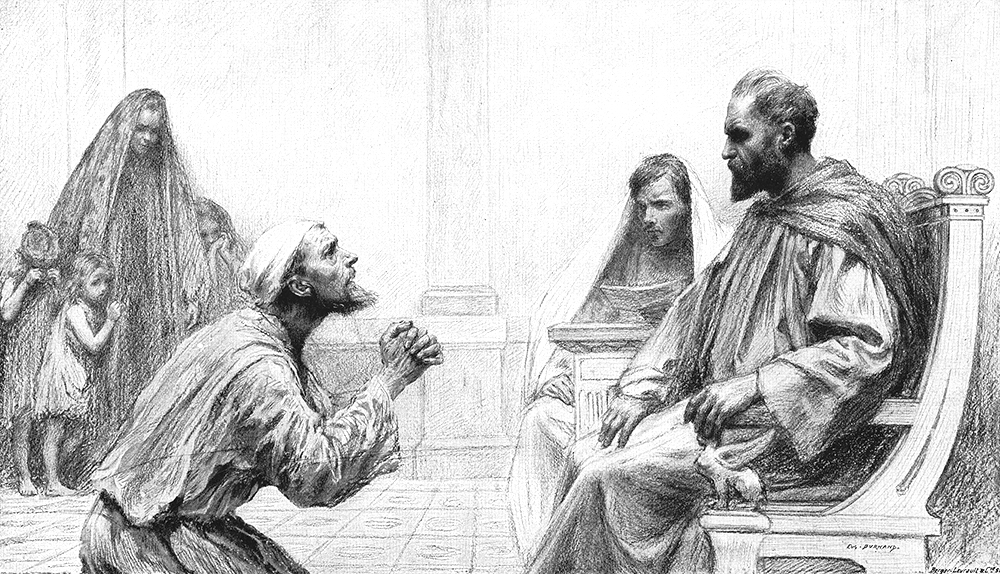
A terrific study is finding the people who fell at Jesus’ feet. Tucked in the Gospels you’ll find stories of those who despair. You’ll also see them come to Jesus in brokenness and humility, without any other recourse. I call these the “people of the feet.”
They came to Jesus because they had no hope otherwise. They were people who were hopeless and wretched, they had long ago run out of options. They came to Jesus, falling down in front of Him. They were all people of the feet.
They were men and women who were truly desperate.
There are some common characteristics that feet-finders have:
A great need that can’t be met without His touch
To understand one’s true condition–humility, brokenness
To beg for a healing, for self or family
To honor Jesus as the Messiah
To be more receptive to His teaching, to understand Him
To become a witness to others (although it does seem secondary)
“But immediately a woman whose little daughter had an unclean spirit heard of him and came and fell down at his feet.“
Mark 7:25
“Then people went out to see what had happened, and they came to Jesus and found the man from whom the demons had gone, sitting at the feet of Jesus, clothed and in his right mind.”
Luke 8:35
But there are several other instances where people came to sit at Jesus’ feet:
Mark 5:22-23, Jairus, a leader in the local synagogue
Luke 7:37-38, a sorrowing mother for her daughter
Luke 8:41, also Jairus
Luke 10:39, Mary, when Jesus was teaching
John 11:32, Mary, meeting Jesus entering Bethany
John 12:3, Mary, with her perfume
Revelation 1:17, John to express what he was seeing (also 19:10)
In every case we find people consciously coming and kneeling at the feet of the Lord Jesus. It was a deliberate action that came from their hearts. Each had a terrible need, and each was without hope.
It’s the end of religion if you’re a feet-finder. No more facades, no more treadmills. Instead your heart forever changes.
Hardly decent to religious people.
Are you really that desperate yet? Have you seen your need, and do you realize how lost you would be without His healing touch?
I’m convinced only Jesus can make me clean and whole.
But I found my rightful place at His feet. It’s where I belong. I love Him.
What happened was nothing less than a miracle. Let me explain and let you be the judge. Over the years of ministry I’ve heard the Lord speak clearly at different times. He has this tendency to overcome confusion and doubt to make His will super clear.
In 1995 we were sent by our church to Mexico to assist a church/mission station. We would be their first missionaries in Baja California. We knew we were called, and we also understood that it would definitely be challenging (and it was). We made a three year commitment.
We took Spanish at King’s Way Missionary Institute in McAllen, Texas. It was there we met another couple who would be working 40 miles south of where we were going. We agreed that once school was done we would travel together.
Now this is where it gets interesting.
We left south Texas and convoyed to San Diego. When we hit New Mexico the heat got terrible and my car didn’t have AC. The couple we were travelling with was pulling a trailer and couldn’t travel over 45 mph. It was over 100 F., I remember looking at our kids in the backseat and they were sprawled out, they were on the verge of heat stroke.
Now please bear with me.
Then something quite amazing happened!
There are several lanes available at the border crossing–they’re always backed up with 20 cars in each lane. So I pulled into one waiting for my turn to be inspected. Suddenly I heard honking behind me. I looked in my rear view to see what the deal was. It was our friends we had left back in New Mexico. They were in the car directly behind me!
My brain immediately started to calculate the odds.
It was then I heard Him speak to me.
Our three years were very difficult. We lived in a very old and very small “burned out” trailer, with no electricity or running water. We had a 55 gallon drum that was filled occasionally by a water truck. We had to boil it to kill the mosquito larva.
I killed rattlesnakes and battled with black widow spiders, and hundreds of tarantulas that wanted to nest on the property.
To know that God was taking care of us, had led us, and was using us was comforting. When things got very hard that experience at the border would comfort us repeatedly. It gave us confidence in His purposes for us being there. He put us there, and would not leave us.
When we left Mexico I was a little bit discouraged. “Where is the fruit?” About 6 months after returning to the Bay Area, I was in church when one of the elders came up to inform me that one of the leaders in our Mexico church had named their newborn son after me–Bryan Allen Rodriquez!
That news staggered me, it was like a 2×4 up the side of my head. They saw our steadfastness and wanted to name their son after me. That pretty much undid me. I admit that since then, I’ve struggled with this. I guess you can never fully understand your impact on others.
“You have multiplied, O Lord my God, your wondrous deeds and your thoughts toward us; none can compare with you! I will proclaim and tell of them, yet they are more than can be told.”
God is generous. We owe him an outrageous kind of debt. But what happens when we refuse to forgive another person? Jesus now teaches what happens–it’s frightening.
Matthew 18:22-34
23 “For this reason, the kingdom of heaven can be compared to a king who wanted to settle accounts with his servants. 24 When he began to settle accounts, one who owed ten thousand talents was brought before him. 25 Since he did not have the money to pay it back, his master commanded that he, his wife, his children, and everything he had be sold to pay the debt.
26 “At this, the servant fell facedown before him and said, ‘Be patient with me, and I will pay you everything.’ 27 Then the master of that servant had compassion, released him, and forgave him the loan.
28 “That servant went out and found one of his fellow servants who owed him a hundred denarii. He grabbed him, started choking him, and said, ‘Pay what you owe!’
“‘Shouldn’t you also have had mercy on your fellow servant, as I had mercy on you?’”
“And because he was angry, his master handed him over to the jailers to be tortured until he could pay everything that was owed.”
God is generous. All that he does is grace. It’s also grace when we really meet another. He loves us, and we need to siphon that love to everyone we meet. When we come before the Lord, we don’t get the justice we deserve. He has forgiven us—the ten thousand ones.
God is generous. We owe him an outrageous kind of debt. Commentators list the modern value of 10,000 talents would be $1 billion USD. Granted this is figurative, but that doesn’t mean it’s untrue. Grace is God’s extravagant for scandalous sinners.
That is an insane amount of money. To settle our debt would far, far more than we can repay; but isn’t that the point. God’s grace on us, is a precious thing.
When he gets off his knees, we realize that he really hasn’t changed by grace. His heart is teflon, and the mercy the father gave him doesn’t stick. His heart hasn’t really grasped his lesson in forgiveness. God forgave, the servant didn’t understand. His treatment of another proclaims this.
The parable directly speaks of grace, and ungrace.
The $10,000 guy meets the $100 talent guy and we see our own inability to forgive. We shake down our brother and sister for just small things. Notice verse 28, the text tells us that he actually assaulted him, “he started to choke him.” How bizarre and how disturbing. And yet, God sees, and responds.
Was the $10,000 guy really forgiven? Did he understand the spiritual transaction of what just happened? I don’t think so—and it scares me.
The other servants have seen the issue.
The key word is “distressed,” or lypeō in Greek, the word means “to throw into sorrow, to grieve or offend., to make heavy.” All that the forgiven servant did, was recognizable by others, and they reported what they saw to the master.
His behavior is clearly meant to disturbs us.
He’s called “wicked” in verse 32. What he did was awful, and again he’s brought in. Because of his mistreatment of the other who owed, he was now thrown into prison, owing a billion bucks. He gets what he now deserves. He gets justice instead of mercy. He is turned over the torturers.
“But if you don’t forgive others, your Father will not forgive your offenses.”
Matthew 6:15
What does all of this mean?
I’m pretty sure that God isn’t hammering us over our unforgiveness of others. I suspect it’s our sin that does that. When we consider our sin, how can we understand others who sin against us? We have been forgiven much (very much!) how can we not forgive others for sinning against us?
“Many people ruin their health and their lives by taking the poison of bitterness, resentment and unforgiveness. Matthew 18:23-35 tells us that if we do not forgive people, we get turned over to the torturers.“
“They stand before the throne and before the Lamb, clothed in white robes, with palm branches in their hands,”
Rev. 7:9, ESV
We fail to grasp the essence of grace and its significance.
When we speak about grace, we must define it. First, grace is a free gift and kindness from God that people do not earn or deserve. When we appropriate grace as believers we understand that it gives us the power and gifts to live biblically and faithfully. We see that grace is given for both salvation and service.
Sometimes we forget this. I wonder sometimes if we’re ‘allergic’ to God’s grace.
We fall into the trap of work and legalism! I often lose sight of my true identity before a holy God, as unmerited favor tragically tries to become merited favor. This is not biblical; it is a distortion of the truth!
OK. What about repentance? We must understand that we’re called to renounce our sin and utterly turn from it. You are called to live holy and free. When Jesus met the adulteress who was about to be stoned, He forgave her, but He also commanded her:
“Jesus stood up and said to her, “Woman, where are they? Has no one condemned you?” 11 She said, “No one, Lord.” And Jesus said, “Neither do I condemn you; go, and from now on sin no more.”
John 8:10-11
The whole incident was grace, and this woman was receiving the unmerited favor of Jesus. She deserved death, she should have been stoned. But the first thing after her salvation was to live differently. This was a command to turn away from the sin which was going to destroy her.
I’m amazed by this grace.
Remember the thief hanging on the cross, consider the prodigal son, or the tax man Zaccheus. All three intrigue me as they found favor without meeting our own definition of repentance. Salvation seems to come by grace through faith alone.
Perhaps grace includes both faith and repentance? I must think about this more.
Brennan Manning compassionately comments on God’s grace:
“Because salvation is by grace through faith, I believe that among the countless number of people standing in front of the throne and in front of the Lamb, dressed in white robes and holding palms in their hands.
I shall see the prostitute from the Kit-Kat Ranch in Carson City, Nevada, who tearfully told me that she could find no other employment to support her two-year-old son.
I shall see the woman who had an abortion and is haunted by guilt and remorse but did the best she could faced with grueling alternatives; the businessman besieged with debt who sold his integrity in a series of desperate transactions; the insecure clergyman addicted to being liked, who never challenged his people from the pulpit and longed for unconditional love.
The sexually abused teen molested by his father and now selling his body on the street, who, as he falls asleep each night after his last ‘trick’, whispers the name of the unknown God he learned about in Sunday school.
‘But how?’ We should ask.
Then the voice says, ‘They have washed their robes and have made them white in the blood of the Lamb.’
There they are. There we are – the multitude who so wanted to be faithful, who at times got defeated, soiled by life, and bested by trials, wearing the bloodied garments of life’s tribulations, but through it all clung to faith.
My friends, if this is not good news to you, you have never understood the gospel of grace.”
10 Finally, be strong in the Lord and in the strength of His might. 11 Put on the full armor of God, so that you will be able to stand firm against the schemes of the devil.
12 For our struggle is not against flesh and blood, but against the rulers, against the powers, against the world forces of this darkness, against the spiritual forces of wickedness in the heavenly places.
Eph. 6:10-12, NASB
Paul tells us that discerning the cosmic forces of wickedness is now critical. If we choose to ignore his words and make them optional, we will become spiritual toast. We need to hear reality. We want to be told the truth. And the truth is that we’re neck deep in spiritual alligators.
Point blank: We were each born for battle. Every believer must wear armor.
This passage in Ephesians 6 stresses that there is something sinister, an organized force, something evil, a darkness that’s focused directly on us. Verse 12 unveils to us a veritable government of wickedness. Satan leads his demons out with the intention of confusing believers and destroying holiness.
We also need to understand that human beings have a terrible knack of walking in their sin, and also by being manipulated by evil forces. Human history bears this out. We have a lousy track record. Without the Spirit we will be lost and destroyed by our own darkness.
Christians are to see life very differently than others do.
Ephesians 6 teaches us to find strength in being connected with God, which is critical to walk through in this confusing darkness. By prioritizing our relationship with Him, we can draw upon His strength and a sincere faith to navigate through all of this.
Without intimacy there is no obedience and there can be no real victory.
You must come to him humbly and holy, and sit before Him and listen, learn and love. And that is the major step in true holiness. Being controlled by Him means when you need to, you can stand and deliver damage to Satan’s kingdom.
You’ll be leading angels in this terrible battle! They have their swords drawn and are quite capable. Remember that this is a spiritual war–not physical. Your attack must be fought on your knees. And angels, they’re watching and listening to you as you pray. They are God’s messengers to protect you.
Satan presses us hard through redirection and forgetfulness of who we are.
Without the humble intimacy that can only grow on prayer and Bible reading, we will be spiritually destroyed. We need the protection of the Presence. Please don’t forget this; you need Jesus more today than yesterday. You must come closer. He will help you.
You see, your only hope is in Jesus’ strength and intimate love for you.
We must reach for our power and grab upon this intense love. We can only become strong through our intimacy with Jesus. He shields us from the spiritual corruption that swirls all around us. As we draw to Him we become mighty, as we listen closely to the Holy Spirit, we will walk in true discipleship with Jesus.
You will hear Him speak clearly to you, perhaps when you actively push to do His will than your own.
“We are a long time in learning that all our strength and salvation is in God.”
“When he came down from the mountain, great crowds followed him. 2 And behold, a leper came to him and knelt before him, saying, “Lord, if you will, you can make me clean.” 3 And Jesus stretched out his hand and touched him, saying, “I will; be clean.” And immediately his leprosy was cleansed.”
Matthew 8:1-4
It was a wild scene, we can’t forget this. But it’s funny, Jesus through all this sees and hears this leper. He doesn’t respond to the crowd but to the diseased man. The text tells us that the leperous man was on his knees and he was “praying.” His pleas were directed at Jesus.
But remember, the end of the previous verses explains exactly what’s happening. Matthew 7:28-29, (MSG) explains their excitement–
“When Jesus concluded his address, the crowd burst into applause. They had never heard teaching like this. It was apparent that he was living everything he was saying—quite a contrast to their religion teachers! This was the best teaching they had ever heard.“
The crowds responded wildly to the marvelous teaching of Jesus, and that was awesome. We really shouldn’t minimize that. However, in the Gospels, the “crowd” is pretty much a bad term, or at least a neutral one.
I suppose that Jesus seems to ignore the multitude’s extremely positive reaction. He knows it won’t last. The fickle crowd will soon cry out and demand His crucifixion.
But I understand, I’m that leper and He sees me.
Scripture tells me that Jesus now sits in heaven and makes intercession for me. He focuses on just me, I’m the center of His care–but I also know that attention is also on you, and others, and yet I’m assured that He sees me and each of His sheep. This should be a comfort. He concentrates and ministers to the person, and never to the multitude.
Jesus loves you, and He loves me too.
“So he told them this parable: 4 “What man among you, who has a hundred sheep and loses one of them, does not leave the ninety-nine in the open field and go after the lost one until he finds it?5 When he has found it, he joyfully puts it on his shoulders, 6 and coming home, he calls his friends and neighbors together, saying to them, ‘Rejoice with me, because I have found my lost sheep!’”