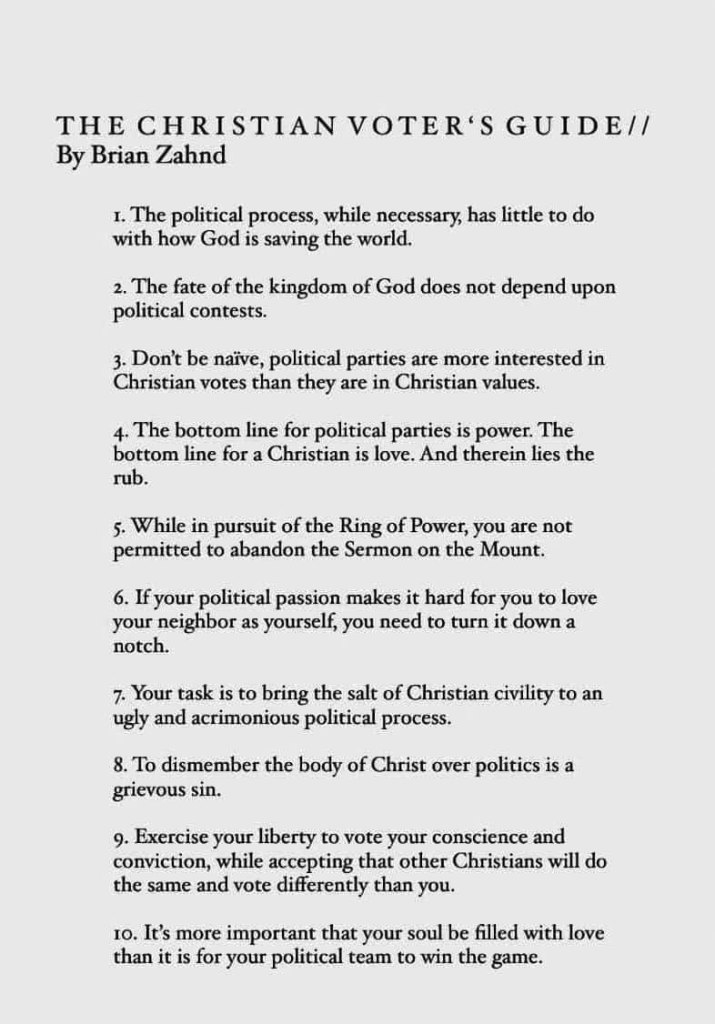
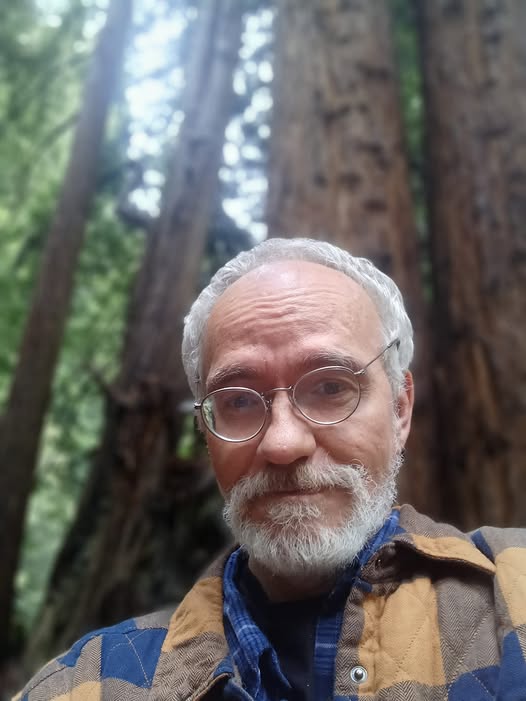
Our vote matters a lot. Here are some principles a believer should always follow. This list is a good way to function and maybe even see our own hearts in the light of the Gospel, and the direction of the Holy Spirit.
As a believer who is also a citizen this matters so much.
We maybe Republican, Democrat, or independent, but we know that God’s Kingdom rules over all. We must keep our hearts firmly fixed and settled in something that knows our Father’s purpose.
Please read the above list through, as I think it directs us to Him. I guess if I’ve got any insight into this at all I would add prayer and intercession. That wasn’t included, but adding it would enhance this list even more.
“If My people, who are called by My name, shall humble themselves and pray, and seek My face and turn from their wicked ways, then will I hear from heaven, and will forgive their sin and will heal their land.”
“Praying at all times in the Spirit, with all prayer and supplication. To that end, keep alert with all perseverance, making supplication for all the saints,
and also for me, that words may be given to me in opening my mouth boldly to proclaim the mystery of the gospel, 20 for which I am an ambassador in chains, that I may declare it boldly, as I ought to speak.”
Eph. 6:18-20, ESV
I’m convinced that our most challenging work is learning to pray. Whenever we experience revival, whenever we rediscover our true calling and purpose for living, we do so by prayer.
Prayer is the way we become like Jesus.
Satan’s primary focus is to destroy our prayer lives, he works to eliminate our communion with our Father. He detests that, and he and his demons (and the world system) work overtime to tear down our walk. The enemy concentrates everything on our prayer life.
There are four “alls” in verse 18!
All times
All prayer
All perseverance
All the saints
With this in mind we see that Paul stresses the complete effort of prayer and its focus. All the time, every kind, no matter what and for your brother and sisters in Christ. It’s work, spiritual work. It seems that once we put the armor on (verses 10-17) we can stand in God’s own strength.
It’s not enough to wear your armor.
If we’re clothed it’s for the purpose of prayer. Yes we must dress for war and protection, but its ultimate purpose is prayer and intercession. Don’t just wear it but pray out of it. You must strive in prayer, so much is counting on you. You can make a difference.
He’s waiting for you to ask. He wants you to intercede for others.
It will not be easy. The enemy wants to suppress your prayer life. He absolutely hates it. Satan wants to see us passive and dull and you cannot let him do this. You have a very critical part and place in God’s kingdom. Perhaps others are waiting for you, and perhaps you’re the only one who can step up in the gap for them.
You’ve been given a part of God’s field to care for, you have your own sphere of influence. No one else has it, but you.
There many different ways to pray:
On your knees
walking
standing or sitting
vocally, or in your thoughts
with others, a group
using a prayer list
“arrow” prayers (shot up with 1-2 sentences)
using the Psalms or reading the many prayers in the Bible
There’s a “school” of prayer and the Holy Spirit intends to teach you.
Don’t play hooky. You will make mistakes or lose focus. The Spirit will teach you stanima. You might pray for one or two minutes at first, but it’ll grow and you’ll learn endurance. Remember though–you’re most like Jesus when you start to intercede for others.
Maybe your sanctification comes when you pray?
“You need not cry very loud; he is nearer to us than we think.”
“Praying at all times in the Spirit, with all prayer and supplication. To that end, keep alert with all perseverance, making supplication for all the saints,
19 and also for me, that words may be given to me in opening my mouth boldly to proclaim the mystery of the gospel, 20 for which I am an ambassador in chains, that I may declare it boldly, as I ought to speak.”
Eph. 6:18-20, ESV
I am convinced that our most challenging work is learning to pray. Whenever we experience revival, whenever we rediscover our true calling and purpose for living, we do so by prayer. Prayer isn’t the way to get things, it’s how we change.
Prayer is the way we become like Jesus.
Satan’s primary focus is to destroy our prayer lives, he works to eliminate our communion with our Father. He detests that, and he and his demons (and the world system) work overtime to tear down our walk. The enemy concentrates everything on our prayer life.
This passage (v.v. 18-20) emphasizes several truths about prayer. If you take apart these you’ll discover how to shape and direct your ‘time on your knees.’ Notice the following.
There are four “alls” used in verse 18, and they must be understood.
All times
All prayer
All perseverance
All the saints
If we go further we see that the word “all” in Greek, (although it’s a simple adjective), gets used 1245 times in the Bible. It can mean:
all manner of
the whole or entirety
everything, or the totality of
completely
With this in mind we see that Paul stresses the complete effort of prayer and its focus. All the time, every kind, no matter what and for your brother and sisters in Christ need. It’s work, spiritual work. It seems that once we put the armor on (verses 10-17) we can stand in God’s own strength. It’s from that we start to learn prayer.
It’s not enough to wear your armor. There’s something you must do wearing it.
If we’re clothed in armor it’s pretty much for the exclusive purpose of prayer. Yes we must dress for war and protection, true, but its ultimate purpose is prayer and intercession. Don’t just wear it but pray out of it. It’ll be work, but you must do this, even if you sweat. You must strive in prayer, so much is counting on you.
You can make a difference.
The Church is counting on you. “Paul,” (symbolizing all pastors and elders, teachers and leaders), absolutely need your prayers. We need boldness, and we need grace and love, and only God can give it, if you’ll only intercede for us.
God will do nothing unless you start to pray. He’s waiting for you to ask. He wants you to intercede for others.
It will not be easy. The enemy wants to suppress your prayer life. He absolutely hates it. Satan wants to see you passive and dull and you cannot let him do this. You have a very critical part and place in God’s kingdom. Perhaps others are waiting for you, and perhaps you’re the only one who can step in the gap for them.
You’ve been given a part of God’s field to care for, you have your own sphere of influence. No one else has it, but you.
There many different ways to pray:
On your knees
walking
standing or sitting
vocally, or in your focused thoughts
with others, a group
using a prayer list, (very helpful).
“arrow” prayers, (those with 1-2 sentences that end up in His throne room).
using the Psalms or reading the many prayers in the Bible
(I know there are many more, but these are what comes to mind right now.)
There’s a “school” of prayer and the Holy Spirit intends to teach you.
Don’t play hooky. You’ll make mistakes or perhaps lose focus. The Spirit will teach you holy stamina. You might pray for one or two minutes at first, but it’ll grow and you’ll learn endurance. Remember though–you’re most like Jesus when you start to intercede for others.
Just maybe your sanctification will come when you start to pray?
“You need not cry very loud; he is nearer to us than we think.”
“And He withdrew from them about a stone’s throw, and He knelt down and began to pray,”
Luke 22:41
WHO KNOWS WHAT JESUS IS THINKING AT THIS PRECISE MOMENT as he entered the Garden? His disciples waited for Jesus and scripture states that he proceeded ahead of them to find some needed strength through prayer— this verse tells us he went “a stone’s throw.”
We often share in the sorrows of the people closest to us, and Jesus wants His disciples to follow him. And they do, but not all the way. They came close, but were oblivious to the full nature of the pain that was beginning for Jesus. They slept while he agonized.
He was for the first time perhaps, needing someone close.
Many of us will make the same trip to the garden. Soon every believer makes the trip to ‘Gethsemane,’ but not as mere observers. It is a distinct place of testing and of sorrow. And each will experience it for themselves. “The servant is not above his master.”
But Jesus is close— he completely understands what it means to be alone with sorrow. The believer can lean on Jesus as the pain continues. He sends his “Comforter” to each, as he escorts us through this time. He comes in grace, and is completely kind.
He is truly just a stone’s throw away.
“God is our refuge and strength, always ready to help in times of trouble.”
10 Finally, be strong in the Lord and in the strength of His might. 11 Put on the full armor of God, so that you will be able to stand firm against the schemes of the devil.
12 For our struggle is not against flesh and blood, but against the rulers, against the powers, against the world forces of this darkness, against the spiritual forces of wickedness in the heavenly places.
Eph. 6:10-12, NASB
Paul tells us that discerning the cosmic forces of wickedness is now critical. If we choose to ignore his words and make them optional, we will become spiritual toast. We need to hear reality. We want to be told the truth. And the truth is that we’re neck deep in spiritual alligators.
Point blank: We were each born for battle. Every believer must wear armor.
This passage in Ephesians 6 stresses that there is something sinister, an organized force, something evil, a darkness that’s focused directly on us. Verse 12 unveils to us a veritable government of wickedness. Satan leads his demons out with the intention of confusing believers and destroying holiness.
We also need to understand that human beings have a terrible knack of walking in their sin, and also by being manipulated by evil forces. Human history bears this out. We have a lousy track record. Without the Spirit we will be lost and destroyed by our own darkness.
Christians are to see life very differently than others do.
Ephesians 6 teaches us to find strength in being connected with God, which is critical to walk through in this confusing darkness. By prioritizing our relationship with Him, we can draw upon His strength and a sincere faith to navigate through all of this.
Without intimacy there is no obedience and there can be no real victory.
You must come to him humbly and holy, and sit before Him and listen, learn and love. And that is the major step in true holiness. Being controlled by Him means when you need to, you can stand and deliver damage to Satan’s kingdom.
You’ll be leading angels in this terrible battle! They have their swords drawn and are quite capable. Remember that this is a spiritual war–not physical. Your attack must be fought on your knees. And angels, they’re watching and listening to you as you pray. They are God’s messengers to protect you.
Satan presses us hard through redirection and forgetfulness of who we are.
Without the humble intimacy that can only grow on prayer and Bible reading, we will be spiritually destroyed. We need the protection of the Presence. Please don’t forget this; you need Jesus more today than yesterday. You must come closer. He will help you.
You see, your only hope is in Jesus’ strength and intimate love for you.
We must reach for our power and grab upon this intense love. We can only become strong through our intimacy with Jesus. He shields us from the spiritual corruption that swirls all around us. As we draw to Him we become mighty, as we listen closely to the Holy Spirit, we will walk in true discipleship with Jesus.
You will hear Him speak clearly to you, perhaps when you actively push to do His will than your own.
“We are a long time in learning that all our strength and salvation is in God.”
“When he came down from the mountain, great crowds followed him. 2 And behold, a leper came to him and knelt before him, saying, “Lord, if you will, you can make me clean.” 3 And Jesus stretched out his hand and touched him, saying, “I will; be clean.” And immediately his leprosy was cleansed.”
Matthew 8:1-4
It was a wild scene, we can’t forget this. But it’s funny, Jesus through all this sees and hears this leper. He doesn’t respond to the crowd but to the diseased man. The text tells us that the leperous man was on his knees and he was “praying.” His pleas were directed at Jesus.
But remember, the end of the previous verses explains exactly what’s happening. Matthew 7:28-29, (MSG) explains their excitement–
“When Jesus concluded his address, the crowd burst into applause. They had never heard teaching like this. It was apparent that he was living everything he was saying—quite a contrast to their religion teachers! This was the best teaching they had ever heard.“
The crowds responded wildly to the marvelous teaching of Jesus, and that was awesome. We really shouldn’t minimize that. However, in the Gospels, the “crowd” is pretty much a bad term, or at least a neutral one.
I suppose that Jesus seems to ignore the multitude’s extremely positive reaction. He knows it won’t last. The fickle crowd will soon cry out and demand His crucifixion.
But I understand, I’m that leper and He sees me.
Scripture tells me that Jesus now sits in heaven and makes intercession for me. He focuses on just me, I’m the center of His care–but I also know that attention is also on you, and others, and yet I’m assured that He sees me and each of His sheep. This should be a comfort. He concentrates and ministers to the person, and never to the multitude.
Jesus loves you, and He loves me too.
“So he told them this parable: 4 “What man among you, who has a hundred sheep and loses one of them, does not leave the ninety-nine in the open field and go after the lost one until he finds it?5 When he has found it, he joyfully puts it on his shoulders, 6 and coming home, he calls his friends and neighbors together, saying to them, ‘Rejoice with me, because I have found my lost sheep!’”
Prayer can often be just a nice religious duty, that makes us feel warm and fuzzy. But such prayer does not suit a disciple who is tired of religion and is seeking authenticity. There are few models who can be our guides.
That is one of the reasons why we need elders in our fellowships; they have been through so much, they can anchor us to all that is real. As elders, they probably had lessons in prayer.
We often will theologically play on the periphery, and cleverly deceive others and ourselves. My own heart gets pretty creative as I display self-righteousness. (I should win an Academy Award as ‘best actor.’) But Jesus insists on us becoming real. You might say that really is the prayer that touches his heart.
When you talk with Jesus, do you truly talk to Him?
Do you have a real awareness that you are really talking with Him?
Is it the real you that fellowships with the ‘real’ God?
The following is an excerpt from A Diary of Private Prayer, by the Scottish theologian, John Baillie, 1886-1960:
Eternal Father of my soul, let my first thought today be of You, let my first impulse be to worship You, let my first speech be Your name, let my first action be to kneel before You in prayer.
For Your perfect wisdom and perfect goodness:
For the love with which You love mankind:
For the love with which You love me:
For the great and mysterious opportunity of my life:
For the indwelling of your Spirit in my heart:
For the sevenfold gifts of your Spirit:
I praise and worship You, O Lord.
Yet let me not, when this morning prayer is said, think my worship ended and spend the day in forgetfulness of You. Rather from these moments of quietness let light go forth, and joy, and power, that will remain with me through all the hours of the day;
Keeping me chaste in thought:
Keeping me temperate and truthful in speech:
Keeping me faithful and diligent in my work:
Keeping me humble in my estimation of myself:
Keeping me honorable and generous in my dealings with others:
Keeping me loyal to every hallowed memory of the past:
Keeping me mindful of my eternal destiny as a child of Yours.
His Ordination Prayer as a Pastor, serving in the Christian and Missionary Alliance
August 18, 1920
O Lord, I have heard Thy voice and was afraid. Thou has called me to an awesome task in a grave and perilous hour. Thou art about to shake all nations and the earth and also heaven, that the things that cannot be shaken may remain. O Lord, my Lord, Thou has stooped to honor me to be Thy servant. No man taketh this honor upon himself save he that is called of God as was Aaron. Thou has ordained me Thy messenger to them that are stubborn of heart and hard of hearing. They have rejected Thee, the Master, and it is not to be expected that they will receive me, the servant.
My God, I shall not waste time deploring my weakness nor my unfittedness for the work. The responsibility is not mine, but Thine. Thou has said, “I knew thee – I ordained thee – I sanctified thee,” and Thou hast also said, “Thou shalt go to all that I shall send thee, and whatsoever I command thee thou shalt speak.” Who am I to argue with Thee or to call into question Thy sovereign choice? The decision is not mine but Thine.
So be it, Lord. Thy will, not mine, be done.
Well do I know, Thou God of the prophets and the apostles, that as long as I honor Thee Thou will honor me. Help me therefore to take this solemn vow to honor Thee in all my future life and labors, whether by gain or by loss, by life or by death, and then to keep that vow unbroken while I live.
It is time, O God, for Thee to work, for the enemy has entered into Thy pastures and the sheep are torn and scattered. And false shepherds abound who deny the danger and laugh at the perils which surround Thy flock. The sheep are deceived by these hirelings and follow them with touching loyalty while the wolf closes in to kill and destroy. I beseech Thee, give me sharp eyes to detect the presence of the enemy; give me understanding to see and courage to report what I see faithfully. Make my voice so like Thine own that even the sick sheep will recognize it and follow Thee.
Lord Jesus, I come to Thee for spiritual preparation.
Lay Thy hand upon me. Anoint me with the oil of the New Testament prophet. Forbid that I should be come a religious scribe and thus lose my prophetic calling. Save me from the curse that lies dark across the modern clergy, the curse of compromise, of imitation, of professionalism. Save me from the error of judging a church by its size, its popularity or the amount of its yearly offering. Help me to remember that I am a prophet – not a promoter, not a religious manager, but a prophet. Let me never become a slave to crowds. Heal my soul of carnal ambitions and deliver me from the itch for publicity.
Save me from bondage to things. Let me not waste my days puttering around the house. Lay Thy terror upon me, O God, and drive me to the place of prayer where I may wrestle with principalities and powers and the rulers of the darkness of this world. Deliver me from overeating and late sleeping. Teach me self-discipline that I may be a good soldier of Jesus Christ.
I accept hard work and small rewards in this life.
I ask for no easy place. I shall try to be blind to the little ways that could make life easier. If others seek the smoother path I shall try to take the hard way without judging them too harshly. I shall expect opposition and try to take it quietly when it comes. Or if, as sometimes it falleth out to Thy servants, I should have grateful gifts pressed upon me by Thy kindly people, stand by me then and save me from the blight that often follows. Teach me to use whatever I receive in such manner that will not injure my soul nor diminish my spiritual power. And if in Thy permissive providence honor should come to me from Thy church, let me not forget in that hour that I am unworthy of the least of Thy mercies, and that if men knew me as intimately as I know myself they would withhold their honors or bestow them upon others more worthy to receive them.
And now, O Lord of heaven and earth, I consecrate my remaining days to Thee; let them be many or few, as Thou wilt. Let me stand before the great or minister to the poor and lowly; that choice is not mine, and I would not influence it if I could. I am Thy servant to do Thy will, and that will is sweeter to me than position or riches or fame.
I choose it above all things on earth or in heaven.
Though I am chosen of Thee and honored by a high and holy calling, let me never forget that I am but a man of dust and ashes, a man with all the natural faults and passions that plague the race of men. I pray Thee, therefore, my Lord and Redeemer, save me from myself and from all the injuries I may do myself while trying to be a blessing to others. Fill me with Thy power by the Holy Spirit, and I will go in Thy strength and tell of Thy righteousness, even Thine only. I will spread abroad the message of redeeming love while my normal powers endure.
Then, dear Lord, when I am old and weary and too tired to go on, have a place ready for me above, and make me to be numbered with Thy saints in glory everlasting. Amen. AMEN.
The apostle Peter waswell acquainted with failure. He understood blowing it big time. I’ve identified at least 11 times when he did the wrong thing; He stumbled repeatedly, but that encourages me.
(I’m really glad he struggled.)
I suppose that we must acknowledge that Jesus saw something in Peter–a definite future of a ministry that would be critical in the lives of the other disciples, but it wasn’t going to be easy for Peter. Jesus was alert and He prayed specifically for His bumbling disciple.
“…but I have prayed for you that your faith may not fail. And when you have turned again, strengthen your brothers.”
Luke 22:32, ESV
Here’s my list of Peter’s greatest flops:
Peter can’t figure out the Parable of the Sower, so he asks Jesus for further explanation. We too don’t understand all the things Jesus taught, we get confused. Peter’s example is a strength for us. Jesus doesn’t reject our ignorance. (Matthew 15:15-16.)
Peter and the others try to keep the children away from Jesus. (Mark 10:13-14.)
Peter is full of selfish ambition and argues with the other disciples as they walk with Jesus. (Mark 9:33-34; Luke 22:24.)
Peter tried to follow Jesus by walking on the water. He failed and sank; Jesus took him by the hand and gave him a gentle rebuke. (Matthew 14:28-33.)
On the Mountain of the Transfiguration Peter witnessed an incredible event when Jesus was seen in all His glory. Peter blew it by not understanding what had just happened. (Mark 9:2-8.)
Peter actually is strongly rebuked by Jesus and called, “Satan.” (Matthew 16:23.)
Peter resists Jesus when He is washing the disciple’s feet. (John 13:5-9.)
Peter fails to listen to Jesus in the garden of Gethsemane and falls asleep. He was told to watch and pray. Peter failed, and fell asleep. (Matthew 26:36-46.)
Peter, with “oaths” and “curses” denies knowing Jesus in the courtyard of the High Priest. (Matthew 26:69-75.) See also, Matt. 10:33.
Peter is broken over his denial of Jesus. It seems that he’s a complete failure as a disciple and returns to his boat and goes fishing. The other disciples follow him.(John 21:1-3.) We also see Jesus restoring Peter to Himself. (John 21:15-19.)
Peter is intimidated by the Jews, and withdraws from fellowshipping with the Gentile believers. He is soundly rebuked by Paul “to his face.” (Gal. 2:11-14.)
It seems that none of these are spiritually fatal, but perhaps they could be. In every case listed we can see the tenderness and goodness of the Lord Jesus who forgave and restored Peter. He loves His disciple much more than Peter realizes.
At times our walk is also somewhat discouraging.
We sin, and we fail in so many ways. It seems overwhelming at times. The Holy Spirit calls us to pray and sing, but if we’re honest we often can’t do these things. Our failures seem to disqualify us to be disciples. A kind of “spiritual depression” falls over us. We seem to believe that God is angry with us. We think He condemns us.
“I give them eternal life, and they will never perish, and no one will snatch them out of my hand.”
John 10:28
But God’s love for you is total and everlasting.
On that day you accepted Him as your Savior a covenant was made. He’s committed to bring you through life and to Himself. Forever. Jesus is completely faithful and He loves you deeply and most unreasonably. We call this “grace.”
God has initiated your salvation. He launched it and He is in charge of it.
God works over and over in your life to make you like His Son.
When you die and stand before Him that process will be finished completely.
“And I am sure of this, that he who began a good work in you will bring it to completion at the day of Jesus Christ.”
“Therefore take up the whole armor of God, that you may be able to withstand in the evil day and having done all, to stand firm. 14 Stand therefore, having fastened on the belt of truth and having put on the breastplate of righteousness, 15 and, as shoes for your feet, having put on the readiness given by the gospel of peace. 16 In all circumstances take up the shield of faith, with which you can extinguish all the flaming darts of the evil one; 17 and take the helmet of salvation, and the sword of the Spirit, which is the word of God,“
Eph. 6:13-17, ESV
You’re called to be armor-plated.
Ephesians is quite clear about this, and we dare not live without spiritual protection, and as a matter of fact, we must wear each piece to survive spiritually. To be ‘naked’ is catastrophic. Neglecting to dress appropriately brings cataclysmic disorder. We dare not minimize our need for wearing our armor.
Each piece listed must be worn. This is a scriptural mandate for every believer in Jesus.
“The whole armor of God” explains the equipment we need to survive spiritually. Here’s a list of the six:
The belt of truth–this pulls everything together and holds us and keeps us secure in the truth.
The breastplate of righteousness–our spiritual heart is protected by knowing we’re accepted by the Father. Being right with God is not a feeling nor is it a mere hopeful wish. We wear what is real.
The shoes of the gospel (of peace)–the idea of standing in place (“to stand”) explain our ability to be fixed on grace. When we wear battle shoes we cannot be pushed back or lose our footing. Wearing gospel shoes brings us spiritual stability. We can stand in place, rooted and strong.
The shield of faith–is a vital way of protecting ourselves from the evil arrows shot by the enemy. Satan targets us when he thinks that we aren’t using faith to defend ourselves.
The helmet of salvation–this is the realization that our mind is protected. This vital piece brings us wholeness as we understand what Jesus has done. We know we are saved and wearing our helmet is our protection from demonic-inspired lies.
The sword of the Holy Spirit–the only offensive weapon we have, and it’s all we need. The Word of God will frighten the enemy and push him back. The Word slices and cuts down every obstacle and every lie.
“Only those who are spiritual perceive the reality of the spiritual foe and hence engage in battle. Such warfare is not fought with arms of the flesh. Because the conflict is spiritual so must the weapons.“
I must stress that clothing yourself is vital. You dare not live spiritually naked wearing nothing. You will be totally vulnerable to the satanic wickedness that is swirling around you. I’m afraid it’s all very real and sobering and there is no escape clause until you finally arrive in heaven.
“We know [positively] that we are of God, and the whole world [around us] is under the power of the evil one.”
1 John 5:19, Amplified Bible
I’m afraid you haven’t been given an option in all of this. Our battle equipment in Ephesians 6 is not just some theological preference or concept. It’s real.
Over 40 years of following Jesus have taught me that most believers struggle because they won’t arm themselves for battle. They refuse to acknowledge the environment they’re in and don’t realize the spiritual battle they are facing. They like the sentiment behind this particular passage, (it stirs their heart) but the reality of the battle never fully sinks in.
They end up leaving their armor behind.
The good news is that we have already won because of what the Lord has done. Wearing the armor strengthens and stabilizes us. He pours out His grace, and there will be times of rest of that I am certain. “He leads me beside still waters.”
As obedient and faithful believers we need to realize we’re secure in Him. Yes, there is a terrible fight, but “The battle is the Lord’s.”
“For you equipped me with strength for the battle; you made those who rise against me sink under me.”