The Parable of the Unmerciful

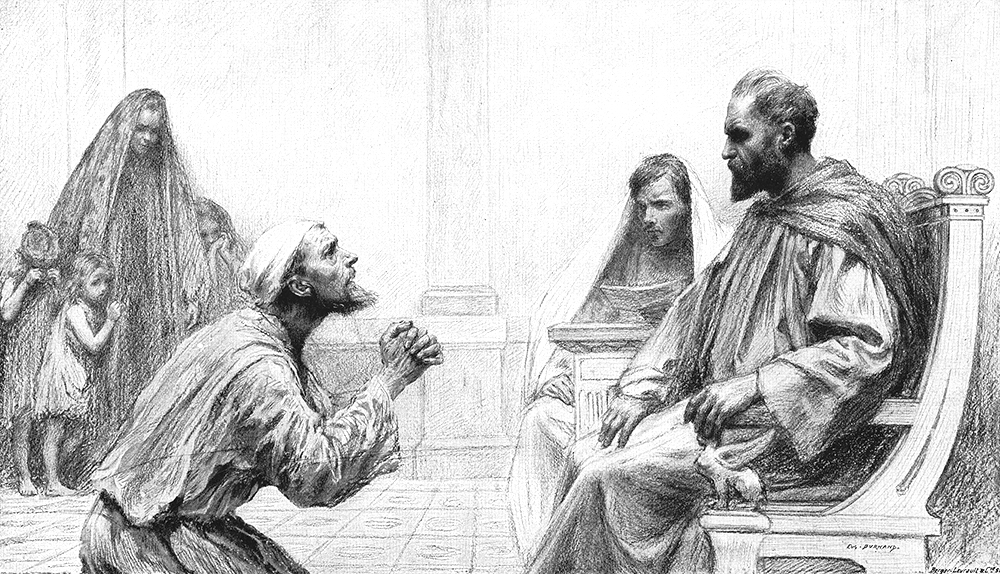
God is generous. We owe him an outrageous kind of debt. But what happens when we refuse to forgive another person? Jesus now teaches what happens–it’s frightening.

Matthew 18:22-34

God is generous. All that he does is grace. It’s also grace when we really meet another. He loves us, and we need to siphon that love to everyone we meet. When we come before the Lord, we don’t get the justice we deserve. He has forgiven us—the ten thousand ones.

God is generous. We owe him an outrageous kind of debt. Commentators list the modern value of 10,000 talents would be $1 billion USD. Granted this is figurative, but that doesn’t mean it’s untrue. Grace is God’s extravagant for scandalous sinners.

That is an insane amount of money. To settle our debt would far, far more than we can repay; but isn’t that the point. God’s grace on us, is a precious thing.

When he gets off his knees, we realize that he really hasn’t changed by grace. His heart is teflon, and the mercy the father gave him doesn’t stick. His heart hasn’t really grasped his lesson in forgiveness. God forgave, the servant didn’t understand. His treatment of another proclaims this.

The parable directly speaks of grace, and ungrace.

The $10,000 guy meets the $100 talent guy and we see our own inability to forgive. We shake down our brother and sister for just small things. Notice verse 28, the text tells us that he actually assaulted him, “he started to choke him.” How bizarre and how disturbing. And yet, God sees, and responds.

Was the $10,000 guy really forgiven? Did he understand the spiritual transaction of what just happened? I don’t think so—and it scares me.

The other servants have seen the issue.

The key word is “distressed,” or lypeō in Greek, the word means “to throw into sorrow, to grieve or offend., to make heavy.” All that the forgiven servant did, was recognizable by others, and they reported what they saw to the master.

His behavior is clearly meant to disturbs us.

He’s called “wicked” in verse 32. What he did was awful, and again he’s brought in. Because of his mistreatment of the other who owed, he was now thrown into prison, owing a billion bucks. He gets what he now deserves. He gets justice instead of mercy. He is turned over the torturers.

Matthew 6:15

What does all of this mean?

I’m pretty sure that God isn’t hammering us over our unforgiveness of others. I suspect it’s our sin that does that. When we consider our sin, how can we understand others who sin against us? We have been forgiven much (very much!) how can we not forgive others for sinning against us?

J. Meyer

alaskabibleteacher.com

Spiritual Alligators

10 Finally, be strong in the Lord and in the strength of His might. 11 Put on the full armor of God, so that you will be able to stand firm against the schemes of the devil. 

12 For our struggle is not against flesh and blood, but against the rulers, against the powers, against the world forces of this darkness, against the spiritual forces of wickedness in the heavenly places.

Eph. 6:10-12, NASB 

Paul tells us that discerning the cosmic forces of wickedness is now critical. If we choose to ignore his words and make them optional, we will become spiritual toast. We need to hear reality. We want to be told the truth. And the truth is that we’re neck deep in spiritual alligators.

Point blank: We were each born for battle. Every believer must wear armor.

This passage in Ephesians 6 stresses that there is something sinister, an organized force, something evil, a darkness that’s focused directly on us. Verse 12 unveils to us a veritable government of wickedness. Satan leads his demons out with the intention of confusing believers and destroying holiness.

We also need to understand that human beings have a terrible knack of walking in their sin, and also by being manipulated by evil forces. Human history bears this out. We have a lousy track record. Without the Spirit we will be lost and destroyed by our own darkness.

Christians are to see life very differently than others do.

Ephesians 6 teaches us to find strength in being connected with God, which is critical to walk through in this confusing darkness. By prioritizing our relationship with Him, we can draw upon His strength and a sincere faith to navigate through all of this.

Without intimacy there is no obedience and there can be no real victory.

You must come to him humbly and holy, and sit before Him and listen, learn and love. And that is the major step in true holiness. Being controlled by Him means when you need to, you can stand and deliver damage to Satan’s kingdom.

You’ll be leading angels in this terrible battle! They have their swords drawn and are quite capable. Remember that this is a spiritual war–not physical. Your attack must be fought on your knees. And angels, they’re watching and listening to you as you pray. They are God’s messengers to protect you.

Satan presses us hard through redirection and forgetfulness of who we are.

Without the humble intimacy that can only grow on prayer and Bible reading, we will be spiritually destroyed. We need the protection of the Presence. Please don’t forget this; you need Jesus more today than yesterday. You must come closer. He will help you.

You see, your only hope is in Jesus’ strength and intimate love for you.

We must reach for our power and grab upon this intense love. We can only become strong through our intimacy with Jesus. He shields us from the spiritual corruption that swirls all around us. As we draw to Him we become mighty, as we listen closely to the Holy Spirit, we will walk in true discipleship with Jesus.

You will hear Him speak clearly to you, perhaps when you actively push to do His will than your own.

“We are a long time in learning that all our strength and salvation is in God.”

     David Brainerd

alaskabibleteacher.com

Kissing His Feet

Luke 7:40-47

I don’t mean to be blunt, but how much do you love Jesus? This parable looks at the heart of the forgiven believer, the person who has been incredibly forgiven for everything–all sins, past, present and future. And it’s here we see a woman whose heart is broken by her sin, and we see that she discovers Jesus’ grace, total forgiveness and tremendous mercy.

Jesus has been invited to Simon’s home.

He’s a Pharisee, “a pure one,” one who kept the Law. So far the Pharisees haven’t banded together to attack Jesus’ ministry. It seems that there were still some Pharisees who were true seekers of truth. But that’s about to change.

The text jumps right in and we see Jesus reclining at a table (the Jewish people didn’t use chairs–pillows were used instead.) At a feast like this people who weren’t officially invited could come in to stand in the back and listen in on the conversation. (How awkward.)

Suddenly a woman bursts into the room.

She’s described as “a woman of the city,” which is a code word for “a sinner, or a harlot.” (Let your imagination roll that one around.) She comes with a purpose, for she brings a jar of expensive perfume with her.

She knows what she must do.

The passage reveals that she’s on her knees, weeping on Jesus’ feet, and rubbing His feet with her hair, and pouring out the perfume. Only a harlot would undo her hair like this. She’s even kissing his feet!

She’s obviously a broken person—yet someone who knows who Jesus is.

Living in deep sin has completely destroyed her.

And at this point Simon is deeply offended, and probably embarrassed by what’s happening. But he also assumes that Jesus isn’t who he’s saying he is. “How dare does this man let an unclean person do this!” But Jesus understands everything. His parable is short and it’s a broadside directed at Simon.

The interpretation is obvious: the man who owes the most will love the most.

Jesus accentuates Simon’s breach of protocol. The Lord deftly explains the entire situation; Simon is busted. He’s put on the spot and Jesus has made his point. It’s all so obvious. The essence of the story is clear.

How much do you love the Master?

Have you really grasped how much of your sin that’s been forgiven, or maybe you’re a Simonite—someone who doesn’t quite accept God’s forgiveness? The Bible tells us repeatedly that no one is righteous. No one, and Scripture has a very low opinion of the righteousness of men.

Isaiah 64:6, KJV

The Hebrew word for “filthy” is extremely graphic.

I don’t want to offend, but it literally means “a menstruating cloth or rag.” It was something that a woman used before there was Tampax. How very clear and descriptive. Human righteousness is soiled and vulgar to God.

Will we receive God’s righteousness, or will we still try to walk in our righteous filth?

Forgiveness can come only from Him–there is no hesitation or shortage on His part. Our part is to come with loving submission and brokenness at Jesus’s feet, and to fully accept the forgiveness He offers by faith.

“Christianity happens when men and women accept with unwavering trust that their sins have been not only forgiven, but forgotten, washed away in the blood of the Lamb.”


― Brennan Manning, The Ragamuffin Gospel

Bryan

alaskabibleteacher.com

Breaking Down the Door

Luke 11:5-8

This parable is known by some as “the Importunate Neighbor.” That’s an excellent description. Importunate is defined as being persistent, especially to the point of annoyance or intrusion. It’s tenacious and stubborn–not giving up even when being ignored, and that describes what’s happening here.

What immediately proceeds this parable is Luke’s version of the Lord’s prayer, which the disciples requested. They wanted to understand the methods and mechanics of praying–perhaps the Pharisee’s prayers weren’t quite up to snuff–they wanted more; and they insisted that Jesus instruct them.

The disciples wanted to do prayer right.

A typical Jewish home had sleeping quarters (one room!) located on a raised platform. A ladder was used to access that level (which could be crowded, sometimes two to a bed.) Often their livestock were brought inside. And when it was time to get up, everyone got up. That explains the homeowner’s reluctance to give bread to his neighbor. To get up, light a lamp, wasn’t a solitary affair.

He’s obviously unenthusiastic to make that effort.

The word used here to explain the neighbor actions is ἀναίδεια “anaídeia,” which is only used once–it’s translated as impudence, shamelessness, audacity or chutzpah. It’s a Greek word that explains the knocker’s rudeness. He won’t stop. He knocks and pounds until he gets his bread. Not having bread for his guests is unheard of, for it violates all kinds of convention.

The unwritten law of Jewish hospitality demanded action. 

This is part of Jesus’ view on prayer. It means we must be inappropriate sometimes–even to the point were we are being rude.

Immediately following this parable (the very next thought) are the following instructions:

“So I say to you, ask, and it will be given to you. Seek, and you will find. Knock, and the door will be opened to you. 10 For everyone who asks receives, and the one who seeks finds, and to the one who knocks, the door will be opened.”

Luke 11:9-10

Perhaps it’s a matter of forcefulness?

We “pray” but don’t insist. We desire but don’t demand. Maybe it takes a certain shamelessness to make prayer work. Jesus emphasizes a necessary attitude to praying God’s way. It’s never automatic, but in this parable we see words that move the Father’s heart, and loosen his hand. In Jesus’ teaching, prayer means effort.

It means spiritual work. He wants us to know this. It is important.

“There is neither encouragement nor room in Bible religion for feeble desires, listless efforts, lazy attitudes; all must be strenuous, urgent, ardent. Flamed desires, impassioned, unwearied insistence delight heaven. God would have His children incorrigibly in earnest and persistently bold in their efforts. Our whole being must be in our praying.”

    E.M. Bounds

f

Peter the Great

The apostle Peter was well acquainted with failure. He understood blowing it big time. I’ve identified at least 11 times when he did the wrong thing; He stumbled repeatedly, but that encourages me.

(I’m really glad he struggled.)

I suppose that we must acknowledge that Jesus saw something in Peter–a definite future of a ministry that would be critical in the lives of the other disciples, but it wasn’t going to be easy for Peter. Jesus was alert and He prayed specifically for His bumbling disciple.

“…but I have prayed for you that your faith may not fail. And when you have turned again, strengthen your brothers.”

Luke 22:32, ESV

Here’s my list of Peter’s greatest flops:

  • Peter can’t figure out the Parable of the Sower, so he asks Jesus for further explanation. We too don’t understand all the things Jesus taught, we get confused. Peter’s example is a strength for us. Jesus doesn’t reject our ignorance. (Matthew 15:15-16.)
  • Peter and the others try to keep the children away from Jesus. (Mark 10:13-14.)
  • Peter is full of selfish ambition and argues with the other disciples as they walk with Jesus. (Mark 9:33-34; Luke 22:24.)
  • Peter tried to follow Jesus by walking on the water. He failed and sank; Jesus took him by the hand and gave him a gentle rebuke. (Matthew 14:28-33.)
  • On the Mountain of the Transfiguration Peter witnessed an incredible event when Jesus was seen in all His glory. Peter blew it by not understanding what had just happened. (Mark 9:2-8.)
  • Peter actually is strongly rebuked by Jesus and called, “Satan.” (Matthew 16:23.)
  • Peter resists Jesus when He is washing the disciple’s feet. (John 13:5-9.)
  • Peter fails to listen to Jesus in the garden of Gethsemane and falls asleep. He was told to watch and pray. Peter failed, and fell asleep. (Matthew 26:36-46.)
  • Peter, with “oaths” and “curses” denies knowing Jesus in the courtyard of the High Priest. (Matthew 26:69-75.) See also, Matt. 10:33.
  • Peter is broken over his denial of Jesus. It seems that he’s a complete failure as a disciple and returns to his boat and goes fishing. The other disciples follow him.(John 21:1-3.) We also see Jesus restoring Peter to Himself. (John 21:15-19.)
  • Peter is intimidated by the Jews, and withdraws from fellowshipping with the Gentile believers. He is soundly rebuked by Paul “to his face.” (Gal. 2:11-14.)

It seems that none of these are spiritually fatal, but perhaps they could be. In every case listed we can see the tenderness and goodness of the Lord Jesus who forgave and restored Peter. He loves His disciple much more than Peter realizes.

At times our walk is also somewhat discouraging.

We sin, and we fail in so many ways. It seems overwhelming at times. The Holy Spirit calls us to pray and sing, but if we’re honest we often can’t do these things. Our failures seem to disqualify us to be disciples. A kind of “spiritual depression” falls over us. We seem to believe that God is angry with us. We think He condemns us.

 “I give them eternal life, and they will never perish, and no one will snatch them out of my hand.”

John 10:28

But God’s love for you is total and everlasting.

On that day you accepted Him as your Savior a covenant was made. He’s committed to bring you through life and to Himself. Forever. Jesus is completely faithful and He loves you deeply and most unreasonably. We call this “grace.”

  1. God has initiated your salvation. He launched it and He is in charge of it.
  2. God works over and over in your life to make you like His Son.
  3. When you die and stand before Him that process will be finished completely.

“And I am sure of this, that he who began a good work in you will bring it to completion at the day of Jesus Christ.”

Philippians 1:6

alaskabibleteacher.com

A Glowing Witness

The more I have read the Bible and studied the life of Jesus, the more I have become convinced that Christianity spreads best not through force but through fascination.

Shane Claiborne

I believe in evangelism. Right after Bible college I joined SOS Ministries as a full-time evangelist. I was there for three years living in a ministry house in the Mission district. We did high-visibility street work, preaching and leading teams to various parts of the City. This was in the 1980s and the City was pretty challenging.

I was primarily a street preacher and a team leader.

San Francisco is a city of 800,000 people. The work was intense. I remember once I was leading a Church team on Haight-Ashbury, and I was punched in the face by a backslidden Christian who strenuously objected to the Gospel being preached. I tried to respond in humility and kindness, even though I thought my nose was broken. (It wasn’t.)

Over the years I have come to see that the most powerful witness is a joyful and loving character that’s submitted to Christ.

Walking through the dusty roads and journeying into the small villages of Judea we read of the incredible hold that Jesus had on the hearts of men. They were fascinated by Him. People came face to face with God’s presence and it grabbed them. They traveled great distances to meet Him.

“And all the people were amazed, and said, “Can this be the Son of David?”

Matthew 12:23; see also Luke 5:26

As we submit to His Spirit we begin to understand this same amazing dynamic. It’s not us, it’s Him. And it will always be Him. The fruits of His presence are becoming very visible. Jesus is living inside of us!

“But the fruit of the Spirit is love, joy, peace, patience, kindness, goodness, faithfulness, 23 gentleness, self-control; against such things there is no law.”

Galatians 5:22-23

I remember visiting a Christian commune in the early 70s. I was a young believer with a ton of questions. I recall the peace, humility, and joy I saw on the faces of these brothers and sisters. I instinctively knew that I was encountering Jesus. And it shook me in a good way, a deeply supernatural way.

Please do not remove the presence of Jesus from your evangelism.

If you ask me, I will tell you. Jesus is still fascinates, and it’s His residence in you that still touches people. Evangelism is far more than the ability to recite facts and good arguments. It’s something far more.

And yet I still believe in high visibility evangelism. God’s word must be proclaimed openly and without compromise. But 40 years have passed now,and I have come to see that our faith spreads best through our example.

Perhaps He must be seen as well as to be heard?

“Soon we shall be up there with Christ. God did not mean us to be happy without Him; but God would first have us to be witnesses for Him down here, to hold out as much light as we can.”

    G.V. Wigram

So What Happened to the Church in Ephesus?

God speaks to the Church of Ephesus:

But I have this against you, that you have abandoned the love you had at first. Remember therefore from where you have fallen; repent, and do the works you did at first. If not, I will come to you and remove your lampstand from its place, unless you repent.

“Anyone with ears to hear must listen to the Spirit and understand what he is saying to the churches.

Revelation 2:4-5, 7

I ministered full-time in San Francisco, preaching and teaching in a very difficult place for three years. The sin and degradation of that city were extremely difficult. But I suppose ministering in the city of Ephesus was also quite challenging. Like San Francisco, it was full of false idols, immorality, and much sinfulness. I encountered much of this. I’ve learned firsthand about evil powers in high places.

Paul knows what the Ephesians are up against, there is an organized evil in Ephesus that could very well destroy them. Paul is on his way to Jerusalem, and in order not to miss his boat, he requests that the elders of Ephesus meet him near his port. He has an urgent warning for them. He says “goodbye” with tears, and deep concern.

“So guard yourselves and God’s people. Feed and shepherd God’s flock—his church, purchased with his own blood—over which the Holy Spirit has appointed you as leaders. 29 I know that false teachers, like vicious wolves, will come in among you after I leave, not sparing the flock. 30 Even some men from your own group will rise up and distort the truth in order to draw a following. 

31 Watch out! Remember the three years I was with you—my constant watch and care over you night and day, and my many tears for you.’

Acts 20:28-31

Keep in mind that Paul lived in Ephesus. He taught the church daily and prayed often for them for three years. Also, Apollos (a tremendous evangelist) would become a disciple there. Also, Timothy based his ministry in Ephesus.

There seems to be a slow drift away from the first love for Jesus and slippage into an unacceptable doctrine. During my own time in ministry in San Francisco, there always seemed to be resistance there, constant spiritual pressure on any attempt to stay faithful and live in purity.

In Revelation 2 an angel speaks to the church in Ephesus. His assessment wasn’t kind but yet it was accurate.

A papyrus fragment from the book of Revelation chapter 2 written to the Ephesians by John the Apostle.

Maintaining the first love in this center of wickedness and depravity wasn’t easy.

Paul was in a Roman prison when he wrote to the Ephesians. He put pen to papyrus to write down and to show God’s purpose for them. He taught and preached, he knew that they must know the intentions of God for their lives.

In Acts 20 he states a warning to the elders of the church in Ephesus. They must be aware. And for the most, they stayed true, and yet they were missing a vital and critical truth. In Revelation 2 they are nailed and we must understand. They had somehow down the line they had lost their “first love.” This happens, regularly.

Jesus must be primary to the true walk of the real believer–this isn’t optional.

This is the critical definition of an authentic Christian. We must love Him first. The Ephesians had faithfully protected against heresy. But we discover good theology without real love isn’t acceptable.

We’re called to love Him first of all.

Living in a wicked world demands a love that exceeds the norm that isn’t acceptable to “polite society.” We must go on to love Him first. What we think we know isn’t going to be enough. We must love Him. Him!

Is Jesus our first love? And what does that really mean anyway?

You really must figure this out for yourself. But, the first step is humility.

Restoration of Peter

15 “When they had finished breakfast, Jesus said to Simon Peter, “Simon, son of John, do you love me more than these?” He said to him, “Yes, Lord; you know that I love you.” He said to him, “Feed my lambs.” 

16 He said to him a second time, “Simon, son of John, do you love me?” He said to him, “Yes, Lord; you know that I love you.” He said to him, “Tend my sheep.” 17 He said to him the third time,” 

“Simon, son of John, do you love me?” Peter was grieved because he said to him the third time, “Do you love me?” and he said to him, “Lord, you know everything; you know that I love you.” Jesus said to him, “Feed my sheep.'”

John 21:15-17, (context vv. 15-19)

Peter’s denial was public one, and it was important that his restoration be public as well. It may come as a shock, but Peter needed to do this–even though it was a grief to him (verse 17.) He needed to do this to heal properly. It was also a clear testimony to the others that he was completely restored.

Repeatedly in this passage, love gets linked to service.

(Can you see this, it’s important that you do.) The Lord asks Peter if he really loved him, and most likely it was a solemn affair, not something trivial or casual. The word used is ἀγαπάω, “agape”–this is the type of love that God has for people. It’s an all-powerful love, one that gives 110%.

The third time the word for love is different though, the word used is φιλέω, “philo”–this is a type of love that a man has for others, a brotherly kind of love. Something good, but not quite agape love.

Each time Jesus uses agape to Peter, Peter responds with philo.

Peter responds, but he’s fixated on the brotherly type of love. I don’t mean to be confusing here, but every time Jesus uses agape to Peter, Peter responds with philo. It’s as if Peter is struggling with loving Jesus wholeheartedly. Perhaps Peter was ashamed of his denial. But to his credit he was honest.

Service is now connected to agape love.

Love can’t be seen unless it has a physical aspect. Love can’t be abstract, a vague feeling, or a hazy concept–it has to be seen by others. Jesus’ sheep (and lambs) must be fed, and watched over. This is now Peter’s call to ministry.

This is Jesus’ ministry as well.

Apparently there is plenty of this kind of work to go around! Isaiah prophesied about Jesus’ work in Isa. 40:11. This now becomes Peter’s work as well.

“He will tend his flock like a shepherd;
he will gather the lambs in his arms;
he will carry them in his bosom,
and gently lead those that are with young.”

Whether or not Peter was the first “pope” is debatable. But it’s clear that Jesus focused on Peter. And isn’t it just like him to turn our failings into victories. Peter’s denial was now his ministry to others. It dealt with the pride issue, which disrupts true ministry to His flock.

“And I will give you shepherds after my own heart, who will feed you with knowledge and understanding.”

Jeremiah 3:15

God uses broken things. It takes broken soil to produce a crop, broken clouds to give rain, broken grain to give bread, broken bread to give strength. It is the broken alabaster box that gives forth perfume. It is Peter, weeping bitterly, who returns to greater power than ever.

  Vance Havner

Refusing to Give Up

Luke 18:1-8

“Now he told them a parable on the need for them to pray always and not give up. “There was a judge in a certain town who didn’t fear God or respect people. And a widow in that town kept coming to him, saying, ‘Give me justice against my adversary.’”

“For a while he was unwilling, but later he said to himself, ‘Even though I don’t fear God or respect people, yet because this widow keeps pestering me, I will give her justice, so that she doesn’t wear me out by her persistent coming.’”

“Then the Lord said, “Listen to what the unjust judge says. Will not God grant justice to his elect who cry out to him day and night? Will he delay helping them?”

8 “I tell you that he will swiftly grant them justice. Nevertheless, when the Son of Man comes, will he find faith on earth?”

This parable deals with heavy-duty prayer—not the weak watered-down stuff. But rather something that’s bold and confident. Jesus teaches us to intensify our prayers. There are parallels here with the woman from Canaan. We see Jesus seemingly ignore a seeker (Matthew 15:21-28, Message). I guess that bothers me somewhat. But he wants her faith to grow.

Jesus uses the word “unjust” to accentuate the story to his listeners. It more or less creates a tension where true faith can be seen up close. Back in the Old Testament we read of Jacob refusing to let go of the angel (Gen.32:22-25). We see Rachel who demanded children, “or else I die,” (Genesis 30:8). Both prevailed even when confronted with difficult situations.

“Don’t give up” in verse 1 explains this passage.

Discouragement is a frontal assault on a believer’s faith. Satan uses different tactics, but attacking ones faith is his specialty. Whenever Satan sees faith, he attacks. He absolutely hates your relationship with the Father. He will turn you against him if he can. We are told that our faith must become a shield when he tries to assault us, (Ephesians 6:16).

It seems that to me that some believers refuse to wear their armor. They don’t realize how vulnerable they really are.

This parable is clear. Often God seems to be distant and unconcerned, but that isn’t true, and yet Satan insists that it is. As believers we’re told to press the father about our need. Repeatedly, we’re told that God is very much aware of us, he only wants to build our faith—to make it strong. He uses Satan’s assault on us to magnify the fathers glory.

The widow is a case in point. She demands that the judge listen to her case, and finally he relents. Her insistence is finally rewarded. He realizes that this widow isn’t going away. She’s starting to give him a headache, and she is very persistent. Her faith is stronger than his reluctance.

Our faith needs to be exercised. It’s very much like working out in a gym.

Weights are used, and once you’ve mastered one level, it’s increased. It may sound like a cliche, but God won’t give you anymore than you can handle, our faith isn’t much different. Sometimes we’ll sweat and strain spiritually, but we must understand that our faith has to be strengthened. We never seem to arrive.

You must understand that our faith will be tried, but that isn’t a bad thing. If God withdraws, then we must pursue. If he doesn’t answer we must crank it up. Like the widow we need to persevere; we must not give up. This is how your faith grows. Hebrews 11 declares what faith looks like when it’s wrapped up in flesh and bone.

“For everyone who asks receives, and the one who seeks finds, and to the one who knocks, it will be opened.”

Luke 11:10

Art by Eugène Burnand

David and Goliath, Reloaded

Physically there was no comparison. 

Goliath was almost 10 feet tall, a warrior since birth–we read of his armor–he was like a Sherman tank. And David was just a very small, skinny boy–nothing more.

Young David stood and looked at Goliath face-to-face. (If it’s been awhile, you can read of this encounter in 1 Samuel 17.) My guess is that Goliath preened and strutted into the field of battle, and the boy David was stepping up for his very first try at hand-to-hand combat. David is called a “youth” in Hebrew, which means anyone from infancy to adolescence.

And that’s when Goliath begins to blaspheme loudly. Perhaps that’s what giants do best.

He boasts. He mocks.  He believes he is superior, and his arrogance seems to know no bounds.  In his mind the center of the universe is the Philistine army, and he is their champion. He is contemptuous of everything else–physical or spiritual.

Essentially all you need to know is that Goliath is a human wood chipper. 

Everyone who has faced him has been destroyed.  No one has ever survived. But he has never met David before. And Goliath knows nothing of the living God. It amazes me, but David never backs down, his reaction to the ‘human mountain’ of Goliath was to run directly at him. 

“As the Philistine moved closer to attack him, David ran quickly toward the battle line to meet him.  Reaching into his bag and taking out a stone, he slung it and struck the Philistine on the forehead. The stone sank into his forehead, and he fell facedown on the ground”.

1 Sam. 17:48

Many of us face our giants. They come with many names, some are called guilt, pride, doubt, or despair and lust. And they come with many other names as well.

Satan our enemy has marched out on the field of battle, arrogant and supremely confident of his ultimate triumph over us. I suppose that should terrify us. Over the years we’ve been indoctrinated to accept sin’s control, and our inevitable slavery–with a spirit of timidity.

We’ve been rightly told that there are enemies that can destroy us.

As believers we are especially hated in the spiritual world of darkness. Our destruction is inevitable in the mind of the evil one.  Satan still expects to win over your soul, but Jesus stands as our advocate shielding you. I believe you are saved because He really did die for you.

Our own particular favorite demonic ‘monster’ is real and brutal. 

Yet so many believers are intimidated, listening, and then surrendering to the boasting of the giant.  The warfare dimension gets nullified, and soon becomes irrelevant.  Despair reaches us and has the full intention of taking total control. It’s never satisfied with just a little bit.

David ran to the battle–to face the giant who was standing right in front of him. 

He passed through the dark intimidation and influence to approach Goliath.  There was no doubt to cloud his mind.  David took a spiritually aggressive position, he took on the fear, and then ran directly at the giant Goliath.  His spirit was untouchable. This is the boy who wrote Psalm 23.

Some of us stare down our giants repeatedly, over and over.

As believers, we might struggle.  We can turn our hearts over to despair.  Sometimes we actually make ourselves available to the enemy’s workings. When we do this the enemy spreads his influence to others through us. And any confidence we might have through faith is dissolved into doubt and confusion. 

But the victory we have in Christ allows us liberty, through the Blood of Him who defeats our own Goliath of despair. We can run into the battle. We fight our giant, but we’re never defeated.

     Thomas Watson

“But thanks be to God, who gives us the victory through our Lord Jesus Christ.”

1 Corinthians 15:57, ESV

alaskabibleteacher.com