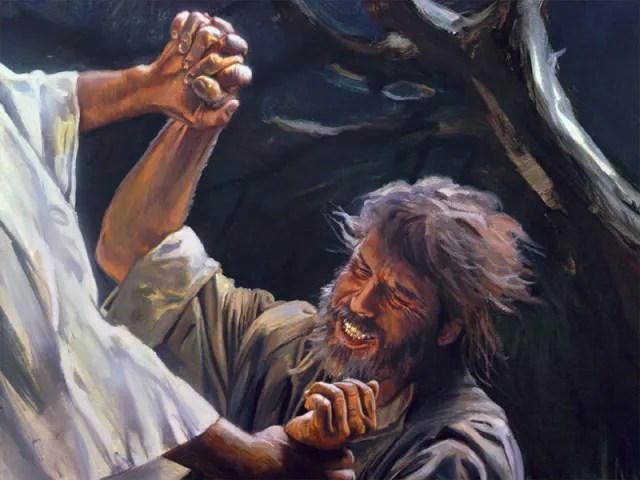
Finding the Feet of Jesus

A terrific study is finding the people who fell at Jesus’ feet. Tucked in the Gospels you’ll find stories of those who despair. You’ll also see them come to Jesus in brokenness and humility, without any other recourse. I call these the “people of the feet.”

They came to Jesus because they had no hope otherwise. They were people who were hopeless and wretched, they had long ago run out of options. They came to Jesus, falling down in front of Him. They were all people of the feet.

They were men and women who were truly desperate.

There are some common characteristics that feet-finders have:

  • A great need that can’t be met without His touch
  • To understand one’s true condition–humility, brokenness
  • To beg for a healing, for self or family
  • To honor Jesus as the Messiah
  • To be more receptive to His teaching, to understand Him
  • To become a witness to others (although it does seem secondary)

“But immediately a woman whose little daughter had an unclean spirit heard of him and came and fell down at his feet.“

Mark 7:25

“Then people went out to see what had happened, and they came to Jesus and found the man from whom the demons had gone, sitting at the feet of Jesus, clothed and in his right mind.”

Luke 8:35

But there are several other instances where people came to sit at Jesus’ feet:

  • Mark 5:22-23, Jairus, a leader in the local synagogue
  • Luke 7:37-38, a sorrowing mother for her daughter
  • Luke 8:41, also Jairus
  • Luke 10:39, Mary, when Jesus was teaching
  • John 11:32, Mary, meeting Jesus entering Bethany
  • John 12:3, Mary, with her perfume
  • Revelation 1:17, John to express what he was seeing (also 19:10)

In every case we find people consciously coming and kneeling at the feet of the Lord Jesus. It was a deliberate action that came from their hearts. Each had a terrible need, and each was without hope.

It’s the end of religion if you’re a feet-finder. No more facades, no more treadmills. Instead your heart forever changes.

Hardly decent to religious people.

Are you really that desperate yet? Have you seen your need, and do you realize how lost you would be without His healing touch?

I’m convinced only Jesus can make me clean and whole.

But I found my rightful place at His feet. It’s where I belong. I love Him.

I’m not ashamed to be found kneeling.

alaskabiblrteacher.com

The Leper Meets Jesus

Matthew 8:1-4 

It was a wild scene, we can’t forget this. But it’s funny, Jesus through all this sees and hears this leper. He doesn’t respond to the crowd but to the diseased man. The text tells us that the leperous man was on his knees and he was “praying.” His pleas were directed at Jesus.

But remember, the end of the previous verses explains exactly what’s happening. Matthew 7:28-29, (MSG) explains their excitement–

When Jesus concluded his address, the crowd burst into applause. They had never heard teaching like this. It was apparent that he was living everything he was saying—quite a contrast to their religion teachers! This was the best teaching they had ever heard.

The crowds responded wildly to the marvelous teaching of Jesus, and that was awesome. We really shouldn’t minimize that. However, in the Gospels, the “crowd” is pretty much a bad term, or at least a neutral one.

I suppose that Jesus seems to ignore the multitude’s extremely positive reaction. He knows it won’t last. The fickle crowd will soon cry out and demand His crucifixion.

But I understand, I’m that leper and He sees me.

Scripture tells me that Jesus now sits in heaven and makes intercession for me. He focuses on just me, I’m the center of His care–but I also know that attention is also on you, and others, and yet I’m assured that He sees me and each of His sheep. This should be a comfort. He concentrates and ministers to the person, and never to the multitude. 

Jesus loves you, and He loves me too.

“So he told them this parable: “What man among you, who has a hundred sheep and loses one of them, does not leave the ninety-nine in the open field and go after the lost one until he finds it? When he has found it, he joyfully puts it on his shoulders, and coming home, he calls his friends and neighbors together, saying to them, ‘Rejoice with me, because I have found my lost sheep!’”

Luke 15:3-6

Without Your Wound? (John 5)

angel6

The subject of “the pool at Bethesda” alludes to the Thorton Wilder play, “The Angel that Troubled the Waters.” 

The play tells of a physician who comes to the pool of Bethesda, hoping to see the stir, and then be the first in the water, and healed of his debilitating depression.  An angel appears and troubles the water. Everybody at the pool hopes to be the first one in and to be healed of their disability.

An angel appears and blocks a physician at the very moment he is about to step into the pool and be healed.

angel1

Angel: “Drawback, physician, this moment is not for you.”

Physician: “Angelic visitor, I pray thee, listen to my prayer.

Angel: “This healing dear physician, is not for you.”

Physician: “Surely, surely, the angels are wise. Surely, O Prince, you are not deceived by my apparent wholeness. Your eyes can see the nets in which my wings are caught; the sin into which all my endeavors sink half-performed, cannot be concealed from you.”

Angel: “I know.”

Later, the person who enters the pool first, and was healed rejoices in his good fortune, then turns to the physician before leaving and says:

“But come with me first, an hour only, to my home. My son is lost in dark thoughts. I — I do not understand him, and only you have ever lifted his mood.”

“Only an hour… my daughter… since her child has died, sits in the shadow. She will not listen to us, but she will listen to you.”

The play pierces me with this line— “Without your wound where would your power be?“ That thought causes me to look at my many weaknesses with an entirely different perspective.

Paul’s teachings offer us a powerful revelation: it is through our weaknesses that we can authentically minister to others, just as Jesus did by going to the cross. This priniple slowly permeates my understanding, and emphasizes the reasons behind my weaknesses.

Paul boldly declares that it is the very things we perceive as weak that have the potential to cultivate strength and truth within us and to others. It is my sincere hope that the ministry of alaskabibleteacher.com will impact lives by declaring this.

I hope so anyway. Please pray for me. I desperately need it.

I first encountered this excerpt in the book, “Abba’s Child: The Cry of the Heart for Intimate Belonging,” by Brennan Manning. The book is a worthy read, and worth finding if you can. The play is based on the biblical verses of John 5:1-4, however, it changes the end of the parable. The play is fictitious.


alaskabibleteacher.com

Living as His Brother

Jesus Papyrus, jerusalemperspective.com

Matthew 12:49-50, (context, vv. 46-50)

His family is spiritual. Earthly connections aren’t what really matters, Jesus expresses an important understanding of the Kingdom of God. Things are not evaluated by physical relationships anymore. Life is different now.

I don’t think Jesus has gone out of His way to alienate His earthly or physical connections to His family. I don’t think He is being rude or uncaring. That isn’t part of His thinking. And yet He does seem to point to something that’s more permanent and everlasting.

It isn’t enough to be His brother, or cousin or uncle. These things really don’t matter. What does matter is being part of His spiritual family. To be painfully honest, it seems to me anyway, that the spiritual relationship is what truly counts. Being Jesus’ disciple, and doing the Father’s will for us transforms us and lifts us up to family ‘status.’

But it doesn’t strictly matter “how” you relate to Jesus so much, but how you do the will of God. That is what impresses Jesus. That’s what He communicates to those who are standing around Him. Do you really understand what is family? Can you grasp the idea that doing the will of God now makes you authentic?

We must reach out and grab this concept–we are family if we do the will of God, believe in His sacrificial work and immerse ourselves into His purposes. We become His family, spiritually anyway, when we start to do what He wants for us. Am I doing what He wants for me at this moment, or the next, or the next?

Are we really part of His family, or is someone else our father?

“The purpose of the Bible is simply to proclaim God’s plan to save His children. It asserts that man is lost and needs to be saved. And it communicates the message that Jesus is the God in the flesh sent to save His children.”

– Max Lucado

Having an Anointed Life

I have to admit, I always wondered what this verse in Psalm 23 meant. I thought He anoints my head with oilwas a nice poetic phrase for God blessing David. But as I delved deeper into the context and explored different interpretations, a beautiful and profound meaning unfolded before my eyes.

First of all the act of anointing with oil holds significant cultural and spiritual symbolism in biblical times. It was a practice to anoint guests as a sign of honor and welcome, especially in lavish feasts and celebrations.

Anointing with oil also had medicinal purposes, as it could soothe and heal various ailments. (Now that’s interesting, I thought.)

In the context of Psalm 23, the phrase “He anoints my head with oil” takes on a deeper metaphorical meaning. It signifies God’s abundant blessings, His provision, and His care for His people. Just as a host anoints the head of a guest as an act of honor and hospitality, God lovingly anoints us with blessings and favor.

Moreover, the act of anointing with oil has spiritual connotations. In ancient religious rituals, anointing with oil was a sign of consecration, setting apart someone or something for a holy purpose.

This verse also portrays a practical picture of medicinal shepherding.

In biblical times, shepherds used oil to treat and protect the sheep’s wounds and keep insects away from their heads. By anointing our heads with oil, God brings healing and comfort to our brokenness, soothing our hurts and protecting us from the turmoil of life.

Sheep often can do harmful things to themselves as they try to find relief from flies and ticks.

Their ears and eyes can be targets for tormenting insects as well.

Sheep have been known to bash their heads against rock walls to dislodge flies from their ears, noses, and eyes. A good shepherd watches closely over his flock. He watches over them carefully.

A good shepherd knows that poured out oil forms a barrier of protection against these things that would try to destroy the sheep.

Have you ever asked God to anoint your head with oil?

Psalm 23 as a whole beautifully paints a picture of God as our loving and caring Shepherd, guiding us, providing for us, and protecting us. The imagery of anointing with oil further illuminates the depth of His love and the extent of His care. It reminds us that we are chosen and cherished by God, and that His blessings are abundant and unending.

But ask yourself these questions. Do you have times of mental torment? Do the worrisome thoughts invade your mind over and over? Do you beat your head against a wall trying to stop them?

The Holy Spirit can come with His endless supply of oil!

“You prepare a table before me
    in the presence of my enemies;
you anoint my head with oil;
    my cup overflows.”

Psalm 23:5, ESV

Oh how He loves you!

Wrestling with God

Jacob was a scoundrel, a cheat and a swindler. It seems that his life was built on defrauding others. I see no integrity, no goodness in his early life. He plotted and tricked everyone he could in order to advance his own status.

Yes, Jacob was tricked also, which I suppose was a “good” thing. It seems that when men like Jacob get deceived themselves we tend to gloat a bit. After all, they are finally getting what they deserve.

But no bad man is outside of God’s grace and mercy.

Jacob is a grifter. He has built his life around a selfish deception. But again, he is still on God’s radar, and the Father isn’t finished with him yet.

A night of wrestling with God is really something we all will do at least once in our life. We each have a “Jabbok” and each will go body to body with the Holy One. Some of us will learn how to surrender, others will not. But sometimes, our dealings with God are silent, and unobservable.

It fascinates me to see Jacob wounded. “When the man saw that he would not win the match, he touched Jacob’s hip and wrenched it out of its socket” (v. 25). Jacob will limp for the rest of his life. Every morning as he got out of bed, he would groan from the stiffness and be reminded of that fight by the river.

So dear one, how should we process all of this?

  1. No man is too far gone for God’s dealings.
  2. Each of us, whether we realize it or not, will have our encounter with God. (Our personal “Jabbok.”)
  3. God loves us too much to let us remain in our sin and darkness.
  4. And sometimes, from that encounter we’ll walk with a limp.

My own experience. I was not in a good place 8 years ago, I was wrestling with God, and having some issues, but the Holy Spirit had no intention of letting me go. I had a very bad fall. Needless to say I laid on the ground with my right arm pinned beneath me for some time. That injury is known as “compartment syndrome.” I went into surgery immediately.

My right forearm/hand is now paralyzed. about 80% of the muscle tissue and nerves had to be removed. The doctors considered taking my arm off, but I’m glad they didn’t.

Like Jacob, I now have a tangible reminder of my fight with the Lord. There are times when I hurt. I’ve had to relearn and adjust to using my left hand. It has not been easy. Jacob would limp for the rest of his life, I can relate having just one arm.

“God has no pleasure in afflicting us, but He will not keep back even the most painful chastisement if He can but thereby guide His beloved child to come home and abide in the beloved Son.”

 Andrew Murray

Listen to Him

“Jesus told this simple story, but they had no idea what he was talking about.

John 10:6

For context: 10:7-18

What a joy can be found in the Shepherd’s care, and to hear his voice. Nothing really can match this wonder. We follow as he leads. The voice is an integral part of this passage and the foundation of authentic discipleship. You really can’t walk with him unless you hear him. We belong to him. We’re his flock that he keeps and provides for.

John 10:1-6

Amazing. He knows our name! That’s the intimacy found in these verses. We’re never forgotten and he will never overlook us. To think otherwise is slander and an attack on his present-day ministry. Jesus is our good shepherd. He always will be.

“Intimacy with God comes in whispers, not shouts.”

     Woodrow Kroll

He sometimes whispers, and this world can’t hear him. To be perfectly honest, my ‘busy-ness’ silences him. I suppose that the real issue isn’t with him, but with myself.

“And after the earthquake, there was a fire, but the Lord was not in the fire. And after the fire, there was the sound of a gentle whisper.”

1 Kings 19:12

The gentle whisper to a man afraid. This fits the Father’s m.o. He doesn’t speak through a windstorm, earthquake, or fire. He chooses to speak very quietly, and that’s a problem for me. In the original Hebrew, the word for “whisper” can be translated as calm, silence, or something gentle. He speaks this way if only we shut up for a little while.

If we are to recognize God’s voice, we must belong to Him. We hear His voice when we spend time in Bible study and quiet contemplation of His Word. The more time we spend intimately with God and His Word, the easier it is to recognize His voice and His leading in our lives.

The flock hears the shepherd, and it’s that voice that breaks through our cluttered-up life. We can hear, and it’s that communication that encourages us to walk through life—one day at a time. Just today. That’s all you must do.

There are so many other voices. You must ignore them.

So many are speaking, so many want us to hear and follow them. But in reality, they want us to leave the Shepherd and his flock behind. But we can’t allow this, we must learn to listen to him alone.

    Elisabeth Elliot

Art by Eugène Burnan

Piles and Piles of Manure

The Augean Stable

Proverbs 30:12

The dictionary explains filthy things like this, “to be disgustingly dirty” or “to an extreme extent.” Understanding this draws us into a perilous understanding of what our situation really is–to despair is our only real step of being acceptable in God’s eyes.

Despairing is our first step.

The Pharisees (“the holy ones”) never understood. But they never understood the basics. They read but never really understood the words of the prophet Isaiah,

“Their tables are covered with vomit; filth is everywhere.”

Isaiah 28:8. (Context 28:8-9.)

Hercules in Greek mythology was assigned to clean the Augean stables. King Augeaus had 3,000 oxen and their stable had not been cleaned in 30 years! (That’s a whole lot of manure.)

He was given 24 hours to clean it up. And rather than grab a shovel, he concentrated on redirecting two rivers, turning them directly into the stable, and essentially flushing out the accrued filth of the oxen. His ingenuity fulfilled the task. The stables were cleaned.

The formidable task of cleaning those stables was totally fulfilled by Jesus Christ.

Our hearts were soiled by our sin and iniquity. No man could ever clean them, the piles of sin merely got deeper. At times we’ve tried hard, but sin continued to climb higher. Sometimes we pointed to others as having even worse kept stables than us, but that does not work.

“We are all infected and impure with sin.
    When we display our righteous deeds,
    they are nothing but filthy rags.

Isaiah 64:6

So much we hear seems to diminish our sin. Nothing we hear preached changes this. Only the heroic effort of Jesus can cleanse us from what we know, deep down, is true. We are “infected” with sin. The fever rages within, and it abates at times, but it’s always there.

“So get rid of all the filth and evil in your lives, and humbly accept the word God has planted in your hearts, for it has the power to save your souls.”

James 1:21

Some suggest the repentance is archaic and obsolete. I don’t think so. Rather it seems like it’s the starting point, we don’t change by feeling bad about the piles of manure (and yes, we know about them). We are simply those who’ve decided that we need God’s “river” to clean us.

I point no fingers. I blame or accuse no one. I’m merely a man who is wet, by the grace of God alone.

God came in the humanity of Jesus to heal us, to “flush” us clean. He alone can cleanse us from our filth and darkness.

“I will cleanse you of your filthy behavior.”

Ezekiel 37:29

“God the Father knew you and chose you long ago, and his Spirit has made you holy. As a result, you have obeyed him and have been cleansed by the blood of Jesus Christ.”

1 Peter 1:2

You have to decide. Will you simply adapt to your manure, or simply allow the rivers of grace to change you?

Sitting on God’s Couch

“The Lord confides in those who fear him; he makes his covenant known to them.”

Psalm 25:14

“The secret things belong to the Lord our God, but the things that are revealed belong to us and to our children forever, that we may do all the words of this law.”

Deut. 29:29

What I need to share with you is privileged information, profoundly insightful yet delicate in nature. Not every believer will understand or resonate with the depths of this revelation. Some will readily agree with the truths I will unveil, finding comfort and clarity in them, while others might struggle to grasp the significance of the message. This is a secret but not secretive; it is an invitation to explore a deeper relationship with the divine. Every Christian can enter into this profound understanding if they choose to open their hearts and minds. Some will accept this call willingly, embracing the journey of discovery, and some won’t, perhaps choosing to remain within their comfort zones, unaware of the profound impact this knowledge could have on their spiritual walk. Yet, for those who are willing to seek, an incredible path of enlightenment and connection awaits them.

“Then Jesus strictly warned them not to tell anyone about Him.” Mark 8:30

“Call to me and I will answer you, and will tell you great and hidden things that you have not known.” Jeremiah 33:3

Learning His secrets–

  • Intimacy with God: Seeking Him personally, not just intellectually. 
  • Fear & Awe: Having reverence and respect for God (Psalm 25:14). 
  • Dependence on the Spirit: Relying on the Holy Spirit for understanding, as humans cannot know these things on their own (1 Corinthians 2:10-12). 
  • Faith & Surrender: Trusting God’s revealed truths and surrendering to His will, even when answers are withheld. 

To understand His special things is not automatic. I encourage you to come and sit, read and pray. And listen. It will come to you by grace through His blood.

Maker of the Universe

The Maker of the universe
As Man, for man was made a curse.
The claims of law which He had made,
Unto the uttermost He paid.

2

His holy fingers made the bough
Which grew the thorns that crowned His brow.
The nails that pierced His hands were mined
In secret places He designed.

3

He made the forest whence there sprung
The tree on which His body hung.
He died upon a cross of wood,
Yet made the hill on which it stood.

4

The sky that darkened o’er His head
By Him above the earth was spread.
The sun that hid from Him its face
By His decree was poised in space.

5

The spear which spilled His precious blood
Was tempered in the fires of God.
The grave in which His form was laid,
Was hewn in rocks His hands had made.

6

The throne on which He now appears
Was His from everlasting years.
But a new glory crowns His brow.
And every knee to Him shall bow.

“The Maker of the Universe,” lyrics by Phil Keaggy, 1986