The Whip Which Heals

John 2:14-17, NCV

 “In the Temple he found people selling cattle, sheep, and doves. He saw others sitting at tables, exchanging different kinds of money. 15 Jesus made a whip out of cords and forced all of them, both the sheep and cattle, to leave the Temple. He turned over the tables and scattered the money of those who were exchanging it. 16 Then he said to those who were selling pigeons, “Take these things out of here! Don’t make my Father’s house a place for buying and selling!”

17 When this happened, the followers remembered what was written in the Scriptures: “My strong love for your Temple completely controls me.”

He used a whip. The text tells us that. Jesus carefully took cords and braided a whip. What can I say? I’m amazed at His reaction to what He saw going down in the Temple. What Jesus saw grieved His heart so intensely that there wasn’t anything else He could do. The last verse of the passage tells us that His “strong love” for the Temple was what provoked Jesus’ response.

I think we should consider three different whips.

  • The one Jesus carefully braided to “cleanse the Temple.”
  • The one used on Jesus’ back as part of our atonement. (Isaiah 53:4-6).
  • The one that believers experience in the ways God disciplines us as His children.

All three are critical to see and know. Each carries a significance to this particular teaching. All three carry their own “pain.” We discover that the Temple becomes “pure” again. We learn that His pain becomes our salvation. And finally, I get the discipline to become holy.

There are many times when Jesus has used the “whip” on me!

Not a leather one mind you, but a braided cord of discipline and sonship. What He saw taking place in the marketplace of “me” (I’m His temple now), can bring Jesus grief and sorrow. You see, I am the residence of the Holy Spirit, and He fully intends to make me conform. Hebrews 12 tells me what to expect as a son.

“For whom the Lord loveth He chasteneth, and scourgeth every son whom He receiveth.”

Hebrews 12:7-8, (in context)

It’s best to remember that Jesus was beaten almost to death for my sin. So “whips” often happen when the will and purposes of God occur. It’s His way of cleansing through the effort of the Holy Spirit. I believe that certain “things” will only take place when the whip is cracked. His loving discipline is what we need.

Think about this for a moment.

“But he was wounded for the wrong we did;
    he was crushed for the evil we did.
The punishment, which made us well, was given to him,
    and we are healed because of his wounds.”

Isaiah 53:5, (context. 4-7)

Yes, a whip carefully used is needful, and yes, it will bring us pain. But the three can show us spiritual realities. It’s through each that we see God doing His work. I should warn you–this is not a “prosperity” gospel. There’s not “a blab it and grab it” theology. Just reading Hebrews 11 and 12 should alert you to what’s real.

God understands us. He knows exactly what we need to have so we might grow up in Him. Trust and obey.

“We may feel God’s hand as a Father upon us when He strikes us as well as when He strokes us.”

   Abraham Wright

When You Set Yourself on Fire

Difficulty and pain sometimes come from others, and challenges to the Lordship of Jesus often come from our unique circumstances.

But what if it was something we’ve done?

I remember the classic picture of a Buddhist monk who sat in the middle of a street. He was serene as he soaked himself with gasoline, and lit himself on fire as a protest against a war he believed was wrong and evil. He burned himself in front of the cameras.

All too often we’re pretty much responsible for our own self-immolation. It is we (and we alone) that set ourselves ablaze. Sin affects our minds and hearts. We set ourselves on fire.

When we sin– when we walk in ‘known’ disobedience we always put ourselves in an awful place. We love it but learn to hate it too. But we continue to do it regardless of the awful death that ensues.

God promises to forgive us. Out of our ashes, He keeps bringing us life and hope.

You can be forgiven. You can find life again, even if you’re fully responsible for the evil we’ve done to yourself. Yes, we all sin, and yes we walk in our own personal rebellion. But Jesus knows it all. These awful things we’ve all done can be forgiven.

As a man and a preacher of the Gospel, I realize that I choose to sin. In spite of all I know and teach I realize that I can live in the ashes of my own making. As one who also struggles with bipolar, I understand that I’m even more susceptible to doing awful things. I understand that I choose darkness even though others sometimes call me “a man of God.”

As you read this I’m praying that you find His forgiveness and mercy. You’ve come a long way it seems, but you must see His blood that was ‘released’ from His veins and arteries for you.

He desperately loves you–even if you’ve set yourself on fire, and sit in the ashes of your doing.

“To appoint unto them that mourn in Zion, to give unto them beauty for ashes, the oil of joy for mourning, the garment of praise for the spirit of heaviness; that they might be called trees of righteousness, the planting of the Lord, that he might be glorified.”

Isaiah 61:3

alaskabibleteacher.com

Our Father is in Control

Tapestry: Front and Back

 “Thus says the Lord, You shall not go up or fight against your relatives the people of Israel. Every man return to his home, for this thing is from me.’ So they listened to the word of the Lord and went home again, according to the word of the Lord.”  

 1 Kings 12:24, KJV

You can never accuse the Lord of being cold and distant and aloof.  He doesn’t detach Himself from the needs of His people.  He doesn’t ever disconnect and isolate Himself from you.  On the contrary, He is constantly thinking and acting on your behalf.  He is a proactive God, and that’s impressive.

The God of the Bible is always intensively involved in the affairs and concerns of His covenant people.

What we see as a muddled-up mess is actually His work. Perhaps in eternity we’ll see and understand. We see the backside of the tapestry now but (I assure you) we’ll know the beauty of His handiwork.

“For this thing is from Me.” 

God directs a confused king who has significant issues.  (Sound familiar?) God decides that the civil war between Judah and Israel is wrong.  In 1 Kings 12, He sends His prophet Shemaiah to stand before the king of Judah, and speak out a word to the nation.  The Lord is involved, and it is He who is actively enmeshed in this issue.

“For this thing is from Me.” 

There is something here that can mystify and perplex the best of us.  He begins to weave and guide His active presence into the confusing issues of that time.  He is not a “landlord God,”  but He is intensely involved in our affairs.  He initiates and directs the very things that concern us.

“For this thing is from Me.” 

The text clearly opens up this ugly situation.  In the midst of this bizarre issue, God has assumed control.  His prophet Shemaiah carries this a Word of power into a room of possibly explosive personalities.  Now the arrogance of the king can be a strong and strange thing.  But God decides and moves wherever He wills. Kings are never an issue when God enters in. They must serve now, like anyone else.

Dear one, He is incredibly involved in your affairs. 

He draws you and He has engaged to be intricately focused on your situation.  “For this thing is from Me.”  and that truth opens up His purposes to our desperate poverty.  We may try very hard to try to maintain control and direction.  But God directs and superintends. 

He is big enough to touch and direct my small heart.  We will come into confusion if we try to sidestep His lordship.

 “The Lord can control a king’s mind as he controls a river;  he can direct it as he pleases.” 

Proverbs 21:1

bry-signat (1)

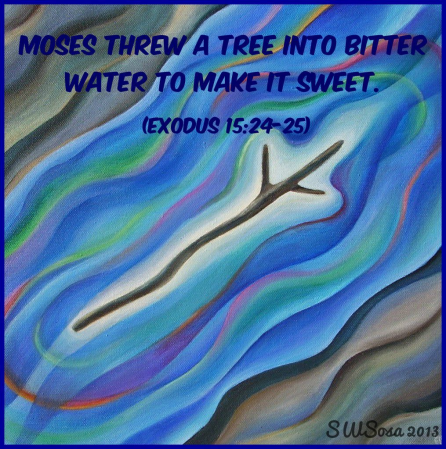
Bitter Water

In Exodus 15 there’s an incident that carries weight for today. Israel has come to the springs of Marah. The water is bitter. The people turn to Moses. They challenge him and the complaint voraciously. “Why have you brought us here?” They press Moses to the point of mutiny. They are furious.

Some commentators believe this bitter water was a laxative, and anyone who drank this “bitter” water made many trips to the outhouse!

Moses is shown a branch of a common tree. The Lord speaks a word of the direction he’s to throw the branch directly into the spring. It’ll cure the water, and make it sweet and drinkable.

t seems to me that this awful cross cures the bitterness we absorb as we make our way through life.

The cross of Jesus is critically important. When that ugly tree touches our lives it makes what is bitter sweet. He has changed us by that incredible sacrifice on the hill of Golgotha.

.

Those Strange Christians

I was thinking about this today.

Do you have any idea how ridiculous unbelievers must see us? Just imagine for a minute that you’re on the outside of faith looking in.

———————

They get very solemn as they slowly take the bread and wine. They say that when they sing it’s to God Himself. Some get loud raising hands in surrender to Him. Some will even dance in the worship of someone who’s invisible. How bizarre is that?

They call a man who died a long time ago, they declare that He was their Lord and Master.

They’re gathering to read from a special and “magical” book, and they say that it speaks to them. They talk about living a life separated from Him. They truly think that others need to join them in this silly group. They regard each other as brothers and sisters and they serve each other.

They tell us that Jesus is God in human flesh, who was put to death on a cross and is now alive. They also believe that His blood saves them from their “sin.” These very odd ones think this man is going to return and rule the world, physically bring the Kingdom of God to this planet.

How very odd of them. How very strange these Christians are.

—————————

There exists a letter written to Diogenes, who is known as the Cynic. It was written around 130 AD. This letter itself is fairly extensive. I suggest that you read it in its entirety. It describes the faith and beliefs of the Christian to a man who really has no idea about them but wants to understand–here is a small portion of this epistle. Remember that this is one of the very first observations of our Faith:

“They live in the flesh, but they are not governed by the desires of the flesh. They pass their days upon earth, but they are citizens of heaven. Obedient to the laws, they yet live on a level that transcends the law. Christians love all men, but all men persecute them. Condemned because they are not understood, they are put to death, but raised to life again. They live in poverty, but enrich many; they are totally destitute, but possess an abundance of everything. They suffer dishonor, but that is their glory.”