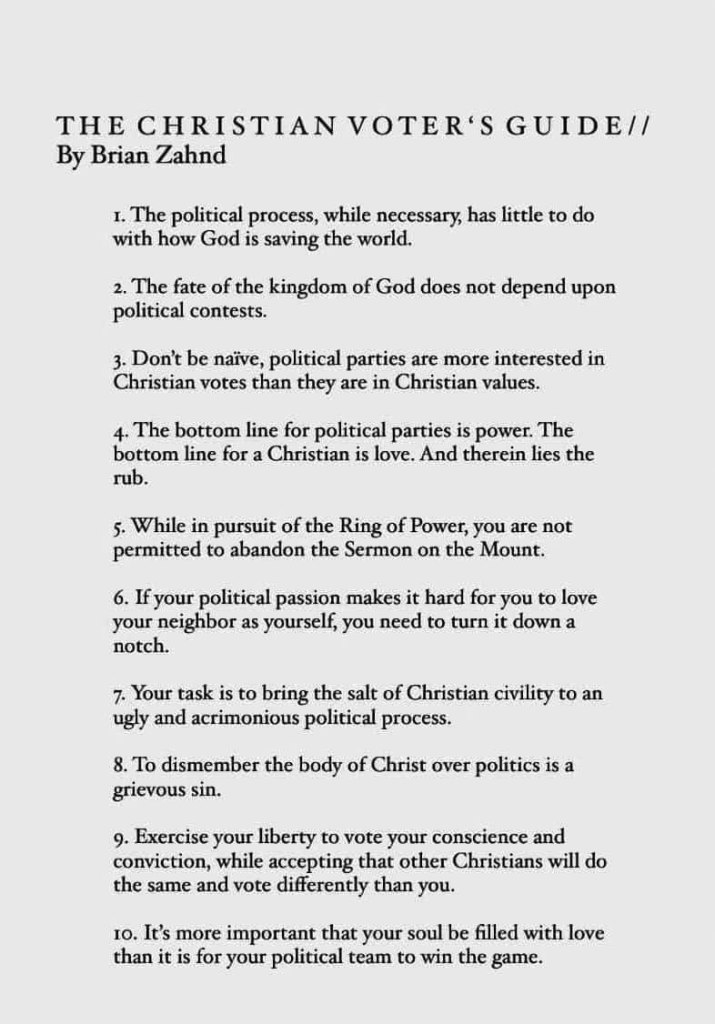
Our vote matters a lot. Here are some principles a believer should always follow. This list is a good way to function and maybe even see our own hearts in the light of the Gospel, and the direction of the Holy Spirit.
As a believer who is also a citizen this matters so much.
We maybe Republican, Democrat, or independent, but we know that God’s Kingdom rules over all. We must keep our hearts firmly fixed and settled in something that knows our Father’s purpose.
Please read the above list through, as I think it directs us to Him. I guess if I’ve got any insight into this at all I would add prayer and intercession. That wasn’t included, but adding it would enhance this list even more.
“If My people, who are called by My name, shall humble themselves and pray, and seek My face and turn from their wicked ways, then will I hear from heaven, and will forgive their sin and will heal their land.”
“But I am like a green olive tree in the house of God. I trust in the steadfast love of God forever and ever.”
Psalm 52:8
In Psalm 52 we read of David’s run-in with Doeg, a very bad man, (a mass murderer actually). But David, hearing about the slaughter of 85 innocent priests doesn’t respond in hatred, rather he sits down and writes this song of contemplation which we know as Psalm 52.
It isn’t something written out of wrath and vengeance rather the word that begins his writing is “maskil” which implies– enlightenment, or something reflective, thoughtful, discerning. He sat down and considered Doeg’s awful evil, and by doing this was able to understand own heart as well.
The first is Doeg’s vicious atrocity, and the condemnation that it incurs, (v.v. 1-7). The second was David’s own commitment to following God, and understanding his own place in a very evil world, (v.v. 8-9).
Rather than castigate himself for being discovered in Nob–a circumstance which directly led to the mass murder of these priests (and their families). We find that David does not blame himself. He could have, but he didn’t. Rather he thoughtfully, and carefully, detailed his own “observations” of the whole sordid matter.
David could easily have destroyed himself with guilt and grief. He didn’t.
He chose not to play the losing game of ‘what if.’ He instead would be like a green olive tree rooted himself in the holy temple and into the protective presence of God. David knew he would destroy himself if he didn’t place himself there. It was a deliberate decision.
It would keep himself sane.
It seems to me that trees work heavily into David’s own theology and that this is how he sees his relationship with God. He’s planted and therefore able to survive terrible trials. He shows us how to survive and thrive.
His roots would need to go very deep indeed.
David’s thoughtful imagery is himself as an olive tree planted in God’s presence.
I believe knowing this is the antidote to the poison of guilt. Perhaps we should follow his example?
“They are like trees planted along a riverbank, with roots that reach deep into the water. Such trees are not bothered by the heat or worried by long months of drought. Their leaves stay green, and they never stop producing fruit.”
Once I was punched in the face while preaching. At the time I was an evangelist with SOS Ministries in 1987. I was leading a group to Haight/Ashbury St. in San Francisco. I remember it was really busy, and it was a good team, and they were excited to take their church to the streets.
Haight/Ashbury was the place the “summer of love” kicked off, it peaked in 1968. It has a certain sense of notoriety, and even in 1983 it still had a dubious reputation as a center of the counter-culture. “A cult a day is born in San Francisco,” a pastor friend once shared with me.
Normally the neighborhood where I took a team would direct me on how to preach. Tonight especially I focused on God’s love for sinful people.
That message seemed appropriate for this place, especially on this street. God loves these people very much.
A young man came forward. He told me that he was a backslidden Christian, and his father was an Assembly of God pastor. He had run away from home. Suddenly he began to weep. The entire team seemed to lean forward and I know they were praying earnestly for him. It seemed to me that he was teetering on the brink.
His punch however came unexpectedly.
His fist hit me square in the nose. My eyes began to water. Oddly enough he took a step back and began to really cry out. My team wasn’t quite sure how to respond, but I hoped they prayed even harder. I sort of gasped and tried to shake it off. Someone must have called the police.
The Holy Spirit was very much present, both convicting and comforting each of us.
One or two minutes went by and suddenly he stopped sobbing and he became really angry. He took a step and then tried to kick me in the stomach, but I dropped the mic and caught his foot. I was ready for him this time.
About 20 minutes went by before SFPD showed up and asked if I wanted to press charges. I thought for a bit, but deep down I knew that wasn’t the will of my Father. Maybe I should of, I don’t know. But I thought about my own sin and couldn’t judge no one.
The Father was reaching him while teaching me!
God loves His prodigal children very much, He understands the guilt and shame (and frustration) they feel. The Father however is always watching and waiting. He works through life’s circumstances to lead them home. Each belongs to Him. He continues far past what we think is possible. He will never give up.
“We know what real love is because Jesus gave up his life for us. So we also ought to give up our lives for our brothers and sisters.”
1 John 3:16
I suddenly saw a “wounded” brother, very confused and quite angry. Not with me, the team, or the music–but with God who created him, and died for him.
At that moment in time, I just happened to be God’s love for this prodigal.
“Jesus answered, “Mykingdom is not of this world. If mykingdomwere of this world, my servants would have been fighting, that I might not be delivered over to the Jews. But mykingdomis not from the world.”
John 18:36
Jesus perfectly the extent of His kingdom. Three times in this one verse, Jesus uses the statement, “My kingdom.” Three times. Perhaps there is something here we should look at closer? Maybe?
First, Jesus affirms to Pilate that he indeed holds the title of king. However, this kingdom does not represent a political adversarial entity; its borders are not defined by physical realms. Instead, they are spiritual in nature, rendering Pilate and the emperor as mere peripheral issues.
Simply put, these 40 words are Jesus’ powerful declarations to Pilate that yes, He was truly a King. But also notice what Jesus says, “My kingdom.” He is the supreme Lord of it.
Jesus’ kingdom was “not of this world,” which He also repeated three times in this one verse!
No, Jesus was referring to a kingdom that was spiritual, but no less tangible. As a matter of fact, it was more real than the kingdoms of this earth.
Those who choose to follow King Jesus have boldly rejected the shallow tenets of this world—force, pride, public image, and the lure of power. The arrival of God’s kingdom doesn’t fit neatly into our expectations; it’s revealed through the radical Beatitudes and shocking parables. These committed souls have declared their allegiance to the One who reigns supreme over the entire universe, daring to defy the status quo.
“Romans thought they knew about kingdoms and their might; that armies, navies, swords, and battles measured the strength of kingdoms. What Jesus knew was that His kingdom – though not of this world – was mightier than Rome and would continue to expand and influence when Rome passed away.”
Brokenness, humility, love, servanthood, and sacrifice are essential pathways through which His kingdom manifests to people. The world’s approaches, including those that are religious and deemed “moral,” fail to align with the reality of His authority.
At times even, they may seem very noble and right; but that simply isn’t the way Jesus’ rule truly comes.
“Until the will and the affections are brought under the authority of Christ, we have not begun to understand, let alone to accept, His lordship.”
I believe the Church, especially here in the western hemisphere, understands Jesus as our Savior, but not really as the King. The idea of a king and lord isn’t automatic for us. We have senators and constitutions, a vote, media outlets and freedom of speech–but that somehow never prepares us for the rule of a true sovereign.
Jesus is calling us to live out his rule in our lives, and to embrace him as King. He’s much more than our Savior, and we must understand that. If we want to really grow up in him, we must understand his lordship.
“The lordship of Jesus is not simply a hope of Christians that someday might be realized; it is a truth that has already taken place.”
“Praying at all times in the Spirit, with all prayer and supplication. To that end, keep alert with all perseverance, making supplication for all the saints,
and also for me, that words may be given to me in opening my mouth boldly to proclaim the mystery of the gospel, 20 for which I am an ambassador in chains, that I may declare it boldly, as I ought to speak.”
Eph. 6:18-20, ESV
I’m convinced that our most challenging work is learning to pray. Whenever we experience revival, whenever we rediscover our true calling and purpose for living, we do so by prayer.
Prayer is the way we become like Jesus.
Satan’s primary focus is to destroy our prayer lives, he works to eliminate our communion with our Father. He detests that, and he and his demons (and the world system) work overtime to tear down our walk. The enemy concentrates everything on our prayer life.
There are four “alls” in verse 18!
All times
All prayer
All perseverance
All the saints
With this in mind we see that Paul stresses the complete effort of prayer and its focus. All the time, every kind, no matter what and for your brother and sisters in Christ. It’s work, spiritual work. It seems that once we put the armor on (verses 10-17) we can stand in God’s own strength.
It’s not enough to wear your armor.
If we’re clothed it’s for the purpose of prayer. Yes we must dress for war and protection, but its ultimate purpose is prayer and intercession. Don’t just wear it but pray out of it. You must strive in prayer, so much is counting on you. You can make a difference.
He’s waiting for you to ask. He wants you to intercede for others.
It will not be easy. The enemy wants to suppress your prayer life. He absolutely hates it. Satan wants to see us passive and dull and you cannot let him do this. You have a very critical part and place in God’s kingdom. Perhaps others are waiting for you, and perhaps you’re the only one who can step up in the gap for them.
You’ve been given a part of God’s field to care for, you have your own sphere of influence. No one else has it, but you.
There many different ways to pray:
On your knees
walking
standing or sitting
vocally, or in your thoughts
with others, a group
using a prayer list
“arrow” prayers (shot up with 1-2 sentences)
using the Psalms or reading the many prayers in the Bible
There’s a “school” of prayer and the Holy Spirit intends to teach you.
Don’t play hooky. You will make mistakes or lose focus. The Spirit will teach you stanima. You might pray for one or two minutes at first, but it’ll grow and you’ll learn endurance. Remember though–you’re most like Jesus when you start to intercede for others.
Maybe your sanctification comes when you pray?
“You need not cry very loud; he is nearer to us than we think.”
God’s temple was now filled with an evil darkness. King Manasseh made the Lord’s holy place a fountain of sin and filth. Instead of holiness, it was an evil place.
He brought in dark things that were twisted, perverted and clearly forbidden.
“Manasseh led Judah and the inhabitants of Jerusalem astray, to do more evil than the nations whom the Lord destroyed before the people of Israel.”
2 Chronicles 33:9, ESV
His own darkness was now encouraged by others, it became accessible, available and promoted:
The high places were rebuilt throughout the land.
Altars to Baal rebuilt, using images of wood.
In the holy temple, altars to the “starry host,” astrology, plain and simple.
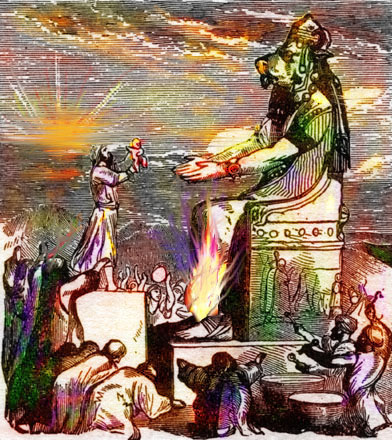
Human sacrifice of his own sons to Molech, a false god. Murder.
He practiced soothsaying, used witchcraft and sorcery, and consulted mediums and spiritists.
Evil was being encouraged and something wicked was replacing all that was good and true. The analysis of Manasseh’s policies was way beyond disturbing. Of all the kings of Judah, he was the most sinful and the most corrupt. He was at the bottom of the barrel.
The Hebrew word for “led astray” can be translated seduced.
Manasseh was an incredibly immoral man, a king who ruled for 40 years. “He did all he could to pervert the national character, and totally destroy the worship of the true God; and he succeeded.” (Clarke)
It’s believed that he put Isaiah to death by cutting him in two.
Moreover Manasseh shed very much innocent blood, till he had filled Jerusalem from one end to another, besides his sin by which he made Judah sin, in doing evil in the sight of the LORD.
1 Kings 21:16
But then something happened.
And the LORD spoke to Manasseh and his people, but they would not listen. Therefore the LORD brought upon them the captains of the army of the king of Assyria, who took Manasseh with hooks, bound him with bronze fetters, and carried him off to Babylon.
2 Chronicles 33:10-11
Assyria came knocking on Manasseh’s door. I think there was a certain mercy here, but also discipline. Manasseh had “hooks,” inserted through his jaw and out of his mouth. Like a fish he was led to Babylon, a trophy of the power of the army of Babylon.
It was from a dark dungeon that Manasseh cried out to the Lord and repented.
There’s a Jewish fable that when Manasseh cried out to God the angels boarded up the windows in heaven. They wanted to block out his prayer so God wouldn’t be able to hear. But God, rich in mercy, bored a hole in front of His throne to hear Manasseh’s desperate cry.
The Lord’s intention was to forever show His kindness and grace given to the most awful repentant sinner.
I believe that Manasseh was the “Prodigal Son” of the Old Testament.
God is not at a loss when He moves to bring us back to Himself. He can woo or whip. He can draw or drive. He can work rapidly or slowly, as He pleases. In other words, He is free to be God! And in His own way, at His own pace, He brings us back.
God is wildly in love with you. Yes, the sin you’ve committed is awful, but the Lord wants you to come back. He may discipline you, but He forgives everything if you’ll turn and repent.
No matter how awful your sin, He forgives and restores. Manasseh is proof of that.
“But his delight is in the law of the Lord, and on his law he meditates day and night.”
Psalm 1:2
In Psalm 1:2 the Hebrew word for meditation is hagah. In this Psalm we have a contrast between the blessed and the “not-so-blessed,” and it commands that as Jesus’ followers that we process the reality of this to become blessed by our Father.
In Psalm 1:1 the word blessed is used, and actually just in the book is Psalms alone blessed is used 51 times. The word has a very simple and concise meaning: “to be happy.” I really don’t think we can minimize how important it is to be happy.
In 1:2 we read hagah or meditate. That Hebrew word is a little bit more complicated and it seems more nuanced than “blessed.”
Hagah, or meditate means:
to chew a cud like a cow
to growl like a lion who is eating an antelope
to moan or groan
to talk to oneself, or mutter or whisper
finally, it can mean to muse or imagine
Yeah, it’s an interesting word and I suppose all of these meanings are to be factored into meditation [hagah]. It seems that these five definitions shape the different meanings that go into our understanding.
Using the above definitions, this is how it might look:
sometimes I regurgitate the word like a cow chewing its cud
at times I attack it like a lion
I moan and groan as I wrestle with it, seeking for a handhold
thinking about the passage I talk to myself about its meaning
I imagine being there, sometimes it’s like I’m a “fly-on-the-wall”
When we come to God’s words, the Bible, we are required to assimilate all that the Holy Spirit graciously gives. When He gives us something from the Word we must apply it to ourselves. You can do this through any of the 5 definitions I’ve given.
The Holy Spirit is the One who ignites His Word into our hearts. He makes us glow for His glory.
“This Book of the Law shall not depart from your mouth, but you shall meditate on it day and night, so that you may be careful to do according to all that is written in it. For then you will make your way prosperous, and then you will have good success.”
10 Finally, be strong in the Lord and in the strength of His might. 11 Put on the full armor of God, so that you will be able to stand firm against the schemes of the devil.
12 For our struggle is not against flesh and blood, but against the rulers, against the powers, against the world forces of this darkness, against the spiritual forces of wickedness in the heavenly places.
Eph. 6:10-12, NASB
Paul tells us that discerning the cosmic forces of wickedness is now critical. If we choose to ignore his words and make them optional, we will become spiritual toast. We need to hear reality. We want to be told the truth. And the truth is that we’re neck deep in spiritual alligators.
Point blank: We were each born for battle. Every believer must wear armor.
This passage in Ephesians 6 stresses that there is something sinister, an organized force, something evil, a darkness that’s focused directly on us. Verse 12 unveils to us a veritable government of wickedness. Satan leads his demons out with the intention of confusing believers and destroying holiness.
We also need to understand that human beings have a terrible knack of walking in their sin, and also by being manipulated by evil forces. Human history bears this out. We have a lousy track record. Without the Spirit we will be lost and destroyed by our own darkness.
Christians are to see life very differently than others do.
Ephesians 6 teaches us to find strength in being connected with God, which is critical to walk through in this confusing darkness. By prioritizing our relationship with Him, we can draw upon His strength and a sincere faith to navigate through all of this.
Without intimacy there is no obedience and there can be no real victory.
You must come to him humbly and holy, and sit before Him and listen, learn and love. And that is the major step in true holiness. Being controlled by Him means when you need to, you can stand and deliver damage to Satan’s kingdom.
You’ll be leading angels in this terrible battle! They have their swords drawn and are quite capable. Remember that this is a spiritual war–not physical. Your attack must be fought on your knees. And angels, they’re watching and listening to you as you pray. They are God’s messengers to protect you.
Satan presses us hard through redirection and forgetfulness of who we are.
Without the humble intimacy that can only grow on prayer and Bible reading, we will be spiritually destroyed. We need the protection of the Presence. Please don’t forget this; you need Jesus more today than yesterday. You must come closer. He will help you.
You see, your only hope is in Jesus’ strength and intimate love for you.
We must reach for our power and grab upon this intense love. We can only become strong through our intimacy with Jesus. He shields us from the spiritual corruption that swirls all around us. As we draw to Him we become mighty, as we listen closely to the Holy Spirit, we will walk in true discipleship with Jesus.
You will hear Him speak clearly to you, perhaps when you actively push to do His will than your own.
“We are a long time in learning that all our strength and salvation is in God.”
“When he came down from the mountain, great crowds followed him. 2 And behold, a leper came to him and knelt before him, saying, “Lord, if you will, you can make me clean.” 3 And Jesus stretched out his hand and touched him, saying, “I will; be clean.” And immediately his leprosy was cleansed.”
Matthew 8:1-4
It was a wild scene, we can’t forget this. But it’s funny, Jesus through all this sees and hears this leper. He doesn’t respond to the crowd but to the diseased man. The text tells us that the leperous man was on his knees and he was “praying.” His pleas were directed at Jesus.
But remember, the end of the previous verses explains exactly what’s happening. Matthew 7:28-29, (MSG) explains their excitement–
“When Jesus concluded his address, the crowd burst into applause. They had never heard teaching like this. It was apparent that he was living everything he was saying—quite a contrast to their religion teachers! This was the best teaching they had ever heard.“
The crowds responded wildly to the marvelous teaching of Jesus, and that was awesome. We really shouldn’t minimize that. However, in the Gospels, the “crowd” is pretty much a bad term, or at least a neutral one.
I suppose that Jesus seems to ignore the multitude’s extremely positive reaction. He knows it won’t last. The fickle crowd will soon cry out and demand His crucifixion.
But I understand, I’m that leper and He sees me.
Scripture tells me that Jesus now sits in heaven and makes intercession for me. He focuses on just me, I’m the center of His care–but I also know that attention is also on you, and others, and yet I’m assured that He sees me and each of His sheep. This should be a comfort. He concentrates and ministers to the person, and never to the multitude.
Jesus loves you, and He loves me too.
“So he told them this parable: 4 “What man among you, who has a hundred sheep and loses one of them, does not leave the ninety-nine in the open field and go after the lost one until he finds it?5 When he has found it, he joyfully puts it on his shoulders, 6 and coming home, he calls his friends and neighbors together, saying to them, ‘Rejoice with me, because I have found my lost sheep!’”
“We must quickly carry out the tasks assigned us by the one who sent us. The night is coming, and then no one can work.”
John 9:4, NLT
To be quick means that we move very fast; being slow often implies a reluctance or a mental delay. To hesitate while doing God’s will for us suggests a degree of ignorance or stubbornness. Our quickness is to be seen while doing “the tasks assigned to us.”
Urgency should be woven into our hearts. We need to have wings on our feet, fleet, and alacrity. A “double eagerness” as we carry out His work. It should be of no surprise that God sets before us an itinerary of work He wants us to do. We have a schedule to keep work that needs us to be diligent and sure.
So many brothers and sisters sleepwalk through their salvation. They snooze when Jesus desires they “watch and pray” with Him.
Jesus was on a timetable. He communicated with the need to do it. He is in tune with the work of God and is involved in the urgency of his present moment. Jesus knows this, and he clearly communicates the need to do. We are not called to be manic for Jesus; we are expected to be alert and aware. And busy.
This is a cry for urgency to his disciples.
“The night is coming.” It is getting late. In response Jesus issues an order. Work at what the Father has assigned you. It is almost dark now. There is a “principle of spiritual velocity” calling us to an alertness and an awareness of needful things to do before “the time is up.”
In Acts 9 the disciples show a holy zeal in their day’s work. “We can’t stop speaking what we have seen and heard.” The Old Testament prophets carried this urgency–Jeremiah and Amos both declared to us this avidity placed on the believer. Jesus desires that we factor in this intense awareness of the approaching night.
“We should be holy people eager to greet our Lord when He returns, ready at any moment for the trumpet’s call, people of optimism, busy in evangelism, hands to the plow, eyes on the prize.”
I recently read about an evangelist in the last century. He had a watch made, and on the dial, he had a picture of a setting sun. And over it, the words, “the night comes.” Every time he looked at his watch, he would be reminded of the shortness of life and the need for the performance of his duty. That lesson should be transmitted to each zealous believer.
The key word I guess, in all of this, is zeal. Often the older we get the more this word becomes diminished, and distant. (I believe our Father understands this about us.) No matter what we do, He focuses His love on us. There will never be condemnation for us. But we can still waste our lives in a tragic way, which we will later regret.
But we have to ask ourselves this, will I just be an admirer, or can I become a zealous disciple of Christ?
The secret of the Christian’s passion is simple: Everything we do in life we do it as to the Lord and not to men.