“He made my feet like the feet of a deer and set me secure on the heights. 35 He trains my hands for war, so that my arms can bend a bow of bronze.”
2 Samuel 22:34-35
David’s Song of Deliverance
This entire psalm was written after David was delivered from the hand of Saul. David had been a fugitive for years and had experienced extreme difficulties. He had been pushed to the brink many times, yet maintained a close walk with God.
This verse in 2 Samuel has always blessed me. The image of a deer who has been put on a mountaintop through the direct action of the Lord–it’s a place of safety, a position of victory. It comes as a decisive maneuver of the Holy Spirit.
“He made my feet like the feet of a deer and set me secure on the heights.”
Psalm 18:33
David had learned things in the wilderness that he would never have otherwise. At times life got pretty extreme for him. When he struggled it was understandable. He followed the path that God laid out. It wasn’t easy for David, but he walked in faith and not by sight.
Danger surrounded David on every side – physically, spiritually, emotionally, socially. It would come from enemies, and even from his dearest friends.
God’s people are not immune from trials. It’s good to know that these are now orchestrated by our Father, and they’re purposeful and planned.
The prophet Isaiah extends the imagery of a deer in his prophetic ministry, but adds other ideas as well. The lame, mute and the desperately thirsty are descriptive of people who are given a special grace and touch. They’re promised something. They receive the promise of the Lord Jesus Christ.
“Then shall the lame man leap like a deer, and the tongue of the mute sing for joy. For waters break forth in the wilderness, and streams in the desert;”
Isaiah 35:6
“David thought of how deer seem to skip from place to place and never lose their footing. God gave him the same kind of skill in working through the challenges brought by his enemies.”
His Ordination Prayer as a Pastor, serving in the Christian and Missionary Alliance
August 18, 1920
O Lord, I have heard Thy voice and was afraid. Thou has called me to an awesome task in a grave and perilous hour. Thou art about to shake all nations and the earth and also heaven, that the things that cannot be shaken may remain. O Lord, my Lord, Thou has stooped to honor me to be Thy servant. No man taketh this honor upon himself save he that is called of God as was Aaron. Thou has ordained me Thy messenger to them that are stubborn of heart and hard of hearing. They have rejected Thee, the Master, and it is not to be expected that they will receive me, the servant.
My God, I shall not waste time deploring my weakness nor my unfittedness for the work. The responsibility is not mine, but Thine. Thou has said, “I knew thee – I ordained thee – I sanctified thee,” and Thou hast also said, “Thou shalt go to all that I shall send thee, and whatsoever I command thee thou shalt speak.” Who am I to argue with Thee or to call into question Thy sovereign choice? The decision is not mine but Thine.
So be it, Lord. Thy will, not mine, be done.
Well do I know, Thou God of the prophets and the apostles, that as long as I honor Thee Thou will honor me. Help me therefore to take this solemn vow to honor Thee in all my future life and labors, whether by gain or by loss, by life or by death, and then to keep that vow unbroken while I live.
It is time, O God, for Thee to work, for the enemy has entered into Thy pastures and the sheep are torn and scattered. And false shepherds abound who deny the danger and laugh at the perils which surround Thy flock. The sheep are deceived by these hirelings and follow them with touching loyalty while the wolf closes in to kill and destroy. I beseech Thee, give me sharp eyes to detect the presence of the enemy; give me understanding to see and courage to report what I see faithfully. Make my voice so like Thine own that even the sick sheep will recognize it and follow Thee.
Lord Jesus, I come to Thee for spiritual preparation.
Lay Thy hand upon me. Anoint me with the oil of the New Testament prophet. Forbid that I should be come a religious scribe and thus lose my prophetic calling. Save me from the curse that lies dark across the modern clergy, the curse of compromise, of imitation, of professionalism. Save me from the error of judging a church by its size, its popularity or the amount of its yearly offering. Help me to remember that I am a prophet – not a promoter, not a religious manager, but a prophet. Let me never become a slave to crowds. Heal my soul of carnal ambitions and deliver me from the itch for publicity.
Save me from bondage to things. Let me not waste my days puttering around the house. Lay Thy terror upon me, O God, and drive me to the place of prayer where I may wrestle with principalities and powers and the rulers of the darkness of this world. Deliver me from overeating and late sleeping. Teach me self-discipline that I may be a good soldier of Jesus Christ.
I accept hard work and small rewards in this life.
I ask for no easy place. I shall try to be blind to the little ways that could make life easier. If others seek the smoother path I shall try to take the hard way without judging them too harshly. I shall expect opposition and try to take it quietly when it comes. Or if, as sometimes it falleth out to Thy servants, I should have grateful gifts pressed upon me by Thy kindly people, stand by me then and save me from the blight that often follows. Teach me to use whatever I receive in such manner that will not injure my soul nor diminish my spiritual power. And if in Thy permissive providence honor should come to me from Thy church, let me not forget in that hour that I am unworthy of the least of Thy mercies, and that if men knew me as intimately as I know myself they would withhold their honors or bestow them upon others more worthy to receive them.
And now, O Lord of heaven and earth, I consecrate my remaining days to Thee; let them be many or few, as Thou wilt. Let me stand before the great or minister to the poor and lowly; that choice is not mine, and I would not influence it if I could. I am Thy servant to do Thy will, and that will is sweeter to me than position or riches or fame.
I choose it above all things on earth or in heaven.
Though I am chosen of Thee and honored by a high and holy calling, let me never forget that I am but a man of dust and ashes, a man with all the natural faults and passions that plague the race of men. I pray Thee, therefore, my Lord and Redeemer, save me from myself and from all the injuries I may do myself while trying to be a blessing to others. Fill me with Thy power by the Holy Spirit, and I will go in Thy strength and tell of Thy righteousness, even Thine only. I will spread abroad the message of redeeming love while my normal powers endure.
Then, dear Lord, when I am old and weary and too tired to go on, have a place ready for me above, and make me to be numbered with Thy saints in glory everlasting. Amen. AMEN.
There can be no resurrection power without crucifixion weakness. There can be no power unless you die to self, taking up your personal cross. Many are frustrated by this. This teaching is not fully understood or really preached.
“If anyone would come after me, let him deny himself and take up his cross and follow me.”
Crosses hurt, for they are a way of dying to self, plain and simple. Every spirit-filled believer must die to his agenda. If you want a resurrected life, overcoming sin and death, you must carry your cross. Death comes first, and then is resurrection. There is freedom to all who obey.
Simply put, there’s no other way for you to be holy but a cross.
Whether you’re struggling with a physical ailment (think pain), or a mental illness (also pain), you still must carry a cross. Our issues can be formidable, I understand, but you’re not exempt from the terms of discipleship. All must follow Jesus.
Jesus fully understands Calvary. He recognizes agony. His pain was real. I believe that He knows this intimately. I also think Jesus understands our weakness and confusion. His grace meets every believer. No matter if they struggle and stumble. The Spirit teaches us. All who really come are redeemed.
I think He understands our reluctance and hesitation.
I want to follow Him. I’m pretty sure that you do too (you’re reading this which tells me something). So what cross are you called to carry? They seem to be custom made–designed uniquely for you. But it’s also true that others have been tempted, just like you.
Your cross must be deliberately chosen.
It’s often a path of brokenness and humility. It may involve shame and pain–a reproach to those who can’t understand. But if you take it up you can expect the world to belittle you. If they abused Jesus, you can count on them belittling you.
Avoiding your cross means you have been conformed to what the world thinks, and that’s an awful place to be. You really can diminish your cross without doing harm to your spiritual walk. Honestly, there is not another way.
His resurrection power is given to those who have already expired. Struggles with sin and doubt often evaporate when He abides in you. He’s the power given to overcome. He’s the only one who can give it to you.
“To take up the cross of Christ is no great action done once for all; it consists in the continual practice of small duties which are distasteful to us.”
You may struggle with this and I hear you. This is not an easy word. I don’t know if I’ve given this topic justice, but I pray that I’ve touched the heart of Jesus. I stress that’s a hard word, but I think it’s true.
But you must tell yourself of the gift of joy and peace that is found by carrying your cross.
“The cross of Christ is the sweetest burden that I ever bore; it is such a burden as wings are to a bird, or sails to a ship, to carry me forward to my harbor.”
“Dear brothers and sisters, when troubles of any kind come your way, consider it an opportunity for great joy.”
“For you know that when your faith is tested, your endurance has a chance to grow. So let it grow, for when your endurance is fully developed, you will be perfect and complete, needing nothing.”
James 1:2-4, NLT
There are many different points where our Lord connects to us through our desperation. Our sorrow and confusion can be how God ‘wires us’ for additional contact— in some kind of weird and cosmic way, my pain becomes His ‘copper wire.’ Often is how He touches my heart as He flows through it.
I think it’s helpful to see our issues in this way.
There is a current that must work through us, making contact and ultimately creating a circuit. What I mean by this is that it seems we have to experience pain, in order to know His presence. Only if you know that a brother has struggled, do you become aware that a pearl of tremendous wisdom (and love) is now accompanying him. Usually.
We must be aware that our distress allows us access to His ‘careful’ grace. Our trials, properly received, endow us with special and supplemental power.
When it gets dark, light becomes exceptional. In a book by Stephen Lawhead, (I think it was “the Silver Hand.”) we see a man, the hero take up stones that have been infused with the creative power of the universe. Standing on the walls of a besieged stronghold, the desperate hero throws the stones down on the attackers. And as each stone smashes into the ground it releases a part of a song, which destroys the enemy and defeats those strong in the darkness. (Silly story.)
I know that His Spirit infuses Himself into our hearts.
He has imparted something in us that is both precious and powerful. He works through the pain and struggles that we encounter. These are terribly ugly, no question. But it is through these we plug into something real and eternal.
I suppose when the tragedy finally brings real life it’s a most precious thing. We treasure all this for it comes at such an exorbitant price.
Pain indeed has a purpose, but oh, so many times it seems to only hurt. But that’s the way it works.
But yet, that is our calling. I certainly know that life is seldom easy and our choices are even harder. I recently read that Queen Victoria, as just a teen fiercely opposed her future coronation as the sovereign of England. She grew sullen, and rebellious and would continually frustrate her teachers.
Once when Victoria was shown a lineage that showed her and revealed her place in England’s future as queen. She became uncharacteristically quiet and she responded with an astonishing simple awareness, “I will be good.” From that moment everything changed for her.
We want to avoid suffering, death, sin, ashes. But we live in a world crushed and broken and torn, a world God Himself visited to redeem. We receive his poured-out life, and being allowed the high privilege of suffering with Him, may then pour ourselves out for others.
One of my favorite places to fish in Alaska is Kodiak Island, where I tried to catch silver salmon with some friends. Just as we were setting up camp, the sun disappeared, and the temperature dropped quickly. While we struggled with our tents, the wind joined in. Then, it started pouring rain—like someone dumped a bucket of water on us! I woke up at midnight to strong winds flattening my tent, making me wonder if fishing Kodiak was really worth it. 😁
But in the morning, the storm had moved on. The sky transformed into something gold! The sun shone brightly, making the world come alive. The night gracefully stepped aside, allowing the darkness to fade away and make room for a new, vibrant day.
I realized then that’s the way of Christmas.
We have an Advent hope. The light doesn’t negotiate with darkness; there’s no struggle. The darkness retreats when the light arrives. Plain and simple.
Advent hope seems slow, but honestly, it’s unstoppable.
When Jesus came into the world, nothing could stop Him. His birth is recognized during Advent. His arrival was predicted in the scriptures. Jesus came to take away our sins and offer us eternal life.
The Bible teaches us that Jesus is God in the flesh, fully divine and fully man, who came to save us from our sin. This is basic Christianity.
“In the beginning” reminds us of Genesis, where God created everything (Genesis 1:1). Through the Spirit, he shows that he has taken an important step towards us with the arrival of Jesus. He is dedicated to saving us.
God created us to know and enjoy him (Gen 3:8). We must understand that sin entered the world and screwed everything up. Jesus came to sacrifice Himself to secure our salvation, restoring his image in those who trust him.
Jesus Christ restores all that we lost because of our sin.
In the beginning was the Word. The Word did not come into existence in Mary’s womb but He always was. The Word is eternal. Before it all began, he was there, and he was coming for us.
The phrase “the word was also with God” indicates that the Word is from God but is closely connected to Him (Mk 6:3; 11:4; 2 Cor 5:8; 1 John 1:2). The Word is also God and represents the eternal Son of God, who is both with God and is God. He is the Word and the Son, distinct yet unified with God.
Everything we see was made through Jesus, and nothing exists without him (see Col 1:16-17). The Old Testament says that God created the heavens and the earth, while the New Testament shows that the Word is the true Creator. This highlights Christ’s key role in creation and his divine nature. Both Testaments emphasize the relationship between God the Father and Jesus, confirming that all existence is intentional and meaningful.
Recognizing Jesus as the Creator enhances our understanding of his authority, showing us that all things were created through him and find their purpose in him.
We must understand that we’re born spiritually dead and blind. But that can change.
Jesus is the light and every one of us is spiritually blind to truth and beauty and glory (John 17:24). Jesus overcomes our darkness and now gives life. Jesus does for us what we cannot do for ourselves. His love is seeking us.
The word, the gospel, brings forth life and light so that we are born again, literally born from above, and so we see (John 3:3). The light shines into our darkness and the darkness leaves us.
From a sermon given at Community Christian Church, December 7, 2025
David Taylor has been a follower of Christ since 1983 and a pastor since 1988. He moved from Los Angeles to Homer, Alaska in 2004.
There is an old French fable about Jesus. It’s pretty interesting. I came across it several years ago and I’ve been considering it since. Now, it’s a legend of course–a story, a simple folk tale. But maybe it will speak to your heart like it did mine.
It’s said that wherever Jesus walked, flowers would grow in His footprints.
We experience moments of fleeting joy as we travel through life. Do you remember how life was before knowing Jesus? It was dull and empty. But now, as His followers, we walk on His beautiful path, learning to be obedient, grateful, and devoted in prayer and worship. It can be challenging, but can you sense the wonderful presence of Jesus? Do you notice the beauty around you?
Discipleship can be tough, but even in the hard times, it’s eternally worth it.
Perhaps we’ll see the flowers blooming as we follow in His steps.
And sometimes you must be patient, just a little while longer.
I’m beginning to see His flowers flourish in His steps through my difficulties. Jesus is close. Don’t be alarmed if your own walk takes you through this awful valley. Very often there are tears, but pay attention, our path is full of flowers, and even when we are hurt. Especially when we hurt.
“Can we follow the Savior far, who have no wound or scar?”
Amy Carmichael
– Amy Carmichael
In life’s journey, amidst challenges and awareness of sin, it is important to remember to raise our heads, appreciate the beauty around us, and find joy in the presence of Jesus. He is there, even when it seems like we’re all alone.
Worship out of affliction becomes a special sacrifice that God values highly.
When we come with tears into His presence it means something special to our Father. The combination of pain and praise is a potent spiritual mixture. I don’t think I’ve fully grasped this. But there are blossoms and flowers, even if I can’t fully see them yet.
I guess that he patriarch Job is a prime example of this. One of themes of the book is that his life is wrecked and his faith when almost is totalled. The writings of this ultimate sufferer are pretty profound.
“Though he slay me, I will hope in him.”
Job 13:15, ESV
Dear one, keep on the flowered path with Jesus. Don’t look at this present and physical life, your gaze needs to be on eternity. Good things are about to happen, but it may take some time. Remember that when times get rough.
“He will wipe away every tear from their eyes, and death shall be no more, neither shall there be mourning, nor crying, nor pain anymore, for the former things have passed away.”
“Some Christians are called to endure a disproportionate amount of suffering. Such Christians are a spectacle of grace to the church, like flaming bushes unconsumed, and cause us to ask, like Moses: ‘Why is this bush not burned up?’” (Exodus 3:2-3)
“The strength and stability of these believers can be explained only by the miracle of God’s sustaining grace. The God who sustains Christians in unceasing pain is the same God — with the same grace — who sustains me in my smaller sufferings. We marvel at God’s persevering grace and grow in our confidence in Him as He governs our lives.”
— John Newton, author of “Amazing Grace
We all know a brother or sister who seems to be a target of an undue amount of suffering. It looks like they’re always in the furnace. All we can do really is to shake our heads and then give them double honor for their faith in God’s grace and providence.
Ministering to these sufferers can be a challenge.
What can we say to those who seem to be on “God’s anvil?” How can we bless those who are in pain?
Perhaps a simple word of calm encouragement is the most effective. In the midst of some awful difficulties, I once had a dear brother who gently and carefully quoted Philippians 1:6 to me over and over, whenever we met and whenever we parted:
“And I am certain that God, who began the good work within you, will continue his work until it is finally finished on the day when Christ Jesus returns.”
Philippians 1:6
It was a precious thing that he did. I didn’t mind it all, as a matter of fact, I grew to like it. At first, I’ll admit it was strange, but my faith began to ‘mix’ with the Word and I began to believe it. It’s now my favorite verse in the Bible.
Fred refused to preach to me.
He had the maturity to see what God was doing and to make himself available to God on my behalf. Perhaps that patience he showed should be for us the method of choice? I look forward to seeing him someday, someway.
“We can rejoice, too, when we run into problems and trials, for we know that they help us develop endurance.”
Romans 5:3
A keyword in this verse is “rejoice.”
It’s a good reminder that the pain we feel is not the end. These trials have a limited duration (although it seems far away). There’s a day when we can navigate through these issues and come out on the other side. “We will shine like the stars” (Daniel 12:3).
Much wisdom is needed in our ministry to disproportionate sufferers. We should have a fear of intruding on the work the Lord is doing. We must be patient and humble in this matter. There is no rushing God, after all, it’s His work. Most importantly we must be very much ‘present’ for our friend.
“But not only that! We even take pride in our problems, because we know that trouble produces endurance”
Romans 5:3
A “word” spoken out of place can cause even more heartache for the sufferer. Let’s be careful. At times it’s better not to say anything, and that’s alright. Job’s friends were best sitting in the ash heap, saying no word.
“The Lord God gives me the right words to encourage the weary. Each morning he awakens me eager to learn his teaching.”
Isaiah 50:4, CEB
Trust Jesus to show you how to love, and serve those who seem to struggle so very much. Ask the Father to give you the right words–He will if you only ask.
Timothy was given a remedy for stomach issues, (1 Tim. 5:23)
Paul had to suffer his “thorn in the flesh,” (2 Cor. 12:7)
I find this moderately disturbing. In over 35 years of ministry I have seen a lot. I once prayed over a saint who had a leg that was shorter than the other. She walked in a painful limp, and yet in a brief second, her leg grew. I’ve prayed over terrible fevers, and I instantly saw it leave. I know God heals. He does wonders still.
And yet there has been prayer that doesn’t make it beyond the ceiling.
For believers today who suffer physically or mentally, we may question our faith. (Especially when the healing evangelist comes to town). After 2-3 tries we settle back on our “deficient’ faith feeling a bit miserable.
I honestly don’t think that’s what the Lord wants.
It seems to me that the real issue is not so much a weak faith, but holding on to your faith when you are not healed.
I hear talk about having faith to be healed–but what about the faith that’s needed to be sick?
Why do we suffer from illness? I suspect that for many believers sickness is really there to bring glory to God. Holding onto faith in the midst of pain often encourages those who witness it. I believe that was Paul’s experience (2 Cor. 12:7-10).
Oh dear one, continue to seek healing, (James 5:14).
Healing will happen. We look forward to that special day when all our sin, and all our sickness will be eternally dealt with. Those ugly and painful and savage things will no longer be part of us. We’ll walk unencumbered by earth’s ugly shackles.
“He will wipe away every tear from their eyes, and death shall be no more, neither shall there be mourning, nor crying, nor pain anymore, for the former things have passed away.”
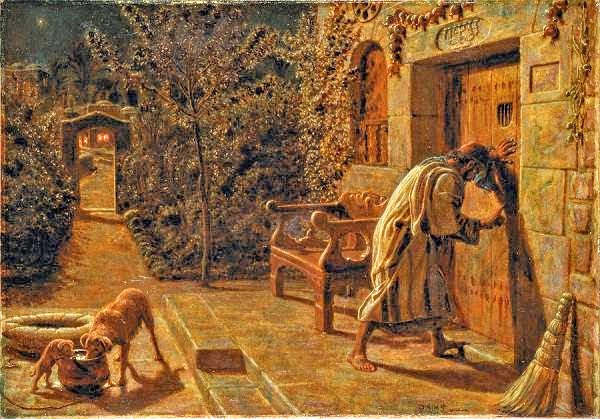
“And he arose and came to his father. But while he was still a long way off, his father saw him and felt compassion, and ran and embraced him and kissed him.”
Luke 15:20, ESV
There comes a time when the prodigal stands up–looks around, and then decides he can’t live this way anymore–it’s now time to return home. But he is no longer a ‘rich man’s son,’ the pig-pen completely crushed that idea. He returns home, thinking that at least he can be a slave.
The devastated prodigal now understands.
And it’s that which gives him the propulsion to leave the pigs behind, and begin to somehow be received by his father. The trip is a long one, lots of walking, and yes, it’s hard–he’s far from where he’s supposed to be. He is tired, ragged and worn.
But please dear one, you must understand this about Jesus’ parable–the story isn’t so much about the prodigal son, rather I think that the focus should really be on the father. Jesus is teaching us that the love of God is a searching/seeking kind of love, and it cannot be shut down, or go away over time. Not ever.
You see, it is a 24/7/365 day kind of love. Intense and constant.
Think of it like high intensity radar that steadily sweeps over extreme distances, it is always looking, seeking, and it won’t be denied. The Father is seeking for His sons and daughters. He intends to find them. If we refuse we will continue to feed pigs, over and over, and we will starve.
The Father never sits on His backside, calmly watching from His throne. He reaches out and runs to us. He is far from passive, rather He intensely yearns for His sons. And God is fully focused into the work of reclaiming His missing sons and daughters, just like in Jesus’ story.
He continues to search, even when things get really nasty for the son. He won’t give up.
I personally believe that this parable is the greatest of them all!
Jesus is explaining the deep love the Father has for prodigals like us. This story is so revealing, for in it we see that the Father who is running. We must know this about Him. We must internalize it and understand the compassion He has. If we stall in our discipleship it’s often because we don’t grip the awesome depth of His love.
There seems to be very few people who understand a God who runs.
As the prodigal hits bottom he realizes the futility of his choices and yearns to return to the forgiving embrace of his father. Overwhelmed by guilt and shame, he makes the long journey back to the home he once took for granted. Little does he know it, behind the scenes, his father has been watching, waiting, and hoping for his return.
And then, in a moment that encapsulates the beauty of unconditional love, the father catches sight of his boy from afar. Without a second thought, the father runs towards him with outstretched arms, his love insisting on forgiveness. His arms reaching through the filth.
Here we see a love that surpasses all human understanding.
Jesus teaches us a different kind of love. It’s not based on achievements or what society says. This love is given to everyone, regardless of their flaws, but in order to have it, they must leave the pigs behind. Sometimes that isn’t always easy. I hate to tell you this, but some will never make the journey home.
This profound depth of His love often leaves us feeling totally doubtful or skeptical.
Our logical minds struggle to grasp how such boundless love can exist, especially when we witness the failings and flaws of human love. Yet, it is precisely because love transcends logic that it is so powerful. It operates on a different plane, bypassing our human limitations and revealing a deeper truth about the nature of God’s infinite compassion.
We’re simply beggers telling other beggers where to find bread.
Let’s speak out boldly of this love that will transform lives. For when we approach Jesus’ parable with a bit more humility and faith, we may just catch a glimpse of its astronomical power and love that will never give up on His sons who are camouflaging themselves as pig farmers.
We shout of the love the Father has for His blundering and wayward children.
If the Church can just keep up with our running God, we will finally understand who He really is. And if we only accept the love of the Father towards prodigals—no matter what the sin—it’s then we will finally understand the ‘white-hot’ love of the Kingdom of Jesus.
And the Church will finally be doing His will in the world.
15 “When they had finished breakfast, Jesus said to Simon Peter, “Simon, son of John, do you love me more than these?” He said to him, “Yes, Lord; you know that I love you.” He said to him, “Feed my lambs.”
16 He said to him a second time, “Simon, son of John, do you love me?” He said to him, “Yes, Lord; you know that I love you.” He said to him, “Tend my sheep.”17 He said to him the third time,”
“Simon, son of John, do you love me?” Peter was grieved because he said to him the third time, “Do you love me?” and he said to him, “Lord, you know everything; you know that I love you.” Jesus said to him, “Feed my sheep.'”
Peter’s denial was public one, and it was important that his restoration be public as well. It may come as a shock, but Peter needed to do this–even though it was a grief to him (verse 17.) He needed to do this to heal properly. It was also a clear testimony to the others that he was completely restored.
Repeatedly in this passage, love gets linked to service.
(Can you see this, it’s important that you do.) The Lord asks Peter if he really loved him, and most likely it was a solemn affair, not something trivial or casual. The word used is ἀγαπάω, “agape”–this is the type of love that God has for people. It’s an all-powerful love, one that gives 110%.
The third time the word for love is different though, the word used is φιλέω, “philo”–this is a type of love that a man has for others, a brotherly kind of love. Something good, but not quite agape love.
Each time Jesus uses agape to Peter, Peter responds with philo.
Peter responds, but he’s fixated on the brotherly type of love. I don’t mean to be confusing here, but every time Jesus uses agape to Peter, Peter responds with philo. It’s as if Peter is struggling with loving Jesus wholeheartedly. Perhaps Peter was ashamed of his denial. But to his credit he was honest.
Service is now connected to agape love.
Love can’t be seen unless it has a physical aspect. Love can’t be abstract, a vague feeling, or a hazy concept–it has to be seen by others. Jesus’ sheep (and lambs) must be fed, and watched over. This is now Peter’s call to ministry.
This is Jesus’ ministry as well.
Apparently there is plenty of this kind of work to go around! Isaiah prophesied about Jesus’ work in Isa. 40:11. This now becomes Peter’s work as well.
“He will tend his flock like a shepherd; he will gather the lambs in his arms; he will carry them in his bosom, and gently lead those that are with young.”
Whether or not Peter was the first “pope” is debatable. But it’s clear that Jesus focused on Peter. And isn’t it just like him to turn our failings into victories. Peter’s denial was now his ministry to others. It dealt with the pride issue, which disrupts true ministry to His flock.
“And I will give you shepherds after my own heart, who will feed you with knowledge and understanding.”
Jeremiah 3:15
God uses broken things. It takes broken soil to produce a crop, broken clouds to give rain, broken grain to give bread, broken bread to give strength. It is the broken alabaster box that gives forth perfume. It is Peter, weeping bitterly, who returns to greater power than ever.