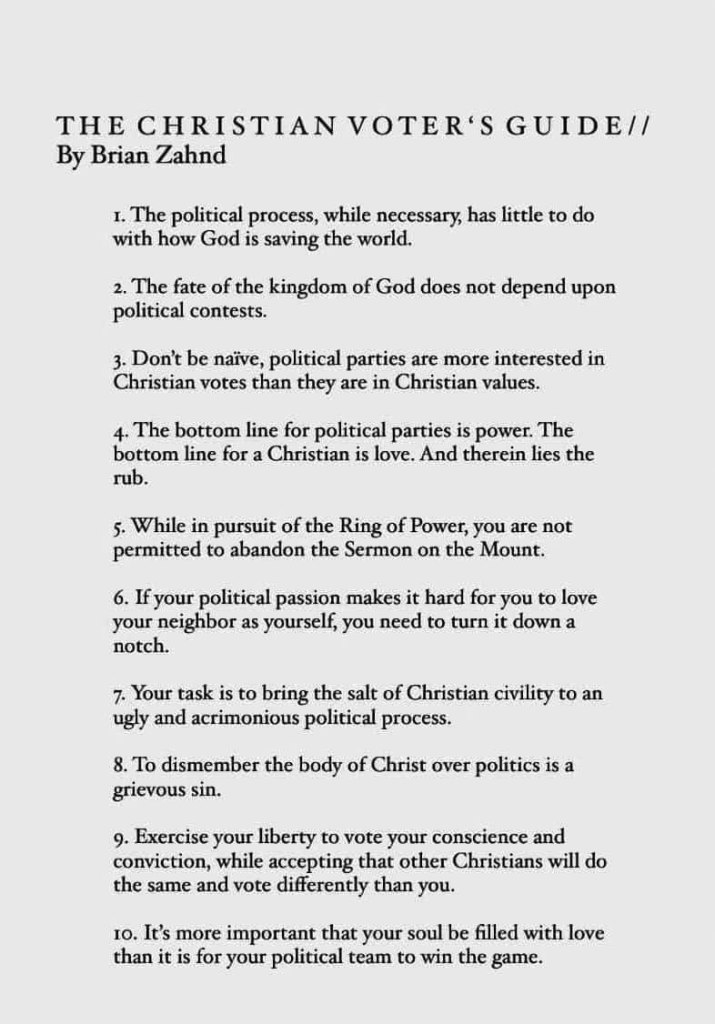
Our vote matters a lot. Here are some principles a believer should always follow. This list is a good way to function and maybe even see our own hearts in the light of the Gospel, and the direction of the Holy Spirit.
As a believer who is also a citizen this matters so much.
We maybe Republican, Democrat, or independent, but we know that God’s Kingdom rules over all. We must keep our hearts firmly fixed and settled in something that knows our Father’s purpose.
Please read the above list through, as I think it directs us to Him. I guess if I’ve got any insight into this at all I would add prayer and intercession. That wasn’t included, but adding it would enhance this list even more.
“If My people, who are called by My name, shall humble themselves and pray, and seek My face and turn from their wicked ways, then will I hear from heaven, and will forgive their sin and will heal their land.”
Some time ago I came across a story that connected. It seems a visiting speaker came and stood in front of a congregation. He shared a painful incident from his childhood. He wanted to bring healing to others. After he spoke, an elder came and spoke to him–
“You have learned how to become a proper steward of your pain.”
The visiting speaker was profoundly touched by this. Finally, something came together in his heart and soul. Yes, he did learn how to deal scripturally with those ugly things from his past. He was becoming a proper steward of his pain.
The word for steward in the original Greek is oikonomos. It literally means “a keeper of a home.” It describes a manager, a superintendent to whom the head of the house or proprietor has entrusted the management of his affairs, the diligent care of receipts and expenditures.
The issue seems to be of management, how can God use these awful things for building His Kingdom?
No question about it, we live in a world of darkness. Each of us has been touched by hard things. Scars are part of our lives. When we come to Christ they come with us. All of these grim things are a real piece of us, we have been hurt (or maybe we’ve wounded others?)
Are you a good steward of who you are? Whether you’ve experienced trauma–something physical, sexual, or perhaps a mental illness. It could be any scar you carry from your past, and no one is immune from them it seems. You’ll find freedom if you can use these things for Him and his Kingdom.
We must see and understand that Jesus has taken everything and redeems it all for His glory.
He understands us fully–our past, present, and future. He ‘knows’ us–the real and hidden us. The challenge I suppose is to take these sad events to the throne. He alone can heal and then use that which has devastated us. What was intended to destroy is now meant to build.
Satan has afflicted you in his dark attempt to destroy you.
Jesus intervenes to save. As we grow to accept this, the Holy Spirit comes as our comforter and guide. He starts to teach us true redemption, and the incredible healing that he brings with him. It really is his work, not ours. We finally understand. It’s then we become broken healers that God can use.
His light has truly overcome our dark.
We’re being taught (sometimes very slowly) to carry all of these things and plead the blood of Jesus over our past. He covers us completely. He has redeemed us. Luke 1:68 explains much clearer than I can:
“Blessed is the Lord, the God of Israel because he has visited and provided redemption for his people.”
Becoming a steward of our pain is his doing. We’re able to touch others with these things that would cripple and destroy others. He has made us “managers” of these things, and we are taught to teach others, declaring that God has completely saved us. He works miracles!
“Therefore, if anyone is in Christ, he is a new creation; the old has passed away, and see, the new has come!”
2 Corinthians 5:17
We’ll sovereignly meet those who need to hear our story. We’re being transformed into authentic witnesses. Yes, at times these awful things still hurt, and I suppose that’s to be expected. But we’re learning to manage them. We’ve become real-life stewards of our pain.
“That’s why we can be so sure that every detail in our lives of love for God is worked into something good.”
I’m an ordained Bible teacher. I’ve developed study resources and was a teacher at the Alaska Bible Institute for years. I served as an evangelist in San Francisco and worked as a missionary to Mexico. I’ve have been a pastor serving in Alaska.
And yet there are many verses that I really don’t understand. I may have taught them, but I still haven’t fully grasped them. Here are three that I’m starting to work through.
1) Ecclesiastes 7:16
“Be not overly righteous, and do not make yourself too wise. Why should you destroy yourself?”
How can you be overly righteous? Isn’t being righteous a good thing, after all, isn’t that God really wants from us?
But in this verse, it seems that there exists a form of destruction that comes when we try too hard to please God.
The best I can come up with is that this verse speaks of “self-righteousness.” I suppose this attitude comes from a desire to achieve and excel outside of the righteousness of Jesus. Reflecting on this dynamic of self-effort I can see how offensive it is to God. To strive to approach God by my personal goodness is utterly impossible.
2) Matthew 24:34
“Verily I say unto you, this generation shall not pass till all these things be fulfilled.”
Basically, the apostles will see the end times entirely on their lifespan. Before they physically die, Jesus will return. This is disturbing because it never happened like I thought it should. Why didn’t He return?
Again, what is Jesus talking about? Are the end times contingent on this sign? And if so, are we deceived by a “non-returning” fake messiah?
They’re maybe a better translation and meaning. Perhaps Jesus was speaking of the destruction of the Temple in 70 AD, about 40 years after Jesus spoke these words. Jesus was acting like a prophet and spoke of the destruction of the Temple within the lifespan of the apostles.
3) John 14:12
“Truly, truly, I say to you, whoever believes in me will also do the works that I do; and greater works than these will he do, because I am going to the Father.”
How in the world are we going to do more miracles what Jesus did? Was Jesus overstating things and promising something that could never happen; or maybe our faith deficient? As I read of the miracles that Jesus did. There is no way I can achieve this.
But maybe I’m really misinterpreting things? Maybe my works will never be as sensational as Jesus did; but there will be something of a magnitude about them. Jesus set in motion the kingdom of God on earth. It was like a rock thrown into a still pond. The waves will stretch out and reach the uttermost.
I may never raise the dead or walk on water. But if I share the gospel with my neighbor the kingdom advances. From my home it’s about 6,000 miles to Jerusalem. I’m practically on the other side of the earth. But, His kingdom advances.
These three are just the beginning.
There are other verses or passages that are hard and difficult to interpret. Ask the Holy Spirit to guide you, humbly turn to your church elders. Buy a good commentary. (Contact me if you need guidance.)
And if you find that you encounter something that totally mystifies you, (and you will,) I counsel you to approach it with faith, knowing that the Holy Spirit will teach you. That is what He does.
“But the Helper, the Holy Spirit, whom the Father will send in my name, He will teach you all things and bring to your remembrance all that I have said to you.”
Once I was punched in the face while preaching. At the time I was an evangelist with SOS Ministries in 1987. I was leading a group to Haight/Ashbury St. in San Francisco. I remember it was really busy, and it was a good team, and they were excited to take their church to the streets.
Haight/Ashbury was the place the “summer of love” kicked off, it peaked in 1968. It has a certain sense of notoriety, and even in 1983 it still had a dubious reputation as a center of the counter-culture. “A cult a day is born in San Francisco,” a pastor friend once shared with me.
Normally the neighborhood where I took a team would direct me on how to preach. Tonight especially I focused on God’s love for sinful people.
That message seemed appropriate for this place, especially on this street. God loves these people very much.
A young man came forward. He told me that he was a backslidden Christian, and his father was an Assembly of God pastor. He had run away from home. Suddenly he began to weep. The entire team seemed to lean forward and I know they were praying earnestly for him. It seemed to me that he was teetering on the brink.
His punch however came unexpectedly.
His fist hit me square in the nose. My eyes began to water. Oddly enough he took a step back and began to really cry out. My team wasn’t quite sure how to respond, but I hoped they prayed even harder. I sort of gasped and tried to shake it off. Someone must have called the police.
The Holy Spirit was very much present, both convicting and comforting each of us.
One or two minutes went by and suddenly he stopped sobbing and he became really angry. He took a step and then tried to kick me in the stomach, but I dropped the mic and caught his foot. I was ready for him this time.
About 20 minutes went by before SFPD showed up and asked if I wanted to press charges. I thought for a bit, but deep down I knew that wasn’t the will of my Father. Maybe I should of, I don’t know. But I thought about my own sin and couldn’t judge no one.
The Father was reaching him while teaching me!
God loves His prodigal children very much, He understands the guilt and shame (and frustration) they feel. The Father however is always watching and waiting. He works through life’s circumstances to lead them home. Each belongs to Him. He continues far past what we think is possible. He will never give up.
“We know what real love is because Jesus gave up his life for us. So we also ought to give up our lives for our brothers and sisters.”
1 John 3:16
I suddenly saw a “wounded” brother, very confused and quite angry. Not with me, the team, or the music–but with God who created him, and died for him.
At that moment in time, I just happened to be God’s love for this prodigal.
“Jesus answered, “Mykingdom is not of this world. If mykingdomwere of this world, my servants would have been fighting, that I might not be delivered over to the Jews. But mykingdomis not from the world.”
John 18:36
Jesus perfectly the extent of His kingdom. Three times in this one verse, Jesus uses the statement, “My kingdom.” Three times. Perhaps there is something here we should look at closer? Maybe?
First, Jesus affirms to Pilate that he indeed holds the title of king. However, this kingdom does not represent a political adversarial entity; its borders are not defined by physical realms. Instead, they are spiritual in nature, rendering Pilate and the emperor as mere peripheral issues.
Simply put, these 40 words are Jesus’ powerful declarations to Pilate that yes, He was truly a King. But also notice what Jesus says, “My kingdom.” He is the supreme Lord of it.
Jesus’ kingdom was “not of this world,” which He also repeated three times in this one verse!
No, Jesus was referring to a kingdom that was spiritual, but no less tangible. As a matter of fact, it was more real than the kingdoms of this earth.
Those who choose to follow King Jesus have boldly rejected the shallow tenets of this world—force, pride, public image, and the lure of power. The arrival of God’s kingdom doesn’t fit neatly into our expectations; it’s revealed through the radical Beatitudes and shocking parables. These committed souls have declared their allegiance to the One who reigns supreme over the entire universe, daring to defy the status quo.
“Romans thought they knew about kingdoms and their might; that armies, navies, swords, and battles measured the strength of kingdoms. What Jesus knew was that His kingdom – though not of this world – was mightier than Rome and would continue to expand and influence when Rome passed away.”
Brokenness, humility, love, servanthood, and sacrifice are essential pathways through which His kingdom manifests to people. The world’s approaches, including those that are religious and deemed “moral,” fail to align with the reality of His authority.
At times even, they may seem very noble and right; but that simply isn’t the way Jesus’ rule truly comes.
“Until the will and the affections are brought under the authority of Christ, we have not begun to understand, let alone to accept, His lordship.”
I believe the Church, especially here in the western hemisphere, understands Jesus as our Savior, but not really as the King. The idea of a king and lord isn’t automatic for us. We have senators and constitutions, a vote, media outlets and freedom of speech–but that somehow never prepares us for the rule of a true sovereign.
Jesus is calling us to live out his rule in our lives, and to embrace him as King. He’s much more than our Savior, and we must understand that. If we want to really grow up in him, we must understand his lordship.
“The lordship of Jesus is not simply a hope of Christians that someday might be realized; it is a truth that has already taken place.”
14 After he had spent everything, a severe famine struck that country, and he had nothing. 15 Then he went to work for one of the citizens of that country, who sent him into his fields to feed pigs. 16 He longed to eat his fill from the pods that the pigs were eating, but no one would give him anything. 17 When he came to his senses, he said, ‘How many of my father’s hired workers have more than enough food, and here I am dying of hunger! 18 I’ll get up, go to my father, and say to him, “Father, I have sinned against heaven and in your sight. 19 I’m no longer worthy to be called your son. Make me like one of your hired workers.”’
20 So he got up and went to his father. But while the son was still a long way off, his father saw him and was filled with compassion. He ran, threw his arms around his neck, and kissed him.21 The son said to him, ‘Father, I have sinned against heaven and in your sight. I’m no longer worthy to be called your son.’
22 “But the father told his servants, ‘Quick! Bring out the best robe and put it on him; put a ring on his finger and sandals on his feet. 23 Then bring the fattened calf and slaughter it, and let’s celebrate with a feast, 24 because this son of mine was dead and is alive again; he was lost and is found!’ So they began to celebrate.
Luke 15:14-24
Sometimes, when reading this we diminish this parable to a really nice story, but nothing more. It comforts us. It’s so evocative after all, but somehow it never enters our spiritual hearts like it’s meant to. We may mentally assent but we do not absorb what it really says.
In Luke 15 everything is lost, but is finally found. Luke 15 also has incredible theology, and is meant to jolt us like a spiritual defibrillator.
Luke 15 is magnificent in the deepest sense of the word.
The Parable of the Prodigal Son is Mt. Everest of the Bible. It requires believers to read it often and prayerfully.
Our Father runs to us because He sees our desperate hearts. His joy can’t be explained but only received. It’s just the way He is.
Just perhaps it will take an eternity to understand this simple parable? If so, we should get started now.
There are just three characters here in Luke 15:14-24: there’s the Father, the son, and the elder brother–and each plays an integral part. The prodigal is the main character, yet the father is the main focus. The son is a wastrel, a good-for-nothing rascal who blows his father’s inheritance on parties, booze, and prostitutes. He lives for the moment, he seeks pleasure in those things which will come very close to destroying him.
But haven’t we all done that?
The father represents God, who represents the loving patriarch of the parable. He’s the one who has turned over the prodigal’s portion of the inheritance. To a degree I suppose he has funded the prodigal’s descent into depravity, and yet it was the son who decided to go crazy. The father is certainly not to blame.
But nevertheless, in this story, the father is the main character. Not the prodigal.
His actions are very difficult to grasp. God behaves outrageously, and His character is difficult to understand or fathom. (After all, who acts this way?) Granted we think our earthly fathers might do this for us–but even that may be a stretch for some. Yet this parable describes how God feels about sinners.
“They stand before the throne and before the Lamb, clothed in white robes, with palm branches in their hands,”
Rev. 7:9, ESV
We fail to grasp the essence of grace and its significance.
When we speak about grace, we must define it. First, grace is a free gift and kindness from God that people do not earn or deserve. When we appropriate grace as believers we understand that it gives us the power and gifts to live biblically and faithfully. We see that grace is given for both salvation and service.
Sometimes we forget this. I wonder sometimes if we’re ‘allergic’ to God’s grace.
We fall into the trap of work and legalism! I often lose sight of my true identity before a holy God, as unmerited favor tragically tries to become merited favor. This is not biblical; it is a distortion of the truth!
OK. What about repentance? We must understand that we’re called to renounce our sin and utterly turn from it. You are called to live holy and free. When Jesus met the adulteress who was about to be stoned, He forgave her, but He also commanded her:
“Jesus stood up and said to her, “Woman, where are they? Has no one condemned you?” 11 She said, “No one, Lord.” And Jesus said, “Neither do I condemn you; go, and from now on sin no more.”
John 8:10-11
The whole incident was grace, and this woman was receiving the unmerited favor of Jesus. She deserved death, she should have been stoned. But the first thing after her salvation was to live differently. This was a command to turn away from the sin which was going to destroy her.
I’m amazed by this grace.
Remember the thief hanging on the cross, consider the prodigal son, or the tax man Zaccheus. All three intrigue me as they found favor without meeting our own definition of repentance. Salvation seems to come by grace through faith alone.
Perhaps grace includes both faith and repentance? I must think about this more.
Brennan Manning compassionately comments on God’s grace:
“Because salvation is by grace through faith, I believe that among the countless number of people standing in front of the throne and in front of the Lamb, dressed in white robes and holding palms in their hands.
I shall see the prostitute from the Kit-Kat Ranch in Carson City, Nevada, who tearfully told me that she could find no other employment to support her two-year-old son.
I shall see the woman who had an abortion and is haunted by guilt and remorse but did the best she could faced with grueling alternatives; the businessman besieged with debt who sold his integrity in a series of desperate transactions; the insecure clergyman addicted to being liked, who never challenged his people from the pulpit and longed for unconditional love.
The sexually abused teen molested by his father and now selling his body on the street, who, as he falls asleep each night after his last ‘trick’, whispers the name of the unknown God he learned about in Sunday school.
‘But how?’ We should ask.
Then the voice says, ‘They have washed their robes and have made them white in the blood of the Lamb.’
There they are. There we are – the multitude who so wanted to be faithful, who at times got defeated, soiled by life, and bested by trials, wearing the bloodied garments of life’s tribulations, but through it all clung to faith.
My friends, if this is not good news to you, you have never understood the gospel of grace.”
In biblical hermeneutics, the “Law of First Mention” states that the initial occurrence of a word or concept in scripture determines its subsequent understanding. Obviously the book of Genesis is a main source of these initial mentions.
In Genesis 22, we have the story of Abraham and Isaac on Mt. Moriah.
Abraham has tied his son on an altar to offer him as a sacrifice in obedience to God’s direction (v. 2). His faith is tested to the ultimate extreme. Abraham shows us how to enter into real worship.
“Then on the third day Abraham lifted his eyes and saw the place afar off. 5 And Abraham said to his young men, “Stay here with the donkey; the lad and I will go yonder and worship, and we will come back to you.”
Genesis 22:4-5
This is the first time in scripture the word “worship” is used.
It sets the singular tone for all the scriptures on this subject. I guess what’s really interesting is that there areno musical instruments involved. There were just these needful things:
stones
wood
rope
fire
a knife
and Isaac, (the would be ‘lamb.’)
When the Hebrew word for ‘worship’ was used for the first time, it was infused with the idea of a sacrifice. Abraham is the first ‘worship leader’ and he has no guitar. No piano, or drums either. No musical instruments whatsoever. No amplifier, no overhead lyrics to speak of.
Just a handmade altar, and a very sharp knife.
In the end, as Abraham raises that knife, and he is suddenly stopped, (to the relief of us all). His faith has withstood the test, and he has genuinely ‘worshiped.’
“But the Angel of the Lord called to him from heaven and said, “Abraham, Abraham!” So he said, “Here I am.” And He said, “Do not lay your hand on the lad, or do anything to him; for now I know that you fear God, since you have not withheld your son, your only son, from Me.”
Gen. 22:11-12
Principle One:
There really can’t be worship without sacrifice.
Sometimes we think that only talented and gifted people should lead worship, and maybe they should. But in reality, we all must worship, regardless of our talents or skills. Let’s remember that worship isn’t about impressing others, but it’s about expressing our devotion and commitment to God. But in the long run, there needs to be a sacrifice of some sort. It may be something small, but it’s always dear.
Principle Two:
The first worshiper didn’t use a guitar, but a knife.
This difference keeps the idea of sacrifice in its definition. I truly believe that there can’t be real worship without sacrifice. The knife thrust he was ready to use wasn’t backed up by drums or piano. Yet Abraham understood worship every step he took to Mt. Moriah with the knife in his belt.
We must realize our sacrifice is the Lamb of God. It’s His blood on God’s altar for our sin. As believers, our faith firmly rests in this spiritual fact. It’s a sacrifice, and He did it for us. We of all people have cause to really worship.
“God wills to be displayed and known and loved and cherished and worshiped.”
10 Finally, be strong in the Lord and in the strength of His might. 11 Put on the full armor of God, so that you will be able to stand firm against the schemes of the devil.
12 For our struggle is not against flesh and blood, but against the rulers, against the powers, against the world forces of this darkness, against the spiritual forces of wickedness in the heavenly places.
Eph. 6:10-12, NASB
Paul tells us that discerning the cosmic forces of wickedness is now critical. If we choose to ignore his words and make them optional, we will become spiritual toast. We need to hear reality. We want to be told the truth. And the truth is that we’re neck deep in spiritual alligators.
Point blank: We were each born for battle. Every believer must wear armor.
This passage in Ephesians 6 stresses that there is something sinister, an organized force, something evil, a darkness that’s focused directly on us. Verse 12 unveils to us a veritable government of wickedness. Satan leads his demons out with the intention of confusing believers and destroying holiness.
We also need to understand that human beings have a terrible knack of walking in their sin, and also by being manipulated by evil forces. Human history bears this out. We have a lousy track record. Without the Spirit we will be lost and destroyed by our own darkness.
Christians are to see life very differently than others do.
Ephesians 6 teaches us to find strength in being connected with God, which is critical to walk through in this confusing darkness. By prioritizing our relationship with Him, we can draw upon His strength and a sincere faith to navigate through all of this.
Without intimacy there is no obedience and there can be no real victory.
You must come to him humbly and holy, and sit before Him and listen, learn and love. And that is the major step in true holiness. Being controlled by Him means when you need to, you can stand and deliver damage to Satan’s kingdom.
You’ll be leading angels in this terrible battle! They have their swords drawn and are quite capable. Remember that this is a spiritual war–not physical. Your attack must be fought on your knees. And angels, they’re watching and listening to you as you pray. They are God’s messengers to protect you.
Satan presses us hard through redirection and forgetfulness of who we are.
Without the humble intimacy that can only grow on prayer and Bible reading, we will be spiritually destroyed. We need the protection of the Presence. Please don’t forget this; you need Jesus more today than yesterday. You must come closer. He will help you.
You see, your only hope is in Jesus’ strength and intimate love for you.
We must reach for our power and grab upon this intense love. We can only become strong through our intimacy with Jesus. He shields us from the spiritual corruption that swirls all around us. As we draw to Him we become mighty, as we listen closely to the Holy Spirit, we will walk in true discipleship with Jesus.
You will hear Him speak clearly to you, perhaps when you actively push to do His will than your own.
“We are a long time in learning that all our strength and salvation is in God.”
Life can get out of hand sometimes, becoming hectic and frantic. It seems like we’ve got 1000 ‘irons in the fire.’ The anxiety of doing everything creates fear and worry. We cannot possibly keep up. There isn’t enough hours in the day.
We are not at rest with ourselves, or with the Lord.
And oh my, the news, the internet, and our cell phones create awful issues if we can’t manage them with the Holy Spirit’s direction and purposes. Our computers seem like a pipeline for darkness. Unless they’re “given” to God, they can destroy you.
What causes me anxiety? I’m quite sure you can add your own issues.But here’s a partial list:
ambition, self-promotion, pride, jockeying for position
family issues, marriage and children
my job and career, “keeping up with the Joneses”
religious ‘duties’
finances, bills
politics, media
unrepented sin, separation from God, peace is missing
But I assure you, there is rest.
The Old Testament uses a word, נוח or ‘nuach.’ It’s a Hebrew word. Both Moses and Jesus understood the implications. It means calming, to become quiet or still. To rest quietly.
“And He said, “My Presence will go with you, and I will give you rest.”
(Exodus 33:14)
This promise is given to Moses; frankly, he’s overwhelmed by his burden. In the “tent of the meeting” he battles with God, and it’s in that place Moses insists on the Lord’s active presence on him and on the people. He will not take another step unless God does this.
“Come to Me, all you who labor and are heavy laden, and I will give you rest.“
(Matthew 11:28)
The Lord Jesus calls each of us to rest in Him. It seems we work hard and we carry awful heavy burdens. Jesus uses the word, “Come” which is typically a command or an imperative. (It can be used with an explanation mark!)
Jesus understands our hearts and our effort and “labor.” He fully grasps that we’re “heavy laden” much of the time. His invitation is to come and find the peace of a resting disciple. It is His gift to us, and only Jesus can give it to us.
“‘Come’; he drives none away; he calls them to himself. His favorite word is ‘Come.’ Not, go to Moses – ‘Come unto me.’ To Jesus himself we must come, by a personal trust. Not to doctrine, ordinance, nor ministry are we to come first; but to the personal Saviour.”