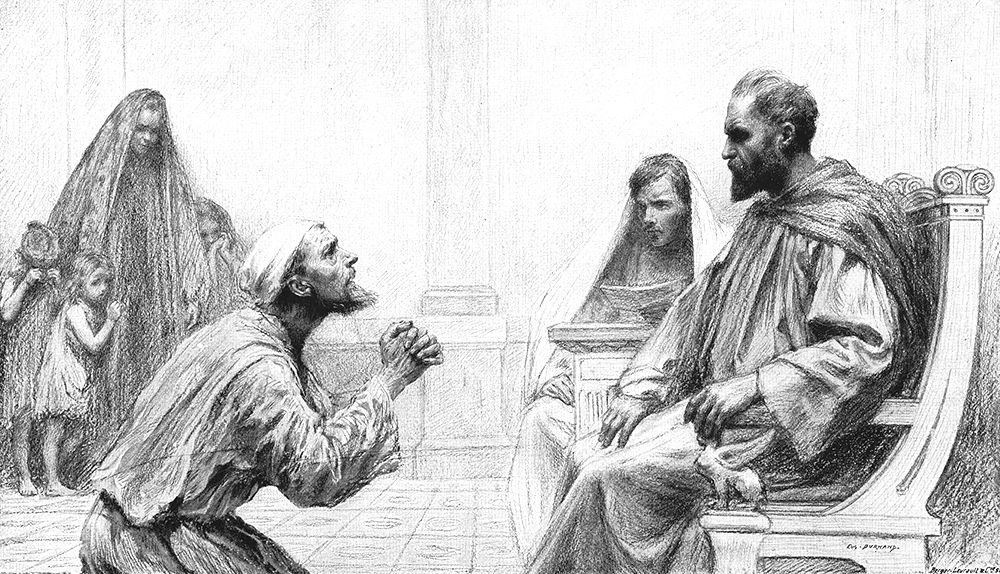
The Eye of a Needle

Matthew 19:23-25

Some call this a parable, but I don’t think it is, at least in a classic theological sense, but it is an analogy of what’s true in the somewhat invisible Kingdom of God. It’s explaining something we can understand about the spiritual realm. It seems to communicate what is real, and solidly true about Jesus’ rule.

What precedes this passage is what we call “The Rich Young Ruler.” It’s a painful part of scripture; we see this young man, devout and upright, crash and burn. He simply can’t extract himself from his riches, and that’s scary. He’s wealthy, and when Jesus reaches out to him and calls him to follow, he cannot. He’s chained to his money, (Matthew 19:22).

How terrible this is, and what a warning to us.

Let’s get to Jesus’ observation about this mostly invisible Kingdom of God. He chooses a very big land animal—a camel (this is not the cigarette type) trying to squeeze the smallest imaginable hole (a needle hole). I don’t know for certain, but Jesus’ audience gets awfully quiet, and it says that his disciples are “astonished.”

“Then who can be saved?”

This question flips everything upside down. The text says that Jesus looked at them (interesting) and declares what is true—“With man this is impossible, but with God all things are possible.”

Okay. But what does this mean?

I believe that when wealth sticks to a man it makes it impossible for him to enter God’s Kingdom. It cannot be done, at least not without the Holy Spirit’s stripping process. Let’s not quibble about this, and let’s not sweep it under the proverbial rug. It is what it is.

It’ll take an act of God (maybe several acts of God?) to sever that golden rope. Wealthy is tricky—it affects the wealthy 1% as well as the penniless “street-person.” Money is such a snare that only a definite act of God can break it.

The Holy Spirit knows exactly how to do this.

Living in the Spirit, and walking in the Kingdom, demands definite action on our part. To go back to Jesus’ comments—our camel must get really, really skinny. Wealth must shrink until its needle eye size, and I haven’t really figured out how to do that. I suppose I must take off my camel’s saddle and bridle, and whack him on the behind, and let him loose.

“Nothing is more fallacious than wealth. It is a hostile comrade, a domestic enemy.”
John Chrysostom

The Parable of the Unmerciful

God is generous. We owe him an outrageous kind of debt. But what happens when we refuse to forgive another person? Jesus now teaches what happens–it’s frightening.

Matthew 18:22-34

God is generous. All that he does is grace. It’s also grace when we really meet another. He loves us, and we need to siphon that love to everyone we meet. When we come before the Lord, we don’t get the justice we deserve. He has forgiven us—the ten thousand ones.

God is generous. We owe him an outrageous kind of debt. Commentators list the modern value of 10,000 talents would be $1 billion USD. Granted this is figurative, but that doesn’t mean it’s untrue. Grace is God’s extravagant for scandalous sinners.

That is an insane amount of money. To settle our debt would far, far more than we can repay; but isn’t that the point. God’s grace on us, is a precious thing.

When he gets off his knees, we realize that he really hasn’t changed by grace. His heart is teflon, and the mercy the father gave him doesn’t stick. His heart hasn’t really grasped his lesson in forgiveness. God forgave, the servant didn’t understand. His treatment of another proclaims this.

The parable directly speaks of grace, and ungrace.

The $10,000 guy meets the $100 talent guy and we see our own inability to forgive. We shake down our brother and sister for just small things. Notice verse 28, the text tells us that he actually assaulted him, “he started to choke him.” How bizarre and how disturbing. And yet, God sees, and responds.

Was the $10,000 guy really forgiven? Did he understand the spiritual transaction of what just happened? I don’t think so—and it scares me.

The other servants have seen the issue.

The key word is “distressed,” or lypeō in Greek, the word means “to throw into sorrow, to grieve or offend., to make heavy.” All that the forgiven servant did, was recognizable by others, and they reported what they saw to the master.

His behavior is clearly meant to disturbs us.

He’s called “wicked” in verse 32. What he did was awful, and again he’s brought in. Because of his mistreatment of the other who owed, he was now thrown into prison, owing a billion bucks. He gets what he now deserves. He gets justice instead of mercy. He is turned over the torturers.

Matthew 6:15

What does all of this mean?

I’m pretty sure that God isn’t hammering us over our unforgiveness of others. I suspect it’s our sin that does that. When we consider our sin, how can we understand others who sin against us? We have been forgiven much (very much!) how can we not forgive others for sinning against us?

J. Meyer

alaskabibleteacher.com

Listen Closely to the Rich Young Ruler

Mark 10:17-22

As he was starting out on a trip, a man came running to him and knelt down and asked, “Good Teacher, what must I do to get to heaven?”

18 “Why do you call me good?” Jesus asked. “Only God is truly good! 19 But as for your question—you know the commandments: don’t kill, don’t commit adultery, don’t steal, don’t lie, don’t cheat, respect your father and mother.”

20 “Teacher,” the man replied, “I’ve never once broken a single one of those laws.”

21 Jesus felt genuine love for this man as he looked at him. “You lack only one thing,” he told him; “go and sell all you have and give the money to the poor—and you shall have treasure in heaven—and come, follow me.”

22 Then the man’s face fell, and he went sadly away, for he was very rich.

My name is inconsequential. I suppose all you must know of me is I tried to keep God’s Law and that I was very wealthy. Many believed that being rich was evidence that God approved of me. Of that, I wasn’t too sure. I kept the Law out of fear I suppose, and at times I just knew it wasn’t quite enough.

As I studied I began to realize that riches weren’t going to make me righteous. There was enough Scripture in me to let me know that it wasn’t enough. The prophets, especially Isaiah spoke about the deadliness of wealth, but there was one verse in Proverbs that really disturbed me:

“Your riches won’t help you on Judgment Day; only righteousness counts then.”

This verse and all of the others were the cause of many a sleepless night.

I was tormented by the reality of standing before God with nothing but my money to cover me. Coming under God’s righteous judgment haunted me. I thought of it day and night. I was terrified of being damned. My own righteousness wasn’t enough, and I knew it.

I heard about Jesus (and who hasn’t)–some were claiming that he was the Messiah. He was at least a wonderful teacher and many said he worked miracles. Just perhaps he had answers for me. I hoped so, but I needed to know. It was my questions that drove me to find him.

And finding him was easy–I just followed the crowd.

I went ahead of his retinue of followers. I knelt in his path and waited. I must know what he thought. When he stood before me I asked the question that had haunted me my whole life–“Good Teacher, what must I do to get eternal life?”

Being a good Jew he answered my question with a question. It now seems that he wanted me to see what really mattered. I answered him with my “righteous” commitment to the Law of Moses. I did what was important–at least that’s what I thought. But still, in spite of all that, I felt no security and no real peace.

Jesus looked straight at me, and I knew deep down that he loved me.

But oh those words, His words really disturbed me. He told me that I only lacked one thing, that I must sell everything and distribute the money to the poor. Only by doing that would discover riches in heaven. And only then could I truly follow him.

And that was the thing I could never do.

I went away grieved. If he had asked for anything else I would have done it. You see, my wealth was my real obstacle. Deep down I suddenly knew that everything I possessed was now my stumbling block. It was my idol, my golden calf, and it was a sacrifice that I could never make.

I’ve come to realize now, over my many years, that when I do finally stand before God, I will have nothing to save me. Jesus invited me to follow, and I didn’t.

And that my friend meant I would die in my sin.