Getting Ready for Water Baptism

water-baptism1

“Those who accepted his message were baptized.”

Acts 2:41 

 “Repent and be baptized.”

Acts 2:38 

 “Having been buried with him in baptism and raised with him through your  faith in the power of God.”

Col. 2:12 

Perhaps the most significant decision we’ll make is to follow Jesus Christ into the waters of baptism.  This is just obedience to the Lord’s command to be baptized. Discipleship begins when we appropriate baptism into our faith. Ideally, it should forever alter your life. At least that is the Father’s intention.

It takes faith to be authentically prepared for baptism.  You will be taking a stand. By faith, you’re making public your allegiance to Christ. It is an important and critical step.

“Baptism was to put a line of demarcation between your past sins when you are buried with Him by Baptism–you are burying your past sins–eradicating them–putting a line in the sand saying that old man is dead and he is no longer alive anymore and I rise up to walk in the newness of life.”

T.D. Jakes

I suggest that you prayerfully attend examine the process listed below.  You’ll find there’s a big difference between truly being baptized, and just getting wet!

The interrogative process can be used to solidify the faith before man and in front of His people. In a sense, it’s much like the vows made by a husband and wife in the vows of marriage.

Here are some suggestions you should consider:

A series of questions are asked, to which the reply is always, “I renounce them.”

  1. Do you renounce Satan and all the spiritual forces of wickedness that rebel against God?
  2. Do you renounce the evil powers of this world that corrupt and destroy the creatures of God?
  3. Do you renounce all sinful desires that draw you from the love of God?

The second half also must be asked, to which the reply is always, “I do.”

  1. Do you turn to Jesus Christ and accept him as your Savior?
  2. Do you put your whole trust in his grace and love?
  3. Do you promise to follow and obey him as your Lord?

The Apostle’s Creed can be recited publicly (or privately in prayer).

This creed is our faith boiled down to its core essence. This declaration helps set us apart from the World, the flesh, and the devil:

“I believe in God, the Father Almighty, maker of heaven and earth. And in Jesus Christ, his only Son, our Lord,

who was conceived by the Holy Spirit, and born of the Virgin Mary, suffered under Pontius Pilate, who was crucified, died and was buried.

He descended into hell. and on the third day, He rose again from the dead. He ascended into heaven and sits at the right hand of the Father. From thence He will come to judge the living and the dead.

I believe in the Holy Spirit, the holy catholic Church,  the communion of saints, the forgiveness of sins, the resurrection of the body, and the life everlasting. Amen.”

We need to develop these into a living discipleship; you’ll see that water baptism is analogous to a master key that opens the door to a special joy. Obeying the command to be baptized pleases Jesus. And that is what we long to do.

“Indeed, baptism is a vow, a sacred vow of the believer to follow Christ. Just as a wedding celebrates the fusion of two hearts, baptism celebrates the union of the sinner with the Savior.”

–Max Lucado

“Baptism is an outward expression of inward faith.”

–Watchman Nee

“Baptism separates the tire kickers from the car buyers.”

    –Max Lucado

A special word to “older” believers:

There may come a time when you feel that you would want to be baptized again.  I believe that this is not only allowable but commendable.  You may have not had a good understanding of the baptismal process, but now it makes more sense to you.  I would encourage you to follow your heart. God will honor your re-dedication.

Ask your pastor or an elder what they think.

1brobry-sig

You may copy and distribute this post in its entirety.

You Need to Understand This

Finally, be strong in the Lord and in the strength of his might. 11 Put on the whole armor of God, that you may be able to stand against the schemes of the devil. 

For we do not wrestle against flesh and blood, but against the rulers, against the authorities, against the cosmic powers over this present darkness, against the spiritual forces of evil in the heavenly places.

Eph. 6:10-12, ESV 

Often in Scripture we’ll understand something which will shake us. Dismissing its truth as optional would be a grave oversight. Instead of perceiving it as a mere emphasis reserved for those more inclined towards “charisma,” we must insist on its relevance for each and every believer.

We face a battle. Every one of us.

We look around and see others whose ‘reality’ is different from ours. We see politics, psychology, biology or cosmology, religion or philosophy, entertainment or science that are blind to reality. But Ephesians 6 tells us what we’re up against. We’re starting to realize that humans have a terrible knack for being manipulated by evil powers.

1 John 5:19, Amplified

Ephesians 6 declares that we’re in a world where every individual is in a war.

This passage clearly tells us that the only place of safety is to be strong in God and to find that the only safety is pressing into His presence. To survive we must push everything else aside to be in His presence. He gives us His strength to overcome all evil.

The above passage stresses that there is an organized force of darkness focused on us. These verses in Ephesians 6 unveil a government of wickedness that’s everywhere. Without the humble intimacy that needs prayer and Bible reading, we will be spiritually destroyed.

C.S. Lewis

We need protection. Our only hope is Jesus’ strength. But we must actively step into this spiritual intensity.

We’re only strong through our intimacy with Him. He shields us from the spiritual corruption that swirls all around us. As we draw to Him we become mighty, as we listen closely to the Holy Spirit, we will walk in true discipleship with Jesus.

Watchman Nee

alaskabibleteacher.com

The Dark and Theological Niceties

“On the next day, when they had come down from the mountain, a great crowd met him. 38 And behold, a man from the crowd cried out, “Teacher, I beg you to look at my son, for he is my only child. 39 And behold, a spirit seizes him, and he suddenly cries out. It convulses him so that he foams at the mouth, and shatters him, and will hardly leave him. 40 And I begged your disciples to cast it out, but they could not.” 41 Jesus answered, “O faithless and twisted generation, how long am I to be with you and bear with you? Bring your son here.” 

42While he was coming, the demon threw him to the ground and convulsed him. But Jesus rebuked the unclean spirit and healed the boy, and gave him back to his father. 43 And all were astonished at the majesty of God.”

Luke 9:37-43

All of this takes place immediately after Jesus’ transfiguration. He has shown Himself to be God, wrapped tightly into manhood–He’s fully and completely the Word made flesh. He is the Creator, and He is holding the universe together. Who really can fathom this?

Full of power, but also completely covered with incredible compassion. He meets this desperate man, a man who is carrying incredible weight, a burden that had taken over his life. Jesus steps into a theological circus, after all, the Scribes had shown up, and the disciples were disputing with them. The terrible need of the demonized boy had been forgotten.

The disciples had tried to free him, they really had.

But between the gathering crowd and the arguing Scribes, they were overwhelmed. His disciples were completely out of their element. Defeated, they didn’t know what to do. (Isn’t this a description of much of today’s church? Maybe?)

Sometimes we as the Church can only stress theological niceties.

Often we look beyond the awful needs around us. We rather argue with each other rather than love. We prefer to debate rather than meet the incredible pain around us. How sad is this? We constantly meet terrible pain, and we choose to reside in some strange theological bubble of our own making.

When Jesus comes down from glory on the mountain, He immediately faces off with a desperate man and a demonized son. This father is terribly overwhelmed–the disciples had made a try (or two) and yet couldn’t free the boy. The demons had ignored their efforts and laughed at attempts to free him. These demons decided to stay inside this boy. The disciples can do nothing about it.

But when Jesus shows up, all hell breaks loose, quite literally.

There is amazing power here. Jesus, already shown to be God on the mountain top, now declares His authority over the ugliness of the darkness. He’s been unleashed and absolutely demolishes the works of Satan. He dismantles the evil and decisively frees the boy.

And all were astonished at the majesty of God.”

We can link this power to what we’ve seen on the mountain top–His Words are powerful enough to hold the world in place! He is the Almighty One that has chosen to walk shoulder-to-shoulder with us. He pushes against the darkness and sets us free.

“But have we Holy Spirit power – power that restricts the devil’s power, pulls down strongholds and obtains promises? Daring delinquents will be damned if they are not delivered from the devil’s dominion. What has hell to fear other than a God-anointed, prayer-powered church?”

   Leonard Ravenhill

alaskabibleteacher.com

Not a Cliché

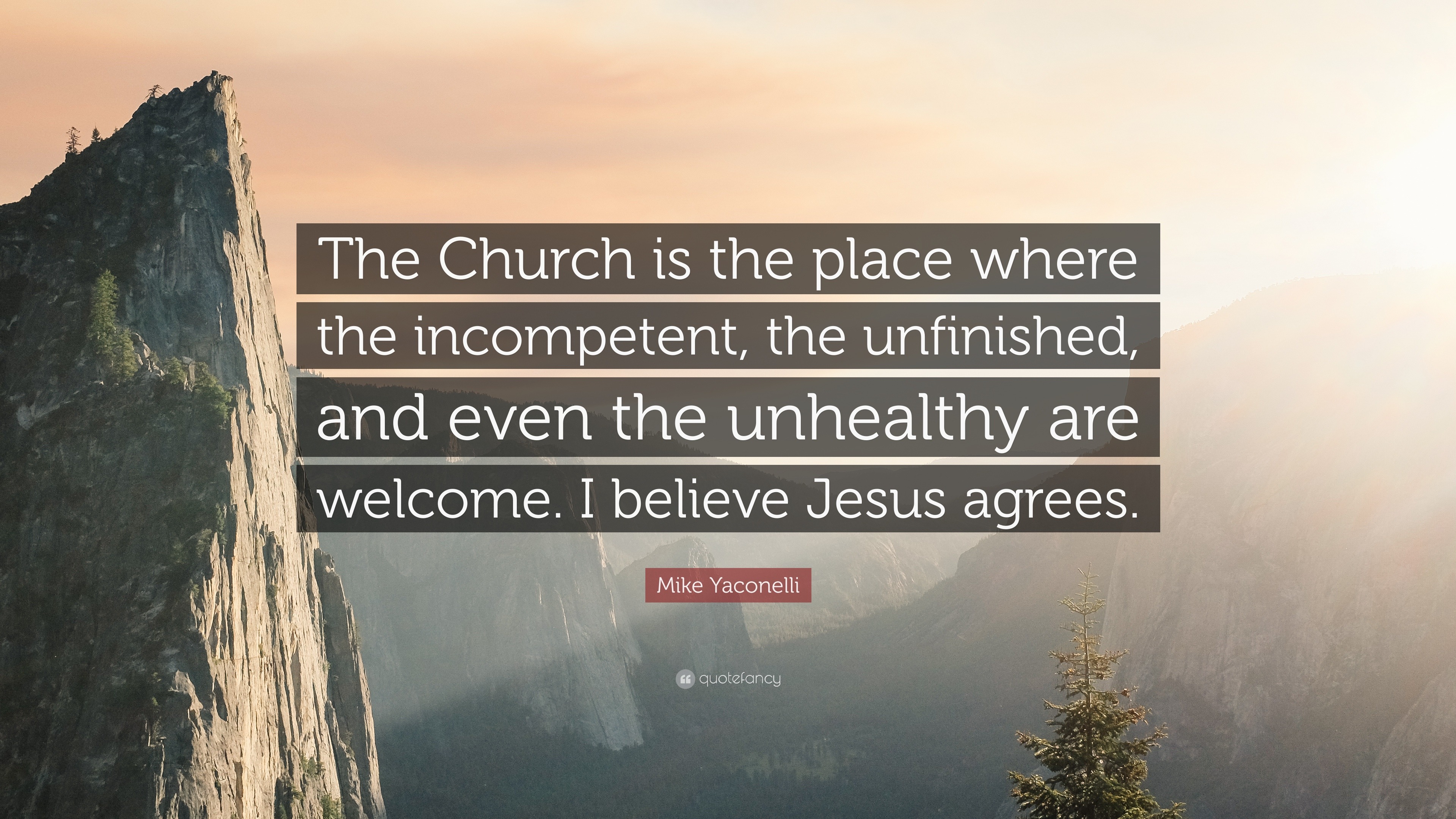
Image result for mike yaconelli quotes images

“A bruised reed he will not break, and a faintly burning wick he will not quench.”

Isaiah 42:3

Somehow, we can get ‘side-tracked’ in our thinking. We get confused and the enemy makes sure we don’t walk in the truth. At this present time, it does seem like some of the Church is nothing more than an exclusive club for the wonderful. It seems that those who attend are the ‘achievers,’ those who have somehow arrived at a certain acceptability.

They are there for social reasons–they eschew any real intimacy with Jesus.

For many of us, we are taught that we must have it all together; more or less complete and functioning at an acceptable level to follow Christ. We keep thinking if we work really hard then we just might arrive at a place of acceptable ‘perfection.’ This has become our religion now, this “gospel by achievement.”

But does Jesus agree? Is His Church made up of only ‘completed’ people, those who have it all together? Do we need to become accomplished before we are acceptable? Perhaps we need to find some answers. Perhaps we won’t like what we find.

After over 40 years of following Jesus (most of the time in ministry) I’m starting to realize that I’ve had much of it all wrong. I’ve read that Jesus receives the lame, the tax-collector, the leper and the whore. He deeply loves the unlovable, in spite of what the Church might say.

I believe that true grace is ‘foolish’ to man, and defies human attempts to explain it. Grace is the free, undeserved goodness and favor of God to mankind. We dare not doubt this.

Zephaniah 3:17

God’s love is completely undeserved. It comes without preconditions. He loves us when we are terribly lost and fallen. It has no bounds or limitations. It is unconditional. Grace grabs us and takes us to a place we’ve only dreamed about. We’re irrevocably changed when we understand.

It is a relationship and not a religion. That’s not a cliché.

This ‘world-system’ desperately wants to confuse us. We discover that Satan detests our intimacy with the Lord Jesus. He marshals all of his demonic strength in order to obscure this truth. It’s funny, but Satan likes ‘religion.’ And he hates our nearness to Jesus. (2 Cor. 11:2-3).

All of us are seeking forgiveness, and yet somehow we think that God won’t accept us. Often we stop going to church, pray, or read His Word. We are slowly becoming hard, and it seems like we are slipping into some sort of a ‘spiritual daze’. Our spiritual malaise is starting to look like it’s permanent.

But Jesus is completely enthralled by your faith in Him!

He doesn’t pull away from the ‘sick’ and the weak. You must understand that intimacy is Jesus’ idea to ‘heal’ you. He draws us to a place of friendship with God. Intimacy with Jesus is God’s exclusive way of ‘turning us’ holy. That’s why Satan militates against “first love” faith.

There is a repentance in all of this.

We need to completely change our mind about our sinfulness. His cross and His blood are enough. But it’s genuine intimacy with Jesus that cures us, not keeping rules or having excellent doctrine. We will never be ‘good’ enough, but even in our sin we are deeply loved!

He knows it all, inside and out. He energizes those who get tired, and gives fresh strength to dropouts. For even young people tire and drop out, young folk in their prime stumble and fall. But those who wait upon God get fresh strength.

They spread their wings and soar like eagles, They run and don’t get tired, they walk and don’t lag behind.”

Isaiah 40:29-31, Message

alaskabibleteacher.com

Dragon Warfare

Pencil art by Amiri Bennett, fineartamerica.com

I recently heard a sermon that referred to St. George and the Dragon– a fable, perhaps true, but it does communicate the reality of spiritual warfare. And how easily we forget. The battle is very real for the believer, and Satan has a million and a half strategies and schemes to use against us.

There is a monster out there–described as a vicious dragon and his existence can never be disputed or even minimized. Unbelief in him doesn’t change the reality of his wicked ministry. He often goes by the name of Satan.

“There is no neutral ground in the universe; every square inch, every split second, is claimed by God and counter-claimed by Satan.”

     C.S. Lewis

The image of a dragon is used repeatedly in the rook of Revelation. (Thirteen times to be exact.) The imagery is a potent one, and the readers of John’s letter are brought into the cosmic reality of darkness personified. But never fear, Satan (the dragon) is bound and cast down.

Paul writes to the Ephesian church about the absolute necessity of going to war.

Finally, be strong in the Lord and in the strength of his might. 11 Put on the whole armor of God, that you may be able to stand against the schemes of the devil. 

Ephesians 6:10-11, (read 6:10-18)

Passivity isn’t an option. Apathy or lethargy will kill you spiritually. If it were not for the grace of God we would collapse. Below is Paul’s exhortation to young Timothy–it’s sobering.

“Fight the good fight for the true faith. Hold tightly to the eternal life to which God has called you, which you have declared so well before many witnesses.”

Ephesians 6:10-11, (read 6:10-18)

I would not be a good teacher or writer if I failed to convey this truth. It’s now past time to wake up and go to war. Our own survival depends on this–our families, friends, church and nation are desperately needy.

Your armor hangs in God’s closet waiting for you and you need to wear it. Ephesians 6 has never been more applicable or relevant than in this present moment.

It’s time to step into the battle.

alaskabibleteacher.com

We Speak a Different Language

John 18:17-18, ESV

The Galileans had a distinct accent. Just as we easily identify someone from Texas just by the tone and cadence of their speech, Peter had that distinct drawl that told everyone that he came from that same province as Jesus. It was something he couldn’t hide.

Peter could not conceal his Galilean identity.

Peter was a very different man in his three years of being with Jesus. And you might say that had transformed him–and you might even say that he was now a marked man, the enemy was now quite aware of him. He was no longer a captain of a small fishing boat looking for a catch. He was now the leader of Jesus’ disciples. And he was full of fear.

The entire text (18:15-18) reveals a confrontation that Peter had with a servant girl, and we hear him making a bold-faced lie. At this very moment Peter was fulfilling the “promise” that Jesus had predicted (Matthew 26:31-32).

What was going through Peter’s head at that moment?

She was a simple servant girl, perhaps one who ministered at the gate of the high priest’s home. It’s interesting that she is the first one to question Peter’s duplicity. Most likely she was just doing her job, watching and listening. She was probably quite alert.

It’s easy to point our finger at Peter, but really, are we much different?

He was a coward, and when he was put on the spot he bailed. People hate cowards–we extol those who take a definite stand against evil. But he was frightened, scared of being connected with Jesus–the man on trial. There was much at stake here.

Just like Peter we also speak with an accent. I know it might be a stretch–but being with Jesus has fundamentally changed us. Our lives now have a specific dialect that others hear, we’re not the same people that we once were.

We open our mouths and others start to hear the Kingdom of God!

Sometimes I try to pretend that I haven’t been with Jesus, and I’m very ashamed of that. I personally battled for a long time with “fear of man.” Like Peter, I stand with the others and choose to warm myself by their fire, and I try very hard to make myself inconspicuous.

But all I have to do is open my mouth, and I proclaim who I really am. It’s really funny, but even servant girls know that I belong to Him.

Proverbs 29:25, ESV

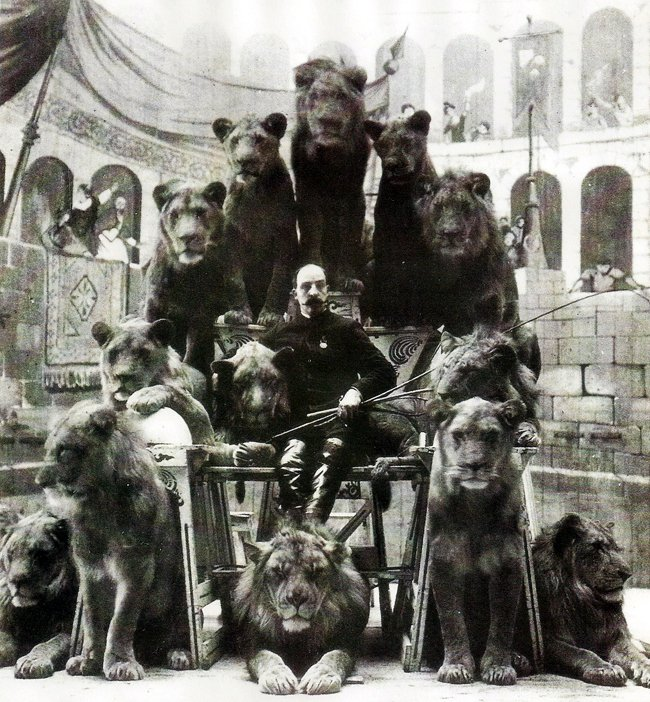
Daniel, the Lion Tamer

Daniel 6:22-23, ESV

I am rather frustrated with myself. I confess I haven’t read Daniel in years, and I’ve chosen to rectify this. Lately I’ve busted through this book and discovered some wonderful stuff. I guess chapter 6 has become my favorite.

A couple of things stick out.

Daniel was an incredibly faithful man, praying three times a day. He was true-hearted who served each king with the gifts God had given him. I like him a lot.

Daniel became the king’s favorite, the Hebrew word used means “prominent or esteemed.” He was the greatest and best there was to be found. You could say that he was the finest man in the kingdom.

Daniel knew how to lead and direct others. We read that he oversaw 120 chief overseers. I suspect he knew a thing or two about good leadership. Daniel understood his work, and it seems that he instinctively knew what good government required.

But Daniel was a victim of jealousy. A concerted effort, carefully planned and directed was meant to destroy him. Although the leaders of this rebellion could find nothing to accuse him of, they resorted to trap him because he prayed to God. Faithfully and consistently.

Their plot worked. These officials, through their twisting and manipulation of the legal code, were able to sentence Daniel to death. It seems being fed to hungry lions was the penalty for “breaking the law.”

Sometimes we must choose to serve God, even if it means breaking men’s laws.

Acts 5:29

Daniel was over 90 years old when he was thrown to the lions. Even in his advanced years he kept up serving God. The passage declares that he had “an excellent spirit.”

The lions, (several I assume), were not at all interested in devouring Daniel. King Darius however was incredibly distraught over Daniel’s execution, but it seems he was forced into it. The passage tells us that the king was so distressed that he couldn’t sleep that night.

Undoubtedly, Daniel slept far better then Darius.

To be faithful to the Lord God may require us to sleep with lions, but we can be assured of the Holy Spirit’s presence with us even then. A verse in Hebrews suggests “faith” protects us from the strong jaws of the enemy. Daniel understood.

Hebrews 11:33

But yet, sometimes even the faithful will be eaten.

Sometimes the lions will devour believers. But we must trust and believe no matter what happens. Hebrews goes on to show us the extremity of the faithful. Read Hebrews 11:35-38 and you’ll understand what I mean. Being faithful can be very difficult. Bad things often happen.

*****

     Thomas Watson

alaskabibleteacher.com

Was Judas Forgiven?

And Jesus said, “Father, forgive them, for they know not what they do.”

Luke 23:34

From the cross Jesus spoke this. He was being executed in an extreme way, crucifixion was a terrible way to die. Roman soldiers surrounded the cross, and yet Jesus asked the Father to forgive them. They would not be guilty, but forgiven for what they were doing to Him.

But what about Judas?

How broad was Jesus’ statement? Did Jesus grant Judas absolution from this sin of betrayal when He said this? There’s far too many questions, and it’s good to think these things through. Was there forgiveness for this man of treachery?

“Then Satan entered into Judas called Iscariot, who was of the number of the twelve.” (Luke 22:3, ESV.) Perhaps this verse should become our entry point. It’s apparent that Judas was being controlled by the evil one. Something (or someone) took possession of him at this point. It seems astonishing that this happened at the special moment of the Lord’s Supper.

At this point Judas sought out the chief priests.

Judas offered to turn Jesus in, and it seems that money was given, perhaps to encourage Judas to commit himself to follow through. We read that Jesus was “troubled in His spirit.” It seems that this had to do with the impending betrayal.

So what was the early Judas like? Was he an authentic disciple? It seems he was called like the others. He listened to Jesus’ teaching and saw most of the miracles. Later he was sent out to proclaim the “good news.” Apparently, he teamed up with another disciple, miracles were seen.

“Judas heard all of Christ’s sermons.”

Thomas Goodwin

I can’t verify this yet, but each of the 12 called Jesus “Lord,” but only Judas called Jesus “rabbi.” Perhaps this points to a problem Judas has identifying the ministry of Jesus. There would be a kiss commonly given by a disciple, but was it real?

Judas seemed to have problems with money. Apparently Jesus decided that he was to be the treasurer of His followers. This was a problem for Judas. It’s clear that he stole money from that was entrusted to Jesus’ ministry.

Yet I believe Judas would be forgiven of these things if he only asked.

There are a few other things we really must consider. Did Jesus forgive Judas? The Romans and the Jewish leaders were forgiven by Jesus from the cross. But there was never any indication that Judas was forgiven for his betrayal. It seems that Judas carried his sin which ended up in suicide.

Both Peter and Judas betrayed their Lord.

And yet I have to believe that they were not the same. Somehow Peter’s denial would find a way to be forgiven. And even though it seems very painful, Peter would be restored. But Judas took his own life. It was his choice. Simon Peter felt remorse. Judas was overcome with guilt and chose death instead of seeking forgiveness.

I’m completely convinced that we will not see Judas in heaven.

I say that cautiously. I hardly ever understand the mind and heart of God. His compassion is everlasting. Who am I to decide these things? But it seems to me that when he sold Jesus for 30 pieces of silver, he was really selling himself.

“While I was with them, I kept them in your name, which you have given me. I have guarded them, and not one of them has been lost except the son of destruction, that the Scripture might be fulfilled.”

John 17:12

This verse seems to clarify much about Judas. We understand Jesus’ care and love for each of His disciples; yet we see a pronouncement of judgement against the person who would betray Him. It seems that Judas convinced himself that he could not be forgiven. His awful suicide declared he was beyond grace. Judas decided he would hang himself, committing himself to the rope rather than accepting any kind of forgiveness.

Sobering, isn’t it?

“Judas Iscariot was not a greatly wicked person, just a common money-lover, and like most money-lovers, he did not understand Christ.”

A.W. Tozer

Rooted Firmly and Deeply

“But I am like a green olive tree
    in the house of God.
I trust in the steadfast love of God
    forever and ever.”

Psalm 52:8

In Psalm 52 we read of David’s run-in with Doeg, a very bad man, (a mass murderer actually). But David, hearing about the slaughter of 85 innocent priests doesn’t respond in hatred, rather he sits down and writes this song of contemplation which we know as Psalm 52.

It isn’t something written out of wrath and vengeance rather the word that begins his writing is “maskil” which implies– enlightenment, or something reflective, thoughtful, discerning. He sat down and considered Doeg’s awful evil, and by doing this was able to understand own heart as well.

Psalm 52 has two distinct parts.

The first is Doeg’s vicious atrocity, and the condemnation that it incurs, (v.v. 1-7). The second was David’s own commitment to following God, and understanding his own place in a very evil world, (v.v. 8-9).

Rather than castigate himself for being discovered in Nob–a circumstance which directly led to the mass murder of these priests (and their families). We find that David does not blame himself. He could have, but he didn’t. Rather he thoughtfully, and carefully, detailed his own “observations” of the whole sordid matter.

David could easily have destroyed himself with guilt and grief. He didn’t.

He chose not to play the losing game of ‘what if.’ He instead would be like a green olive tree rooted himself in the holy temple and into the protective presence of God. David knew he would destroy himself if he didn’t place himself there. It was a deliberate decision.

It would keep himself sane.

It seems to me that trees work heavily into David’s own theology and that this is how he sees his relationship with God. He’s planted and therefore able to survive terrible trials. He shows us how to survive and thrive.

His roots would need to go very deep though.

David’s thoughtful imagery is himself as an olive tree planted in God’s presence.

I believe knowing this is the antidote to the poison of guilt. Perhaps we should follow his example?


“They are like trees planted along a riverbank,
    with roots that reach deep into the water.
Such trees are not bothered by the heat
    or worried by long months of drought.
Their leaves stay green,
    and they never stop producing fruit.”

Jeremiah 17:8

Organized Evil

“Finally, be strong in the Lord and in the strength of his might. 11 Put on the whole armor of God, that you may be able to stand against the schemes of the devil.” 

12 “For we do not wrestle against flesh and blood, but against the rulers, against the authorities, against the cosmic powers over this present darkness, against the spiritual forces of evil in the heavenly places.”

Ephesians 6:10-12, ESV

This is the last final doctrinal passage of the book of Ephesians. In it Paul tells us we must be very conscious of an ongoing battle which swirls around every person.

Understand, the war is hardly an elective. We can’t drop this, thinking it’s optional or non-compulsory. We might think it’s just an emphasis for some of our brothers and sisters who are more charismatic than us.

We were born for battle. Every one of us. No exceptions.

We look around and see those whose ‘reality’ is different than others. We see politics, psychology, biology, religion, entertainment or science. Ephesians 6 tells us what we’re up against. Humans have a terrible knack for being manipulated by evil.

Believe me, it’s all pretty frightening and dangerous.

We must wear the armor that God assigns to us.

Ephesians 6 declares that we’re in a world where every individual is now a battleground. This passage clearly tells us that the only place of safety is to be “strong” in God and to find that the only place of any safety is pressing into His presence. To survive we must push everything else aside to be into His very being. Intimacy always gives power.

But remember, everything above is only found in first-love intimacy. You must come to him humbly and holy, and sit before Him and learn and love. And that is a major step in true holiness. Not legalism, it’s love.

Is it a playground or a battleground?

Which is it? The passage stresses that there is an organized force of evil darkness arrayed against us. This passage unveils the government of wickedness. I’ve learned that without the humble closeness that vitalizes prayer and Bible reading, we will be spiritually destroyed. We desperately need protection.

Our only hope of spiritual survival is appropriating Jesus’ strength.

We must “step” into it. We become strong through being close to Him. He shields us from the spiritual corruption that swirls all around us. As we draw to Him we become truly mighty, and as we listen closely to the Holy Spirit, we’ll walk in true discipleship with Jesus.

You need to do this. I believe when you do come close you will hear Him speak–especially when you push past the powers of evil. You are born for battle.

You have the spiritual DNA to stand.

“The Christian life is a battle against Satan.”

 Zac Poonen