It Gets Even Better

I just saw a t-shirt. “It gets better,” and inside me something connected, it resonated. If there is something like spiritual mirth and laughter, I could barely contain myself. I wanted to shout and dance, but being an old man I knew I had to take extra Advil if I did. (Besides I was in Safeway.)

Romans 8:18

 The last 20 years are something I’d rather forget and erase. It seems I’ve been hit with just about everything awful you can imagine. After each incident I find myself thinking, “finally, it’s done,” but no, it’s not really done, there’s more coming. I’m smiling as I write these words. “But no, it’s not.” Ha!

Being slammed over and over has created within me a special longing for my real home. When I ponder the eternity of heaven the knots of this life begin to unravel, and I see life as it really is. You see present day life is quite temporary, and these many issues will be forgotten.

The Apostle is remarkably clear about this.

“Neither count my life dear unto myself, so that I might finish my course with joy,” is Paul’s take on his life’s issues. To finally complete all of the moments–and do it with joy, is his goal. Crossing the tape triumphantly is the hope of the staggering believer. And it is mine.

My pain is just for a simple singular moment, but eternity is time on steroids.

It is forever and ever and ever and ever.

On my end, the exchange I make is hardly perfect. I turn in my “sawdust” and get gold in return, and who can turn this trade down? My ugliness becomes eternal beauty and who can resist such a deal? These terrible things that hurt me so badly carry an everlasting weight of glory.

Brother, please believe this. Yes, I know, it hurts.

The Greek word “worthy” in verse 18 can be translated “having weight” which suggests a heaviness or burden that must be carried. But even so, it’s temporary. It enters but passes, even though at the moment it seems forever. You carry it for a moment–but that is all. and it’s done.

I look, and gaze into eternity, and laugh in joy.

Breaking Down the Door

Luke 11:5-8

This parable is known by some as “the Importunate Neighbor.” That’s an excellent description. Importunate is defined as being persistent, especially to the point of annoyance or intrusion. It’s tenacious and stubborn–not giving up even when being ignored, and that describes what’s happening here.

What immediately proceeds this parable is Luke’s version of the Lord’s prayer, which the disciples requested. They wanted to understand the methods and mechanics of praying–perhaps the Pharisee’s prayers weren’t quite up to snuff–they wanted more; and they insisted that Jesus instruct them.

The disciples wanted to do prayer right.

A typical Jewish home had sleeping quarters (one room!) located on a raised platform. A ladder was used to access that level (which could be crowded, sometimes two to a bed.) Often their livestock were brought inside. And when it was time to get up, everyone got up. That explains the homeowner’s reluctance to give bread to his neighbor. To get up, light a lamp, wasn’t a solitary affair.

He’s obviously unenthusiastic to make that effort.

The word used here to explain the neighbor actions is ἀναίδεια “anaídeia,” which is only used once–it’s translated as impudence, shamelessness, audacity or chutzpah. It’s a Greek word that explains the knocker’s rudeness. He won’t stop. He knocks and pounds until he gets his bread. Not having bread for his guests is unheard of, for it violates all kinds of convention.

The unwritten law of Jewish hospitality demanded action. 

This is part of Jesus’ view on prayer. It means we must be inappropriate sometimes–even to the point were we are being rude.

Immediately following this parable (the very next thought) are the following instructions:

“So I say to you, ask, and it will be given to you. Seek, and you will find. Knock, and the door will be opened to you. 10 For everyone who asks receives, and the one who seeks finds, and to the one who knocks, the door will be opened.”

Luke 11:9-10

Perhaps it’s this intensity that’s lacking.

We “pray” but don’t insist. We desire but don’t demand. Maybe it takes a certain shamelessness to make prayer work. Jesus emphasizes a necessary attitude to praying God’s way. It’s never automatic, but in this parable we see words that move the Father’s heart, and loosen his hand. In Jesus’ teaching, prayer means effort.

It means spiritual work. He wants us to know this. It is important.

“There is neither encouragement nor room in Bible religion for feeble desires, listless efforts, lazy attitudes; all must be strenuous, urgent, ardent. Flamed desires, impassioned, unwearied insistence delight heaven. God would have His children incorrigibly in earnest and persistently bold in their efforts. Our whole being must be in our praying.”

    E.M. Bounds

f

Thorns for the Whore

“Therefore I will hedge up her way with thorns,
    and I will build a wall against her,
    so that she cannot find her paths.”

Hosea 2:6

A holy prophet is told to marry a prostitute–sounds crazy I know, but this union was intentionally commanded by God. It served to announce to Israel the present condition of their hearts, (1:2). In God’s eyes, Israel was nothing more than a spiritual whore. They would now be forced to grapple with this truth.

Her name was Gomer, and the prophet was Hosea.

The truth is sometimes a very hard thing. God has a bellyful of Israel’s prostitution, the nation has repeatedly went astray, they’re full of sin and idolatry. What else can God do to break this ‘spell’ and get their attention?

O.K. So why this hedge of thorns?

  • This hedge was initiated by God Himself
  • It was not vindictive; it wasn’t meant to destroy
  • Sin will never satisfy those in a covenant relationship with Him
  • Repentance was the goal God wanted to see
  • It’s function was to resist their sin and idolatry
  • This hedge was to bring Israel back into a right relationship with Himself

Imagine being restrained by the Lord in this way. Spiritual handcuffs and fetters and anything else that would restrict you from sin. He loves you and as a believer you belong to Him exclusively. He will discipline you if you persist in your sin. (But that is a good thing.)

He does this out of an everlasting love that’s forever loyal to you.

The very next verse (v. 7) is the response of Israel to being hedged in. It seems to be doing what He intends it to do. The ‘block’ seems to be working. (This sounds a bit like the “prodigal son.”)


“She shall pursue her lovers
    but not overtake them,
and she shall seek them
    but shall not find them.
Then she shall say,
    ‘I will go and return to my first husband,
    for it was better for me then than now.’

Hosea 2:7

When you receive Jesus as your Savior you now belong exclusively to Him. That covenant is far more than eternal life. It also means that He is fully and irrevocably committed Himself to making you a holy person. He disciplines when you persist in sin. But it’s done out of love.

Some have suggested praying the hedge of thorns over straying children or family. Perhaps that’s what is necessary. Pastors and elders could intercede for wandering believers using the same example found in Hosea 2. I believe God hears us as we pray.

“We often learn more of God under the rod that strikes us than under the staff that comforts us.”

   Stephen Charnock

Needing His Cross Daily

We live in this place.

I confess that peace has never been really high on my list. Love, joy, kindness, and even goodness are clear priorities. Peace… not so much. Until I find out it’s not there. And then I get frantic by its absence and scrambling look for it with bewilderment.

Sometimes I don’t understand why God still loves me. At times like this anxiety eats at me. I beat myself up by my last failure. The guilt of my latest sin grows until it looms larger than the blood that saved me. Sometimes I suppose, religious people seem to have the most neurosis.

I’m afraid that we are taking the ‘present tense’ out of the Gospel.

The past tense is preferable to us as we find it easier to ‘manage’ our Christian life. We like to make check marks on our list. [Church attendance– check. Baptism– check. Bible study– check.] I think it gives me a definite feeling of ‘maturity.’

But these things matter little without intimacy with Jesus Christ.

I certainly haven’t arrived, and it seems at times I’m still the hideous sinner I always was. I cannot pretend otherwise, even with a spiritual truckload of cosmetics at my disposal. I know, I’ve tried. And I’m still ‘ugly.’ I do know forgiveness, and I do walk in its wonderful light (by grace).

I read Luther 30 years ago. (And Bonhoeffer would say something similar.)

“When our Lord and Master Jesus Christ said, ‘Repent,’ he willed the entire life of believers to be one of repentance.”

Martin Luther

This is the first of his 95 Theses nailed to the door of the Castle Church in Wittenberg, Germany. And there is a present tense here we can’t ignore about these declarations. I don’t just repent over smoking, beer drinking, fornication, or hypocrisy, once and done. But my entire way of living is to be one of repenting. To repent everyday opens the door to a true grace-filled discipleship.

“All of the Christian life is repentance. Turning from sin and trusting in the good news that Jesus saves sinners aren’t merely a one-time inaugural experience but the daily substance of Christianity. The gospel is for every day and every moment. Repentance is to be the Christian’s continual posture.”

John Piper

Luther’s last words, on his deathbed, was found written on a scrap of paper stuck in his coat, “We are beggars! This is true.” Even after thirty years, he was only echoing his first thesis.

It seems dear ones, we are to live at the foot of the cross.

You Need to Understand This

Finally, be strong in the Lord and in the strength of his might. 11 Put on the whole armor of God, that you may be able to stand against the schemes of the devil. 

For we do not wrestle against flesh and blood, but against the rulers, against the authorities, against the cosmic powers over this present darkness, against the spiritual forces of evil in the heavenly places.

Eph. 6:10-12, ESV 

Often in Scripture we’ll understand something which will shake us. Dismissing its truth as optional would be a grave oversight. Instead of perceiving it as a mere emphasis reserved for those more inclined towards “charisma,” we must insist on its relevance for each and every believer.

We face a battle. Every one of us.

We look around and see others whose ‘reality’ is different from ours. We see politics, psychology, biology or cosmology, religion or philosophy, entertainment or science that are blind to reality. But Ephesians 6 tells us what we’re up against. We’re starting to realize that humans have a terrible knack for being manipulated by evil powers.

1 John 5:19, Amplified

Ephesians 6 declares that we’re in a world where every individual is in a war.

This passage clearly tells us that the only place of safety is to be strong in God and to find that the only safety is pressing into His presence. To survive we must push everything else aside to be in His presence. He gives us His strength to overcome all evil.

The above passage stresses that there is an organized force of darkness focused on us. These verses in Ephesians 6 unveil a government of wickedness that’s everywhere. Without the humble intimacy that needs prayer and Bible reading, we will be spiritually destroyed.

C.S. Lewis

We need protection. Our only hope is Jesus’ strength. But we must actively step into this spiritual intensity.

We’re only strong through our intimacy with Him. He shields us from the spiritual corruption that swirls all around us. As we draw to Him we become mighty, as we listen closely to the Holy Spirit, we will walk in true discipleship with Jesus.

Watchman Nee

alaskabibleteacher.com

The Dark and Theological Niceties

“On the next day, when they had come down from the mountain, a great crowd met him. 38 And behold, a man from the crowd cried out, “Teacher, I beg you to look at my son, for he is my only child. 39 And behold, a spirit seizes him, and he suddenly cries out. It convulses him so that he foams at the mouth, and shatters him, and will hardly leave him. 40 And I begged your disciples to cast it out, but they could not.” 41 Jesus answered, “O faithless and twisted generation, how long am I to be with you and bear with you? Bring your son here.” 

42While he was coming, the demon threw him to the ground and convulsed him. But Jesus rebuked the unclean spirit and healed the boy, and gave him back to his father. 43 And all were astonished at the majesty of God.”

Luke 9:37-43

All of this takes place immediately after Jesus’ transfiguration. He has shown Himself to be God, wrapped tightly into manhood–He’s fully and completely the Word made flesh. He is the Creator, and He is holding the universe together. Who really can fathom this?

Full of power, but also completely covered with incredible compassion. He meets this desperate man, a man who is carrying incredible weight, a burden that had taken over his life. Jesus steps into a theological circus, after all, the Scribes had shown up, and the disciples were disputing with them. The terrible need of the demonized boy had been forgotten.

The disciples had tried to free him, they really had.

But between the gathering crowd and the arguing Scribes, they were overwhelmed. His disciples were completely out of their element. Defeated, they didn’t know what to do. (Isn’t this a description of much of today’s church? Maybe?)

Sometimes we as the Church can only stress theological niceties.

Often we look beyond the awful needs around us. We rather argue with each other rather than love. We prefer to debate rather than meet the incredible pain around us. How sad is this? We constantly meet terrible pain, and we choose to reside in some strange theological bubble of our own making.

When Jesus comes down from glory on the mountain, He immediately faces off with a desperate man and a demonized son. This father is terribly overwhelmed–the disciples had made a try (or two) and yet couldn’t free the boy. The demons had ignored their efforts and laughed at attempts to free him. These demons decided to stay inside this boy. The disciples can do nothing about it.

But when Jesus shows up, all hell breaks loose, quite literally.

There is amazing power here. Jesus, already shown to be God on the mountain top, now declares His authority over the ugliness of the darkness. He’s been unleashed and absolutely demolishes the works of Satan. He dismantles the evil and decisively frees the boy.

And all were astonished at the majesty of God.”

We can link this power to what we’ve seen on the mountain top–His Words are powerful enough to hold the world in place! He is the Almighty One that has chosen to walk shoulder-to-shoulder with us. He pushes against the darkness and sets us free.

“But have we Holy Spirit power – power that restricts the devil’s power, pulls down strongholds and obtains promises? Daring delinquents will be damned if they are not delivered from the devil’s dominion. What has hell to fear other than a God-anointed, prayer-powered church?”

   Leonard Ravenhill

alaskabibleteacher.com

The Shepherd’s Own Voice

John 10:1-5, ESV

 “Truly, truly, I say to you, he who does not enter the sheepfold by the door but climbs in by another way, that man is a thief and a robber. But he who enters by the door is the shepherd of the sheep. To him the gatekeeper opens. The sheep hear his voice, and he calls his own sheep by name and leads them out. When he has brought out all his own, he goes before them, and the sheep follow him, for they know his voice. A stranger they will not follow, but they will flee from him, for they do not know the voice of strangers.”

What joy can be found in the Shepherd’s care, and to hear his voice. Nothing really can match this wonder. We follow as he leads us. The voice is an integral part of this passage and the foundation of discipleship that is real.

Please understand: You really can’t walk with him unless you hear him. We belong to him. We’re his flock that he keeps and provides for.

And He knows our name!

That’s the intimacy found in these verses. We’re never forgotten and he will never overlook us. To think otherwise is slander and an attack on his present-day ministry. Jesus is our good shepherd. He always will be.

“Intimacy with God comes in whispers, not shouts.”

     Woodrow Kroll

He sometimes whispers, and yet this world can’t hear him (or they refuse to). To be perfectly honest, my ‘busy-ness’ silences Him. I suppose that the real issue isn’t with Him, but with myself.

“And after the earthquake, there was a fire, but the Lord was not in the fire. And after the fire, there was the sound of a gentle whisper.”

1 Kings 19:12

He doesn’t speak through a windstorm, earthquake, or fire. He chooses to speak very quietly, and that’s a problem for me. In the original Hebrew, the word “whisper” can be translated as “calm, something gentle.” He speaks this way if only we shut up for a little while.

If we are to recognize God’s voice, we must belong to Him. We hear His voice best when we spend time in Bible study and quiet prayer. The more time we spend intimately with God and His Word, the easier it is to recognize His voice and His leading in our lives. He’s always speaking, and we’re seldom listening.

The flock hears the shepherd, and it’s that voice that breaks through our cluttered-up life. We can hear, and it’s that communication that encourages us to walk through life—one day at a time. Just today. That’s all you must do.

There are so many other voices. Please dear one, you must ignore them.

So many are speaking, and so many want us to hear and follow them. But in reality, they want us to leave the Shepherd and his flock behind. But we can’t allow this, we must learn to listen to him alone.

alaskabibleteacher.com

Art by Eugène Burnan

Peter’s Greatest Flops

The apostle Peter was well acquainted with failure. He understood blowing it big time. I’ve identified at least 11 times when he did the wrong thing; He stumbled repeatedly, but that encourages me.

(I’m really glad he struggled.)

I suppose that we must acknowledge that Jesus saw something in Peter–a definite future of a ministry that would be critical in the lives of the other disciples, but it wasn’t going to be easy for Peter. Jesus was alert and He prayed specifically for His bumbling disciple.

“…but I have prayed for you that your faith may not fail. And when you have turned again, strengthen your brothers.”

Luke 22:32, ESV

Here’s my list of Peter’s greatest flops:

  • Peter can’t figure out the Parable of the Sower, so he asks Jesus for further explanation. We too don’t understand all the things Jesus taught, we get confused. Peter’s example is a strength for us. Jesus doesn’t reject our ignorance. (Matthew 15:15-16.)
  • Peter and the others try to keep the children away from Jesus. (Mark 10:13-14.)
  • Peter is full of selfish ambition and argues with the other disciples as they walk with Jesus. (Mark 9:33-34; Luke 22:24.)
  • Peter tried to follow Jesus by walking on the water. He failed and sank; Jesus took him by the hand and gave him a gentle rebuke. (Matthew 14:28-33.)
  • On the Mountain of the Transfiguration Peter witnessed an incredible event when Jesus was seen in all His glory. Peter blew it by not understanding what had just happened. (Mark 9:2-8.)
  • Peter actually is strongly rebuked by Jesus and called, “Satan.” (Matthew 16:23.)
  • Peter resists Jesus when He is washing the disciple’s feet. (John 13:5-9.)
  • Peter fails to listen to Jesus in the garden of Gethsemane and falls asleep. He was told to watch and pray. Peter failed, and fell asleep. (Matthew 26:36-46.)
  • Peter, with “oaths” and “curses” denies knowing Jesus in the courtyard of the High Priest. (Matthew 26:69-75.) See also, Matt. 10:33.
  • Peter is broken over his denial of Jesus. It seems that he’s a complete failure as a disciple and returns to his boat and goes fishing. The other disciples follow him.(John 21:1-3.) We also see Jesus restoring Peter to Himself. (John 21:15-19.)
  • Peter is intimidated by the Jews, and withdraws from fellowshipping with the Gentile believers. He is soundly rebuked by Paul “to his face.” (Gal. 2:11-14.)

It seems that none of these are spiritually fatal, but perhaps they could be. In every case listed we can see the tenderness and goodness of the Lord Jesus who forgave and restored Peter. He loves His disciple much more than Peter realizes.

At times our walk is also somewhat discouraging.

We sin, and we fail in so many ways. It seems overwhelming at times. The Holy Spirit calls us to pray and sing, but if we’re honest we often can’t do these things. Our failures seem to disqualify us to be disciples. A kind of “spiritual depression” falls over us. We seem to believe that God is angry with us. We think He condemns us.

 “I give them eternal life, and they will never perish, and no one will snatch them out of my hand.”

John 10:28

But God’s love for you is total and everlasting.

On that day you accepted Him as your Savior a covenant was made. He’s committed to bring you through life and to Himself. Forever. Jesus is completely faithful and He loves you deeply and most unreasonably. We call this “grace.”

  1. God has initiated your salvation. He launched it and He is in charge of it.
  2. God works over and over in your life to make you like His Son.
  3. When you die and stand before Him that process will be finished completely.

“And I am sure of this, that he who began a good work in you will bring it to completion at the day of Jesus Christ.”

Philippians 1:6

alaskabibleteacher.com

Not a Cliché

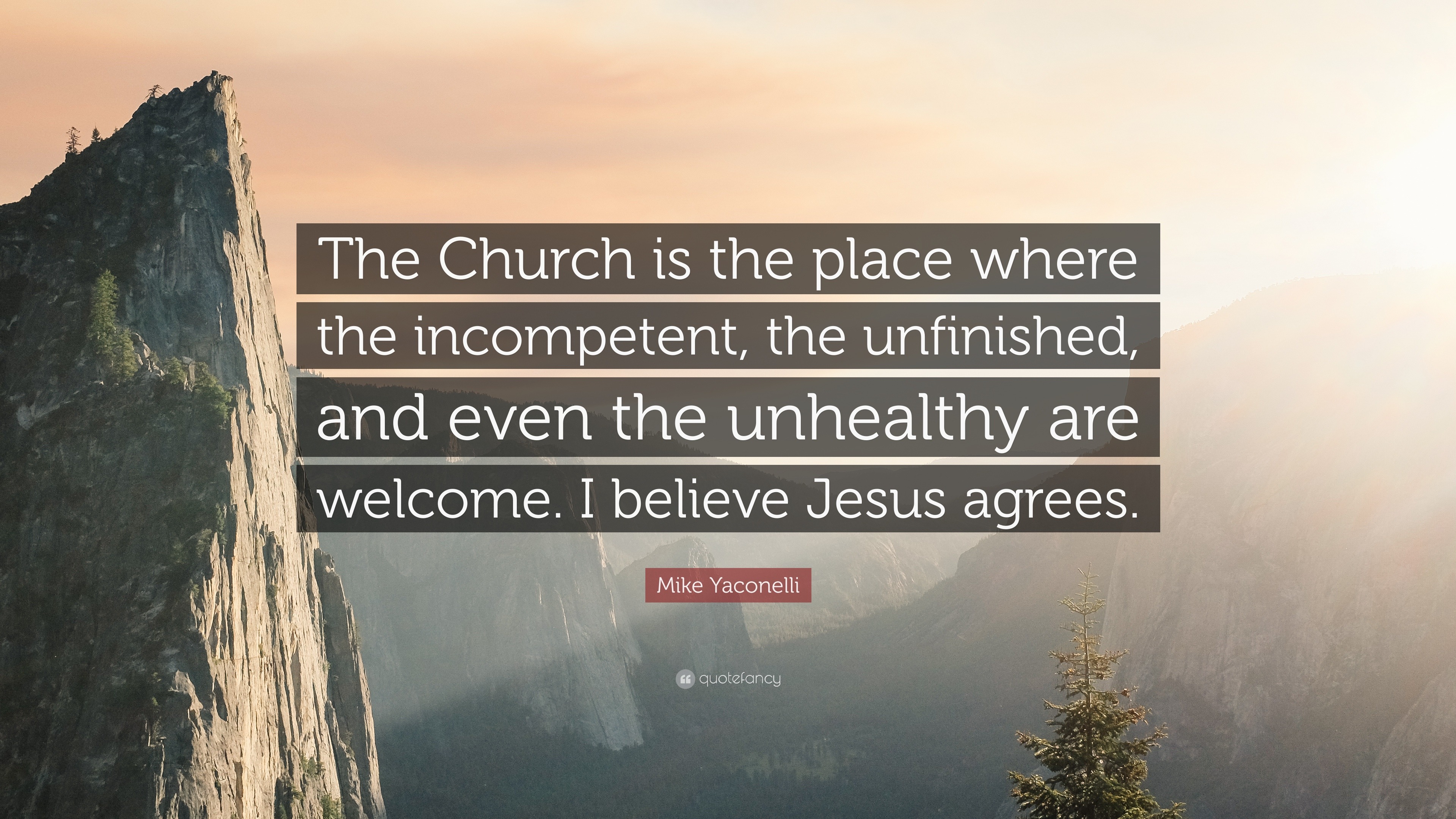
Image result for mike yaconelli quotes images

“A bruised reed he will not break, and a faintly burning wick he will not quench.”

Isaiah 42:3

Somehow, we can get ‘side-tracked’ in our thinking. We get confused and the enemy makes sure we don’t walk in the truth. At this present time, it does seem like some of the Church is nothing more than an exclusive club for the wonderful. It seems that those who attend are the ‘achievers,’ those who have somehow arrived at a certain acceptability.

They are there for social reasons–they eschew any real intimacy with Jesus.

For many of us, we are taught that we must have it all together; more or less complete and functioning at an acceptable level to follow Christ. We keep thinking if we work really hard then we just might arrive at a place of acceptable ‘perfection.’ This has become our religion now, this “gospel by achievement.”

But does Jesus agree? Is His Church made up of only ‘completed’ people, those who have it all together? Do we need to become accomplished before we are acceptable? Perhaps we need to find some answers. Perhaps we won’t like what we find.

After over 40 years of following Jesus (most of the time in ministry) I’m starting to realize that I’ve had much of it all wrong. I’ve read that Jesus receives the lame, the tax-collector, the leper and the whore. He deeply loves the unlovable, in spite of what the Church might say.

I believe that true grace is ‘foolish’ to man, and defies human attempts to explain it. Grace is the free, undeserved goodness and favor of God to mankind. We dare not doubt this.

Zephaniah 3:17

God’s love is completely undeserved. It comes without preconditions. He loves us when we are terribly lost and fallen. It has no bounds or limitations. It is unconditional. Grace grabs us and takes us to a place we’ve only dreamed about. We’re irrevocably changed when we understand.

It is a relationship and not a religion. That’s not a cliché.

This ‘world-system’ desperately wants to confuse us. We discover that Satan detests our intimacy with the Lord Jesus. He marshals all of his demonic strength in order to obscure this truth. It’s funny, but Satan likes ‘religion.’ And he hates our nearness to Jesus. (2 Cor. 11:2-3).

All of us are seeking forgiveness, and yet somehow we think that God won’t accept us. Often we stop going to church, pray, or read His Word. We are slowly becoming hard, and it seems like we are slipping into some sort of a ‘spiritual daze’. Our spiritual malaise is starting to look like it’s permanent.

But Jesus is completely enthralled by your faith in Him!

He doesn’t pull away from the ‘sick’ and the weak. You must understand that intimacy is Jesus’ idea to ‘heal’ you. He draws us to a place of friendship with God. Intimacy with Jesus is God’s exclusive way of ‘turning us’ holy. That’s why Satan militates against “first love” faith.

There is a repentance in all of this.

We need to completely change our mind about our sinfulness. His cross and His blood are enough. But it’s genuine intimacy with Jesus that cures us, not keeping rules or having excellent doctrine. We will never be ‘good’ enough, but even in our sin we are deeply loved!

He knows it all, inside and out. He energizes those who get tired, and gives fresh strength to dropouts. For even young people tire and drop out, young folk in their prime stumble and fall. But those who wait upon God get fresh strength.

They spread their wings and soar like eagles, They run and don’t get tired, they walk and don’t lag behind.”

Isaiah 40:29-31, Message

alaskabibleteacher.com

The Thief on the Cross Speaks

Luke 23:39-43

“One of the criminals who were hanged railed at him, saying, “Are you not the Christ? Save yourself and us!” 40 But the other rebuked him, saying, “Do you not fear God, since you are under the same sentence of condemnation? 41 And we indeed justly, for we are receiving the due reward of our deeds; but this man has done nothing wrong.” 

42 “And he said, “Jesus, remember me when you come into your kingdom.” 43 And he said to him, “Truly, I say to you, today you will be with me in paradise.”

The pain was incredible, but I know that deep down I deserved to die. But not like this. Never like this. I was almost out of my mind with fear. What they were doing to me was terrifying.

You must understand that I was a common thief. I had stolen a loaf of bread when I was eight years old and that’s how it all got started for me. It more or else got bigger and easier. I knew how to steal and I was quite good at it. I was Jacob, the master thief!

When I was finally caught, they sentenced me to die. I supposed it was inevitable. I fault no one but myself as I knew what I was getting into. As I dragged my beam up to Golgotha, it was really strange but I suddenly remembered a verse from the scripture and it really did unsettle me.

(Gal. 3:13, ESV)

It’s a terrible thing to die this way. There were three of us, nailed to the wood and lifted up between heaven and earth. Jesus was nailed to the middle cross, not that it really mattered; all three of us were going to die today.

Many hope for an easy death, maybe in their sleep–but that’s not going to happen to us.

The third man could only mock, he was afraid, and I suppose he just echoed those Pharisees who didn’t really understand. But I knew better. I knew who this other man was, I had heard all the stories. Deep down I knew that this man on the center cross was the Messiah.

A crowd had gathered to watch us die. The Romans in their wonderful ingenuity had made a sign that they nailed above Jesus’ head, and it declared to everyone that Jesus was “the king of the Jews.” Even as he was dying, they found a way to malign him and irritate the crowd.

The other man being crucified continued to mock Jesus, and it infuriated me.

Why I defended him I don’t know for sure.

But I understood. Jesus was murdered out of the envy and jealousy of the Pharisees. He didn’t deserve to die like this, but He was hated, and who can confront these religious men without becoming a victim. Jesus had repeatedly crossed the line, so now they were now putting him to death. It seemed evil was really winning today.

I saw the soldiers throwing dice for Jesus’ clothes. He was now being mocked by them as well, even as He was dying on a brutal cross.

But all of a sudden it all made perfect sense.

He really was the Messiah, and these bastards were killing him. Crucifixion was starting to work on me now. I began to choke on my words, and it was getting hard to breathe.

“Jesus… please remember me. When your kingdom comes, please let me be a part of it.”

And as beaten as He was, He managed to turn and look directly at me. They had whipped and brutalized Him, and yet He was still aware. His words were whispered now, but I understood. “I promise that today you will be with me in paradise.”

I was starting to spasm again.

But the horror of death had left me. Some time had passed, and I could hear his breathing stop. But for the first time, I had peace. They used a spear on Jesus, but he was already dead.

The soldiers now came to the two of us, and they were carrying an ax to break our legs. It all had to do with the coming festival, and the Pharisees wanted us dead. When they swung that ax I knew a pain that I could never describe. My own death came quickly after that.

I was suddenly standing in paradise, whole and complete, and loved.

Someone was standing before me. He was shining, and I knew he was powerful; stronger, and He was more glorious than anyone I had ever met. It was crazy but somehow I knew that it was the Lord Jesus. He had come to meet me. It’s funny, but I realized that somehow I really did belong. Me–a dirty rotten thief.

Jesus had promised me, pronouncing me righteous, me of all people. I suddenly had a joy that I could never explain. I really was a part of the Kingdom that was beyond anything I had ever known. I believed him and asked if somehow I could be part of his eternal rule.

I simply asked and He gave me everything.

“I am going to heaven just like the thief on the cross who said in that final last moment: “Lord remember me.”

Billy Graham

alaskabibleteacher.com

Cover Art: “Christ on the Cross between Two Thieves,” by Peter Paul Rubens