God, Have Mercy On Me

Luke 18:9-14

“He also told this parable to some who trusted in themselves that they were righteous and looked down on everyone else: 10 “Two men went up to the temple to pray, one a Pharisee and the other a tax collector. 11 The Pharisee was standing and praying like this about himself: ‘God, I thank you that I’m not like other people—greedy, unrighteous, adulterers, or even like this tax collector. 12 I fast twice a week; I give a tenth of everything I get.’”

13 “But the tax collector, standing far off, would not even raise his eyes to heaven but kept striking his chest and saying, ‘God, have mercy on me, a sinner!’ 14 I tell you, this one went down to his house justified rather than the other, because everyone who exalts himself will be humbled, but the one who humbles himself will be exalted.”

He despised others. As a Pharisee he prided himself as a holy person; he stood before God and congratulated himself. I believe that self-righteousness has many levels. You can be blatant and obvious about it, or it can be subtle and hidden. But we must understand that the father sees and knows. Notice the “we all” here in Isaiah 64:6

(Hmm. Is that what He sees? A menstrual rag? You got to be kidding!)

We often advance ourselves by demeaning those who struggle hard with their sin–there are those who see and somehow know that they’re superior. We don’t come out and say so; but we’ve arrived— but guess what— God (and scripture) tell us something radically different.

But we’re not dealing here with a hidden self-righteousness. The Pharisee truly believes that he is special. He stands and doesn’t kneel. He feels comfortable and confident in the holy presence of God Almighty. He’s not like the others. He is sure that he’s holy.

Look though, the tax-collector was being brutally honest.

He didn’t need anyone to tell him how sinful he was—he understood his own wickedness. Jesus’ story reveals God’s love for those who know that they’re twisted inside. Notice the heart of the tax-collector:

  • “He stood afar off” which showed his awareness of his separation from God.
  • “He wouldn’t even raise his eyes to heaven,” which declared his humility in the presence of God.
  • He kept “striking his chest,” which tells us of a deep pain over his sin against God.
  • He prayed, ‘God, have mercy on me, a sinner!’ This describes his desperate heart.

These both came to pray, but that is all they had in common.

The Pharisee came to the temple to show off his righteousness, the tax-collector out of a terrible despair. It strikes me that the text in verse 11 says the Pharisee “began praying to himself.” It seems that his prayer never really met God—he was proud and showy, doing the things God hates (Prov. 29:23).

Things really came obvious in verse 14. That’s the critical point of the entire story—“one went down to his house justified rather than the other.” Wow! What a statement. One professionally religious man, sure of his holiness, the other a sinful sinner, who came humble and broken. One showed off his faith—boasting with a legalistic swagger. The other desperate and desolate, completely undone.

But it was the tax-man who became righteous in the eyes of God.

Humility is the foundation of the kingdom of Jesus. In Matthew 5:3-4 makes a lot of sense—to be “poor in spirit” and to “mourn” are the bedrock of a Christian’s discipleship. To be justified (made right) was a gift. He didn’t try to earn it, and there wasn’t a probationary period. The tax-collector now became righteous; the Pharisee carried his sin.

God wants us to have a broken-heart. He rejects everything else. I suppose that the question is this: Do you mourn over your sin? 

Psalm 34:18

Art by Eugène Burnand

The Stomach Churning Sin of Manasseh

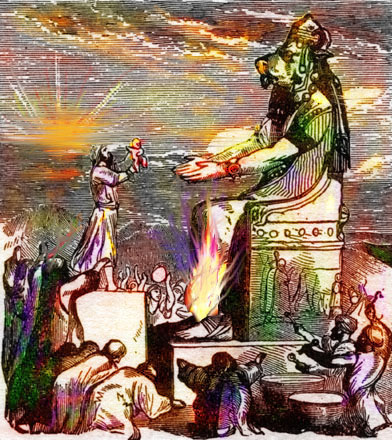
God’s temple was now filled with an evil darkness. King Manasseh made the Lord’s holy place a fountain of sin and filth. Instead of holiness, it was an evil place.

He brought in dark things that were twisted, perverted and clearly forbidden.

“Manasseh led Judah and the inhabitants of Jerusalem astray, to do more evil than the nations whom the Lord destroyed before the people of Israel.”

2 Chronicles 33:9, ESV

His own darkness was now encouraged by others, it became accessible, available and promoted:

  • The high places were rebuilt throughout the land.
  • Altars to Baal rebuilt, using images of wood.
  • In the holy temple, altars to the “starry host,” astrology, plain and simple.
  • Human sacrifice of his own sons to Molech, a false god. Murder.
  • He practiced soothsaying, used witchcraft and sorcery, and consulted mediums and spiritists.

Evil was being encouraged and something wicked was replacing all that was good and true. The analysis of Manasseh’s policies was way beyond disturbing. Of all the kings of Judah, he was the most sinful and the most corrupt. He was at the bottom of the barrel.

The Hebrew word for “led astray” can be translated seduced.

Manasseh was an incredibly immoral man, a king who ruled for 40 years. “He did all he could to pervert the national character, and totally destroy the worship of the true God; and he succeeded.” (Clarke)

It’s believed that he put Isaiah to death by cutting him in two.

Moreover Manasseh shed very much innocent blood, till he had filled Jerusalem from one end to another, besides his sin by which he made Judah sin, in doing evil in the sight of the LORD.

1 Kings 21:16

But then something happened.

And the LORD spoke to Manasseh and his people, but they would not listen. Therefore the LORD brought upon them the captains of the army of the king of Assyria, who took Manasseh with hooks, bound him with bronze fetters, and carried him off to Babylon.

2 Chronicles 33:10-11

Assyria came knocking on Manasseh’s door. I think there was a certain mercy here, but also discipline. Manasseh had “hooks,” inserted through his jaw and out of his mouth. Like a fish he was led to Babylon, a trophy of the power of the army of Babylon.

It was from a dark dungeon that Manasseh cried out to the Lord and repented.

(2 Chronicles 33:12-13.)

There’s a Jewish fable that when Manasseh cried out to God the angels boarded up the windows in heaven. They wanted to block out his prayer so God wouldn’t be able to hear. But God, rich in mercy, bored a hole in front of His throne to hear Manasseh’s desperate cry.

The Lord’s intention was to forever show His kindness and grace given to the most awful repentant sinner.

I believe that Manasseh was the “Prodigal Son” of the Old Testament.

God is not at a loss when He moves to bring us back to Himself. He can woo or whip. He can draw or drive. He can work rapidly or slowly, as He pleases. In other words, He is free to be God! And in His own way, at His own pace, He brings us back.

     Tom Wells

God is wildly in love with you. Yes, the sin you’ve committed is awful, but the Lord wants you to come back. He may discipline you, but He forgives everything if you’ll turn and repent.

No matter how awful your sin, He forgives and restores. Manasseh is proof of that.

Sources:

2 Chronicles 33:1-20

2 Kings 21:1-18

Enduring Word commentary

alaskabibleteacher.com

Spiritual Sloth

Matthew 25:1-13

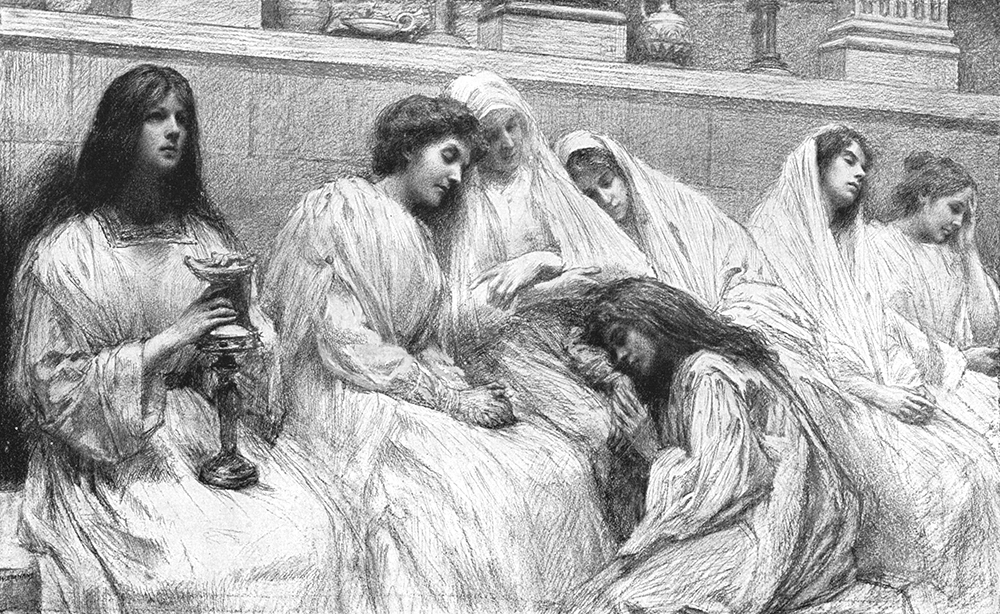
“At that time the kingdom of heaven will be like ten virgins who took their lamps and went out to meet the groom. Five of them were foolish and five were wise. When the foolish took their lamps, they didn’t take oil with them; but the wise ones took oil in their flasks with their lamps. When the groom was delayed, they all became drowsy and fell asleep.

“In the middle of the night there was a shout: ‘Here’s the groom! Come out to meet him.’

“Then all the virgins got up and trimmed their lamps. The foolish ones said to the wise ones, ‘Give us some of your oil, because our lamps are going out.’

“The wise ones answered, ‘No, there won’t be enough for us and for you. Go instead to those who sell oil, and buy some for yourselves.’

10 “When they had gone to buy some, the groom arrived, and those who were ready went in with him to the wedding banquet, and the door was shut. 11 Later the rest of the virgins also came and said, ‘Master, master, open up for us!’

12 “He replied, ‘Truly I tell you, I don’t know you!’

13 “Therefore be alert, because you don’t know either the day or the hour.

There were three stages in every ancient Jewish wedding.

  • Engagement–when fathers got together to make sure that it would be a good match.
  • Betrothal—a ceremony in which formal promises were made by the lovers.
  • Marriage—a surprise arrival, usually a year later, by the groom at the home of the woman.

Each was incredibly important. There couldn’t be any short-cuts; one just didn’t jump into this. It wasn’t a Las Vegas approach to just getting hitched. This parable was an extension of the previous verses in Matthew 24:36-51 and had to do with being prepared.

We can extract this from the third step of marriage. The groom would show up at night, and torches were used to light their way, (apparently the flashlight hadn’t been invented yet). Within Jesus’ parable was the idea of suddenness or surprise.

But no one knew exactly when the groom would show up.

Hence there is an emergency feel to this story. The text states in verse 5:

Five of them were foolish and five were wise.”

The story hinges on this sentence. Readiness is the issue here. Everything of any significance must take on the sudden arrival of the groom’s entourage. The virgins, apparently, would go out to meet him—the torches mingling their light, and drive out any darkness. (It seems that 10 was the acceptable number for a proper rabbinical ceremony).

The problem was that only 1/2 of them were ready. It’s interesting to note that everyone was sleeping. Obviously, that didn’t mean anything for it was the availability of “oil” that would make the difference. The idea was a surprise visit.

The oil was the key. And for us, it represents the Holy Spirit.

Sleep is not the whole issue here, but being prepared is. Five girls were foolish, they were simply not ready. They realized their error and tried to finagle oil from the others, but ultimately that would short everyone in their group. There was an idea that a trip to the local oil merchant would work. It was an idea anyway.

But it was already too late!

The door was closed. The five simply missed it. They stood outside knocking and calling, but they didn’t enter in on time. Reading between the lines, I sense they were desperate. Verse 12 is meant to penetrate and reveal the price of tolerating spiritual sloth.

“He replied, ‘Truly I tell you, I don’t know you!’

The purpose of this parable is the ending line that stresses alertness in a society that dulls everything. The temptation is to act like you’re spiritually aware when you’re not. It’s one of our greatest sins. We assume our lamps are lit when the reality is that our oil (the Holy Spirit) is running close to zero. When our sloth gets mixed with hypocrisy it’ll surely destroy us.

We’re snoring our way to spiritual death.

We must resist slumber and slothfulness. Jesus asserts that his virgins must be prepared and ready for his coming. We must be ready, we must—the price of our unreadiness is high indeed.

“Take care of giving up your first zeal; beware of cooling in the least degree. Ye were hot and earnest once; be hot and earnest still, and let the fire which once burnt within you still animate you. Be ye still men of might and vigor, men who serve their God with diligence and zeal.”

    Charles Spurgeon

Art by Eugène Burnan

Repairing Your Nets

“Yet those who wait for the Lord
Will gain new strength;
They will mount up with wings like eagles,
They will run and not get tired,
They will walk and not become weary.”

Isaiah 40:31, NASB

The word “wait” used here is powerful. It’s an awesome word, never used casually in the Hebrew scriptures. It does not mean to be uncaring or idle. Sometimes we wait in line at the grocery store, or maybe we’re waiting for a phone call. We wait all the time, and often, we don’t even realize it.

The Hebrew word for ‘wait’ is special. It’s qāvâ. It means, ‘to bind together by twisting.’ It’s an active word.

It sometimes means to work like a fisherman repairing his nets to get them ready for tomorrow’s catch.

(There are always holes to mend after a long night’s efforts.)

When we wait spiritually, repairing our nets, the following should be used. Much of this can be done in prayer.

  • Calming ourselves, setting aside everything that doesn’t fit
  • Reading His word
  • Seeing His face
  • Hearing His voice
  • Keeping pace with Him, whether He moves (or doesn’t)

Fixing our nets is a cool way to describe our journey, right? Sometimes, when we think about waiting, we usually only think about it in English, and that can be annoying. It often stops us from truly understanding the true meaning of ‘wait’.

I strongly believe that the Holy Spirit wants us to understand the concept of being closely connected to Him. Sadly, we are often held back by our own definitions, rather than embracing the definitions found in God’s Word.

“The LORD is good to those who WAIT for him,
to the soul who seeks him.”

Psalm 27:14

Sometimes we are instructed by someone to “wait on the Lord.” This instruction can be challenging and we are unsure exactly how we should do it. It’s usual for us to simply show agreement through a smile and a nod. We never completely grasp the essence of that word.

He becomes my source of power that comes from waiting.

He is now the sturdy bond that I am intertwined with. (Maybe this is how He gives strength and power to His people?) We must listen to this, and the Lord is very enthusiastic about guiding us into this fresh form of closeness.

The promise in Isaiah 40:31 talks about receiving new strength, like an eagle’s wings, a holy energy. This verse is important for us, especially today; we need this kind of strength right now. We need to repair our nets as often as we can.

“Waiting for God is not laziness. Waiting for God is not going to sleep. Waiting for God is not the abandonment of effort. Waiting for God means, first, activity under command; second, readiness for any new command that may come; third, the ability to do nothing until the command is given.”

    G. Campbell Morgan

alaskabibleteacher.com

Our City of Refuge

“Unless we are thoroughly convinced that without Christ we are under the eternal curse of God, as the worst of His enemies, we shall never flee to Him for refuge.”

   John Owen

Buried in the Old Testament we discover the idea of the Cities of Refuge.

They speak profoundly to our situation and bring real hope to those who struggle. Six places of safety were given to protect those who accidentally killed another person— maybe an ax head flew and hit someone, and they died as a result.

God told Joshua to establish cities of protection where one could be safe from an avenger. There were six of them, three on the east side of the Jordan river, and three on the west. The cities covered Israel; each was spread out intentionally so they were always close.

That city became a place of asylum for those guilty of manslaughter.

As believers, we know that we’ve committed crimes against God and other people. The burden we carry threatens to undo us. Satan (and his minions) want to destroy us—and honestly, we deserve it. We are essentially spiritual ‘criminals’ who have hurt others and damaged ourselves in the process.

Outside the city, we’re vulnerable—but inside those walls we find safety.

Those who have killed others are protected. If we venture outside, we find our adversary who is waiting. Scripture tells us that we must stay cloistered there until the current high priest dies. Upon his death, we’re released and may leave the city walls.

For broken believers, the whole concept rings true.

The text speaks for itself, and there is spiritual logic in all of this. We see parallels here that speak to our condition. We’ve messed up big time. We also carry issues that the enemy can attack. Depression, bipolar, trauma, and even thoughts of committing suicide— can be a fundamental part of our lives.

I must tell you that safety is found only in the Savior.

Finding God and abiding in him is our place of safety. His walls protect us, Jesus is our high priest, who never dies; that means we need to stay with him, permanently. I like Hebrews 6:18, LB:

“Now all those who flee to him to save them can take new courage when they hear such assurances from God; now they can know without a doubt that he will give them the salvation he has promised them.”

For us especially, we often have problems with the doctrine of assurance of salvation. Our enemy works overtime to accuse us (Rev.12:10). We’re his targets and the lies of many demons assault us. We can, at times, wonder if we’re really saved. We wonder if we are really forgiven, and we doubt our salvation. Satan’s efforts can be constant and crippling.

I encourage you to think this over and pray about this.

Numbers 35 is a good place to start. That chapter is pretty clear. Look also at Exodus 21:13-14; Joshua 20:1-6; Deuteronomy 19:2-13.

Modern Idolatry, Plain and Simple

“The human heart is an idol factory.”

John Calvin

The definition of idolatry, according to Webster, is “the worship of idols or excessive devotion to, or reverence for some person or thing.” Idolatry is real, and it’s really a challenge to the believer, and it’s seldom mentioned today. In almost 40 years of following Jesus, I honestly can’t remember one real sermon on idolatry. That’s sad.

In fact, one of the first commandments given by God is in Exodus 20:3, “You shall have no other gods before me.” This has never been rescinded. It’s not obsolete or old-fashioned. The unredeemed human heart remains a factory of idolatry. Nothing has changed.

“An idol is anything that replaces the one, true God. The most prevalent form of idolatry in Bible times was the worship of images that were thought to embody the various pagan deities.”

So what is modern idolatry –what does a modern idol look like?

To help clear that up, Nicholas McDonald wrote a letter to you from the perspective of your very own, personal idol. (The last line is definitely a whopper.)

Hello. I am an idol.

Don’t be afraid, it’s just me. I notice you’re turned off by my name: “Idol.”

It’s okay. I get that a lot.

Allow me to rename myself.

I’m your family.

Your bank account.

Your sex life.

The people who accept you.

Your career.

Your self-image.

Your ideal spouse.

Your law-keeping.

I’m whatever you want me to be.

I’m what you think about while you drive on the freeway.

I’m your anxiety when you lay your head on the pillow.

I’m where you turn when you need comfort.

I’m what your future cannot live without.

When you lose me, you’re nothing.

When you have me, you’re the center of existence.

You look up to those who have me.

You look down on those who don’t.

You’re controlled by those who offer me.

You’re furious at those who keep you from me.

When I make a suggestion to you, you’re compelled.

When you cannot gratify me, I consume you.

No—I cannot see you, or hear you, or speak back to you.

But that’s what you like about me.

No—I am never quite what you think I am.

But that’s why you keep coming back.

And no—I don’t love you.

But I’m there for you, whenever you need me.

What am I?

I think you know by now.

You tell me.

I hope this helps. And I hope God gives you understanding.

alaskabibleteacher.com

The School of the Prophets

The phrase “the School of the Prophets” has been identified as the ‘naioth’ or “dwellings” in Ramah in 1 Samuel 19:18-24 where the fellowship or “school of the prophets” assembled to worship, pray, and ask God for wisdom. The idea of ‘naioth’ described an idea of community. They seemed to live in a commune of sorts.

An older prophet became the teacher. They would be drilled into the Law. Much of the character of God was talked about, and this would become the core of these new prophets. They learned to seek His anointing, and also humility of heart and mind. The older prophet would emphasize these two things. He was understood as the foundation of any real ministry.

I wish there was more given to us. 

We can only emphasize and extrapolate out of a few verses. Even so, I must believe that the Holy Spirit was profoundly involved in speaking deliberately and honestly to the nations of Judea and Israel. These prophets would be sent out into ministry as needed.

I believe that there were many who spoke the heart of God. And yes, there were the majors: Isaiah, Jeremiah, Ezekiel, and Daniel. The minor prophets would carry a shorter ministry, at least in the written sense, but were not regarded as lesser ministries.

So what does this mean for you?

If your ministry is a specialized one, community becomes key. In this place you will learn about God, in a way that you’ll never ever learn on your own. A prophet is not a prophet unless he learns from a brother. When you fail (and you will) that dear-hearted brother will confront and teach you where you went wrong.

You must recognize the authority of God in the words of a true prophet. You must also understand the treacherous voice of the flesh and the demonic. You must discern, and as a believer that is paramount. You must listen, and hear the Voice of Jesus. “And many false prophets will appear and deceive many people.” Matthew 24:11.

Do You Really Love the Master?

How much do you love Jesus? This parable looks at the heart of the believer, the person who has been incredibly forgiven of everything–past, present and future. And it’s here we see a woman whose heart is broken by her sin, and she discovers Jesus’ grace, and tremendous mercy.

“A certain moneylender had two debtors. One owed five hundred denarii, and the other fifty. 42 When they could not pay, he cancelled the debt of both. Now which of them will love him more?” 43 Simon answered, “The one, I suppose, for whom he cancelled the larger debt.” And he said to him, “You have judged rightly.” 

44 “Then turning toward the woman he said to Simon, “Do you see this woman? I entered your house; you gave me no water for my feet, but she has wet my feet with her tears and wiped them with her hair. 45 You gave me no kiss, but from the time I came in she has not ceased to kiss my feet. 46 You did not anoint my head with oil, but she has anointed my feet with ointment.” 

47 “Therefore I tell you, her sins, which are many, are forgiven—for she loved much. But he who is forgiven little, loves little.”

Luke 7:40-47

Jesus has been invited to Simon’s home. He’s a Pharisee, and at this point they haven’t quite banded together to attack Jesus, it seems that there were still some Pharisees who were true seekers.

The text jumps right in and we see Jesus reclining at a table (the Jewish people didn’t use chairs–pillows were used instead.) At a feast like this people who weren’t officially invited could come in to stand in the back and listen in on the conversation. (That seems awkward.)

Suddenly a woman enters the room.

She’s described as “a woman of the city,” which is a code word for “a sinner, or a harlot.” (Let your imagination roll that one around.) She comes with a definite purpose, for she brings a jar of quite expensive perfume with her.

The passage reveals that she’s on her knees, weeping on Jesus’ feet, and rubbing her tears with her hair, and pouring out the perfume. She’s kissing his feet. She’s obviously a broken person—someone who knows who Jesus is, and who understands who she is, and how deep sin has destroyed her.

At this point Simon is deeply offended, and probably embarrassed by what’s happening. But he also assumes that Jesus isn’t who he’s saying he is. “How dare does this man let an unclean person even touch Him!” But Jesus understands everything. His parable is short (just two verses) and it’s directed at Simon; and it’s a no-brainer.

The interpretation is obvious: the man who owes the most will love the most.

Jesus accentuates Simon’s breach of protocol. The Lord deftly explains the entire situation and Simon is busted. He’s put on the spot and Jesus has made his point. It’s all so obvious. The essence of the story is clear. How much do you love the Master?

Do you fully fathom how much sin Jesus has forgiven you?

(Or maybe you’re a Simonite?)

Perhaps you’re someone who doesn’t quite accept what’s real? The Bible tells us repeatedly that no one is righteous. No one. Scripture has a very low opinion of the righteousness of men. (That should shatter your thinking.)

“But we are all as an unclean thing, and all our righteousnesses are as filthy rags; and we all do fade as a leaf; and our iniquities, like the wind, have taken us away.”

Isaiah 64:6, KJV

The Hebrew word for “filthy rags” is extremely graphic–literally it means “a menstruating cloth.” It was something that a woman used before Tampax came along. How very descriptive. Do we even have the slightest idea what that means? Are our good deeds that bad?

Yes they are. Isaiah announces that’s exactly how God sees our best attempts to find acceptance apart from grace. It often seems we try to please Him by doing the best we can, but that isn’t sufficient. We always fall short and mess up.

How does understanding this change our discipleship? I’ll let you be the judge on this on this one.

“He loved us not because we are lovable, but because He is love.”

C.S. Lewis

Learning Christmas Again

“This Gospel anticipates a world far different from C.S. Lewis’s Narnia, where it is “always winter, and never Christmas.” But the promise of the Gospel is that it is always Christmas. To be “in Christ” is to enjoy each morning as a Christmas morning with the family of God, celebrating the gift of God around the tree of life.”

–Kevin Van Hoozer

Christmas can be a torment for many. I have no doubt it brings grief. Family, friends, finances– mixed liberally with heavy doses of materialism and politics will always bring us issues.  The music and decorations seem like nothing more than mere Novocaine (which doesn’t always work). Stress builds up. And we want none of that.

Being mentally or physically ill often accentuates these issues.

I’m not sure why exactly, but suicide increases during this season. Perhaps the challenges Christmas brings just overwhelm a person who is struggling hard just to make it.

“Christmas is for children. But it is for grown-ups too. Even if it is a headache, a chore, and a nightmare, but it is a period of necessary defrosting of chilled hidebound hearts.”  

–Lenora Mattingly Weber

As I think about Christmas, it is helpful for me to see it as a “mirror.” It is my own reflection and it’s not always pleasant. What we see, is who we are. If we have issues in our own life, the Season will just magnify them.  But this doesn’t mean it’s bad, far from it.

I’m convinced that in all of this, there is an opportunity for us to grow.  

There is a real chance to connect to “Christmas.” The very idea may seem strange.  But Christmas can be an exquisite treat.  It is made by mixing love and truth in generous portions. Our discipleship needs this holiday. I really do need Bethlehem.

I had to learn Christmas.

When we truly process this, we’ll find Christmas. And honestly, it is more than a holiday. For the Christian, it is now a special time. And yes, there will be times when it is trying. Refuse to let that happen. Stop and look for God’s presence.

For me Christmas is becoming a time of great joy and anticipation. Jesus has come for me!

bry-signat (1)

Crisis Hotlines List for Ministry

List of Hotlines and 1-800 Phone Numbers and Websites

These numbers, hotlines or texts may or may not work. I’m constantly adjusting/adding to this resource. As far as we know, this is the U.S. only for phone numbers. Additionally, many of these have regular office hours, and some are not staffed at night. Also, use this resource with caution. Obviously, the online links work for everyone, everywhere.

This list isn’t complete yet.  If you have a contact that isn’t here, please email me that information.  I’m Bryan Lowe at slowe299@yahoo.com or brokenbelievers.com, or here at alaskabibleteacher.com.

Mostly, these are organizations and ministries that are there when life gets challenging.  Use these phone numbers wisely, I am not able to check each number.  These numbers are to be used with some precaution as a result. They may change without notice. But it’s a start I think.

You’ll discover that some have different theology and beliefs. I added them with the hope you’ll sort things out on your own. You also may want to verify each number, and find out what you can comfortably use. I strongly suggest you do this prior to sharing it with others.

In general, these hotlines have three things in common:

1) they are available to call 24/7 in the USA, but the websites are not
2) they are 100% confidential
3) they are free

If you are experiencing a medical emergency, are in danger, or are feeling suicidal, call 911 immediately.

Suicide Hotline: 988

988 Lifeline Chat: https://988lifeline.org/chat/

Los servicios de llamada, texto, y chat de 988 Lifeline se ofrecen en español.

Main Helpline: 988

Crisis Text: 741-741

Chat 24/7 at http://www.thehopeline.com

General and Suicidal Prevention Numbers

  • Main suicide prevention line: 988
  • 1-800-273-TALK (8255) or TTY 1-800-799-4TTY (4889)
  • Spanish, Red Nacional de Prevencion del Suicidio 1-888-628-9454.
  • Los servicios de llamada, texto, y chat de 988 Lifeline se ofrecen en español.
  • Veterans Suicide Prevention: 1-800-273-TALK (8255) and press 1
  • Suicide Hotline Listings by State http://www.suicidehotlines.com
  • Veterans Suicide Hotline, 1-800-273-8255
  • Online Chat, 24/7: https://988lifeline.org/chat/

More General Numbers

  • General needs 24/7: 1-888-NEEDHIM
  • NAMI Hotline, 1-800-950-6264
  • Suicide Hotline, 1-800-273-8255
  • DGCC Prayer Line, 708-512-7011, (can Skype also)
  • Prayer and General Counseling www.prayerandhope.org, 1-866-599-2264
  • New Life Clinics 1-800-NEW-LIFE
  • National Prayer Line 1-800-4-PRAYER
  • Bethany Lifeline Pregnancy Hotline 1-800-BETHANY
  • Liberty Godparent Ministry 1-800-368-3336
  • The 700 Club Hotline 1-800-759-0700
  • Want to know Jesus? 1-888-NEED-HIM
  • Biblical help for youth in crisis 1-800-HIT-HOME
  • Rapha National Network 1-800-383-HOPE
  • Emerge Ministries 330-867-5603
  • Meier Clinics 1-888-7-CLINIC or 1-888-725-4642
  • Pine Rest 1-800-678-5500
  • Timberline Knolls 1-877-257-9611

Abortion Help & Counseling

Abuse of Any Kind

  • National Sexual Assault Hotline 1-800-656-HOPE (4673)
  • Helping Survivors, Sexual assault, (mostly legal, advocacy), helpingsurvivors.org
  • Stop it Now! 1-888-PREVENT
  • United States Elder Abuse Hotline 1-866-363-4276
  • National Child Abuse Hotline 1-800-4-A-CHILD (422-4453)
  • Child Abuse Hotline / Dept of Social Services 1-800-342-3720
  • Child Abuse National Hotline 1-800-25ABUSE
  • Children in immediate danger 1-800-THE-LOST
  • The exploitation of Children 1-800-843-5678
  • Missing Children Help Center, Thursday’s Child, 1-800-USA-KIDS
  • http://www.ThursdaysChild.org

Helpline – Provides referrals to local facilities where adolescents and adults can seek help. Brief intervention only, 1-800-821-4357

Drug & Alcohol

  • Alcohol Treatment Referral Hotline (24 hours) 1-800-252-6465
  • Families Anonymous 1-800-736-9805
  • Cocaine Hotline (24 hours) 1-800-262-2463
  • Cocaine National Hotline 1-800-COCAINE
  • Drug Abuse National Helpline 1-800-662-4357
  • National Association for Children of Alcoholics 1-888-554-2627
  • Ecstasy Addiction 1-800-468-6933
  • Alcoholics for Christ 1-800-441-7877

Battered Women

  • Friends of Battered Women or Children, 1-800-603-HELP
  • Domestic Abuse, 1-800-799-7233

Bullying

Cancer

Caregivers

  • Elder Care Locator 1-800-677-1116
  • Well Spouse Foundation 1-800-838-0879

Child Abuse

  • Child Abuse National Hotline, call 1-800-252-2873, 1-800-25ABUSE
  • Child Abuse: To report call 1-800-4-A-CHILD
  • Children in immediate risk or danger 1-800-THE-LOST
  • CyberTipline for reporting the exploitation of children, 1-800-843-5678
  • Childhelp National Child Abuse Hotline Call 1-800-422-4453 (24/7)
  • National Safe Place  Text SAFE and your current location to the number 69866 (24/7)
  • Child Abuse Hotline, 1-800-422-4453
  • Center for Missing or Exploited Children, 1-800-843-5678

Crisis Numbers for Teens (Under 18)

  • Girls and Boys town 1-800-448-3000
  • Hearing Impaired 1-800-448-1833
  • Youth Crisis Hotline 1-800-448-4663
  • Teen Hope Line 1-800-394-HOPE

Crisis Numbers for Help (Any age)

  • United Way Crisis Helpline 1-800-233-HELP
  • Covenant House Hotline: 800-999-9999
  • Christian Oriented Hotline 1-877-949-HELP
  • Social Security Administration 1-800-772-1213

Crisis Pregnancy Helpline

  • Crisis Pregnancy Hotline Number 1-800-67-BABY-6
  • Liberty Godparent Ministry 1-800-368-3336
  • Heartbeat International, list of clinics
  • Reproaction, list of clinics, (seems antagonistic though, but database seems good.)

Cult Information

Cutting

Depression 

  • National Suicide Prevention Helpline 1-800-273-8255 (1-800-273-TALK)
  • National Hopeline Network 1-800-784-2433 (1-800-SUICIDE) http://www.hopeline.com/
  • The Trevor Project, 866-488-7386 (24/7) Live Chat  with the Trevor Project (Fridays 4pm- 5pm EST)

Domestic Violence

  • National Domestic Violence Hotline 1-800-799-SAFE
  • National Domestic Violence Hotline Spanish 1-800-942-6908
  • Battered Women and their Children 1-800-603-HELP
  • Elder Abuse Hotline 1-800-252-8966
  • RAINN 1-800-656-HOPE (4673)

Eating Disorders

  • Eating Disorders Awareness and Prevention 1-800-931-2237
  • Eating Disorders Center 1-888-236-1188
  • National Association of Anorexia Nervosa and Associated Disorders 1-847-831-3438
  • Remuda Ranch 1-800-445-1900
  • National Association of Anorexia Nervosa and Eating Disorders
    630-577-1330, 10 a.m. to 6 p.m. EST, Monday to Friday, http://www.anad.org

Elder Abuse

  • Elder Abuse Hotline 1-800-252-8966
  • HelpGuide.org, teaching and guidance

Family Violence

  • Family Violence Prevention Center 1-800-313-1310

Gambling

  • Compulsive Gambling Hotline 410-332-0402
  • 1-800-Gambler

General Issues and Problems

  • CBN, 700 Club,  Call our 700 Club Prayer Center, or http://www.CBN.com , 1-800-823-6053

Homeless/Shelters

Homosexual/Lesbian

  • Helpline: 1-800-398-GAYS
  • Gay and Lesbian National Hotline 1-888-843-4564
  • Trevor Hotline (Suicide) 1-866-4-U-TREVOR

Online Issues

Cyber Crime Response Agency has a 24-hour call center for reporting online crime and online predators. 1-888-798-2272.

Parents

Poison

  • Poison Control 1-800-942-5969
  • Poison Control: 1-800-222-1222

Porn Addiction

Pregnant & Scared?

Runaways

  • Boystown National Hotline 1-800-448-3000
  • Laurel House 1-714-832-0207
  • National Runaway Switchboard 1-800-621-4000
  • Teenline 1-888-747-TEEN
  • Youth Crisis Hotline 1-800-448-4663
  • Childhelp National Child Abuse Hotline, 1-800-422-4453 (24/7)
  • National Safe Place  Text SAFE and your current location to the number 69866 (24/7)
  • National Runaway Switchboard Call 1-800-786-2929, (24/7) Live Chat  with the Veterans Crisis Line (24/7)

Salvation

  • Call the 24-hour Billy Graham Prayer Line at 888-388-2683
  • Grace Help Line 24-Hour Christian Service 1-800-982-8032
  • Want to know Jesus? 1-888-NEED-HIM
  • Eternal Life Line 1-888-KNOW-Him, http://www.theFathersFriends.org

Self-Injury, “Cutting”

  • S.A.F.E. (Self Abuse Finally Ends) 1-800-DONT-CUT
  • Crisis Help, text 741741, or teaching/direction

Sexual Abuse

Sexual Addiction & Porn

  • Focus on the Family, 1-800-A-FAMILY

Suicide, 9-1-1

  • Emergency, dial 9-1-1
  • Suicide Hotline 1-800-SUICIDE (784-2433)
  • 1-800-723-TALK (8255)
  • Suicide Prevention Hotline 1-800-827-7571
  • Deaf Hotline 1-800-799-4TTY
  • NineLine 1-800-999-9999
  • Holy Spirit Teenline  1-800-722-5385
  • Crisis Intervention 1- 888- 596-4447
  • Crisis Intervention 1-800-673-2496
  • Suicide Prevention hotline 1-800-273-825
  • Feel like someone is thinking about suicide, 1-800-273-8255
  • Check out, Heartcrossers: http://www.heartcrossers.org

The American Counseling Association recommends:

“Five Ways to Help with Coping AFTER a Crisis Situation.”

  1. Recognize your own feelings about the situation and talk to others about your fears. Know that these feelings are a normal response to an abnormal situation.
  2. Be willing to listen to family and friends who have been affected and encourage them to seek counseling if necessary.
  3. Be patient with people; fuses are short when dealing with a crisis and others may be feeling as much stress as you.
  4. Recognize normal crisis reactions, such as sleep disturbances and nightmares, withdrawal, reverting to childhood behaviors, and trouble focusing on work or school.
  5. Take time with your children, spouse, life partner, friends, and co-workers to do something you enjoy.

“And I am certain that God, who began the good work within you, will continue his work until it is finally finished on the day when Christ Jesus returns.”

(Philippians 1:6, NLT)

This resource is subject to change at any given moment. You may copy this (in its entirety please) and distribute it freely.

alaskabibleteacher.com

e