Three Hard Verses, Understood

I’m an ordained Bible teacher. I’ve developed study resources and was a teacher at the Alaska Bible Institute for years. I served as an evangelist in San Francisco and worked as a missionary to Mexico. I’ve have been a pastor serving in Alaska. 

And yet there are many verses that I really don’t understand. I may have taught them, but I still haven’t fully grasped them.  Here are three that I’m starting to work through.

“Be not overly righteous, and do not make yourself too wise. Why should you destroy yourself?” 

How can you be overly righteous? Isn’t being righteous a good thing, after all, isn’t that God really wants from us?

But in this verse, it seems that there exists a form of destruction that comes when we try too hard to please God.

The best I can come up with is that this verse speaks of “self-righteousness.” I suppose this attitude comes from a desire to achieve and excel outside of the righteousness of Jesus. Reflecting on this dynamic of self-effort I can see how offensive it is to God. To strive to approach God by my personal goodness is utterly impossible. 

“Verily I say unto you, this generation shall not pass till all these things be fulfilled.” 

Basically, the apostles will see the end times entirely on their lifespan. Before they physically die, Jesus will return. This is disturbing because it never happened like I thought it should. Why didn’t He return? 

Again, what is Jesus talking about? Are the end times contingent on this sign? And if so, are we deceived by a “non-returning” fake messiah? 

They’re maybe a better translation and meaning. Perhaps Jesus was speaking of the destruction of the Temple in 70 AD, about 40 years after Jesus spoke these words. Jesus was acting like a prophet and spoke of the destruction of the Temple within the lifespan of the apostles. 

“Truly, truly, I say to you, whoever believes in me will also do the works that I do; and greater works than these will he do, because I am going to the Father.” 

How in the world are we going to do more miracles what Jesus did? Was Jesus overstating things and promising something that could never happen; or maybe our faith deficient? As I read of the miracles that Jesus did. There is no way I can achieve this.

But maybe I’m really misinterpreting things? Maybe my works will never be as sensational as Jesus did; but there will be something of a magnitude about them. Jesus set in motion the kingdom of God on earth. It was like a rock thrown into a still pond. The waves will stretch out and reach the uttermost.  

I may never raise the dead or walk on water. But if I share the gospel with my neighbor the kingdom advances. From my home it’s about 6,000 miles to Jerusalem. I’m practically on the other side of the earth.  But, His kingdom advances.

There are other verses or passages that are hard and difficult to interpret. Ask the Holy Spirit to guide you, humbly turn to your church elders. Buy a good commentary.  (Contact me if you need guidance.)

And if you find that you encounter something that totally mystifies you, (and you will,) I counsel you to approach it with faith, knowing that the Holy Spirit will teach you. That is what He does. 

“But the Helper, the Holy Spirit, whom the Father will send in my name, He will teach you all things and bring to your remembrance all that I have said to you.” 

John 14:26  

Study Links for the Believer

25 Links for the Christian 

  1. biblegateway.com/, Many Bible translations, comparisons  
  1. thetreasuryofscriptureknowledge.com/, Cross references. A classic.  
  1. blueletterbible.org/, Greek, Hebrew dictionary, quite useful 
  1.  thebible.org/gt/index, Seven translations at one time  
  1. biblestudytools.com/compare-translations/, Another site w/ translations  
  1. bibleresources.org/parallel-bible-form/, lots of different stuff, useful  
  1. enduringword.com/, David Guzik’s commentary on the whole Bible  
  1. spurgeon.org/, C.H. Spurgeon’s resources  
  1. awtozer.com/, A,W. Tozer’s resources  
  1. desiringgod.org/articles,. John Piper’s site  
  1. raystedman.org/complete-library, Ray Stedman’s resources  
  1. onlinechristianlibrary.com/author/dwight-l-moody/ Some stuff by D.L. Moody  
  1. alaskabibleteacher.com/, Bryan Lowe’s teaching site  
  1. gotquestions.org/, Excellent site, search questions  
  1. executableoutlines.com/, 1800 outlines, topical and verse-by-verse  
  1. christian-quotes.ochristian.com/, Over 1000 quotes by Christian leaders  
  1. onlinechristianlibrary.com/authors/, good site.  
  1. betterbibleteachers.com/, Teaching kids!  
  1. precept.org/, Precept aids, needs sign-in though.  
  1. biblestudytools.com/, Bible articles mostly.  
  1. walkthru.org/resources/free-resources/free-study-guides/, excellent.  
  1. biblestudylessons.com/classbooks/index.php, workbooks, commentaries.  
  1. todayintheword.org/, Moody Bible Institute, study aids, good site  
  1. reasonabletheology.org. Books, theology, apologetics  
  1. truewaykids.com/, Reaching children, some SS resources 

I personally use some of these regularly, and can vouch for them. Some I haven’t used, but I do recognize their connections with reputable ministries, so I included them.

On all of these sites it just might take a few visits to get used to them (especially if you’re a “tech dinosaur” like me). I suggest that you explore before giving up on them.

For any reason you need to get in touch please email me at slowe299@yahoo.com.

Golly, I really hope this list blesses you somehow. Please feel completely free to bless others with this.

alaskabibleteacher.com

The School of the Prophets

The phrase “the School of the Prophets” has been identified as the ‘naioth’ or “dwellings” in Ramah in 1 Samuel 19:18-24 where the fellowship or “school of the prophets” assembled to worship, pray, and ask God for wisdom. The idea of ‘naioth’ described an idea of community. They seemed to live in a commune of sorts.

An older prophet became the teacher. They would be drilled into the Law. Much of the character of God was talked about, and this would become the core of these new prophets. They learned to seek His anointing, and also humility of heart and mind. The older prophet would emphasize these two things. He was understood as the foundation of any real ministry.

I wish there was more given to us. 

We can only emphasize and extrapolate out of a few verses. Even so, I must believe that the Holy Spirit was profoundly involved in speaking deliberately and honestly to the nations of Judea and Israel. These prophets would be sent out into ministry as needed.

I believe that there were many who spoke the heart of God. And yes, there were the majors: Isaiah, Jeremiah, Ezekiel, and Daniel. The minor prophets would carry a shorter ministry, at least in the written sense, but were not regarded as lesser ministries.

So what does this mean for you?

If your ministry is a specialized one, community becomes key. In this place you will learn about God, in a way that you’ll never ever learn on your own. A prophet is not a prophet unless he learns from a brother. When you fail (and you will) that dear-hearted brother will confront and teach you where you went wrong.

You must recognize the authority of God in the words of a true prophet. You must also understand the treacherous voice of the flesh and the demonic. You must discern, and as a believer that is paramount. You must listen, and hear the Voice of Jesus. “And many false prophets will appear and deceive many people.” Matthew 24:11.

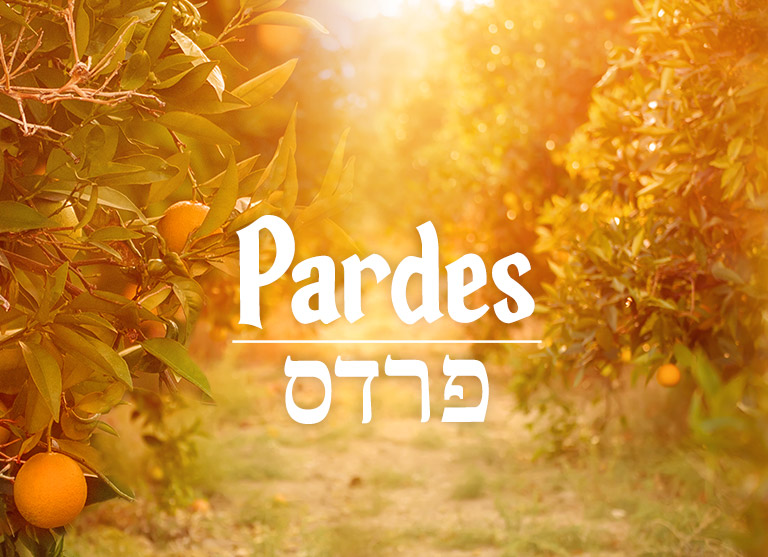
Walking With Him in The Garden

This image has an empty alt attribute; its file name is pardes-hebrew-yellow-1.jpg

“When the cool evening breezes were blowing, the man and his wife heard the Lord God walking about in the garden. So they hid from the Lord God among the trees.”

Genesis 3:8

I honestly have never had the wonderful experience of strolling a lush garden with my Father. At least not totally. But when I’m engaging the Word, pressing in to comprehend a passage, it’s as if I’m truly walking in His orchard with Jesus.

But there is something more to this.

This word “pardes” is also an acronym. The rabbis taught that there are four levels of understanding as we peer into a passage.

  • P’shat–the surface or literal meaning of a verse or passage.
  • Remez– the symbolic or applied reason of the Word. How it connects with my daily life.
  • Drash–how it fits into other parts of the Bible, forming a purposeful teaching.
  • Sod–a hidden meaning that resides “underneath” the verse. This seems when the Holy Spirit gets really involved in the way I live. (Some would say “mystical.)

Now I’m not sure that every passage reaches the “sod” level. (Maybe we’re not really aware?)

When we truly study God’s Word it’s as we walk in the garden. He reveals Himself to us. The Genesis story shows us where we can find Him. The important thing I suppose is trying to hide from God’s presence. We can’t.

We must come to our Father, and learn to walk with Him. The Bible is the best way to fellowship with Him.