If You Really Want to Worship, Use a Knife

In Biblical hermeneutics, the ‘Law of First Mention‘ is used. Essentially it means that the first time a word or a concept is mentioned should go on to determine the way it needs to be understood throughout scripture. It is a guiding principle more than anything, but a good one at that. Genesis, being the first book, is a blessed repository for many of these ‘first mentions.’

In Genesis 22, we have the story of Abraham and Isaac on Mt. Moriah.

Abraham has tied up his son on an altar to offer him as a sacrifice in obedience to God’s direction (v. 2). This is faith being tested to the ultimate extreme. And Abraham shows us how to enter in.

“Then on the third day Abraham lifted his eyes and saw the place afar off. And Abraham said to his young men, “Stay here with the donkey; the lad and I will go yonder and worship, and we will come back to you.”

Genesis 22:4-5

This is the first time that  the word “worship” is used in the Bible.

It sets the singular tone for all the scriptures on this subject. I guess what is interesting is there were no musical instruments involved. There was just these needful things:

  • stones,
  • wood,
  • rope,
  • fire,
  • a knife,
  • and Isaac, (the would-be ‘lamb.’)

When the Hebrew word for ‘worship’ was used for the first time; it is interlaced with the idea of an incredible sacrifice. Abraham is the first ‘worship leader’ and he has no guitar. No piano, or drums either. No musical instruments whatsoever. No overhead lyrics to speak of.

Just a handmade altar, and a knife.

In the end, Abraham raises that knife, and then suddenly, to the relief of us all, he is stopped. His faith has withstood the test, and he has truly ‘worshiped.’

But the Angel of the Lord called to him from heaven and said, “Abraham, Abraham!” So he said, “Here I am.” And He said, “Do not lay your hand on the lad, or do anything to him; for now I know that you fear God, since you have not withheld your son, your only son, from Me.”

Gen. 22:11-12

Principle One: There really can’t be worship without sacrifice.

Recovering this truth concerning worship would be beneficial. It seems we delegate ‘worship’ to a select few who are talented and gifted. We probably don’t do this deliberately, but sometimes we feel it makes a better presentation. We all want to look good, even Christians. (Perhaps this is more substantial than we know.)

Principle Two: The first worshiper didn’t use a guitar, but a knife.

This difference keeps the idea of sacrifice in its definition. There isn’t worship without sacrifice. The knife thrust that he was ready to wield wasn’t backed up by drums or piano. Yet Abraham understood worship every step to Moriah with the knife in his belt.

“The Scriptures include or allude to just about every approach to worship there is: organized, spontaneous, public, private, simple, complex, ornate or plain. Yet there is no comment anywhere about any one way being preferred over another. Rather, it is the spiritual condition of the worshiper that determines whether or not God is at work.”  

Harold Best

So, brothers and sisters, because of God’s mercies, I encourage you to present your bodies as a living sacrifice that is holy and pleasing to God. This is your appropriate priestly service.”

Romans 12:1

Ultimately, we must realize our sacrifice is the Lamb of God. It’s His blood on God’s altar for our sins. As believers, our faith firmly rests in this spiritual fact.

We of all people have cause to really worship.

A Summons to War

battle

Watch, O Lord, with those who wake or weep tonight, and give your angels and saints charge over those who slumber.

“Tend your sick ones, O Lord Christ, Rest your weary ones, Bless your dying ones, Soothe your suffering ones, Pity your afflicted ones, Shield your joyous ones,

And all for your love’s sake.”

Amen.

Augustine

Woven into this ancient ‘evening prayer’ is an idea of God meeting us with overflowing grace and kindness.  There is a strong sense of God watching everyone! And there is also a “tending” sense that He has overall.

As I read this prayer, I seem to focus on the single phrase, “shield your joyous ones.”  To think that these joyful people need protection strikes me as odd.  Why do they even need a “shield?”  Of all people, don’t they have it together?

God sees to our every need, and His flock can be incredibly needy.

As I thought it through, I started to realize that joy is its best standing in the shadow of warfare. The joyful ones are companions– “buddies” who share the same ‘fox hole’ on enemy lines.  But this isn’t a grim thing, Nehemiah told those trying to build the city walls,

“The joy of the Lord is your strength” 

Neh. 8:10

Joy connects with the desperate need of the moment; it is the muscle of all ministry.  And as a result, perhaps more vulnerable.

He didn’t say that the joy of the Lord is our happiness, cheeriness, or merriment. 

But rather, joy would impart strength, and stiffen one’s ability to go to war for our brothers and sisters, our churches, and our communities. There are certain epoxy resins that will only harden when a special light is used on them.  Maybe joy transforms into strength when we step toward our Father.

We need to spiritually protect and cover those who are His “joyous ones.”  They can be found sprinkled throughout our churches and ministries.  And they need us to shield them.  They seem to be quite exceptional, and seemingly invulnerable.  But that isn’t the case.  We need to pray for them. Joyful people inspire me in battle.

“The joy of the Lord will arm us against the assaults of our spiritual enemies and put our mouths out of taste for those pleasures with which the tempter baits his hooks.”     Matthew Henry

20 Quotes for the Believer at Christmas

Some quotes on the meaning of Christmas:

He was created of a mother whom He created. He was carried by hands that He formed. He cried in the manger in wordless infancy, He the Word, without whom all human eloquence is mute.    

–Augustine

There were many who saw the babe, but did not see the salvation.  

–Author Unknown

For the Christ-child who comes is the Master of all; No palace too great, no cottage too small.  

 –Phillips Brooks

Rejoice, that the immortal God is born, so that mortal man may live in eternity.    

–John Hus

His poverty was so great that He was born in another man’s house, and buried in another man’s tomb.    

–John Boys

It is here, in the thing that happened at the first Christmas, that the most profound unfathomable depths of the Christian revelation lie. God became man; Nothing in fiction is so fantastic as this truth of the incarnation.  

–J.I. Packer

Who can add to Christmas? The perfect motive is that God so loved the world. The perfect gift is that He gave His only Son. The only requirement is to believe in Him. The reward of faith is that you shall have everlasting life.  

–Corrie Ten Boom

The Almighty appeared on earth as a helpless human baby, needing to be fed and changed and taught to talk like any other child. The more you think about it, the more staggering it gets. Nothing in fiction is so fantastic as this truth of the Incarnation.  

— J.I. Packer

There were only a few shepherds at the first Bethlehem. The ox and the donkey understood more of the first Christmas than the high priests in Jerusalem. And it is the same today.    

–Thomas Merton

Christmas is based on an exchange of gifts, the gift of God to man – His unspeakable gift of His Son, and the gift of man to God – when we present our bodies a living sacrifice.   

 –Vance Havner

The idea that there’s a force of love and logic behind the universe is overwhelming to start with, if you believe it. Actually, maybe even far-fetched to start with, but the idea that that same love and logic would choose to describe itself as a baby born in shit and straw and poverty is genius, and brings me to my knees, literally. To me, as a poet, I am just in awe of that. It makes some sort of poetic sense. It’s the thing that makes me a believer, though it didn’t dawn on me for many years.    

–Bono

The central miracle asserted by Christians is the incarnation. They say that God became man.   

— C.S. Lewis

Infinite, and an infant. Eternal, and yet born of a woman. Almighty, and yet hanging on a woman’s breast. Supporting a universe, and yet needing to be carried in a mother’s arms. King of angels, and yet the reputed son of Joseph. Heir of all things, and yet the carpenter’s despised son.   

–Charles Spurgeon

Carols stir us. Holy words inspire us. The golden glow from the manger warms us. A little religion at Christmas is fine. But that glow in the manger comes from the Light of the world. It exposes evil and either redeems it or destroys it. The babe in the manger is far more than an object for sentimental sighs. He is the Son of God who must be accepted as ruler – or confronted as rival.  

–John G. Stackhouse, Jr.

It is good to be children sometimes, and never better than at Christmas when its mighty Founder was a child Himself.  

–Charles Dickens

Christmas is for children. But it is for grown-ups too. Even if it is a headache, a chore, and a nightmare, it is a period of necessary defrosting of chilled hidebound hearts.  

–Lenora Mattingly Weber

Hark the herald angels sing,
Glory to the newborn king.”
Peace on earth, and mercy mild,
God and sinners reconciled.

–Charles Wesley

This Gospel anticipates a world far different from C.S. Lewis’s Narnia, where it is “always winter, and never Christmas.” The promise of the Gospel is that it is “always Christmas.”  To be “in Christ” is to enjoy each morning as a Christmas morning with the family of God, celebrating the gift of God around the tree of life.  

–Kevin VanHoozer

The spirit of Christmas needs to be superseded by the Spirit of Christ. The spirit of Christmas is annual; the Spirit of Christ is eternal. The spirit of Christmas is sentimental; the Spirit of Christ is supernatural. The spirit of Christmas is a human product; the Spirit of Christ is a divine person. That makes all the difference in the world.  

–Stuart Briscoe

Here’s a side to the Christmas story that isn’t often told: Those soft little hands, fashioned by the Holy Spirit in Mary’s womb, were made so that nails might be driven through them. Those baby feet, pink and unable to walk, would one day walk up a dusty hill to be nailed to a cross. That sweet infant’s head with sparkling eyes and eager mouth was formed so that someday men might force a crown of thorns onto it. That tender body, warm and soft, wrapped in swaddling clothes, would one day be ripped open by a spear. Jesus was born to die.    

–John MacArthur

The Present Tense Jesus

All we really have is the present moment. The past is gone, you can’t change it. The future isn’t here yet, we really have no idea what it’ll bring. But we have the now, and Jesus reveals Himself to us, right now.

This doesn’t mean the past or future is irrelevant or unimportant.

God redeems our past, and our future as believers are filled with His precious promises. This is no small thing. We learn from our past, and believe Jesus will be there for our future. I cannot or won’t diminish this. Both our past, and our future, matter. We learn (reflect) and trust (faith).

But Jesus often refers to the present moment. For instance, in the Gospel of John, the Lord uses the immediate now to explain who He really is. (There are seven of these here and now verses.) He says I am, and that is right now.

Notice: Not I was, or I will be, but now in this present moment, Jesus says, “I am.

Due to grammatical rules, “I am” must be translated, from the original Greek, as present tense, and 99% of every Bible translation agrees. “I am” is right now, in the present tense. Not I was, or i will be. (Sorry, I am being redundant here.)

The Seven I AM Statements of Jesus as found in John’s Gospel.

  • I am the bread of life.” (John 6:35, 41, 48, 51)
  • “I am the light of the world.” (John 8:12) 
  • “I am the door [or gate] of the sheep.” (John 10:7, 9) 
  • “I am the good shepherd.” (John 10:11, 14) 
  • “I am the resurrection and the life.” (John 11:25) 
  • “I am the way, the truth, and the life.” (John 14:6) 
  • “I am the true vine.” (John 15:1, 5) 

Because these characteristics are neither past or future we can be confident that these are in the now. We know that God doesn’t change, “Jesus Christ is the same yesterday and today and forever.” (Hebrews 13:8.)

So, when you wait on God, it’s all in the present moment.

The “I am” is now. When He states “I am the bread of life,” we understand that Jesus wants us to come and dine, right now. When he says, “I am the good shepherd,” it is meant for me being in His flock, right now.

Why does this even matter?

Well first of all, it gives us confidence that Jesus is our present tense Savior. He is always there. Furthermore we’re not trapped in the distant past or the nebulous future. We only have the now– this present moment. When this present moment happens, it slides into the past.

I guess this idea is a bit of a shocker for me.

Living in the now and gripping on Jesus when I pray and worship, or read the Word gives me the powerful sense that He is present. He’s now focusing on me. I do admit that my past life has been terrible, I can’t live there, and my future, well, it only builds on the now.

It has taken me almost 40 years to see this.

Moses understood this concept. God said to Moses, “I am who I am. And he said, “Say this to the people of Israel: ‘I am has sent me to you.’” (Exodus 3:14.) These emancipated slaves needed the present tense “I am God” to lead them every step of the way. They needed Him every morning–everyday.

Be aware of Him in this present moment. Jesus is waiting for you. It’s time to press into the Lord of the now. I believe He can’t wait for you to join Him. He stands at your door, and knocks. Please let Him in.

We See So Little

Job 26:14

Job’s suffering has led him to this point. He realizes how little he understands God. I guess pain can have a powerful effect on how we see things. Job has learned the immensity of God.

In verse 14 he speaks about the “outskirts” the word in Hebrew means the mere edge, or fringe. One translation of this verse reads like this: “These are only a few of the things that God does. We only know about a few small things. If he used all of his power, we could never understand.

“That being the case, let’s consider God’s capacity for just a moment. He’s not only “high capacity”, He’s “infinite capacity.” He never sleeps or slumbers. He is perfect in all His abilities. There isn’t a single thing that He doesn’t know, and there is no one more powerful than Him. And unlike humans who can only be in one place at one time, He is everywhere at the same time. This is amazing, and just like the Psalmist said in Psalm 113, “Who is like the Lord our God?” The answer, very simply, is no one.”

John Piper

“For now we see in a mirror dimly, but then face to face. Now I know in part; then I shall know fully, even as I have been fully known.” (1 Cor. 13:12)

I’m thinking about Moses who asked to see God’s glory. Moses was called “the friend of God,” but he wanted to see more. God’s response was that He couldn’t because it would kill Moses. But provision was made for him to see the backside of God as Moses was in a cleft of a rock. (Exodus 33.)

The Bible doesn’t reveal it all. But we’re given enough. Job told us that only the outer fringes can be seen by men and women. We see His periphery, but we must understand our limits. We’re told that we will see Him someday–but not yet. But at the moment of death, we will see Him.

The Lord Jesus came to show us the Father. “In [Christ] all the fullness of deity dwells bodily.” When we see Jesus we see the Father. Reading the Gospels we are encountering God, because Jesus reveals Him fully.


“He is the radiance of the glory of God and the exact imprint of his nature, and he upholds the universe by the word of his power.” 

Hebrews 1:3

Romans 11:33

alaskabibleteacher.com

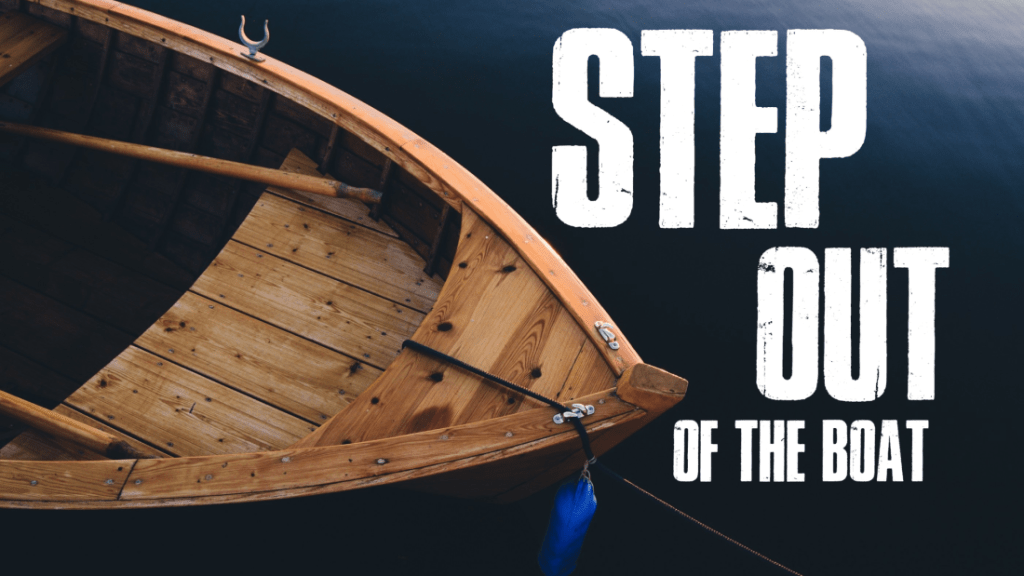
Leaving Your Boat Behind

27 “But immediately Jesus spoke to them, saying, 

“Take heart; it is I. Do not be afraid.”

28 And Peter answered him, “Lord, if it is you, command me to come to you on the water.” 29 He said, “Come.” So Peter got out of the boat and walked on the water and came to Jesus.”

Matthew 14:27-29, (context, vv. 22-33)


Jesus is full of surprises! You can never guess the things He will do next. He is Lord after all. To walk on water is totally impossible. But Jesus does it. He walks on it as if it were a concrete sidewalk. When they see Him they freak out. They couldn’t believe their eyes.

Jesus wants to reveal to His disciples His true nature.

They had just seen Him multiply fish and loaves, He fed five thousand plus just a few hours ago. Wasn’t that a miracle enough? It seems that Jesus doesn’t think so.

For some inexplicable reason, Peter wants to insert himself into Jesus’ miracle. Oddly, he has decided he’ll join Jesus, and leave behind the security of the boat–for the insecurity of the impossible! He truly believes that Jesus can hold him up somehow. Perhaps this alone is the most amazing part of this passage. Can a man duplicate the walk of Jesus? Can we walk like Him?

Peter really wants to leave the security of the boat, for the insecurity of the impossible.

It seems to me that we’re constantly doing the “Peter thing.” It’s true our walk of faith really is intensely supernatural, and yet we somehow forget this. And face it, we’ll never generate the “fruits of the Holy Spirit” on our own. Our most sincere efforts will never turn water into something solid.

We will never walk the disciple’s path without faith in the Master who calls us to come to Him.

I think Jesus wants us to join Him. Our faith in Him is the key. We believe that we can walk with Him, we believe we will see the impossible. Without question it’s Jesus’ power that holds us up. Our faith in Him is the ignition point in all of this. Our mustard seed faith, combined with Jesus’ power. becomes the true walk of the disciple.

We must bravely launch ourselves into the purposes of God. Jump when God puts opportunity in your path.

To merely sit in the boat is hardly faith. When Peter steps over the gunwales, he steps into the world of the amazing. The water holds him, and his trust in Jesus solidifies like the water he walks on. He is now doing the impossible. He’s now becoming very much like Jesus.

Our walk seems terribly weak at times, we can easily list our sin and weaknesses. We’re not quite convinced that the blood of Jesus covers all our sin–and therefore we can’t step out of the boat. I think it’s Peter’s faith in Jesus’ power that holds him up.

When his faith falters, he does the “rock thing,” There is something about his circumstances–the wind, and the waves that begin to frighten him. (But I must believe Jesus was pleased.)

To really understand, to obey Jesus is to step out of our boat in faith; when we do we’ll start to see miracles happen.

“Christ will always accept the faith the puts its trust in Him.”

-Andrew Murray


alaskabibleteacher.com

Getting Ready for Water Baptism

water-baptism1

“Those who accepted his message were baptized.”

Acts 2:41 

 “Repent and be baptized.”

Acts 2:38 

 “Having been buried with him in baptism and raised with him through your  faith in the power of God.”

Col. 2:12 

Perhaps the most significant decision we’ll make is to follow Jesus Christ into the waters of baptism.  This is just obedience to the Lord’s command to be baptized. Discipleship begins when we appropriate baptism into our faith. Ideally, it should forever alter your life. At least that is the Father’s intention.

It takes faith to be authentically prepared for baptism.  You will be taking a stand. By faith, you’re making public your allegiance to Christ. It is an important and critical step.

“Baptism was to put a line of demarcation between your past sins when you are buried with Him by Baptism–you are burying your past sins–eradicating them–putting a line in the sand saying that old man is dead and he is no longer alive anymore and I rise up to walk in the newness of life.”

T.D. Jakes

I suggest that you prayerfully attend examine the process listed below.  You’ll find there’s a big difference between truly being baptized, and just getting wet!

The interrogative process can be used to solidify the faith before man and in front of His people. In a sense, it’s much like the vows made by a husband and wife in the vows of marriage.

Here are some suggestions you should consider:

A series of questions are asked, to which the reply is always, “I renounce them.”

  1. Do you renounce Satan and all the spiritual forces of wickedness that rebel against God?
  2. Do you renounce the evil powers of this world that corrupt and destroy the creatures of God?
  3. Do you renounce all sinful desires that draw you from the love of God?

The second half also must be asked, to which the reply is always, “I do.”

  1. Do you turn to Jesus Christ and accept him as your Savior?
  2. Do you put your whole trust in his grace and love?
  3. Do you promise to follow and obey him as your Lord?

The Apostle’s Creed can be recited publicly (or privately in prayer).

This creed is our faith boiled down to its core essence. This declaration helps set us apart from the World, the flesh, and the devil:

“I believe in God, the Father Almighty, maker of heaven and earth. And in Jesus Christ, his only Son, our Lord,

who was conceived by the Holy Spirit, and born of the Virgin Mary, suffered under Pontius Pilate, who was crucified, died and was buried.

He descended into hell. and on the third day, He rose again from the dead. He ascended into heaven and sits at the right hand of the Father. From thence He will come to judge the living and the dead.

I believe in the Holy Spirit, the holy catholic Church,  the communion of saints, the forgiveness of sins, the resurrection of the body, and the life everlasting. Amen.”

We need to develop these into a living discipleship; you’ll see that water baptism is analogous to a master key that opens the door to a special joy. Obeying the command to be baptized pleases Jesus. And that is what we long to do.

“Indeed, baptism is a vow, a sacred vow of the believer to follow Christ. Just as a wedding celebrates the fusion of two hearts, baptism celebrates the union of the sinner with the Savior.”

–Max Lucado

“Baptism is an outward expression of inward faith.”

–Watchman Nee

“Baptism separates the tire kickers from the car buyers.”

    –Max Lucado

A special word to “older” believers:

There may come a time when you feel that you would want to be baptized again.  I believe that this is not only allowable but commendable.  You may have not had a good understanding of the baptismal process, but now it makes more sense to you.  I would encourage you to follow your heart. God will honor your re-dedication.

Ask your pastor or an elder what they think.

1brobry-sig

You may copy and distribute this post in its entirety.

The Absolute Danger in Exalting Yourself

Now he told a parable to those who were invited, when he noticed how they chose the places of honor, saying to them, “When you are invited by someone to a wedding feast, do not sit down in a place of honor, lest someone more distinguished than you be invited by him, and he who invited you both will come and say to you, ‘Give your place to this person,’ and then you will begin with shame to take the lowest place. 

10 But when you are invited, go and sit in the lowest place, so that when your host comes he may say to you, ‘Friend, move up higher.’ Then you will be honored in the presence of all who sit at table with you. 11 For everyone who exalts himself will be humbled, and he who humbles himself will be exalted.”

Luke 14:7-11, ESV

Choose your seat carefully. In Jesus’ day, there was a definite seating order to a wedding feast. It wasn’t first come, first served. There was a strict protocol, where one’s importance mattered.

Honored people got honorable seats–close to the front as possible. Average people got average spots; but no one wanted be at the bottom, having to sit at the “kids table.”

Jesus was watching, and he what he saw was a spiritual principle of his Kingdom.

Jesus often teaches us out of the things we encounter.

Truth often hits us from those things we actually see. If you want to know what God is doing in your life, all you need to do is look around at the practical things, and start to see the spiritual lessons inside them. We learn from real-life. That’s how he often teaches us, he combines the Word with what we’re experiencing.

Our natural inclination is to move higher up.

We think that we’re deserving, and so we take our rightful positions. That’s the way humans think. We all want to sit in the best possible place, and so we end up wheedling our way up front. We can fall into the subtle trap of self-promotion. But that’s not how discipleship works.

Jesus corrects, advising us to take the lowest place.

I think verse 11 is the key to figuring out this seating arrangement. We’re starting to see a physical situation become a spiritual lesson. There’s much to learn. Here’s verse 11 in the Amplified version:

For everyone who exalts himself will be humbled [before others], and he who habitually humbles himself (keeps a realistic self-view) will be exalted.”

Luke 14:11

This particular translation injects some realism into our lives, especially in how we see ourselves. It’s quite foundational. It lays down a principle that is always true in his Kingdom (1 Peter 5:6). If we don’t accept and implement this, we’ll suffer a definite weakness in our discipleship. It stunts the growth of many believers. And that is tragic.

The whole scene lays out how life in the spirit really works, and it seems paradoxical.

Our human logic asserts that deliberately choosing the lesser is foolish, things really don’t work that way. We think, (falsely,) that we’ll only advance by asserting ourselves. But Jesus, quite aptly, clarifies the ways of the Kingdom.

True maturity will only come if we decide to take the lowest place.

James 4:10

alaskabibleteacher.com

The Seed Must Grow

26 And he said, “The kingdom of God is as if a man should scatter seed on the ground. 27 He sleeps and rises night and day, and the seed sprouts and grows; he knows not how. 28 The earth produces by itself, first the blade, then the ear, then the full grain in the ear. 29 But when the grain is ripe, at once he puts in the sickle, because the harvest has come.”

Mark 4:26-29

From a seed to a plant. We have no idea how this happens, it just does. This is a “kingdom” parable, one of several that explain what God’s realm is, and how it happens. In this particular story, we’re told how the Holy Spirit works. It also explains our role in this (which isn’t a whole lot).

The farmer puts the seed in the ground—and that’s it.

He’s done his work, there’s nothing more he can do. He doesn’t do anything else from this point, and honestly he can’t. And yet the soil needs to be prepared—plowed, fertilized and tilled again. You might say he creates the conditions (that’s what makes a good farmer, I guess) for something to happen.

He doesn’t massage the seed, coaxing it to grow.

He doesn’t sing to it, or tell it about the wonders of being lush and green. He does zero. The seed grows on its own. He goes to bed, and gets up. After several days, bingo! That seed turns into a plant—something green and alive. He doesn’t do a thing. Life occurs without his work.

The point is this. God’s work is done invisibly within us (and that’s a relief)!

Robertson’s Commentary

God’s kingdom works pretty much like this. The farmer doesn’t cause the seed growth, all he does is go to bed! He sleeps and waits and watches. It grows and he hasn’t the slightest. It’s a complete mystery. He has done everything he can, and God has done the rest. He “shares” in this amazing transformation, but the father has done it all.

We trust in a process we cannot see, or really understand.

We don’t dig the seed up every morning to see what’s happening. We just let the (super)natural happen. And it does!

The farmer has faith in the process (after all, he did plant the seed), but that’s it. There’s a verse in 1 Corinthians that should be considered. It gives us confidence and a definite trust in this process of growth. The Apostle Paul understands this “principle of growth.”

“So neither he who plants nor he who waters is anything, but only God who gives the growth.”

1 Cor. 3:7

We must trust God completely to grow. We’re responsible for tilling and planting. But you need to understand what happens after that is up to him. The kingdom of God is supernatural. It’s exactly how the kingdom happens—and we must be very patient and incredibly wise.

“There is nothing more important to learn about Christian growth than this: Growing in grace means becoming like Christ.”

     Sinclair B. Ferguson

alaskabibleteacher.com

You Need to Understand This

Finally, be strong in the Lord and in the strength of his might. 11 Put on the whole armor of God, that you may be able to stand against the schemes of the devil. 

For we do not wrestle against flesh and blood, but against the rulers, against the authorities, against the cosmic powers over this present darkness, against the spiritual forces of evil in the heavenly places.

Eph. 6:10-12, ESV 

Often in Scripture we’ll understand something which will shake us. Dismissing its truth as optional would be a grave oversight. Instead of perceiving it as a mere emphasis reserved for those more inclined towards “charisma,” we must insist on its relevance for each and every believer.

We face a battle. Every one of us.

We look around and see others whose ‘reality’ is different from ours. We see politics, psychology, biology or cosmology, religion or philosophy, entertainment or science that are blind to reality. But Ephesians 6 tells us what we’re up against. We’re starting to realize that humans have a terrible knack for being manipulated by evil powers.

1 John 5:19, Amplified

Ephesians 6 declares that we’re in a world where every individual is in a war.

This passage clearly tells us that the only place of safety is to be strong in God and to find that the only safety is pressing into His presence. To survive we must push everything else aside to be in His presence. He gives us His strength to overcome all evil.

The above passage stresses that there is an organized force of darkness focused on us. These verses in Ephesians 6 unveil a government of wickedness that’s everywhere. Without the humble intimacy that needs prayer and Bible reading, we will be spiritually destroyed.

C.S. Lewis

We need protection. Our only hope is Jesus’ strength. But we must actively step into this spiritual intensity.

We’re only strong through our intimacy with Him. He shields us from the spiritual corruption that swirls all around us. As we draw to Him we become mighty, as we listen closely to the Holy Spirit, we will walk in true discipleship with Jesus.

Watchman Nee

alaskabibleteacher.com