How to Die Well

“Even though I walk through the valley of the shadow of death, I will fear no evil, for you are with me; your rod and your staff, they comfort me.”

Psalm 23:4, ESV

“Precious in the sight of the Lord is the death of his saints.”

Psalm 116:15

“Death is like my car. It takes me where I want to go.” 

Pastor John Piper

Our generation simply doesn’t know how to die well.  There are many conflicting messages and attitudes which have steered us away from the reality of dying.  Much of it is the natural development of unbelief.  Our pop culture develops this and gives it momentum.  We are trying to convince ourselves that “death is impossible, my life will not end.”  But we’re escaping into a delusion. And it only intensifies as we age. 

We are running from what is real.

There is a Latin phrase,  Ars moriendi  (“The Art of Dying”) which the Church practiced in past generations.  In the past, Christians would be buried as close as possible to a Church building.  Many would be interred within the very walls of the Church.  The understanding was that the dead were part of the congregation.  That there was only a thin veil that stood between the living and the dead.  

The dead didn’t just vanish. They still live. We just don’t see them.

Our generation is confused.  We have forced death to wear a mask.  We insist on a significant camouflage to hide the reality of sickness and death.  No one really ever talks about it, and so no instructions are given on how to die well. So we don’t, and we die poorly–often in ICUs. We die sedated, separated and unable to process dying. We never help our families process it. 

For many, the fear of dying is intense and paralyzing.  

It’s time for the Church to step up and guide us to our next step.  Our pastors and elders have got to prepare us to die well.  It is a part of being a disciple.  It is discipleship, and dying is inclusive.  We need somebody to prepare us for the inevitable and the certainty that is approaching us.  I need someone that will help me face my own death.

You know what?  No one escapes.  

And the reality of that drives some of us mad, or addicted, or psychotic.  The idea of filling a casket up for forever is incomprehensible.  We cannot live with this sick idea of dying.  It disturbs us on the deepest level possible.  It is completely evil.

Psalm 23 has been pure comfort and healing for generations.  And it is an excellent starting point for us.  Verse 4 develops the idea of traversing death.  The writer has incredible insight of passing through death.  This verse alone is worth billions of dollars in gold.

Psalm 23 has been pure comfort and healing for generations.  And it is an excellent starting point for us.  Verse 4 develops the idea of traversing death.  The writer has incredible insight of passing through death. Psalm 23 has made me a very wealthy man.  His Word has become my rich treasure.

“Some day you will read in the papers that D.L. Moody of East Northfield, is dead. Don’t you believe a word of it! At that moment I shall be more alive than I am now; I shall have gone up higher, that is all, out of this old clay tenement into a house that is immortal- a body that death cannot touch, that sin cannot taint; a body fashioned like unto His glorious body.”

    D.L. Moody

But God…

But God, being rich in mercy, because of the great love with which he loved us, even when we were dead in our trespasses, made us alive together with Christ — by grace you have been saved.”

(Ephesians 2:4–5)

But God. Short words with a powerful meaning, used over 4100 times in the Bible (every 7 verses). It’s used to imply intervention and change, typically a holy interruption of some kind. This verse in Ephesians 2 describes the Father getting involved in a tangible way.

We were terribly lost–actually the Bible says, “dead.”

But He is rich in love and mercy, and it’s grace (and only grace] that makes us alive. Now we’re not reformed or rehabilitated. These are good words, but the verse describes a resurrection–a revivification. The dead live!

Jesus actually resurrects each believer.

“But God.” Joseph learned that “all things work together for good.” His brothers cruelty sold him into slavery and even though he endured prison, he would become the prime minister of Egypt. After many years his wicked brothers come before him. Revenge? Not on your life.

“As for you, you meant evil against me, but God meant it for good in order to bring about this present result, to preserve many people alive.

Genesis 50:20

Let God have His way with you. Acknowledge His sovereignty by allowing Him to interrupt when He wants to. He is active in our lives. Having resurrected us from the dead, the Holy Spirit becomes actively involved in our lives (and He brings us grace and beauty).

If you do this, I expect great things for you.

“My flesh and my heart may fail, But God is the strength of my heart and my portion forever.”

Psalm 73:26


Purity in an Impure World

First, let’s start off with a definition. Purity describes something that is not mixed with anything else. It’s not 80% of something, or even 99.9%, rather it’s fully and completely one thing. Purity also means to be solely without any additive, contamination or pollution.

Purity of heart is to be exclusively focused on one thing.

This verse, 5:8, “strikes the very center of the target as he says, not ‘Blessed are the pure in language, or the pure in action,’ much less ‘Blessed are the pure in ceremonies, or in raiment, or in food;’ but ‘Blessed are the pure in heart.’” (C.H. Spurgeon)

We really must see this world as God sees it. 

We find that scripture is not very kind to us. It seems that mankind defiles everything he touches. (I wish it wasn’t so.)

“The human mind is the most deceitful of all things. It is incurable. No one can understand how deceitful it is.” Jeremiah 17:9

Consider the following areas that are affected by out “fallenness:

  • Entertainment, movies, the internet 
  • Politics, local, national and world 
  • Religion, philosophy, theology and spirituality
  • Culture and art, literature and music
  • Education
  • Science and technology, medicine and psychology
  • Economics, wealth and poverty
  • Sexuality

The above list is hardly complete, and as I compiled it I got a little heavy-hearted. I had to ask myself, are we really this bad? Again the Christian must look at the Bible for wisdom and direction.

 “All have sinned and continually fall short of the glory of God.” Romans 3:23

“The heart of the sons of men is full of evil, and madness is in their heart while they live.” Ecclesiates 9:3

As Christians who spiritually understand the work and the love of Jesus Christ. We are called to know and love God, must continually reacquaint ourselves to the absolutely depraved condition of this world. No one, and nothing is exempt.

There is another verse I want to consider, it mentions purity twice!

“Having purified your souls by your obedience to the truth for a sincere brotherly love, love one another earnestly from a pure heart,” 1 Peter 1:22

Notice. The verse stresses that we have to take the initiative. Now I suspect that being pure is our responsibility. “Obedience to the truth” must lead to “brotherly love.” It’s not really a surprise that that’s where we end up. 

To really see God, and to truly love others, requires purity. 

When it comes to being pure we must become humble–that’s our starting point. Humility keeps purity from becoming false. We dare not become “holier-than-thou.” We can easily become hard, religious and judgemental. Becoming a “Pharisee” is easy and always possible.

Lower Seat Christians

Luke 14:7-11

Choose your seat carefully. In Jesus’ day, there was a definite seating order to a wedding feast. It wasn’t first come, first served. There was a strict protocol, where one’s importance mattered. Honored people got honorable seats–close to the front as possible. Average people got average spots; but no one wanted be at the bottom, having to sit at the “kids table.”

Jesus was watching, and what he saw was a spiritual principle of His Kingdom.

Jesus often teaches out of the things we encounter–real life events. Spiritual truth often hits us from those things we actually see. If you want to know what God is doing in your life, all you need to do is look around at the “practical” things, and start to see the spiritual lessons inside them. We learn from real-life. That’s how he often teaches us, he combines the Word with what we’re experiencing.

Our natural inclination is to move higher up.

We often think that we’re deserving, and so we take our “rightful” positions. That’s the way humans think. We all want to sit in the best possible place, and so we end up wheedling our way up front. We can fall into the subtle trap of self-promotion. But that’s not how discipleship works.

Jesus corrects, advising us to take the lowest place. I think verse 11 is the key to figuring out this seating arrangement. We’re starting to see a physical situation become a spiritual lesson. There’s much to learn. Here’s verse 11 in the Amplified version:

“For everyone who exalts himself will be humbled [before others], and he who habitually humbles himself (keeps a realistic self-view) will be exalted.”

Verse 14, Amplified Bible

This translation injects some realism into our lives, especially in how we see ourselves. It’s something quite foundational. It lays down a principle that is always true in his Kingdom (1 Peter 5:6). If we don’t accept and implement this, we’ll suffer a definite deficiency in our discipleship. It stunts the growth of many believers. And that is tragic.

The whole scene lays out how life in the spirit really works, and it seems terribly paradoxical.

Our human logic asserts that deliberately choosing the lesser is foolish, things really don’t work that way. We think (falsely), that we’ll only advance by asserting ourselves. But Jesus, quite aptly, clarifies the ways of the Kingdom–true maturity will only come if we decide to take the lowest place.

“Humble yourselves before the Lord, and he will exalt you.”

James 4:10

The Great Sculptor’s Shop

Romans 9:20, ESV

“Christianity is a world that is a great sculptor’s shop. We are the statues and there a rumor going around the shop that some of us are some day going to come to life.”

     C.S. Lewis

Scripture describes the process of becoming like Jesus in different ways. But one is a potter fashioning something beautifully useful. He works to bring out something good from that which is formless. Both the potter, and the sculptor, fully intend to create something out of improbable clay or hard marble.

What sculpture is to a block of marble, so is a person who is being shaped into the image of God.

“For we are his workmanship.” Ephesians 2:10

The word used for workmanship is ποίημαpoíēma, and this word strongly suggests something that a creator does, and it’s also used in Genesis 1 to describe God making the earth. I suppose that it’s His “work” that goes into the reality of all we see. He designs it all.

God is also a sculptor, but not one limited to granite or marble.

Instead, He sculpts our characters. He can take a sinful human being and mold and chisel and hammer away until that person reflects something of heaven’s glory. 

The Sculptor must do with us as the sculptor did with the stone. He must bring to bear upon us the sharp chisel of circumstances, of disappointment, of trial. These are tough, and sometimes painful. It seems that these things will destroy us.


God is a sculptor, but not one limited to granite or marble. Instead, He sculpts our character. He can take a sinful human being and mold and chisel and hammer away until that person reflects something of heaven’s glory.

Let Him do the work of the Spirit in you. As He chips away it may seem like destruction. But the sculptor is a master, he has studied the marble and knows exactly what it takes to shape out what He wants.

Trust in His wisdom and love. He knows what He is doing. Of that I have no doubt.

Can you accept God’s tools? Do you trust Him?

alaskabibleteacher.com

Love Wears Work Gloves

 “But if anyone has the world’s goods and sees his brother in need, yet closes his heart against him, how does God’s love abide in him?”

“Little children, let us not love in words or talk but in deeds and in truth.”

1 John 3:17-18, ESV

Love is a noble idea, it’s admired and extolled by practically everyone–we see it in our music and poetry, ethics and religion. For the most part it’s a word for something decent and virtuous and honorable. It’s a good thing, but I’m afraid it’s not always scriptural.

You see, Bible love wears work gloves.

It labors and sweats. Bible love has chores to do, and it actively looks and sees what needs to be done. 1 John 3 tells us that we shouldn’t deceive ourselves and only see the world’s definition. That love that a believer has is to be different.

Love, in John’s eyes, is most assuredly “doing.” It burns spiritual calories as it labors to serve our brothers and sisters. Love finds things it can do–it doesn’t just talk but it gets busy. Love sees the need and then gets down to serve.

“You must show sincere love to each other as brothers and sisters. Love each other deeply with all your heart.”

1 Peter 1:22

Working (serving) has nothing to do with our salvation, that is a free gift. We’re saved by grace through the blood of Jesus–that’s a given. And this serving love isn’t drudgery, as a matter of fact, working and serving each other is a joy. The deepest kind of joy there is.

Our words, although important, are really an insufficient way of proving our authenticity.  The love we serve another with isn’t “pretty poetry” kind of love. It’s so easy to just shout out truth and never ever show a working, serving kind of love. 

That disconnect is a bit disconcerting. When do we suppose we figure out that His love is actually a verb?


Walking With Him in The Garden

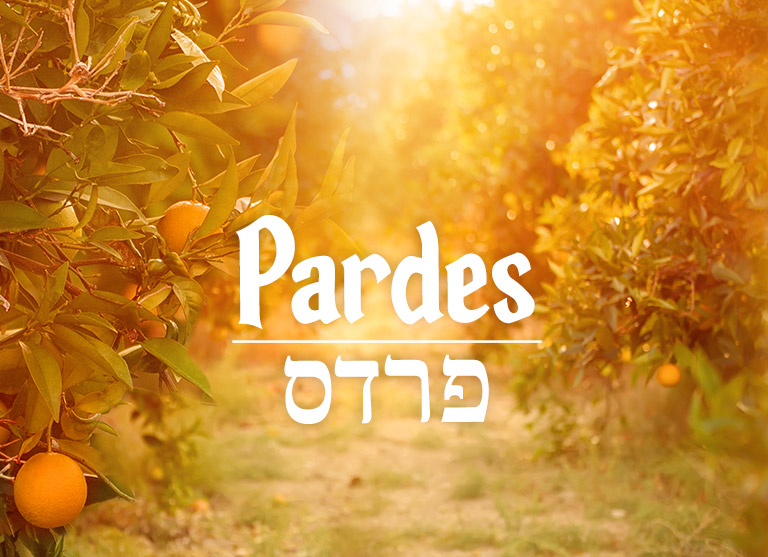
This image has an empty alt attribute; its file name is pardes-hebrew-yellow-1.jpg

“When the cool evening breezes were blowing, the man and his wife heard the Lord God walking about in the garden. So they hid from the Lord God among the trees.”

Genesis 3:8

I honestly have never had the wonderful experience of strolling a lush garden with my Father. At least not totally. But when I’m engaging the Word, pressing in to comprehend a passage, it’s as if I’m truly walking in His orchard with Jesus.

But there is something more to this.

This word “pardes” is also an acronym. The rabbis taught that there are four levels of understanding as we peer into a passage.

  • P’shat–the surface or literal meaning of a verse or passage.
  • Remez– the symbolic or applied reason of the Word. How it connects with my daily life.
  • Drash–how it fits into other parts of the Bible, forming a purposeful teaching.
  • Sod–a hidden meaning that resides “underneath” the verse. This seems when the Holy Spirit gets really involved in the way I live. (Some would say “mystical.)

Now I’m not sure that every passage reaches the “sod” level. (Maybe we’re not really aware?)

When we truly study God’s Word it’s as we walk in the garden. He reveals Himself to us. The Genesis story shows us where we can find Him. The important thing I suppose is trying to hide from God’s presence. We can’t.

We must come to our Father, and learn to walk with Him. The Bible is the best way to fellowship with Him.

Going to War

13 Therefore take up the whole armor of God, that you may be able to withstand in the evil day and having done all, to stand firm. 14 Stand therefore, having fastened on the belt of truth and having put on the breastplate of righteousness, 15 and, as shoes for your feet, having put on the readiness given by the gospel of peace. 16 In all circumstances take up the shield of faith, with which you can extinguish all the flaming darts of the evil one; 17 and take the helmet of salvation, and the sword of the Spirit, which is the word of God,

Eph. 6:13-17, ESV

You’re called to be armor-plated. Ephesians is quite clear about this, and we DARE not live without spiritual protection, and as a matter of fact, we must wear each piece to survive spiritually. To be ‘naked’ is to invite disaster. Neglecting to dress appropriately brings cataclysmic disaster. We dare not minimize the need for armor.

Each piece listed must be worn. This is a scriptural mandate for every believer in Jesus.

“The whole armor of God” explains the equipment we need to survive spiritually. Here’s a list and a brief comment on the six:

  • The belt of truth–this pulls everything together and holds us and keeps us secure in the truth.
  • The breastplate of righteousness–our spiritual heart is protected by knowing we’re accepted by the Father. Being right with God is not a feeling nor is it a mere hopeful wish.
  • The shoes of the gospel (of peace)–the idea of standing in place (“to stand”) explain our ability to be fixed on grace. When we wear battle shoes we cannot be pushed back or lose our footing. Wearing gospel shoes brings us spiritual stability. We can stand in place, rooted and strong.
  • The shield of faith–is a vital way of protecting ourselves from the evil arrows shot by the enemy. Satan targets us when he thinks that we aren’t using faith to defend ourselves.
  • The helmet of salvation–this is the realization that our mind is protected. This vital piece brings us wholeness as we understand what Jesus has done. We know we are saved and wearing our helmet is our protection from demonic-inspired lies.
  • The sword of the Holy Spirit–the only offensive weapon we have, and it’s all we need. The Word of God will frighten the enemy and push him back. The Word slices and cuts down every obstacle and every lie.

Only those who are spiritual perceive the reality of the spiritual foe and hence engage in battle. Such warfare is not fought with arms of the flesh. Because the conflict is spiritual so must the weapons.

     Watchman Nee

I must stress that clothing yourself is vital. You dare not live spiritually naked wearing nothing. You will be totally vulnerable to the satanic wickedness that is swirling around you. I’m afraid it’s all very real and sobering and there is no escape clause until you finally arrive in heaven.

“We know [positively] that we are of God, and the whole world [around us] is under the power of the evil one.”

1 John 5:19, Amplified Bible

I’m afraid you haven’t been given an option in all of this. Our battle equipment in Ephesians 6 is not just some theological preference or concept. It’s real.

Over 40 years of following Jesus have taught me that most believers struggle because they won’t arm themselves for battle. They refuse to acknowledge the environment they’re in and don’t realize the spiritual battle they are facing. They like the sentiment behind this particular passage, (it stirs their heart) but the reality of the battle never fully sinks in.

They end up leaving their armor behind.

The good news is that we have already won because of what the Lord has done. Wearing the armor strengthens and stabilizes us. He pours out His grace, and there will be times of rest of that I am certain. “He leads me beside still waters.”

As obedient and faithful believers we need to realize we’re secure in Him. Yes, there is a terrible fight, but “The battle is the Lord’s.”

“For you equipped me with strength for the battle; you made those who rise against me sink under me.”

Psalm 18:39, ESV

Straining at Your Oars

“He saw the disciples straining at the oars because the wind was against them.”

Mark 6:48

We must know that Jesus sees our labor and effort.  He understands all that concerns us, and he perceives every issue that we take.  Jesus is attentive and He comes to our little boat.  It’s quite common for us to think that he isn’t really concerned, and we may feel that He’ll pass us by without a word.  But that’s only from our own perspective.

Jesus watches over us, all the time. 

He knows all about our battles, the terrible fight we have with our flesh, the profound  difficulty we have with temptation and trials. He understands these things perfectly. I often struggle to steer my boat, but the winds and waves are hard. Jesus knows when and why I labor like I do.  And He doesn’t condemn me.

The disciples were straining very hard to keep the boat afloat. 

Every oar was being used and every man had his seat. Some were frantically bailing, and a couple tried muscling the tiller. A considerable effort was being expended.  But the wind pushed even harder against them.  This is perplexing.  If you remember, they’re simply trying to obey the command of Jesus to cross the sea. 

Why do things have to be so difficult?

I’m intrigued by preachers who preach sunshine, blue sky, and red roses because they are doing God’s will.  They don’t seem to think through the issues of conflict and challenge–my own boat has been pounded by the storm, and it seems it’s always on the verge of taking water and sinking. Is it because I have no faith?

“It is necessary to go through many hardships to enter the kingdom of God.”

Acts 14:22

Often doing the will of God will mean a headwind blowing directly at us.
 

The seas will become impossible, and we may even be driven back.  But special comfort comes when we realize we’re being watched and cared for.  Jesus is in constant lookout and He sees our toil on the oars. He comes to us, walking on the water. He comes and brings us His peace and special comfort.

Even in our storm, our hearts can rejoice.

This is His fantastic and sure promise:

“Lo, I am with you always, even to the end of the age”

Matthew 28:20

alaskabibleteacher.com

When Pain is All You Can Think About

Sometimes we live in darkness. We suffer and it’s hard. We mentally accept God’s grace and His love for us, but in our heart we remain untouched. Pain saturates everything it seems. We seem to go through the motions, but deep down we’re convinced that we’ll never find the light that so many claim to have.

Are we “cursed?”

Pain fills our life. We live with something that is persistent, and our hope is a day when it’s all over. Psalm 88 is our Psalm. Nothing is sugar-coated. It is raw and unabridged. It’s pain under a microscope. That Psalm is yours.

For my soul is full of troubles,

    and my life draws near to Sheol.

I am counted among those who go down to the pit;

    I am a man who has no strength,

Psalm 88:3-4