It Gets Even Better

I just saw a t-shirt. “It gets better,” and inside me something connected, it resonated. If there is something like spiritual mirth and laughter, I could barely contain myself. I wanted to shout and dance, but being an old man I knew I had to take extra Advil if I did. (Besides I was in Safeway.)

Romans 8:18

 The last 20 years are something I’d rather forget and erase. It seems I’ve been hit with just about everything awful you can imagine. After each incident I find myself thinking, “finally, it’s done,” but no, it’s not really done, there’s more coming. I’m smiling as I write these words. “But no, it’s not.” Ha!

Being slammed over and over has created within me a special longing for my real home. When I ponder the eternity of heaven the knots of this life begin to unravel, and I see life as it really is. You see present day life is quite temporary, and these many issues will be forgotten.

The Apostle is remarkably clear about this.

“Neither count my life dear unto myself, so that I might finish my course with joy,” is Paul’s take on his life’s issues. To finally complete all of the moments–and do it with joy, is his goal. Crossing the tape triumphantly is the hope of the staggering believer. And it is mine.

My pain is just for a simple singular moment, but eternity is time on steroids.

It is forever and ever and ever and ever.

On my end, the exchange I make is hardly perfect. I turn in my “sawdust” and get gold in return, and who can turn this trade down? My ugliness becomes eternal beauty and who can resist such a deal? These terrible things that hurt me so badly carry an everlasting weight of glory.

Brother, please believe this. Yes, I know, it hurts.

The Greek word “worthy” in verse 18 can be translated “having weight” which suggests a heaviness or burden that must be carried. But even so, it’s temporary. It enters but passes, even though at the moment it seems forever. You carry it for a moment–but that is all. and it’s done.

I look, and gaze into eternity, and laugh in joy.

Breaking Down the Door

Luke 11:5-8

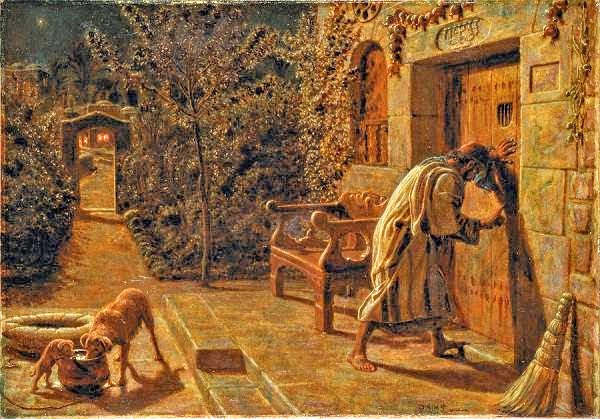
This parable is known by some as “the Importunate Neighbor.” That’s an excellent description. Importunate is defined as being persistent, especially to the point of annoyance or intrusion. It’s tenacious and stubborn–not giving up even when being ignored, and that describes what’s happening here.

What immediately proceeds this parable is Luke’s version of the Lord’s prayer, which the disciples requested. They wanted to understand the methods and mechanics of praying–perhaps the Pharisee’s prayers weren’t quite up to snuff–they wanted more; and they insisted that Jesus instruct them.

The disciples wanted to do prayer right.

A typical Jewish home had sleeping quarters (one room!) located on a raised platform. A ladder was used to access that level (which could be crowded, sometimes two to a bed.) Often their livestock were brought inside. And when it was time to get up, everyone got up. That explains the homeowner’s reluctance to give bread to his neighbor. To get up, light a lamp, wasn’t a solitary affair.

He’s obviously unenthusiastic to make that effort.

The word used here to explain the neighbor actions is ἀναίδεια “anaídeia,” which is only used once–it’s translated as impudence, shamelessness, audacity or chutzpah. It’s a Greek word that explains the knocker’s rudeness. He won’t stop. He knocks and pounds until he gets his bread. Not having bread for his guests is unheard of, for it violates all kinds of convention.

The unwritten law of Jewish hospitality demanded action. 

This is part of Jesus’ view on prayer. It means we must be inappropriate sometimes–even to the point were we are being rude.

Immediately following this parable (the very next thought) are the following instructions:

“So I say to you, ask, and it will be given to you. Seek, and you will find. Knock, and the door will be opened to you. 10 For everyone who asks receives, and the one who seeks finds, and to the one who knocks, the door will be opened.”

Luke 11:9-10

Perhaps it’s this intensity that’s lacking.

We “pray” but don’t insist. We desire but don’t demand. Maybe it takes a certain shamelessness to make prayer work. Jesus emphasizes a necessary attitude to praying God’s way. It’s never automatic, but in this parable we see words that move the Father’s heart, and loosen his hand. In Jesus’ teaching, prayer means effort.

It means spiritual work. He wants us to know this. It is important.

“There is neither encouragement nor room in Bible religion for feeble desires, listless efforts, lazy attitudes; all must be strenuous, urgent, ardent. Flamed desires, impassioned, unwearied insistence delight heaven. God would have His children incorrigibly in earnest and persistently bold in their efforts. Our whole being must be in our praying.”

    E.M. Bounds

f

Crushed Grapes

2 Corinthians 1:8

     David Wilkerson

The word is in New Testament Greek is θλῖψις, or thlipsis. It means affliction, trouble, or pressure. It’s used 45 times in the NT and it seems to be used in a negative sense. Personally I think “pressure” is the most intriguing.

To write anything on suffering and pain is a bit of a fool’s errand.

It’s a broad subject and it will vary from person-to-person.

And I’ve no special insight to give. I know this. Perhaps though, something will come of this. Personally, I have had several traumatic (and dramatic) brushes with pain and suffering. Almost all of them have come as a believer–(I hope that doesn’t mess with your theology).

Looking at the Apostle Paul we can see suffering clearly. Often his ministry was extremely hard. He wrestled repeatedly over his churches and his own sin. When we look at the totality of his work we start to realize that being crushed was part of calling. He understood the challenge of himself and his message.

I write this first to remind you that to minister true grace in any real capacity will mean difficulty. But I also want to encourage you to see that God will always bring life when we remain obedient to Him.

That’s how it works. (At least I think so.)

    Alan Redpath

Finding the Pearl

“Again, the kingdom of heaven is like a merchant looking for fine pearls. When he found one of great value, he went away and sold everything he had and bought it.”

Matthew 13:45-46

A different perspective.

The central issue seems to be of value. The pearl was magnificent. This merchant had never seen one like this. It gleamed in his hands, and he knew he must have it. It wasn’t an option, he had to buy it. His response–sell everything to the highest bidder (of course) and buy it.

The Lord Jesus loves each of us intensely.

Rather the people who make up the body. He loves everyone, but he’s crazy about his people. I have a shirt, and I’ll wear it sometimes when I feel like it could touch someone, it says “Jesus Loves You, but I’m His favorite.” I know it’s funny, but maybe it’s true? I know that he loves me–crazy-like. And I love that He loves, even me.

We’re His pearls.

His blood, and His cross was the purchase price. That’s what it took. When we truly believe we acknowledge that we are His now. He paid for us, completely.

Jesus sees, and he must have us. So he comes, and pays the price, he sells it all just to possess us. He now owns us. We know that there is nothing remarkable about us, for we understand our own sinfulness, we really see that we’re spiritually evil all of the time. The theologians call it “the depravity of man.” (Ecclesiastes 9:3; Job 15:14-16; Matthew 15:19).

But our faith in Him changes everything! We have been bought off the slave block of sin. We have been chosen.

“Therefore I endure everything for the sake of the elect.”

2 Timothy 2:10

We realize that we are the elect as believers when we put our faith in what Jesus did for us. Believe me, that’s not what I feel or sense about myself. But it’s what He sees, and He desperately wants me to be his own–and I don’t know why he would do such a thing. It makes no sense to me at all.

God’s love has reasons which reason cannot understand.


p

Ponder the Word

“But his delight is in the law of the Lord, and on his law he meditates day and night.”

Psalm 1:2

In Psalm 1:2 the Hebrew word for meditation is hagah. In this Psalm we have a contrast between the blessed and the “not-so-blessed,” and it commands that as Jesus’ followers that we process the reality of this to become blessed by our Father.

In Psalm 1:1 the word blessed is used, and actually just in the book is Psalms alone blessed is used 51 times. The word has a very simple and concise meaning: “to be happy.” I really don’t think we can minimize how important it is to be happy.

In 1:2 we read hagah or meditate. That Hebrew word is a little bit more complicated and it seems more nuanced than “blessed.”

Hagah, or meditate means:

  • to chew a cud like a cow
  • to growl like a lion who is eating an antelope
  • to moan or groan
  • to talk to oneself, or mutter or whisper
  • finally, it can mean to muse or imagine

Yeah, it’s an interesting word and I suppose all of these meanings are to be factored into meditation [hagah]. It seems that these five definitions shape the different meanings that go into our understanding.

Using the above definitions, this is how it might look:

  1. sometimes I regurgitate the word like a cow chewing its cud
  2. at times I attack it like a lion
  3. I moan and groan as I wrestle with it, seeking for a handhold
  4. thinking about the passage I talk to myself about its meaning
  5. I imagine being there, sometimes it’s like I’m a “fly-on-the-wall”

When we come to God’s words, the Bible, we are required to assimilate all that the Holy Spirit graciously gives. When He gives us something from the Word we must apply it to ourselves. You can do this through any of the 5 definitions I’ve given.

The Holy Spirit is the One who ignites His Word into our hearts.

Joshua 1:8, ESV

alaskabibleteacher.com

The Seed Must Grow

26 And he said, “The kingdom of God is as if a man should scatter seed on the ground. 27 He sleeps and rises night and day, and the seed sprouts and grows; he knows not how. 28 The earth produces by itself, first the blade, then the ear, then the full grain in the ear. 29 But when the grain is ripe, at once he puts in the sickle, because the harvest has come.”

Mark 4:26-29

From a seed to a plant. We have no idea how this happens, it just does. This is a “kingdom” parable, one of several that explain what God’s realm is, and how it happens. In this particular story, we’re told how the Holy Spirit works. It also explains our role in this (which isn’t a whole lot).

The farmer puts the seed in the ground—and that’s it.

He’s done his work, there’s nothing more he can do. He doesn’t do anything else from this point, and honestly he can’t. And yet the soil needs to be prepared—plowed, fertilized and tilled again. You might say he creates the conditions (that’s what makes a good farmer, I guess) for something to happen.

He doesn’t massage the seed, coaxing it to grow.

He doesn’t sing to it, or tell it about the wonders of being lush and green. He does zero. The seed grows on its own. He goes to bed, and gets up. After several days, bingo! That seed turns into a plant—something green and alive. He doesn’t do a thing. Life occurs without his work.

The point is this. God’s work is done invisibly within us (and that’s a relief)!

Robertson’s Commentary

God’s kingdom works pretty much like this. The farmer doesn’t cause the seed growth, all he does is go to bed! He sleeps and waits and watches. It grows and he hasn’t the slightest. It’s a complete mystery. He has done everything he can, and God has done the rest. He “shares” in this amazing transformation, but the father has done it all.

We trust in a process we cannot see, or really understand.

We don’t dig the seed up every morning to see what’s happening. We just let the (super)natural happen. And it does!

The farmer has faith in the process (after all, he did plant the seed), but that’s it. There’s a verse in 1 Corinthians that should be considered. It gives us confidence and a definite trust in this process of growth. The Apostle Paul understands this “principle of growth.”

“So neither he who plants nor he who waters is anything, but only God who gives the growth.”

1 Cor. 3:7

We must trust God completely to grow. We’re responsible for tilling and planting. But you need to understand what happens after that is up to him. The kingdom of God is supernatural. It’s exactly how the kingdom happens—and we must be very patient and incredibly wise.

“There is nothing more important to learn about Christian growth than this: Growing in grace means becoming like Christ.”

     Sinclair B. Ferguson

alaskabibleteacher.com

You Need to Understand This

Finally, be strong in the Lord and in the strength of his might. 11 Put on the whole armor of God, that you may be able to stand against the schemes of the devil. 

For we do not wrestle against flesh and blood, but against the rulers, against the authorities, against the cosmic powers over this present darkness, against the spiritual forces of evil in the heavenly places.

Eph. 6:10-12, ESV 

Often in Scripture we’ll understand something which will shake us. Dismissing its truth as optional would be a grave oversight. Instead of perceiving it as a mere emphasis reserved for those more inclined towards “charisma,” we must insist on its relevance for each and every believer.

We face a battle. Every one of us.

We look around and see others whose ‘reality’ is different from ours. We see politics, psychology, biology or cosmology, religion or philosophy, entertainment or science that are blind to reality. But Ephesians 6 tells us what we’re up against. We’re starting to realize that humans have a terrible knack for being manipulated by evil powers.

1 John 5:19, Amplified

Ephesians 6 declares that we’re in a world where every individual is in a war.

This passage clearly tells us that the only place of safety is to be strong in God and to find that the only safety is pressing into His presence. To survive we must push everything else aside to be in His presence. He gives us His strength to overcome all evil.

The above passage stresses that there is an organized force of darkness focused on us. These verses in Ephesians 6 unveil a government of wickedness that’s everywhere. Without the humble intimacy that needs prayer and Bible reading, we will be spiritually destroyed.

C.S. Lewis

We need protection. Our only hope is Jesus’ strength. But we must actively step into this spiritual intensity.

We’re only strong through our intimacy with Him. He shields us from the spiritual corruption that swirls all around us. As we draw to Him we become mighty, as we listen closely to the Holy Spirit, we will walk in true discipleship with Jesus.

Watchman Nee

alaskabibleteacher.com

You Just Won the Lottery!

Matthew 13:44

From rags to riches. We like that kind of story, the newspaper boy turned into a publisher, C.E.O. This parable, only a single verse is almost the same thing. A poor man is walking through a field and viola! He finds a treasure chest, and it’s packed full of golden coins, diamonds, and emeralds.

He looks around, and seeing no one, he re-buries it. (After all, when you accidentally discover a treasure chest, you must take certain precautions.)

And a key I suppose is the word “joy.”

And that really isn’t something we really know–unless something wonderful happens to us of course. He has joy, he can’t believe it. I think he was a bit dazed by it all, and he must of walked in an unreal sort of bubble. After all, these things never really happen.

It’s sort of like finding you’ve got the winning numbers of the lottery–you just won $50,000,000!

It’s this kind of unreal “luck” that this guy knows what he must do. Now the owner of the field owns everything, including the chest. The finder realizes he can’t just sneak the chest off to his home–there would be too many questions. (Where did a poor guy like you get a gold coin?) His neighbors would figure it out. And besides, he would be a thief. There has to be a better way.

Suddenly he has an idea. If he sells everything he has, he probably could buy that field. And then everything that was there would be rightfully his. Selling all isn’t a problem, he knows that whatever he gives up is nothing close to the treasure in the field.

The reader should understand two things about the treasure that you find:

  • It’s about Jesus–the Bible is constantly aware of him, and his presence is seen in every chapter and book. He’s the treasure we find, knowing him, is the most valuable thing a person can ever have (by far). “The one who believes in the Son has eternal life, but the one who rejects the Son will not see life; instead, the wrath of God remains on him” (John 3:36).

To be his disciple demands we give everything else up.

We sell it all to get spiritual riches. There’s a “field” that we find that is worth everything, and the only way we can have the treasure is by giving up everything. There really isn’t any other way.

“You must keep all earthy treasures out of your heart, and let Christ be your treasure, and let Him have your heart.”

    Charles Spurgeon

alaskabibleteacher.com

Our Work is Our Worship, “Avad”

It’s interesting–the Hebrew word for worship is also used for work. I think that is pretty significant. Seeing and understanding this is a life-altering experience. It completely changes the way we look at discipleship. Worship and work/serve go together, and God sees them as one and the same.

To work [avad] as a “farmer”and serve as a worshiper [avad] overlap.

  • “The LORD God took the man and put him in the garden of Eden to work it [avad] and keep it.”
  • Serve [Avad] the Lord with gladness! Come into his presence with singing!”

Genesis 2:15 and Psalm 100:2

Notice that both work and worship use the same Hebrew word.

  • “Six days you shall labor, and do all your work, [avad].”
  • “When peoples gather together, and kingdoms, to worship [avad] the Lord.”

And wow! There are dozens of verses that link our work with our worship. The implications are profound–we’re to see our Sunday worship and our jobs as one and the same. Typically we don’t see it that way. Our Monday through Friday are in a separate category than what we do on Sunday.

Our work and our worship overlap. God intends it that way, and we grow in obedience if we also accept the fact that they’re not separate. Our occupation, whether we’re flipping burgers or being a brain surgeon, is to be an act of worship.

One small Hebrew word can mean so much.

Our whole paradigm shifts when we understand that our worship is far more than 20 minutes on a Sunday morning. It’s to extend to all we do throughout our week. Our Monday job is just as significant to God as our shared time with our brothers on Sunday.

This understanding gets used in the New Testament as we see our work and worship are connected.

“Whatever you do, work heartily, as for the Lord and not for men, 24 knowing that from the Lord you will receive the inheritance as your reward. You are serving the Lord Christ.”

Colossians 3: 23-24

“Not by the way of eye-service, as people-pleasers, but as bondservants of Christ, doing the will of God from the heart, rendering service with a good will as to the Lord and not to man.”

Ephesian 6:6-7

Lois Tverberg, En-Gedi Resources

alaskabibleteacher.com

“I Kept You From Sinning”

Genesis 20:6

This is called restraining grace, the doctrine that teaches that God intervenes to prevent sin from happening.

Both the pagan king Abimelech and the patriarch Abraham have problems. One wants to add Sarah to his harem (lust), and the other pretends that Sarah isn’t his wife, but his sister (cowardice).

The dream:

Abimelech goes to bed and has a “God dream.” The Lord threatens him with death for taking another man’s wife. King Abimelech protests and pleads for his life. (Dreams were significant in Genesis.)

God relents and to Abimelech’s credit the Lord understands that this was done from a clear conscience. It seems that Abraham’s spinelessness has given the wrong idea about Sarah. She isn’t his sister, but his wife!

There are some interesting issues here. Not only is the king prevented from sinning here, but we see the lengths God went to protect Abraham and Sarah’s marriage. They were to be the parents of the nation of Israel. God would see to that.

There are real consequences to our sin. We will reap what we sow (Galatians 6:7), but God’s grace protects the believer who desires to be Christ-like. He is a shield to the man who runs to Him.

It probably happens more than you realize. I’ve found that there is a still, small voice that speaks to the Spirit-filled believer. Sometimes we ignore it and sometimes we obey it, but it’s there. It’s meant to guide us.

Our conscience is the “sheriff” of our souls. It’s our compass.

It seems that little is said about conscience anymore, but it’s imperative that you recognize it. Conscience tells you whether something is right or wrong. It’s our guide and must be closely watched over. It can become seared and clouded–it can be defiled. But it also can be purified and made holy.

Our conscience knows this. It’s a spiritual fact.

Ligonier.org

For further study: Psalm 12:7; Proverbs 11:6; Proverbs 13:6; 1 Peter 3:12.

alaskabibleteacher.com