Meet Martha, Her Story

Luke 10:38-41

“While Jesus and his followers were traveling, Jesus went into a town. A woman named Martha let Jesus stay at her house. 39 Martha had a sister named Mary, who was sitting at Jesus’ feet and listening to him teach. 40 But Martha was busy with all the work to be done. She went in and said, “Lord, don’t you care that my sister has left me alone to do all the work? Tell her to help me.”

41 “But the Lord answered her, “Martha, Martha, you are worried and upset about many things. 

42 Only one thing is important. Mary has chosen the better thing, and it will never be taken away from her.”

My name is Martha and I’m a friend of Jesus. My home was one of His favorite places to stay–a refuge for Him whose life was so busy. I joyfully opened my house for Him and His disciples. When Jesus came I went all out, I wanted the best for His followers and that meant there were always things to do. Is that really a bad thing?

The kitchen was getting crazy–lamb, cucumbers, figs, and so on. Roasting and slicing, I had bread in the oven. All of this was requiring constant attention, and I remember not being able to keep up.

I wanted things to be perfect for Jesus.

I took occasional peeks at He who was teaching in my living room. I just brought in some bowls of figs and raisins as an appetizer and found my sister Mary sitting with the men listening to Jesus and asking questions. It was that which started to get a little ticked off.

I was getting really mad at my sister.

There was so much to do and I realized I had to have her help. And the more I thought of Mary the more frustrated I got. I suspect she didn’t understand the work that need to be done. I suppose her priorities were messed up–she simply didn’t understand her role as a hostess, and to sit with the men like she was doing was wrong.

Mary didn’t understand her place.

I admit I was having issues with my sister. I had brought out another bowl of figs and that’s when I gently interrupted the Lord’s teaching. I wanted Him to tell Mary that her place was with me in the kitchen. He could correct her and I knew she would listen. “Tell her to help me.”

Instead, it was Jesus who corrected me. I still remember Jesus’ words. I wasn’t expecting this.

“Martha, Martha, you are worried and upset about many things.”

Was I really that transparent? He understood, but rather than encouraging me I had become another lesson to everyone present. I realize now that the real issue was with my attitude, and not the work. Yes, I was bothered and upset and I know that it’s those things that were the problem.

Only one thing is important. Mary has chosen the better thing, and it will never be taken away from her.”

I suddenly knew that He was right. Jesus was in my home, and all I did was get angry. I thought my work would please Him and after all, wasn’t that important? Didn’t He “deserve” my best efforts?

My younger sister Mary was being praised. She was my example and now I was being gently rebuked. I realized that all I was doing, all my work, was not what Jesus wanted from me. The problem was my own heart—-it wasn’t Mary, it was me!

I had taken my eyes off of Jesus and was immersed in my service to Him.

I had become critical and resentful of Mary, and I had forgotten that my place was at Jesus’ feet, listening and learning. That’s what Jesus wanted from me, and somehow I had forgotten that.

I decided then, the work could wait, my real place was with Jesus.

Martha’s frustration is typical of those who diligently serve with good intent, but forget to also sit at Jesus’ feet. “The Martha spirit says, if the work is done, is not that all? The Mary spirit asks whether Jesus is well pleased or not? All must be done in his name and by his Spirit, or nothing is done.”

C.H. Spurgeon

My Facebook page is here.
Lazarus: In His Own Words

John 11:33-44

When Jesus saw her weeping, and the Jews who had come with her also weeping, he was deeply moved in his spirit and greatly troubled. 34 And he said, “Where have you laid him?” They said to him, “Lord, come and see.” 35 Jesus wept. 36 So the Jews said, “See how he loved him!”  

Jesus Raises Lazarus

38 Then Jesus, deeply moved again, came to the tomb. It was a cave, and a stone lay against it. 39 Jesus said, “Take away the stone.” Martha, the sister of the dead man, said to him, “Lord, by this time there will be an odor, for he has been dead four days.” 40 Jesus said to her, “Did I not tell you that if you believed you would see the glory of God?” 

 So they took away the stone. And Jesus lifted up his eyes and said, “Father, I thank you that you have heard me. 42 I knew that you always hear me, but I said this on account of the people standing around, that they may believe that you sent me.” 43 When he had said these things, he cried out with a loud voice, “Lazarus, come out.” 44 The man who had died came out, his hands and feet bound with linen strips, and his face wrapped with a cloth.

Jesus said to them, “Unbind him, and let him go.”

My name is Lazarus and I was a special “friend” of Jesus. We liked being with each other, and my sisters Mary and Martha also enjoyed fellowshipping with Him. Whenever He passed through Bethany, Jesus always had an open invitation to visit.

What’s it like to be dead? Many ask me this, and I suppose they want to understand, and I don’t blame them. To me, it seemed like a very deep sleep–but I didn’t dream. Those who look for any special insight, will not find it from me. And yet, I am His witness. He has incredible power over death.

I heard Him call my name.

It pierced through everything with an authority I’d never heard before. I had been laid in my tomb for 4 days and my physical body had begun to putrefy. When they rolled the stone away the terrible smell of death lay heavy in the air.

I was tightly bound in cotton wraps and sticky spices had been applied to my body. Mary and Martha had objected to Jesus’ attempt. As I looked back I realize that their actions were justified. After all, who can give life when one is very much dead. And not only dead but well on the way on to decay. The smell wafted from my tomb.

I had heard His shout, and it was then death was reversed.

My heart and brain began to work again. When I came to I found that I was lying on a stone table and tightly wrapped in the clothes of the dead. I managed to sit up, and I shuffled toward the light that had entered the tomb by the stone that covered the door.

When Jesus saw me I believe that He was laughing. He gave the command to the shocked bystanders, He commanded them to unwrap me. I suppose that then I realized I was now in the land of the living. I can’t explain what had happened, But my grave clothes were unwrapped.

There were many that day that became believers.

Many had attested that I was most certainly dead, after all, they had attended my funeral. Some had observed that I had been slathered in the sticky ointment–fragrant spices. And a few were witnesses to see the stone rolled in place.

There were some who simply didn’t (or wouldn’t) believe.

There were the Pharisees and the Sadducees who wanted me dead hoping to nullify my witness and my resurrection from the dead. I had become an embarrassment to them, a constant reminder that Jesus had defeated death.

Their hatred of Jesus’ ministry was only strengthened. My own resurrection proved His authority and power over even death. I was a walking and breathing miracle that they refused to accept. It got so bad that the religious leaders wanted to kill me because so many believed in my resurrection. I was a living witness to many.

Yes, I know that I’ll die again. But I’m not afraid anymore.

“He alone can believe in immortality who feels the resurrection in him already.

Frederick W. Robertson

alaskabibleteacher.com

Art: blogspot.com. Scripture: Christian Standard Bible, Holman Publishers; The Message, Eugene Peterson

Why, God Why?

Job 7:20, 13:24, 9:29, 24:1, 10:18

Job’s profound suffering is one of the most extreme in all of human history. He is essentially a godly man who loses everything (except his faith). Job must pick up the pieces after “catastrophic ” sudden pain and total loss.

Only the brutality of the cross of Jesus eclipsed the suffering of Job.

Job is being tested with dark horrors. Will he “curse God and die” as his wife suggests? Will he cave in to the final four “friends” and accept their twisted theology? (I guess that you have to read chapters 38-39 to find out).

The Book of Job has been regarded as inaccessible and archaic by many.

Unfortunately, many believe this assessment and look elsewhere for comfort. I would agree that Job is a challenging book, but so is Macbeth or Plato. There are plenty of easier books to read; but if we choose to avoid Job, our faith will always be deficient. We will miss something vital.

Job is less an explanation and more a revelation of suffering. “Why” questions go unanswered. “Who” questions matter. I suppose this seems unfair to Job. It certainly seems so to me, but straight answers in a fallen world won’t get any traction at all.

One more thing. The Book of Job is about “twisted” theology. Job’s friends “toe-the-party-line” of theology that is logical. But don’t be mislead by their pronouncements, for they seem reasonable but they are all very much flawed.

I always find it strangely amusing when some quote Eliphaz or one of the other “friends” to encourage or comfort a suffering saint. They totally miss the point of the book. We desperately want to give out good counsel but we really don’t understand.

“If I have the gift of prophecy and can fathom all mysteries and all knowledge, and if I have a faith that can move mountains, but do not have love, I am nothing.” 1 Cor. 13:2

You can’t split your theology from love and get away with it. Something toxic happens if you try.

When you read “Job’s friends” you must remember that. These are lessons it takes a long time to learn. Unless the Holy Spirit tutors you, be very slow to speak. (Job’s friends were at their best at the beginning when they said nothing at all.)

The broken believer, hobbled by chronic illness, has much to learn from Job. He is like “the poster child” for those afflicted. My own illnesses are always an issue of course, but God is fully in control. He brings beauty out of the ashes. He has been more than gracious.

“To bestow on them a crown of beauty
instead of ashes,
the oil of joy
instead of mourning,
and a garment of praise
instead of a spirit of despair.
They will be called oaks of righteousness,
a planting of the Lord
for the display of his splendor.”
Isaiah 61:3

Deer Feet for the Believer

“He made my feet like the feet of a deer
    and set me secure on the heights.
35 He trains my hands for war,
    so that my arms can bend a bow of bronze.”

2 Samuel 22:34-35

David’s Song of Deliverance

This entire psalm was written after David was delivered from the hand of Saul. David had been a fugitive for years and had experienced extreme difficulties. He had been pushed to the brink many times, yet maintained a close walk with God.

This verse in 2 Samuel has always blessed me. The image of a deer who has been put on a mountaintop through the direct action of the Lord–it’s a place of safety, a position of victory. It comes as a decisive maneuver of the Holy Spirit.

Psalm 18:33

David had learned things in the wilderness that he would never have otherwise. At times life got pretty extreme for him. When he struggled it was understandable. He followed the path that God laid out. It wasn’t easy for David, but he walked in faith and not by sight.

Danger surrounded David on every side – physically, spiritually, emotionally, socially. It would come from enemies, and even from his dearest friends.

God’s people are not immune from trials. It’s good to know that these are now orchestrated by our Father, and they’re purposeful and planned.

The prophet Isaiah extends the imagery of a deer in his prophetic ministry, but adds other ideas as well. The lame, mute and the desperately thirsty are descriptive of people who are given a special grace and touch. They’re promised something. They receive the promise of the Lord Jesus Christ.

“Then shall the lame man leap like a deer,
    and the tongue of the mute sing for joy.
For waters break forth in the wilderness,
    and streams in the desert;”

Isaiah 35:6

“David thought of how deer seem to skip from place to place and never lose their footing. God gave him the same kind of skill in working through the challenges brought by his enemies.”

David Guzak

alaskabibleteacher.com

We See So Little

Job 26:14

Job’s suffering has led him to this point. He realizes how little he understands God. I guess pain can have a powerful effect on how we see things. Job has learned the immensity of God.

In verse 14 he speaks about the “outskirts” the word in Hebrew means the mere edge, or fringe. One translation of this verse reads like this: “These are only a few of the things that God does. We only know about a few small things. If he used all of his power, we could never understand.

“That being the case, let’s consider God’s capacity for just a moment. He’s not only “high capacity”, He’s “infinite capacity.” He never sleeps or slumbers. He is perfect in all His abilities. There isn’t a single thing that He doesn’t know, and there is no one more powerful than Him. And unlike humans who can only be in one place at one time, He is everywhere at the same time. This is amazing, and just like the Psalmist said in Psalm 113, “Who is like the Lord our God?” The answer, very simply, is no one.”

John Piper

“For now we see in a mirror dimly, but then face to face. Now I know in part; then I shall know fully, even as I have been fully known.” (1 Cor. 13:12)

I’m thinking about Moses who asked to see God’s glory. Moses was called “the friend of God,” but he wanted to see more. God’s response was that He couldn’t because it would kill Moses. But provision was made for him to see the backside of God as Moses was in a cleft of a rock. (Exodus 33.)

The Bible doesn’t reveal it all. But we’re given enough. Job told us that only the outer fringes can be seen by men and women. We see His periphery, but we must understand our limits. We’re told that we will see Him someday–but not yet. But at the moment of death, we will see Him.

The Lord Jesus came to show us the Father. “In [Christ] all the fullness of deity dwells bodily.” When we see Jesus we see the Father. Reading the Gospels we are encountering God, because Jesus reveals Him fully.


“He is the radiance of the glory of God and the exact imprint of his nature, and he upholds the universe by the word of his power.” 

Hebrews 1:3

Romans 11:33

alaskabibleteacher.com

Breaking Down the Door

Luke 11:5-8

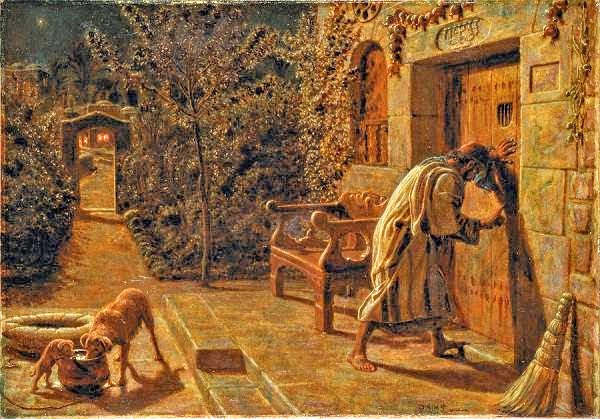
This parable is known by some as “the Importunate Neighbor.” That’s an excellent description. Importunate is defined as being persistent, especially to the point of annoyance or intrusion. It’s tenacious and stubborn–not giving up even when being ignored, and that describes what’s happening here.

What immediately proceeds this parable is Luke’s version of the Lord’s prayer, which the disciples requested. They wanted to understand the methods and mechanics of praying–perhaps the Pharisee’s prayers weren’t quite up to snuff–they wanted more; and they insisted that Jesus instruct them.

The disciples wanted to do prayer right.

A typical Jewish home had sleeping quarters (one room!) located on a raised platform. A ladder was used to access that level (which could be crowded, sometimes two to a bed.) Often their livestock were brought inside. And when it was time to get up, everyone got up. That explains the homeowner’s reluctance to give bread to his neighbor. To get up, light a lamp, wasn’t a solitary affair.

He’s obviously unenthusiastic to make that effort.

The word used here to explain the neighbor actions is ἀναίδεια “anaídeia,” which is only used once–it’s translated as impudence, shamelessness, audacity or chutzpah. It’s a Greek word that explains the knocker’s rudeness. He won’t stop. He knocks and pounds until he gets his bread. Not having bread for his guests is unheard of, for it violates all kinds of convention.

The unwritten law of Jewish hospitality demanded action. 

This is part of Jesus’ view on prayer. It means we must be inappropriate sometimes–even to the point were we are being rude.

Immediately following this parable (the very next thought) are the following instructions:

“So I say to you, ask, and it will be given to you. Seek, and you will find. Knock, and the door will be opened to you. 10 For everyone who asks receives, and the one who seeks finds, and to the one who knocks, the door will be opened.”

Luke 11:9-10

Perhaps it’s this intensity that’s lacking.

We “pray” but don’t insist. We desire but don’t demand. Maybe it takes a certain shamelessness to make prayer work. Jesus emphasizes a necessary attitude to praying God’s way. It’s never automatic, but in this parable we see words that move the Father’s heart, and loosen his hand. In Jesus’ teaching, prayer means effort.

It means spiritual work. He wants us to know this. It is important.

“There is neither encouragement nor room in Bible religion for feeble desires, listless efforts, lazy attitudes; all must be strenuous, urgent, ardent. Flamed desires, impassioned, unwearied insistence delight heaven. God would have His children incorrigibly in earnest and persistently bold in their efforts. Our whole being must be in our praying.”

    E.M. Bounds

f

Jesus Loves Children

Luke 18:15-17, KJV

15 “And they brought unto Him also infants, that He would touch them; but when His disciples saw it, they rebuked them.

16 But Jesus called them unto Him and said, “Suffer little children to come unto Me, and forbid them not, for of such is the Kingdom of God.

17 Verily I say unto you, whosoever shall not receive the Kingdom of God as a little child shall in no wise enter therein.”

Again we were wrong (like usual it seems). I guess that we were trying to maximize Jesus’ ministry. We meant well, but He needed organization. So that was now our “ministry.” We simply felt that Jesus’ time was our concern, and as His disciples we wanted Him to connect with those who really mattered.

The parents were bringing their children to be blessed by Jesus.

“It was the custom for mothers to bring their children to some distinguished Rabbi on the first birthday that he might bless them.”

William Barclay

Jesus made it clear that these children needed to be the focus of our ministry. Our efforts were not to be centered on adults, rather it was misguided thinking that we direct Jesus’ work to be focused and redirected. These little ones were in the way.

Up to now, Jesus’ work was for adults. There were lepers, demon-possessed, paralyzed, tax-collectors all waiting for His ministry. Somehow we overlooked the needs of little children. Again, we were wrong, misguided, and ignorant of the walk of the true believer.

And sure enough, Jesus explained what we were missing. Children were to become our focus. They were the ones who we were to emulate and esteem. The radical thing to us was understanding that these ‘little ones’ were that significant.

I must say that this was a powerful jolt.

“Let these children alone. Don’t get between them and me. These children are the kingdom’s pride and joy. Mark this: Unless you accept God’s kingdom in the simplicity of a child, you’ll never get in.”

Luke 18:16-17, The Message

This was astounding! It was nothing less than another radical thought from our Teacher. Accepting this wasn’t easy, but Jesus was crystal clear. We dare not think otherwise, but to believe this was against all we thought we understood.

Jesus understood that childlikeness was the only way we could enter His Kingdom.

Trust me on this–we believed otherwise. Up to now, we assumed that maturity meant sophistication. It was all about right thinking and good theology that God was looking for. We assumed that being simple wasn’t quite what Jesus wanted from us. Rather we believed the opposite.

Children were now to be our examples. Their simplicity was to be our guide–it was the Kingdom of God’s doorway into true discipleship.

“Part of the exquisite beauty of salvation is its simplicity. Any man, woman, or child can come to Christ with absolutely nothing to offer Him but simple faith-just as they are. Salvation requires nothing more than childlike faith-believing that Jesus Christ died for my sins and accepting His gift of Salvation.”

Beth Moore

Sinners Need Jesus’ Love

“And when the Pharisees saw this, they said to his disciples, “Why does your teacher eat with tax collectors and sinners?” 12 But when he heard it, he said, 

“Those who are well have no need of a physician, but those who are sick. 13 Go and learn what this means: ‘I desire mercy, and not sacrifice.’ For I came not to call the righteous, but sinners.”

Matthew 9:11-13 (context vv. 10-13)

God is not against us because of our sin, rather, He is with us against our sin. Jesus wants to eat with sinners; with us!

We barely believe this. It doesn’t make any sense at all. It’s one of those pure and astonishing grace ideas that God must reveal to each person. It’s counter-intuitive to everything we know.

Don’t look now, but Jesus, (God’s own Son), is sitting and eating with sinners!

Can we even grasp how amazing this is? His guests at the table were the awful–the nasty dregs of a nice proper society. Tax collectors who had renounced Judaism for Rome. There were the sinners who were the unacceptable. (Even the whores and the drunks showed up!) Can’t He do any better than this?

We see (or read) of the Lord who chooses to fellowship with the ungodly rather than the religious. That shakes us to the core, as it should. He loves associating with unacceptable people. That alone should floor us-and maybe scare us too.

It seems to me we’re living in this world ‘blind and dumb’ to what grace really is.

The religious Pharisees found the grace of Jesus to be unacceptable. They walked and breathed legalism. Keeping the Law was their way to be acceptable in God’s eyes. And they were now angry, or maybe somewhat mystified, by Jesus’ incredible desire to associate with evil people. But they’re misunderstanding the grace and mercy that resides in God’s heart.

Man is born broken. He lives by mending. The grace of God is glue.

–Anne Lamott

Do we seriously understand the kindness and grace of Jesus? Does it ‘saturate’ your mind and heart? Are you completely ‘marinated’ in God’s outrageous love for you, the ugly? Think about this; ‘Could it be that the Pharisees are still alive and well today?’

Eating with sinners. We read that the Pharisees objected.

Perhaps these guys were trying to attack Jesus by ‘splitting’ the disciples from Him. They wanted them to question His actions. This is Satan’s strategy.”Why does your teacher eat with tax collectors and sinners?” ‘Why’ seems to be the voice of the doubter, the offended and the ungraceful.

The ‘healthy’ don’t need any help. No doctor’s appointments are necessary. And yet Jesus chooses out the sinners” instead. You need to understand this, to be called like this is the ultimate gift. Grace for the ungraceful is unreal. It seems oddly unnatural. And yet the Father’s grace is now waiting for you. You must believe this.

What are you struggling with?

What ‘distracts you? What are you trying to do to be ‘righteous’ in God’s eyes? Do you really believe that He desperately wants to sit down and have a meal with you, just as you are?

Or are you still wallowing in shame and unworthiness?

“The bridge of grace will bear your weight, brother. Thousands of big sinners have gone across that bridge, yea, tens of thousands have gone over it. Some have been the chief of sinners and some have come at the very last of their days but the arch has never yielded beneath their weight. I will go with them trusting to the same support. It will bear me over as it has for them.”

    Charles Spurgeon

The Real Glory of the Real Jesus

Mark 9:2-8, ESV

“And after six days Jesus took with him Peter and James and John, and led them up a high mountain by themselves. And he was transfigured before them, and his clothes became radiant, intensely white, as no one on earth could bleach them. And there appeared to them Elijah with Moses, and they were talking with Jesus. 

“And Peter said to Jesus, “Rabbi, it is good that we are here. Let us make three tents, one for you and one for Moses and one for Elijah.” For he did not know what to say, for they were terrified.” 

And a cloud overshadowed them, and a voice came out of the cloud, “This is my beloved Son; listen to him.” And suddenly, looking around, they no longer saw anyone with them but Jesus only.”

I could go a hundred different ways with this passage. After much thought (disorganized most of the time) I’ve decided to go with the following. I know deep down how deficient it is, and I know you have much to add to it, which is very good.

But what I do understand I give to you.

The more I try to process Mark 9 the more I see things that are wildly significant. What happened there was radical, and I realize that I still don’t have a solid grip on it, and if I did I know deep down it’d change my life.

  • James, John, and Peter. Why these three? Some have suggested that these particular disciples were the ones who desperately needed to see what was going to happen. That’s very possible. Perhaps they were the weakest, and maybe they needed to see the real Jesus in His glory. My personal view is that these three wrote books, epistles. Maybe Jesus understood this, and gave them this earth-shaking experience?
  • The impact on Peter was profound. “”For we did not follow cleverly devised stories when we told you about the coming of our Lord Jesus Christ in power, but we were eyewitnesses of his majesty. 17 He received honor and glory from God the Father when the voice came to him from the Majestic Glory, saying, “This is my Son, whom I love; with Him, I am well pleased.”  We ourselves heard this voice that came from heaven when we were with him on the sacred mountain.” (2 Peter 1:16-18).
  • Toward the end of Peter’s life he couldn’t shake the Transfiguration and what he witnessed there. He recalled the “glory” but it seems it was the voice that was the most profound. It was that voice that completely altered his life and ministry. (Notice that he mentions it twice in verse 18.)
  • The Greek word for “transfigured” is metamorphosis. (Like a butterfly coming out of a cocoon.) Jesus wasn’t put in some spiritual “spotlight,” rather the glory that was seen was coming from inside Him. We see that He was God and Jesus revealed Himself clearly as God. The three disciples who were witnesses seem to struggle with exactly what took place. They use human analogies and images to try to explain to us what they saw.
  • The word “terrified” is the word phobia. Could it be that our encounter with God could go to that extreme? Could we be that we could be terrified in His presence? Does that fit into our theology? You need to decide if it’s significant or not.
  • And what about Moses and Elijah? Most feel that each represented the Law and the Prophets. I must point out that both had ministered from the top of mountains before? But notice, even though Jesus emanated extreme glory, these two did not. Also, the arrival of these two reinforces the real world of life after death. Both Moses and Elijah were very much alive!
  • The “human” part of Jesus was temporarily set aside. We know that Jesus was fully man, but here we see Him as He really is–fully and completely God. What a revelation! The three disciples were profoundly touched. Seeing the power and glory of the Creator of the universe on the top of the mountain altered their lives and changed their ministry.
  • John would write his Gospel and three letters. James wrote the first book in the NT. Peter is credited with the Gospel of Mark and his two books. They “knew” exactly who Jesus was! They had become fully convinced and needed no theological explanation. They finally understood!

So much more should be considered.

What I’ve written today is so incomplete–I feel a little foolish putting this down in this post. But yet I’m actively praying for you that this might add to your understanding. The Transfiguration is profound. It certainly needs to be internally processed by every real believer. And for those who don’t know Jesus yet, I hope you can understand exactly who He is to us who believe.

“In the beginning was the Word, and the Word was with God, and the Word was God.  He was with God in the beginning.  Through him all things were made; without him, nothing was made that has been made.  In him was life, and that life was the light of all mankind.  The light shines in the darkness, and the darkness has not overcome it.”

John 1:1-4, NIV

alaskabibleteacher.com

Being a Friend of the King


“A Christian is not a person who believes in his head the teachings of the Bible. Satan believes in his head the teachings of the Bible! A Christian is a person who has died with Christ, whose stiff neck has been broken, whose brazen forehead has been shattered, whose stony heart has been crushed, whose pride has been slain, and whose life is now mastered by Jesus Christ.”

–John Piper

No longer do I call you servants, for a servant does not know what his master is doing; but I have called you friends, for all things that I heard from My Father I have made known to you.”

John 15:15

It seems that the purpose of life is not to find our freedom. It’s really meant to find our Master.

Yes, the idea of being a slave to anyone is repugnant. We chafe at this, and yet man was never meant to be separated from the Lordship of Jesus. We’re instructed repeatedly with the New Testament idea that “our life is not our own”  Over and over God proclaims Himself as the King.

That troubles us somewhat.

Not so much when life is fairly good, granted, but in those hard moments when a decision must be made between enjoying the titillating “lusts of the flesh,” or accepting the fruits of the Spirit. This is one of those “lordship moments.” They come and go, and they show us exactly who we are.

If you’re really going to be authentic–a legitimate and real disciple, then you must determine who is going to be in charge, and this isn’t one of those casual decisions. Your decision must become a settled issue.

You must securely fix it in your heart.

The thief on the cross knew salvation, he was promised an eternity with God simply by faith. But I submit to you that he put himself under the Lordship of Jesus. He recognized the sign, “the King of the Jews.” I believe he saw and understood its implications. Jesus was King! He realized he was in the presence of royalty.

This is a very hard word for some, but so many of our personal issues hang on this.

I know this first-hand. It’s a monumental struggle at times. You must admit to not only having Jesus as your Savior, but you also must put your life under His total Lordship.  You need to pick up your cross daily in order to follow. 

We need to learn how to kneel.

I’ve chosen a crown to open up this post–it’s done on purpose.  I simply want you to understand the supreme call He has on your life. Here’s Bob Dylan, and he nails this idea down:

You must learn here and now how to kneel before the Sovereign King

AlaskaBibleTeacher.com