Going to War

13 Therefore take up the whole armor of God, that you may be able to withstand in the evil day and having done all, to stand firm. 14 Stand therefore, having fastened on the belt of truth and having put on the breastplate of righteousness, 15 and, as shoes for your feet, having put on the readiness given by the gospel of peace. 16 In all circumstances take up the shield of faith, with which you can extinguish all the flaming darts of the evil one; 17 and take the helmet of salvation, and the sword of the Spirit, which is the word of God,

Eph. 6:13-17, ESV

You’re called to be armor-plated. Ephesians is quite clear about this, and we DARE not live without spiritual protection, and as a matter of fact, we must wear each piece to survive spiritually. To be ‘naked’ is to invite disaster. Neglecting to dress appropriately brings cataclysmic disaster. We dare not minimize the need for armor.

Each piece listed must be worn. This is a scriptural mandate for every believer in Jesus.

“The whole armor of God” explains the equipment we need to survive spiritually. Here’s a list and a brief comment on the six:

  • The belt of truth–this pulls everything together and holds us and keeps us secure in the truth.
  • The breastplate of righteousness–our spiritual heart is protected by knowing we’re accepted by the Father. Being right with God is not a feeling nor is it a mere hopeful wish.
  • The shoes of the gospel (of peace)–the idea of standing in place (“to stand”) explain our ability to be fixed on grace. When we wear battle shoes we cannot be pushed back or lose our footing. Wearing gospel shoes brings us spiritual stability. We can stand in place, rooted and strong.
  • The shield of faith–is a vital way of protecting ourselves from the evil arrows shot by the enemy. Satan targets us when he thinks that we aren’t using faith to defend ourselves.
  • The helmet of salvation–this is the realization that our mind is protected. This vital piece brings us wholeness as we understand what Jesus has done. We know we are saved and wearing our helmet is our protection from demonic-inspired lies.
  • The sword of the Holy Spirit–the only offensive weapon we have, and it’s all we need. The Word of God will frighten the enemy and push him back. The Word slices and cuts down every obstacle and every lie.

Only those who are spiritual perceive the reality of the spiritual foe and hence engage in battle. Such warfare is not fought with arms of the flesh. Because the conflict is spiritual so must the weapons.

     Watchman Nee

I must stress that clothing yourself is vital. You dare not live spiritually naked wearing nothing. You will be totally vulnerable to the satanic wickedness that is swirling around you. I’m afraid it’s all very real and sobering and there is no escape clause until you finally arrive in heaven.

“We know [positively] that we are of God, and the whole world [around us] is under the power of the evil one.”

1 John 5:19, Amplified Bible

I’m afraid you haven’t been given an option in all of this. Our battle equipment in Ephesians 6 is not just some theological preference or concept. It’s real.

Over 40 years of following Jesus have taught me that most believers struggle because they won’t arm themselves for battle. They refuse to acknowledge the environment they’re in and don’t realize the spiritual battle they are facing. They like the sentiment behind this particular passage, (it stirs their heart) but the reality of the battle never fully sinks in.

They end up leaving their armor behind.

The good news is that we have already won because of what the Lord has done. Wearing the armor strengthens and stabilizes us. He pours out His grace, and there will be times of rest of that I am certain. “He leads me beside still waters.”

As obedient and faithful believers we need to realize we’re secure in Him. Yes, there is a terrible fight, but “The battle is the Lord’s.”

“For you equipped me with strength for the battle; you made those who rise against me sink under me.”

Psalm 18:39, ESV

Straining at Your Oars

“He saw the disciples straining at the oars because the wind was against them.”

Mark 6:48

We must know that Jesus sees our labor and effort.  He understands all that concerns us, and he perceives every issue that we take.  Jesus is attentive and He comes to our little boat.  It’s quite common for us to think that he isn’t really concerned, and we may feel that He’ll pass us by without a word.  But that’s only from our own perspective.

Jesus watches over us, all the time. 

He knows all about our battles, the terrible fight we have with our flesh, the profound  difficulty we have with temptation and trials. He understands these things perfectly. I often struggle to steer my boat, but the winds and waves are hard. Jesus knows when and why I labor like I do.  And He doesn’t condemn me.

The disciples were straining very hard to keep the boat afloat. 

Every oar was being used and every man had his seat. Some were frantically bailing, and a couple tried muscling the tiller. A considerable effort was being expended.  But the wind pushed even harder against them.  This is perplexing.  If you remember, they’re simply trying to obey the command of Jesus to cross the sea. 

Why do things have to be so difficult?

I’m intrigued by preachers who preach sunshine, blue sky, and red roses because they are doing God’s will.  They don’t seem to think through the issues of conflict and challenge–my own boat has been pounded by the storm, and it seems it’s always on the verge of taking water and sinking. Is it because I have no faith?

“It is necessary to go through many hardships to enter the kingdom of God.”

Acts 14:22

Often doing the will of God will mean a headwind blowing directly at us.
 

The seas will become impossible, and we may even be driven back.  But special comfort comes when we realize we’re being watched and cared for.  Jesus is in constant lookout and He sees our toil on the oars. He comes to us, walking on the water. He comes and brings us His peace and special comfort.

Even in our storm, our hearts can rejoice.

This is His fantastic and sure promise:

“Lo, I am with you always, even to the end of the age”

Matthew 28:20

alaskabibleteacher.com

When Pain is All You Can Think About

Sometimes we live in darkness. We suffer and it’s hard. We mentally accept God’s grace and His love for us, but in our heart we remain untouched. Pain saturates everything it seems. We seem to go through the motions, but deep down we’re convinced that we’ll never find the light that so many claim to have.

Are we “cursed?”

Pain fills our life. We live with something that is persistent, and our hope is a day when it’s all over. Psalm 88 is our Psalm. Nothing is sugar-coated. It is raw and unabridged. It’s pain under a microscope. That Psalm is yours.

For my soul is full of troubles,

    and my life draws near to Sheol.

I am counted among those who go down to the pit;

    I am a man who has no strength,

Psalm 88:3-4

Still Standing, Still Running

Hebrews 12:1

“Endurance is not just the ability to bear a hard thing, but to turn it into glory.”

     Philip Yancey

Just on a general basis, life can be terribly hard. I have had to face down so many enemies. Most all of them have been health issues, some critical. I know that there are many others that have also been besieged. To stand, and run with endurance takes the Holy Spirit (+ our weakness).

We’ve been called to stay standing, and to continue running.

The Bible is rich with verses that encourage believers to persevere, remain steadfast, and endure through hardships. Here are 10 promises that will never fail.

  • “I have fought the good fight, I have finished the race, I have kept the faith.” 2 Timothy 4:7
  • “For you have need of endurance, so that when you have done the will of God you may receive what is promised.” Hebrews 10:36
  • “Not only that, but we rejoice in our sufferings, knowing that suffering produces endurance,” Romans 5:3
  • “Consider it pure joy, my brothers and sisters, whenever you face trials of many kinds, because you know that the testing of your faith produces perseverance.” James 1:2-3
  • “Rejoice in hope, be patient in tribulation, be constant in prayer.” Romans 12:12

“To learn strong faith is to endure great trials. I have learned my faith by standing firm amid severe testings.”

    George Mueller

  • “As you know, we count as blessed those who have persevered. You have heard of Job’s perseverance and have seen what the Lord finally brought about. The Lord is full of compassion and mercy.” James 5:11
  • “Patient endurance is what you need now, so that you will continue to do God’s will. Then you will receive all that he has promised.”  Hebrews 10:36, NLT
  • “But the one who endures to the end will be saved.” Matthew 24:13
  • “May the God who gives endurance and encouragement give you the same attitude of mind toward each other that Christ Jesus had,” Romans 15:5
  • “Let perseverance finish its work so that you may be mature and complete, not lacking anything.” James 1:4
  • “But if we must keep trusting God for something that hasn’t happened yet, it teaches us to wait patiently and confidently.” Romans 8:25, LB

Somehow I just realized that “joy” must be found. The race is long and hard. If you are really a believer, you will run for the rest of your life. Challenging, yes. But the Holy Spirit will give you His joy. “The joy of the Lord is your strength.” (Neh. 8:10.)

“The only true conqueror who shall be crowned in the end is he who continues until war’s trumpet is blown no more…. Christian, wear your shield close to your armor and cry earnestly to God, that by His Spirit you may endure to the end.”

     Alistair Begg

Under the Knife

John 15:2, ESV

 “Dead wood is worse than fruitlessness, for dead wood can harbor disease and decay…God removes the dead wood from his church and disciplines the life of the believer so that it is directed into fruitful activity.”

Merrill C. Tenney

It takes a sharp eye and a sharper knife to do the Father’s work of cutting.  He slices to the quick, and all that is not useful falls to the ground.  The vine must produce grapes, and every bit of “grape-energy” needs to be used productively. Fruitlessness will be cursed, sterility is condemned. This is a hard choice to make.

I want to encourage you though–fruitless believers can possibly become fruitful ones. 

Understand, the vine dresser isn’t attacking the vine with his knife.  He is not malicious or vengeful.  All that He does is for the good of the vine.  He is motivated to produce fruit.  That is what He thinks about as he cuts away the dead branches.

Pruning and fruit are concepts that we vacillate over, some days we understand and other days we don’t.  After over 40 years, I’ve heard every “John 15 sermon” known to man.  And most of the time I turn down my spiritual hearing aid. That is tragic–I listen, but I don’t listen.

I need to grapple with this imagery.  If I don’t, bad things are bound to happen.

For years I have asked God to “show me His ways.” I’d like to believe that this understanding of pruning has changed me.  I would like to think that I have attained a clearer view of wisdom.  This pruning business is all well and good.  But being sanctified by the knife is decidedly unattractive and uncomfortable.

I grew up in the northwoods of Wisconsin and wondered if the trees that were designated with a ‘red X’ understood that they were the ones to be cut down by the lumbermen. I wondered if these trees that were marked with spray paint understood what was up? (Maybe they felt special with their new found prestige?)

You will be pruned!

I completely and absolutely declare this to you. (It’s one of those “thus says the Lord” moments.) Pieces of your life are earmarked to be lopped off. You will probably not understand why and you will chafe at what is coming.

The Christian life is as much about subtraction as it’s about addition.

He will cut you and you’ll think you’re dying. But I assure you, Jesus loves you, and all that He does is for your good. He trims you to bring you true life.

There is simply no other way He can work.

“And if it be painful to bleed, it is worse to wither. Better be pruned to grow than cut up to burn.”

John Trapp

It Gets Even Better

I just saw a t-shirt. “It gets better,” and inside me something connected, it resonated. If there is something like spiritual mirth and laughter, I could barely contain myself. I wanted to shout and dance, but being an old man I knew I had to take extra Advil if I did. (Besides I was in Safeway.)

Romans 8:18

 The last 20 years are something I’d rather forget and erase. It seems I’ve been hit with just about everything awful you can imagine. After each incident I find myself thinking, “finally, it’s done,” but no, it’s not really done, there’s more coming. I’m smiling as I write these words. “But no, it’s not.” Ha!

Being slammed over and over has created within me a special longing for my real home. When I ponder the eternity of heaven the knots of this life begin to unravel, and I see life as it really is. You see present day life is quite temporary, and these many issues will be forgotten.

The Apostle is remarkably clear about this.

“Neither count my life dear unto myself, so that I might finish my course with joy,” is Paul’s take on his life’s issues. To finally complete all of the moments–and do it with joy, is his goal. Crossing the tape triumphantly is the hope of the staggering believer. And it is mine.

My pain is just for a simple singular moment, but eternity is time on steroids.

It is forever and ever and ever and ever.

On my end, the exchange I make is hardly perfect. I turn in my “sawdust” and get gold in return, and who can turn this trade down? My ugliness becomes eternal beauty and who can resist such a deal? These terrible things that hurt me so badly carry an everlasting weight of glory.

Brother, please believe this. Yes, I know, it hurts.

The Greek word “worthy” in verse 18 can be translated “having weight” which suggests a heaviness or burden that must be carried. But even so, it’s temporary. It enters but passes, even though at the moment it seems forever. You carry it for a moment–but that is all. and it’s done.

I look, and gaze into eternity, and laugh in joy.

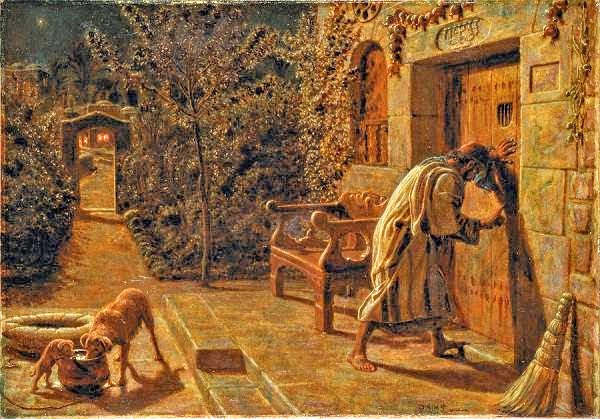
Breaking Down the Door

Luke 11:5-8

This parable is known by some as “the Importunate Neighbor.” That’s an excellent description. Importunate is defined as being persistent, especially to the point of annoyance or intrusion. It’s tenacious and stubborn–not giving up even when being ignored, and that describes what’s happening here.

What immediately proceeds this parable is Luke’s version of the Lord’s prayer, which the disciples requested. They wanted to understand the methods and mechanics of praying–perhaps the Pharisee’s prayers weren’t quite up to snuff–they wanted more; and they insisted that Jesus instruct them.

The disciples wanted to do prayer right.

A typical Jewish home had sleeping quarters (one room!) located on a raised platform. A ladder was used to access that level (which could be crowded, sometimes two to a bed.) Often their livestock were brought inside. And when it was time to get up, everyone got up. That explains the homeowner’s reluctance to give bread to his neighbor. To get up, light a lamp, wasn’t a solitary affair.

He’s obviously unenthusiastic to make that effort.

The word used here to explain the neighbor actions is ἀναίδεια “anaídeia,” which is only used once–it’s translated as impudence, shamelessness, audacity or chutzpah. It’s a Greek word that explains the knocker’s rudeness. He won’t stop. He knocks and pounds until he gets his bread. Not having bread for his guests is unheard of, for it violates all kinds of convention.

The unwritten law of Jewish hospitality demanded action. 

This is part of Jesus’ view on prayer. It means we must be inappropriate sometimes–even to the point were we are being rude.

Immediately following this parable (the very next thought) are the following instructions:

“So I say to you, ask, and it will be given to you. Seek, and you will find. Knock, and the door will be opened to you. 10 For everyone who asks receives, and the one who seeks finds, and to the one who knocks, the door will be opened.”

Luke 11:9-10

Perhaps it’s this intensity that’s lacking.

We “pray” but don’t insist. We desire but don’t demand. Maybe it takes a certain shamelessness to make prayer work. Jesus emphasizes a necessary attitude to praying God’s way. It’s never automatic, but in this parable we see words that move the Father’s heart, and loosen his hand. In Jesus’ teaching, prayer means effort.

It means spiritual work. He wants us to know this. It is important.

“There is neither encouragement nor room in Bible religion for feeble desires, listless efforts, lazy attitudes; all must be strenuous, urgent, ardent. Flamed desires, impassioned, unwearied insistence delight heaven. God would have His children incorrigibly in earnest and persistently bold in their efforts. Our whole being must be in our praying.”

    E.M. Bounds

f

The Seed Must Grow

26 And he said, “The kingdom of God is as if a man should scatter seed on the ground. 27 He sleeps and rises night and day, and the seed sprouts and grows; he knows not how. 28 The earth produces by itself, first the blade, then the ear, then the full grain in the ear. 29 But when the grain is ripe, at once he puts in the sickle, because the harvest has come.”

Mark 4:26-29

From a seed to a plant. We have no idea how this happens, it just does. This is a “kingdom” parable, one of several that explain what God’s realm is, and how it happens. In this particular story, we’re told how the Holy Spirit works. It also explains our role in this (which isn’t a whole lot).

The farmer puts the seed in the ground—and that’s it.

He’s done his work, there’s nothing more he can do. He doesn’t do anything else from this point, and honestly he can’t. And yet the soil needs to be prepared—plowed, fertilized and tilled again. You might say he creates the conditions (that’s what makes a good farmer, I guess) for something to happen.

He doesn’t massage the seed, coaxing it to grow.

He doesn’t sing to it, or tell it about the wonders of being lush and green. He does zero. The seed grows on its own. He goes to bed, and gets up. After several days, bingo! That seed turns into a plant—something green and alive. He doesn’t do a thing. Life occurs without his work.

The point is this. God’s work is done invisibly within us (and that’s a relief)!

Robertson’s Commentary

God’s kingdom works pretty much like this. The farmer doesn’t cause the seed growth, all he does is go to bed! He sleeps and waits and watches. It grows and he hasn’t the slightest. It’s a complete mystery. He has done everything he can, and God has done the rest. He “shares” in this amazing transformation, but the father has done it all.

We trust in a process we cannot see, or really understand.

We don’t dig the seed up every morning to see what’s happening. We just let the (super)natural happen. And it does!

The farmer has faith in the process (after all, he did plant the seed), but that’s it. There’s a verse in 1 Corinthians that should be considered. It gives us confidence and a definite trust in this process of growth. The Apostle Paul understands this “principle of growth.”

“So neither he who plants nor he who waters is anything, but only God who gives the growth.”

1 Cor. 3:7

We must trust God completely to grow. We’re responsible for tilling and planting. But you need to understand what happens after that is up to him. The kingdom of God is supernatural. It’s exactly how the kingdom happens—and we must be very patient and incredibly wise.

“There is nothing more important to learn about Christian growth than this: Growing in grace means becoming like Christ.”

     Sinclair B. Ferguson

alaskabibleteacher.com

Abide.

The repetition of this should be obvious. Our discipleship must hang on that simple (yet profound) word. We are clearly called to “abide.” It’s a small word, and yet the thought it carries is deep and heartfelt. Jesus calls His disciples to rest and obey Him.

To abide means to “dwell,” “remain,” “be present,” and to “be connected.” Abiding addresses our posture and place. How connected are we to our source? Where are we in proximity to Christ? A disciple must ask these questions.

The issue is “sap.” Am I connected in such a way that His presence flows through me?

A branch must be attached in order to bear fruit. If, somehow, it isn’t connected, it dries up and needs to be cut off the vine. Many believers are in danger, they’re not producing fruit and they are not growing. Somehow they aren’t affixed to the Lord Jesus.

This doesn’t mean they have lost their salvation, it just means that their discipleship has little meaning. They have no purpose, the sap of Jesus becomes a trickle and fruit is never really produced. It is a sad and difficult place to be.

Often the real issue comes down to obedience/disobedience.

I must learn that “abide” is now my life, my sap, my fruitfulness.

“Abide in Me says Jesus. Cling to Me. Stick fast to Me. Live the life of close and intimate communion with Me. Get nearer to Me. Roll every burden on Me. Cast your whole weight on Me. Never let go your hold on Me for a moment. Be, as it were, rooted and planted in Me. Do this and I will never fail you. I will ever abide in you.”

     J.C. Ryle

alaskabibleteacher.com

Not a Cliché

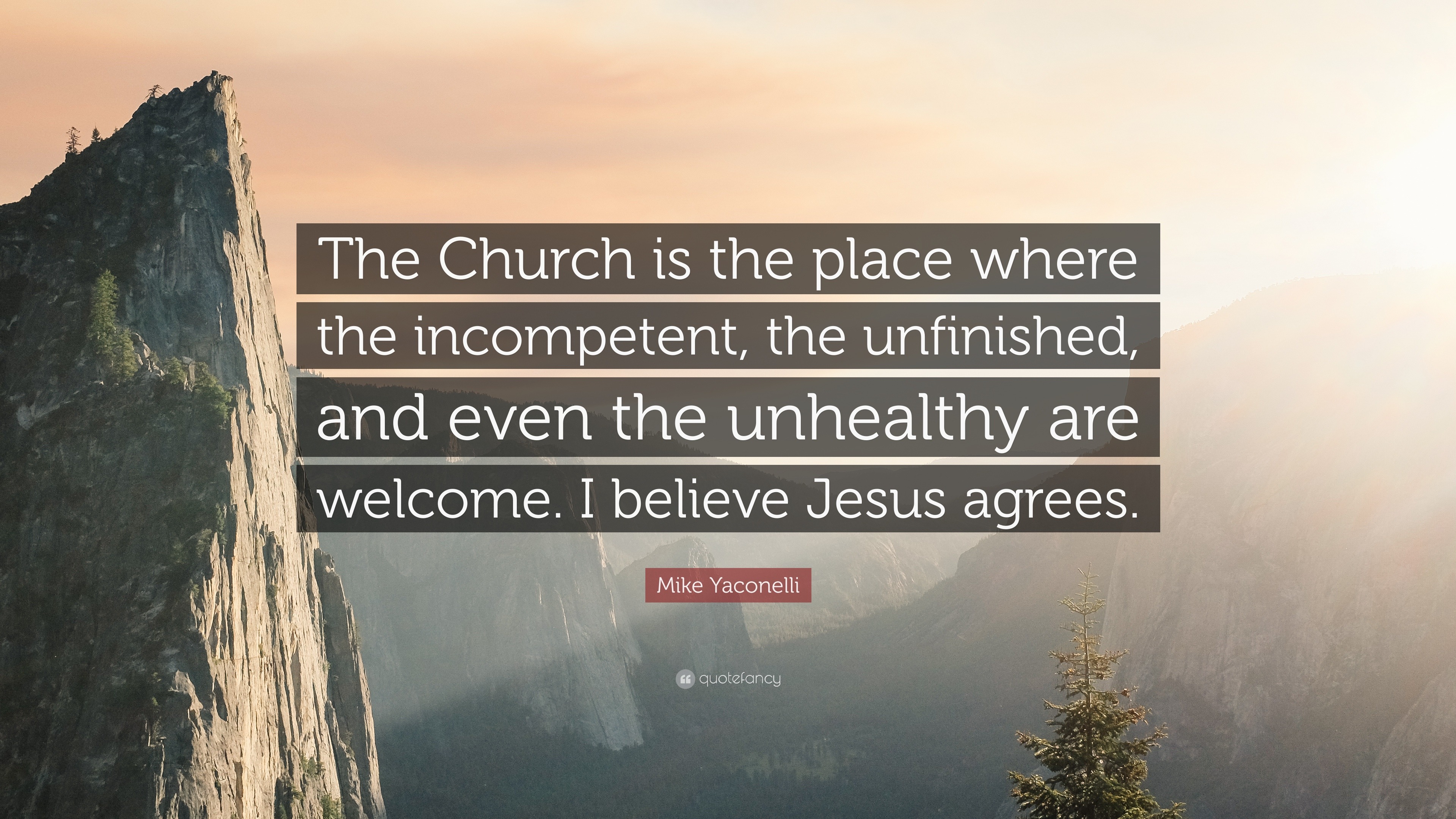
Image result for mike yaconelli quotes images

“A bruised reed he will not break, and a faintly burning wick he will not quench.”

Isaiah 42:3

Somehow, we can get ‘side-tracked’ in our thinking. We get confused and the enemy makes sure we don’t walk in the truth. At this present time, it does seem like some of the Church is nothing more than an exclusive club for the wonderful. It seems that those who attend are the ‘achievers,’ those who have somehow arrived at a certain acceptability.

They are there for social reasons–they eschew any real intimacy with Jesus.

For many of us, we are taught that we must have it all together; more or less complete and functioning at an acceptable level to follow Christ. We keep thinking if we work really hard then we just might arrive at a place of acceptable ‘perfection.’ This has become our religion now, this “gospel by achievement.”

But does Jesus agree? Is His Church made up of only ‘completed’ people, those who have it all together? Do we need to become accomplished before we are acceptable? Perhaps we need to find some answers. Perhaps we won’t like what we find.

After over 40 years of following Jesus (most of the time in ministry) I’m starting to realize that I’ve had much of it all wrong. I’ve read that Jesus receives the lame, the tax-collector, the leper and the whore. He deeply loves the unlovable, in spite of what the Church might say.

I believe that true grace is ‘foolish’ to man, and defies human attempts to explain it. Grace is the free, undeserved goodness and favor of God to mankind. We dare not doubt this.

Zephaniah 3:17

God’s love is completely undeserved. It comes without preconditions. He loves us when we are terribly lost and fallen. It has no bounds or limitations. It is unconditional. Grace grabs us and takes us to a place we’ve only dreamed about. We’re irrevocably changed when we understand.

It is a relationship and not a religion. That’s not a cliché.

This ‘world-system’ desperately wants to confuse us. We discover that Satan detests our intimacy with the Lord Jesus. He marshals all of his demonic strength in order to obscure this truth. It’s funny, but Satan likes ‘religion.’ And he hates our nearness to Jesus. (2 Cor. 11:2-3).

All of us are seeking forgiveness, and yet somehow we think that God won’t accept us. Often we stop going to church, pray, or read His Word. We are slowly becoming hard, and it seems like we are slipping into some sort of a ‘spiritual daze’. Our spiritual malaise is starting to look like it’s permanent.

But Jesus is completely enthralled by your faith in Him!

He doesn’t pull away from the ‘sick’ and the weak. You must understand that intimacy is Jesus’ idea to ‘heal’ you. He draws us to a place of friendship with God. Intimacy with Jesus is God’s exclusive way of ‘turning us’ holy. That’s why Satan militates against “first love” faith.

There is a repentance in all of this.

We need to completely change our mind about our sinfulness. His cross and His blood are enough. But it’s genuine intimacy with Jesus that cures us, not keeping rules or having excellent doctrine. We will never be ‘good’ enough, but even in our sin we are deeply loved!

He knows it all, inside and out. He energizes those who get tired, and gives fresh strength to dropouts. For even young people tire and drop out, young folk in their prime stumble and fall. But those who wait upon God get fresh strength.

They spread their wings and soar like eagles, They run and don’t get tired, they walk and don’t lag behind.”

Isaiah 40:29-31, Message

alaskabibleteacher.com