Love Wears Work Gloves

 “But if anyone has the world’s goods and sees his brother in need, yet closes his heart against him, how does God’s love abide in him?”

“Little children, let us not love in words or talk but in deeds and in truth.”

1 John 3:17-18, ESV

Love is a noble idea, it’s admired and extolled by practically everyone–we see it in our music and poetry, ethics and religion. For the most part it’s a word for something decent and virtuous and honorable. It’s a good thing, but I’m afraid it’s not always scriptural.

You see, Bible love wears work gloves.

It labors and sweats. Bible love has chores to do, and it actively looks and sees what needs to be done. 1 John 3 tells us that we shouldn’t deceive ourselves and only see the world’s definition. That love that a believer has is to be different.

Love, in John’s eyes, is most assuredly “doing.” It burns spiritual calories as it labors to serve our brothers and sisters. Love finds things it can do–it doesn’t just talk but it gets busy. Love sees the need and then gets down to serve.

“You must show sincere love to each other as brothers and sisters. Love each other deeply with all your heart.”

1 Peter 1:22

Working (serving) has nothing to do with our salvation, that is a free gift. We’re saved by grace through the blood of Jesus–that’s a given. And this serving love isn’t drudgery, as a matter of fact, working and serving each other is a joy. The deepest kind of joy there is.

Our words, although important, are really an insufficient way of proving our authenticity.  The love we serve another with isn’t “pretty poetry” kind of love. It’s so easy to just shout out truth and never ever show a working, serving kind of love. 

That disconnect is a bit disconcerting. When do we suppose we figure out that His love is actually a verb?


Listening to Brennan Manning

Here are several quotes written by Brennan Manning. They’re definitely thought-provoking and should be prayed through. I think they’re worth considering. If you like them great, if not that’s ok too.

“The gospel declares that no matter how dutiful or prayerful we are, we can’t save ourselves. What Jesus did was sufficient.”

“When we wallow in guilt, remorse, and shame over real or imagined sins of the past, we are disdaining God’s gift of grace.”

“God loves you unconditionally, as you are, and not as you should be because nobody is as they should be.”

“I could more easily contain Niagara Falls in a teacup than I can comprehend the wild, uncontainable love of God.”

“In my experience, self-hatred is the dominant malaise crippling Christians and stifling their growth in the Holy Spirit.”

“The splendor of a human heart that trusts it is loved unconditionally gives God more pleasure than Westminster Cathedral, the Sistine Chapel, Beethoven’s “Ninth Symphony”, Van Gogh’s “Sunflowers”, the sight of 10,000 butterflies in flight, or the scent of a million orchids in bloom. Trust is our gift back to God, and he finds it so enchanting that Jesus died for love of it.”

“Those who have the disease called Jesus will never be cured.”

“The men and women who are truly filled with light are those who have gazed deeply into the darkness of their own imperfect existence.”

“God loves us as we are…not as we ought to be, because we are never going to be as we ought to be.”

“The ragamuffin gospel reveals that Jesus forgives sins, including the sins of the flesh; that He is comfortable with sinners who remember how to show compassion; but that He cannot and will not have a relationship with pretenders in the Spirit.”

“The North American Church is at a critical juncture. The gospel of grace is being confused and compromised by silence, seduction, and outright subversion. The vitality of the faith is being jeopardized. The lying slogans of the fixers who carry religion like a sword of judgment pile up with impunity. Let ragamuffins everywhere gather as a confessing Church to cry out in protest. Revoke the licenses of religious leaders who falsify the idea of God. Sentence them to three years in solitude with the Bible as their only companion.”

“When I get honest, I admit I am a bundle of paradoxes. I believe and I doubt, I hope and get discouraged, I love and I hate, I feel bad about feeling good, I feel guilty about not feeling guilty. I am trusting and suspicious. I am honest and I still play games. Aristotle said I am a rational animal; I say I am an angel with an incredible capacity for beer.”

alaskabibleteacher.com

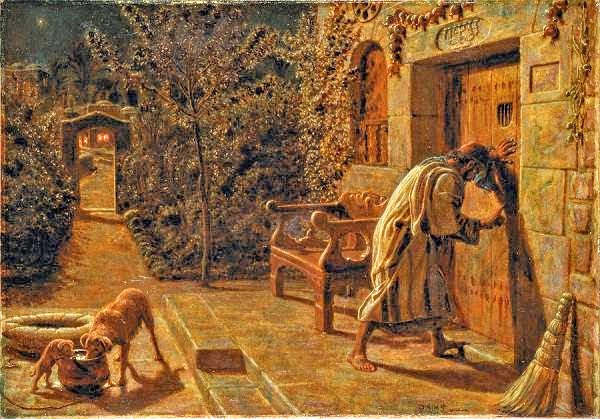
Breaking Down the Door

Luke 11:5-8

This parable is known by some as “the Importunate Neighbor.” That’s an excellent description. Importunate is defined as being persistent, especially to the point of annoyance or intrusion. It’s tenacious and stubborn–not giving up even when being ignored, and that describes what’s happening here.

What immediately proceeds this parable is Luke’s version of the Lord’s prayer, which the disciples requested. They wanted to understand the methods and mechanics of praying–perhaps the Pharisee’s prayers weren’t quite up to snuff–they wanted more; and they insisted that Jesus instruct them.

The disciples wanted to do prayer right.

A typical Jewish home had sleeping quarters (one room!) located on a raised platform. A ladder was used to access that level (which could be crowded, sometimes two to a bed.) Often their livestock were brought inside. And when it was time to get up, everyone got up. That explains the homeowner’s reluctance to give bread to his neighbor. To get up, light a lamp, wasn’t a solitary affair.

He’s obviously unenthusiastic to make that effort.

The word used here to explain the neighbor actions is ἀναίδεια “anaídeia,” which is only used once–it’s translated as impudence, shamelessness, audacity or chutzpah. It’s a Greek word that explains the knocker’s rudeness. He won’t stop. He knocks and pounds until he gets his bread. Not having bread for his guests is unheard of, for it violates all kinds of convention.

The unwritten law of Jewish hospitality demanded action. 

This is part of Jesus’ view on prayer. It means we must be inappropriate sometimes–even to the point were we are being rude.

Immediately following this parable (the very next thought) are the following instructions:

“So I say to you, ask, and it will be given to you. Seek, and you will find. Knock, and the door will be opened to you. 10 For everyone who asks receives, and the one who seeks finds, and to the one who knocks, the door will be opened.”

Luke 11:9-10

Perhaps it’s this intensity that’s lacking.

We “pray” but don’t insist. We desire but don’t demand. Maybe it takes a certain shamelessness to make prayer work. Jesus emphasizes a necessary attitude to praying God’s way. It’s never automatic, but in this parable we see words that move the Father’s heart, and loosen his hand. In Jesus’ teaching, prayer means effort.

It means spiritual work. He wants us to know this. It is important.

“There is neither encouragement nor room in Bible religion for feeble desires, listless efforts, lazy attitudes; all must be strenuous, urgent, ardent. Flamed desires, impassioned, unwearied insistence delight heaven. God would have His children incorrigibly in earnest and persistently bold in their efforts. Our whole being must be in our praying.”

    E.M. Bounds

f

Finding the Pearl

“Again, the kingdom of heaven is like a merchant looking for fine pearls. When he found one of great value, he went away and sold everything he had and bought it.”

Matthew 13:45-46

A different perspective.

The central issue seems to be of value. The pearl was magnificent. This merchant had never seen one like this. It gleamed in his hands, and he knew he must have it. It wasn’t an option, he had to buy it. His response–sell everything to the highest bidder (of course) and buy it.

The Lord Jesus loves each of us intensely.

Rather the people who make up the body. He loves everyone, but he’s crazy about his people. I have a shirt, and I’ll wear it sometimes when I feel like it could touch someone, it says “Jesus Loves You, but I’m His favorite.” I know it’s funny, but maybe it’s true? I know that he loves me–crazy-like. And I love that He loves, even me.

We’re His pearls.

His blood, and His cross was the purchase price. That’s what it took. When we truly believe we acknowledge that we are His now. He paid for us, completely.

Jesus sees, and he must have us. So he comes, and pays the price, he sells it all just to possess us. He now owns us. We know that there is nothing remarkable about us, for we understand our own sinfulness, we really see that we’re spiritually evil all of the time. The theologians call it “the depravity of man.” (Ecclesiastes 9:3; Job 15:14-16; Matthew 15:19).

But our faith in Him changes everything! We have been bought off the slave block of sin. We have been chosen.

“Therefore I endure everything for the sake of the elect.”

2 Timothy 2:10

We realize that we are the elect as believers when we put our faith in what Jesus did for us. Believe me, that’s not what I feel or sense about myself. But it’s what He sees, and He desperately wants me to be his own–and I don’t know why he would do such a thing. It makes no sense to me at all.

God’s love has reasons which reason cannot understand.


p

Maximum Servanthood

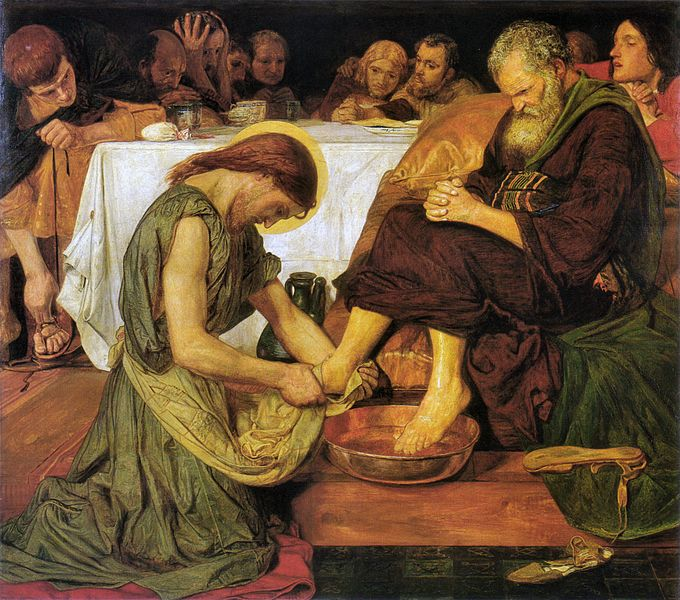
“He came to Simon Peter, who said to him, “Lord, do you wash my feet?” Jesus answered him, “What I am doing you do not understand now, but afterward you will understand.” Peter said to him, “You shall never wash my feet.” Jesus answered him, “If I do not wash you, you have no share with me.”

John 13:6-8 (context vv. 3-17)

Chapter 13 always rocks my world. I visualize this, like a fly on-the-wall, watching it happen–and then I replay it over, and over in my mind. It always unravels me. Why does this have to happen? What does this passage tell me about Jesus, and his kingdom? (John 13).

Why can’t I just walk away from it, and leave it be?

Jesus made himself a slave, (or perhaps he was always a slave all along, and we just didn’t realize it?) Foot-washers were pretty much regarded as sub-human, mindless drones who mechanically performed a necessary duty. The lowest of the low, the very least of the least.

But Jesus took that role on himself, he laid aside his garments, and his Godhood. (They landed in a pile in the corner of the room). When he knelt down to scrub feet (making sure he got between the toes), it was deity serving man. This God/rabbi intentionally did this, not reluctantly or halfheartedly–but carefully.

He was their teacher.

Custom demanded he enjoy the prerogatives of that position. But he wouldn’t, and didn’t. He mustn’t. As I stress over this, I must conclude he really was their “teacher,” but not in the way I expect. What he was doing on his knees, was instructing them in the art of loving each other. He showed us a leader in action.

Real disciples function best when they wash between the toes.

There was a point in Jewish history when the people actually demanded that God would give them a king, instead of a judge (1 Samuel 8:5-9). God warned them that this wasn’t in his plans–but they insisted. They had to have one, everyone else did. We still must have celebrities, and then we wonder why they short circuit on us. Who can resist the privilege, and the limelight?

Peter of course was classic Peter.

It seems that whenever he resists, he gets rebuked. He makes it quite clear that Jesus will never wash feet–that Jesus will never use a basin or towel and serve him like this. It was outrageous. It didn’t fit in Peter’s personal theology. He had no room for Jesus the slave. Perhaps Peter knew that to follow meant he would have to do the same thing?

Jesus still washes feet.

He sits us down and takes off our shoes and socks, and scrubs us clean. And we hate it. But to be washed by him is a condition of our discipleship. Every follower must be clean, and he continues his work to this day. We sin daily, even as his own, and he cleans us up–and yet somehow that really bothers us.

“Does God ask us to do what is beneath us? This question will never trouble us again if we consider the Lord of heaven taking a towel and washing feet.

 Elisabeth Elliot

alaskabibleteacher.com

When Water Became a Sidewalk

Matthew 14:24-31

Peter is speaking:

It was the dead of night–the fourth watch, sometime between 3-6 a.m. The crossing was going all wrong, the water and wind were contrary, and we were exhausted. We had worked hard and made little headway. I seldom have seen anything like this, and the waves were pounding our boat. We had no idea how long we could keep this up.

Someone shouted and started pointing. We all looked, and quickly came to the realization that it was Jesus–but that was impossible. It had to be His “ghost.” He was walking on water, calming striding toward us. As absurd as it seems now, we believed that. After all, what we were all seeing defied reason. No way, it was impossible!

As He got closer to our boat when it shouted to us.

We all knew Jesus’ voice—and He was telling us not to be afraid, He understood our fear and He wanted us to know that we were in God’s hands. Our terror got mixed up in skepticism. After all, it had been a long day and this just doesn’t happen. Besides we knew that Jesus was left back in Gaiilee.

I don’t know why to this day where my courage came, but I needed to be with Jesus. Maybe it was curiosity, maybe it was more than that. Somewhere I came up with this wild idea that if He was really Jesus then He could allow me to walk on the water. I know that seems bizarre, but my “faith” in Him was greater than anything else.

Jesus told me to join Him.

So guess what? I stepped out of the boat.

The water was as solid as if I were walking on land! I couldn’t figure that out, it was impossible. Completely unbelievable. I saw the waves and felt the wind–My eyes shifted from Jesus and it was then I began to sink. The water was becoming water, and I began to sink.

“Jesus, save me!”

If there was any lesson that cry moved the heart of Jesus. Perhaps that’s what has shaped my ministry today. The cry of desperation has become an integral part of my walk. At that moment I realized that is my best prayer. “Master, save me!” I use it a lot. Especially when I’m “sinking.”

Jesus grabbed me.

I was pulled up and out of the water to safety. He gently spoke a rebuke–a kind word of instruction and direction. But I learned something.

Following Jesus is a supernatural walk.

It can’t be done in any other way. And you must get out of the safety of the boat, which must come at His invitation. He wasn’t angered by my unbelief, but I believe He was encouraged by my faith, and the lesson was clearly understood by the disciples still in the boat.

The steps of faith fall on the seeming void, but find the rock beneath.

    John Greenleaf Whittier

alaskabibleteacher.com

The Ministry of Poured Oil

I have to admit, I never really appreciated the depth of Psalm 23:5. I supposed that “He anoints my head with oil” was simply just figurative language for something nice. Poetic. I never knew this definite parallel until recently. But David completely understood and was able to understand the full ministry of the Shepherd.

“You prepare a table before me
    in the presence of my enemies;
you anoint my head with oil;
    my cup overflows.”

Psalm 23:5, ESV

I recently read this and suddenly I understood.

“Sheep can get their head caught in briers and die trying to get untangled. There are horrid little flies that like to torment sheep by laying eggs in their nostrils which turn into worms and drive the sheep to beat their head against a rock, sometimes to death. Their ears and eyes are also susceptible to tormenting insects.”

So the shepherd anoints their whole head with oil.

“Then there is peace. That oil forms a barrier of protection against the evil that tries to destroy the sheep. Do you have times of mental torment? Do the worrisome thoughts invade your mind over and over? Do you beat your head against a wall trying to stop them? Have you ever asked God to anoint your head with oil?”

He has an endless supply!

His oil protects and makes it possible for you to fix your heart, mind, and eyes on Him today and always! There is peace in the valley! May our good good Father anoint your head with oil today so that your cup overflows with blessings! God is good and He is faithful!!”

Posted by Heart Prints

“But you have an anointing from the Holy One, and all of you know the truth.”

1 John 2:20

Oh, How He Loves You!

How Much Do You Love Him?

How much do you love Jesus? This parable looks at the heart of the believer, the person who has been incredibly forgiven of everything–past, present and future. And it’s here we see a woman whose heart is broken by her sin, and she discovers Jesus’ grace, and tremendous mercy.

“A certain moneylender had two debtors. One owed five hundred denarii, and the other fifty. 42 When they could not pay, he cancelled the debt of both. Now which of them will love him more?” 43 Simon answered, “The one, I suppose, for whom he cancelled the larger debt.” And he said to him, “You have judged rightly.” 

44 “Then turning toward the woman he said to Simon, “Do you see this woman? I entered your house; you gave me no water for my feet, but she has wet my feet with her tears and wiped them with her hair. 45 You gave me no kiss, but from the time I came in she has not ceased to kiss my feet. 46 You did not anoint my head with oil, but she has anointed my feet with ointment.” 

47 “Therefore I tell you, her sins, which are many, are forgiven—for she loved much. But he who is forgiven little, loves little.”

Luke 7:40-47

Jesus has been invited to Simon’s home. He’s a Pharisee, and at this point they haven’t quite banded together to attack Jesus, it seems that there were still some Pharisees who were true seekers.

The text jumps right in and we see Jesus reclining at a table (the Jewish people didn’t use chairs–pillows were used instead.) At a feast like this people who weren’t officially invited could come in to stand in the back and listen in on the conversation. (That seems awkward.)

Suddenly a woman enters the room.

She’s described as “a woman of the city,” which is a code word for “a sinner, or a harlot.” (Let your imagination roll that one around.) She comes with a definite purpose, for she brings a jar of quite expensive perfume with her.

The passage reveals that she’s on her knees, weeping on Jesus’ feet, and rubbing her tears with her hair, and pouring out the perfume. She’s kissing his feet. She’s obviously a broken person—someone who knows who Jesus is, and who understands who she is, and how deep sin has destroyed her.

At this point Simon is deeply offended, and probably embarrassed by what’s happening. But he also assumes that Jesus isn’t who he’s saying he is. “How dare does this man let an unclean person even touch Him!” But Jesus understands everything. His parable is short (just two verses) and it’s directed at Simon; and it’s a no-brainer.

The interpretation is obvious: the man who owes the most will love the most.

Jesus accentuates Simon’s breach of protocol. The Lord deftly explains the entire situation and Simon is busted. He’s put on the spot and Jesus has made his point. It’s all so obvious. The essence of the story is clear. How much do you love the Master?

(Or maybe you’re a Simonite?)

Perhaps you’re someone who doesn’t quite accept what’s real? The Bible tells us repeatedly that no one is righteous. No one. Scripture has a very low opinion of the righteousness of men. (That should shatter your thinking.)

“But we are all as an unclean thing, and all our righteousnesses are as filthy rags; and we all do fade as a leaf; and our iniquities, like the wind, have taken us away.”

Isaiah 64:6, KJV

The Hebrew word for “filthy rags” is extremely graphic–literally it means “a menstruating cloth.” It was something that a woman used before Tampax came along. How very descriptive. Do we even have the slightest idea what that means? Are our good deeds that bad?

Yes they are. Isaiah announces that’s exactly how God sees our best attempts to find acceptance apart from grace. It often seems we try to please Him by doing the best we can, but that isn’t sufficient. We always fall short and mess up.

How does understanding this change our discipleship? I’ll let you be the judge on this on this one.

“He loved us not because we are lovable, but because He is love.”

C.S. Lewis

Choosing a Pierced Ear

Body piercing has become pretty much acceptable just in the last ten years. 

Studs are placed in a hole or piercing to make a permanent decoration.  I have seen a fair amount of it, and I think that a stud in the tongue has got to be the most intrusive.  (I recently read of a young girl who died after her tongue was pierced from an infection).

There is “body piercing” in scripture.  In Deuteronomy 15:12-18, slaves who are being set free by their master after six years of service, could, if they loved and were loved by their master, could choose to remain a slave to him.

“But if your slave says to you, “I don’t want to leave you,” because he loves you and your family and has a good life with you,17 stick an awl through his ear into the door; he will be your slave for life. Also do this to a female slave.”

Deuteronomy 15:12-18

This was a decision that required elders to act as witnesses.  It was significant as well as completely binding.  I like to think of the ceremony to be kind of a cross between a wedding and a circumcision. (Sounds fun, huh?!)

The slave would be led to a doorpost and the master would take an awl, and push it through his ear lobe.  This designated the slave to be forever “owned” by a specific master.  Herein lies a picture of the Christian.

Many times in the New Testament we are called to be servants (slaves) of Christ.

Peter, Paul, James, and Jude referred to themselves as “bond servants of Jesus Christ” in their epistles. This is not a forced servitude. It’s a choice made in love!

There are many believers who have done the same, they have fallen in love with their Savior.  They do not plan on a life apart from Him.  So spiritually they have gone to the doorpost, the awl is pushed through their ear, and they are marked from that point on.

Although the ear was pierced physically in the Old Testament, a different kind of piercing takes place in the New.  In Romans 6:16 we read,

“Surely you know that when you give yourselves like slaves to obey someone, then you are really slaves of that person. The person you obey is your master. You can follow sin, which brings spiritual death, or you can obey God, which makes you right with him.”

Romans 6:16, (NCV)

When the prodigal son returned home from the far country he fell before his father and humbly ask,make me your servant.” (Luke 15:19,21) He, in essence, was saying to the father, “pierce my ear.” The father made him a son, but the attitude of the son’s heart had changed to the heart of a servant. So it must be with us. Only then will we live a “pierced ear” life, revealing to all that we are servants of Jesus Christ!

“Savior, I know Thou hast allowed me absolute liberty, to serve Thee, or to go my own way. I would serve Thee forever, for I love my Master. I will not go out free. Mark my ear, Lord, that it might respond only to Thy voice.”

— Jim Elliot, Missionary and Martyr


alaskabibleteacher.com

When God Became Man

“The central miracle asserted by Christians is the incarnation. They say that God became man.”

C.S. Lewis

Incarnation, the central Christian doctrine that God became flesh, that God assumed a human nature and became a man in the form of Jesus Christ, the Son of God and the second person of the Trinity.

Christ was completely God and fully man at the same time. This teaching is clear and I honestly can’t wrap my mind around it. Becoming man did not diminish God–if anything it was an addition and not a subtraction.

Now it’s true that Jesus voluntary set aside all of the prerogative of being God–He chose to lay His deity aside. Please think these verses through–let them sink deeply into your hearts. It really is an awesome passage.

Philippians 2:6-8, ESV

Have a blessed Christmas. Know deep down that He has come for you, He holds you and cares for you. He will never, ever leave you!

Never, ever.

alaskabibleteacher.com