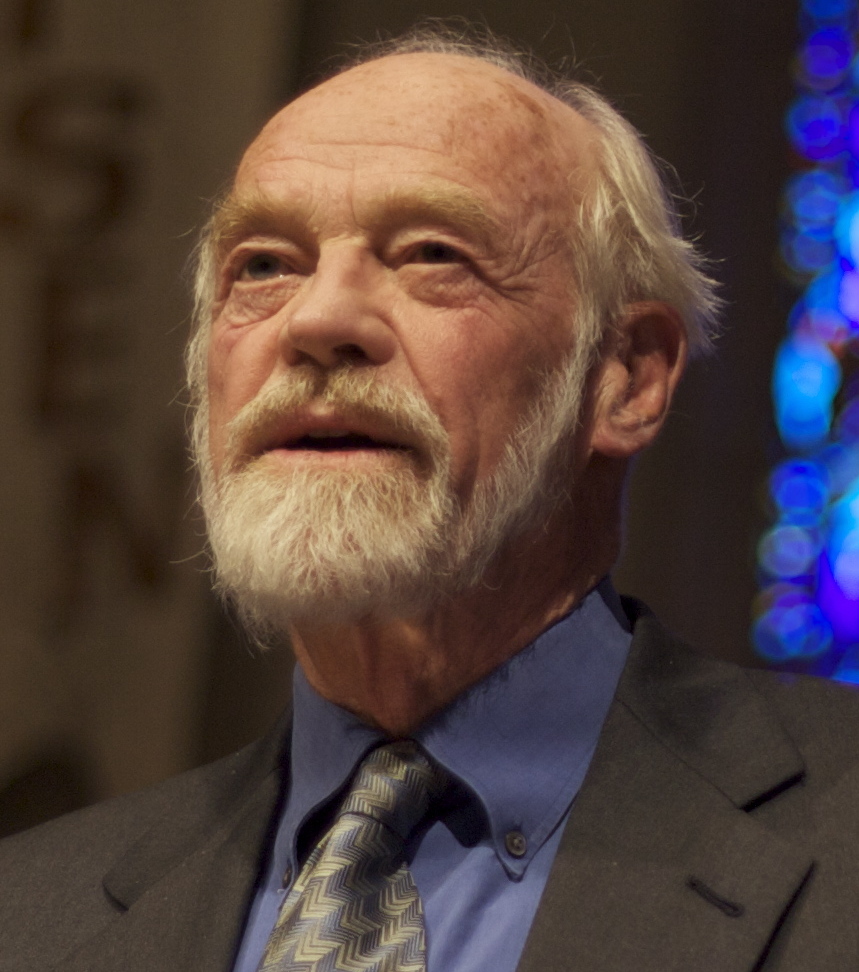
The following excerpt is from the devotional book, “Living the Message,” by Eugene H. Peterson. This pastor-professor is probably the person I want to grow up to be like; he has a gentleness and eloquence that is seldom seen–and highly respected.
Dr. Peterson died in 2018.
***********
“When Christian believers gather in churches, everything that can go wrong sooner or later does. Outsiders, on observing this, conclude there is nothing to this religious business, except perhaps, business…and a distant one at that. Insiders see it much differently.”
“Just as a hospital gathers the sick under one roof and labels them as such, the Church collects sinners.”
“Many people outside are just as sick as the ones inside, but their illnesses are either undiagnosed or disguised. It is similar with sinners outside the church.”
“One way to define spiritual life is getting so tired and fed up with yourself you go on to something better, which is following Jesus.”
Some other quotes by Eugene Peterson:
“All the persons of faith I know are sinners, doubters, uneven performers. We are secure not because we are sure of ourselves but because we trust that God is sure of us.”
“Suffering attracts fixers the way road-kills attract vultures.”
“When we sin and mess up our lives, we find that God doesn’t go off and leave us- he enters into our trouble and saves us.”
“That’s the whole spiritual life. It’s learning how to die. And as you learn how to die, you start losing all your illusions, and you start being capable now of true intimacy and love.”
“American religion is conspicuous for its messianically pretentious energy, its embarrassingly banal prose, and its impatiently hustling ambition.”
“He saw the disciples straining at the oars because the wind was against them.”
Mark 6:48
We must know that Jesus sees our labor and effort. He understands all that concerns us, and he perceives every issue that we take. Jesus is attentive and He comes to our little boat. It’s quite common for us to think that he isn’t really concerned, and we may feel that He’ll pass us by without a word. But that’s only from our own perspective.
Jesus watches over us, all the time.
He knows all about our battles, the terrible fight we have with our flesh, the profound difficulty we have with temptation and trials. He understands these things perfectly. I often struggle to steer my boat, but the winds and waves are hard. Jesus knows when and why I labor like I do. And He doesn’t condemn me.
The disciples were straining very hard to keep the boat afloat.
Every oar was being used and every man had his seat. Some were frantically bailing, and a couple tried muscling the tiller. A considerable effort was being expended. But the wind pushed even harder against them. This is perplexing. If you remember, they’re simply trying to obey the command of Jesus to cross the sea.
Why do things have to be so difficult?
I’m intrigued by preachers who preach sunshine, blue sky, and red roses because they are doing God’s will. They don’t seem to think through the issues of conflict and challenge–my own boat has been pounded by the storm, and it seems it’s always on the verge of taking water and sinking. Is it because I have no faith?
“It is necessary to go through many hardships to enter the kingdom of God.”
Acts 14:22
Often doing the will of God will mean a headwind blowing directly at us.
The seas will become impossible, and we may even be driven back. But special comfort comes when we realize we’re being watched and cared for. Jesus is in constant lookout and He sees our toil on the oars. He comes to us, walking on the water. He comes and brings us His peace and special comfort.
Even in our storm, our hearts can rejoice.
This is His fantastic and sure promise:
“Lo, I am with you always, even to the end of the age”
“Behold, these are but the outskirts of his ways, and how small a whisper do we hear of him! But the thunder of his power who can understand?”
Job 26:14
Job’s suffering has led him to this point. He realizes how little he understands God. I guess pain can have a powerful effect on how we see things. Job has learned the immensity of God.
In verse 14 he speaks about the “outskirts” the word in Hebrew means the mere edge, or fringe. One translation of this verse reads like this: “These are only a few of the things that God does. We only know about a few small things. If he used all of his power, we could never understand.“
“That being the case, let’s consider God’s capacity for just a moment. He’s not only “high capacity”, He’s “infinite capacity.” He never sleeps or slumbers. He is perfect in all His abilities. There isn’t a single thing that He doesn’t know, and there is no one more powerful than Him. And unlike humans who can only be in one place at one time, He is everywhere at the same time. This is amazing, and just like the Psalmist said in Psalm 113, “Who is like the Lord our God?”The answer, very simply, is no one.”
John Piper
“For now we see in a mirror dimly, but then face to face. Now I know in part; then I shall know fully, even as I have been fully known.” (1 Cor. 13:12)
I’m thinking about Moses who asked to see God’s glory. Moses was called “the friend of God,” but he wanted to see more. God’s response was that He couldn’t because it would kill Moses. But provision was made for him to see the backside of God as Moses was in a cleft of a rock. (Exodus 33.)
The Bible doesn’t reveal it all. But we’re given enough. Job told us that only the outer fringes can be seen by men and women. We see His periphery, but we must understand our limits. We’re told that we will see Him someday–but not yet. But at the moment of death, we will see Him.
The Lord Jesus came to show us the Father. “In [Christ] all the fullness of deity dwells bodily.” When we see Jesus we see the Father. Reading the Gospels we are encountering God, because Jesus reveals Him fully.
“He is the radiance of the glory of God and the exact imprint of his nature, and he upholds the universe by the word of his power.”
Hebrews 1:3
“Oh, the depth of the riches and wisdom and knowledge of God! How unsearchable are his judgments and how inscrutable his ways!”
28 And Peter answered him, “Lord, if it is you, command me to come to you on the water.” 29 He said, “Come.” So Peter got out of the boat and walked on the water and came to Jesus.”
Matthew 14:27-29, (context, vv. 22-33)
Jesus is full of surprises! You can never guess the things He will do next. He is Lord after all. To walk on water is totally impossible. But Jesus does it. He walks on it as if it were a concrete sidewalk. When they see Him they freak out. They couldn’t believe their eyes.
Jesus wants to reveal to His disciples His true nature.
They had just seen Him multiply fish and loaves, He fed five thousand plus just a few hours ago. Wasn’t that a miracle enough? It seems that Jesus doesn’t think so.
For some inexplicable reason, Peter wants to insert himself into Jesus’ miracle. Oddly, he has decided he’ll join Jesus, and leave behind the security of the boat–for the insecurity of the impossible! He truly believes that Jesus can hold him up somehow. Perhaps this alone is the most amazing part of this passage. Can a man duplicate the walk of Jesus? Can we walk like Him?
Peter really wants to leave the security of the boat, for the insecurity of the impossible.
It seems to me that we’re constantly doing the “Peter thing.” It’s true our walk of faith really is intensely supernatural, and yet we somehow forget this. And face it, we’ll never generate the “fruits of the Holy Spirit” on our own. Our most sincere efforts will never turn water into something solid.
We will never walk the disciple’s path without faith in the Master who calls us to come to Him.
I think Jesus wants us to join Him. Our faith in Him is the key. We believe that we can walk with Him, we believe we will see the impossible. Without question it’s Jesus’ power that holds us up. Our faith in Him is the ignition point in all of this. Our mustard seed faith, combined with Jesus’ power. becomes the true walk of the disciple.
We must bravely launch ourselves into the purposes of God. Jump when God puts opportunity in your path.
To merely sit in the boat is hardly faith. When Peter steps over the gunwales, he steps into the world of the amazing. The water holds him, and his trust in Jesus solidifies like the water he walks on. He is now doing the impossible. He’s now becoming very much like Jesus.
Our walk seems terribly weak at times, we can easily list our sin and weaknesses. We’re not quite convinced that the blood of Jesus covers all our sin–and therefore we can’t step out of the boat. I think it’s Peter’s faith in Jesus’ power that holds him up.
When his faith falters, he does the “rock thing,” There is something about his circumstances–the wind, and the waves that begin to frighten him. (But I must believe Jesus was pleased.)
To really understand, to obey Jesus is to step out of our boat in faith; when we do we’ll start to see miracles happen.
“Christ will always accept the faith the puts its trust in Him.”
“Again, the kingdom of heaven is like a merchant looking for fine pearls. When he found one of great value, he went away and sold everything he had and bought it.”
Matthew 13:45-46
A different perspective.
The central issue seems to be of value. The pearl was magnificent. This merchant had never seen one like this. It gleamed in his hands, and he knew he must have it. It wasn’t an option, he had to buy it. His response–sell everything to the highest bidder (of course) and buy it.
TheLordJesusloveseachofusintensely.
Rather the people who make up the body. He loves everyone, but he’s crazy about his people. I have a shirt, and I’ll wear it sometimes when I feel like it could touch someone, it says “Jesus Loves You, but I’m His favorite.” I know it’s funny, but maybe it’s true? I know that he loves me–crazy-like. And I love that He loves, even me.
We’reHispearls.
His blood, and His cross was the purchase price. That’s what it took. When we truly believe we acknowledge that we are His now. He paid for us, completely.
Jesus sees, and he must have us. So he comes, and pays the price, he sells it all just to possess us. He now owns us. We know that there is nothing remarkable about us, for we understand our own sinfulness, we really see that we’re spiritually evil all of the time. The theologians call it “the depravity of man.” (Ecclesiastes 9:3; Job 15:14-16; Matthew 15:19).
But our faith in Him changes everything! We have been bought off the slave block of sin. We have been chosen.
“ThereforeIendureeverythingforthesakeoftheelect.”
2 Timothy 2:10
We realize that we are the elect as believers when we put our faith in what Jesus did for us. Believe me, that’s not what I feel or sense about myself. But it’s what He sees, and He desperately wants me to be his own–and I don’t know why he would do such a thing. It makes no sense to me at all.
The life of Moses is a wonderful story. When he was a young man he met God in a common shrub. He was shepherding a flock for his father-in-law. Then something quite extraordinary happened. He saw a bush on fire.
“When the Lord saw that he turned aside to see, God called to him out of the bush, “Moses, Moses!” And he said, “Here I am.”
Exodus 3:4, ESV
God would call Abraham, Issac, Jacob, Joshua. And there was also Samuel and Isaiah. In the book of Acts Paul heard Jesus call him on the Damascus road. And they all responded with one Hebrew word– hineni.
“Here I am.”
God is never silent. He still speaks to each believer. He calls out to us, and hineni must be our response. Yes, walking in faith can be hard, but each one has been summoned. I believe this is true. Each of us is valuable in God’s eyes–“You were bought with a price.”
How are you going to respond to this?
Hineni is a dangerous word. Ask the disciples. When Jesus called them to follow they had no idea how turbulent and troublesome life would become. Each believer gets a cross. And each will know grace and peace.
“And calling the crowd to him with his disciples, he said to them, “If anyone would come after me, let him deny himself and take up his cross and follow me.”
Mark 8:34
There’s grace given to everyone who can really say, hineni, “Here I am.” I have known that there is joy in my journey, a kindness that has no bottom, a love that surpasses every pinnacle. I’m loved that much.
“Christianity without discipleship is always Christianity without Christ.”
I have wondered about this. It strikes me that there are two giants that David encountered in his walk with God. Granted, there are many other events and people that he experienced, obviously. But there are these two that stick out:
The Goliath showdown, and the Bathsheba fiasco.
These seem to be hinges or pivot points that would change the entire course of king David’s life, and his faith in God. They’re to be an encouragement and warning to us, as both are incredibly significant.
Goliath, 1 Samuel 17
This is a powerful chapter, for it reveals David’s spectacular faith in God. When the boy David killed Goliath it changed the entire future of Israel. One stone from his sling was all it took. Israel routed the Philistine army. David’s faith was the spark that made victory real.
David became a hero that day, and quickly ascended into Saul’s favor. It was both a military and a political development that Israel needed and king Saul welcomed it, the kingdom thrived. The boy David became the man of the hour, a national hero which everyone talked about.
I’d like to point out that David had already been anointed by Samuel to be the next king. This, combined with David’s celebrity status pushed king Saul over the edge–Saul developed a deep resentment that became insanity. David handled this adroitly, fleeing into the wilderness (with his faith) for years.
Bathsheba, 2 Samuel 11
At this point David is now king and is fighting the Ammonites. The Israelites were besieging Rabbah, the capital city of that country, and it seems like it’s an intense battle. But interestingly enough, David remained in Jerusalem. (And I can’t figure out why.) David can’t sleep so he paces the rooftop and it’s then things get crazy.
David spies Bathsheba who is cleansing herself from her monthly cycle. She is a very beautiful woman, and king David inquires about her. He lusts after her which results in him more or less raping her, commiting adultery and then murdering her husband. This is all very disturbing.
Bathsheba is the wife of Uriah, one of David’s mighty men of proven valor. He has him murdered after committing adultery with her.
(2 Sam. 11:14-15.)
When David had sex with Bathsheba it set in motion the ugliest chain of events imaginable. It seems that up to now David has taken the intiative of events, and then, after this great evil, his story shifts and for the rest of his life he becomes acted upon, a “victim.” He reacts, but doesn’t act anymore.
For the rest of his life he will struggle. All because of lust.
In 2 Samuel 12 David is confronted by a prophet for these sins. Samuel speaks with a parable that penetrates David’s heart. The king responds, “he shall restore the lamb fourfold, because he did this thing, and because he had no pity,” (v. 6). And interestingly enough, David would indeed pay fourfold. There would be four major incidents after this that he would now face.
Summary
David faced two “giants” in his walk with God. They were very different but both life altering. He killed Goliath but was not able to destroy his lust with Bathsheba.
Sometimes one “giant” is not enough. It would be nice if that was the case. David walked in victory for a period of time, but failed both himself, his family and his kingdom. Lust always is an act of the will, a deliberate decision that destroys all that it touches. David would be forgiven, but the damage was already done.
There would be dire consequences for everyone.
I believe that our giants were meant to be slaughtered. That is their function and purpose for the faithful believer. There can be no compromise. They’ll take different forms and will often approach you in peculiar ways. Paul tells us to wear God’s armor in Ephesians 6:11-18. I don’t think that protection should be taken off–you dare not only wear it only on special occasions.
Brother, sister–you must be covered all the time.
King David is a lesson for us. There is tremendous pain for us if we deliberately choose to compromise with the giants in our lives. Some of you already understand this; others will. I promise you.
“Many of us suffer from temptations from which we have no business to suffer.”
“Jesus said to them again, “Peace be with you. As the Father has sent me, I also send you.”22 After saying this, he breathed on them and said, “Receive the Holy Spirit. 23 If you forgive the sins of any, they are forgiven them; if you retain the sins of any, they are retained.”
John 20:21-23 (19-23)
This is the second “peace be with you” in this passage. So why the duplication of this peace proclamation? The disciples are sequestered and scared in the upper room (v. 19; and Luke 24:36. Having peace is being emphasized–the disciples were afraid of the Pharisees, but they were also undone by Jesus’ surprise visit.
Peace was definitely a precious commodity for them.
Jesus gives his disciples a mission to do, and they must be as ‘familiar’ with Jesus just as Jesus is with God. The disciples had followed him for three years–seeing incredible miracles, and hearing profound teaching, they’re ready, they just need power.
In track and field, there’s a relay race where a baton is passed from runner to runner, and maybe that’s how it’s working here? We see the same idea in John 17:18.
The baton has now been passed to the disciples.
The breath of the risen Jesus is necessary (and yes, he’s breathing.) What went down here, I don’t know exactly. But Jesus recognizes that his 12 followers will need this to do his work. Also, we might consider Adam in Genesis 2:7 where God’s breath brought him to life, which is pretty awesome when you think of the parallels.
The disciples were pretty much observers, but now they are to take up the ‘mantle’ of Jesus’ work. This is a definite duplication, which connects with the idea of one seed producing many others (John 12:24.) That’s how the Kingdom will come to people.
Verse 23 intrigues me. It seems that our life comes from the breath of Jesus. And it’s the Holy Spirit that gives both power and the authority that’s needed to function like Jesus. We now have the ability to pronounce forgiveness to the new believer, and yet that doesn’t seem a function of the Church today.
I wonder why this is so?
This entire passage is a real humdinger for Bible students. But it clearly declares the Churches new role as we follow in his footsteps. Disciples are to do exactly what Jesus does–with his breath and authority–filled with the Holy Spirit. We have a mission.
If we neglect these things we’re going to fall flat on our face.
“The work of Jesus for His disciples on resurrection Sunday gives an ongoing pattern for His work among His people. Jesus wants to continue this fourfold ministry of assurance, mission, the Holy Spirit and authority to His people today.”
Body piercing has become pretty much acceptable just in the last ten years.
Studs are placed in a hole or piercing to make a permanent decoration. I have seen a fair amount of it, and I think that a stud in the tongue has got to be the most intrusive. (I recently read of a young girl who died after her tongue was pierced from an infection).
There is “body piercing” in scripture. In Deuteronomy 15:12-18, slaves who are being set free by their master after six years of service, could, if they loved and were loved by their master, could choose to remain a slave to him.
“But if your slave says to you, “I don’t want to leave you,” because he loves you and your family and has a good life with you,17 stick an awl through his ear into the door; he will be your slave for life. Also do this to a female slave.”
Deuteronomy 15:12-18
This was a decision that required elders to act as witnesses. It was significant as well as completely binding. I like to think of the ceremony to be kind of a cross between a wedding and a circumcision. (Sounds fun, huh?!)
The slave would be led to a doorpost and the master would take an awl, and push it through his ear lobe. This designated the slave to be forever “owned” by a specific master. Herein lies a picture of the Christian.
Many times in the New Testament we are called to be servants (slaves) of Christ.
Peter, Paul, James, and Jude referred to themselves as “bond servants of Jesus Christ” in their epistles. This is not a forced servitude. It’s a choice made in love!
There are many believers who have done the same, they have fallen in love with their Savior. They do not plan on a life apart from Him. So spiritually they have gone to the doorpost, the awl is pushed through their ear, and they are marked from that point on.
Although the ear was pierced physically in the Old Testament, a different kind of piercing takes place in the New. In Romans 6:16 we read,
“Surely you know that when you give yourselves like slaves to obey someone, then you are really slaves of that person. The person you obey is your master. You can follow sin, which brings spiritual death, or you can obey God, which makes you right with him.”
Romans 6:16, (NCV)
When the prodigal son returned home from the far country he fell before his father and humbly ask, “make me your servant.” (Luke 15:19,21) He, in essence, was saying to the father, “pierce my ear.” The father made him a son, but the attitude of the son’s heart had changed to the heart of a servant. So it must be with us. Only then will we live a “pierced ear” life, revealing to all that we are servants of Jesus Christ!
“Savior, I know Thou hast allowed me absolute liberty, to serve Thee, or to go my own way. I would serve Thee forever, for I love my Master. I will not go out free. Mark my ear, Lord, that it might respond only to Thy voice.”
“The servant girl at the door said to Peter, “You also are not one of this man’s disciples, are you?” He said, “I am not.”
“Now the servants and officers had made a charcoal fire, because it was cold, and they were standing and warming themselves. Peter also was with them, standing and warming himself.“
John 18:17-18, ESV
The Galileans had a distinct accent. Just as we easily identify someone from Texas just by the tone and cadence of their speech, Peter had that distinct drawl that told everyone that he came from that same province as Jesus. It was something he couldn’t hide.
Peter could not conceal his Galilean identity.
Peter was a very different man in his three years of being with Jesus. And you might say that had transformed him–and you might even say that he was now a marked man, the enemy was now quite aware of him. He was no longer a captain of a small fishing boat looking for a catch. He was now the leader of Jesus’ disciples. And he was full of fear.
The entire text (18:15-18) reveals a confrontation that Peter had with a servant girl, and we hear him making a bold-faced lie. At this very moment Peter was fulfilling the “promise” that Jesus had predicted (Matthew 26:31-32).
What was going through Peter’s head at that moment?
She was a simple servant girl, perhaps one who ministered at the gate of the high priest’s home. It’s interesting that she is the first one to question Peter’s duplicity. Most likely she was just doing her job, watching and listening. She was probably quite alert.
It’s easy to point our finger at Peter, but really, are we much different?
He was a coward, and when he was put on the spot he bailed. People hate cowards–we extol those who take a definite stand against evil. But he was frightened, scared of being connected with Jesus–the man on trial. There was much at stake here.
Just like Peter we also speak with an accent. I know it might be a stretch–but being with Jesus has fundamentally changed us. Our lives now have a specific dialect that others hear, we’re not the same people that we once were.
We open our mouths and others start to hear the Kingdom of God!
Sometimes I try to pretend that I haven’t been with Jesus, and I’m very ashamed of that. I personally battled for a long time with “fear of man.” Like Peter, I stand with the others and choose to warm myself by their fire, and I try very hard to make myself inconspicuous.
But all I have to do is open my mouth, and I proclaim who I really am. It’s really funny, but even servant girls know that I belong to Him.
“The fear of man lays a snare, but whoever trusts in the Lord is safe.”