Furnace People Understand

The Furnace

Isaiah 48:10

“Once we have come through the ‘furnace of humiliation,’ desperately, fearfully clinging to Christ for all He is worth, then we are fully equipped to march into somebody else’s furnace.”

You will not be able to handle the Kingdom of God unless you’re walking out of a life of brokenness and humility!

Furnace people will often recognize those without any real and tangible connection with God’s work. There are furnace promises, but many, without truly understanding will walk around in unreality. Often ‘they get religion.’ These are those who land on “the rocky soil.” They become ‘quasi-disciples’ who will do and say things that they really don’t really understand.

But furnace people have a connection to that which is honest and true. The Holy Spirit refuses to give up. These people can’t tolerate anything false or manipulative.  Their own hearts are being transformed by the fire, and it seems only then are qualified to minister God’s grace. Only furnace people can enter. You will know them by their scars.

The Church has a tremendous need for those who have withstood the furnace of humiliation.

After we endure its ugliness and its great evil, we’ll discover that we’re in an altogether different place than when we first started. The Church is waiting for those who went in and then come out on the other side.

Again, the furnace of affliction will have done its work.

I was thinking today about Joseph, and his ordeal, as found in the Book of Genesis chapters 37-50.  He was a rare kind of person. Perhaps, one in a thousand. You may emulate but never exceed his faith. His confidence in the Lord was true and came from his lousy circumstances.

Furnace people have the ability to function gracefully at this particular stage.

Furnace people are sovereignly brought to a place where they can minister the grace of God into desperate situations. We must convince ourselves, that furnace people have a gift.  They have been through the worst.  They may be battered and bruised.  But they still stand.  We must look to those who have become the gracious agents of a loving God.

Our brothers and sisters have carried the Word with wisdom and grace. They come to us, through the fire.

But will we receive them? I hope so.

My hope is that you will personally grasp what God has worked for you. That really is your truest calling.  The things good or bad, that have happened are part of how you’ll understand grace. He waits for you to respond.  Will you come to Him, through the grace you find in flames?

Frequently the most gracious people you’ll ever meet are those who endured God’s furnace.

Malachi 3:3

***

The Man on the Other Cross

Luke 23:39-43, ESV

The pain was incredible, but I know that deep down I deserved to die. But not like this. Never like this. I was almost out of my mind with fear. What they were about to do to me was terrifying.

You must understand that I was just a common thief. I had stolen a loaf of bread when I was eight years old and that’s how it all got started for me. It more or else got bigger and easier. I knew how to steal and I was quite good at it. I was Jacob, the master thief!

When I was finally caught, they had sentenced me to die.

I supposed it was inevitable. I fault no one but myself, I knew what I was getting into. As I dragged my beam up to Golgotha, it was really strange but I suddenly remembered a verse from the scripture and it really did unsettle me.

“Cursed is everyone who hangs on a tree.”

It’s a terrible thing to die this way. There were three of us, nailed to the wood and lifted up between heaven and earth. Jesus was nailed to the middle cross, not that it really mattered; all three of us were going to die today. Many hope for a simple and easy death, maybe in their sleep–but that’s not going to happen to us.

The third man could only mock, he was afraid, and I suppose he just echoed those Pharisees who didn’t really understand. But I knew better. I knew who this other man was, I had heard all the stories. Deep down I knew that this man on the center cross was the Messiah.

A crowd had gathered to watch us die. The Romans in their wonderful ingenuity had made a sign that they nailed above Jesus’ head, and it declared to everyone that Jesus was “the king of the Jews.” Even as he was dying, they found a way to malign him and to stir-up the crowd.

The other man being crucified continued to mock Jesus, and it infuriated me.

Why I defended him I don’t know for sure.

But I understood. He was being murdered out of envy and jealousy. He didn’t deserve to die like this, but the powers that be hated him, and who can confront these religious men without becoming a victim. Jesus had repeatedly crossed the line, so now they were now putting him to death. It seemed evil was really winning today.

I saw the soldiers throwing dice for Jesus’ clothes. He was now being mocked by them as well, even as he was dying on a brutal cross.

But all of a sudden it all made perfect sense, he really was the Messiah, and these bastards were killing him. Crucifixion was starting to work on me now. I began to choke on my words, and it was getting hard to breathe.

“Jesus… please remember me. When your Kingdom comes, please let me be a part of it.”

And as beaten as he was, he managed to turn and look directly at me. They had whipped and brutalized him, and yet he was still aware. His words were whispered now, but I understood. “I promise that today you will be with me in paradise.”

I was starting to spasm again, but the horror of death had left me. Some time had passed, and I could hear his breathing stop. But for the first time, I had peace. They used a spear on Jesus, but he was already dead.

The soldiers now came to the two of us, and they were carrying an ax to break our legs. It all had to do with the coming festival, and the Pharisees wanted us dead. When they swung that ax I knew pain that I could never describe. My own death came quickly after that.

I was suddenly standing in paradise, whole and complete.

Someone was standing before me. He was shining I remember, and I knew he was powerful; stronger, and he was more glorious than anyone I had ever met. It was crazy but somehow I knew that he was an angel and he had been sent to meet me. It’s funny, but I realized that somehow I really did belong. Me–a dirty rotten thief.

Jesus had promised me, he had pronounced me righteous, me of all people.

I suddenly had a joy that I could never explain. I really was a part of the Kingdom that was beyond anything I had ever known. And all I can really say about this was that I was privileged to die with him. That is all I could claim. I simply believed him and asked if somehow I could be part of his eternal rule.

I simply asked and you know what, He gave me everything.

And so, I’ll see you in heaven.

Cover Art: “Christ on the Cross between Two Thieves,” by Peter Paul Rubens

Meet Martha, Her Story

Luke 10:38-41

“While Jesus and his followers were traveling, Jesus went into a town. A woman named Martha let Jesus stay at her house. 39 Martha had a sister named Mary, who was sitting at Jesus’ feet and listening to him teach. 40 But Martha was busy with all the work to be done. She went in and said, “Lord, don’t you care that my sister has left me alone to do all the work? Tell her to help me.”

41 “But the Lord answered her, “Martha, Martha, you are worried and upset about many things. 

42 Only one thing is important. Mary has chosen the better thing, and it will never be taken away from her.”

My name is Martha and I’m a friend of Jesus. My home was one of His favorite places to stay–a refuge for Him whose life was so busy. I joyfully opened my house for Him and His disciples. When Jesus came I went all out, I wanted the best for His followers and that meant there were always things to do. Is that really a bad thing?

The kitchen was getting crazy–lamb, cucumbers, figs, and so on. Roasting and slicing, I had bread in the oven. All of this was requiring constant attention, and I remember not being able to keep up.

I wanted things to be perfect for Jesus.

I took occasional peeks at He who was teaching in my living room. I just brought in some bowls of figs and raisins as an appetizer and found my sister Mary sitting with the men listening to Jesus and asking questions. It was that which started to get a little ticked off.

I was getting really mad at my sister.

There was so much to do and I realized I had to have her help. And the more I thought of Mary the more frustrated I got. I suspect she didn’t understand the work that need to be done. I suppose her priorities were messed up–she simply didn’t understand her role as a hostess, and to sit with the men like she was doing was wrong.

Mary didn’t understand her place.

I admit I was having issues with my sister. I had brought out another bowl of figs and that’s when I gently interrupted the Lord’s teaching. I wanted Him to tell Mary that her place was with me in the kitchen. He could correct her and I knew she would listen. “Tell her to help me.”

Instead, it was Jesus who corrected me. I still remember Jesus’ words. I wasn’t expecting this.

“Martha, Martha, you are worried and upset about many things.”

Was I really that transparent? He understood, but rather than encouraging me I had become another lesson to everyone present. I realize now that the real issue was with my attitude, and not the work. Yes, I was bothered and upset and I know that it’s those things that were the problem.

Only one thing is important. Mary has chosen the better thing, and it will never be taken away from her.”

I suddenly knew that He was right. Jesus was in my home, and all I did was get angry. I thought my work would please Him and after all, wasn’t that important? Didn’t He “deserve” my best efforts?

My younger sister Mary was being praised. She was my example and now I was being gently rebuked. I realized that all I was doing, all my work, was not what Jesus wanted from me. The problem was my own heart—-it wasn’t Mary, it was me!

I had taken my eyes off of Jesus and was immersed in my service to Him.

I had become critical and resentful of Mary, and I had forgotten that my place was at Jesus’ feet, listening and learning. That’s what Jesus wanted from me, and somehow I had forgotten that.

I decided then, the work could wait, my real place was with Jesus.

Martha’s frustration is typical of those who diligently serve with good intent, but forget to also sit at Jesus’ feet. “The Martha spirit says, if the work is done, is not that all? The Mary spirit asks whether Jesus is well pleased or not? All must be done in his name and by his Spirit, or nothing is done.”

C.H. Spurgeon

My Facebook page is here.

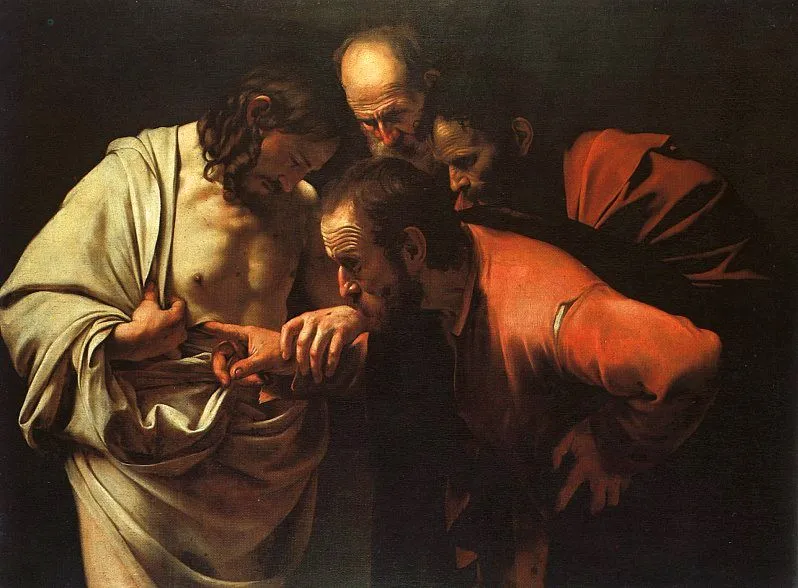
Doubting Thomas Speaks Up

John 20:25-29

But Thomas, sometimes called the Twin, one of the Twelve, was not with them when Jesus came. The other disciples told him, “We saw the Master.”

But he said, “Unless I see the nail holes in his hands, put my finger in the nail holes, and stick my hand in his side, I won’t believe it.”

Eight days later, his disciples were again in the room. This time Thomas was with them. Jesus came through the locked doors, stood among them, and said, “Peace to you.”

Then he focused his attention on Thomas. “Take your finger and examine my hands. Take your hand and stick it in my side. Don’t be unbelieving. Believe.”

Thomas said, “My Master! My God!”

Jesus said, “So, you believe because you’ve seen with your own eyes. Even better blessings are in store for those who believe without seeing.”

The others had told me that they had seen Jesus. But this couldn’t be. Either they imagined it or they saw His ghost. I saw him brutalized, crucified, and buried, and I knew He was really dead. I was never into pretending, or wish fulfillment. No, not me. When you’re dead, you’re dead. (At least that’s what I thought.)

I told the others that I would only believe them if I could see and feel the scars–the nail holes and the hole in his side. I needed proof, something tangible or solid before I could believe their stories. Part of me hoped it was so, but I honestly couldn’t join the others in their excitement.

Some would call me a doubter–a skeptic. But that isn’t quite true.

A realist is how I would describe myself. To go along with the others wasn’t going to cut it. They said that they had seen Him and He was very much alive, that somehow, someway He was now resurrected. But for me, I couldn’t believe it. I myself must know it for myself.

Was Jesus alive after all they had done to Him?

We had all gathered in a large room. We had locked the door–we were afraid that the authorities would come for us next. In spite of the confinement, we had some good fellowship that Sunday morning, catching up and sharing stories of the last three years, thinking about all the things Jesus had taught and done.

And then, suddenly, Jesus showed up! Trust me on this if you can–the door was locked, and there was no other way to get in. When Jesus “dropped in” we were completely amazed. He was very much alive–and how can this be? We were all in shock as He stood right in front of us!

Immediately Jesus looked at me, and I looked back–it was really Him!!

Jesus immediately focused on me, He asked me to come close; He wanted me to touch Him, to inspect and see for myself that He was as real as you or I. He asked me to come and see the nail prints in His hands, and stick my hand in the hole where the Roman soldiers had thrust a spear into His side.

And I was completely undone.

It was really Him, and I couldn’t explain it away. Jesus was real flesh and blood! In a second I went from doubt to faith. How He knew that I had voiced my hesitation out loud I didn’t know. But I now knew for certain Jesus was very much alive. Death was now dead.

“My Master! My God!” (That was all I could say.)

At that moment I became a “believing believer.” It wasn’t second-hand anymore; I wept and laughed at the same time! I couldn’t explain it, I must believe it. Jesus had overcome death and He was now commanding me to believe.

Immediately I knew, I saw Him for myself.

Looking back I admit my foolishness and doubt; Jesus had sought me out, and somehow He knew that of all His disciples, I needed that special touch. He understood and came me just for me. To this day I realized how much He really loved me–the doubting Thomas.

According to Christian tradition, Thomas, was killed by jealous Hindu priests of Kali India. He was burned to death in 72 AD. A church is now established there and still recognizes him as an apostle.

Bryan’s note: I can relate to Thomas. I was also one who needed to know for myself that Jesus was really God and that He really did rise from the dead. It was reading “More Than a Carpenter” by Josh McDowell that propelled me into belief. If you need to know for yourself, I suggest you buy this book. (If you can’t afford it, I’ll buy it for you.)

Art: Caravaggio’s The Incredulity of Saint Thomas, c. 1601-1502, oil on canvas–Verses are from The Message, a translation by Eugene Peterson.

Am I Ignitable?


“Who makes His angels spirits and His ministers a flame of fire.”

Hebrews 1:7

Jim Elliot was a Christian missionary martyred by the Auca Indians of Ecuador in 1956. He was just 29 years old. This quote was found in a journal he kept, and it was found after his death. There’s much here to process.

He makes His ministers a flame of fire.” Am I ignitable? God deliver me from the dread asbestos of ‘other things.’ Saturate me with the oil of the Spirit that I may be aflame. But flame is transient, often short lived. Canst thou bear this, my soul – short life? … Make me thy fuel, Flame of God.”

Jim Elliot, “Shadow of the Almighty”

A wonderful and intense quote. Passionate. Maybe we should dismantle it and consider what he was trying to say. There are some great insights to be found here.

First, he writes of asking God to be saturated with the oil of the Spirit. Jim Elliot wants to be set on fire with his life, heart, and spirit becoming the fuel.

Second, he writes of “dread asbestos.” Almost 2000 degrees F is needed to melt this down. Now regarded as a carcinogen but because it’s basically fireproof it was used often. For the person walking by faith it illustrates the power of sin.

Third, he writes about the brevity and shortness of his life and his need to live in the bright light of eternity.

O.K. Let’s switch metaphors.

The ponderosa pine needs fire to propagate. Their seeds are fire-activated.

Fire activates the cone that holds the seeds. Looking we see a tight little bundle which is covered in resin. To germinate they must be burned. Fire melts the exterior and the pine cone and releases the seed; and actually they can lay dormant for several years just waiting for the heat.

The believer needs heat to grow.

I don’t think there is any other way. The Word and the Spirit, combined with the heat of the circumstances we face, creates a blaze that is often seen by others. The furnace is God’s way to bring lasting change to His people. I wish it were different.

“They said to each other, “Did not our hearts burn within us while he talked to us on the road, while he opened to us the Scriptures?”’

Walking with Jesus to Emmaus, Luke 24:32

“Who among us shall dwell with the devouring fire? Who among us shall dwell with everlasting burnings?”

Isaiah 33:14

Rediscovering the Feet of Jesus

A terrific study is finding the people who fell at Jesus’ feet. Tucked in the Gospels you’ll find stories of those who despair. You’ll also see them come to Jesus in brokenness and humility, without any other recourse. I call these the “people of the feet.”

They came to Jesus because they had no hope otherwise. They were people who were hopeless and wretched, they had long ago run out of options. They came to Jesus, falling down in front of Him. They were all people of the feet.

They were men and women who were truly desperate.

Now when Mary came to where Jesus was and saw him, she fell at his feet, saying to him, “Lord, if you had been here, my brother would not have died.”

John 11:32

One of the classic scenes in the Gospels is when Mary meets Jesus after her brother’s death. She doesn’t understand Jesus’ delay, Lazarus has been very ill and Jesus could have healed him. She is grieving and confused. But she only has one posture and one place in her heart to be– at the feet!

There are some common characteristics that feet-finders have:

  • A great need that can’t be met without His touch
  • To understand one’s true condition–humility, brokenness
  • To beg for a healing, for self or family
  • To honor Jesus as the Messiah
  • To be more receptive to His teaching, to understand Him
  • To become a witness to others (although it does seem secondary)

The following 3 verses are just a small selection of those who fell at Jesus feet.

“And great crowds came to him, bringing with them the lame, the blind, the crippled, the mute, and many others, and they put them at his feet, and he healed them.”

Matthew 15:30

“But immediately a woman whose little daughter had an unclean spirit heard of him and came and fell down at his feet.“

Mark 7:25

“Then people went out to see what had happened, and they came to Jesus and found the man from whom the demons had gone, sitting at the feet of Jesus, clothed and in his right mind.”

Luke 8:35

But there are several other instances where people came to sit at Jesus’ feet:

  • Mark 5:22-23, Jairus, a leader in the local synagogue
  • Luke 7:37-38, a sorrowing mother for her daughter
  • Luke 8:41, also Jairus
  • Luke 10:39, Mary, when Jesus was teaching
  • John 11:32, Mary, meeting Jesus entering Bethany
  • John 12:3, Mary, with her perfume
  • Revelation 1:17, John to express what he was seeing (also 19:10)

In every case we find people consciously coming and kneeling at the feet of the Lord Jesus. It was a deliberate action that came from their hearts. Each had a terrible need, and each was without hope.

It’s the end of religion if you’re a feet-finder. No more facades, no more treadmills. Instead your heart forever changes.

Formality and religious politeness are jettisoned. Brokenness and true humility takes their place. A foot-finder is no longer operating on spiritual niceties. Religion is comfortable, noble, and respectable, but it cannot heal or change people deeply.

Feet-finders know that they need Jesus desperately and will go to any length just to be touched by Him. They defy what is conventional and proper. They are not what we call respectable. You can find them at the feet of Jesus. They are feet-finders. Foot-finders weep, kneel, beg, shout. Too many tears and maybe some snot.

Hardly decent to religious people.

Are you really that desperate yet? Have you seen your need, and do you realize how lost you would be without His healing touch?

Often when I do pray, I sometimes think of the woman who was unclean. She speaks to me about approaching Jesus. I see myself in a crushing crowd of people, and I’m reaching out just to touch the hem of His robe. I know only Jesus can stop my own uncleanness. (Matthew 9.)

I’m convinced only Jesus can make me clean and whole.

I’ve tried to be holy and acceptable to Him. But I felt like a juggler, trying to keep my balls in the air all at the same time, and I could never pull it off. So I tried again and again. I was the unofficial master of religious effort.

But I found my rightful place at His feet. It’s where I belong. I love Him.

I’m not ashamed to be found kneeling.

Why, God Why?

Job 7:20, 13:24, 9:29, 24:1, 10:18

Job’s profound suffering is one of the most extreme in all of human history. He is essentially a godly man who loses everything (except his faith). Job must pick up the pieces after “catastrophic ” sudden pain and total loss.

Only the brutality of the cross of Jesus eclipsed the suffering of Job.

Job is being tested with dark horrors. Will he “curse God and die” as his wife suggests? Will he cave in to the final four “friends” and accept their twisted theology? (I guess that you have to read chapters 38-39 to find out).

The Book of Job has been regarded as inaccessible and archaic by many.

Unfortunately, many believe this assessment and look elsewhere for comfort. I would agree that Job is a challenging book, but so is Macbeth or Plato. There are plenty of easier books to read; but if we choose to avoid Job, our faith will always be deficient. We will miss something vital.

Job is less an explanation and more a revelation of suffering. “Why” questions go unanswered. “Who” questions matter. I suppose this seems unfair to Job. It certainly seems so to me, but straight answers in a fallen world won’t get any traction at all.

One more thing. The Book of Job is about “twisted” theology. Job’s friends “toe-the-party-line” of theology that is logical. But don’t be mislead by their pronouncements, for they seem reasonable but they are all very much flawed.

I always find it strangely amusing when some quote Eliphaz or one of the other “friends” to encourage or comfort a suffering saint. They totally miss the point of the book. We desperately want to give out good counsel but we really don’t understand.

“If I have the gift of prophecy and can fathom all mysteries and all knowledge, and if I have a faith that can move mountains, but do not have love, I am nothing.” 1 Cor. 13:2

You can’t split your theology from love and get away with it. Something toxic happens if you try.

When you read “Job’s friends” you must remember that. These are lessons it takes a long time to learn. Unless the Holy Spirit tutors you, be very slow to speak. (Job’s friends were at their best at the beginning when they said nothing at all.)

The broken believer, hobbled by chronic illness, has much to learn from Job. He is like “the poster child” for those afflicted. My own illnesses are always an issue of course, but God is fully in control. He brings beauty out of the ashes. He has been more than gracious.

“To bestow on them a crown of beauty
instead of ashes,
the oil of joy
instead of mourning,
and a garment of praise
instead of a spirit of despair.
They will be called oaks of righteousness,
a planting of the Lord
for the display of his splendor.”
Isaiah 61:3

Give Me Dove’s Eyes


“Behold, you are beautiful, my love;
    behold, you are beautiful;
    your eyes are doves.

Song of Solomon 1:15

Doves have single vision. They can only see one thing at a time, that makes them unique. They are one of a kind. Doves are also the emblem of the Holy Spirit in scripture, and when they are mentioned we should be alerted that something spiritual is happening.

What the Shepherd is proclaiming is “she only has eyes for me, she sees no one else.” For the true believer there isn’t anything that can take the place of Him. Vain philosophy, political involvement, Eastern mysticism, science, or empty materialism should never take the place of the Lord Jesus. Never, ever.

We need “dove’s eyes.” We must see Jesus only.

There are a lot of noble things we can get involved in. Good things, yes, but not the best, we need to fix our eyes on Jesus. I have personally seen brothers, sisters, and whole churches lose their vision, and focus on something other than their “first love.”

Satan hates our intimacy with Jesus.

There are many preachers and teachers in the Church who no longer have dove’s eyes. Satan has blurred their vision, and they have lost the intimacy they once had with Jesus. Most of the time, they don’t even realize it.

This saddens me.

I remember a blazing church who once closed down entire blocks in San Francisco. They worshiped Jesus intensely. They were powerful evangelists who took the Church into the streets and brought with them a passion. They were people on fire. It was a pleasure to work with them, they were so in love with Jesus.

But within two years they lost it.

They adopted a political stance that was commendable, but it diminished their first love for Jesus, and Satan was pleased. The church quickly split in a dozen different ways. This isn’t a new thing, the apostle Paul saw it and was afraid for the church in Corinth.

“For I feel a divine jealousy for you, since I betrothed you to one husband, to present you as a pure virgin to Christ. But I am afraid that as the serpent deceived Eve by his cunning, your thoughts will be led astray from a sincere and pure devotion to Christ.”

2 Corinthians 11:2-3 

In the book of Revelation, chapters 2 and 3 emphasize the level of intimacy each Church possesses. “Angels” come and carry the message of repentance and a return to that first love. I have to think that having dove’s eyes comes as a result of being filled with God’s Spirit.

We now can look at things, with the eyes of the Holy Spirit. Jesus thinks that is beautiful.

Return dear one, come back to the Lord Jesus. Let your first love blaze again. Don’t allow Satan to sidetrack you into something that is good, but not the best. Have “dove’s eyes” that only see Jesus. –Amen and amen.

When the Rooster Crows

Jesus had full knowledge of him, and yet, His love for him remained unwavering. Can one truly fathom the magnitude of this? In verse 37, Peter boldly declared his unwavering commitment to follow Jesus, even if it meant laying down his very life. I firmly believe in Peter’s sincerity and his readiness to follow through on his words, even if he had to die.

But Jesus bought none of it, He knew all about Peter.

He poses a question to Peter–the type of question that had to have penetrated Peter’s interior bravado. It’s said someplace that “the spirit is willing, but the flesh is weak.” Perhaps this is true here. But Jesus knew.

In contemplating the depth of understanding that someone truly possesses about us, it becomes a fascinating journey of knowing ourselves. How well does he truly know us? Is He aware of the moments of doubt that creep into our minds, the fears that grip our hearts, and the dreams we cherish in the depths of our souls?

It is as though he sees straight through our facades and masks, peering into the deepest recesses of our being, unearthing our vulnerabilities and laying them bare.

When he casts his gaze upon us, it is not merely a superficial glance. It’s a penetrating look that delves into the very essence of our existence. In those moments, it’s as though Jesus knows our every flaw and imperfection. We cannot hide from Him, for he perceives the intricate details of our lives with a clarity that surpasses even our own self-awareness.

He knows us.

Yet, in the midst of this profound understanding, Jesus’ love remains unwavering and unconditional. It’s a love that transcends our frailties and shortcomings. It extends beyond our misplaced zeal and faltering commitments. His love for us is not based on our performance or achievements but on the simple fact that we are his creation – flawed and imperfect, yet filled with potential and worth.

In His presence, we find solace and acceptance. We are reminded that we don’t have to strive to earn his love, for it is freely given. Our weaknesses do not diminish His heart, but rather, they provide an opportunity for his grace to shine through. It is in our moments of weakness that Jesus’ strength is made perfect, and His love becomes all the more real.

So, let us embrace the reality that we are known – truly known – by Someone who cares deeply for us. Let’s cast aside the illusion of perfection and allow ourselves to be seen in our sins and flaws. For it is in this authentic state that we can fully experience the depth of His love and find true healing and restoration.

As we journey through life, let’s grab a hold of the assurance that we are known by name, understood beyond measure, and loved unconditionally. And in that love, may we find the courage to embrace our true selves and live out our purpose with confidence and joy.

That both comforts and disturbs me, and I don’t really understand how or why He does it.

Have you heard the rooster?

Maybe that’s the way He’s going to teach you the depths of his love?

    C.S. Lewis, The Problem of Pain

When the Father Runs

20 “And he arose and came to his father. But while he was still a long way off, his father saw him and felt compassion, and ran and embraced him and kissed him. 21 And the son said to him, ‘Father, I have sinned against heaven and before you. I am no longer worthy to be called your son.’”

22 “But the father said to his servants, ‘Bring quickly the best robe, and put it on him, and put a ring on his hand, and shoes on his feet. 23 And bring the fattened calf and kill it, and let us eat and celebrate. 24 For this my son was dead, and is alive again; he was lost, and is found.’ And they began to celebrate.”

Luke 15:20-24

“Cursed is the man that feeds the swine.” That’s the commentary on Jewish ritual cleanness. The prodigal knew this, but when you’re starving, tradition is thrown out the window. It’s really hard to be spiritually correct when your stomach is growling. In verse 17, we see that the prodigal suddenly realized his condition. Notice the change:

It took sometime for this to happen. But it was a true and a complete repentance. A total alteration of his mind and heart took place at that point. And I must assume, when he finally made the decision to return, he didn’t even say ‘good bye’ to the pigs.

It’s the Father’s reaction that fascinates me.

How does God see us? Is he angry or frustrated? And yes I suppose, there is ample reason for him to treat us with caution. Deep down, we know exactly how dark we are, and on a superficial level we realize our dirt doesn’t belong in heaven. And yet the father is in a party frame of mind. That isn’t rational.

There were no tests to see if the repentance was real.

Did he really repent, or was it all for show? The text tell us that he was hungry, maybe he just wanted a hand-out? Did he meet the criteria needed for reinstatement? It amazes me, there wasn’t a 30 day waiting period to determine whether the prodigal had truly repented. No, the party started when the father hugged his son.

Do you see the “suddenness” of this part of the story?

At least for me, the pace quickens, and I imagine the whole household jumped up to get in the act. Verse 10 explains the joy that reverberates through heaven at this, Just so, I tell you, “there is joy before the angels of God over one sinner who repents.”

Joy seems to be the key thought to really “get” these verses. If we can’t see it saturate (like a sponge) we’ll never understand this parable. Its not hard if you can read it with excitement and anticipation. If you decide to do so, it’ll make a lot of sense, and it’ll be less mysterious.

This story is as much about the father as it’s about the son.

In it we see the character of the Father revealed. We see his joy, and excitement over his son’s return. Right from the start we see him running, (v. 20) moving to his son. I can see a weeping father giving his son a big bear hug and lots of kisses. He has hoped and dreamed about this moment.

Golly, there is so much to be said: there’s a ring and shoes and a roasted calf. But I think that the overwhelming lesson is the joy of the father. It tells me much about what he’s like–and he’s not at all what I thought he’d be.

I’m convinced, after 30 years of reading this parable, that He’s the Father who is always moving, and he runs to meet us. He’s the One who is filled with joy at our return. Please dear one, take Him at His word.

“What marvelous love the Father has extended to us! Just look at it—we’re called children of God!”

1 John 3:1. MSG

a

.