Listening to A.W. Tozer

I believe that these quotes by A.W Tozer will really touch your heart. I’ve tremendous respect for him and his ministry. His is a voice that we really don’t hear too often anymore–but we should.

― A.W. Tozer, The Pursuit of God: The Human Thirst for the Divine

“Between the scribe who has read and the prophet who has seen there is a difference as wide as the sea. We are today overrun with orthodox scribes, but the prophets, where are they? The hard voice of the scribe sounds over evangelicalism, but the Church waits for the tender voice of the saint who has penetrated the veil and has gazed with an inward eye upon the Wonder that is God. And yet, thus to penetrate, to push in sensitive living experience into the holy Presence, is a privilege open to every child of God.”

“Complacency is a deadly foe of all spiritual growth. Acute desire must be present or there will be no manifestation of Christ to His people. He waits to be wanted. Too bad that with many of us He waits so long, so very long, in vain.”

“To men and women everywhere Jesus says, “Come unto me, and I will give you rest.” The rest He offers is the rest of meekness, the blessed relief which comes when we accept ourselves for what we are and cease to pretend.”

“Whoever defends himself will have himself for defense, and he will have no other. But let him come defenseless before the Lord and he will have for his defender no less than God Himself.”

“How tragic that we in this dark day have had our seeking done for us by our teachers.”

“Lord, make me childlike. Deliver me from the urge to compete with another for place or prestige or position. I would be simple and artless as a little child. Deliver me from pose and pretense. Forgive me for thinking of myself. Help me to forget myself and find my true peace in beholding Thee. That Thou mayest answer this prayer I humble myself before Thee. Lay upon me Thy easy yoke of self-forgetfulness that through it I may find rest. Amen.”

alaskabibleteacher.com

Restore the Sparkle or I Will Die

Trials are hard, at times they seem to suffocate us and weaken our walk with God. David shares with us his own difficulty in these six verses.

Buckle your seat belt folks!


Commentary, Psalm 13

For the choir director: A psalm of David.
 

O Lord, how long will you forget me? Forever?
    How long will you look the other way?
2 How long must I struggle with anguish in my soul,
    with sorrow in my heart every day?
    How long will my enemy have the upper hand?

V. 1-2, David believes that he has been forgotten. A phrase is repeated an astounding four times, “How long?”  It seems that impatience is a significant issue for him. Often when it gets this bad, we desperately look around to find anything to fill the gap. Anything.

Something else struck me. Within these two verses, you’ll find five hard questions. Whenever you find a question in the psalms especially, you must stop reading and take a closer look–why is he asking this?

V. 2, “Anguish…sorrow, every day.” Somehow David is alert enough to recognize (and admit) that his life is saturated with real difficulty. It seems it comes and when it comes there’s  no relief– it’s a constant, gnawing, challenging pain which can be physical, emotional, or spiritual (or all three).

Turn and answer me, O Lord my God!
    Restore the sparkle to my eyes, or I will die.
4 Don’t let my enemies gloat, saying, “We have defeated him!” Don’t let them rejoice at my downfall.

V. 3, “ Turn and answer me, O Lord my God! Restore the sparkle to my eyes, or I will die.” (I love this version–“sparkle“). David knew that life could be exceptional, it was meant to gleam and shine. There is much more than just breathing in life. He speaks of being restored. He looks toward God to change his world again.

V. 4, Also, he is quite aware that his life is being threatened. The word, “gloat” is an interesting translation. It has the idea of relishing someone else’s failure. The dark prince savors your defeat. He has been looking forward to this desperate moment. The enemy rejoices at his failures.

But I trust in your unfailing love.
    I will rejoice because you have rescued me.
6 I will sing to the Lord
    because he is good to me.

V. 5, “ But I trust in your unfailing love. I will rejoice because you have rescued me.” The Lord has covered David with His hand. His life has been saved by a love that never falters or weakens. Never! He knows that God has rescued him.

Notice how David responds to the wonderful goodness of God.

  • I trust. 
  • I rejoice.
  • I sing.

V. 6,  Tremendous verse; it is really wonderful. When we finally get to this last verse, we see that we have “run the gauntlet” with David. And we have learned how to sing.

Often good jewelers display their diamond necklaces on a black background. The darkness intensifies the brightness of the jewels. They become even more beautiful to look at. David is singing and praising the Lord in His nearness. The darkness has only strengthened his faith.

I truly believe that this is what we were made to do.

Others May, You Cannot

Love you,

Bryan

alaskabibleteacher.com

When You Set Yourself on Fire

Difficulty and pain sometimes come from others, and challenges to the Lordship of Jesus often come from our unique circumstances.

But what if it was something we’ve done?

I remember the classic picture of a Buddhist monk who sat in the middle of a street. He was serene as he soaked himself with gasoline, and lit himself on fire as a protest against a war he believed was wrong and evil. He burned himself in front of the cameras.

All too often we’re pretty much responsible for our own self-immolation. It is we (and we alone) that set ourselves ablaze. Sin affects our minds and hearts. We set ourselves on fire.

When we sin– when we walk in ‘known’ disobedience we always put ourselves in an awful place. We love it but learn to hate it too. But we continue to do it regardless of the awful death that ensues.

God promises to forgive us. Out of our ashes, He keeps bringing us life and hope.

You can be forgiven. You can find life again, even if you’re fully responsible for the evil we’ve done to yourself. Yes, we all sin, and yes we walk in our own personal rebellion. But Jesus knows it all. These awful things we’ve all done can be forgiven.

As a man and a preacher of the Gospel, I realize that I choose to sin. In spite of all I know and teach I realize that I can live in the ashes of my own making. As one who also struggles with bipolar, I understand that I’m even more susceptible to doing awful things. I understand that I choose darkness even though others sometimes call me “a man of God.”

As you read this I’m praying that you find His forgiveness and mercy. You’ve come a long way it seems, but you must see His blood that was ‘released’ from His veins and arteries for you.

He desperately loves you–even if you’ve set yourself on fire, and sit in the ashes of your doing.

“To appoint unto them that mourn in Zion, to give unto them beauty for ashes, the oil of joy for mourning, the garment of praise for the spirit of heaviness; that they might be called trees of righteousness, the planting of the Lord, that he might be glorified.”

Isaiah 61:3

alaskabibleteacher.com

Bitter Water

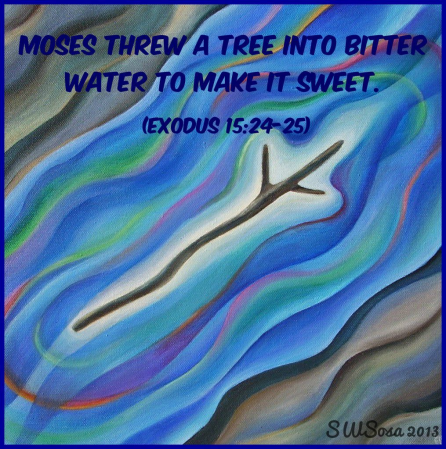
In Exodus 15 there’s an incident that carries weight for today. Israel has come to the springs of Marah. The water is bitter. The people turn to Moses. They challenge him and the complaint voraciously. “Why have you brought us here?” They press Moses to the point of mutiny. They are furious.

Some commentators believe this bitter water was a laxative, and anyone who drank this “bitter” water made many trips to the outhouse!

Moses is shown a branch of a common tree. The Lord speaks a word of the direction he’s to throw the branch directly into the spring. It’ll cure the water, and make it sweet and drinkable.

t seems to me that this awful cross cures the bitterness we absorb as we make our way through life.

The cross of Jesus is critically important. When that ugly tree touches our lives it makes what is bitter sweet. He has changed us by that incredible sacrifice on the hill of Golgotha.

.

The Hidden Power of the Kingdom

Mix it up and watch out!

 “He told them another parable.” 

“The kingdom of heaven is like leaven that a woman took and hid in three measures of flour, till it was all leavened.”

Matthew 13:33

One version says 50 lbs (or 40 liters for your metric fiends) of flour. Crazy, why that much is beyond me–some figured it out and it would be enough bread for 100 people at least. Far more flour and yeast that was close to normal use. The parable that Jesus taught would certainly be humorous to the listeners. I suppose their imaginations were in overdrive.

What Jesus taught in these stories was incredibly practical and it engaged the listeners. They would leave and the stories would stick. Whether they realized it or not, His truth would impact them.

These stories were like bombs that would eventually explode in the hearts of the people.

Sooner or later, maybe when they least expected it, these parables would suddenly make sense. A lightning strike. Very seldom did they connect immediately. We can see this by the disciples’ desire to have them explained. They didn’t get it at first. But when Jesus illuminated them, they understood.

I believe that the Kingdom of God is hidden in us and it has outrageous power.

It works secretly, it’s not visible to anyone. It just does its stuff. The yeast, combined with the flour is a hidden process–something that isn’t observable. Perhaps that’s the way God’s kingdom comes, quietly, secretly but powerfully. Once the flour and yeast combine it’s pretty difficult to stop it.

That kingdom is working in our lives.

And most of the time it’s a hidden work. We can’t understand the process or grasp how it’s happening. We seldom know what God is doing. We may concentrate on being a witness to our neighbor, (which is a good thing, please do) but perhaps the Holy Spirit is working instead on our patience or love.

Usually, what we think is going on isn’t.

I’ve been in ministry for almost 40 years now, and I’ve tried to be faithful and worked on my discernment. But it seems I don’t quite grasp yet what the Father is doing inside of me. And I admit, I’m not really sure what’s going on in the lives of those I teach and counsel. Most of the time, I have no idea what he’s doing.

And that’s alright. I know he loves me very much and I trust him to work in me.

“And I am sure of this, that he who began a good work in you will bring it to completion at the day of Jesus Christ.”

Philippians 1:6

alaskabibleteacher.com