Sitting on God’s Couch

“The Lord confides in those who fear him; he makes his covenant known to them.”

Psalm 25:14

“The secret things belong to the Lord our God, but the things that are revealed belong to us and to our children forever, that we may do all the words of this law.”

Deut. 29:29

What I need to share with you is privileged information, profoundly insightful yet delicate in nature. Not every believer will understand or resonate with the depths of this revelation. Some will readily agree with the truths I will unveil, finding comfort and clarity in them, while others might struggle to grasp the significance of the message. This is a secret but not secretive; it is an invitation to explore a deeper relationship with the divine. Every Christian can enter into this profound understanding if they choose to open their hearts and minds. Some will accept this call willingly, embracing the journey of discovery, and some won’t, perhaps choosing to remain within their comfort zones, unaware of the profound impact this knowledge could have on their spiritual walk. Yet, for those who are willing to seek, an incredible path of enlightenment and connection awaits them.

“Then Jesus strictly warned them not to tell anyone about Him.” Mark 8:30

“Call to me and I will answer you, and will tell you great and hidden things that you have not known.” Jeremiah 33:3

Learning His secrets–

  • Intimacy with God: Seeking Him personally, not just intellectually. 
  • Fear & Awe: Having reverence and respect for God (Psalm 25:14). 
  • Dependence on the Spirit: Relying on the Holy Spirit for understanding, as humans cannot know these things on their own (1 Corinthians 2:10-12). 
  • Faith & Surrender: Trusting God’s revealed truths and surrendering to His will, even when answers are withheld. 

To understand His special things is not automatic. I encourage you to come and sit, read and pray. And listen. It will come to you by grace through His blood.

Meet Martha, Her Story

Luke 10:38-41

“While Jesus and his followers were traveling, Jesus went into a town. A woman named Martha let Jesus stay at her house. 39 Martha had a sister named Mary, who was sitting at Jesus’ feet and listening to him teach. 40 But Martha was busy with all the work to be done. She went in and said, “Lord, don’t you care that my sister has left me alone to do all the work? Tell her to help me.”

41 “But the Lord answered her, “Martha, Martha, you are worried and upset about many things. 

42 Only one thing is important. Mary has chosen the better thing, and it will never be taken away from her.”

My name is Martha and I’m a friend of Jesus. My home was one of His favorite places to stay–a refuge for Him whose life was so busy. I joyfully opened my house for Him and His disciples. When Jesus came I went all out, I wanted the best for His followers and that meant there were always things to do. Is that really a bad thing?

The kitchen was getting crazy–lamb, cucumbers, figs, and so on. Roasting and slicing, I had bread in the oven. All of this was requiring constant attention, and I remember not being able to keep up.

I wanted things to be perfect for Jesus.

I took occasional peeks at He who was teaching in my living room. I just brought in some bowls of figs and raisins as an appetizer and found my sister Mary sitting with the men listening to Jesus and asking questions. It was that which started to get a little ticked off.

I was getting really mad at my sister.

There was so much to do and I realized I had to have her help. And the more I thought of Mary the more frustrated I got. I suspect she didn’t understand the work that need to be done. I suppose her priorities were messed up–she simply didn’t understand her role as a hostess, and to sit with the men like she was doing was wrong.

Mary didn’t understand her place.

I admit I was having issues with my sister. I had brought out another bowl of figs and that’s when I gently interrupted the Lord’s teaching. I wanted Him to tell Mary that her place was with me in the kitchen. He could correct her and I knew she would listen. “Tell her to help me.”

Instead, it was Jesus who corrected me. I still remember Jesus’ words. I wasn’t expecting this.

“Martha, Martha, you are worried and upset about many things.”

Was I really that transparent? He understood, but rather than encouraging me I had become another lesson to everyone present. I realize now that the real issue was with my attitude, and not the work. Yes, I was bothered and upset and I know that it’s those things that were the problem.

Only one thing is important. Mary has chosen the better thing, and it will never be taken away from her.”

I suddenly knew that He was right. Jesus was in my home, and all I did was get angry. I thought my work would please Him and after all, wasn’t that important? Didn’t He “deserve” my best efforts?

My younger sister Mary was being praised. She was my example and now I was being gently rebuked. I realized that all I was doing, all my work, was not what Jesus wanted from me. The problem was my own heart—-it wasn’t Mary, it was me!

I had taken my eyes off of Jesus and was immersed in my service to Him.

I had become critical and resentful of Mary, and I had forgotten that my place was at Jesus’ feet, listening and learning. That’s what Jesus wanted from me, and somehow I had forgotten that.

I decided then, the work could wait, my real place was with Jesus.

Martha’s frustration is typical of those who diligently serve with good intent, but forget to also sit at Jesus’ feet. “The Martha spirit says, if the work is done, is not that all? The Mary spirit asks whether Jesus is well pleased or not? All must be done in his name and by his Spirit, or nothing is done.”

C.H. Spurgeon

My Facebook page is here.

Spiritual Sloth

Matthew 25:1-13

“At that time the kingdom of heaven will be like ten virgins who took their lamps and went out to meet the groom. Five of them were foolish and five were wise. When the foolish took their lamps, they didn’t take oil with them; but the wise ones took oil in their flasks with their lamps. When the groom was delayed, they all became drowsy and fell asleep.

“In the middle of the night there was a shout: ‘Here’s the groom! Come out to meet him.’

“Then all the virgins got up and trimmed their lamps. The foolish ones said to the wise ones, ‘Give us some of your oil, because our lamps are going out.’

“The wise ones answered, ‘No, there won’t be enough for us and for you. Go instead to those who sell oil, and buy some for yourselves.’

10 “When they had gone to buy some, the groom arrived, and those who were ready went in with him to the wedding banquet, and the door was shut. 11 Later the rest of the virgins also came and said, ‘Master, master, open up for us!’

12 “He replied, ‘Truly I tell you, I don’t know you!’

13 “Therefore be alert, because you don’t know either the day or the hour.

There were three stages in every ancient Jewish wedding.

  • Engagement–when fathers got together to make sure that it would be a good match.
  • Betrothal—a ceremony in which formal promises were made by the lovers.
  • Marriage—a surprise arrival, usually a year later, by the groom at the home of the woman.

Each was incredibly important. There couldn’t be any short-cuts; one just didn’t jump into this. It wasn’t a Las Vegas approach to just getting hitched. This parable was an extension of the previous verses in Matthew 24:36-51 and had to do with being prepared.

We can extract this from the third step of marriage. The groom would show up at night, and torches were used to light their way, (apparently the flashlight hadn’t been invented yet). Within Jesus’ parable was the idea of suddenness or surprise.

But no one knew exactly when the groom would show up.

Hence there is an emergency feel to this story. The text states in verse 5:

Five of them were foolish and five were wise.”

The story hinges on this sentence. Readiness is the issue here. Everything of any significance must take on the sudden arrival of the groom’s entourage. The virgins, apparently, would go out to meet him—the torches mingling their light, and drive out any darkness. (It seems that 10 was the acceptable number for a proper rabbinical ceremony).

The problem was that only 1/2 of them were ready. It’s interesting to note that everyone was sleeping. Obviously, that didn’t mean anything for it was the availability of “oil” that would make the difference. The idea was a surprise visit.

The oil was the key. And for us, it represents the Holy Spirit.

Sleep is not the whole issue here, but being prepared is. Five girls were foolish, they were simply not ready. They realized their error and tried to finagle oil from the others, but ultimately that would short everyone in their group. There was an idea that a trip to the local oil merchant would work. It was an idea anyway.

But it was already too late!

The door was closed. The five simply missed it. They stood outside knocking and calling, but they didn’t enter in on time. Reading between the lines, I sense they were desperate. Verse 12 is meant to penetrate and reveal the price of tolerating spiritual sloth.

“He replied, ‘Truly I tell you, I don’t know you!’

The purpose of this parable is the ending line that stresses alertness in a society that dulls everything. The temptation is to act like you’re spiritually aware when you’re not. It’s one of our greatest sins. We assume our lamps are lit when the reality is that our oil (the Holy Spirit) is running close to zero. When our sloth gets mixed with hypocrisy it’ll surely destroy us.

We’re snoring our way to spiritual death.

We must resist slumber and slothfulness. Jesus asserts that his virgins must be prepared and ready for his coming. We must be ready, we must—the price of our unreadiness is high indeed.

“Take care of giving up your first zeal; beware of cooling in the least degree. Ye were hot and earnest once; be hot and earnest still, and let the fire which once burnt within you still animate you. Be ye still men of might and vigor, men who serve their God with diligence and zeal.”

    Charles Spurgeon

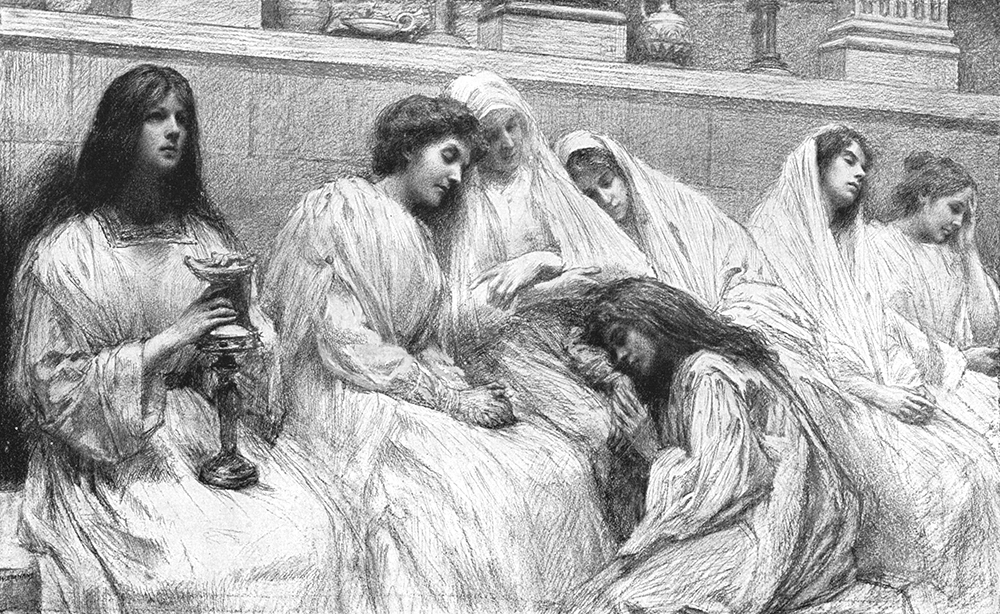
Art by Eugène Burnan

Refusing to Give Up

Luke 18:1-8

“Now he told them a parable on the need for them to pray always and not give up. “There was a judge in a certain town who didn’t fear God or respect people. And a widow in that town kept coming to him, saying, ‘Give me justice against my adversary.’”

“For a while he was unwilling, but later he said to himself, ‘Even though I don’t fear God or respect people, yet because this widow keeps pestering me, I will give her justice, so that she doesn’t wear me out by her persistent coming.’”

“Then the Lord said, “Listen to what the unjust judge says. Will not God grant justice to his elect who cry out to him day and night? Will he delay helping them?”

8 “I tell you that he will swiftly grant them justice. Nevertheless, when the Son of Man comes, will he find faith on earth?”

This parable deals with heavy-duty prayer—not the weak watered-down stuff. But rather something that’s bold and confident. Jesus teaches us to intensify our prayers. There are parallels here with the woman from Canaan. We see Jesus seemingly ignore a seeker (Matthew 15:21-28, Message). I guess that bothers me somewhat. But he wants her faith to grow.

Jesus uses the word “unjust” to accentuate the story to his listeners. It more or less creates a tension where true faith can be seen up close. Back in the Old Testament we read of Jacob refusing to let go of the angel (Gen.32:22-25). We see Rachel who demanded children, “or else I die,” (Genesis 30:8). Both prevailed even when confronted with difficult situations.

“Don’t give up” in verse 1 explains this passage.

Discouragement is a frontal assault on a believer’s faith. Satan uses different tactics, but attacking ones faith is his specialty. Whenever Satan sees faith, he attacks. He absolutely hates your relationship with the Father. He will turn you against him if he can. We are told that our faith must become a shield when he tries to assault us, (Ephesians 6:16).

It seems that to me that some believers refuse to wear their armor. They don’t realize how vulnerable they really are.

This parable is clear. Often God seems to be distant and unconcerned, but that isn’t true, and yet Satan insists that it is. As believers we’re told to press the father about our need. Repeatedly, we’re told that God is very much aware of us, he only wants to build our faith—to make it strong. He uses Satan’s assault on us to magnify the fathers glory.

The widow is a case in point. She demands that the judge listen to her case, and finally he relents. Her insistence is finally rewarded. He realizes that this widow isn’t going away. She’s starting to give him a headache, and she is very persistent. Her faith is stronger than his reluctance.

Our faith needs to be exercised. It’s very much like working out in a gym.

Weights are used, and once you’ve mastered one level, it’s increased. It may sound like a cliche, but God won’t give you anymore than you can handle, our faith isn’t much different. Sometimes we’ll sweat and strain spiritually, but we must understand that our faith has to be strengthened. We never seem to arrive.

You must understand that our faith will be tried, but that isn’t a bad thing. If God withdraws, then we must pursue. If he doesn’t answer we must crank it up. Like the widow we need to persevere; we must not give up. This is how your faith grows. Hebrews 11 declares what faith looks like when it’s wrapped up in flesh and bone.

“For everyone who asks receives, and the one who seeks finds, and to the one who knocks, it will be opened.”

Luke 11:10

Art by Eugène Burnand

Do You Belong in the Fellowship of Pain?

The hands of a leper

“In one of the villages, Jesus met a man with an advanced case of leprosy. When the man saw Jesus, he bowed with his face to the ground, begging to be healed. “Lord,” he said, “if you are willing, you can heal me and make me clean.”

Luke 5:12, NLT

The Bible text reveals a man who is desperate.  His leprosy has advanced; he is covered with it from ‘head-to-toe.’ He’s an outcast now, completely infected by something he never asked for; he is ‘unclean’ and completely without hope. There is no treatment, the doctors can do nothing.

The leper knows that without the touch of Jesus, he’ll never be healed. 

He knows it; he doesn’t need to be convinced by anyone over the complete hopelessness of his condition. He is lost. And yet he has heard that Jesus can do incredible miracles. Could it be that Jesus can heal his sickness? The leper comes and falls on his knees before the Lord, with his face in the dirt. This man is completely broken; he has no hope, except for Jesus. What else can he do?

Our diseases differ, but our lives have been completely changed by our pain. We all have this in common. 

Our pain and darkness vary. Some hurt more, some less. But we’ve all come to the place where we no longer have illusions of somehow being made whole. Whenever we meet, I think there should be a secret handshake or a password. We all share a comradeship— we’re all part of the same community.  We’re a broken club of tired and decidedly unclean misfits.

We belong to the fellowship of pain.

Lying in the dirt, we start to believe the unbelievable.  Our faith doesn’t activate our healing, as much as it simply guides us to Jesus. We can kneel, and perhaps that’s all we need to do. His presence drives away the fear, the doubt, and the pain. He’s come, and somehow we begin to hope for mercy. Only he can carry us through this.

In times past I’ve struggled with deep dark depression. I’ve had to take meds.  But when I come into Jesus’ presence, all my melancholy is driven out. He comes and I start to hope again.  Am I a stellar example of perfect discipleship?  I think not. But isn’t about us becoming “angels,” perhaps it’s more about us learning how to kneel, and to allow Jesus to touch our hearts.

You must do this, repeatedly.

“The power of the Church is not a parade of flawless people, but of a flawless Christ who embraces our flaws.”

“The Church is not made up of whole people, rather of the broken people who find wholeness in a Christ who was broken for us.”   

–Mike Yaconelli

alaskabibleteacher.com

Weak Eyes

Stuck in the wonders of scripture we read about Leah and her sister Rachel. We see the two daughters of Laban have become Jacob’s wives. We must step into Genesis 29 to see more.

Jacob longs for Rachel. She is his “soul mate” and because he’s in love, the customs and technicalities of the day somehow get by him. Because of this, he will have to take on Laban’s subtle trickery, where daughters get exchanged, and we must sort out who is who.

Laban’s deception creates a huge crisis for everyone. 

But it seems Jacob just rolls with it. I suppose deception has always been Jacob’s strong suit. (But when we see a deceiver like Jacob gets deceived, that can’t be all bad).

But it’s Leah that I tend to think about. Her own issues are unique. Genesis 29 explains it a bit cryptically,

“Leah’s eyes were weak, but Rachel was beautiful in form and appearance.” 

Genesis 29:17

You must know that there is confusion by commentators about the “weak eyes.” Some take it literally (as in, she is very “near-sighted,”) while others who look at the original Hebrew find the words to be a bit looser and vague. They tend to think that this is a polite way of saying she really wasn’t pretty.

The text also states that Leah was “hated.”

Genesis 29:30-31.

She is wounded, and life requires that she live as unwanted. She is a woman of tragedy and broken hopes and dreams. She will always live as a reject. At best, she will always be a distant second, and perhaps a bit scorned and neglected for this.

I conclude that Leah is the champion for the challenged.

I love Leah and I think I understand her. Her life is a long tragedy and very full of sadness. For the next 30-40 years she will always be a cast-off, someone who has been broken on life’s bitter vagaries. She’s a fellow struggler, and a survivor.

Her sad life is comparable to us who have to fight so hard over our own illness or handicaps.

She must’ve been challenged by her terrible weakness. I understand this. My own life has been “topsy-turvy” and a really hard struggle. Somehow it seems we must work through these things way too much.

It doesn’t seem fair. 

For those of you who are confined to a wheelchair, or must use a cane, or who deal with a physical or mental illness. Leah should be our hero. For those who have been betrayed by addiction, or who have felt rejected through a bitter divorce– Leah speaks to us.

She is for every loser and for failures of all stripes. But through all of our setbacks and messes, we must realize that God does love us– even as we weep.

We may have Leah’s eyes, but we also have His grace.

Psalm 139:14

I have a new site at alaskabibleteacher.com.

But God…

But God, being rich in mercy, because of the great love with which he loved us, even when we were dead in our trespasses, made us alive together with Christ — by grace you have been saved.”

(Ephesians 2:4–5)

But God. Short words with a powerful meaning, used over 4100 times in the Bible (every 7 verses). It’s used to imply intervention and change, typically a holy interruption of some kind. This verse in Ephesians 2 describes the Father getting involved in a tangible way.

We were terribly lost–actually the Bible says, “dead.”

But He is rich in love and mercy, and it’s grace (and only grace] that makes us alive. Now we’re not reformed or rehabilitated. These are good words, but the verse describes a resurrection–a revivification. The dead live!

Jesus actually resurrects each believer.

“But God.” Joseph learned that “all things work together for good.” His brothers cruelty sold him into slavery and even though he endured prison, he would become the prime minister of Egypt. After many years his wicked brothers come before him. Revenge? Not on your life.

“As for you, you meant evil against me, but God meant it for good in order to bring about this present result, to preserve many people alive.

Genesis 50:20

Let God have His way with you. Acknowledge His sovereignty by allowing Him to interrupt when He wants to. He is active in our lives. Having resurrected us from the dead, the Holy Spirit becomes actively involved in our lives (and He brings us grace and beauty).

If you do this, I expect great things for you.

“My flesh and my heart may fail, But God is the strength of my heart and my portion forever.”

Psalm 73:26


No Doctor Could Heal Me

A woman suffering from bleeding for twelve years, who had spent all she had on doctors and yet could not be healed by any, approached from behind and touched the end of his robe. Instantly her bleeding stopped.

45 “Who touched me?” Jesus asked.

When they all denied it, Peter said, “Master, the crowds are hemming you in and pressing against you.”

Luke 8:43-45

(Matthew 9:20-22)

I just had to touch Him. I had to reach out and somehow get His attention. It was no longer an option. I bled all the time and it wouldn’t stop. It was constant, and it had been 12 miserable years. No one or nothing could cure this, no doctor, no medicine. I was so desperate. It had to stop, you must understand, I was dying.

I had spent so much money on so many doctors.

I had nothing left. Each doctor promised a cure and my hopes were always dashed. But then I heard about a teacher named Jesus, I was told He had the power to raise the dead and heal every disease He encountered. I don’t really know why, but instantly I knew only He could heal me.

I had an issue of blood, that meant I was ritually unclean and all that I touched became unclean. The temple was off-limits to me, I had been cut off from sacrifice and any kind of personal forgiveness for my sins. In my darker moments, I really wondered if God really had forsaken me? Was I damned?

After all, it had been 12 long years.

What I had to do must be done secretly and quietly. I knew I just somehow had to touch this man. I would have to wriggle my way through the crowd to get close enough. I would be violating ritual law and if I got caught and I’d be harshly censured and condemned. I was unclean and I knew only He could change that.

And I was always tired. Sometimes I barely could walk without feeling faint.

The crowds were packed all around Him, but honestly, I knew all I needed was just a simple touch. I knew Jesus had the power. I just knew it. I needed somehow to get close enough; I knew that everything depended on me somehow connecting with Him.

So I waited and watched. I tried to jockey myself and get in the right position. The crowds were tightly surrounding Jesus, I had to push, drive and squeeze. Sometimes I had to get on my hands and knees. But in that split second when He passed, I just managed to grab just the very outside corner of the tassel of His head covering.

And immediately the flow stopped. Just like that! I felt it inside, and immediately knew what happened. Finally I knew, deep down, I had been healed! I was clean.

_____

Please understand dear one, only Jesus can free you. If you can only reach out and touch Him, He will change you– forever.

Christ is the Good Physician. There is no disease He cannot heal; no sin He cannot remove; no trouble He cannot help.”

    James H. Aughey

alaskabibleteacher.com

When Pain is All You Can Think About

Sometimes we live in darkness. We suffer and it’s hard. We mentally accept God’s grace and His love for us, but in our heart we remain untouched. Pain saturates everything it seems. We seem to go through the motions, but deep down we’re convinced that we’ll never find the light that so many claim to have.

Are we “cursed?”

Pain fills our life. We live with something that is persistent, and our hope is a day when it’s all over. Psalm 88 is our Psalm. Nothing is sugar-coated. It is raw and unabridged. It’s pain under a microscope. That Psalm is yours.

For my soul is full of troubles,

    and my life draws near to Sheol.

I am counted among those who go down to the pit;

    I am a man who has no strength,

Psalm 88:3-4

Catching Men

“The Morning of the Fisherman,” Valentina Kostadinva, oil

“And so also were James and John, sons of Zebedee, who were partners with Simon. And Jesus said to Simon,

“Do not be afraid; from now on you will be catching men.”

Luke 5:10

Fear is an ugly thing, it turns men into timid cowards who cannot really trust God. Simon Peter is promised courage. Throughout his life this will be a constant battle for him. It seems like Simon Peter will always struggle with what people will think about him. He is ‘crippled’ and he needs Jesus to intervene. And He does.

I remember Jody and I were sent out by a pastor to do “door-to-door” evangelism. I was terrified. We knocked on a door and then I sort of freaked out, I left her on the porch and hid behind a tree. Witnessing scared me. She shared Jesus while I ran away. How ‘Peter-like’ I am.

“Catching men” is a reference to Peter’s occupation as a fisherman. Jesus speaks so Peter will understand. He expresses evangelism in a way that describes the work of the Kingdom. Fishing describes the main task of the believer. All too often we’re ‘fixed’ on self-improvement, and our vision becomes blurred. Evangelism is to be our work.

“Evangelism is not a professional job for a few trained men, but is instead the unrelenting responsibility of every person who belongs to the company of Jesus.”

-Elton Trueblood