Meet Martha, Her Story

Luke 10:38-41

“While Jesus and his followers were traveling, Jesus went into a town. A woman named Martha let Jesus stay at her house. 39 Martha had a sister named Mary, who was sitting at Jesus’ feet and listening to him teach. 40 But Martha was busy with all the work to be done. She went in and said, “Lord, don’t you care that my sister has left me alone to do all the work? Tell her to help me.”

41 “But the Lord answered her, “Martha, Martha, you are worried and upset about many things. 

42 Only one thing is important. Mary has chosen the better thing, and it will never be taken away from her.”

My name is Martha and I’m a friend of Jesus. My home was one of His favorite places to stay–a refuge for Him whose life was so busy. I joyfully opened my house for Him and His disciples. When Jesus came I went all out, I wanted the best for His followers and that meant there were always things to do. Is that really a bad thing?

The kitchen was getting crazy–lamb, cucumbers, figs, and so on. Roasting and slicing, I had bread in the oven. All of this was requiring constant attention, and I remember not being able to keep up.

I wanted things to be perfect for Jesus.

I took occasional peeks at He who was teaching in my living room. I just brought in some bowls of figs and raisins as an appetizer and found my sister Mary sitting with the men listening to Jesus and asking questions. It was that which started to get a little ticked off.

I was getting really mad at my sister.

There was so much to do and I realized I had to have her help. And the more I thought of Mary the more frustrated I got. I suspect she didn’t understand the work that need to be done. I suppose her priorities were messed up–she simply didn’t understand her role as a hostess, and to sit with the men like she was doing was wrong.

Mary didn’t understand her place.

I admit I was having issues with my sister. I had brought out another bowl of figs and that’s when I gently interrupted the Lord’s teaching. I wanted Him to tell Mary that her place was with me in the kitchen. He could correct her and I knew she would listen. “Tell her to help me.”

Instead, it was Jesus who corrected me. I still remember Jesus’ words. I wasn’t expecting this.

“Martha, Martha, you are worried and upset about many things.”

Was I really that transparent? He understood, but rather than encouraging me I had become another lesson to everyone present. I realize now that the real issue was with my attitude, and not the work. Yes, I was bothered and upset and I know that it’s those things that were the problem.

Only one thing is important. Mary has chosen the better thing, and it will never be taken away from her.”

I suddenly knew that He was right. Jesus was in my home, and all I did was get angry. I thought my work would please Him and after all, wasn’t that important? Didn’t He “deserve” my best efforts?

My younger sister Mary was being praised. She was my example and now I was being gently rebuked. I realized that all I was doing, all my work, was not what Jesus wanted from me. The problem was my own heart—-it wasn’t Mary, it was me!

I had taken my eyes off of Jesus and was immersed in my service to Him.

I had become critical and resentful of Mary, and I had forgotten that my place was at Jesus’ feet, listening and learning. That’s what Jesus wanted from me, and somehow I had forgotten that.

I decided then, the work could wait, my real place was with Jesus.

Martha’s frustration is typical of those who diligently serve with good intent, but forget to also sit at Jesus’ feet. “The Martha spirit says, if the work is done, is not that all? The Mary spirit asks whether Jesus is well pleased or not? All must be done in his name and by his Spirit, or nothing is done.”

C.H. Spurgeon

My Facebook page is here.

Rediscovering the Feet of Jesus

A terrific study is finding the people who fell at Jesus’ feet. Tucked in the Gospels you’ll find stories of those who despair. You’ll also see them come to Jesus in brokenness and humility, without any other recourse. I call these the “people of the feet.”

They came to Jesus because they had no hope otherwise. They were people who were hopeless and wretched, they had long ago run out of options. They came to Jesus, falling down in front of Him. They were all people of the feet.

They were men and women who were truly desperate.

Now when Mary came to where Jesus was and saw him, she fell at his feet, saying to him, “Lord, if you had been here, my brother would not have died.”

John 11:32

One of the classic scenes in the Gospels is when Mary meets Jesus after her brother’s death. She doesn’t understand Jesus’ delay, Lazarus has been very ill and Jesus could have healed him. She is grieving and confused. But she only has one posture and one place in her heart to be– at the feet!

There are some common characteristics that feet-finders have:

  • A great need that can’t be met without His touch
  • To understand one’s true condition–humility, brokenness
  • To beg for a healing, for self or family
  • To honor Jesus as the Messiah
  • To be more receptive to His teaching, to understand Him
  • To become a witness to others (although it does seem secondary)

The following 3 verses are just a small selection of those who fell at Jesus feet.

“And great crowds came to him, bringing with them the lame, the blind, the crippled, the mute, and many others, and they put them at his feet, and he healed them.”

Matthew 15:30

“But immediately a woman whose little daughter had an unclean spirit heard of him and came and fell down at his feet.“

Mark 7:25

“Then people went out to see what had happened, and they came to Jesus and found the man from whom the demons had gone, sitting at the feet of Jesus, clothed and in his right mind.”

Luke 8:35

But there are several other instances where people came to sit at Jesus’ feet:

  • Mark 5:22-23, Jairus, a leader in the local synagogue
  • Luke 7:37-38, a sorrowing mother for her daughter
  • Luke 8:41, also Jairus
  • Luke 10:39, Mary, when Jesus was teaching
  • John 11:32, Mary, meeting Jesus entering Bethany
  • John 12:3, Mary, with her perfume
  • Revelation 1:17, John to express what he was seeing (also 19:10)

In every case we find people consciously coming and kneeling at the feet of the Lord Jesus. It was a deliberate action that came from their hearts. Each had a terrible need, and each was without hope.

It’s the end of religion if you’re a feet-finder. No more facades, no more treadmills. Instead your heart forever changes.

Formality and religious politeness are jettisoned. Brokenness and true humility takes their place. A foot-finder is no longer operating on spiritual niceties. Religion is comfortable, noble, and respectable, but it cannot heal or change people deeply.

Feet-finders know that they need Jesus desperately and will go to any length just to be touched by Him. They defy what is conventional and proper. They are not what we call respectable. You can find them at the feet of Jesus. They are feet-finders. Foot-finders weep, kneel, beg, shout. Too many tears and maybe some snot.

Hardly decent to religious people.

Are you really that desperate yet? Have you seen your need, and do you realize how lost you would be without His healing touch?

Often when I do pray, I sometimes think of the woman who was unclean. She speaks to me about approaching Jesus. I see myself in a crushing crowd of people, and I’m reaching out just to touch the hem of His robe. I know only Jesus can stop my own uncleanness. (Matthew 9.)

I’m convinced only Jesus can make me clean and whole.

I’ve tried to be holy and acceptable to Him. But I felt like a juggler, trying to keep my balls in the air all at the same time, and I could never pull it off. So I tried again and again. I was the unofficial master of religious effort.

But I found my rightful place at His feet. It’s where I belong. I love Him.

I’m not ashamed to be found kneeling.

Boasting for Dummies


“Let not the wise man boast in his wisdom, let not the mighty man boast in his might, let not the rich man boast in his riches,”

“but let him who boasts boast in this, that he understands and knows me, that I am the Lord who practices steadfast love, justice, and righteousness in the earth. For in these things I delight, declares the Lord.”

Jeremiah 9:23-24

There is bad boasting (v.23), and good boasting (v.24). When I think of someone who brags it’s almost always in a negative sense. 

Boasting is one way pride becomes visible, it’s the way we exaggerate or embellish our identity. We magnify ourselves, amplifying our achievements beyond what is reality. We must understand that all it really is is arrogance on display.

There is no room for braggarts in the Church.

You cannot sanctify boasting. It is pride that we vocalize and use to influence. We want to change another person’s perspective of you. We desperately want others to admire and think better of us. Some have postulated that it really is nothing more than masking insecurity. I think they’re right.

The Word differentiates between good and bad boasting.

The book of Jeremiah (9:23-24) does precisely that. It explains that what is worldly: wisdom, strength, money– is the wrong way of seeking recognition and importance. God’s people are to declare (brag) that they are in an intimate relationship with God.

We understand, we know that we have a loving connection with the Lord. We learn we can brag about Him.

I encourage you to become aware of how you conduct yourself in front of others. We seldom think of ourselves realistically. For many of us our lives are so intertwined with the false that we struggle with what is true.

God resists pride. (James 4:6.)

Jeremiah tells us we can choose to be different. We can swivel from the negative to the positive. We must quit exalting any attainment we have and instead boast that we now know God.

No longer do we strut, but now we choose to kneel.

“Humility is to make a right estimate of one’s self.” 

Charles Spurgeon


Spiritual Sloth

Matthew 25:1-13

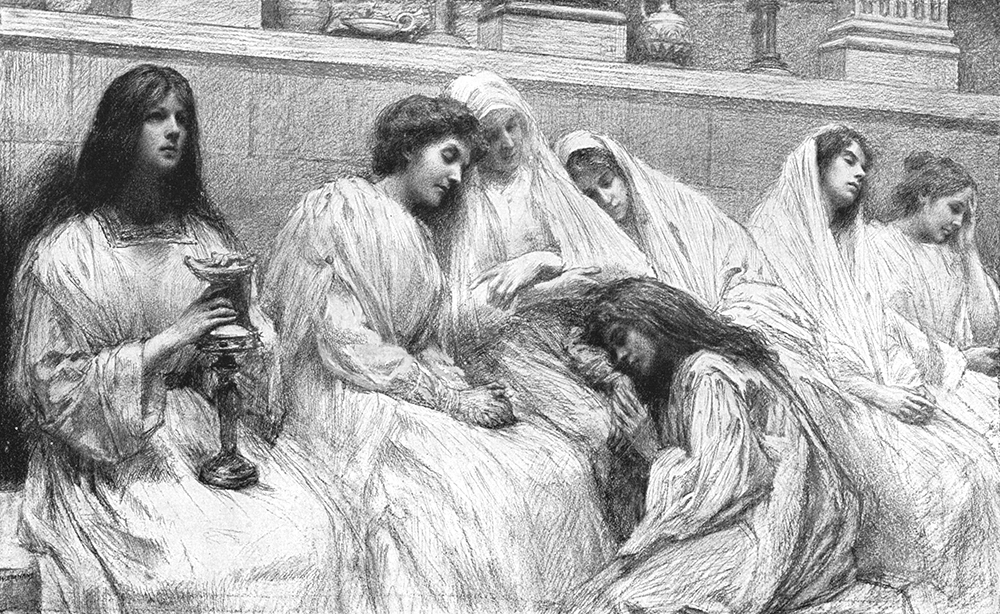
“At that time the kingdom of heaven will be like ten virgins who took their lamps and went out to meet the groom. Five of them were foolish and five were wise. When the foolish took their lamps, they didn’t take oil with them; but the wise ones took oil in their flasks with their lamps. When the groom was delayed, they all became drowsy and fell asleep.

“In the middle of the night there was a shout: ‘Here’s the groom! Come out to meet him.’

“Then all the virgins got up and trimmed their lamps. The foolish ones said to the wise ones, ‘Give us some of your oil, because our lamps are going out.’

“The wise ones answered, ‘No, there won’t be enough for us and for you. Go instead to those who sell oil, and buy some for yourselves.’

10 “When they had gone to buy some, the groom arrived, and those who were ready went in with him to the wedding banquet, and the door was shut. 11 Later the rest of the virgins also came and said, ‘Master, master, open up for us!’

12 “He replied, ‘Truly I tell you, I don’t know you!’

13 “Therefore be alert, because you don’t know either the day or the hour.

There were three stages in every ancient Jewish wedding.

  • Engagement–when fathers got together to make sure that it would be a good match.
  • Betrothal—a ceremony in which formal promises were made by the lovers.
  • Marriage—a surprise arrival, usually a year later, by the groom at the home of the woman.

Each was incredibly important. There couldn’t be any short-cuts; one just didn’t jump into this. It wasn’t a Las Vegas approach to just getting hitched. This parable was an extension of the previous verses in Matthew 24:36-51 and had to do with being prepared.

We can extract this from the third step of marriage. The groom would show up at night, and torches were used to light their way, (apparently the flashlight hadn’t been invented yet). Within Jesus’ parable was the idea of suddenness or surprise.

But no one knew exactly when the groom would show up.

Hence there is an emergency feel to this story. The text states in verse 5:

Five of them were foolish and five were wise.”

The story hinges on this sentence. Readiness is the issue here. Everything of any significance must take on the sudden arrival of the groom’s entourage. The virgins, apparently, would go out to meet him—the torches mingling their light, and drive out any darkness. (It seems that 10 was the acceptable number for a proper rabbinical ceremony).

The problem was that only 1/2 of them were ready. It’s interesting to note that everyone was sleeping. Obviously, that didn’t mean anything for it was the availability of “oil” that would make the difference. The idea was a surprise visit.

The oil was the key. And for us, it represents the Holy Spirit.

Sleep is not the whole issue here, but being prepared is. Five girls were foolish, they were simply not ready. They realized their error and tried to finagle oil from the others, but ultimately that would short everyone in their group. There was an idea that a trip to the local oil merchant would work. It was an idea anyway.

But it was already too late!

The door was closed. The five simply missed it. They stood outside knocking and calling, but they didn’t enter in on time. Reading between the lines, I sense they were desperate. Verse 12 is meant to penetrate and reveal the price of tolerating spiritual sloth.

“He replied, ‘Truly I tell you, I don’t know you!’

The purpose of this parable is the ending line that stresses alertness in a society that dulls everything. The temptation is to act like you’re spiritually aware when you’re not. It’s one of our greatest sins. We assume our lamps are lit when the reality is that our oil (the Holy Spirit) is running close to zero. When our sloth gets mixed with hypocrisy it’ll surely destroy us.

We’re snoring our way to spiritual death.

We must resist slumber and slothfulness. Jesus asserts that his virgins must be prepared and ready for his coming. We must be ready, we must—the price of our unreadiness is high indeed.

“Take care of giving up your first zeal; beware of cooling in the least degree. Ye were hot and earnest once; be hot and earnest still, and let the fire which once burnt within you still animate you. Be ye still men of might and vigor, men who serve their God with diligence and zeal.”

    Charles Spurgeon

Art by Eugène Burnan

Refusing to Give Up

Luke 18:1-8

“Now he told them a parable on the need for them to pray always and not give up. “There was a judge in a certain town who didn’t fear God or respect people. And a widow in that town kept coming to him, saying, ‘Give me justice against my adversary.’”

“For a while he was unwilling, but later he said to himself, ‘Even though I don’t fear God or respect people, yet because this widow keeps pestering me, I will give her justice, so that she doesn’t wear me out by her persistent coming.’”

“Then the Lord said, “Listen to what the unjust judge says. Will not God grant justice to his elect who cry out to him day and night? Will he delay helping them?”

8 “I tell you that he will swiftly grant them justice. Nevertheless, when the Son of Man comes, will he find faith on earth?”

This parable deals with heavy-duty prayer—not the weak watered-down stuff. But rather something that’s bold and confident. Jesus teaches us to intensify our prayers. There are parallels here with the woman from Canaan. We see Jesus seemingly ignore a seeker (Matthew 15:21-28, Message). I guess that bothers me somewhat. But he wants her faith to grow.

Jesus uses the word “unjust” to accentuate the story to his listeners. It more or less creates a tension where true faith can be seen up close. Back in the Old Testament we read of Jacob refusing to let go of the angel (Gen.32:22-25). We see Rachel who demanded children, “or else I die,” (Genesis 30:8). Both prevailed even when confronted with difficult situations.

“Don’t give up” in verse 1 explains this passage.

Discouragement is a frontal assault on a believer’s faith. Satan uses different tactics, but attacking ones faith is his specialty. Whenever Satan sees faith, he attacks. He absolutely hates your relationship with the Father. He will turn you against him if he can. We are told that our faith must become a shield when he tries to assault us, (Ephesians 6:16).

It seems that to me that some believers refuse to wear their armor. They don’t realize how vulnerable they really are.

This parable is clear. Often God seems to be distant and unconcerned, but that isn’t true, and yet Satan insists that it is. As believers we’re told to press the father about our need. Repeatedly, we’re told that God is very much aware of us, he only wants to build our faith—to make it strong. He uses Satan’s assault on us to magnify the fathers glory.

The widow is a case in point. She demands that the judge listen to her case, and finally he relents. Her insistence is finally rewarded. He realizes that this widow isn’t going away. She’s starting to give him a headache, and she is very persistent. Her faith is stronger than his reluctance.

Our faith needs to be exercised. It’s very much like working out in a gym.

Weights are used, and once you’ve mastered one level, it’s increased. It may sound like a cliche, but God won’t give you anymore than you can handle, our faith isn’t much different. Sometimes we’ll sweat and strain spiritually, but we must understand that our faith has to be strengthened. We never seem to arrive.

You must understand that our faith will be tried, but that isn’t a bad thing. If God withdraws, then we must pursue. If he doesn’t answer we must crank it up. Like the widow we need to persevere; we must not give up. This is how your faith grows. Hebrews 11 declares what faith looks like when it’s wrapped up in flesh and bone.

“For everyone who asks receives, and the one who seeks finds, and to the one who knocks, it will be opened.”

Luke 11:10

Art by Eugène Burnand

Singing From the Pit

“I waited patiently for the Lord to help me,
    and he turned to me and heard my cry.
He lifted me out of the pit of despair,
    out of the mud and the mire.
He set my feet on solid ground
    and steadied me as I walked along.”

3″He has given me a new song to sing,
    a hymn of praise to our God.
Many will see what he has done and be amazed.
    They will put their trust in the Lord.”

Psalms 40:1-3, NLT

Psalm 40 is jam packed with great and wonderful truth. It contains freedom for the Christian– a way out for the broken believer. We do well when we use it, and that’s what it’s there for. The deep pit has been used over many centuries as the way God teaches us to sing certain songs. But that doesn’t make it easier, does it?

Verse 1

“I waited patiently for the Lord to help me, and he turned to me and heard my cry.”

Waiting is a critical word, it should not be regarded as trivial. In our daily walk we must be patiently seeking the Lord, that comes first. Admitting you need help is the first step. And guess what? You need help. 😁

The word ‘wait’ is special, it’s kawvah in Hebrew. It can mean ‘to bind together by twisting.‘ It can be used with the idea of braiding strands of rope together. It is never a passive act that just happens. Waiting on God is to be done with intentional purpose.

Remember that the Lord is not some distant deity on a hill far away.

He’s not hiding from you. It’s really quite the opposite. He is closer to you than you think. He is responsive and aware. He hears your cries and wants to act; He is not deaf, but our patience is critical. Waiting on Him is crucial to being free. We must bind and twist our hearts and live our life to His desires.

Verse 2

He lifted me out of the pit of despair, out of the mud and the mire. He set my feet on solid ground and steadied me as I walked along.

The seeable terrain can be awful, with muddy paths and mucky pits. Things that pull you down and suck you in. They’ll trap the traveler. But the Holy Spirit is quite able to lift us out. He picks us up and secures us. He uses the rope of God’s Word.

He is way more willing to save us, than we are to being saved.

Solid ground is where we are meant to be. It’s become a place of firm standing and secure footing. He makes us steady and He keeps us safe. The Holy Spirit now has intimate care over your soul.

Verse 3-4

“He has given me a new song to sing, a hymn of praise to our God. Many will see what he has done and be amazed. They will put their trust in the Lord.

Some of the greatest songs are the ones that come from those just delivered from the pit. These are ‘pit songs,’ offered to God from sincere and true hearts that have once been trapped. There’s something solid heard from the hearts of those redeemed from disaster.

These songs no longer sound religious or contrived.

“YOU CAN SEE GOD FROM ANYWHERE IF YOUR MIND IS SET TO LOVE AND OBEY HIM.”

AW Tozer

From our deepest pits come our greatest praises.

There is a passionate quality that saturates these ‘pit praises’ that is highly treasured by God, and esteemed and valued by the Church– a sense of authenticity starts to be finally heard. We can finally start to see that our pits become ‘launching pads’ of true songs of deliverance.

The School of the Prophets

The phrase “the School of the Prophets” has been identified as the ‘naioth’ or “dwellings” in Ramah in 1 Samuel 19:18-24 where the fellowship or “school of the prophets” assembled to worship, pray, and ask God for wisdom. The idea of ‘naioth’ described an idea of community. They seemed to live in a commune of sorts.

An older prophet became the teacher. They would be drilled into the Law. Much of the character of God was talked about, and this would become the core of these new prophets. They learned to seek His anointing, and also humility of heart and mind. The older prophet would emphasize these two things. He was understood as the foundation of any real ministry.

I wish there was more given to us. 

We can only emphasize and extrapolate out of a few verses. Even so, I must believe that the Holy Spirit was profoundly involved in speaking deliberately and honestly to the nations of Judea and Israel. These prophets would be sent out into ministry as needed.

I believe that there were many who spoke the heart of God. And yes, there were the majors: Isaiah, Jeremiah, Ezekiel, and Daniel. The minor prophets would carry a shorter ministry, at least in the written sense, but were not regarded as lesser ministries.

So what does this mean for you?

If your ministry is a specialized one, community becomes key. In this place you will learn about God, in a way that you’ll never ever learn on your own. A prophet is not a prophet unless he learns from a brother. When you fail (and you will) that dear-hearted brother will confront and teach you where you went wrong.

You must recognize the authority of God in the words of a true prophet. You must also understand the treacherous voice of the flesh and the demonic. You must discern, and as a believer that is paramount. You must listen, and hear the Voice of Jesus. “And many false prophets will appear and deceive many people.” Matthew 24:11.

The Absolute Danger in Exalting Yourself

Now he told a parable to those who were invited, when he noticed how they chose the places of honor, saying to them, “When you are invited by someone to a wedding feast, do not sit down in a place of honor, lest someone more distinguished than you be invited by him, and he who invited you both will come and say to you, ‘Give your place to this person,’ and then you will begin with shame to take the lowest place. 

10 But when you are invited, go and sit in the lowest place, so that when your host comes he may say to you, ‘Friend, move up higher.’ Then you will be honored in the presence of all who sit at table with you. 11 For everyone who exalts himself will be humbled, and he who humbles himself will be exalted.”

Luke 14:7-11, ESV

Choose your seat carefully. In Jesus’ day, there was a definite seating order to a wedding feast. It wasn’t first come, first served. There was a strict protocol, where one’s importance mattered.

Honored people got honorable seats–close to the front as possible. Average people got average spots; but no one wanted be at the bottom, having to sit at the “kids table.”

Jesus was watching, and he what he saw was a spiritual principle of his Kingdom.

Jesus often teaches us out of the things we encounter.

Truth often hits us from those things we actually see. If you want to know what God is doing in your life, all you need to do is look around at the practical things, and start to see the spiritual lessons inside them. We learn from real-life. That’s how he often teaches us, he combines the Word with what we’re experiencing.

Our natural inclination is to move higher up.

We think that we’re deserving, and so we take our rightful positions. That’s the way humans think. We all want to sit in the best possible place, and so we end up wheedling our way up front. We can fall into the subtle trap of self-promotion. But that’s not how discipleship works.

Jesus corrects, advising us to take the lowest place.

I think verse 11 is the key to figuring out this seating arrangement. We’re starting to see a physical situation become a spiritual lesson. There’s much to learn. Here’s verse 11 in the Amplified version:

For everyone who exalts himself will be humbled [before others], and he who habitually humbles himself (keeps a realistic self-view) will be exalted.”

Luke 14:11

This particular translation injects some realism into our lives, especially in how we see ourselves. It’s quite foundational. It lays down a principle that is always true in his Kingdom (1 Peter 5:6). If we don’t accept and implement this, we’ll suffer a definite weakness in our discipleship. It stunts the growth of many believers. And that is tragic.

The whole scene lays out how life in the spirit really works, and it seems paradoxical.

Our human logic asserts that deliberately choosing the lesser is foolish, things really don’t work that way. We think, (falsely,) that we’ll only advance by asserting ourselves. But Jesus, quite aptly, clarifies the ways of the Kingdom.

True maturity will only come if we decide to take the lowest place.

James 4:10

alaskabibleteacher.com

What Jesus Wants Us to Know About God

14 After he had spent everything, a severe famine struck that country, and he had nothing. 15 Then he went to work for one of the citizens of that country, who sent him into his fields to feed pigs. 16 He longed to eat his fill from the pods that the pigs were eating, but no one would give him anything. 17 When he came to his senses, he said, ‘How many of my father’s hired workers have more than enough food, and here I am dying of hunger! 18 I’ll get up, go to my father, and say to him, “Father, I have sinned against heaven and in your sight. 19 I’m no longer worthy to be called your son. Make me like one of your hired workers.”’ 

20 So he got up and went to his father. But while the son was still a long way off, his father saw him and was filled with compassion. He ran, threw his arms around his neck, and kissed him. 21 The son said to him, ‘Father, I have sinned against heaven and in your sight. I’m no longer worthy to be called your son.’

22 “But the father told his servants, ‘Quick! Bring out the best robe and put it on him; put a ring on his finger and sandals on his feet. 23 Then bring the fattened calf and slaughter it, and let’s celebrate with a feast, 24 because this son of mine was dead and is alive again; he was lost and is found!’ So they began to celebrate.

Luke 15:14-24

Sometimes when reading this it can remain theological. For instance, the terms predestination or adoption remain on our bookshelves and somehow they never enter our spiritual hearts. We may assent but we do not absorb.

Luke 15 is magnificent in the deepest sense of the word.

Now if the Bible was a mountain range, then this would be Mt. Everest.

Our Father runs to us because He sees our desperate hearts. His joy can’t be explained but only received. It’s just the way He is.

Just perhaps it will take an eternity to understand this simple parable? If so, we should get started now.

There are just three characters here in Luke 15:14-24: there’s the Father, the son, and the elder brother–and each plays an integral part. The prodigal is the main character, yet the father is the main focus. The son is a wastrel, a good-for-nothing rascal who blows his father’s inheritance on parties, booze, and prostitutes. He lives for the moment, he seeks pleasure in those things which will come very close to destroying him.

But haven’t we all done that?

The father represents God, who represents the loving patriarch of the parable. He’s the one who has turned over the prodigal’s portion of the inheritance. To a degree I suppose he has funded the prodigal’s descent into depravity, and yet it was the son who decided to go crazy. The father is certainly not to blame.

But nevertheless, in this story, the father is the main character. Not the prodigal.

His actions are very difficult to grasp. God behaves outrageously, and His character is difficult to understand or fathom. (After all, who acts this way?) Granted we think our earthly fathers might do this for us–but even that may be a stretch for some. Yet this parable describes how God feels about sinners.

He is passionately in love with sinners.

The mysteries of this parable explain who God is, and His love for nasty varmints like us. We are His Church, and yet we still need to come home. Again.

And we serve a running God.w

“Jesus wants to make it clear that the God of whom he speaks is a God of compassion who joyously welcomes repentant sinners into his house.”

Henri J.M. Nouwen, Return of the Prodigal Son

(My favorite painting. Rembrandt’s painted this in 1669. I know that that was done long ago, but I enjoy seeing and reacting to what he did. I’m always blessed.)

alaskabibleteacher.com

The Dark and Theological Niceties

“On the next day, when they had come down from the mountain, a great crowd met him. 38 And behold, a man from the crowd cried out, “Teacher, I beg you to look at my son, for he is my only child. 39 And behold, a spirit seizes him, and he suddenly cries out. It convulses him so that he foams at the mouth, and shatters him, and will hardly leave him. 40 And I begged your disciples to cast it out, but they could not.” 41 Jesus answered, “O faithless and twisted generation, how long am I to be with you and bear with you? Bring your son here.” 

42While he was coming, the demon threw him to the ground and convulsed him. But Jesus rebuked the unclean spirit and healed the boy, and gave him back to his father. 43 And all were astonished at the majesty of God.”

Luke 9:37-43

All of this takes place immediately after Jesus’ transfiguration. He has shown Himself to be God, wrapped tightly into manhood–He’s fully and completely the Word made flesh. He is the Creator, and He is holding the universe together. Who really can fathom this?

Full of power, but also completely covered with incredible compassion. He meets this desperate man, a man who is carrying incredible weight, a burden that had taken over his life. Jesus steps into a theological circus, after all, the Scribes had shown up, and the disciples were disputing with them. The terrible need of the demonized boy had been forgotten.

The disciples had tried to free him, they really had.

But between the gathering crowd and the arguing Scribes, they were overwhelmed. His disciples were completely out of their element. Defeated, they didn’t know what to do. (Isn’t this a description of much of today’s church? Maybe?)

Sometimes we as the Church can only stress theological niceties.

Often we look beyond the awful needs around us. We rather argue with each other rather than love. We prefer to debate rather than meet the incredible pain around us. How sad is this? We constantly meet terrible pain, and we choose to reside in some strange theological bubble of our own making.

When Jesus comes down from glory on the mountain, He immediately faces off with a desperate man and a demonized son. This father is terribly overwhelmed–the disciples had made a try (or two) and yet couldn’t free the boy. The demons had ignored their efforts and laughed at attempts to free him. These demons decided to stay inside this boy. The disciples can do nothing about it.

But when Jesus shows up, all hell breaks loose, quite literally.

There is amazing power here. Jesus, already shown to be God on the mountain top, now declares His authority over the ugliness of the darkness. He’s been unleashed and absolutely demolishes the works of Satan. He dismantles the evil and decisively frees the boy.

And all were astonished at the majesty of God.”

We can link this power to what we’ve seen on the mountain top–His Words are powerful enough to hold the world in place! He is the Almighty One that has chosen to walk shoulder-to-shoulder with us. He pushes against the darkness and sets us free.

“But have we Holy Spirit power – power that restricts the devil’s power, pulls down strongholds and obtains promises? Daring delinquents will be damned if they are not delivered from the devil’s dominion. What has hell to fear other than a God-anointed, prayer-powered church?”

   Leonard Ravenhill

alaskabibleteacher.com