“Everyone then who hears these words of mine and does them will be like a wise man who built his house on the rock. 25 And the rain fell, and the floods came, and the winds blew and beat on that house, but it did not fall, because it had been founded on the rock.”
“And everyone who hears these words of mine and does not do them will be like a foolish man who built his house on the sand.”
Matthew 7:24-26, ESV
Embedded in Jesus’ Sermon on the Mount are these words: they absolutely penetrate any “religious” sensitivity we think we have. This parable Jesus taught carries the full weight of divine authority.
Up to now, Jesus’ listeners just might reduce his words to nice religious platitudes–something future, and maybe conceptual. I must warn you, this isn’t the case.
Obedience is the critical idea here.
If they’re wise, they are told to put all they’ve heard into practice. It’s really not enough to hear and respect what Jesus declares–they must do the words. Jesus isn’t simply a great moral teacher, all that he says is authoritative; and not just in a benevolent, superficial way–what he says are the very words of God to people, like you and I.
Pay attention: There are two builders in this parable. Two different men; the wise and the very foolish.
The each have their own strategies, their methods are quite different. Both listen; but one responds with careful planning. He understands the potential dangers–rain, floods and wind things that are going to happen. It’s funny, our Lord never “sugarcoats” life. Nasty things are going to get challenging.
Following Jesus never gives us any immunity; there are no special favors given to a believer. (Only comfort. Forgiveness. Eternal life.)
The other man is foolish. He decided to take a shortcut in all of this construction stuff. Maybe it takes too much time? But he decides to implement the work as soon as he can. Maybe his motive is just wanting to put Jesus’ words into practice? Maybe he’s got a noble reason for this?
Obedience is mentioned twice. Enthusiasm is never mentioned; and eagerness is not good spirituality it seems. Careful work (and planning) are critical issues.
I want to stress that you take your time laying down his words. Examine carefully what he’s telling you about your construction. He’s your true Architect–you’re only the only obedient builder. We read his plans and examine his blueprints. We really need to be faithful.
“Using the gift God gave me, I laid the foundation of that house like an expert builder. Others are building on that foundation, but all people should be careful how they build on it.”
1 Corinthians 3:10
“Be diligent in these matters; give yourself wholly to them, so that everyone may see your progress.”
“He also told this parable to some who trusted in themselves that they were righteous and looked down on everyone else: 10 “Two men went up to the temple to pray, one a Pharisee and the other a tax collector. 11 The Pharisee was standing and praying like this about himself: ‘God, I thank you that I’m not like other people—greedy, unrighteous, adulterers, or even like this tax collector. 12 I fast twice a week; I give a tenth of everything I get.’”
13 “But the tax collector, standing far off, would not even raise his eyes to heaven but kept striking his chest and saying, ‘God, have mercy on me, a sinner!’ , 14 I tell you, this one went down to his house justified rather than the other, because everyone who exalts himself will be humbled, but the one who humbles himself will be exalted.”
He despised others. As a Pharisee he prided himself as a holy person; he stood before God and congratulated himself. I believe that self-righteousness has many levels. You can be blatant and obvious about it, or it can be subtle and hidden. But we must understand that the Father sees and knows. Notice the “all” here in Isaiah 64:6:
“We are all like one who is unclean, all our so-called righteous acts are like a menstrual rag in your sight. We all wither like a leaf; our sins carry us away like the wind.”
(Hmm. A menstrual rag? You got to be kidding!)
We often advance ourselves by demeaning those who struggle hard with their sin–there are those who see them and somehow suspect that they’re more superior. We don’t come out and say so; but we’ve arrived— but guess what— God (and scripture) knows better than this.
But we’re not dealing here with a hidden self-righteousness. The Pharisee truly believes that he is different from the tax-collector. He stands and doesn’t kneel. He feels comfortable and confident in the holy presence of God Almighty. He’s not like the others. He is sure that he’s holy.
But the tax-collector was brutally honest about himself.
He didn’t need anyone to tell him how sinful he was—he understood his own wickedness. This parable reveals God’s love for those who know that they’re twisted inside. Notice the heart of the tax-collector:
“He stood afar off” which showed his awareness of his separation from God.
“He wouldn’t even raise his eyes to heaven,” which declared his humility in the presence of God.
He kept “striking his chest,” which tells us of a deep pain over his sin against God.
He prayed, ‘God, have mercy on me, a sinner!’ This describes his desperate heart.
Both came to pray, but really, that’s all they had in common.
The Pharisee came to the temple to show off his righteousness, the tax-collector out of a terrible despair. It strikes me that the text in verse 11 says the Pharisee “began praying to himself.“ It seems that his prayer never really met God—he was proud and showy, and ended up doing the things God detests, (Prov. 29:23).
Things really heat up in verse 14. That’s the critical point of the entire story—“one went down to his house justified rather than the other.” Wow! What a statement. One professionally religious man, sure of his holiness, and the other a sinful sinner, who came humble and broken. One showed off his faith–boasting with a legalistic swagger. The other desperate and desolate, completely undone.
But it was the tax-man who became righteous in the eyes of God.
Humility is the foundation of the kingdom of Jesus. In Matthew 5:3-4 makes a lot of sense—to be “poor in spirit” and to “mourn” are the bedrock of a Christian’s discipleship. To be justified (made right) was a gift. He didn’t try to earn it, and there wasn’t a probationary period. The tax-collector now became righteous; the Pharisee carried his sin still inside him.
God wants us to have a broken-heart. He rejects everything else. I suppose that the question is this:
Do you truly mourn over your sin?
“The Lord is near the brokenhearted; he saves those crushed in spirit.”
O Lord, my heart is not lifted up; my eyes are not raised too high; I do not occupy myself with things too great and too marvelous for me. 2 But I have calmed and quieted my soul, like a weaned child with its mother; like a weaned child is my soul within me.
3 O Israel, hope in the Lord from this time forth and forevermore.
Psalm 131
The Christian who is struggling should become a reader of the Psalms. We must remind ourself of this need to study through them, repeatedly. For believers, Psalm 131 is mandatory, and this is a great place to start.
This particular psalm is unique, and incredibly insightful. It begins its work in us right at the start; the superscription. “A song for going up to worship,” and it strikes me that a work must happen inside of my heart. It is a preparation that will take me higher, and it helps me see God more clearly from a new vantage point.
Verse 1 states the certain issue we have; it is called ‘pride.’ What David says seems to be a very arrogant and audacious thing to say. There is a truism that you think you’re humble, you’re not. To claim you are suddenly liberated from pride, knowing ears perk up. It is almost always a sign of danger.
😁
A church once decided to give an elder a medal for his remarkable humility. But then they had to take it away, because he wore it everywhere!
Take it at face value, David states that he has a real contentment with his limitations and weaknesses. It appears that he has been freed from the vicious cycle of needing to be the center of everything. He sings of his ignorance, and weakness. David goes public with his self-flattery. He knows that if he really wants to ascend he must descend.
And it must happen continuously.
Are you content to be the simple servant now, and delay the accolades and praise until you get to heaven?
Some make themselves spiritually sick by the deep dark quest to be important. In verse 2, we connect with some astonishing imagery. A baby! I am like a little child being held by my mom. It’s not an issue of sophistication, but simplicity. You must choose to do this.
The word for weaned isn’t a newborn here. Rather in Hebrew it denotes a small toddler.
A weaned child no longer needs his mom’s milk. He doesn’t fuss, or nuzzle his mother’s breast, demanding his food. The child no longer receives his nourishment this way.
This is a significant step into maturity. To me, verse 2 is the centerpiece of Psalm 131. OK, let’s apply this spiritually. There was a time when it was necessary for me to have my mother’s milk. I screamed and would throw a terrible tantrum if she didn’t feed me from her breast. I would starve if she didn’t give me her milk.
For all practical purposes, it seems we use God to get what we need. But we grow, and become mature. David is saying that we need to emulate his example.
Now we can come into God’s presence– just to be with Him.
That’s all. So simple. As a child, we just want to be where He is at. We have no ulterior motives, there is no manipulation. We seek His face, not what is in His hands. If we rightly connect the dots, we find that we land right back to that opening superscription.
This is an amazing concept of true adoration– the real kind. As a struggler, more a rascal than Christlike, I must start at the beginning– again, and again, and again. I can only do this if I become a little boy again.
I finally start to realize that I must renounce my selfish ambition and silly pride. Polished people won’t understand, they never will.
“At that time Jesus declared, “I thank you, Father, Lord of heaven and earth, that you have hidden these things from the wise and understanding and revealed them to little children.”
10 Finally, be strong in the Lord and in the strength of His might. 11 Put on the full armor of God, so that you will be able to stand firm against the schemes of the devil.
12 For our struggle is not against flesh and blood, but against the rulers, against the powers, against the world forces of this darkness, against the spiritual forces of wickedness in the heavenly places.
Eph. 6:10-12, NASB
Paul tells us that discerning the cosmic forces of wickedness is now critical. If we choose to ignore his words and make them optional, we will become spiritual toast. We need to hear reality. We want to be told the truth. And the truth is that we’re neck deep in spiritual alligators.
Point blank: We were each born for battle. Every believer must wear armor.
This passage in Ephesians 6 stresses that there is something sinister, an organized force, something evil, a darkness that’s focused directly on us. Verse 12 unveils to us a veritable government of wickedness. Satan leads his demons out with the intention of confusing believers and destroying holiness.
We also need to understand that human beings have a terrible knack of walking in their sin, and also by being manipulated by evil forces. Human history bears this out. We have a lousy track record. Without the Spirit we will be lost and destroyed by our own darkness.
Christians are to see life very differently than others do.
Ephesians 6 teaches us to find strength in being connected with God, which is critical to walk through in this confusing darkness. By prioritizing our relationship with Him, we can draw upon His strength and a sincere faith to navigate through all of this.
Without intimacy there is no obedience and there can be no real victory.
You must come to him humbly and holy, and sit before Him and listen, learn and love. And that is the major step in true holiness. Being controlled by Him means when you need to, you can stand and deliver damage to Satan’s kingdom.
You’ll be leading angels in this terrible battle! They have their swords drawn and are quite capable. Remember that this is a spiritual war–not physical. Your attack must be fought on your knees. And angels, they’re watching and listening to you as you pray. They are God’s messengers to protect you.
Satan presses us hard through redirection and forgetfulness of who we are.
Without the humble intimacy that can only grow on prayer and Bible reading, we will be spiritually destroyed. We need the protection of the Presence. Please don’t forget this; you need Jesus more today than yesterday. You must come closer. He will help you.
You see, your only hope is in Jesus’ strength and intimate love for you.
We must reach for our power and grab upon this intense love. We can only become strong through our intimacy with Jesus. He shields us from the spiritual corruption that swirls all around us. As we draw to Him we become mighty, as we listen closely to the Holy Spirit, we will walk in true discipleship with Jesus.
You will hear Him speak clearly to you, perhaps when you actively push to do His will than your own.
“We are a long time in learning that all our strength and salvation is in God.”
“In the Temple he found people selling cattle, sheep, and doves. He saw others sitting at tables, exchanging different kinds of money. 15 Jesus made a whip out of cords and forced all of them, both the sheep and cattle, to leave the Temple. He turned over the tables and scattered the money of those who were exchanging it. 16 Then he said to those who were selling pigeons, “Take these things out of here! Don’t make my Father’s house a place for buying and selling!”
17 When this happened, the followers remembered what was written in the Scriptures: “My strong love for your Temple completely controls me.”
He really did use a whip. The text tells us that Jesus carefully took some cords and made a whip by intertwining them. What can I say? I’m amazed at His response to what He saw happening in the Temple. Jesus saw deeply saddened Him to the point that there wasn’t anything else He could do.
It appears that there are three distinct whips in the N.T. that we should take into consideration.
The one Jesus carefully braided to “cleanse the Temple.” (John 2:25.)
The one used on Jesus’ back as part of our atonement. (Isaiah 53:4-6.)
The one that believers experience in the ways God disciplines us as His children. (Heb. 12:6.)
All three are important to see. All three have their own meaning. The first one: The Temple is finally clean. The second one: He was punished for me. The third one: He intervenes in my life to make me a holy person.
The third whip is my focus here. He intends to sanctify us by correction. This discipline is the way Jesus separates us from our sin. We’re being disciplined in order to become holy people. Hebrews 12 explains the process.
“If ye endure chastening, God dealeth with you as with sons; for what son is he whom the father chasteneth not? But if ye be without chastisement, whereof all are partakers, then are ye bastards, and not sons.“
Hebrews 12:7-8, KJV
God’s intention isn’t to inflict punishment upon us. His correction isn’t a way by which we make amends for our transgressions. It’s crucial to remember that Jesus has already taken upon Himself the full weight of our sins, fully satisfying any debt. He absorbed it all.
God, in His role as a loving father, corrects and guides us with deep affection.
It’s important to note that God’s methods of discipline do not involve any form of “spiritual child abuse” whatsoever. His love is extraordinarily good, it never wavers, never turns into something evil. He patiently works His will, using loving and healing hands.
“For the moment all discipline seems painful rather than pleasant, but later it yields the peaceful fruit of righteousness to those who have been trained by it.”
Hebrews 12:11, ESV
God has corrected me a 1000 times throughout my 40 years of following Him.
Not with a leather whip mind you, but a braided spiritual cord of correction. What He saw taking place in the marketplace of “me,” (my temple), brings Jesus grief and sorrow. I’m the temple of the Holy Spirit, and He fully intends to make me pure inside. Hebrews 12 tells me what to expect as a son. I need to be corrected.
Yes, a “whip” will be used, but cautiously, even though it may hurt us. Jesus will never intentionally correct you beyond what you can handle.
These three whips are vital, they educate us about the Lord’s efforts. They help us to comprehend and experience God’s workings. As much as we’re able, we must embrace them.
“God’s corrections are our instructions; His lashes our lessons, and His scourges our schoolmasters.“
41-44 Sitting across from the offering box, he was observing how the crowd tossed money in for the collection. Many of the rich were making large contributions. One poor widow came up and put in two small coins—a measly two cents. Jesus called his disciples over and said, “The truth is that this poor widow gave more to the collection than all the others put together.”
“All the others gave what they’ll never miss; she gave extravagantly what she couldn’t afford—she gave her all.”
It wasn’t much but it’s all I had. Some might laugh–but truthfully, I really wasn’t giving just my money, I was giving my heart. That’s really all I had, simply my heart.
When my husband died, I was left with very little. What I did have I hid in a hole in the wall, but I was concerned, money was going out and nothing was coming in. Often I sat on my stool and stared at that hole, and I was frightened. There is nothing to live on. What was I going to do?
You must understand. No one was going to help me.
I got up one morning to pull out the leather sack, all that was there were two pennies. That’s it. Two very small pennies, and that’s all I had to live on! I knew that this day would come, but it seemed to come so soon. I was afraid of what was going to happen to me, a widow that had nothing.
There were six stone receptacles placed in strategic spots, where people could tithe as the Law required of every Jew. Occasionally there was a procession: trumpets blowing and bright banners waving. Another rich man announced to everyone that he was coming to contribute to the Temple.
Jesus was watching closely to all of this.
Suddenly an old woman came to give, and there were no trumpets, no fanfare. She simply came to give what she had–two very small copper pennies. Just two pennies. Most would laugh I suppose. After all, the rich were dropping in thousands of silver.
Jesus turned to His disciples. They sat and listened carefully to what He had to say:
“Truly, I say to you, this poor widow has put in more than all those who are contributing to the offering box.”
They gasped as they struggled to understand the Teacher. It seemed idiotic, but Jesus often said many outrageous things. You could see their minds working to grip this. It made absolutely no sense to their carnal minds.
“They all contributed out of their abundance, but she out of her poverty has put in everything she had, all she had to live on.”
The twelve were dumbfounded.
When I gave, I gave my heart. I had nothing, but you have to understand, a strange peace came over me. I rejoiced to give to God and His work. Yes, I now had nothing–nothing but the grace and care of God. Maybe I was a fool. Maybe I was stark raving mad. But I knew what I wanted to do. When I threw in my two pennies, I threw myself into the heart and care of God.
What was going to happen next? I really don’t know, but we will find out, won’t we?
“Don’t be afraid, you tiny flock! Your Father plans to give you the kingdom. Sell your possessions and give the money away. Get yourselves purses that never grow old, inexhaustible treasure in Heaven, where no thief can ever reach it, or moth ruin it. For wherever your treasure is, you may be certain that your heart will be there too!”
Luke 12:33, Phillips
Art: Coin Week; verses used are from The Message, a translation of Eugene Peterson
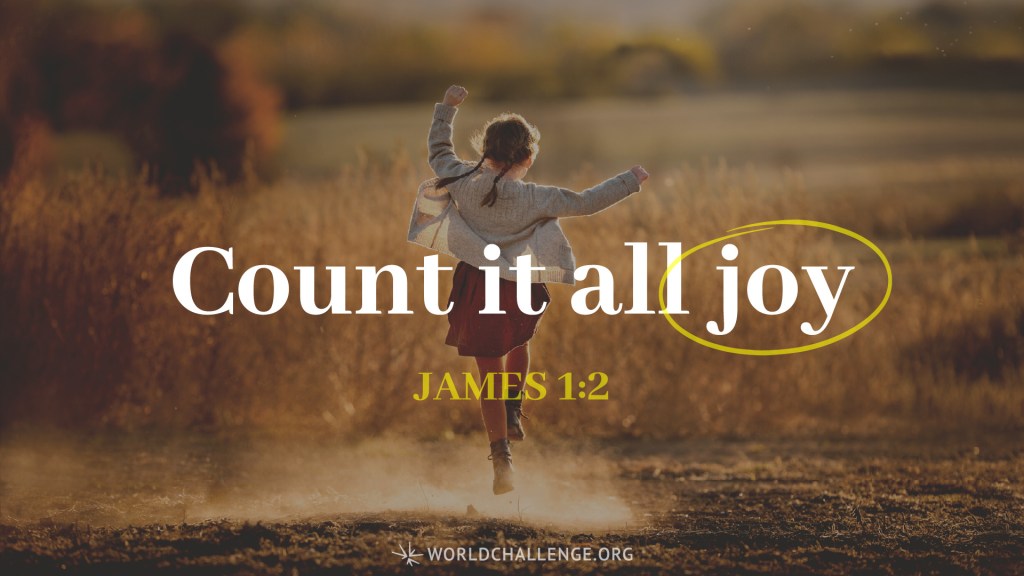
“Count it all joy, my brothers, when you meet trials of various kinds, 3 for you know that the testing of your faith produces steadfastness.”
James 1:2-3, ESV
“There is no circumstance, no trouble, no testing, that can ever touch me until, first of all, it has gone past God and past Christ, right through to me. If it has come that far, it has come with a great purpose.”
“All joy,” (verse 2) is a fantastic thought. It stresses a joy that becomes militant, something powerful and significant. “All joy,” surpasses “some joy” or even “occasional joy.” Instead it’s a joy that remains joy even when tired and weak. It will only shine brighter in the darkness.
Jewels, diamonds, and pearls are typically displayed on a black background.
This reveals their brilliance and value. In the same way darkness should only encourage us to be deliberately brighter than our surroundings. We must understand that we shine only because He makes us shine. There is a divine incandescence that awaits every believer who feels the need or desire for more of God.
God’s special nearness is available to each believer, especially those in the heat of the furnace. He is close to those who want Him, and there is nothing will stand in His way. The Lord cherishes and treasures the seeking heart. There is nothing that can detour the believer’s yearning after their Father. Your faith must be purified, and this is never optional.
Name your trial, then turn it to God in prayer.
Leave it alone and refuse to carry it no further. It’s now the Lord’s concern. Simply watch for the deliverance to come. When God sees your heart, He will lavish Himself out on you. He delights to see your faith becoming solid and real.
We never choose to suffer, rather we choose His will. We must do so whether we suffer or not.
Trust Him.
“God, who foresaw your tribulation, has specially armed you to go through it, not without pain but without stain.”
A heart at peace gives life to the body, but envy rots the bones.
Proverbs 14:30
“Of the Seven Deadly Sins, anger [envy] is possibly the most fun. To lick your wounds, to smack your lips over grievances long past … to savor to the last toothsome morsel both the pain you are given and the pain you are giving back — in many ways it is a feast fit for a king. The chief drawback is that what you are wolfing down is yourself. The skeleton at the feast is you.”
Frederick Buechner
Some churches designate seven deadly sins that people practice. They are pride, greed, wrath, envy, lust, gluttony and sloth. These are also known as the “cardinal” sins. Now this type of classification or grouping seems important and useful to some. I want to examine “envy.”
Envy is a sin that each of us understands.
Envy can be defined as “a feeling of discontented or resentful longing by someone else’s possessions, or qualities.”
(Wikipedia)
It made its entrance with Cain and Abel and the first murder. We see that Cain’s offering was rejected by God, (apparently He doesn’t like veggies). Also, keep in mind that part of Adam’s sin was that the ground was cursed. And Cain had tilled and planted from a field that had been cursed already. (Genesis 4)
But Abel offered up a “blood sacrifice” which God saw as acceptable. That drove Cain nuts. He was so envious that he murdered Abel. He couldn’t handle rejection, and seeing that his brother was extolled and honored was more that he could handle.
Envy became anger which led to murder.
It might come as a surprise to you but envy is why the Pharisees murdered Jesus, “For he knew that it was out of envy that they had delivered him up.” Matthew 27:18
We’re warned repeatedly by New Testament writers to renounce the sin of envy.
“But if you harbor bitter envy and selfish ambition in your hearts, do not boast about it or deny the truth. For where you have envy and selfish ambition, there you find disorder and every evil practice. Let us not become conceited, provoking one another, envying one another.”
James 3:14, 16
I realize I can easily become an envier. (That’s a word, I looked it up.)
Selfish ambition is directly linked in the book of James to envy.
The Greek phrase for selfish ambition is often used to describe one who is full of envy. Incidentally, the word is also used as one “who is deceitfully promoting himself for public office.” (Too often I see myself as “President Bryan.”)
A Prayer for Freedom
Holy Father, I want to bind that spirit of envy that’s attempting to eat up my life. I curse it out completely in the name of Jesus, for it is more than cruelty and overwhelming fury.
I renounce it completely.You are all I want and need. I only want to be your child. I renounce envy.
Please remove it now, mighty God, along with the hatred, anger, fear, and insecurities that fuel it. In Jesus’ mighty name, Amen.
“Whenever you attempt a good work you will find other men doing the same kind of work, and probably doing it better. Envy them not.”
On a dirt road in the middle of a wide field stood a beautiful carriage, something on the order of a stagecoach but all edged in gold and with beautiful carvings. It was pulled by six large chestnut horses: two in the lead, two in the middle and two in the rear. But they were not moving, they were not pulling the carriage, and I wondered why. Then I saw the driver underneath the carriage on the ground on his back just behind the last two horses’ heels working on something between the front wheels on the carriage. I thought, “My, he is in a dangerous place; for if one of those horses kicked or stepped back, they could kill him, or if they decided to go forward, or got frightened somehow, they would pull the carriage right over him.”
But he didn’t seem afraid for he knew that those horses were disciplined and would not move till he told them to move. The horses were not stamping their feet nor acting restless, and though there were bells on their feet, the bells were not tinkling. There were pom-poms on their harness over their heads but the pom-poms were not moving. They were simply standing still and quiet waiting for the voice of the Master.
THERE WERE TWO YOUNG COLTS IN THE FIELD
As I watched the harnessed horses I noticed two young colts coming out of the open field and they approached the carriage and seemed to say to the horses: “Come and play with us, we have many fine games, we will race with you, come catch us.” And with that the colts kicked up their heels flicked their tails and raced across the open field. But when they looked back and saw the horses were not following they were puzzled. They knew nothing of the harnesses and could not understand why the horses did not want to play. So they called to them: “Why do you not race with us? Are you tired? Are you too weak? Do you not have strength to run? You are much too solemn, you need more joy in life.” But the horses answered not a word nor did they stamp their feet or toss their heads.
But they stood, quiet and still, waiting for the voice of the Master.
Again the colts called to them: “Why do you stand so in the hot sun? Come over here in the shade of this nice tree. See how green the grass is? You must be hungry, come and feed with us, it is so green and so good. You look thirsty, come drink of one of our many streams of cool clear water.” But the horses answered them not so much as a glance but stood still waiting for the command to go forward with the King.
COLTS IN THE MASTER’S CORRAL
And then the scene changed and I saw lariat nooses fall around the necks of the two colts and they were led off to the Master’s corral for training and discipline. How sad they were as the lovely green fields disappeared and they were put into the confinement of the corral with its brown dirt and high fence. The colts ran from fence to fence seeking freedom but found that they were confined to this place of training. And then the Trainer began to work on them with His whip and His bridle. What a death for those who had been all their lives accustomed to such a freedom!
They could not understand the reason for this torture, this terrible discipline. What crime had they done to deserve this? Little did they know of the responsibility that was to be theirs when they had submitted to the discipline, learned to perfectly obey the Master and finished their training. All they knew was that this processing was the most horrible thing they had ever known.
SUBMISSION AND REBELLION
One of the colts rebelled under the training and said, “This is not for me. I like my freedom, my green hills, my flowing streams of fresh water. I will not take any more of this confinement, this terrible training.” So he found a way out jumped the fence and ran happily back to the meadows of grass. I was astonished that the Master let him go and went not after him. But He devoted His attention to the remaining colt. This colt though he had the same opportunity to escape decided to submit his own will and learn the ways of the Master. The training got harder than ever but he was rapidly learning more and more how to obey the slightest wish of the Master and to respond to even the quietness of His voice. And I saw that had there been no training, no testing, there would have been neither submission nor rebellion from either of the colts. For in the field they did not have the choice to rebel or submit, they were sinless in their innocence. But when brought to the place of testing and training and discipline, then was made manifest the obedience of one and the rebellion of the other. And though it seemed safer not to come to the place of discipline because of the risk of being found rebellious, yet I saw that without this there could be no sharing of His glory, no Sonship.
INTO THE HARNESS
Finally this period of training was over. Was he now rewarded with his freedom and sent back to the fields? Oh no. But a greater confinement than ever now took place as a harness dropped about his shoulders. Now he found there was not even the freedom to run about the small corral for in the harness he could only move where and when his Master spoke. And unless the Master spoke he stood still.
The scene changed and I saw the other colt standing on the side of a hill nibbling at some grass. Then across the fields, down the road came the King’s carriage drawn by six horses. With amazement he saw that in the lead, on the right side, was his brother colt now made strong and mature on the good corn in the Master’s stable. He saw the lovely pom-poms shaking in the wind, noticed the glittering gold bordered harness about his brother, heard the beautiful tinkling of the bells on his feet — and envy came into his heart. Thus he complained to himself: “Why has my brother been so honored, and I am neglected? They have not put bells on MY feet nor pom-poms on MY head. The Master has not given ME the wonderful responsibility of pulling His carriage, has not put about ME the gold harness. Why have they chosen my brother instead of me?” And by the Spirit the answer came back to me as I watched: “Because one submitted to the will and discipline of the Master and one rebelled, thus has one been chosen and the other set aside.”
A FAMINE IN THE LAND
Then I saw a great drought sweep across the countryside and the green grass became dead, dry, brown and brittle. The little streams of water dried up, stopped flowing, and there was only a small muddy puddle here and there. I saw the little colt (I was amazed that it never seemed to grow or mature) as he ran here and there across the fields looking for fresh streams and green pastures finding none. Still he ran, seemingly in circles, always looking for something to feed his famished spirit. But there was a famine in the land and the rich green pastures and flowing streams of yesterday were not to be had. And one day the colt stood on the hillside on weak and wobbly legs wondering where to go next to find food and how to get strength to go. It seemed like there was no use, for good food and flowing streams were a thing of the past and all the efforts to find more only taxed his waning strength.
Suddenly he saw the King’s carriage coming down the road pulled by six great horses. And he saw his brother, fat and strong, muscles rippling, sleek and beautiful with much grooming. His heart was amazed and perplexed, and he cried out: “My brother where do you find the food to keep you strong and fat in these days of famine? I have run everywhere in my freedom, searching for food, and I find none. Where do you in your awful confinement find food in this time of drought? Tell me, please, for I must know!” And then the answer came back from a voice filled with victory and praise: “In my Master’s House there is a secret place in the confining limitations of His stables where He feeds me by His own hand and His granaries never run empty and His well never runs dry.” And with this the Lord made me to know that in the day when people are weak and famished in their spirits in the time of spiritual famine that those who have lost their own wills and have come into the secret place of the most High into the utter confinement of His perfect will shall have plenty of the corn of Heaven and a never ending flow of fresh streams of revelation by His Spirit. Thus the vision ended.
INTERPRETATION OF THE VISION
“Write the vision, and make it plain upon tables, that he may run that readeth it,” (Habakkuk 2:2). “Harness the horses; and get up, ye horseman,” (Jeremiah 46:4). I am sure that many of you who can hear what the Spirit saith to the Church have already seen what God was showing in the vision. But let me make it plain. Being born into the Family of God feeding in the green pastures and drinking of the many streams of the unfolding revelation of His purposes is fine and wonderful. But it is not enough. While we were children, young and undisciplined, limited only by the outer fence of the Law that ran around the limits of the pastures (that kept us from getting into the dark pastures of poison weeds) He was content to watch us develop and grow into young manhood, spiritually speaking.
But the time came to those who fed in His pastures and drank at His streams, when they were to be brought into discipline or “child-training” for the purpose of making them mature Sons. Many of the children today cannot understand why some of those who have put on the harness of God cannot get excited by the many religious games and the playful antics of the immature. They wonder why the disciplined ones run not after every new revelation or feed on every opportunity to engage in seemingly “good and profitable” religious activities. They wonder why some will not race with them in their frantic efforts to build great works and great and notable ministries. They cannot understand the simple fact that this Company of saints is waiting for the voice of the Master and they do not hear God in all this outward activity.
They will move in their time when the Master speaks. But not before, though many temptations come from the playful colts. And the colts cannot understand why those who seemingly appear to have great abilities and strength are not putting it to good use. “Get the carriage on the road,” they say, but the disciplined ones, those in God’s harness, know better than to move before they hear the voice of the Master. They will move in their time with purpose and great responsibility.
And the Lord made me to know that there were many whom He had brought into training who had rebelled against the discipline, the chastising of the Father. They could not be trusted with the great responsibility of mature Sonship so He let them go back to their freedom, back to their religious activities and revelations and gifts. They are still His people, still feeding in His pastures, but He has set them aside from the great purposes for this end of the age. So they revel in their freedom feeling that they were the Chosen Ones with the many streams of living water not knowing that they have been set aside as unfit for His great work in this end of the age.
He showed me that though the chastising seemeth grievous for the time and the discipline hard to endure yet the result with all the glory of Sonship is worth it all and the glory to follow far exceeds the suffering we endure. And though some lose even their lives in this training yet they will share alike in the glory of His eternal purposes. So faint not saints of God for it is the Lord that doth bring thee into confinement and not thine enemy. It is for thy good and for His glory so endure all things with praises and thanksgiving that He hath counted thee worthy to share His glory!
Fear thou not the whip in His hand for it is not to punish thee but to correct and train thee that thou mightest come into submission to His will and be found in His likeness in that hour. Rejoice thou in thy trials in all thy tribulations and glory thou in His cross and in the confining limitations of His harness for He hath chosen thee and He hath taken upon Himself the responsibility of keeping thee strong and well fed. So lean thou upon Him and trust not in thine own ability and thine own understanding. So shalt thou be fed and His hand shall be upon thee and His glory shall overshadow thee and shall flow through thee as it goes forth to cover the earth. Glory to God! Bless the Lord! He’s wonderful! Let Him be Lord of your life, friends, and complain not at that which He bringeth to pass in your life.
Bill Britton served as Vice President of Pinecrest Bible Training Center for the first three years of its existence and was a great blessing in helping to establish the work at Pinecrest.
A comment–
I first connected with this message in 1984, by a man named, Bob Mumford. As a young Christian, the allegory “nailed” me. What did I want for my life? I had to make some decisions. I sincerely wanted to follow the Father through this process. And this hasn’t changed in almost 40 years.
For more of these and other messages: Bill Britton P.O. Box 707 Springfield, Missouri 65801-0707. This is a faith ministry, made possible by members of the Body of Christ. Not copyrighted, may be translated or reprinted without further permission. All messages are free as the Lord provides.
“The heart is deceitful above all things And it is extremely sick; Who can understand it fully, and know its secret motives?”
Jeremiah 17:9, Amplified
“The Lord observed the extent of human wickedness on the earth, and he saw that everything they thought or imagined was consistently and totally evil.”
Genesis 6:5
The Bible in its tremendous insight, never once makes humans out to be wonderful creatures. I think we would all volunteer to be that way. But we are not. Rather the opposite is quite true. We are manipulators, rascals, liars and sinners.
There is not a single iota of evidence that we can become exceptionally kind, loving and holy people in any sense of the word.
Somehow we generate a lot of self-deceit.
We trick our own hearts into believing that we are such noble people. We ignore evidence that would convict us otherwise. The prophet spoke to his generation in Jeremiah 17. He would speak directly to people who thought they were true and good. Jeremiah called this a lie, a serious miscalculation, especially when the opposite was true!
This is not the way “to win friends and influence people.” So many pastors, priests, elders, and leaders have a desire deep down to be acceptable and relevant. But God says, we are rascals, tricksters, phonies. Something inside is sick. There can be no human remedy. We simply cannot become religious enough to surmount our profound sin. Pride and selfishness opposes God and harms others.
As a boy living in Northern Wisconsin, on a farm somewhat, we found one of our dogs killing chickens. He was a nice dog, quite friendly and very gentle. But when he started in on the chickens my dad decided to intervene. One of the dead chickens was recovered. My father wired that dead chicken to our dogs neck, nice and tight. That dog wore that rotting chicken for several weeks. Finally the dog laid down, foaming and tongue lolling, eyes rolled back. He was profoundly sick. So Dad cut off the decaying remains.
The SPCA would have a fit. But that dog would never again chase a chicken, or even think of killing one. But even so, our sin is disgusting to God. We just seem to do evil without considering Him or others we effect. It’s all about us, as we think we can just skate through this “problem” without any issues. But Jeremiah tells us we are rotting inside.
We all carry around a dead chicken. I must tell you the truth, you’re terminally ill. You are quite sick, in the most essential part of you.
But Jesus died to free you. He’s the only One who can.
“Our life is full of brokenness – broken relationships, broken promises, broken expectations. How can we live with that brokenness without becoming bitter and resentful except by returning again and again to God’s faithful presence in our lives.”
–Henri Nouwen
We are a broken lot of confused people, and we have never solved the mystery of our own iniquity. In those rare, fleeting times we step into clarity, we are ashamed and disturbed by what we see. Our awful sin needs a wonderful Savior. Jesus does what we could never do.
Jesus died to free us from death. He has come to cut us free from our spiritual evil.
He has died to destroy our sin. But there is much more. He gives us real life–eternal life. His life!
“Come now, let us reason together, says the Lord: though your sins are like scarlet, they shall be as white as snow; though they are red like crimson, they shall become like wool.”













 Alaska Bible Teacher
