Refusing to Give Up

Luke 18:1-8

“Now he told them a parable on the need for them to pray always and not give up. “There was a judge in a certain town who didn’t fear God or respect people. And a widow in that town kept coming to him, saying, ‘Give me justice against my adversary.’”

“For a while he was unwilling, but later he said to himself, ‘Even though I don’t fear God or respect people, yet because this widow keeps pestering me, I will give her justice, so that she doesn’t wear me out by her persistent coming.’”

“Then the Lord said, “Listen to what the unjust judge says. Will not God grant justice to his elect who cry out to him day and night? Will he delay helping them?”

8 “I tell you that he will swiftly grant them justice. Nevertheless, when the Son of Man comes, will he find faith on earth?”

This parable deals with heavy-duty prayer—not the weak watered-down stuff. But rather something that’s bold and confident. Jesus teaches us to intensify our prayers. There are parallels here with the woman from Canaan. We see Jesus seemingly ignore a seeker (Matthew 15:21-28, Message). I guess that bothers me somewhat. But he wants her faith to grow.

Jesus uses the word “unjust” to accentuate the story to his listeners. It more or less creates a tension where true faith can be seen up close. Back in the Old Testament we read of Jacob refusing to let go of the angel (Gen.32:22-25). We see Rachel who demanded children, “or else I die,” (Genesis 30:8). Both prevailed even when confronted with difficult situations.

“Don’t give up” in verse 1 explains this passage.

Discouragement is a frontal assault on a believer’s faith. Satan uses different tactics, but attacking ones faith is his specialty. Whenever Satan sees faith, he attacks. He absolutely hates your relationship with the Father. He will turn you against him if he can. We are told that our faith must become a shield when he tries to assault us, (Ephesians 6:16).

It seems that to me that some believers refuse to wear their armor. They don’t realize how vulnerable they really are.

This parable is clear. Often God seems to be distant and unconcerned, but that isn’t true, and yet Satan insists that it is. As believers we’re told to press the father about our need. Repeatedly, we’re told that God is very much aware of us, he only wants to build our faith—to make it strong. He uses Satan’s assault on us to magnify the fathers glory.

The widow is a case in point. She demands that the judge listen to her case, and finally he relents. Her insistence is finally rewarded. He realizes that this widow isn’t going away. She’s starting to give him a headache, and she is very persistent. Her faith is stronger than his reluctance.

Our faith needs to be exercised. It’s very much like working out in a gym.

Weights are used, and once you’ve mastered one level, it’s increased. It may sound like a cliche, but God won’t give you anymore than you can handle, our faith isn’t much different. Sometimes we’ll sweat and strain spiritually, but we must understand that our faith has to be strengthened. We never seem to arrive.

You must understand that our faith will be tried, but that isn’t a bad thing. If God withdraws, then we must pursue. If he doesn’t answer we must crank it up. Like the widow we need to persevere; we must not give up. This is how your faith grows. Hebrews 11 declares what faith looks like when it’s wrapped up in flesh and bone.

“For everyone who asks receives, and the one who seeks finds, and to the one who knocks, it will be opened.”

Luke 11:10

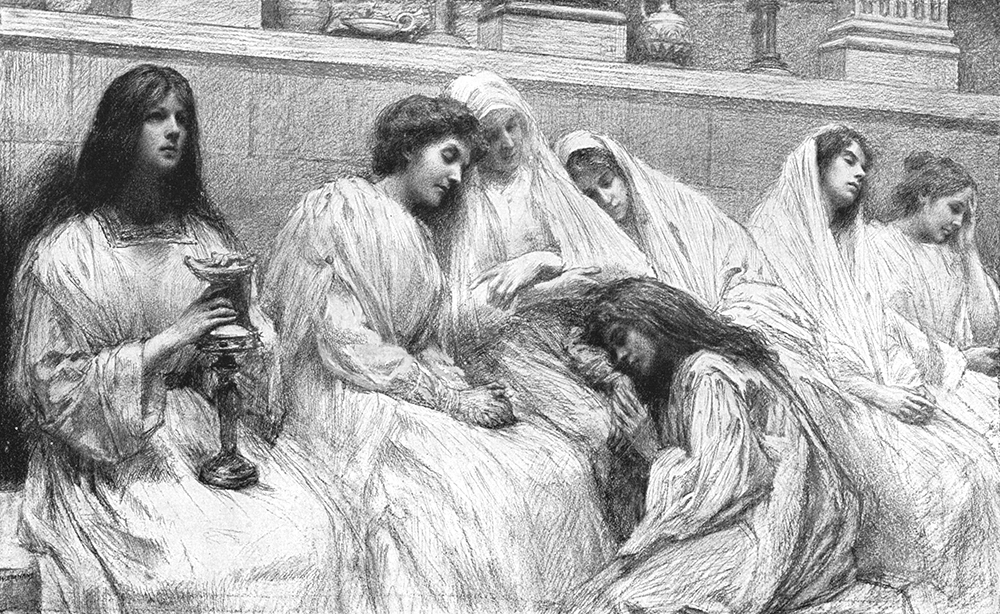
Art by Eugène Burnand

The Holy Club

John 8:31

Being a disciple of Jesus is serious business. We’re learning to walk in His footsteps, and we do this through God’s grace and mercy. It takes discipline, and that can be hard. In 1729 a group of Christian believers started meeting at Oxford University with the intention of becoming more accountable in their walk.

They became known as the “Holy Club.”

Here are 22 questions they asked themselves in their private times with Jesus.

  1. Am I consciously or unconsciously creating the impression that I am better than I really am? In other words, am I a hypocrite?
  2. Am I honest in all my acts and words, or do I exaggerate?
  3. Do I confidentially pass on to another what was told to me in confidence?
  4. Can I be trusted?
  5. Am I a slave to dress, friends, work, or habits?
  6. Am I self-conscious, self-pitying, or self-justifying?
  7. Did the Bible live in me today?
  8. Do I give it time to speak to me everyday?
  9. Am I enjoying prayer?
  10. When did I last speak to someone else about my faith?
  11. Do I pray about the money I spend?
  12. Do I get to bed on time and get up on time?
  13. Do I disobey God in anything?
  14. Do I insist upon doing something about which my conscience is uneasy?
  15. Am I defeated in any part of my life?
  16. Am I jealous, impure, critical, irritable, touchy, or distrustful?
  17. How do I spend my spare time?
  18. Am I proud?
  19. Do I thank God that I am not as other people, especially as the Pharisees who despised the publican?
  20. Is there anyone whom I fear, dislike, disown, criticize, hold a resentment toward or disregard? If so, what am I doing about it?
  21. Do I grumble or complain constantly?
  22. Is Christ real to me?

“We have suffered from the preaching of cheap grace. Grace is free, but it is not cheap. People will take anything that is free, but they are not interested in discipleship. They will take Christ as Savior but not as Lord.”

    Vance Havner

I sincerely hope that this blesses you.

The Five Crowns

In the New Testament crowns are given to certain believers. They’re more than a reward, they’re recognition of a Christian’s life and character. Keep in mind that each one given is pure grace. They are not rewards that we earn, but recognition of God’s blessing. We can do nothing unless He gives us His grace. You must understand this.

We find that there are five. But understand, these are not given as recompense or compensation. A crown is never earned, and it’s never given as an achievement for exceptional behavior. All are received by His grace and kindness. (And, we’re not in any competition on who can receive the most.)

Here’s a list which I hope is complete.

  • the Victor’s Crown
  • the Crown of Rejoicing
  • the Crown of Righteousness
  • the Crown of Life
  • the Crown of Glory 

The Victor’s Crown, which is also called the Martyr’s Crown. We can read it in James 1:12 and also in Revelation 2:10. The Church of Smyrna is promised by Jesus, Do not fear what you are about to suffer…the devil is about to throw some of you into prison…Be faithful unto death, and I will give you the crown of life.”

The Crown of Rejoicing, is described in 1 Thessalonians 2:19 and in Philippians 4:1. This crown is given to those dedicated to evangelism or the mission field. Paul receives this crown for his work with the Thessalonians. “Therefore, my brothers, whom I love and long for, my joy and crown, stand firm thus in the Lord, my beloved.”

The Crown of Righteousness, this is given to believers who steadfastly look for Jesus’ Second Coming. It seems it’s also given to those who seek after an intimacy with Jesus. We can read of this in 2 Timothy 4:8. “There is laid up for me the crown of righteousness, which the Lord, the righteous judge, will award to me on that day, and not only to me but also to all who have loved his appearing.”

The Crown of Life, this is given to those who have laid aside all the things this world offers and are committed to a life that is eternal. “Everyone who competes in the games goes into strict training. “They do it to get a crown that will not last, but we do it to get a crown that will last forever.” (1 Cor. 9:25.)

The Crown of Glory, given to the pastoral servants who have prayed and served the Church, “And when the chief Shepherd appears, you will receive the unfading crown of glory.” According to 1 Peter 5:2-4 this crown is given to those who have served the flock faithfully as His shepherds and teachers.

These five crowns are freely given, by grace, to each who deserves them. In each and every case it’s Jesus who coronates each believer. We’ll watch and we’ll agree with His decision. We will not vote to see who is worthy but we will understand His gracious wisdom of that person’s trials and challenges.

None of these crowns will not be worn very long. There will not be any reason to show them off to other believers, “Look at me, I’m wearing two, how many crowns are you wearing?” No. Rather, in love, we return each crown to Him who gave it to us.

A crown is temporary and is given back to Him who loved us so much. 

“The twenty-four elders fall down before him who is seated on the throne and worship him who lives forever and ever. They cast their crowns before the throne, saying,

“Worthy are you, our Lord and God,
    to receive glory and honor and power,
for you created all things,
    and by your will they existed and were created.”

Revelation 4:10-12

Willian Tiptaft

Deer Feet for the Believer

“He made my feet like the feet of a deer
    and set me secure on the heights.
35 He trains my hands for war,
    so that my arms can bend a bow of bronze.”

2 Samuel 22:34-35

David’s Song of Deliverance

This entire psalm was written after David was delivered from the hand of Saul. David had been a fugitive for years and had experienced extreme difficulties. He had been pushed to the brink many times, yet maintained a close walk with God.

This verse in 2 Samuel has always blessed me. The image of a deer who has been put on a mountaintop through the direct action of the Lord–it’s a place of safety, a position of victory. It comes as a decisive maneuver of the Holy Spirit.

Psalm 18:33

David had learned things in the wilderness that he would never have otherwise. At times life got pretty extreme for him. When he struggled it was understandable. He followed the path that God laid out. It wasn’t easy for David, but he walked in faith and not by sight.

Danger surrounded David on every side – physically, spiritually, emotionally, socially. It would come from enemies, and even from his dearest friends.

God’s people are not immune from trials. It’s good to know that these are now orchestrated by our Father, and they’re purposeful and planned.

The prophet Isaiah extends the imagery of a deer in his prophetic ministry, but adds other ideas as well. The lame, mute and the desperately thirsty are descriptive of people who are given a special grace and touch. They’re promised something. They receive the promise of the Lord Jesus Christ.

“Then shall the lame man leap like a deer,
    and the tongue of the mute sing for joy.
For waters break forth in the wilderness,
    and streams in the desert;”

Isaiah 35:6

“David thought of how deer seem to skip from place to place and never lose their footing. God gave him the same kind of skill in working through the challenges brought by his enemies.”

David Guzak

alaskabibleteacher.com

Weak Eyes

Stuck in the wonders of scripture we read about Leah and her sister Rachel. We see the two daughters of Laban have become Jacob’s wives. We must step into Genesis 29 to see more.

Jacob longs for Rachel. She is his “soul mate” and because he’s in love, the customs and technicalities of the day somehow get by him. Because of this, he will have to take on Laban’s subtle trickery, where daughters get exchanged, and we must sort out who is who.

Laban’s deception creates a huge crisis for everyone. 

But it seems Jacob just rolls with it. I suppose deception has always been Jacob’s strong suit. (But when we see a deceiver like Jacob gets deceived, that can’t be all bad).

But it’s Leah that I tend to think about. Her own issues are unique. Genesis 29 explains it a bit cryptically,

“Leah’s eyes were weak, but Rachel was beautiful in form and appearance.” 

Genesis 29:17

You must know that there is confusion by commentators about the “weak eyes.” Some take it literally (as in, she is very “near-sighted,”) while others who look at the original Hebrew find the words to be a bit looser and vague. They tend to think that this is a polite way of saying she really wasn’t pretty.

The text also states that Leah was “hated.”

Genesis 29:30-31.

She is wounded, and life requires that she live as unwanted. She is a woman of tragedy and broken hopes and dreams. She will always live as a reject. At best, she will always be a distant second, and perhaps a bit scorned and neglected for this.

I conclude that Leah is the champion for the challenged.

I love Leah and I think I understand her. Her life is a long tragedy and very full of sadness. For the next 30-40 years she will always be a cast-off, someone who has been broken on life’s bitter vagaries. She’s a fellow struggler, and a survivor.

Her sad life is comparable to us who have to fight so hard over our own illness or handicaps.

She must’ve been challenged by her terrible weakness. I understand this. My own life has been “topsy-turvy” and a really hard struggle. Somehow it seems we must work through these things way too much.

It doesn’t seem fair. 

For those of you who are confined to a wheelchair, or must use a cane, or who deal with a physical or mental illness. Leah should be our hero. For those who have been betrayed by addiction, or who have felt rejected through a bitter divorce– Leah speaks to us.

She is for every loser and for failures of all stripes. But through all of our setbacks and messes, we must realize that God does love us– even as we weep.

We may have Leah’s eyes, but we also have His grace.

Psalm 139:14

I have a new site at alaskabibleteacher.com.

Love Wears Work Gloves

 “But if anyone has the world’s goods and sees his brother in need, yet closes his heart against him, how does God’s love abide in him?”

“Little children, let us not love in words or talk but in deeds and in truth.”

1 John 3:17-18, ESV

Love is a noble idea, it’s admired and extolled by practically everyone–we see it in our music and poetry, ethics and religion. For the most part it’s a word for something decent and virtuous and honorable. It’s a good thing, but I’m afraid it’s not always scriptural.

You see, Bible love wears work gloves.

It labors and sweats. Bible love has chores to do, and it actively looks and sees what needs to be done. 1 John 3 tells us that we shouldn’t deceive ourselves and only see the world’s definition. That love that a believer has is to be different.

Love, in John’s eyes, is most assuredly “doing.” It burns spiritual calories as it labors to serve our brothers and sisters. Love finds things it can do–it doesn’t just talk but it gets busy. Love sees the need and then gets down to serve.

“You must show sincere love to each other as brothers and sisters. Love each other deeply with all your heart.”

1 Peter 1:22

Working (serving) has nothing to do with our salvation, that is a free gift. We’re saved by grace through the blood of Jesus–that’s a given. And this serving love isn’t drudgery, as a matter of fact, working and serving each other is a joy. The deepest kind of joy there is.

Our words, although important, are really an insufficient way of proving our authenticity.  The love we serve another with isn’t “pretty poetry” kind of love. It’s so easy to just shout out truth and never ever show a working, serving kind of love. 

That disconnect is a bit disconcerting. When do we suppose we figure out that His love is actually a verb?


Discipleship When It Gets Dark

  • We are afflicted in every way, but not crushed
  • perplexed, but not driven to despair
  • persecuted, but not forsaken
  • struck down, but not destroyed;

2 Corinthians 4:8-9, ESV

The issues we face can be formidable. Our relationships, our circumstances can present daunting obstacles to joyful Christlike living. We live out at times from unpleasant realities and less than ideal situations. We are broken believers who follow Jesus through our deadly minefields.

Struggling with mental illness is just as much a challenge as with any other handicap. The young man struggling with bipolar disorder or someone else who faces a clinical depression, may seem to be tangled up in something quite brutal and very hopeless. “Will I ever find normal again?

I know that struggle and at times it has ripped me apart. But I suppose the grinding hopelessness is the worst part of that.

I want to encourage you in this. The issues we face on a daily basis are hard. And we don’t minimize their complexity or diminish their bitterness. They can be awful. But the Holy Spirit is with you in the midst of your issues. That’s a promise.

There is a wisdom emanating from the fire. It’s only waiting for discovery. The flames can not destroy us when God shows up.

I believe that the constant presence of difficulty produces a faith and tenderness that can’t be just prayed for.

The most kind and gentle people are those who themselves have been afflicted.

Please understand we have a real challenge. We have to walk through the trials or tests, not around them. We see a mountain, and God gives us a shovel. But He also gives us the strength we need.

But I’ve discovered a tenuous joy in these issues— more precisely, a joy because of them. Our illness is not meant to destroy us. That is not why God has allowed you to be afflicted.

I definitely did not choose this path I’m on.

Think about Jesus’ great love for people with hard issues:

Luke 7:21

Jesus has special spot for the afflicted, we see him repeated touching them. He drew them like a magnet draws iron. And he is the same today in our time. It is comforting to know that he cares for us and that we are understood. Let him draw you into his caring presence.

Our disabilities do not trouble him. Yes, I know the issues are formidable. But your obedience in them is an exquisitely special commodity to Jesus. I believe He values the shaking faith of broken people far more than the happy shiny people with no pain or scars.

Faith is precious in his sight and holds its value for all eternity.

Understanding this should be a cause for joy for the broken believer. Having the lightness of heart, right in the middle of our disability, often transforms these issues into a lighter burden. We are  beaten but not totaled. Incredibly challenged but not completely devastated. The apostle wrote this in his letter to the Corinthians, and it gives us hope.

I have learned that if I can bless a difficult thing it will bless me.

If we curse it and it will curse us. If you bless a situation, it has no power to hurt you, and even if it is troublesome for a time, it will gradually fade out, but only you can only sincerely bless it.  

There’s a deep joy waiting for those who choose to do this.

I guarantee it!

Going to War

13 Therefore take up the whole armor of God, that you may be able to withstand in the evil day and having done all, to stand firm. 14 Stand therefore, having fastened on the belt of truth and having put on the breastplate of righteousness, 15 and, as shoes for your feet, having put on the readiness given by the gospel of peace. 16 In all circumstances take up the shield of faith, with which you can extinguish all the flaming darts of the evil one; 17 and take the helmet of salvation, and the sword of the Spirit, which is the word of God,

Eph. 6:13-17, ESV

You’re called to be armor-plated. Ephesians is quite clear about this, and we DARE not live without spiritual protection, and as a matter of fact, we must wear each piece to survive spiritually. To be ‘naked’ is to invite disaster. Neglecting to dress appropriately brings cataclysmic disaster. We dare not minimize the need for armor.

Each piece listed must be worn. This is a scriptural mandate for every believer in Jesus.

“The whole armor of God” explains the equipment we need to survive spiritually. Here’s a list and a brief comment on the six:

  • The belt of truth–this pulls everything together and holds us and keeps us secure in the truth.
  • The breastplate of righteousness–our spiritual heart is protected by knowing we’re accepted by the Father. Being right with God is not a feeling nor is it a mere hopeful wish.
  • The shoes of the gospel (of peace)–the idea of standing in place (“to stand”) explain our ability to be fixed on grace. When we wear battle shoes we cannot be pushed back or lose our footing. Wearing gospel shoes brings us spiritual stability. We can stand in place, rooted and strong.
  • The shield of faith–is a vital way of protecting ourselves from the evil arrows shot by the enemy. Satan targets us when he thinks that we aren’t using faith to defend ourselves.
  • The helmet of salvation–this is the realization that our mind is protected. This vital piece brings us wholeness as we understand what Jesus has done. We know we are saved and wearing our helmet is our protection from demonic-inspired lies.
  • The sword of the Holy Spirit–the only offensive weapon we have, and it’s all we need. The Word of God will frighten the enemy and push him back. The Word slices and cuts down every obstacle and every lie.

Only those who are spiritual perceive the reality of the spiritual foe and hence engage in battle. Such warfare is not fought with arms of the flesh. Because the conflict is spiritual so must the weapons.

     Watchman Nee

I must stress that clothing yourself is vital. You dare not live spiritually naked wearing nothing. You will be totally vulnerable to the satanic wickedness that is swirling around you. I’m afraid it’s all very real and sobering and there is no escape clause until you finally arrive in heaven.

“We know [positively] that we are of God, and the whole world [around us] is under the power of the evil one.”

1 John 5:19, Amplified Bible

I’m afraid you haven’t been given an option in all of this. Our battle equipment in Ephesians 6 is not just some theological preference or concept. It’s real.

Over 40 years of following Jesus have taught me that most believers struggle because they won’t arm themselves for battle. They refuse to acknowledge the environment they’re in and don’t realize the spiritual battle they are facing. They like the sentiment behind this particular passage, (it stirs their heart) but the reality of the battle never fully sinks in.

They end up leaving their armor behind.

The good news is that we have already won because of what the Lord has done. Wearing the armor strengthens and stabilizes us. He pours out His grace, and there will be times of rest of that I am certain. “He leads me beside still waters.”

As obedient and faithful believers we need to realize we’re secure in Him. Yes, there is a terrible fight, but “The battle is the Lord’s.”

“For you equipped me with strength for the battle; you made those who rise against me sink under me.”

Psalm 18:39, ESV

Straining at Your Oars

“He saw the disciples straining at the oars because the wind was against them.”

Mark 6:48

We must know that Jesus sees our labor and effort.  He understands all that concerns us, and he perceives every issue that we take.  Jesus is attentive and He comes to our little boat.  It’s quite common for us to think that he isn’t really concerned, and we may feel that He’ll pass us by without a word.  But that’s only from our own perspective.

Jesus watches over us, all the time. 

He knows all about our battles, the terrible fight we have with our flesh, the profound  difficulty we have with temptation and trials. He understands these things perfectly. I often struggle to steer my boat, but the winds and waves are hard. Jesus knows when and why I labor like I do.  And He doesn’t condemn me.

The disciples were straining very hard to keep the boat afloat. 

Every oar was being used and every man had his seat. Some were frantically bailing, and a couple tried muscling the tiller. A considerable effort was being expended.  But the wind pushed even harder against them.  This is perplexing.  If you remember, they’re simply trying to obey the command of Jesus to cross the sea. 

Why do things have to be so difficult?

I’m intrigued by preachers who preach sunshine, blue sky, and red roses because they are doing God’s will.  They don’t seem to think through the issues of conflict and challenge–my own boat has been pounded by the storm, and it seems it’s always on the verge of taking water and sinking. Is it because I have no faith?

“It is necessary to go through many hardships to enter the kingdom of God.”

Acts 14:22

Often doing the will of God will mean a headwind blowing directly at us.
 

The seas will become impossible, and we may even be driven back.  But special comfort comes when we realize we’re being watched and cared for.  Jesus is in constant lookout and He sees our toil on the oars. He comes to us, walking on the water. He comes and brings us His peace and special comfort.

Even in our storm, our hearts can rejoice.

This is His fantastic and sure promise:

“Lo, I am with you always, even to the end of the age”

Matthew 28:20

alaskabibleteacher.com

When Pain is All You Can Think About

Sometimes we live in darkness. We suffer and it’s hard. We mentally accept God’s grace and His love for us, but in our heart we remain untouched. Pain saturates everything it seems. We seem to go through the motions, but deep down we’re convinced that we’ll never find the light that so many claim to have.

Are we “cursed?”

Pain fills our life. We live with something that is persistent, and our hope is a day when it’s all over. Psalm 88 is our Psalm. Nothing is sugar-coated. It is raw and unabridged. It’s pain under a microscope. That Psalm is yours.

For my soul is full of troubles,

    and my life draws near to Sheol.

I am counted among those who go down to the pit;

    I am a man who has no strength,

Psalm 88:3-4