Prayer can often be just a nice religious duty, that makes us feel warm and fuzzy. But such prayer does not suit a disciple who is tired of religion and is seeking authenticity. There are few models who can be our guides.
That is one of the reasons why we need elders in our fellowships; they have been through so much, they can anchor us to all that is real. As elders, they probably had lessons in prayer.
We often will theologically play on the periphery, and cleverly deceive others and ourselves. My own heart gets pretty creative as I display self-righteousness. (I should win an Academy Award as ‘best actor.’) But Jesus insists on us becoming real. You might say that really is the prayer that touches his heart.
When you talk with Jesus, do you truly talk to Him?
Do you have a real awareness that you are really talking with Him?
Is it the real you that fellowships with the ‘real’ God?
The following is an excerpt from A Diary of Private Prayer, by the Scottish theologian, John Baillie, 1886-1960:
Eternal Father of my soul, let my first thought today be of You, let my first impulse be to worship You, let my first speech be Your name, let my first action be to kneel before You in prayer.
For Your perfect wisdom and perfect goodness:
For the love with which You love mankind:
For the love with which You love me:
For the great and mysterious opportunity of my life:
For the indwelling of your Spirit in my heart:
For the sevenfold gifts of your Spirit:
I praise and worship You, O Lord.
Yet let me not, when this morning prayer is said, think my worship ended and spend the day in forgetfulness of You. Rather from these moments of quietness let light go forth, and joy, and power, that will remain with me through all the hours of the day;
Keeping me chaste in thought:
Keeping me temperate and truthful in speech:
Keeping me faithful and diligent in my work:
Keeping me humble in my estimation of myself:
Keeping me honorable and generous in my dealings with others:
Keeping me loyal to every hallowed memory of the past:
Keeping me mindful of my eternal destiny as a child of Yours.
His Ordination Prayer as a Pastor, serving in the Christian and Missionary Alliance
August 18, 1920
O Lord, I have heard Thy voice and was afraid. Thou has called me to an awesome task in a grave and perilous hour. Thou art about to shake all nations and the earth and also heaven, that the things that cannot be shaken may remain. O Lord, my Lord, Thou has stooped to honor me to be Thy servant. No man taketh this honor upon himself save he that is called of God as was Aaron. Thou has ordained me Thy messenger to them that are stubborn of heart and hard of hearing. They have rejected Thee, the Master, and it is not to be expected that they will receive me, the servant.
My God, I shall not waste time deploring my weakness nor my unfittedness for the work. The responsibility is not mine, but Thine. Thou has said, “I knew thee – I ordained thee – I sanctified thee,” and Thou hast also said, “Thou shalt go to all that I shall send thee, and whatsoever I command thee thou shalt speak.” Who am I to argue with Thee or to call into question Thy sovereign choice? The decision is not mine but Thine.
So be it, Lord. Thy will, not mine, be done.
Well do I know, Thou God of the prophets and the apostles, that as long as I honor Thee Thou will honor me. Help me therefore to take this solemn vow to honor Thee in all my future life and labors, whether by gain or by loss, by life or by death, and then to keep that vow unbroken while I live.
It is time, O God, for Thee to work, for the enemy has entered into Thy pastures and the sheep are torn and scattered. And false shepherds abound who deny the danger and laugh at the perils which surround Thy flock. The sheep are deceived by these hirelings and follow them with touching loyalty while the wolf closes in to kill and destroy. I beseech Thee, give me sharp eyes to detect the presence of the enemy; give me understanding to see and courage to report what I see faithfully. Make my voice so like Thine own that even the sick sheep will recognize it and follow Thee.
Lord Jesus, I come to Thee for spiritual preparation.
Lay Thy hand upon me. Anoint me with the oil of the New Testament prophet. Forbid that I should be come a religious scribe and thus lose my prophetic calling. Save me from the curse that lies dark across the modern clergy, the curse of compromise, of imitation, of professionalism. Save me from the error of judging a church by its size, its popularity or the amount of its yearly offering. Help me to remember that I am a prophet – not a promoter, not a religious manager, but a prophet. Let me never become a slave to crowds. Heal my soul of carnal ambitions and deliver me from the itch for publicity.
Save me from bondage to things. Let me not waste my days puttering around the house. Lay Thy terror upon me, O God, and drive me to the place of prayer where I may wrestle with principalities and powers and the rulers of the darkness of this world. Deliver me from overeating and late sleeping. Teach me self-discipline that I may be a good soldier of Jesus Christ.
I accept hard work and small rewards in this life.
I ask for no easy place. I shall try to be blind to the little ways that could make life easier. If others seek the smoother path I shall try to take the hard way without judging them too harshly. I shall expect opposition and try to take it quietly when it comes. Or if, as sometimes it falleth out to Thy servants, I should have grateful gifts pressed upon me by Thy kindly people, stand by me then and save me from the blight that often follows. Teach me to use whatever I receive in such manner that will not injure my soul nor diminish my spiritual power. And if in Thy permissive providence honor should come to me from Thy church, let me not forget in that hour that I am unworthy of the least of Thy mercies, and that if men knew me as intimately as I know myself they would withhold their honors or bestow them upon others more worthy to receive them.
And now, O Lord of heaven and earth, I consecrate my remaining days to Thee; let them be many or few, as Thou wilt. Let me stand before the great or minister to the poor and lowly; that choice is not mine, and I would not influence it if I could. I am Thy servant to do Thy will, and that will is sweeter to me than position or riches or fame.
I choose it above all things on earth or in heaven.
Though I am chosen of Thee and honored by a high and holy calling, let me never forget that I am but a man of dust and ashes, a man with all the natural faults and passions that plague the race of men. I pray Thee, therefore, my Lord and Redeemer, save me from myself and from all the injuries I may do myself while trying to be a blessing to others. Fill me with Thy power by the Holy Spirit, and I will go in Thy strength and tell of Thy righteousness, even Thine only. I will spread abroad the message of redeeming love while my normal powers endure.
Then, dear Lord, when I am old and weary and too tired to go on, have a place ready for me above, and make me to be numbered with Thy saints in glory everlasting. Amen. AMEN.
“Forwe do not want you to be unaware,brothers, of the affliction we experienced in Asia. Forwe were so utterly burdened beyond our strength that we despaired of life itself.”
2 Corinthians 1:8
“As I look back over fifty years of ministry, I recall innumerable tests, trials and times of crushing pain. But through it all, the Lord has proven faithful, loving, and totally true to all his promises.”
The word is in New Testament Greek is θλῖψις, or thlipsis. It means affliction, trouble, or pressure. It’s used 45 times in the NT and it seems to be used in a negative sense. Personally I think “pressure” is the most intriguing.
To write anything on suffering and pain is a bit of a fool’s errand.
It’s a broad subject and it will vary from person-to-person.
And I’ve no special insight to give. I know this. Perhaps though, something will come of this. Personally, I have had several traumatic (and dramatic) brushes with pain and suffering. Almost all of them have come as a believer–(I hope that doesn’t mess with your theology).
Looking at the Apostle Paul we can see suffering clearly. Often his ministry was extremely hard. He wrestled repeatedly over his churches and his own sin. When we look at the totality of his work we start to realize that being crushed was part of calling. He understood the challenge of himself and his message.
It meant a crushing cross and it is only the crushed grapes that yielded the wine.
I write this first to remind you that to minister true grace in any real capacity will mean difficulty. But I also want to encourage you to see that God will always bring life when we remain obedient to Him.
That’s how it works. (At least I think so.)
“When God wants to do an impossible task Hetakes an impossible man and crushes him.”
I have to admit, I always wondered what this verse in Psalm 23 meant. I thought “He anoints my head with oil” was a nice poetic phrase for God blessing David. But as I delved deeper into the context and explored different interpretations, a beautiful and profound meaning unfolded before my eyes.
First of all the act of anointing with oil holds significant cultural and spiritual symbolism in biblical times. It was a practice to anoint guests as a sign of honor and welcome, especially in lavish feasts and celebrations.
Anointing with oil also had medicinal purposes, as it could soothe and heal various ailments. (Now that’s interesting, I thought.)
In the context of Psalm 23, the phrase “He anoints my head with oil” takes on a deeper metaphorical meaning. It signifies God’s abundant blessings, His provision, and His care for His people. Just as a host anoints the head of a guest as an act of honor and hospitality, God lovingly anoints us with blessings and favor.
Moreover, the act of anointing with oil has spiritual connotations. In ancient religious rituals, anointing with oil was a sign of consecration, setting apart someone or something for a holy purpose.
This verse also portrays a practical picture of medicinal shepherding.
In biblical times, shepherds used oil to treat and protect the sheep’s wounds and keep insects away from their heads. By anointing our heads with oil, God brings healing and comfort to our brokenness, soothing our hurts and protecting us from the turmoil of life.
Sheep often can do harmful things to themselves as they try to find relief from flies and ticks.
Their ears and eyes can be targets for tormenting insects as well.
Sheep have been known to bash their heads against rock walls to dislodge flies from their ears, noses, and eyes. A good shepherd watches closely over his flock. He watches over them carefully.
A good shepherd knows that poured out oil forms a barrier of protection against these things that would try to destroy the sheep.
Have you ever asked God to anoint your head with oil?
Psalm 23 as a whole beautifully paints a picture of God as our loving and caring Shepherd, guiding us, providing for us, and protecting us. The imagery of anointing with oil further illuminates the depth of His love and the extent of His care. It reminds us that we are chosen and cherished by God, and that His blessings are abundant and unending.
But ask yourself these questions. Do you have times of mental torment? Do the worrisome thoughts invade your mind over and over? Do you beat your head against a wall trying to stop them?
The Holy Spirit can come with His endless supply of oil!
“You prepare a table before me in the presence of my enemies; you anoint my head with oil; my cup overflows.”
“David asked, “Is there no one still left of the house of Saul to whom I can show God’s kindness?” Ziba answered the king, “There is still a son of Jonathan; he is crippled in both feet.”‘
2 Samuel 9:3, NIV
This crippled man was named Mephibosheth. He was injured by the actions of a nurse; she dropped him as she was trying to escape the palace (2 Sam. 4:4). It was not of Mephibosheth’s doing, but someone else made a mistake, and it totally and irrevocably changed his life.
He would always be disabled.
If you haul out your old musty commentaries, you’ll find that Mephibosheth’s name means, “shame.” Perhaps a casual ‘disdain’ would be how people treated him. But David was a different sort of king (as kings go), and he elevates Mephibosheth to the feasting table.
King David wants to include him!
Interesting. I believe that there are a great many people like Mephibosheth. They’ve been injured by someone else’s stumbling. It seems we pass these things on to each other. And the lameness we inflict may not be physical. It may be spiritual or emotional. Sometimes we injure others without knowing what we have really done to them.
Jesus made some powerful statements about people who injure others.
Some of the most vicious and evil woundings that are done are usually on a moral or spiritual level. People can heal physically over time, but the wounds of the spirit are incredibly devastating. When someone harms us on this level it can completely undo us, for a lifetime. (And perhaps, maybe forever).
We are capable of much evil. We affect others in ways we don’t understand. We need to seek God’s grace right now; we cannot allow ourselves the luxury of diminishing or minimizing what we have done. A vital point to consider: We cannot go on crippling others without injuring ourselves.
Wounded people wound. But healed people can often become healers themselves.
We can read of King David’s truly majestic treatment of Mephibosheth in 2 Samuel 9. He actively blessed him, and perhaps that is the proactive action we ought to take. We must make the effort– to bless others.
As a king, this was a very minor incident. Hardly worth recording in the lofty affairs of state. But as a man–to restore Mephibosheth, was definitely one of his greatest decisions. Kindness and gentleness should always be a key part of someone who is in authority, especially over others.
There’s another concept here– we discover something that is profoundly true about us in Paul’s letter to the Church in Ephesus. It’s here, in 1:5, that we see that God our Father, acts like David, and receives Mephibosheth; just like God receives us to Himself. We find that we’re adopted, loved, and held, and we get a prime place at the table!
We may use crutches, but we walk by faith. And that may be the greatest lesson in this portion of scripture–and the most profound experience we can have as believers.
“God decided in advance to adopt us into his own family by bringing us to himself through Jesus Christ. This is what he wanted to do, and it gave him great pleasure.”
Here are several quotes written by Brennan Manning. They’re definitely thought-provoking and should be prayed through. I think they’re worth considering. If you like them great, if not that’s ok too.
“The gospel declares that no matter how dutiful or prayerful we are, we can’t save ourselves. What Jesus did was sufficient.”
“When we wallow in guilt, remorse, and shame over real or imagined sins of the past, we are disdaining God’s gift of grace.”
“God loves you unconditionally, as you are, and not as you should be because nobody is as they should be.”
“I could more easily contain Niagara Falls in a teacup than I can comprehend the wild, uncontainable love of God.”
“In my experience, self-hatred is the dominant malaise crippling Christians and stifling their growth in the Holy Spirit.”
“The splendor of a human heart that trusts it is loved unconditionally gives God more pleasure than Westminster Cathedral, the Sistine Chapel, Beethoven’s “Ninth Symphony”, Van Gogh’s “Sunflowers”, the sight of 10,000 butterflies in flight, or the scent of a million orchids in bloom. Trust is our gift back to God, and he finds it so enchanting that Jesus died for love of it.”
“Those who have the disease called Jesus will never be cured.”
“The men and women who are truly filled with light are those who have gazed deeply into the darkness of their own imperfect existence.”
“God loves us as we are…not as we ought to be, because we are never going to be as we ought to be.”
“The ragamuffin gospel reveals that Jesus forgives sins, including the sins of the flesh; that He is comfortable with sinners who remember how to show compassion; but that He cannot and will not have a relationship with pretenders in the Spirit.”
“The North American Church is at a critical juncture. The gospel of grace is being confused and compromised by silence, seduction, and outright subversion. The vitality of the faith is being jeopardized. The lying slogans of the fixers who carry religion like a sword of judgment pile up with impunity. Let ragamuffins everywhere gather as a confessing Church to cry out in protest. Revoke the licenses of religious leaders who falsify the idea of God. Sentence them to three years in solitude with the Bible as their only companion.”
“When I get honest, I admit I am a bundle of paradoxes. I believe and I doubt, I hope and get discouraged, I love and I hate, I feel bad about feeling good, I feel guilty about not feeling guilty. I am trusting and suspicious. I am honest and I still play games. Aristotle said I am a rational animal; I say I am an angel with an incredible capacity for beer.”
When Jesus noticed that all who had come to the dinner were trying to sit in the seats of honor near the head of the table, he gave them this advice: 8 “When you are invited to a wedding feast, don’t sit in the seat of honor. What if someone who is more distinguished than you has also been invited?
The host will come and say, ‘Give this person your seat.’ Then you will be embarrassed, and you will have to take whatever seat is left at the foot of the table!Instead, take the lowest place at the foot of the table. Then when your host sees you, he will come and say, ‘Friend, we have a better place for you!’ Then you will be honored in front of all the other guests. 11 For those who exalt themselves will be humbled, and those who humble themselves will be exalted.”
Luke 14:7-11
Choose your seat carefully. In Jesus’ day, there was a definite seating order to a wedding feast. It wasn’t first come, first served. There was a strict protocol, where one’s importance mattered. Honored people got honorable seats–close to the front as possible. Average people got average spots; but no one wanted be at the bottom, having to sit at the “kids table.”
Jesus was watching, and he what he saw was a spiritual principle of his Kingdom.
Jesus often teaches out of the things we encounter–real life events. Spiritual truth often hits us from those things we actually see. If you want to know what God is doing in your life, all you need to do is look around at the “practical” things, and start to see the spiritual lessons inside them. We learn from real-life. That’s how he often teaches us, he combines the Word with what we’re experiencing.
Our natural inclination is to move higher up. We often think that we’re deserving, and so we take our “rightful” positions. That’s the way humans think. We all want to sit in the best possible place, and so we end up wheedling our way up front. We can fall into the subtle trap of self-promotion. But that’s not how discipleship works.
Jesus corrects, advising us to take the lowest place. I think verse 11 is the key to figuring out this seating arrangement. We’re starting to see a physical situation become a spiritual lesson. There’s much to learn. Here’s verse 11 in the Amplified version:
“For everyone who exalts himself will be humbled [before others], and he who habitually humbles himself (keeps a realistic self-view) will be exalted.”
This translation injects some realism into our lives, especially in how we see ourselves. It’s something quite foundational. It lays down a principle that is always true in his Kingdom (1 Peter 5:6). If we don’t accept and implement this, we’ll suffer a definite deficiency in our discipleship. It stunts the growth of many believers. And that is tragic.
The whole scene lays out how life in the spirit really works, and it seems terribly paradoxical.
Our human logic asserts that deliberately choosing the lesser is foolish, things really don’t work that way. We think, (falsely,) that we’ll only advance by asserting ourselves. But Jesus, quite aptly, clarifies the ways of the Kingdom–true maturity will only come if we decide to take the lowest place.
“Humble yourselves before the Lord, and he will exalt you.”
“They are pure in their own eyes, but they are filthy and unwashed.”
Proverbs 30:12
The dictionary explains filthy things like this, “to be disgustingly dirty” or “to an extreme extent.” Understanding this draws us into a perilous understanding of what our situation really is–to despair is our only real step of being acceptable in God’s eyes.
Despairing is our first step.
The Pharisees (“the holy ones”) never understood. But they never understood the basics. They read but never really understood the words of the prophet Isaiah,
“Their tables are covered with vomit; filth is everywhere.”
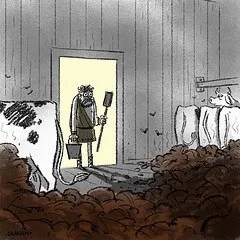
Hercules in Greek mythology was assigned to clean the Augean stables. King Augeaus had 3,000 oxen and their stable had not been cleaned in 30 years! (That’s a whole lot of manure.)
He was given 24 hours to clean it up. And rather than grab a shovel, he concentrated on redirecting two rivers, turning them directly into the stable, and essentially flushing out the accrued filth of the oxen. His ingenuity fulfilled the task. The stables were cleaned.
The formidable task of cleaning those stables was totally fulfilled by Jesus Christ.
Our hearts were soiled by our sin and iniquity. No man could ever clean them, the piles of sin merely got deeper. At times we’ve tried hard, but sin continued to climb higher. Sometimes we pointed to others as having even worse kept stables than us, but that does not work.
“We are all infected and impure with sin. When we display our righteous deeds, they are nothing but filthy rags.“
Isaiah 64:6
So much we hear seems to diminish our sin. Nothing we hear preached changes this. Only the heroic effort of Jesus can cleanse us from what we know, deep down, is true. We are “infected” with sin. The fever rages within, and it abates at times, but it’s always there.
“So get rid of all the filth and evil in your lives, and humbly accept the word God has planted in your hearts, for it has the power to save your souls.”
James 1:21
Some suggest the repentance is archaic and obsolete. I don’t think so. Rather it seems like it’s the starting point, we don’t change by feeling bad about the piles of manure (and yes, we know about them). We are simply those who’ve decided that we need God’s “river” to clean us.
I point no fingers. I blame or accuse no one. I’m merely a man who is wet, by the grace of God alone.
God came in the humanity of Jesus to heal us, to “flush” us clean. He alone can cleanse us from our filth and darkness.
“I will cleanse you of your filthy behavior.”
Ezekiel 37:29
“God the Father knew you and chose you long ago, and his Spirit has made you holy. As a result, you have obeyed him and have been cleansed by the blood of Jesus Christ.”
1 Peter 1:2
You have to decide. Will you simply adapt to your manure, or simply allow the rivers of grace to change you?
Point blank now. You will never get clean enough for God to accept you, it’s never going to happen. It’s impossible. But there’s a way–the only way–is to step into His power, His love, and ask for forgiveness and real change.
“You were cleansed from your sins when you obeyed the truth, so now you must show sincere love to each other as brothers and sisters. Love each other deeply with all your heart.”
Quarantines are a real possibility, even in this day. A quarantine is imposed when disease is contagious enough that it would harm a society: Measles, Smallpox, and the recent COVID-19 are just a few physical diseases where isolation must be imposed. It can be severe— an epidemic, with desperate consequences if not adhered to; in some rare cases, the use of deadly force have been authorized to maintain a quarantine until the disease is no longer communicable.
This may surprise you, but there are examples of ‘quarantines’ in the Bible. The term ‘unclean’ was used for ‘leprosy.’ Those afflicted had to isolate themselves; they had to ‘announce’ their presence when in contact with society. Lepers lived in groups away from the general populace, as a result of their disease.
In Paul’s epistle to the Corinthian he addresses another kind of ‘quarantine.’ The situation was dire; the church had advocated a Christian living with his father’s wife.
“I have already passed judgment on this man in the name of the Lord Jesus. You must call a meeting of the church. I will be present with you in spirit, and so will the power of our Lord Jesus. Then you must throw this man out and hand him over to Satan so that his sinful nature will be destroyed and he himself will be saved on the day the Lord returns.” 1 Corinthians 5:3-5
Understanding the Principal of Usefulness
“Now in a large house there are not only gold and silver vessels, but also vessels of wood and of earthenware, and some to honor and some to dishonor.” 2 Timothy 2:20, NASB
In the pantry of God, one can find an array of pots and pans, each serving a distinct purpose. Paul communicates to Timothy regarding the ‘large house’ that represents the Church as a whole. Timothy must observe the presence of both gold and silver vessels, each bearing a noble purpose befitting such a grand establishment. These are the vessels designated for the guests, appropriately reflecting the significance of the Lord Himself. Their value is inherent, as they are crafted from precious metals.
There are vessels of a different category. These are the ones made of wood, and of clay. These are part of the household, make no mistake about it. But their use is one of function, they’re utilized in common and ignoble ways. (A clay ‘bed-pan’ perhaps?!)
“Therefore, if anyone cleanses himself from these things, he will be a vessel for honor, sanctified, useful to the Master, prepared for every good work.” 2 Timothy 2:21
Paul, the author of New Testament doctrine of grace emphasizes the place of personal holiness. We are to ‘cleanse’ ourselves to become a vessel of honor. There is good news here:
All are vessels in the Father’s house. Each of us belong to Him. He alone determines their use.
Things are not yet in their final state. Change in status can be experienced. In God’s economy, clay pots can become ‘golden.’ Silver can become ‘wood.’
Some sin is indeed contagious. It influences believers, leading to a compromised Church due to our choices. At times, we find ourselves in a protective quarantine by the Holy Spirit—until the contagion is eradicated. This spiritual disease cannot be allowed to persist.
I have walked through this journey many times in my own discipleship. While these moments can be quite challenging, they come without condemnation. I remain His servant, and His love for me is remarkably unwavering. He has never turned away from a repentant child, no matter how deeply they have fallen.
“Yes, I am His servant, but I must wait out in the hall. I haven’t been faithful. So I sit in His waiting room, waiting for His call. This is for my good. And my Father knows what is best.”
“The more I have read the Bible and studied the life of Jesus, the more I have become convinced that Christianity spreads best not through force but through fascination.“
Shane Claiborne
I believe in evangelism. Right after Bible college I joined SOS Ministries as a full-time evangelist. I was there for three years living in a ministry house in the Mission district. We did high-visibility street work, preaching and leading teams to various parts of the City. This was in the 1980s and the City was pretty challenging.
I was primarily a street preacher and a team leader.
San Francisco is a city of 800,000 people. The work was intense. I remember once I was leading a Church team on Haight-Ashbury, and I was punched in the face by a backslidden Christian who strenuously objected to the Gospel being preached. I tried to respond in humility and kindness, even though I thought my nose was broken. (It wasn’t.)
Over the years I have come to see that the most powerful witness is a joyful and loving character that’s submitted to Christ.
Walking through the dusty roads and journeying into the small villages of Judea we read of the incredible hold that Jesus had on the hearts of men. They were fascinated by Him. People came face to face with God’s presence and it grabbed them. They traveled great distances to meet Him.
“And all the people were amazed, and said, “Can this be the Son of David?”
As we submit to His Spirit we begin to understand this same amazing dynamic. It’s not us, it’s Him. And it will always be Him. The fruits of His presence are becoming very visible. Jesus is living inside of us!
“But the fruit of the Spirit is love, joy, peace, patience, kindness, goodness, faithfulness, 23 gentleness, self-control; against such things there is no law.”
Galatians 5:22-23
I remember visiting a Christian commune in the early 70s. I was a young believer with a ton of questions. I recall the peace, humility, and joy I saw on the faces of these brothers and sisters. I instinctively knew that I was encountering Jesus. And it shook me in a good way, a deeply supernatural way.
Please do not remove the presence of Jesus from your evangelism.
If you ask me, I will tell you. Jesus is still fascinates, and it’s His residence in you that still touches people. Evangelism is far more than the ability to recite facts and good arguments. It’s something far more.
And yet I still believe in high visibility evangelism. God’s word must be proclaimed openly and without compromise. But 40 years have passed now,and I have come to see that our faith spreads best through our example.
Perhaps He must be seen as well as to be heard?
“Soon we shall be up there with Christ. God did not mean us to be happy without Him; but God would first have us to be witnesses for Him down here, to hold out as much light as we can.”





















 Alaska Bible Teacher