Piles and Piles of Manure

The Augean Stable

Proverbs 30:12

The dictionary explains filthy things like this, “to be disgustingly dirty” or “to an extreme extent.” Understanding this draws us into a perilous understanding of what our situation really is–to despair is our only real step of being acceptable in God’s eyes.

Despairing is our first step.

The Pharisees (“the holy ones”) never understood. But they never understood the basics. They read but never really understood the words of the prophet Isaiah,

“Their tables are covered with vomit; filth is everywhere.”

Isaiah 28:8. (Context 28:8-9.)

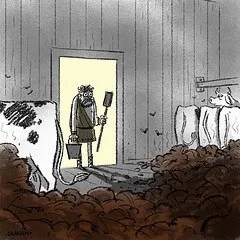
Hercules in Greek mythology was assigned to clean the Augean stables. King Augeaus had 3,000 oxen and their stable had not been cleaned in 30 years! (That’s a whole lot of manure.)

He was given 24 hours to clean it up. And rather than grab a shovel, he concentrated on redirecting two rivers, turning them directly into the stable, and essentially flushing out the accrued filth of the oxen. His ingenuity fulfilled the task. The stables were cleaned.

The formidable task of cleaning those stables was totally fulfilled by Jesus Christ.

Our hearts were soiled by our sin and iniquity. No man could ever clean them, the piles of sin merely got deeper. At times we’ve tried hard, but sin continued to climb higher. Sometimes we pointed to others as having even worse kept stables than us, but that does not work.

“We are all infected and impure with sin.
    When we display our righteous deeds,
    they are nothing but filthy rags.

Isaiah 64:6

So much we hear seems to diminish our sin. Nothing we hear preached changes this. Only the heroic effort of Jesus can cleanse us from what we know, deep down, is true. We are “infected” with sin. The fever rages within, and it abates at times, but it’s always there.

“So get rid of all the filth and evil in your lives, and humbly accept the word God has planted in your hearts, for it has the power to save your souls.”

James 1:21

Some suggest the repentance is archaic and obsolete. I don’t think so. Rather it seems like it’s the starting point, we don’t change by feeling bad about the piles of manure (and yes, we know about them). We are simply those who’ve decided that we need God’s “river” to clean us.

I point no fingers. I blame or accuse no one. I’m merely a man who is wet, by the grace of God alone.

God came in the humanity of Jesus to heal us, to “flush” us clean. He alone can cleanse us from our filth and darkness.

“I will cleanse you of your filthy behavior.”

Ezekiel 37:29

“God the Father knew you and chose you long ago, and his Spirit has made you holy. As a result, you have obeyed him and have been cleansed by the blood of Jesus Christ.”

1 Peter 1:2

You have to decide. Will you simply adapt to your manure, or simply allow the rivers of grace to change you?

Quarantined for a Reason

Quarantines are a real possibility, even in this day. A quarantine is imposed when disease is contagious enough that it would harm a society: Measles, Smallpox, and the recent COVID-19 are just a few physical diseases where isolation must be imposed. It can be severe— an epidemic, with desperate consequences if not adhered to; in some rare cases, the use of deadly force have been authorized to maintain a quarantine until the disease is no longer communicable.

This may surprise you, but there are examples of ‘quarantines’ in the Bible. The term ‘unclean’ was used for ‘leprosy.’ Those afflicted had to isolate themselves; they had to ‘announce’ their presence when in contact with society. Lepers lived in groups away from the general populace, as a result of their disease.

In Paul’s epistle to the Corinthian he addresses another kind of ‘quarantine.’ The situation was dire; the church had advocated a Christian living with his father’s wife.

“I have already passed judgment on this man in the name of the Lord Jesus. You must call a meeting of the church. I will be present with you in spirit, and so will the power of our Lord Jesus. Then you must throw this man out and hand him over to Satan so that his sinful nature will be destroyed and he himself will be saved on the day the Lord returns.” 1 Corinthians 5:3-5

Understanding the Principal of Usefulness

“Now in a large house there are not only gold and silver vessels, but also vessels of wood and of earthenware, and some to honor and some to dishonor.” 2 Timothy 2:20, NASB

In the pantry of God, one can find an array of pots and pans, each serving a distinct purpose. Paul communicates to Timothy regarding the ‘large house’ that represents the Church as a whole. Timothy must observe the presence of both gold and silver vessels, each bearing a noble purpose befitting such a grand establishment. These are the vessels designated for the guests, appropriately reflecting the significance of the Lord Himself. Their value is inherent, as they are crafted from precious metals.

There are vessels of a different category. These are the ones made of wood, and of clay. These are part of the household, make no mistake about it. But their use is one of function, they’re utilized in common and ignoble ways. (A clay ‘bed-pan’ perhaps?!)

“Therefore, if anyone cleanses himself from these things, he will be a vessel for honor, sanctified, useful to the Master, prepared for every good work.” 2 Timothy 2:21

Paul, the author of New Testament doctrine of grace emphasizes the place of personal holiness. We are to ‘cleanse’ ourselves to become a vessel of honor. There is good news here:

All are vessels in the Father’s house. Each of us belong to Him. He alone determines their use.

Things are not yet in their final state. Change in status can be experienced. In God’s economy, clay pots can become ‘golden.’ Silver can become ‘wood.’

Some sin is indeed contagious. It influences believers, leading to a compromised Church due to our choices. At times, we find ourselves in a protective quarantine by the Holy Spirit—until the contagion is eradicated. This spiritual disease cannot be allowed to persist.

I have walked through this journey many times in my own discipleship. While these moments can be quite challenging, they come without condemnation. I remain His servant, and His love for me is remarkably unwavering. He has never turned away from a repentant child, no matter how deeply they have fallen.

“Yes, I am His servant, but I must wait out in the hall. I haven’t been faithful. So I sit in His waiting room, waiting for His call. This is for my good. And my Father knows what is best.”

He Came for Us!

by Pastor David Taylor

“The central miracle asserted by Christians is the incarnation. They say that God became man.” 

CS Lewis

One of my favorite places to fish in Alaska is Kodiak Island, where I tried to catch silver salmon with some friends. Just as we were setting up camp, the sun disappeared, and the temperature dropped quickly. While we struggled with our tents, the wind joined in. Then, it started pouring rain—like someone dumped a bucket of water on us! I woke up at midnight to strong winds flattening my tent, making me wonder if fishing Kodiak was really worth it. 😁

But in the morning, the storm had moved on. The sky transformed into something gold! The sun shone brightly, making the world come alive. The night gracefully stepped aside, allowing the darkness to fade away and make room for a new, vibrant day.

I realized then that’s the way of Christmas. 

We have an Advent hope. The light doesn’t negotiate with darkness; there’s no struggle. The darkness retreats when the light arrives. Plain and simple.

Advent hope seems slow, but honestly, it’s unstoppable.

When Jesus came into the world, nothing could stop Him. His birth is recognized during Advent. His arrival was predicted in the scriptures. Jesus came to take away our sins and offer us eternal life.

The Bible teaches us that Jesus is God in the flesh, fully divine and fully man, who came to save us from our sin. This is basic Christianity.

One: The Word Who Always Was, (vv. 1-2)

“In the beginning” reminds us of Genesis, where God created everything (Genesis 1:1). Through the Spirit, he shows that he has taken an important step towards us with the arrival of Jesus. He is dedicated to saving us.

God created us to know and enjoy him (Gen 3:8). We must understand that sin entered the world and screwed everything up. Jesus came to sacrifice Himself to secure our salvation, restoring his image in those who trust him. 

Jesus Christ restores all that we lost because of our sin.

In the beginning was the Word. The Word did not come into existence in Mary’s womb but He always was. The Word is eternal. Before it all began, he was there, and he was coming for us.

The phrase “the word was also with God” indicates that the Word is from God but is closely connected to Him (Mk 6:3; 11:4; 2 Cor 5:8; 1 John 1:2). The Word is also God and represents the eternal Son of God, who is both with God and is God. He is the Word and the Son, distinct yet unified with God.

Two: The Word Who is the Creator, (v. 3)

Everything we see was made through Jesus, and nothing exists without him (see Col 1:16-17). The Old Testament says that God created the heavens and the earth, while the New Testament shows that the Word is the true Creator. This highlights Christ’s key role in creation and his divine nature. Both Testaments emphasize the relationship between God the Father and Jesus, confirming that all existence is intentional and meaningful. 

Recognizing Jesus as the Creator enhances our understanding of his authority, showing us that all things were created through him and find their purpose in him.

Three: The Word Who is the Light, (vs. 4-5). 

We must understand that we’re born spiritually dead and blind. But that can change.

Jesus is the light and every one of us is spiritually blind to truth and beauty and glory (John 17:24). Jesus overcomes our darkness and now gives life. Jesus does for us what we cannot do for ourselves. His love is seeking us.

The word, the gospel, brings forth life and light so that we are born again, literally born from above, and so we see (John 3:3). The light shines into our darkness and the darkness leaves us.

Come Out of the Closet

“Therefore take up the whole armor of God, that you may be able to withstand in the evil day and having done all, to stand firm. 14 Stand therefore, having fastened on the belt of truth and having put on the breastplate of righteousness, 15 and, as shoes for your feet, having put on the readiness given by the gospel of peace. 16 In all circumstances take up the shield of faith, with which you can extinguish all the flaming darts of the evil one; 17 and take the helmet of salvation, and the sword of the Spirit, which is the word of God,

Eph. 6:13-17, ESV

You’re called to be armor-plated.

Ephesians is quite clear about this, and we dare not live without spiritual protection, and as a matter of fact, we must wear each piece to survive spiritually. To be ‘naked’ is catastrophic. Neglecting to dress appropriately brings cataclysmic disorder. We dare not minimize our need for wearing our armor.

Each piece listed must be worn. This is a scriptural mandate for every believer in Jesus.

“The whole armor of God” explains the equipment we need to survive spiritually. Here’s a list of the six:

  • The belt of truth–this pulls everything together and holds us and keeps us secure in the truth.
  • The breastplate of righteousness–our spiritual heart is protected by knowing we’re accepted by the Father. Being right with God is not a feeling nor is it a mere hopeful wish. We wear what is real.
  • The shoes of the gospel (of peace)–the idea of standing in place (“to stand”) explain our ability to be fixed on grace. When we wear battle shoes we cannot be pushed back or lose our footing. Wearing gospel shoes brings us spiritual stability. We can stand in place, rooted and strong.
  • The shield of faith–is a vital way of protecting ourselves from the evil arrows shot by the enemy. Satan targets us when he thinks that we aren’t using faith to defend ourselves.
  • The helmet of salvation–this is the realization that our mind is protected. This vital piece brings us wholeness as we understand what Jesus has done. We know we are saved and wearing our helmet is our protection from demonic-inspired lies.
  • The sword of the Holy Spirit–the only offensive weapon we have, and it’s all we need. The Word of God will frighten the enemy and push him back. The Word slices and cuts down every obstacle and every lie.

   Watchman Nee

I must stress that clothing yourself is vital. You dare not live spiritually naked wearing nothing. You will be totally vulnerable to the satanic wickedness that is swirling around you. I’m afraid it’s all very real and sobering and there is no escape clause until you finally arrive in heaven.

“We know [positively] that we are of God, and the whole world [around us] is under the power of the evil one.”

1 John 5:19, Amplified Bible

I’m afraid you haven’t been given an option in all of this. Our battle equipment in Ephesians 6 is not just some theological preference or concept. It’s real.

Over 40 years of following Jesus have taught me that most believers struggle because they won’t arm themselves for battle. They refuse to acknowledge the environment they’re in and don’t realize the spiritual battle they are facing. They like the sentiment behind this particular passage, (it stirs their heart) but the reality of the battle never fully sinks in.

They end up leaving their armor behind.

The good news is that we have already won because of what the Lord has done. Wearing the armor strengthens and stabilizes us. He pours out His grace, and there will be times of rest of that I am certain. “He leads me beside still waters.”

As obedient and faithful believers we need to realize we’re secure in Him. Yes, there is a terrible fight, but “The battle is the Lord’s.”

“For you equipped me with strength for the battle; you made those who rise against me sink under me.”

Psalm 18:39, ESV

The Church of the Burning Bush

— John Newton, author of “Amazing Grace
We all know a brother or sister who seems to be a target of an undue amount of suffering. It looks like they’re always in the furnace. All we can do really is to shake our heads and then give them double honor for their faith in God’s grace and providence.

Ministering to these sufferers can be a challenge.

What can we say to those who seem to be on “God’s anvil?” How can we bless those who are in pain?

Perhaps a simple word of calm encouragement is the most effective. In the midst of some awful difficulties, I once had a dear brother who gently and carefully quoted Philippians 1:6 to me over and over, whenever we met and whenever we parted:

 “And I am certain that God, who began the good work within you, will continue his work until it is finally finished on the day when Christ Jesus returns.”

Philippians 1:6

It was a precious thing that he did. I didn’t mind it all, as a matter of fact, I grew to like it. At first, I’ll admit it was strange, but my faith began to ‘mix’ with the Word and I began to believe it. It’s now my favorite verse in the Bible.

Fred refused to preach to me.

He had the maturity to see what God was doing and to make himself available to God on my behalf. Perhaps that patience he showed should be for us the method of choice? I look forward to seeing him someday, someway.

“We can rejoice, too, when we run into problems and trials, for we know that they help us develop endurance.”

Romans 5:3

A keyword in this verse is “rejoice.”

Much wisdom is needed in our ministry to disproportionate sufferers. We should have a fear of intruding on the work the Lord is doing. We must be patient and humble in this matter. There is no rushing God, after all, it’s His work. Most importantly we must be very much ‘present’ for our friend.

“But not only that! We even take pride in our problems, because we know that trouble produces endurance”

Romans 5:3

A “word” spoken out of place can cause even more heartache for the sufferer. Let’s be careful. At times it’s better not to say anything, and that’s alright. Job’s friends were best sitting in the ash heap, saying no word.  

“The Lord God gives me
the right words
    to encourage the weary.
Each morning he awakens me
    eager to learn his teaching.”

Isaiah 50:4, CEB

Trust Jesus to show you how to love, and serve those who seem to struggle so very much. Ask the Father to give you the right words–He will if you only ask.

When Healing Doesn’t Happen

Not everyone who is sick will receive a physical healing.

I find this moderately disturbing. In over 35 years of ministry I have seen a lot. I once prayed over a saint who had a leg that was shorter than the other. She walked in a painful limp, and yet in a brief second, her leg grew. I’ve prayed over terrible fevers, and I instantly saw it leave. I know God heals. He does wonders still.

And yet there has been prayer that doesn’t make it beyond the ceiling.

For believers today who suffer physically or mentally, we may question our faith. (Especially when the healing evangelist comes to town). After 2-3 tries we settle back on our “deficient’ faith feeling a bit miserable.

I honestly don’t think that’s what the Lord wants.

It seems to me that the real issue is not so much a weak faith, but holding on to your faith when you are not healed.

I hear talk about having faith to be healed–but what about the faith that’s needed to be sick?

Why do we suffer from illness? I suspect that for many believers sickness is really there to bring glory to God. Holding onto faith in the midst of pain often encourages those who witness it. I believe that was Paul’s experience (2 Cor. 12:7-10).

Oh dear one, continue to seek healing, (James 5:14).

Healing will happen. We look forward to that special day when all our sin, and all our sickness will be eternally dealt with. Those ugly and painful and savage things will no longer be part of us. We’ll walk unencumbered by earth’s ugly shackles.

“He will wipe away every tear from their eyes, and death shall be no more, neither shall there be mourning, nor crying, nor pain anymore, for the former things have passed away.”

Rev. 21:4

Meet Martha, Her Story

Luke 10:38-41

“While Jesus and his followers were traveling, Jesus went into a town. A woman named Martha let Jesus stay at her house. 39 Martha had a sister named Mary, who was sitting at Jesus’ feet and listening to him teach. 40 But Martha was busy with all the work to be done. She went in and said, “Lord, don’t you care that my sister has left me alone to do all the work? Tell her to help me.”

41 “But the Lord answered her, “Martha, Martha, you are worried and upset about many things. 

42 Only one thing is important. Mary has chosen the better thing, and it will never be taken away from her.”

My name is Martha and I’m a friend of Jesus. My home was one of His favorite places to stay–a refuge for Him whose life was so busy. I joyfully opened my house for Him and His disciples. When Jesus came I went all out, I wanted the best for His followers and that meant there were always things to do. Is that really a bad thing?

The kitchen was getting crazy–lamb, cucumbers, figs, and so on. Roasting and slicing, I had bread in the oven. All of this was requiring constant attention, and I remember not being able to keep up.

I wanted things to be perfect for Jesus.

I took occasional peeks at He who was teaching in my living room. I just brought in some bowls of figs and raisins as an appetizer and found my sister Mary sitting with the men listening to Jesus and asking questions. It was that which started to get a little ticked off.

I was getting really mad at my sister.

There was so much to do and I realized I had to have her help. And the more I thought of Mary the more frustrated I got. I suspect she didn’t understand the work that need to be done. I suppose her priorities were messed up–she simply didn’t understand her role as a hostess, and to sit with the men like she was doing was wrong.

Mary didn’t understand her place.

I admit I was having issues with my sister. I had brought out another bowl of figs and that’s when I gently interrupted the Lord’s teaching. I wanted Him to tell Mary that her place was with me in the kitchen. He could correct her and I knew she would listen. “Tell her to help me.”

Instead, it was Jesus who corrected me. I still remember Jesus’ words. I wasn’t expecting this.

“Martha, Martha, you are worried and upset about many things.”

Was I really that transparent? He understood, but rather than encouraging me I had become another lesson to everyone present. I realize now that the real issue was with my attitude, and not the work. Yes, I was bothered and upset and I know that it’s those things that were the problem.

Only one thing is important. Mary has chosen the better thing, and it will never be taken away from her.”

I suddenly knew that He was right. Jesus was in my home, and all I did was get angry. I thought my work would please Him and after all, wasn’t that important? Didn’t He “deserve” my best efforts?

My younger sister Mary was being praised. She was my example and now I was being gently rebuked. I realized that all I was doing, all my work, was not what Jesus wanted from me. The problem was my own heart—-it wasn’t Mary, it was me!

I had taken my eyes off of Jesus and was immersed in my service to Him.

I had become critical and resentful of Mary, and I had forgotten that my place was at Jesus’ feet, listening and learning. That’s what Jesus wanted from me, and somehow I had forgotten that.

I decided then, the work could wait, my real place was with Jesus.

Martha’s frustration is typical of those who diligently serve with good intent, but forget to also sit at Jesus’ feet. “The Martha spirit says, if the work is done, is not that all? The Mary spirit asks whether Jesus is well pleased or not? All must be done in his name and by his Spirit, or nothing is done.”

C.H. Spurgeon

My Facebook page is here.

Serving God at Night


A song for going up to worship.

“Behold, bless ye the Lord, all ye servants of the Lord, who by night stand in the house of the Lord.

Lift up your hands in the sanctuary, and bless the Lord!

The Lord who made heaven and earth bless thee out of Zion!”

Psalm 134

This remarkable Psalm is part of an elite group known as “the Psalms of Ascent.” There are 15 Psalms (120-134) sung as the congregation of Israel went up the steps of the temple in Jerusalem. They would sing each in “rounds” with each other.

As you can well imagine, this made the ascent slow, but meaningful. As you read the three verses of 134, I get a picture of worshipers turning back and blessing the Levites. This takes place at the very end of the day. The Levites, and other godly ones who lived in the Temple, (remember Anna and Simeon, in Luke 2?)

They were the support staff for the priests.

I have some general thoughts about this Psalm:

V.1, “Behold, bless ye the Lord, all ye servants of the Lord, who by night stand in the house of the Lord.”

The first significant thought is “Lord” mentioned three times. The word is the recognition of someone’s status and standing. We call Him Lord, because He is that (and more). The second has to deal with the Levitical “night shift.”

They served and guarded the Temple during the wee hours of the night.

They probably cleaned, stacked wood, sharpened knives and maintained the Holy Place with its needs. There was no real glory working the night shift. There were no people to serve. The crowds were for the day shift. (Here’s a weird thought– think “Disneyland at 2:00 a.m.”) There was also a contingent of non-Levite people ministering to the Lord as well. They had no duties, and only the priests could serve through their work.

The Levites working at night were not ‘second best.’ At least, not in the eyes of the Holy Spirit. They were integral in both presence and service to the Lord. To despise them is to reveal one’s ignorance. They definitely mattered.

V. 2 “Lift up your hands in the sanctuary, and bless the Lord!

I’ve worked nights before. It’s a real adjustment. You never feel like you’ve had enough sleep, and it is really hard to be positive and cheerful.  I could get pretty grouchy at times. But an exhortation is given, a shout and a blessing as the crowds leave. “Raise up your hands– and praise Him!” It is as the work, although necessary, would be secondary. The worship however, was primary. We need to hear that.

Each of these three verses of this Psalm contain the word “blessing!”

V. 3, “The Lord who made heaven and earth bless thee out of Zion!”

To be blessed (literally, made “lucky”) by our Creator and Lord is pretty profound. As a kid who read a lot, I think of ‘fairy dust.’ I know better now, but to be blessed by God is deeply significant. To summarize, I believe this Psalm is speaking of those in the church who are doing “hidden service.” No one sees them really.

They go about there duties quietly, and purposefully. The only recognition is from God– who sees all. I must encourage you to keep on. There are many more than you think who see your hidden ministry to the Father. You are His ‘night shift.’ You’re seen by few, but Him. He knows what you do.

“There are many of us that are willing to do great things for the Lord, but few of us are willing to do little things.”

     D.L. Moody

Only His Fire

Isaiah 33:14

Perhaps we can become too casual in our intimacy with God? Becoming close is obviously needed, but it must be done with certain precautions. (Bear with me as I try to explain.)

He asks for us to see Him with an awareness of His holiness. It’s important to Him, and it is vital for us. We must honor Him as the One who is supremely holy. But seeing that we can walk with God in a new way.

Hebrews 12:29, ESV

The closer we come, the more significant our response. I believe the Holy Spirit carefully monitors us to see what we will do after we confront the reality of Him. He insists that we should honor Him as ‘holy.’ He passionately desires and requests that we do what is appropriate and honorable as we meet Him.

Giving Jesus honor is critical to all we say or do.

It should be the first thought of every man or woman who presses in to know Him. Honoring Him as holy is not regarded as an option to be debated or brought out for consideration. It is essential to follow Him faithfully.

He is like a tiger whom we have grabbed by the tail, we have but a few options. One is to release our hold and face the consequences. The second is too hold on to Him with all our strength. He loves those who make the second choice. Grab hold of the Lord Jesus, and hang on for dear life!

He is dangerous, but in a good way. Intimacy is important, but so is having a healthy fear of Him.

We should anticipate Him coming and disrupting our Sunday services. Perhaps we need our ushers to hand-out ropes and life-jackets before the service starts? We should expect Him to explode in our congregations in a whirlwind of holy love. He wants us to anticipate His presence.

In Isaiah 33:14 there is something that is needful and mandatory for us to understand about our Father. Often we’ll discover that entering and abiding in His presence requires us to honor His holiness. When we do so, we find we will trigger a response from the Lord, which will it turn be a true blessing to our own souls.

Major Ian Thomas

Why, God Why?

Job 7:20, 13:24, 9:29, 24:1, 10:18

Job’s profound suffering is one of the most extreme in all of human history. He is essentially a godly man who loses everything (except his faith). Job must pick up the pieces after “catastrophic ” sudden pain and total loss.

Only the brutality of the cross of Jesus eclipsed the suffering of Job.

Job is being tested with dark horrors. Will he “curse God and die” as his wife suggests? Will he cave in to the final four “friends” and accept their twisted theology? (I guess that you have to read chapters 38-39 to find out).

The Book of Job has been regarded as inaccessible and archaic by many.

Unfortunately, many believe this assessment and look elsewhere for comfort. I would agree that Job is a challenging book, but so is Macbeth or Plato. There are plenty of easier books to read; but if we choose to avoid Job, our faith will always be deficient. We will miss something vital.

Job is less an explanation and more a revelation of suffering. “Why” questions go unanswered. “Who” questions matter. I suppose this seems unfair to Job. It certainly seems so to me, but straight answers in a fallen world won’t get any traction at all.

One more thing. The Book of Job is about “twisted” theology. Job’s friends “toe-the-party-line” of theology that is logical. But don’t be mislead by their pronouncements, for they seem reasonable but they are all very much flawed.

I always find it strangely amusing when some quote Eliphaz or one of the other “friends” to encourage or comfort a suffering saint. They totally miss the point of the book. We desperately want to give out good counsel but we really don’t understand.

“If I have the gift of prophecy and can fathom all mysteries and all knowledge, and if I have a faith that can move mountains, but do not have love, I am nothing.” 1 Cor. 13:2

You can’t split your theology from love and get away with it. Something toxic happens if you try.

When you read “Job’s friends” you must remember that. These are lessons it takes a long time to learn. Unless the Holy Spirit tutors you, be very slow to speak. (Job’s friends were at their best at the beginning when they said nothing at all.)

The broken believer, hobbled by chronic illness, has much to learn from Job. He is like “the poster child” for those afflicted. My own illnesses are always an issue of course, but God is fully in control. He brings beauty out of the ashes. He has been more than gracious.

“To bestow on them a crown of beauty
instead of ashes,
the oil of joy
instead of mourning,
and a garment of praise
instead of a spirit of despair.
They will be called oaks of righteousness,
a planting of the Lord
for the display of his splendor.”
Isaiah 61:3