A Stone’s Throw Away

tumblr_static_tumblr_static_1odvenqfc6kkgwo0sg0skgsco_1280

“And He withdrew from them about a stone’s throw, and He knelt down and began to pray,”

Luke 22:41

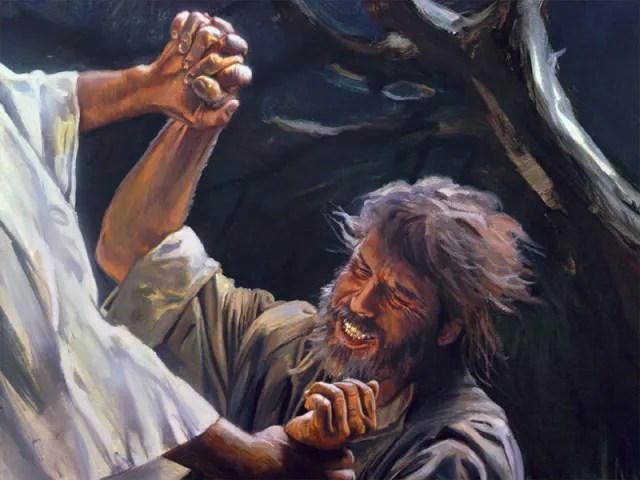
WHO KNOWS WHAT JESUS IS THINKING as he entered the Garden? His disciples followed Jesus but scripture states that he proceeded ahead of them. He knew He must find some much-needed strength through prayer— this verse tells us he went “a stone’s throw.”

Often we share in the sorrows of the people closest to us, and Jesus wants His disciples to follow him. And they do, but not all the way. They came very close but didn’t really understand the full nature of the pain that was beginning for Jesus. They slept while he agonized. He was for the first time perhaps, needing someone close.

Some who are reading this will make the same trip to the garden.

Perhaps every believer makes the trip to ‘Gethsemane,’ but not as mere observer or tourist. The garden is a distinct place of testing and of sorrow. And each disciple will experience it for themselves. The servant is not above his master.” We must follow the Lord Jesus, and it’s not going to be easy.

I’ve gone to the Garden myself, sitting in the dark, waiting for Him to come. And He does. And He is my light.

Jesus is very close. He stands by us. He listens and watches.

He completely understands what it means to be alone with sorrow. The believer can lean on Jesus as the pain continues. He sends his “Comforter” to each, as He personally escorts us through this time in the “garden.” He comes in grace and is completely kind. He truly is just a stone’s throw away.

“God is our refuge and strength, always ready to help in times of trouble.”

Psalm 46:1

“No physician ever weighed out medicine to his patients with half so much care and exactness as God weighs out to us every trial. Not one grain too much does He ever permit to be put in the scale.”

   Henry Ward Beecher

alaskabibleteacher.com

A Glowing Witness

The more I have read the Bible and studied the life of Jesus, the more I have become convinced that Christianity spreads best not through force but through fascination.

Shane Claiborne

I believe in evangelism. Right after Bible college I joined SOS Ministries as a full-time evangelist. I was there for three years living in a ministry house in the Mission district. We did high-visibility street work, preaching and leading teams to various parts of the City. This was in the 1980s and the City was pretty challenging.

I was primarily a street preacher and a team leader.

San Francisco is a city of 800,000 people. The work was intense. I remember once I was leading a Church team on Haight-Ashbury, and I was punched in the face by a backslidden Christian who strenuously objected to the Gospel being preached. I tried to respond in humility and kindness, even though I thought my nose was broken. (It wasn’t.)

Over the years I have come to see that the most powerful witness is a joyful and loving character that’s submitted to Christ.

Walking through the dusty roads and journeying into the small villages of Judea we read of the incredible hold that Jesus had on the hearts of men. They were fascinated by Him. People came face to face with God’s presence and it grabbed them. They traveled great distances to meet Him.

“And all the people were amazed, and said, “Can this be the Son of David?”

Matthew 12:23; see also Luke 5:26

As we submit to His Spirit we begin to understand this same amazing dynamic. It’s not us, it’s Him. And it will always be Him. The fruits of His presence are becoming very visible. Jesus is living inside of us!

“But the fruit of the Spirit is love, joy, peace, patience, kindness, goodness, faithfulness, 23 gentleness, self-control; against such things there is no law.”

Galatians 5:22-23

I remember visiting a Christian commune in the early 70s. I was a young believer with a ton of questions. I recall the peace, humility, and joy I saw on the faces of these brothers and sisters. I instinctively knew that I was encountering Jesus. And it shook me in a good way, a deeply supernatural way.

Please do not remove the presence of Jesus from your evangelism.

If you ask me, I will tell you. Jesus is still fascinates, and it’s His residence in you that still touches people. Evangelism is far more than the ability to recite facts and good arguments. It’s something far more.

And yet I still believe in high visibility evangelism. God’s word must be proclaimed openly and without compromise. But 40 years have passed now,and I have come to see that our faith spreads best through our example.

Perhaps He must be seen as well as to be heard?

“Soon we shall be up there with Christ. God did not mean us to be happy without Him; but God would first have us to be witnesses for Him down here, to hold out as much light as we can.”

    G.V. Wigram

Maker of the Universe

The Maker of the universe
As Man, for man was made a curse.
The claims of law which He had made,
Unto the uttermost He paid.

2

His holy fingers made the bough
Which grew the thorns that crowned His brow.
The nails that pierced His hands were mined
In secret places He designed.

3

He made the forest whence there sprung
The tree on which His body hung.
He died upon a cross of wood,
Yet made the hill on which it stood.

4

The sky that darkened o’er His head
By Him above the earth was spread.
The sun that hid from Him its face
By His decree was poised in space.

5

The spear which spilled His precious blood
Was tempered in the fires of God.
The grave in which His form was laid,
Was hewn in rocks His hands had made.

6

The throne on which He now appears
Was His from everlasting years.
But a new glory crowns His brow.
And every knee to Him shall bow.

“The Maker of the Universe,” lyrics by Phil Keaggy, 1986

Come Out of the Closet

“Therefore take up the whole armor of God, that you may be able to withstand in the evil day and having done all, to stand firm. 14 Stand therefore, having fastened on the belt of truth and having put on the breastplate of righteousness, 15 and, as shoes for your feet, having put on the readiness given by the gospel of peace. 16 In all circumstances take up the shield of faith, with which you can extinguish all the flaming darts of the evil one; 17 and take the helmet of salvation, and the sword of the Spirit, which is the word of God,

Eph. 6:13-17, ESV

You’re called to be armor-plated.

Ephesians is quite clear about this, and we dare not live without spiritual protection, and as a matter of fact, we must wear each piece to survive spiritually. To be ‘naked’ is catastrophic. Neglecting to dress appropriately brings cataclysmic disorder. We dare not minimize our need for wearing our armor.

Each piece listed must be worn. This is a scriptural mandate for every believer in Jesus.

“The whole armor of God” explains the equipment we need to survive spiritually. Here’s a list of the six:

  • The belt of truth–this pulls everything together and holds us and keeps us secure in the truth.
  • The breastplate of righteousness–our spiritual heart is protected by knowing we’re accepted by the Father. Being right with God is not a feeling nor is it a mere hopeful wish. We wear what is real.
  • The shoes of the gospel (of peace)–the idea of standing in place (“to stand”) explain our ability to be fixed on grace. When we wear battle shoes we cannot be pushed back or lose our footing. Wearing gospel shoes brings us spiritual stability. We can stand in place, rooted and strong.
  • The shield of faith–is a vital way of protecting ourselves from the evil arrows shot by the enemy. Satan targets us when he thinks that we aren’t using faith to defend ourselves.
  • The helmet of salvation–this is the realization that our mind is protected. This vital piece brings us wholeness as we understand what Jesus has done. We know we are saved and wearing our helmet is our protection from demonic-inspired lies.
  • The sword of the Holy Spirit–the only offensive weapon we have, and it’s all we need. The Word of God will frighten the enemy and push him back. The Word slices and cuts down every obstacle and every lie.

   Watchman Nee

I must stress that clothing yourself is vital. You dare not live spiritually naked wearing nothing. You will be totally vulnerable to the satanic wickedness that is swirling around you. I’m afraid it’s all very real and sobering and there is no escape clause until you finally arrive in heaven.

“We know [positively] that we are of God, and the whole world [around us] is under the power of the evil one.”

1 John 5:19, Amplified Bible

I’m afraid you haven’t been given an option in all of this. Our battle equipment in Ephesians 6 is not just some theological preference or concept. It’s real.

Over 40 years of following Jesus have taught me that most believers struggle because they won’t arm themselves for battle. They refuse to acknowledge the environment they’re in and don’t realize the spiritual battle they are facing. They like the sentiment behind this particular passage, (it stirs their heart) but the reality of the battle never fully sinks in.

They end up leaving their armor behind.

The good news is that we have already won because of what the Lord has done. Wearing the armor strengthens and stabilizes us. He pours out His grace, and there will be times of rest of that I am certain. “He leads me beside still waters.”

As obedient and faithful believers we need to realize we’re secure in Him. Yes, there is a terrible fight, but “The battle is the Lord’s.”

“For you equipped me with strength for the battle; you made those who rise against me sink under me.”

Psalm 18:39, ESV

The Church of the Burning Bush

— John Newton, author of “Amazing Grace
We all know a brother or sister who seems to be a target of an undue amount of suffering. It looks like they’re always in the furnace. All we can do really is to shake our heads and then give them double honor for their faith in God’s grace and providence.

Ministering to these sufferers can be a challenge.

What can we say to those who seem to be on “God’s anvil?” How can we bless those who are in pain?

Perhaps a simple word of calm encouragement is the most effective. In the midst of some awful difficulties, I once had a dear brother who gently and carefully quoted Philippians 1:6 to me over and over, whenever we met and whenever we parted:

 “And I am certain that God, who began the good work within you, will continue his work until it is finally finished on the day when Christ Jesus returns.”

Philippians 1:6

It was a precious thing that he did. I didn’t mind it all, as a matter of fact, I grew to like it. At first, I’ll admit it was strange, but my faith began to ‘mix’ with the Word and I began to believe it. It’s now my favorite verse in the Bible.

Fred refused to preach to me.

He had the maturity to see what God was doing and to make himself available to God on my behalf. Perhaps that patience he showed should be for us the method of choice? I look forward to seeing him someday, someway.

“We can rejoice, too, when we run into problems and trials, for we know that they help us develop endurance.”

Romans 5:3

A keyword in this verse is “rejoice.”

Much wisdom is needed in our ministry to disproportionate sufferers. We should have a fear of intruding on the work the Lord is doing. We must be patient and humble in this matter. There is no rushing God, after all, it’s His work. Most importantly we must be very much ‘present’ for our friend.

“But not only that! We even take pride in our problems, because we know that trouble produces endurance”

Romans 5:3

A “word” spoken out of place can cause even more heartache for the sufferer. Let’s be careful. At times it’s better not to say anything, and that’s alright. Job’s friends were best sitting in the ash heap, saying no word.  

“The Lord God gives me
the right words
    to encourage the weary.
Each morning he awakens me
    eager to learn his teaching.”

Isaiah 50:4, CEB

Trust Jesus to show you how to love, and serve those who seem to struggle so very much. Ask the Father to give you the right words–He will if you only ask.

His Love Persists, Psalm 136

Psalm 136

“Give thanks to the Lord, for he is good, for his steadfast love endures forever.”

Psalm 136:1, ESV

Repetition is when a single word or phrase is used multiple times in short succession for effect. It can help emphasize a point. This Psalm certainly does that.

Since this post is pretty much about repetition, I’m going to share some different versions that different translators have interpreted the last phrase of all 26 verses. Keep in mind the last phrase is used is repeating itself word for word in each translation.

Now here are seven different English translations of the end of every verse.

AMP: …for His lovingkindness (graciousness, mercy, compassion) endures forever.

NASB: …for His faithfulness is everlasting.

KJV: …for his mercy endureth for ever.

NCV: …His love continues forever.

CJB: …for his grace continues forever.

MSG: …His love never quits.

NET: …for his loyal love endures.

The word, translated in these different ways, is hesed” in Hebrew. It means a forever love, loyalty, faithfulness or kindness. It is something everlasting or eternal that’s based all on covenant. Yes, every translation is different, but the same.

I suppose this repeated phrase (26 times) may seem a bit redundant. I for one am prone to skip Psalms 136 because of that, I mean it seems boring. Just repeating this over and over I start to wonder if there’s something better to read.

But we dare not make this mistake.

If we respectfully dismantle this phrase we find it deals with seeing God as eternally steadfast. We are called to state out loud His love for us that never wavers or ends. A “steady” forever love that will not change, flicker, or diminish. It just goes on and on and on.

The phrase then moves even deeper than that. “Endures forever,” shapes the whole thought. You might say that these two words extend or amplify the complete verse and strengthen the entire Psalm.

O.K. Here’s another bone to chew on.

First, I need to point out that the first part of each verse states the unique circumstance that declares what exactly has been done. For instance notice the wonder and power of each verse. This is verse 15, for example,

“He overthrew Pharaoh and his host in the Red Sea, (the unique phrase)
    
for his steadfast love endures forever.”
(the repeated phrase)

The first part describes a miracle of deliverance from Egypt. The second is that same repeated phrase we find in all 26 verses. First the unique phrase, and but then comes the repeated one. But let’s add even more flavor. We must teach ourselves to remember. You must consider each event He has led you through to be a testimony to others.

You then must tell your children about your own personal experiences with God.

We forget these miracles unless we consciously recall what God has done. Miracles, healings, provisions, and His amazing grace. Never disremember these things. Bring them to mind, over and over again. You should never forget those “God-things.” They’re uniquely yours. He has done distinctive and tremendous things for you alone.

I guess the main point of this post is to emphasize to you to value those unique miracles that you’ve experienced in your own life.

In life it seems we remember what is important to us. What He has done for you is your own unique testimony. It’s yours, and yours alone. What you’ve experienced is completely your own testimony.

When we enter a forever kind of an endless eternity that each of us will have amazing stories to tell each other about God’s special touch, His miracles and all of the grace and forgiveness that He uniquely loved us with. We all will have our own unique and singular stories. What we share will be our evidence of His love.

That’s pretty amazing when you think about it.

“And they have conquered him by the blood of the Lamb and by the word of their testimony,”

Rev. 12:11, ESV

Are You Living in Awe?

“The heavens declare the glory of God,
    and the sky above proclaims his handiwork.”

Psalm 19:1

“Earth’s crammed with heaven, And every common bush afire with God; But only he who sees, takes off his shoes, The rest sit round it and pluck blackberries.”

Elizabeth Barrett Browning

In some odd way, our lives seem to be always getting interrupted by God, and if we’re alert, it can happen a lot. We have a built in need to see the invisible, and the work of the Creator. Our night sky here in Alaska is pretty much unreal. I see stars that others can’t, and the northern lights here are remarkable.

But probably the most incredible night skies were in Mexico while camping. I remember laying on the beach seeing the Milky Way on full display. It seemed there were  more stars than ever before. It was the work of God’s hands.

It was completely overwhelming.

I started to tremble and shake. I got up and ran to our tent. I simply couldn’t handle the incredible universe without some kind of a buffer. I was completely undone and reduced to a quivering speck of dust. I tried to tell my wife what had just happened but I couldn’t. I was too scrambled inside. I couldn’t speak. I couldn’t explain what just happened.

Years later I came to understand that I experienced was called awe.

It was something much more common a few generations ago. There’s a kind of existential crisis which we side-step in these more modern times. We rarely contemplate the night sky, mostly because we can’t see it. It’s called light pollution. Our man-made lights make it impossible to see God’s stars.

We seldom, if ever, have seen “fire in a bush.”MINOLTA DIGITAL CAMERA

It seems we have traded our awareness of an authentically Almighty God, and in turn, we get to pick all blackberries we can haul. We reason it out and feel we have made a better bargain. But when we diminish the created world, we shouldn’t be surprised if we find that we have become spiritual paupers.

Maybe we should start to see those things that are invisible to our naked eye?

Each of us has the opportunity right now to see the spiritual world that swirls around us. Why should we wait for heaven to see these things? Ask our Father to reveal His glory now in this present moment. Learn to see that which can’t be seen, but by faith.

  “When I look at your heavens, the work of your fingers,
    the moon and the stars, which you have set in place,
what is man that you are mindful of him,
    and the son of man that you care for him?”

Psalms 8:3-4

Lazarus: In His Own Words

John 11:33-44

When Jesus saw her weeping, and the Jews who had come with her also weeping, he was deeply moved in his spirit and greatly troubled. 34 And he said, “Where have you laid him?” They said to him, “Lord, come and see.” 35 Jesus wept. 36 So the Jews said, “See how he loved him!”  

Jesus Raises Lazarus

38 Then Jesus, deeply moved again, came to the tomb. It was a cave, and a stone lay against it. 39 Jesus said, “Take away the stone.” Martha, the sister of the dead man, said to him, “Lord, by this time there will be an odor, for he has been dead four days.” 40 Jesus said to her, “Did I not tell you that if you believed you would see the glory of God?” 

 So they took away the stone. And Jesus lifted up his eyes and said, “Father, I thank you that you have heard me. 42 I knew that you always hear me, but I said this on account of the people standing around, that they may believe that you sent me.” 43 When he had said these things, he cried out with a loud voice, “Lazarus, come out.” 44 The man who had died came out, his hands and feet bound with linen strips, and his face wrapped with a cloth.

Jesus said to them, “Unbind him, and let him go.”

My name is Lazarus and I was a special “friend” of Jesus. We liked being with each other, and my sisters Mary and Martha also enjoyed fellowshipping with Him. Whenever He passed through Bethany, Jesus always had an open invitation to visit.

What’s it like to be dead? Many ask me this, and I suppose they want to understand, and I don’t blame them. To me, it seemed like a very deep sleep–but I didn’t dream. Those who look for any special insight, will not find it from me. And yet, I am His witness. He has incredible power over death.

I heard Him call my name.

It pierced through everything with an authority I’d never heard before. I had been laid in my tomb for 4 days and my physical body had begun to putrefy. When they rolled the stone away the terrible smell of death lay heavy in the air.

I was tightly bound in cotton wraps and sticky spices had been applied to my body. Mary and Martha had objected to Jesus’ attempt. As I looked back I realize that their actions were justified. After all, who can give life when one is very much dead. And not only dead but well on the way on to decay. The smell wafted from my tomb.

I had heard His shout, and it was then death was reversed.

My heart and brain began to work again. When I came to I found that I was lying on a stone table and tightly wrapped in the clothes of the dead. I managed to sit up, and I shuffled toward the light that had entered the tomb by the stone that covered the door.

When Jesus saw me I believe that He was laughing. He gave the command to the shocked bystanders, He commanded them to unwrap me. I suppose that then I realized I was now in the land of the living. I can’t explain what had happened, But my grave clothes were unwrapped.

There were many that day that became believers.

Many had attested that I was most certainly dead, after all, they had attended my funeral. Some had observed that I had been slathered in the sticky ointment–fragrant spices. And a few were witnesses to see the stone rolled in place.

There were some who simply didn’t (or wouldn’t) believe.

There were the Pharisees and the Sadducees who wanted me dead hoping to nullify my witness and my resurrection from the dead. I had become an embarrassment to them, a constant reminder that Jesus had defeated death.

Their hatred of Jesus’ ministry was only strengthened. My own resurrection proved His authority and power over even death. I was a walking and breathing miracle that they refused to accept. It got so bad that the religious leaders wanted to kill me because so many believed in my resurrection. I was a living witness to many.

Yes, I know that I’ll die again. But I’m not afraid anymore.

“He alone can believe in immortality who feels the resurrection in him already.

Frederick W. Robertson

alaskabibleteacher.com

Art: blogspot.com. Scripture: Christian Standard Bible, Holman Publishers; The Message, Eugene Peterson

For I’m a Sinful Man

Luke 5:4-8, ESV

Man, could He teach. Jesus sat in my boat speaking to the crowd–His words had the ring of truth–authoritative. I had never in my life encountered anyone like Him. His teaching was masterful and it pierced through the religious rhetoric we grew up with.

But it just wasn’t words. My mother-in-law had a terrible fever, and Jesus had healed her. He had also healed many others as we watched. Never had a man done this, it was unprecedented. And now this very same Jesus was sitting in my boat.

He directed us to go out and fish again.

You must know that we had already fished during the night away, and had caught nothing. Sometimes that happens. But Jesus was asking us to make another try. Fishing during the day just wasn’t done and I suppose I wasn’t thrilled about working again.

We rowed out some distance and threw out our nets. I expected nothing. Suddenly, without warning, the nets began to fill with fish–big, beautiful fish! We scooped out as fast as we could, and our boat began to sink. There were so many and they kept coming. I shouted out to the other boat. We needed help.

Soon both of our boats had taken all they could possibly handle.

I was completely overwhelmed, and I turned around to see Jesus in a new light. He was more than a powerful man–He was the Lord and the Messiah! I instantly knew and believed. It was then I collapsed at His feet. I spoke that which was in my heart.

“Depart from me, for I am a sinful man, O Lord.”

Life was about to change for Peter. Radically. I believe that it was at this point that his discipleship began. As he knelt there on the slimy fish he was told that he was going to become a “fisher of men.” That moment of brokenness would become a moment of real strength for him. I suppose that this is how it works.

Peter would commit a multitude of sins–he fell woefully short on several different occasions, and yet Jesus would forgive him over and over. At the end Peter would end up denying the Lord three times, and yet he repented.

Peter is an example of God’s grace and mercy.

God uses broken things. It takes broken soil to produce a crop, broken clouds to give rain, broken grain to give bread, broken bread to give strength. It is the broken alabaster box that gives forth perfume. It is Peter, weeping bitterly, who returns to greater power than ever.

     Vance Havner

alaskabibleteacher.com

Doubting Thomas Speaks Up

John 20:25-29

But Thomas, sometimes called the Twin, one of the Twelve, was not with them when Jesus came. The other disciples told him, “We saw the Master.”

But he said, “Unless I see the nail holes in his hands, put my finger in the nail holes, and stick my hand in his side, I won’t believe it.”

Eight days later, his disciples were again in the room. This time Thomas was with them. Jesus came through the locked doors, stood among them, and said, “Peace to you.”

Then he focused his attention on Thomas. “Take your finger and examine my hands. Take your hand and stick it in my side. Don’t be unbelieving. Believe.”

Thomas said, “My Master! My God!”

Jesus said, “So, you believe because you’ve seen with your own eyes. Even better blessings are in store for those who believe without seeing.”

The others had told me that they had seen Jesus. But this couldn’t be. Either they imagined it or they saw His ghost. I saw him brutalized, crucified, and buried, and I knew He was really dead. I was never into pretending, or wish fulfillment. No, not me. When you’re dead, you’re dead. (At least that’s what I thought.)

I told the others that I would only believe them if I could see and feel the scars–the nail holes and the hole in his side. I needed proof, something tangible or solid before I could believe their stories. Part of me hoped it was so, but I honestly couldn’t join the others in their excitement.

Some would call me a doubter–a skeptic. But that isn’t quite true.

A realist is how I would describe myself. To go along with the others wasn’t going to cut it. They said that they had seen Him and He was very much alive, that somehow, someway He was now resurrected. But for me, I couldn’t believe it. I myself must know it for myself.

Was Jesus alive after all they had done to Him?

We had all gathered in a large room. We had locked the door–we were afraid that the authorities would come for us next. In spite of the confinement, we had some good fellowship that Sunday morning, catching up and sharing stories of the last three years, thinking about all the things Jesus had taught and done.

And then, suddenly, Jesus showed up! Trust me on this if you can–the door was locked, and there was no other way to get in. When Jesus “dropped in” we were completely amazed. He was very much alive–and how can this be? We were all in shock as He stood right in front of us!

Immediately Jesus looked at me, and I looked back–it was really Him!!

Jesus immediately focused on me, He asked me to come close; He wanted me to touch Him, to inspect and see for myself that He was as real as you or I. He asked me to come and see the nail prints in His hands, and stick my hand in the hole where the Roman soldiers had thrust a spear into His side.

And I was completely undone.

It was really Him, and I couldn’t explain it away. Jesus was real flesh and blood! In a second I went from doubt to faith. How He knew that I had voiced my hesitation out loud I didn’t know. But I now knew for certain Jesus was very much alive. Death was now dead.

“My Master! My God!” (That was all I could say.)

At that moment I became a “believing believer.” It wasn’t second-hand anymore; I wept and laughed at the same time! I couldn’t explain it, I must believe it. Jesus had overcome death and He was now commanding me to believe.

Immediately I knew, I saw Him for myself.

Looking back I admit my foolishness and doubt; Jesus had sought me out, and somehow He knew that of all His disciples, I needed that special touch. He understood and came me just for me. To this day I realized how much He really loved me–the doubting Thomas.

According to Christian tradition, Thomas, was killed by jealous Hindu priests of Kali India. He was burned to death in 72 AD. A church is now established there and still recognizes him as an apostle.

Bryan’s note: I can relate to Thomas. I was also one who needed to know for myself that Jesus was really God and that He really did rise from the dead. It was reading “More Than a Carpenter” by Josh McDowell that propelled me into belief. If you need to know for yourself, I suggest you buy this book. (If you can’t afford it, I’ll buy it for you.)

Art: Caravaggio’s The Incredulity of Saint Thomas, c. 1601-1502, oil on canvas–Verses are from The Message, a translation by Eugene Peterson.