Sometimes we live in darkness. We suffer and it’s hard. We mentally accept God’s grace and His love for us, but in our heart we remain untouched. Pain saturates everything it seems. We seem to go through the motions, but deep down we’re convinced that we’ll never find the light that so many claim to have.
Are we “cursed?”
Pain fills our life. We live with something that is persistent, and our hope is a day when it’s all over. Psalm 88 is our Psalm. Nothing is sugar-coated. It is raw and unabridged. It’s pain under a microscope. That Psalm is yours.
“One of the criminals who were hanged railed at him, saying, “Are you not the Christ? Save yourself and us!” 40 But the other rebuked him, saying, “Do you not fear God, since you are under the same sentence of condemnation? 41 And we indeed justly, for we are receiving the due reward of our deeds; but this man has done nothing wrong.”
42 “And he said, “Jesus, remember me when you come into your kingdom.” 43 And he said to him, “Truly, I say to you, today you will be with me in paradise.”
The pain was incredible, but I know that deep down I deserved to die. But not like this. Never like this. I was almost out of my mind with fear. What they were doing to me was terrifying.
You must understand that I was a common thief. I had stolen a loaf of bread when I was eight years old and that’s how it all got started for me. It more or else got bigger and easier. I knew how to steal and I was quite good at it. I was Jacob, the master thief!
When I was finally caught, they sentenced me to die. I supposed it was inevitable. I fault no one but myself as I knew what I was getting into. As I dragged my beam up to Golgotha, it was really strange but I suddenly remembered a verse from the scripture and it really did unsettle me.
It’s a terrible thing to die this way. There were three of us, nailed to the wood and lifted up between heaven and earth. Jesus was nailed to the middle cross, not that it really mattered; all three of us were going to die today.
Many hope for an easy death, maybe in their sleep–but that’s not going to happen to us.
The third man could only mock, he was afraid, and I suppose he just echoed those Pharisees who didn’t really understand. But I knew better. I knew who this other man was, I had heard all the stories. Deep down I knew that this man on the center cross was the Messiah.
A crowd had gathered to watch us die. The Romans in their wonderful ingenuity had made a sign that they nailed above Jesus’ head, and it declared to everyone that Jesus was “the king of the Jews.” Even as he was dying, they found a way to malign him and irritate the crowd.
The other man being crucified continued to mock Jesus, and it infuriated me.
Why I defended him I don’t know for sure.
But I understood. Jesus was murdered out of the envy and jealousy of the Pharisees. He didn’t deserve to die like this, but He was hated, and who can confront these religious men without becoming a victim. Jesus had repeatedly crossed the line, so now they were now putting him to death. It seemed evil was really winning today.
I saw the soldiers throwing dice for Jesus’ clothes. He was now being mocked by them as well, even as He was dying on a brutal cross.
But all of a sudden it all made perfect sense.
He really was the Messiah, and these bastards were killing him. Crucifixion was starting to work on me now. I began to choke on my words, and it was getting hard to breathe.
“Jesus… please remember me. When your kingdom comes, please let me be a part of it.”
And as beaten as He was, He managed to turn and look directly at me. They had whipped and brutalized Him, and yet He was still aware. His words were whispered now, but I understood. “I promise that today you will be with me in paradise.”
I was starting to spasm again.
But the horror of death had left me. Some time had passed, and I could hear his breathing stop. But for the first time, I had peace. They used a spear on Jesus, but he was already dead.
The soldiers now came to the two of us, and they were carrying an ax to break our legs. It all had to do with the coming festival, and the Pharisees wanted us dead. When they swung that ax I knew a pain that I could never describe. My own death came quickly after that.
I was suddenly standing in paradise, whole and complete, and loved.
Someone was standing before me. He was shining, and I knew he was powerful; stronger, and He was more glorious than anyone I had ever met. It was crazy but somehow I knew that it was the Lord Jesus. He had come to meet me. It’s funny, but I realized that somehow I really did belong. Me–a dirty rotten thief.
Jesus had promised me, pronouncing me righteous, me of all people. I suddenly had a joy that I could never explain. I really was a part of the Kingdom that was beyond anything I had ever known. I believed him and asked if somehow I could be part of his eternal rule.
I simply asked and He gave me everything.
“I am going to heaven just like the thief on the cross who said in that final last moment: “Lord remember me.”
Billy Graham
alaskabibleteacher.com
Cover Art: “Christ on the Cross between Two Thieves,” by Peter Paul Rubens
I have to admit, I never really appreciated the depth of Psalm 23:5. I supposed that “He anoints my head with oil” was simply just figurative language for something nice. Poetic. I never knew this definite parallel until recently. But David completely understood and was able to understand the full ministry of the Shepherd.
“You prepare a table before me in the presence of my enemies; you anoint my head with oil; my cup overflows.”
Psalm 23:5, ESV
I recently read this and suddenly I understood.
“Sheep can get their head caught in briers and die trying to get untangled. There are horrid little flies that like to torment sheep by laying eggs in their nostrils which turn into worms and drive the sheep to beat their head against a rock, sometimes to death. Their ears and eyes are also susceptible to tormenting insects.”
So the shepherd anoints their whole head with oil.
“Then there is peace. That oil forms a barrier of protection against the evil that tries to destroy the sheep. Do you have times of mental torment? Do the worrisome thoughts invade your mind over and over? Do you beat your head against a wall trying to stop them? Have you ever asked God to anoint your head with oil?”
He has an endless supply!
His oil protects and makes it possible for you to fix your heart, mind, and eyes on Him today and always! There is peace in the valley! May our good good Father anoint your head with oil today so that your cup overflows with blessings! God is good and He is faithful!!”
” “Let him who is without sin among you be the first to throw a stone at her.””
John 8:7, ESV
“None knows the weight of another’s burden.”
-George Herbert
Definitely, we must discern motives and false doctrine. We’re to be constantly aware of people and issues that swirl around us–of this, there is no doubt, we mustn’t be ignorant. This is a healthy “discernment.”
But we must learn that having discernment isn’t a way that passes out a ‘guilty’ penalty? We are ‘seeing’ things these things–not to pass judgment, but that we might pray clearly and earnestly, and grow into His love for the weak.
But ‘passing a guilty sentence’ is His exclusive jurisdiction.
It’s far beyond our ‘pay grade.’ He is the final judge in everything. He judges justly and lovingly. He alone knows and understands everything very clearly.
It becomes imperative that we understand this; that any real discernment given is only to intensify and escalate the calling of every ‘saint,’ intercessor, or pastor. We discern, not to pass judgment, but to pray more clearly and effectively.
What you see or sense is for the prayer closet, not before a judge’s bench.
Do we really have the ability to ascribe a penalty to someone else? Could it be when we decide to throw rocks at certain people we’re in terrible danger of forfeiting our own salvation?
Do we really have the ability to ascribe a penalty to someone else? Could it be when we decide to throw rocks at certain people we’re in terrible danger of forfeiting our own salvation?
How foolish we become.
“But if you do not forgive others their sins, your Father will not forgive your sins.” (Matt. 6:15.)
(If you have a ‘rock’ in your hand, you are in considerable danger. Please consider this–it’s never easy, is it?)
“Don’t judge others, or you will be judged. 2 You will be judged in the same way that you judge others, and the amount you give to others will be given to you.
“Why do you notice the little piece of dust in your friend’s eye, but you don’t notice the big piece of wood in your own eye?
Matthew 7:1-3
We are broken people. We struggle with many different things. Some of us are mentally or physically ill. We are not whole yet. Some of us must take meds to help us be ‘normal.’ We deal with issues that would devastate someone else. And we don’t have it anywhere near together.
And yet out of our ‘hot mess,’ do we think we can penalize someone else? Really?
We really don’t have a problem with worldly people. We understand that they are lost in their sins, terribly wrapped up in their own personal darkness, and that should definitely disturb us. We must point to the Blood of Christ that forgives us. We share the good news of true repentance and faith. His Spirit teaches us to be witnesses of His love to everyone we meet.
“The life of faith is a struggle enough in a broken world without us complicating it for other believers.”
–Jake Colsen
It just may come as a shock to some, but it’s extremely difficult to throw stones at someone when we are busy “washing” their feet.
Granted, “we are to be wise as serpents,” But that same verse instructs us “to be as harmless as doves.” (Matt. 10:16.) A loving meekness and gentleness, need to be combined with intense spiritual power. We must embody “the fruits of the Spirit.” These things are the characteristics of the Spirit-saturated believer.
“The nature and end of judgment or sentence must be corrective, never vindictive; it is always for healing, and never for destruction.”
–John Owen
Perhaps when we judge others, we reveal that we don’t understand what ‘real’ discipleship with Jesus is? Somehow it seems, we really aren’t quite grasping the immensity of His grace on guilty people? Do we really understand His profound love for the fallen? “God so loved the World…” Have we had any idea how patient He is with us? Do we doubt His ability to correct others? (Again, these are awfully hard questions.)
“Judge not lest you be judged.” (Jesus’ words really do scare me sometimes. )
Certainly, I intend to confront the darkness. “You are the light, a city set on a hill!” I am His salt and light and I do shine into this black night. But that is His doing, not mine. I do not generate light on my own. The Bible declares me as ‘self-righteous’ when I try. I am a broken person, who is just starting to understand the scope of my own brokenness and weaknesses. I’m starting to realize I’m not in the position to Judge someone else. I’m not quite healed myself yet and I must not think I can point to someone else as being worse than me.
Quite simply, I can’t throw ‘rocks’ at other believers anymore.
I can no longer pass out any condemnation from my own limited understanding. My chief concern right now is to be a humble, earnest Christian who is always ready to forgive those who, in their awful sin and confusion, are hurting others.
I’m beginning to see that my calling is to be; a simple servant to my brothers and sisters, nothing more, and nothing less.
Then he told them many things in parables, saying, “Consider the sower who went out to sow. 4 As he sowed, some seed fell along the path, and the birds came and devoured them. 5 Other seed fell on rocky ground where it didn’t have much soil, and it grew up quickly since the soil wasn’t deep. 6 But when the sun came up, it was scorched, and since it had no root, it withered away. Other seed fell among thorns, and the thorns came up and choked it.
8 Still other seed fell on good ground and produced fruit: some a hundred, some sixty, and some thirty times what was sown. 9 Let anyone who has ears listen.”
Luke 8:5-9
Jesus loved to tell stories. Each of them was packed with truth, and the people loved them. In verse 2, we see the popularity of Jesus–the people were entranced by our Lord. They followed him throughout his earthly ministry. Just imagine a preacher doing this today.
If you were his disciple back then, you had better get used to crowds.
This is all about receptivity to the Kingdom of God. It’s all about seed that is sown indiscriminately–the work of the sower isn’t assessing the ground conditions. He just throws out the insignificant seed. That’s his job, and he seems to do a bang-up job of it. He “broadcasts” the seed, reaching in his bag and spreading it evenly, and quickly.
This parable, believed to be one of his first, begins with the word, “Consider,” and really, isn’t that the needed quality one must have? In the original language it simply means, “to see.” But it’s also in the imperative–a command. Seeing isn’t really an option–may be a good word today would be, “Look!” (And using an exclamation mark!)
In some places the ground had been packed down, things were too hard. Others landed on soil, but it was only the slightest skim of dirt, which wasn’t enough to support any growth. And yet the third scattering made it into the thorns. So there was three different possibilities, which none were ideal.
But wait! There was a fourth.
Seed that landed right where it should–good soil, fertile, tilled, and ready. The first three were all wrong, but the parable isn’t given to find fault–no one was to blame. And certainly not the sower, he was merely doing what was necessary.
The parable is clearly meant to explain how the Kingdom enters our hearts.
Our lives are the soil, and we all react to the seed differently. Sometimes, there’s no response at all, and “birds” get their breakfast. Sometimes, it’s all rocky, and nothing can grow there. Some tried to grow, but thorns and thistles essentially got in the way.
There are always four responses to the words of Jesus.
There was a lot of people sitting on the beach, and all were listening. But Jesus knew deep down that his words would only touch 1 out of 4, and yet he kept sowing. He hoped for good soil, but that wasn’t a given.
In verses 9-15, Jesus had to explain this story to his disciples, who always did seem out-of-touch with these sorts of things. But I’m glad he did–Jesus, by interpreting this parable, gave us the keys that would unlock every one of his others. The seed represents God’s words. The soil is the condition of our hearts. My own heart listens and when the Word comes my heart responds in different ways. At any given time, the soil can be hard as a rock, or thorny
Jesus was never mystical or otherworldly, he didn’t cloak his words in imponderable mysteries like every other teacher longs to do. (Ego, mainly.) He didn’t want things to be an enigma, rather he wanted people to understand the ways and nature of God’s kingdom.
He wanted even the little children to get it–there were to be no secrets, only receptive hearts.
“The Bible is shallow enough for a child not to drown, yet deep enough for an elephant to swim.”
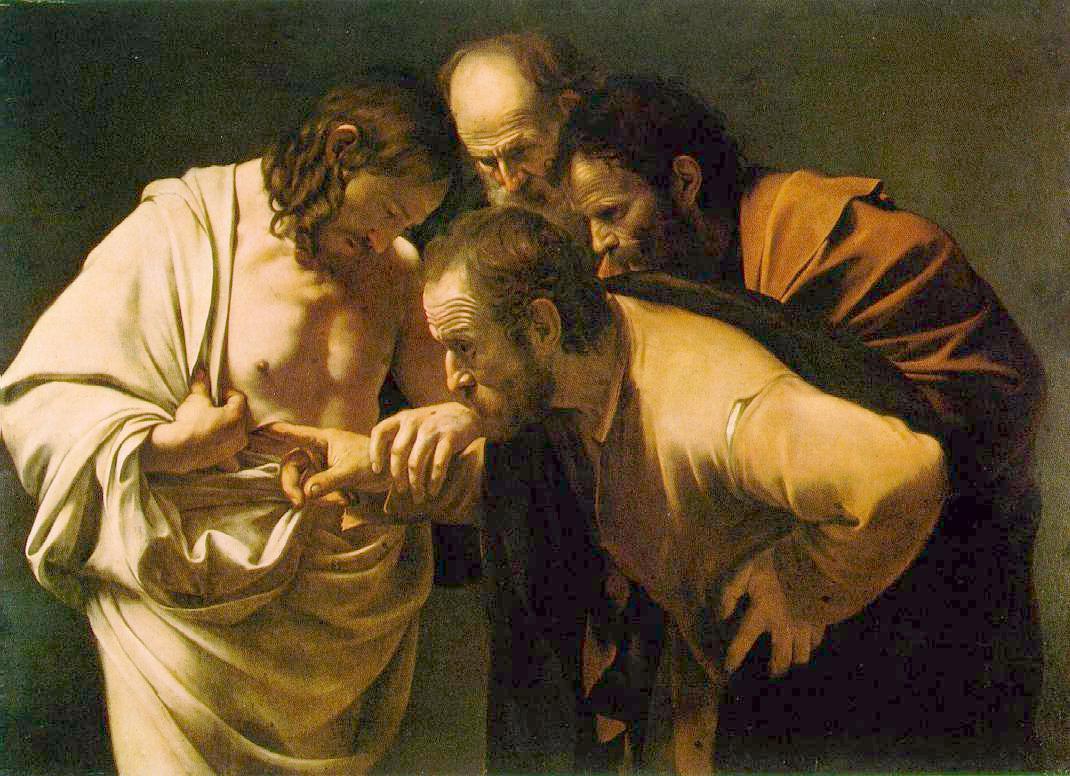
36 As they were talking about these things, Jesus himself stood among them, and said to them, “Peace to you!” 37 But they were startled and frightened and thought they saw a spirit.
38 And he said to them, “Why are you troubled, and why do doubts arise in your hearts? 39 See my hands and my feet, that it is I myself. Touch me, and see. For a spirit does not have flesh and bones as you see that I have.”
40 And when he had said this, he showed them his hands and his feet. 41 And while they still disbelieved for joy and were marveling, he said to them, “Have you anything here to eat?” 42 They gave him a piece of broiled fish, 43 and he took it and ate before them.
Luke 24:36-43, ESV
In the most thrilling moments of a story, there are instances when the true essence of the events becomes crystal clear. Luke’s narrative brilliantly captures that exhilarating sensation. Picture this: Jesus, triumphantly risen from the depths of death, enters the room with a burst of energy that electrifies everyone present. It must have been one of those extraordinary instances where words simply fall short, and experiencing it firsthand is the only way to truly grasp its profound impact.
“Frightened” and “terrified”–it seems it takes two words to describe this spooky experience.
Everyone was terrified; they were convinced that Jesus must be a ghost. They all panicked and tried to run to the nearest exit, but then realized that the door was still locked!
Oh boy, Jesus must have had a good chuckle over this one! I mean, imagine being a human and seeing your disciples, all stooped and scared, trying to approach you like a bunch of timid puppies. It’s like trying to get a dog to come to you when it’s so terrified it’s peeing on the floor! I bet Jesus couldn’t help but smile and think, “What a hilarious sight!”
They slowly encircle Jesus and as they come, I have to believe He’s amused. He has survived a very brutal cross, and walked through hell. And, He has risen from the dead.
He is laughing from the pure joy of one who has endured the worst of a very real hell.
Jesus emerged unscathed on the opposite end, a testament to his invincibility. His arrival has undoubtedly filled him with undeniable joy, surrounded by beloved companions. In his triumphant resurrection, he defied all odds and accomplished the unimaginable, evoking a cascade of profound emotions, a mingling of laughter and tears.
I believe each of us has walls.
Walls can provide a sense of security and protection, both physically and emotionally. People often feel the need for boundaries and walls to feel safe. This is similar to how disciples found safety in numbers and the walls around them. They were afraid, and so they hid themselves.
Jesus insists on penetrating our walls. He’s overcoming much resistance and delusions. And then suddenly we come ‘face-to-face’ with the dead person who’s now alive. He is “The King of Kings and the Lord of Lords.
Behold, behold! Witness the magnificent display of unadulterated resurrection power—a force unparalleled in the vast expanse of the universe. Its brilliance eclipses the sun, its might surpasses that of the mightiest atomic bomb. Prepare to be astounded, for this power knows no bounds!
It’s funny, when Moses prostrated himself before the Lord’s glory, he changed. Not only that, but he had to take precautions to cover his face when he returned to camp. These disciples however have just seen the glory of God first-hand.
As His disciples, we must be prepared for any eventuality. Jesus can and will burst into our homes, and into our very lives. Can you hear him laugh? When he comes, nothing really is the same again. He loves his disciples too much to leave them in a dark stuffy room. They have work to do.
The resurrected Jesus is coming for you!
“Here I am! I stand at the door and knock. If you hear my voice and open the door, I will come in and eat with you, and you will eat with me.”
“In the Temple he found people selling cattle, sheep, and doves. He saw others sitting at tables, exchanging different kinds of money. 15 Jesus made a whip out of cords and forced all of them, both the sheep and cattle, to leave the Temple. He turned over the tables and scattered the money of those who were exchanging it. 16 Then he said to those who were selling pigeons, “Take these things out of here! Don’t make my Father’s house a place for buying and selling!”
17 When this happened, the followers remembered what was written in the Scriptures: “My strong love for your Temple completely controls me.”
He really did use a whip. The text tells us that Jesus carefully took some cords and made a whip by intertwining them. What can I say? I’m amazed at His response to what He saw happening in the Temple. Jesus saw deeply saddened Him to the point that there wasn’t anything else He could do.
It appears that there are three distinct whips in the N.T. that we should take into consideration.
The one Jesus carefully braided to “cleanse the Temple.” (John 2:25.)
The one used on Jesus’ back as part of our atonement. (Isaiah 53:4-6.)
The one that believers experience in the ways God disciplines us as His children. (Heb. 12:6.)
All three are important to see. All three have their own meaning. The first one: The Temple is finally clean. The second one: He was punished for me. The third one: He intervenes in my life to make me a holy person.
The third whip is my focus here. He intends to sanctify us by correction. This discipline is the way Jesus separates us from our sin. We’re being disciplined in order to become holy people. Hebrews 12 explains the process.
“If ye endure chastening, God dealeth with you as with sons; for what son is he whom the father chasteneth not? But if ye be without chastisement, whereof all are partakers, then are ye bastards, and not sons.“
Hebrews 12:7-8, KJV
God’s intention isn’t to inflict punishment upon us. His correction isn’t a way by which we make amends for our transgressions. It’s crucial to remember that Jesus has already taken upon Himself the full weight of our sins, fully satisfying any debt. He absorbed it all.
God, in His role as a loving father, corrects and guides us with deep affection.
It’s important to note that God’s methods of discipline do not involve any form of “spiritual child abuse” whatsoever. His love is extraordinarily good, it never wavers, never turns into something evil. He patiently works His will, using loving and healing hands.
“For the moment all discipline seems painful rather than pleasant, but later it yields the peaceful fruit of righteousness to those who have been trained by it.”
Hebrews 12:11, ESV
God has corrected me a 1000 times throughout my 40 years of following Him.
Not with a leather whip mind you, but a braided spiritual cord of correction. What He saw taking place in the marketplace of “me,” (my temple), brings Jesus grief and sorrow. I’m the temple of the Holy Spirit, and He fully intends to make me pure inside. Hebrews 12 tells me what to expect as a son. I need to be corrected.
Yes, a “whip” will be used, but cautiously, even though it may hurt us. Jesus will never intentionally correct you beyond what you can handle.
These three whips are vital, they educate us about the Lord’s efforts. They help us to comprehend and experience God’s workings. As much as we’re able, we must embrace them.
“God’s corrections are our instructions; His lashes our lessons, and His scourges our schoolmasters.“
In the book of Genesis we find the story of Leah and her sister Rachel. Let’s start by saying two daughters of Laban have become Jacob’s wives. We must step into Genesis 29 to see more.
Jacob longs for Rachel. She is his “soul mate” and because he’s in love, but the customs and technicalities of the day somehow get by him. Because of this, he will have to deal with Laban’s subtle trickery, where his daughters get swapped, and we must sort out the customs of that day to really understand.
Let’s just say that Laban’s deception creates a huge crisis for everyone.
Throughout his life deception has been Jacob’s besetting sin. But now he’s the recipient. When we see a deceiver like Jacob gets deceived, that can’t be all bad. Call it karma, kismet, fate; he deals with it. “As you sow, so will you reap.”
Jacob is so in love with Rachel that he works for seven years for the right to marry her. This may be a bit outrageous. But we really must weigh these issues. I believe Jacob really is a monogamist at heart and he has no real love for Leah.
He can only see that one girl that he is crazy about, his true love, Rachel.
But you know, it’s Leah that I tend to think about. Her own issues are unique. Genesis 29 explains it a bit cryptically,
“Leah’s eyes were weak, but Rachel was beautiful in form and appearance.”
Genesis 29:17
You need to know that there is some confusion by commentators about the “weak eyes.” Others who look at the original Hebrew find the words to be vague. Some take it as she is very near-sighted, or even cross-eyed. Others think that this is a polite way of saying she really wasn’t pretty. I think I can gain from these different interpretations.
But to be honest, I think I might understand Leah.
She is wounded, and life requires that she live as unwanted. She is a woman of tragedy and broken hopes and dreams. She will always live as a reject. At best, she will always be a distant second, and perhaps scorned and neglected for this.
I conclude that Leah is the champion for the second best, those challenged by weakness.
Her life seems a long tragedy and very full of sadness. For the next 30-40 years she will always be a cast-off, someone who has been broken by life’s bitter vagaries. She’s a fellow struggler and a survivor.
Her sad life is similar to us who have to fight so hard over our own illness or handicaps. For some, addiction is an issue. We never choose this path. I believe darkness has many forms.
ButI have no idea what her problem was.
I do know but she must’ve been challenged by this weakness. I understand this. My own life has been topsy turvy and a hard struggle at times. I survived a massive brain tumor and I have a paralyzed right arm. I have no balance and must use a cane. I can no longer drive.
For those who are confined to a wheelchair, or must use a cane, or who deal with a physical or mental illness, Leah should be our hero. For those who have been betrayed by addiction, or who have felt rejected through a bitter divorce, Leah speaks to us.
She is for every loser and for failures of all stripes. But through all of our setbacks and messes, we must realize that God does love us– even as we weep.
Our pain always has a purpose in God’s kingdom. Always.
“One of the main ways we move from abstract knowledge about God to a personal encounter with him as a living reality is through the furnace of affliction.”
“Count it all joy, my brothers, when you meet trials of various kinds, 3 for you know that the testing of your faith produces steadfastness.”
James 1:2-3, ESV
“There is no circumstance, no trouble, no testing, that can ever touch me until, first of all, it has gone past God and past Christ, right through to me. If it has come that far, it has come with a great purpose.”
“All joy,” (verse 2) is a fantastic thought. It stresses a joy that becomes militant, something powerful and significant. “All joy,” surpasses “some joy” or even “occasional joy.” Instead it’s a joy that remains joy even when tired and weak. It will only shine brighter in the darkness.
Jewels, diamonds, and pearls are typically displayed on a black background.
This reveals their brilliance and value. In the same way darkness should only encourage us to be deliberately brighter than our surroundings. We must understand that we shine only because He makes us shine. There is a divine incandescence that awaits every believer who feels the need or desire for more of God.
God’s special nearness is available to each believer, especially those in the heat of the furnace. He is close to those who want Him, and there is nothing will stand in His way. The Lord cherishes and treasures the seeking heart. There is nothing that can detour the believer’s yearning after their Father. Your faith must be purified, and this is never optional.
Name your trial, then turn it to God in prayer.
Leave it alone and refuse to carry it no further. It’s now the Lord’s concern. Simply watch for the deliverance to come. When God sees your heart, He will lavish Himself out on you. He delights to see your faith becoming solid and real.
We never choose to suffer, rather we choose His will. We must do so whether we suffer or not.
Trust Him.
“God, who foresaw your tribulation, has specially armed you to go through it, not without pain but without stain.”
Today I’m thinking about the rich young ruler in Matthew 19:16-26. The passage is tragic and disturbing. These verses detail an encounter with Jesus by a man who couldn’t give up his wealth. He could not become a disciple.
“When the young man heard this he went away sorrowful, for he had great possessions.”
I would like to suggest something.
Perhaps riches aren’t the real point? Yes, I definitely believe that having wealth is inherently dangerous to wannabe disciples; it’s what this passage is all about. And it’s obvious that this man couldn’t give up his money to follow Jesus. But what if the issue for us isn’t about personal wealth; what if it’s envy, lust, selfishness or pride?
Sinful behavior of any kind effectively blocks the call and purpose of our lives.
No matter what it is. No matter what sin that stands in the way of true discipleship. Yes, it could be wealth. But it may be 1000 other sins (take your pick, there’s plenty). Hebrews 12 tells us that there is “the sin that so easily ensnares us.” Perhaps there is that one particular sin is one that traps us, over and over?
Jesus puts His hand on our lives, He calls us to love Him supremely. I like to think that loving Jesus is our energy source–He’s the nuclear core of our discipleship. His presence gives us the power to live and love. A sustained first love for Jesus propels us into the true reason of a disciple’s existence.
Perhaps it’s a daily surrender? Sin must be renounced every day. Jesus must always be the disciple’s first choice.
My most cherished sin would destroy me if it wasn’t for His grace and kindness.
Wealth, of course was this rich, young ruler’s sin. But don’t forget that there are many issues we could add. Lots of different sins that are getting in the way of being an actual follower. It’s a choice, and God’s power is always ready for you.
So who or what do we love most?
“Whoever loves father or mother more than me is not worthy of me, and whoever loves son or daughter more than me is not worthy of me.”

















 Alaska Bible Teacher