Do You Have Dove’s Eyes?

Behold, you are beautiful, my love! Behold, you are beautiful! You have doves’ eyes.

Song of Solomon 1:15

Doves have a single vision. Because of that they can only see one thing at a time, which makes them unique. They are one of a kind. Doves are also the emblem of the Holy Spirit in scripture, and when they are mentioned we should be alerted that something spiritual is happening.

What the Shepherd is proclaiming is “she only has eyes for me, she sees no one else.” For the true believer, there isn’t anything that can take the place of Him. Political involvement, Eastern mysticism, vain philosophy, or stifling materialism should never take the place of the Lord Jesus. Never, ever.

We need “dove’s eyes.” We must see Jesus only.

There are a lot of noble things we can get involved in. Good things, yes, but not the best, we need to fix our eyes on Jesus. I have personally seen brothers, sisters, and whole churches lose their vision, and focus on something other than their “first love.”

Satan detests our intimacy with our Lord.

Every time we move into direct contact with our Savior the enemy goes crazy. He wants to diminish and erode our number one love. He detests that relationship, and he short-circuits our connection with Jesus. The devil diverts believers to take the good, and leave behind the best.

There are many preachers and teachers in the Church who no longer have “dove’s eyes. Satan has blurred their vision, and they have lost the intimacy they once had with Jesus. Most of the time, they don’t even realize it. This saddens me.

I remember a once blazing church in Pacifica, California that once closed down whole blocks in San Francisco. They worshiped Jesus intensely. They took the Church into the streets and brought with them a passion I’ve seldom seen. They were people on fire. It was a pleasure to work with them, they were in love with Jesus.

Within two years they lost it. They adopted a political stance that was quite commendable, but it diminished their first love for Jesus, and Satan was pleased. The church split in a dozen different ways. This isn’t a new thing, the apostle Paul saw it and was afraid for the church in Corinth.

“For I feel a divine jealousy for you, since I betrothed you to one husband, to present you as a pure virgin to Christ. But I am afraid that as the serpent deceived Eve by his cunning, your thoughts will be led astray from a sincere and pure devotion to Christ.”

2 Corinthians 11:2-3 

In the book of Revelation, chapters 2 and 3 emphasize the level of intimacy each Church possesses. “Angels” come and carry the message of repentance and turning to that “first love.” I have to think that “dove’s eyes” come as a result of being filled with God’s Spirit.

We’re finally seeing through the eyes of a dove–the Holy Spirit.

“Return dear one, come back to the Lord Jesus. Let your first love blaze again. Don’t allow Satan to sidetrack you into something that is good, but not the best. Have “dove’s eyes” that only see Jesus.”

alaskabibleteacher.com

Rediscovering the Feet of Jesus

A terrific study is finding the people who fell at Jesus’ feet. Tucked in the Gospels you’ll find stories of those who despair. You’ll also see them come to Jesus in brokenness and humility, without any other recourse. I call these the “people of the feet.”

They came to Jesus because they had no hope otherwise. They were people who were hopeless and wretched, they had long ago run out of options. They came to Jesus, falling down in front of Him. They were all people of the feet.

They were men and women who were truly desperate.

Now when Mary came to where Jesus was and saw him, she fell at his feet, saying to him, “Lord, if you had been here, my brother would not have died.”

John 11:32

One of the classic scenes in the Gospels is when Mary meets Jesus after her brother’s death. She doesn’t understand Jesus’ delay, Lazarus has been very ill and Jesus could have healed him. She is grieving and confused. But she only has one posture and one place in her heart to be– at the feet!

There are some common characteristics that feet-finders have:

  • A great need that can’t be met without His touch
  • To understand one’s true condition–humility, brokenness
  • To beg for a healing, for self or family
  • To honor Jesus as the Messiah
  • To be more receptive to His teaching, to understand Him
  • To become a witness to others (although it does seem secondary)

The following 3 verses are just a small selection of those who fell at Jesus feet.

“And great crowds came to him, bringing with them the lame, the blind, the crippled, the mute, and many others, and they put them at his feet, and he healed them.”

Matthew 15:30

“But immediately a woman whose little daughter had an unclean spirit heard of him and came and fell down at his feet.“

Mark 7:25

“Then people went out to see what had happened, and they came to Jesus and found the man from whom the demons had gone, sitting at the feet of Jesus, clothed and in his right mind.”

Luke 8:35

But there are several other instances where people came to sit at Jesus’ feet:

  • Mark 5:22-23, Jairus, a leader in the local synagogue
  • Luke 7:37-38, a sorrowing mother for her daughter
  • Luke 8:41, also Jairus
  • Luke 10:39, Mary, when Jesus was teaching
  • John 11:32, Mary, meeting Jesus entering Bethany
  • John 12:3, Mary, with her perfume
  • Revelation 1:17, John to express what he was seeing (also 19:10)

In every case we find people consciously coming and kneeling at the feet of the Lord Jesus. It was a deliberate action that came from their hearts. Each had a terrible need, and each was without hope.

It’s the end of religion if you’re a feet-finder. No more facades, no more treadmills. Instead your heart forever changes.

Formality and religious politeness are jettisoned. Brokenness and true humility takes their place. A foot-finder is no longer operating on spiritual niceties. Religion is comfortable, noble, and respectable, but it cannot heal or change people deeply.

Feet-finders know that they need Jesus desperately and will go to any length just to be touched by Him. They defy what is conventional and proper. They are not what we call respectable. You can find them at the feet of Jesus. They are feet-finders. Foot-finders weep, kneel, beg, shout. Too many tears and maybe some snot.

Hardly decent to religious people.

Are you really that desperate yet? Have you seen your need, and do you realize how lost you would be without His healing touch?

Often when I do pray, I sometimes think of the woman who was unclean. She speaks to me about approaching Jesus. I see myself in a crushing crowd of people, and I’m reaching out just to touch the hem of His robe. I know only Jesus can stop my own uncleanness. (Matthew 9.)

I’m convinced only Jesus can make me clean and whole.

I’ve tried to be holy and acceptable to Him. But I felt like a juggler, trying to keep my balls in the air all at the same time, and I could never pull it off. So I tried again and again. I was the unofficial master of religious effort.

But I found my rightful place at His feet. It’s where I belong. I love Him.

I’m not ashamed to be found kneeling.

Under Command

 When Jesus had entered Capernaum, a centurion came to him, asking for help. “Lord,” he said, “my servant lies at home paralyzed, suffering terribly.”

Jesus said to him, “Shall I come and heal him?”

The centurion replied, “Lord, I do not deserve to have you come under my roof. But just say the word, and my servant will be healed. For I myself am a man under authority, with soldiers under me. I tell this one, ‘Go,’ and he goes; and that one, ‘Come,’ and he comes. I say to my servant, ‘Do this,’ and he does it.”

13 Then Jesus said to the centurion, “Go! Let it be done just as you believed it would.” And his servant was healed at that moment.

Matthew 8:5-9, 13; (see Luke 7:2-10)

Obedience was how we would survive. I understood authority and submission to my superior officers. It’s known as “the chain of command” and it’s the reason why armies function well. I blended my will to my superior, and I knew he was also under authority to his own superior.

It wasn’t easy duty as a Roman soldier among the Jews. We were hated everywhere.

But my servant was paralyzed, and I knew that he was suffering greatly, but I had run out of options. My servant was the only family I was allowed to have. Since I served as a centurion I was not allowed to have a wife for the duration of my service. Over the years I’ve kept close and trustworthy servants with me–these men were very dear to me. They were my family.

I certainly was aware that we lived in constant danger from radical Jews, especially the Zealots. They had already assassinated some of my men.

I had exhausted all efforts to bring some relief and healing to my servant, he seemed to be getting worse, not better. I had information that there was an itinerant teacher who had a reputation as a healer of diseases. This man, Jesus from Nazareth, had a large following and I realized that He was now my only possible solution.

So I went to Him for help.

He wanted to return with me to my home. His willingness to come encouraged me, but I simply couldn’t allow that. Jesus’ visit would’ve made Him ceremonially unclean–I was a Gentile, a “dog.” Returning with Him would only sow doubt among my men.

I understood that my home was officially off-limits to Him.

But yet I did understand something. I was under authority as a centurion in the Roman army, and my men followed my orders. Obedience meant survival in a very angry and hostile environment like Judea. Our entire unit was constantly drilled in this, and each man understood the need for following authority. We had to obey our superiors.

So I simply asked Jesus to heal my servant, with just His word of command.

Jesus marveled at this. He said that my adherence to protocol was evidence of real faith. I think it’s funny but He made me an equal with the Israel patriarchs. My faith was now to be emulated by the Jews.

As a Roman centurion I knew I deserved nothing. Simply, Jesus spoke a command and when I returned home my servant was healed. I came and found him completely healthy.

“As the authority of the Caesars flowed through his own yielded life, so the authority of God over diseases, demons, and all else would flow through Christ’s.”

F.B. Meyer

“Christ will always accept the faith that puts its trust in Him.”

    Andrew Murray

Why, God Why?

Job 7:20, 13:24, 9:29, 24:1, 10:18

Job’s profound suffering is one of the most extreme in all of human history. He is essentially a godly man who loses everything (except his faith). Job must pick up the pieces after “catastrophic ” sudden pain and total loss.

Only the brutality of the cross of Jesus eclipsed the suffering of Job.

Job is being tested with dark horrors. Will he “curse God and die” as his wife suggests? Will he cave in to the final four “friends” and accept their twisted theology? (I guess that you have to read chapters 38-39 to find out).

The Book of Job has been regarded as inaccessible and archaic by many.

Unfortunately, many believe this assessment and look elsewhere for comfort. I would agree that Job is a challenging book, but so is Macbeth or Plato. There are plenty of easier books to read; but if we choose to avoid Job, our faith will always be deficient. We will miss something vital.

Job is less an explanation and more a revelation of suffering. “Why” questions go unanswered. “Who” questions matter. I suppose this seems unfair to Job. It certainly seems so to me, but straight answers in a fallen world won’t get any traction at all.

One more thing. The Book of Job is about “twisted” theology. Job’s friends “toe-the-party-line” of theology that is logical. But don’t be mislead by their pronouncements, for they seem reasonable but they are all very much flawed.

I always find it strangely amusing when some quote Eliphaz or one of the other “friends” to encourage or comfort a suffering saint. They totally miss the point of the book. We desperately want to give out good counsel but we really don’t understand.

“If I have the gift of prophecy and can fathom all mysteries and all knowledge, and if I have a faith that can move mountains, but do not have love, I am nothing.” 1 Cor. 13:2

You can’t split your theology from love and get away with it. Something toxic happens if you try.

When you read “Job’s friends” you must remember that. These are lessons it takes a long time to learn. Unless the Holy Spirit tutors you, be very slow to speak. (Job’s friends were at their best at the beginning when they said nothing at all.)

The broken believer, hobbled by chronic illness, has much to learn from Job. He is like “the poster child” for those afflicted. My own illnesses are always an issue of course, but God is fully in control. He brings beauty out of the ashes. He has been more than gracious.

“To bestow on them a crown of beauty
instead of ashes,
the oil of joy
instead of mourning,
and a garment of praise
instead of a spirit of despair.
They will be called oaks of righteousness,
a planting of the Lord
for the display of his splendor.”
Isaiah 61:3

Do You Speak His Language?

Peter Warms Himself

“The girl asked Peter, “Aren’t you one of Jesus’ disciples?”

“No,” he said, “I am not!”

“The police and the household servants were standing around a fire they had made, for it was cold. And Peter stood there with them, warming himself.”

John 18:17-18, Living Bible

The Galileans had a distinct accent. Just as we easily identify someone from Boston just by the tone and cadence of their speech, Peter had that distinct drawl that told everyone that he came from that same province as Jesus. It was something he couldn’t conceal.

Peter was a very different man in his three years of being with Jesus. And you might say that had transformed him–you might even say that he was now a marked man, the enemy was now quite aware of him. He was no longer a captain of a small fishing boat looking for a catch. He was now the leader of Jesus’ disciples.

The entire text (18:15-18) reveals a confrontation that Peter had with a servant girl, and we hear him making a bold-faced lie. At this very moment Peter was fulfilling the “promise” that Jesus had predicted (Matthew 26:31-32).

What was going through Peter’s head at that moment?

She was a simple servant girl, perhaps one who ministered at the gate of the high priest’s home. It’s interesting that she is the first one to question Peter’s duplicity. Most likely she was just doing her job, watching and listening. She was probably quite alert.

It’s easy to point our finger at Peter. He was a coward, and when he was put on the spot he bailed. People hate cowards–we extol those who take a definite stand against evil. But he was frightened, scared of being connected with Jesus–the man on trial. There was much at stake here.

We also speak with an accent. I know it might be a stretch–but being with Jesus has fundamentally changed us. Our lives now have a specific dialect that others hear, we’re not the same people that we once were.

We open our mouths and others can hear the Kingdom of God. We can’t hide that dialect.

Sometimes I try to pretend that I haven’t been with Jesus, and I’m very ashamed of that. Like Peter, I stand with the others and choose to warm myself by their fire, and I try very hard to make myself inconspicuous. But all I have to do is open my mouth, and I betray who I really am.

It’s really funny, but even servant girls know that I belong to him. He has fundamentally touched me.

“To stand before the Holy One of eternity is to change.”

Richard Foster

The ‘Scum’ and the Heart of Jesus

“But when some of the Jewish religious leaders saw him eating with these men of ill repute, they said to his disciples, “How can he stand it, to eat with such scum?”

Mark 2:16

There are four different types of people listed in Mark 2. This is an amazing passage that really does need a closer look. We really do must understand what Jesus did, and what He insisted we do as followers. Is there room for that? There’s something here in verse 16 which we must think about:

  • Jesus, (He’s happily eating and listening)
  • the Pharisees, (the bad guys with religious issues)
  • the disciples, (a mixed bunch of nobodies)
  • the scum, (tax-collectors, harlots, and all-around rascals)

A question is asked by the Pharisees to the disciples–perhaps these religious leaders want Jesus’ followers to see the awful ramifications of the Lord’s conduct. Perhaps the Pharisees wanted to confuse these followers. A divide and conquer strategy?

Jesus has chosen to be with outcasts.

And I believe this was a deliberate decision. Jesus wanted to fellowship, but the religious leaders were not invited. Too bad.

He is eating with these “men of ill repute.” The old KJV brings out a different take, “How is it that he eateth and drinketh with publicans and sinners?” Now, this is fascinating.

I’m encouraged by His decision. It tells me that I still have hope.

“The cumulative testimony of the four Gospels is that when Jesus Christ sees the fallenness of the world all about him, his deepest impulse, his most natural instinct, is to move toward that sin and suffering, not away from it.”


― Dane C. Ortlund, Gentle and Lowly: The Heart of Christ for Sinners and Sufferers

Becoming a Little Christ

Luke 9:1-6, Amplified

Now Jesus called together the twelve [disciples] and gave them [the right to exercise] power and authority over all the demons and to heal diseases. 

Then He sent them out [on a brief journey] to preach the kingdom of God and to perform healing. And He said to them, “Take nothing for your journey [that might encumber you]—neither a walking stick, nor bag, nor bread, nor money; and do not even have two tunics apiece. Whatever house you enter, stay there until you leave that city [to go to another]. And as for all those who do not welcome you, when you leave that city, shake the dust off your feet [breaking all ties with them] as a testimony against them [that they rejected My message].” 

So they began going from village to village, preaching the gospel and healing the sick everywhere.

A disciple’s perspective:

Jesus called the twelve of us together that day for a reason–He wanted us to start doing His work, which, I admit wasn’t really in my thinking. But this was His plan, and He knew exactly what He was doing. I didn’t feel remotely competent, and the thought of doing what Jesus did seemed a bit sacrilegious.

I was intimidated by all of this.

But now I can see that was what He intended all along, to push us into the supernatural–preaching, healing, and exorcising demons. He wanted us to touch people, to meet the needs of the desperate, and by doing so, extend the kingdom of God.

We were all skeptical, obviously. We weren’t Jesus, not by a long shot, and we had no right or ability to do miracles. On our own, I we were still fishermen and tax collectors. And honestly, what Jesus was asking (or commanding?) was for us to leave what we felt was comfortable and to step into His sandals. He wanted us to be just like Him.

He gave us His authority and power–it was His to give.

I suppose that this was the key to it all. We had witnessed fantastic miracles, stunning things that pretty much undid us. Jesus repeatedly defied the laws of nature—with just a word. And we’re His disciples, so I suppose that meant we needed to step out and touch people just like He taught. I guess that was Jesus’ plan for us all along. We just thought it wouldn’t happened this quick.

So the power and authority was given and we became “little Christs.”

Two by two we went in different directions to discover for ourselves what would happen. The needs we encountered were substantial. The world was a needy place that made its home in the pain and darkness of the demonized and the desperate. It seemed overwhelming. I think we all felt weak and very inadequate.

It’s funny, but we suddenly saw all these people through His eyes–it’s like we never had seen them before. We were now cloaked in Jesus’ very own power. When we laid hands on people astonishing miracles began to happen. All at once there were needs all around us. And the people kept coming.

I began to understand what it really meant to love people. We had left the relative safety of learners and had now became doers. I suppose we realized that there was an incredible difference between the two. We were all astonished by what we saw, at that moment we had few doubts about what was happening inside of us.

It changed us like nothing else could!

Being made into “little Christs” now made perfect sense. We saw fantastic miracles and dramatic victories over dark demons. The things we had seen Jesus do were now the things we were doing! Suddenly everything came together and we understood many of the words that He had tried to drill into our thick skulls.

From village to village we went–we stayed with whoever wanted us. The needs we saw were staggering, from sunrise to sunset people came. Wherever we turned there seemed to be somebody else, but Jesus’ own authority was always present, it never diminished or weakened. It was like a bubbling spring that never once ran dry.

I suppose what happened inside me was just as much a miracle as we had seen Him do for others.

I was astonished–up to now I never realized how exciting it was to follow the Lord Jesus. What a joy to see the face of a man or woman who was set free. It was such a thrill to touch a little boy’s dead eyes and suddenly realize that he could see!

So this is what it honestly means to be His disciple!

“Truly I tell you, the one who believes in me will also do the works that I do. And he will do even greater works than these, because I am going to the Father.”

John 14:12

God, Have Mercy On Me

Luke 18:9-14

“He also told this parable to some who trusted in themselves that they were righteous and looked down on everyone else: 10 “Two men went up to the temple to pray, one a Pharisee and the other a tax collector. 11 The Pharisee was standing and praying like this about himself: ‘God, I thank you that I’m not like other people—greedy, unrighteous, adulterers, or even like this tax collector. 12 I fast twice a week; I give a tenth of everything I get.’”

13 “But the tax collector, standing far off, would not even raise his eyes to heaven but kept striking his chest and saying, ‘God, have mercy on me, a sinner!’ 14 I tell you, this one went down to his house justified rather than the other, because everyone who exalts himself will be humbled, but the one who humbles himself will be exalted.”

He despised others. As a Pharisee he prided himself as a holy person; he stood before God and congratulated himself. I believe that self-righteousness has many levels. You can be blatant and obvious about it, or it can be subtle and hidden. But we must understand that the father sees and knows. Notice the “we all” here in Isaiah 64:6

(Hmm. Is that what He sees? A menstrual rag? You got to be kidding!)

We often advance ourselves by demeaning those who struggle hard with their sin–there are those who see and somehow know that they’re superior. We don’t come out and say so; but we’ve arrived— but guess what— God (and scripture) tell us something radically different.

But we’re not dealing here with a hidden self-righteousness. The Pharisee truly believes that he is special. He stands and doesn’t kneel. He feels comfortable and confident in the holy presence of God Almighty. He’s not like the others. He is sure that he’s holy.

Look though, the tax-collector was being brutally honest.

He didn’t need anyone to tell him how sinful he was—he understood his own wickedness. Jesus’ story reveals God’s love for those who know that they’re twisted inside. Notice the heart of the tax-collector:

  • “He stood afar off” which showed his awareness of his separation from God.
  • “He wouldn’t even raise his eyes to heaven,” which declared his humility in the presence of God.
  • He kept “striking his chest,” which tells us of a deep pain over his sin against God.
  • He prayed, ‘God, have mercy on me, a sinner!’ This describes his desperate heart.

These both came to pray, but that is all they had in common.

The Pharisee came to the temple to show off his righteousness, the tax-collector out of a terrible despair. It strikes me that the text in verse 11 says the Pharisee “began praying to himself.” It seems that his prayer never really met God—he was proud and showy, doing the things God hates (Prov. 29:23).

Things really came obvious in verse 14. That’s the critical point of the entire story—“one went down to his house justified rather than the other.” Wow! What a statement. One professionally religious man, sure of his holiness, the other a sinful sinner, who came humble and broken. One showed off his faith—boasting with a legalistic swagger. The other desperate and desolate, completely undone.

But it was the tax-man who became righteous in the eyes of God.

Humility is the foundation of the kingdom of Jesus. In Matthew 5:3-4 makes a lot of sense—to be “poor in spirit” and to “mourn” are the bedrock of a Christian’s discipleship. To be justified (made right) was a gift. He didn’t try to earn it, and there wasn’t a probationary period. The tax-collector now became righteous; the Pharisee carried his sin.

God wants us to have a broken-heart. He rejects everything else. I suppose that the question is this: Do you mourn over your sin? 

Psalm 34:18

Art by Eugène Burnand

The Stomach Churning Sin of Manasseh

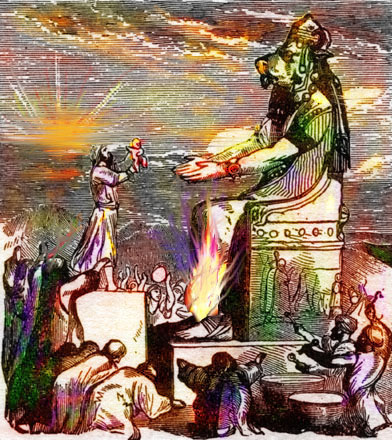
God’s temple was now filled with an evil darkness. King Manasseh made the Lord’s holy place a fountain of sin and filth. Instead of holiness, it was an evil place.

He brought in dark things that were twisted, perverted and clearly forbidden.

“Manasseh led Judah and the inhabitants of Jerusalem astray, to do more evil than the nations whom the Lord destroyed before the people of Israel.”

2 Chronicles 33:9, ESV

His own darkness was now encouraged by others, it became accessible, available and promoted:

  • The high places were rebuilt throughout the land.
  • Altars to Baal rebuilt, using images of wood.
  • In the holy temple, altars to the “starry host,” astrology, plain and simple.
  • Human sacrifice of his own sons to Molech, a false god. Murder.
  • He practiced soothsaying, used witchcraft and sorcery, and consulted mediums and spiritists.

Evil was being encouraged and something wicked was replacing all that was good and true. The analysis of Manasseh’s policies was way beyond disturbing. Of all the kings of Judah, he was the most sinful and the most corrupt. He was at the bottom of the barrel.

The Hebrew word for “led astray” can be translated seduced.

Manasseh was an incredibly immoral man, a king who ruled for 40 years. “He did all he could to pervert the national character, and totally destroy the worship of the true God; and he succeeded.” (Clarke)

It’s believed that he put Isaiah to death by cutting him in two.

Moreover Manasseh shed very much innocent blood, till he had filled Jerusalem from one end to another, besides his sin by which he made Judah sin, in doing evil in the sight of the LORD.

1 Kings 21:16

But then something happened.

And the LORD spoke to Manasseh and his people, but they would not listen. Therefore the LORD brought upon them the captains of the army of the king of Assyria, who took Manasseh with hooks, bound him with bronze fetters, and carried him off to Babylon.

2 Chronicles 33:10-11

Assyria came knocking on Manasseh’s door. I think there was a certain mercy here, but also discipline. Manasseh had “hooks,” inserted through his jaw and out of his mouth. Like a fish he was led to Babylon, a trophy of the power of the army of Babylon.

It was from a dark dungeon that Manasseh cried out to the Lord and repented.

(2 Chronicles 33:12-13.)

There’s a Jewish fable that when Manasseh cried out to God the angels boarded up the windows in heaven. They wanted to block out his prayer so God wouldn’t be able to hear. But God, rich in mercy, bored a hole in front of His throne to hear Manasseh’s desperate cry.

The Lord’s intention was to forever show His kindness and grace given to the most awful repentant sinner.

I believe that Manasseh was the “Prodigal Son” of the Old Testament.

God is not at a loss when He moves to bring us back to Himself. He can woo or whip. He can draw or drive. He can work rapidly or slowly, as He pleases. In other words, He is free to be God! And in His own way, at His own pace, He brings us back.

     Tom Wells

God is wildly in love with you. Yes, the sin you’ve committed is awful, but the Lord wants you to come back. He may discipline you, but He forgives everything if you’ll turn and repent.

No matter how awful your sin, He forgives and restores. Manasseh is proof of that.

Sources:

2 Chronicles 33:1-20

2 Kings 21:1-18

Enduring Word commentary

alaskabibleteacher.com

Repairing Your Nets

“Yet those who wait for the Lord
Will gain new strength;
They will mount up with wings like eagles,
They will run and not get tired,
They will walk and not become weary.”

Isaiah 40:31, NASB

The word “wait” used here is powerful. It’s an awesome word, never used casually in the Hebrew scriptures. It does not mean to be uncaring or idle. Sometimes we wait in line at the grocery store, or maybe we’re waiting for a phone call. We wait all the time, and often, we don’t even realize it.

The Hebrew word for ‘wait’ is special. It’s qāvâ. It means, ‘to bind together by twisting.’ It’s an active word.

It sometimes means to work like a fisherman repairing his nets to get them ready for tomorrow’s catch.

(There are always holes to mend after a long night’s efforts.)

When we wait spiritually, repairing our nets, the following should be used. Much of this can be done in prayer.

  • Calming ourselves, setting aside everything that doesn’t fit
  • Reading His word
  • Seeing His face
  • Hearing His voice
  • Keeping pace with Him, whether He moves (or doesn’t)

Fixing our nets is a cool way to describe our journey, right? Sometimes, when we think about waiting, we usually only think about it in English, and that can be annoying. It often stops us from truly understanding the true meaning of ‘wait’.

I strongly believe that the Holy Spirit wants us to understand the concept of being closely connected to Him. Sadly, we are often held back by our own definitions, rather than embracing the definitions found in God’s Word.

“The LORD is good to those who WAIT for him,
to the soul who seeks him.”

Psalm 27:14

Sometimes we are instructed by someone to “wait on the Lord.” This instruction can be challenging and we are unsure exactly how we should do it. It’s usual for us to simply show agreement through a smile and a nod. We never completely grasp the essence of that word.

He becomes my source of power that comes from waiting.

He is now the sturdy bond that I am intertwined with. (Maybe this is how He gives strength and power to His people?) We must listen to this, and the Lord is very enthusiastic about guiding us into this fresh form of closeness.

The promise in Isaiah 40:31 talks about receiving new strength, like an eagle’s wings, a holy energy. This verse is important for us, especially today; we need this kind of strength right now. We need to repair our nets as often as we can.

“Waiting for God is not laziness. Waiting for God is not going to sleep. Waiting for God is not the abandonment of effort. Waiting for God means, first, activity under command; second, readiness for any new command that may come; third, the ability to do nothing until the command is given.”

    G. Campbell Morgan

alaskabibleteacher.com