“A Christian is a person who has died with Christ, whose stiff neck has been broken, whose brazen forehead has been shattered, whose stony heart has been crushed, whose pride has been slain.”
“His life is now mastered by Jesus Christ.”
–John Piper
“No longer do I call you servants, for a servant does not know what his master is doing; but I have called you friends,for all things that I heard from My Father I have made known to you.”
John 15:15
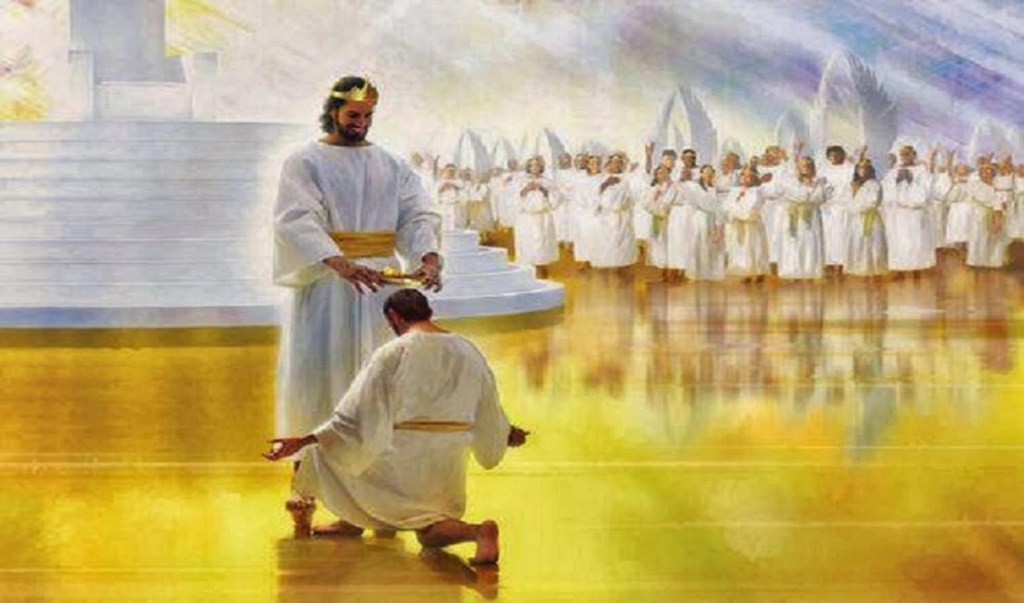
It seems that the purpose of life is not to find our freedom. It’s really meant for us to find our Master.
Yes, the idea of being a slave to anyone is repugnant. We chafe at this, and yet man was never meant to be separated from the Lordship of Jesus. We’re instructed repeatedly with the New Testament idea that “our life is not our own” Over and over God proclaims Himself as the King.
That seems to troubles us somewhat.
Not so much when life is fairly good, granted, but in those hard moments when a decision must be made between enjoying the titillating “lusts of the flesh,” or accepting the fruits of the Spirit. This is one of those “lordship moments.” They come and go, and they show us exactly who we are.
If you’re really going to be authentic–a legitimate and real disciple, then you must determine who is going to be in charge, and this isn’t one of those casual decisions. Your decision must become a settled issue.
You must securely fix it in your heart.
The thief on the cross knew salvation, he was promised an eternity with God simply by faith. But I submit to you that he had put himself under the Lordship of Jesus, simply by recognizing the sign, “the King of the Jews.” I believe he saw and understood its implications. Jesus was King! He knew and understood.
This is a very hard word for some, but so many of our personal issues hinge on this.
I know this first-hand. It is a monumental struggle. You must admit to not only having Jesus as your Savior, but you also must put your life under His total Lordship. You need to pick up your cross daily in order to follow. You need to learn how to kneel.
“Revelation is the first step to holiness, and consecration is the second. A day must come in our lives, as definite as the day of our conversion, when we give up all right to ourselves.”
“We must submit to the absolute Lordship of Jesus Christ.”
” “Let him who is without sin among you be the first to throw a stone at her.””
John 8:7, ESV
“None knows the weight of another’s burden.”
-George Herbert
Definitely, we must discern motives and false doctrine. We’re to be constantly aware of people and issues that swirl around us–of this, there is no doubt, we mustn’t be ignorant. This is a healthy “discernment.”
But we must learn that having discernment isn’t a way that passes out a ‘guilty’ penalty? We are ‘seeing’ things these things–not to pass judgment, but that we might pray clearly and earnestly, and grow into His love for the weak.
But ‘passing a guilty sentence’ is His exclusive jurisdiction.
It’s far beyond our ‘pay grade.’ He is the final judge in everything. He judges justly and lovingly. He alone knows and understands everything very clearly.
It becomes imperative that we understand this; that any real discernment given is only to intensify and escalate the calling of every ‘saint,’ intercessor, or pastor. We discern, not to pass judgment, but to pray more clearly and effectively.
What you see or sense is for the prayer closet, not before a judge’s bench.
Do we really have the ability to ascribe a penalty to someone else? Could it be when we decide to throw rocks at certain people we’re in terrible danger of forfeiting our own salvation?
Do we really have the ability to ascribe a penalty to someone else? Could it be when we decide to throw rocks at certain people we’re in terrible danger of forfeiting our own salvation?
How foolish we become.
“But if you do not forgive others their sins, your Father will not forgive your sins.” (Matt. 6:15.)
(If you have a ‘rock’ in your hand, you are in considerable danger. Please consider this–it’s never easy, is it?)
“Don’t judge others, or you will be judged. 2 You will be judged in the same way that you judge others, and the amount you give to others will be given to you.
“Why do you notice the little piece of dust in your friend’s eye, but you don’t notice the big piece of wood in your own eye?
Matthew 7:1-3
We are broken people. We struggle with many different things. Some of us are mentally or physically ill. We are not whole yet. Some of us must take meds to help us be ‘normal.’ We deal with issues that would devastate someone else. And we don’t have it anywhere near together.
And yet out of our ‘hot mess,’ do we think we can penalize someone else? Really?
We really don’t have a problem with worldly people. We understand that they are lost in their sins, terribly wrapped up in their own personal darkness, and that should definitely disturb us. We must point to the Blood of Christ that forgives us. We share the good news of true repentance and faith. His Spirit teaches us to be witnesses of His love to everyone we meet.
“The life of faith is a struggle enough in a broken world without us complicating it for other believers.”
–Jake Colsen
It just may come as a shock to some, but it’s extremely difficult to throw stones at someone when we are busy “washing” their feet.
Granted, “we are to be wise as serpents,” But that same verse instructs us “to be as harmless as doves.” (Matt. 10:16.) A loving meekness and gentleness, need to be combined with intense spiritual power. We must embody “the fruits of the Spirit.” These things are the characteristics of the Spirit-saturated believer.
“The nature and end of judgment or sentence must be corrective, never vindictive; it is always for healing, and never for destruction.”
–John Owen
Perhaps when we judge others, we reveal that we don’t understand what ‘real’ discipleship with Jesus is? Somehow it seems, we really aren’t quite grasping the immensity of His grace on guilty people? Do we really understand His profound love for the fallen? “God so loved the World…” Have we had any idea how patient He is with us? Do we doubt His ability to correct others? (Again, these are awfully hard questions.)
“Judge not lest you be judged.” (Jesus’ words really do scare me sometimes. )
Certainly, I intend to confront the darkness. “You are the light, a city set on a hill!” I am His salt and light and I do shine into this black night. But that is His doing, not mine. I do not generate light on my own. The Bible declares me as ‘self-righteous’ when I try. I am a broken person, who is just starting to understand the scope of my own brokenness and weaknesses. I’m starting to realize I’m not in the position to Judge someone else. I’m not quite healed myself yet and I must not think I can point to someone else as being worse than me.
Quite simply, I can’t throw ‘rocks’ at other believers anymore.
I can no longer pass out any condemnation from my own limited understanding. My chief concern right now is to be a humble, earnest Christian who is always ready to forgive those who, in their awful sin and confusion, are hurting others.
I’m beginning to see that my calling is to be; a simple servant to my brothers and sisters, nothing more, and nothing less.
Then he told them many things in parables, saying, “Consider the sower who went out to sow. 4 As he sowed, some seed fell along the path, and the birds came and devoured them. 5 Other seed fell on rocky ground where it didn’t have much soil, and it grew up quickly since the soil wasn’t deep. 6 But when the sun came up, it was scorched, and since it had no root, it withered away. Other seed fell among thorns, and the thorns came up and choked it.
8 Still other seed fell on good ground and produced fruit: some a hundred, some sixty, and some thirty times what was sown. 9 Let anyone who has ears listen.”
Luke 8:5-9
Jesus loved to tell stories. Each of them was packed with truth, and the people loved them. In verse 2, we see the popularity of Jesus–the people were entranced by our Lord. They followed him throughout his earthly ministry. Just imagine a preacher doing this today.
If you were his disciple back then, you had better get used to crowds.
This is all about receptivity to the Kingdom of God. It’s all about seed that is sown indiscriminately–the work of the sower isn’t assessing the ground conditions. He just throws out the insignificant seed. That’s his job, and he seems to do a bang-up job of it. He “broadcasts” the seed, reaching in his bag and spreading it evenly, and quickly.
This parable, believed to be one of his first, begins with the word, “Consider,” and really, isn’t that the needed quality one must have? In the original language it simply means, “to see.” But it’s also in the imperative–a command. Seeing isn’t really an option–may be a good word today would be, “Look!” (And using an exclamation mark!)
In some places the ground had been packed down, things were too hard. Others landed on soil, but it was only the slightest skim of dirt, which wasn’t enough to support any growth. And yet the third scattering made it into the thorns. So there was three different possibilities, which none were ideal.
But wait! There was a fourth.
Seed that landed right where it should–good soil, fertile, tilled, and ready. The first three were all wrong, but the parable isn’t given to find fault–no one was to blame. And certainly not the sower, he was merely doing what was necessary.
The parable is clearly meant to explain how the Kingdom enters our hearts.
Our lives are the soil, and we all react to the seed differently. Sometimes, there’s no response at all, and “birds” get their breakfast. Sometimes, it’s all rocky, and nothing can grow there. Some tried to grow, but thorns and thistles essentially got in the way.
There are always four responses to the words of Jesus.
There was a lot of people sitting on the beach, and all were listening. But Jesus knew deep down that his words would only touch 1 out of 4, and yet he kept sowing. He hoped for good soil, but that wasn’t a given.
In verses 9-15, Jesus had to explain this story to his disciples, who always did seem out-of-touch with these sorts of things. But I’m glad he did–Jesus, by interpreting this parable, gave us the keys that would unlock every one of his others. The seed represents God’s words. The soil is the condition of our hearts. My own heart listens and when the Word comes my heart responds in different ways. At any given time, the soil can be hard as a rock, or thorny
Jesus was never mystical or otherworldly, he didn’t cloak his words in imponderable mysteries like every other teacher longs to do. (Ego, mainly.) He didn’t want things to be an enigma, rather he wanted people to understand the ways and nature of God’s kingdom.
He wanted even the little children to get it–there were to be no secrets, only receptive hearts.
“The Bible is shallow enough for a child not to drown, yet deep enough for an elephant to swim.”
“My God sent his angel and shut the lions’ mouths, and they have not harmed me, because I was found blameless before him; and also before you, O king, I have done no harm.” 23 Then the king was exceedingly glad, and commanded that Daniel be taken up out of the den.”
Daniel 6:22-23, ESV
I am rather frustrated with myself. I confess I haven’t read Daniel in years, and I’ve chosen to rectify this. Lately I’ve busted through this book and discovered some wonderful stuff. I guess chapter 6 has become my favorite.
A couple of things stick out.
Daniel was an incredibly faithful man, praying three times a day. He was true-hearted who served each king with the gifts God had given him. I like him a lot.
Daniel became the king’s favorite, the Hebrew word used means “prominent or esteemed.” He was the greatest and best there was to be found. You could say that he was the finest man in the kingdom.
“Then this Daniel became distinguished above all the other high officials and satraps, because an excellent spirit was in him. And the king planned to set him over the whole kingdom.”
Daniel knew how to lead and direct others. We read that he oversaw 120 chief overseers. I suspect he knew a thing or two about good leadership. Daniel understood his work, and it seems that he instinctively knew what good government required.
But Daniel was a victim of jealousy. A concerted effort, carefully planned and directed was meant to destroy him. Although the leaders of this rebellion could find nothing to accuse him of, they resorted to trap him because he prayed to God. Faithfully and consistently.
Their plot worked. These officials, through their twisting and manipulation of the legal code, were able to sentence Daniel to death. It seems being fed to hungry lions was the penalty for “breaking the law.”
Sometimes we must choose to serve God, even if it means breaking men’s laws.
“But Peter and the apostles answered, “We must obey God rather than men.”
Acts 5:29
Daniel was over 90 years old when he was thrown to the lions. Even in his advanced years he kept up serving God. The passage declares that he had “an excellent spirit.”
The lions, (several I assume), were not at all interested in devouring Daniel. King Darius however was incredibly distraught over Daniel’s execution, but it seems he was forced into it. The passage tells us that the king was so distressed that he couldn’t sleep that night.
Undoubtedly, Daniel slept far better then Darius.
To be faithful to the Lord God may require us to sleep with lions, but we can be assured of the Holy Spirit’s presence with us even then. A verse in Hebrews suggests “faith” protects us from the strong jaws of the enemy. Daniel understood.
“Who through faith conquered kingdoms, enforced justice, obtained promises, stopped the mouths of lions,”
Hebrews 11:33
But yet, sometimes even the faithful will be eaten.
Sometimes the lions will devour believers. But we must trust and believe no matter what happens. Hebrews goes on to show us the extremity of the faithful. Read Hebrews 11:35-38 and you’ll understand what I mean. Being faithful can be very difficult. Bad things often happen.
*****
Some side thoughts. Prayer is intensely powerful. Daniel’s strength became the enemy’s focus and attack. That should give us understanding into the power we wield. But, do we use it?
Also, 1 Peter 5:8 explains much for the believer–
“Be sober-minded; be watchful. Your adversary the devil prowls around like a roaring lion, seeking someone to devour.”
It’s been said that the “blood of the martyrs is the seed of the Church.” We really must understand this, especially now.
“The apostles went away rejoicing that they were counted worthy to suffer shame for the name of Christ, that they were graced so far as to be disgraced for the name of Christ!”
Hidden in the Old Testament is the idea of the Cities of Refuge. They have incredible meaning for us today.
They speak profoundly to our situation and bring real hope to those who struggle. Six places of safety were given to protect those who accidentally killed another person— maybe an ax head flew and hit someone, and they died as a result.
God told Joshua to establish cities of protection where one could be safe from an avenger. There were six of them, three on the east side of the Jordan river, and three on the west. The cities covered Israel; each was spread out intentionally so they were always close.
That city became a place of asylum for those guilty of manslaughter.
As believers, we know that we’ve committed crimes against God and other people. The burden we carry threatens to undo us. Satan (and his minions) want to destroy us—and honestly, we deserve it. We are essentially spiritual ‘criminals’ who have hurt others and damaged ourselves in the process.
Outside the city, we’re vulnerable—but inside those walls we find safety.
Those who have killed others are protected. If we venture outside, we find our adversary who is waiting. Scripture tells us that we must stay cloistered there until the current high priest dies. Upon his death, we’re released and may leave the city walls.
For broken believers, the whole concept rings true.
The text speaks for itself, and there is spiritual logic in all of this. We see parallels here that speak to our condition. We’ve messed up big time. We also carry issues that the enemy can attack. Depression, bipolar, trauma, and even thoughts of committing suicide— can be a fundamental part of our lives.
I must tell you that safety is found only in the Savior.
Finding God and abiding in him is our place of safety. His walls protect us, Jesus is our high priest, who never dies; that means we need to stay with him, permanently. I like Hebrews 6:18, LB:
“Now all those who flee to him to save them can take new courage when they hear such assurances from God; now they can know without a doubt that he will give them the salvation he has promised them.”
For us especially, we often have problems with the doctrine of assurance of salvation. Our enemy works overtime to accuse us (Rev.12:10). We’re his targets and the lies of many demons assault us. We can, at times, wonder if we’re really saved. We wonder if we are really forgiven, and we doubt our salvation. Satan’s efforts can be constant and crippling.
I encourage you to think this over and pray about this.
“Everyone then who hears these words of mine and does them will be like a wise man who built his house on the rock. 25 And the rain fell, and the floods came, and the winds blew and beat on that house, but it did not fall, because it had been founded on the rock.”
“And everyone who hears these words of mine and does not do them will be like a foolish man who built his house on the sand.”
Matthew 7:24-26, ESV
Embedded in Jesus’ Sermon on the Mount are these words: they absolutely penetrate any “religious” sensitivity we think we have. This parable Jesus taught carries the full weight of divine authority.
Up to now, Jesus’ listeners just might reduce his words to nice religious platitudes–something future, and maybe conceptual. I must warn you, this isn’t the case.
Obedience is the critical idea here.
If they’re wise, they are told to put all they’ve heard into practice. It’s really not enough to hear and respect what Jesus declares–they must do the words. Jesus isn’t simply a great moral teacher, all that he says is authoritative; and not just in a benevolent, superficial way–what he says are the very words of God to people, like you and I.
Pay attention: There are two builders in this parable. Two different men; the wise and the very foolish.
The each have their own strategies, their methods are quite different. Both listen; but one responds with careful planning. He understands the potential dangers–rain, floods and wind things that are going to happen. It’s funny, our Lord never “sugarcoats” life. Nasty things are going to get challenging.
Following Jesus never gives us any immunity; there are no special favors given to a believer. (Only comfort. Forgiveness. Eternal life.)
The other man is foolish. He decided to take a shortcut in all of this construction stuff. Maybe it takes too much time? But he decides to implement the work as soon as he can. Maybe his motive is just wanting to put Jesus’ words into practice? Maybe he’s got a noble reason for this?
Obedience is mentioned twice. Enthusiasm is never mentioned; and eagerness is not good spirituality it seems. Careful work (and planning) are critical issues.
I want to stress that you take your time laying down his words. Examine carefully what he’s telling you about your construction. He’s your true Architect–you’re only the only obedient builder. We read his plans and examine his blueprints. We really need to be faithful.
“Using the gift God gave me, I laid the foundation of that house like an expert builder. Others are building on that foundation, but all people should be careful how they build on it.”
1 Corinthians 3:10
“Be diligent in these matters; give yourself wholly to them, so that everyone may see your progress.”
“And after six days Jesus took with him Peter and James and John, and led them up a high mountain by themselves. And he was transfigured before them, 3 and his clothes became radiant, intensely white, as no one on earth could bleach them. 4 And there appeared to them Elijah with Moses, and they were talking with Jesus.
5 “And Peter said to Jesus, “Rabbi, it is good that we are here. Let us make three tents, one for you and one for Moses and one for Elijah.” 6 For he did not know what to say, for they were terrified.”
“And a cloud overshadowed them, and a voice came out of the cloud, “This is my beloved Son; listen to him.” 8 And suddenly, looking around, they no longer saw anyone with them but Jesus only.”
I could go a hundred different ways with thispassage. After much thought (disorganized most of the time) I’ve decided to go with the following. I know deep down how deficient it is, and I know you have much to add to it, which is very good.
But what I do understand I give to you.
The more I try to process Mark 9 the more I see things that are wildly significant. What happened there was radical, and I realize that I still don’t have a solid grip on it, and if I did I know deep down it’d change my life.
James, John, and Peter. Why these three? Some have suggested that these particular disciples were the ones who desperately needed to see what was going to happen. That’s very possible. Perhaps they were the weakest, and maybe they needed to see the real Jesus in His glory. My personal view is that these three wrote books, epistles. Maybe Jesus understood this, and gave them this earth-shaking experience?
The impact on Peter was profound. “”For we did not follow cleverly devised stories when we told you about the coming of our Lord Jesus Christ in power, but we were eyewitnesses of his majesty. 17 He received honor and glory from God the Father when the voice came to him from the Majestic Glory, saying, “This is my Son, whom I love; with Him, I am well pleased.” We ourselves heard this voice that came from heaven when we were with him on the sacred mountain.” (2 Peter 1:16-18).
Toward the end of Peter’s life he couldn’t shake the Transfiguration and what he witnessed there. He recalled the “glory” but it seems it was the voice that was the most profound. It was that voice that completely altered his life and ministry. (Notice that he mentions it twice in verse 18.)
The Greek word for “transfigured” is metamorphosis. (Like a butterfly coming out of a cocoon.) Jesus wasn’t put in some spiritual “spotlight,” rather the glory that was seen was coming from inside Him. We see that He was God and Jesus revealed Himself clearly as God. The three disciples who were witnesses seem to struggle with exactly what took place. They use human analogies and images to try to explain to us what they saw.
The word “terrified” is the word phobia. Could it be that our encounter with God could go to that extreme? Could we be that we could be terrified in His presence? Does that fit into our theology? You need to decide if it’s significant or not.
And what about Moses and Elijah? Most feel that each represented the Law and the Prophets. I must point out that both had ministered from the top of mountains before? But notice, even though Jesus emanated extreme glory, these two did not. Also, the arrival of these two reinforces the real world of life after death. Both Moses and Elijah were very much alive!
The “human” part of Jesus was temporarily set aside. We know that Jesus was fully man, but here we see Him as He really is–fully and completely God. What a revelation! The three disciples were profoundly touched. Seeing the power and glory of the Creator of the universe on the top of the mountain altered their lives and changed their ministry.
John would write his Gospel and three letters. James wrote the first book in the NT. Peter is credited with the Gospel of Mark and his two books. They “knew” exactly who Jesus was! They had become fully convinced and needed no theological explanation. They finally understood!
So much more should be considered.
What I’ve written today is so incomplete–I feel a little foolish putting this down in this post. But yet I’m actively praying for you that this might add to your understanding. The Transfiguration is profound. It certainly needs to be internally processed by every real believer. And for those who don’t know Jesus yet, I hope you can understand exactly who He is to us who believe.
“In the beginning was the Word, and the Word was with God, and the Word was God.He was with God in the beginning.Through him all things were made; without him, nothing was made that has been made.In him was life, and that life was the light of all mankind. The light shines in the darkness, and the darkness has not overcome it.”
“Indeed, we felt that we had received the sentence of death, so that we would not trust in ourselves but in God who raises the dead.”
2 Corinthians 1:9
To be chronically ill often means living with awful frustration. We can’t do what we want, we are ‘trapped’ by a disease we never asked for, and we’re held hostage by our minds and bodies. We once had a job– a career… and our time was occupied by that. Suddenly our lives are turned upside down.
We wanted something else, anything more than being very sick.
I once was a pastor of a small church here in Alaska. I also taught Gospels, several years in a local Bible Institute. I loved ministry very much. They defined my identity and gave me purpose. I enjoyed helping people and teaching the Word. I endeavored to be faithful in the ministry. And I hope I did.
With the sudden onset of a brain tumor, followed up by a diagnosis of severe depression, my life more or less exploded. I had extensive memory loss. I knew I had to step out of the ministry. I simply could not function. It was a hard thing to leave it behind. (And I still miss it.)
My depression grew even more profound with the stillborn death of our third child just 3 days before her delivery. Things suddenly ground to a standstill as my wife and I tried to process all of this. I guess I just couldn’t understand and more or less just shut down. I was angry at God. I spent months in bed, unable to function.
Some people were true jewels.
Others were more or less mean and uncaring. (I quickly learned how to take the good with the bad.) I suppose I should have understood, but things were so tangled up inside me that I couldn’t verbalize a thing. But God knew all about me. He loved and never judged.
The post-op recovery following the tumor was an ordeal, as I had to learn many things all over again. A few years later I ended up on disability; I was unable to work, and my symptoms were so unpredictable. I dealt with profound depression and a solid dose of paranoia and fear.
I learned that meds can help, but they can’t fix the problem.
Sometimes the isolation seemed worse than the pain. We wonder why this is happening to us, and we hear lies about our worthiness or God’s goodness. Our value to others seems to be scuttled by our illness. We can feel cursed, forgotten, crippled by God, or even worse. (Maybe even irrevocably lost?)
Satan craves our spiritual destruction, and he snares unsteady souls.
I admit I have been slow to learn this– but God brings good things out of the dark. I’m embarrassed by my personal lack of acquiring all of this. Now I’m starting to learn finally, and I want His words to reflect these truths.
“We now have this light shining in our hearts, but we ourselves are like fragile clay jars containing this great treasure. This makes it clear that our great power is from God, not from ourselves.”
2 Corinthians 4:7
This light will shine, and the treasure is found in clay vessels. Brokenness only means the treasure is now seen clearly. It’s important to note–jewels lose none of their value by being surrounded by broken clay. Our weaknesses are being turned into goodness, understanding, and love for our brothers and sisters.
Troubles of many varieties will pay us a visit.Count on it.
No matter what their nature, God holds his people in place while everything else is falling apart. But for the broken believer, there is another dimension; we will finally triumph. The tragedies we’ve had to endure only supplement our faith. We will stand– because He makes us stand.
“We are pressed on every side by troubles, but we are not crushed. We are perplexed, but not driven to despair. We are hunted down, but never abandoned. We get knocked down, but we are not destroyed.”
“He also told this parable to some who trusted in themselves that they were righteous and looked down on everyone else: 10 “Two men went up to the temple to pray, one a Pharisee and the other a tax collector. 11 The Pharisee was standing and praying like this about himself: ‘God, I thank you that I’m not like other people—greedy, unrighteous, adulterers, or even like this tax collector. 12 I fast twice a week; I give a tenth of everything I get.’”
13 “But the tax collector, standing far off, would not even raise his eyes to heaven but kept striking his chest and saying, ‘God, have mercy on me, a sinner!’ , 14 I tell you, this one went down to his house justified rather than the other, because everyone who exalts himself will be humbled, but the one who humbles himself will be exalted.”
He despised others. As a Pharisee he prided himself as a holy person; he stood before God and congratulated himself. I believe that self-righteousness has many levels. You can be blatant and obvious about it, or it can be subtle and hidden. But we must understand that the Father sees and knows. Notice the “all” here in Isaiah 64:6:
“We are all like one who is unclean, all our so-called righteous acts are like a menstrual rag in your sight. We all wither like a leaf; our sins carry us away like the wind.”
(Hmm. A menstrual rag? You got to be kidding!)
We often advance ourselves by demeaning those who struggle hard with their sin–there are those who see them and somehow suspect that they’re more superior. We don’t come out and say so; but we’ve arrived— but guess what— God (and scripture) knows better than this.
But we’re not dealing here with a hidden self-righteousness. The Pharisee truly believes that he is different from the tax-collector. He stands and doesn’t kneel. He feels comfortable and confident in the holy presence of God Almighty. He’s not like the others. He is sure that he’s holy.
But the tax-collector was brutally honest about himself.
He didn’t need anyone to tell him how sinful he was—he understood his own wickedness. This parable reveals God’s love for those who know that they’re twisted inside. Notice the heart of the tax-collector:
“He stood afar off” which showed his awareness of his separation from God.
“He wouldn’t even raise his eyes to heaven,” which declared his humility in the presence of God.
He kept “striking his chest,” which tells us of a deep pain over his sin against God.
He prayed, ‘God, have mercy on me, a sinner!’ This describes his desperate heart.
Both came to pray, but really, that’s all they had in common.
The Pharisee came to the temple to show off his righteousness, the tax-collector out of a terrible despair. It strikes me that the text in verse 11 says the Pharisee “began praying to himself.“ It seems that his prayer never really met God—he was proud and showy, and ended up doing the things God detests, (Prov. 29:23).
Things really heat up in verse 14. That’s the critical point of the entire story—“one went down to his house justified rather than the other.” Wow! What a statement. One professionally religious man, sure of his holiness, and the other a sinful sinner, who came humble and broken. One showed off his faith–boasting with a legalistic swagger. The other desperate and desolate, completely undone.
But it was the tax-man who became righteous in the eyes of God.
Humility is the foundation of the kingdom of Jesus. In Matthew 5:3-4 makes a lot of sense—to be “poor in spirit” and to “mourn” are the bedrock of a Christian’s discipleship. To be justified (made right) was a gift. He didn’t try to earn it, and there wasn’t a probationary period. The tax-collector now became righteous; the Pharisee carried his sin still inside him.
God wants us to have a broken-heart. He rejects everything else. I suppose that the question is this:
Do you truly mourn over your sin?
“The Lord is near the brokenhearted; he saves those crushed in spirit.”
“A Christian is a person who has died with Christ, whose stiff neck has been broken, whose brazen forehead has been shattered, whose stony heart has been crushed, whose pride has been slain, and whose life is now mastered by Jesus Christ.”
–John Piper
“No longer do I call you servants, for a servant does not know what his master is doing; but I have called you friends,for all things that I heard from My Father I have made known to you.”
John 15:15
It seems that the purpose of life is not to find our freedom. It’s really meant to find our Master.
Yes, the idea of being a slave to anyone is repugnant. We chafe at this, and yet man was never meant to be separated from the Lordship of Jesus. We’re instructed repeatedly with the New Testament idea that “our life is not our own” Over and over God proclaims Himself as the King.
That troubles us somewhat.
Not so much when life is fairly good, granted, but in those hard moments when a decision must be made between enjoying the titillating “lusts of the flesh,” or accepting the fruits of the Spirit. This is one of those “lordship moments.” They come and go, and they show us exactly who we are.
If you’re really going to be authentic–a legitimate and real disciple, then you must determine who is going to be in charge, and this isn’t one of those casual decisions. Your decision must become a settled issue.
You must securely fix it in your heart.
The thief on the cross knew salvation, he was promised an eternity with God simply by faith. But I submit to you that he had put himself under the Lordship of Jesus, simply by recognizing the sign, “the King of the Jews.” I believe he saw and understood its implications. Jesus was King! He knew and understood.
This is a very hard word for some, but so many of our personal issues hinge on this.
I know this first-hand. It is a monumental struggle. You must admit to not only having Jesus as your Savior, but you also must put your life under His total Lordship. You need to pick up your cross daily in order to follow. You need to learn how to kneel.
I’ve chosen a crown to open up this post–it’s done on purpose. I simply want you to understand the supreme call He has on your life. Here’s Bob Dylan, and he nails this idea down:
But you’re gonna have to serve somebody, yes indeed You’re gonna have to serve somebody Well, it may be the devil or it may be the Lord But you’re gonna have to serve somebody
You must learn here and now how to kneel before the Sovereign King.













 Alaska Bible Teacher