The Stomach Churning Sin of Manasseh

God’s temple was now filled with an evil darkness. King Manasseh made the Lord’s holy place a fountain of sin and filth. Instead of holiness, it was an evil place.

He brought in dark things that were twisted, perverted and clearly forbidden.

“Manasseh led Judah and the inhabitants of Jerusalem astray, to do more evil than the nations whom the Lord destroyed before the people of Israel.”

2 Chronicles 33:9, ESV

His own darkness was now encouraged by others, it became accessible, available and promoted:

  • The high places were rebuilt throughout the land.
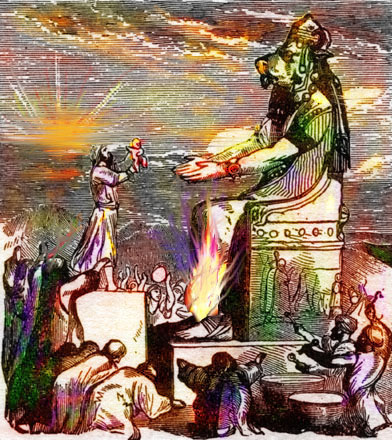
  • Altars to Baal rebuilt, using images of wood.
  • In the holy temple, altars to the “starry host,” astrology, plain and simple.
  • Human sacrifice of his own sons to Molech, a false god. Murder.
  • He practiced soothsaying, used witchcraft and sorcery, and consulted mediums and spiritists.

Evil was being encouraged and something wicked was replacing all that was good and true. The analysis of Manasseh’s policies was way beyond disturbing. Of all the kings of Judah, he was the most sinful and the most corrupt. He was at the bottom of the barrel.

The Hebrew word for “led astray” can be translated seduced.

Manasseh was an incredibly immoral man, a king who ruled for 40 years. “He did all he could to pervert the national character, and totally destroy the worship of the true God; and he succeeded.” (Clarke)

It’s believed that he put Isaiah to death by cutting him in two.

Moreover Manasseh shed very much innocent blood, till he had filled Jerusalem from one end to another, besides his sin by which he made Judah sin, in doing evil in the sight of the LORD.

1 Kings 21:16

But then something happened.

And the LORD spoke to Manasseh and his people, but they would not listen. Therefore the LORD brought upon them the captains of the army of the king of Assyria, who took Manasseh with hooks, bound him with bronze fetters, and carried him off to Babylon.

2 Chronicles 33:10-11

Assyria came knocking on Manasseh’s door. I think there was a certain mercy here, but also discipline. Manasseh had “hooks,” inserted through his jaw and out of his mouth. Like a fish he was led to Babylon, a trophy of the power of the army of Babylon.

It was from a dark dungeon that Manasseh cried out to the Lord and repented.

(2 Chronicles 33:12-13.)

There’s a Jewish fable that when Manasseh cried out to God the angels boarded up the windows in heaven. They wanted to block out his prayer so God wouldn’t be able to hear. But God, rich in mercy, bored a hole in front of His throne to hear Manasseh’s desperate cry.

The Lord’s intention was to forever show His kindness and grace given to the most awful repentant sinner.

I believe that Manasseh was the “Prodigal Son” of the Old Testament.

God is not at a loss when He moves to bring us back to Himself. He can woo or whip. He can draw or drive. He can work rapidly or slowly, as He pleases. In other words, He is free to be God! And in His own way, at His own pace, He brings us back.

     Tom Wells

God is wildly in love with you. Yes, the sin you’ve committed is awful, but the Lord wants you to come back. He may discipline you, but He forgives everything if you’ll turn and repent.

No matter how awful your sin, He forgives and restores. Manasseh is proof of that.

Sources:

2 Chronicles 33:1-20

2 Kings 21:1-18

Enduring Word commentary

alaskabibleteacher.com

Love Wears Work Gloves

 “But if anyone has the world’s goods and sees his brother in need, yet closes his heart against him, how does God’s love abide in him?”

“Little children, let us not love in words or talk but in deeds and in truth.”

1 John 3:17-18, ESV

Love is a noble idea, it’s admired and extolled by practically everyone–we see it in our music and poetry, ethics and religion. For the most part it’s a word for something decent and virtuous and honorable. It’s a good thing, but I’m afraid it’s not always scriptural.

You see, Bible love wears work gloves.

It labors and sweats. Bible love has chores to do, and it actively looks and sees what needs to be done. 1 John 3 tells us that we shouldn’t deceive ourselves and only see the world’s definition. That love that a believer has is to be different.

Love, in John’s eyes, is most assuredly “doing.” It burns spiritual calories as it labors to serve our brothers and sisters. Love finds things it can do–it doesn’t just talk but it gets busy. Love sees the need and then gets down to serve.

“You must show sincere love to each other as brothers and sisters. Love each other deeply with all your heart.”

1 Peter 1:22
Working (serving) has nothing to do with our salvation, that is a free gift. We’re saved by grace through the blood of Jesus–that’s a given. And this serving love isn’t drudgery, as a matter of fact, working and serving each other is a joy. The deepest kind of joy there is.

Our words, although important, are really an insufficient way of proving our authenticity.  The love we serve another with isn’t “pretty poetry” kind of love. It’s so easy to just shout out truth and never ever show a working, serving kind of love. 

That disconnect is a bit disconcerting. When do we suppose we figure out that His love is actually a verb?


Little Christs

Acts 11:26, ESV

Some have suggested that the word “Christian” (grk. christianos) was meant as a slur or insult. It meant little Christs, or mini-Christs. Perhaps that was the best the unbelievers came up with. They identified believers in Jesus and slapped a label on them that was supposed to mock and demean them.

But guess what? The early Christians loved it!

The disciples very quickly adopted it as a great explanation of their new identity. It became a badge of honor. The early Church of disciples became known as little Christs. This now identified them, and they wholeheartedly embraced this new nickname.

From all that I’ve read I see Antioch as a pretty interesting place. It was a city of almost 300,000 people and it had some major Roman temples, and amphitheatres. The city was fully entrenched in the economy and military of the empire. Antioch was regarded as the eastern capital of Rome.

After heavy persecution in Jerusalem, Christians moved north and made Antioch their home base.

This verse (Acts 11:26) tells us that Paul spent a considerable amount of time there teaching the church. After a generation or two, Ignatius of Antioch took over leadership of the Church. By 390 AD the city had almost 200,000 believers!

I’m not sure why, but the word “Christian” is only used 3x in the N.T. (Go figure?) Just maybe the letters of Paul and Peter predated the new label? IDK.

C.S. Lewis

To be a mini-Christ is a pretty profound calling. I think of the 12 being sent out by Jesus to heal and announce the arrival of His kingdom in a new way. In essence they duplicated Jesus’ ministry. (Matthew 10:5.) The more we know Him, the more like Christ we become. (Matthew 11:29.)

Now don’t get me wrong, we are definitely NOT little gods. No way! We are simply broken people who battle sin and must be filled with the Holy Spirit constantly. (Acts 13:52.) In no way, shape, or form are we anything more than human.

And yet we also are little-Christs!

His Spirit comes when, in our neediness we make room for Him in our hearts and minds, and simply ask in faith. Your faith must be humble, and never ever, be proud or arrogant. We are called to reveal the heart of Jesus to an unbelieving world.

Persecution, in its different intensities, will also be present for mini-Christs. Jesus repeatedly warned us to expect it.

John 16:33, ESV

So where do we go from here? Mother Teresa once said, “Calcuttas are everywhere if only we have eyes to see. Find your Calcutta.” It’s probably closer than you’ve ever imagined. Open your eyes and receive the reality of being a little-Christ sent out into this world.

Just like Him.

Walls Don’t Work Anymore

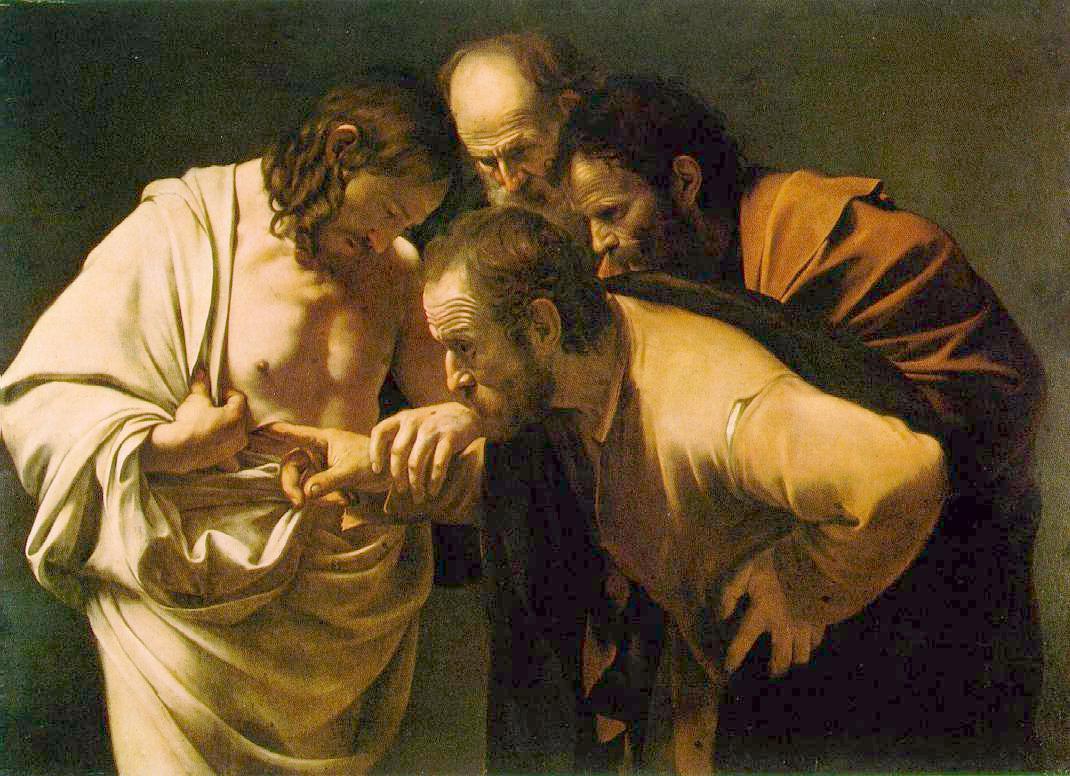
36 As they were talking about these things, Jesus himself stood among them, and said to them, “Peace to you!” 37 But they were startled and frightened and thought they saw a spirit. 

38 And he said to them, “Why are you troubled, and why do doubts arise in your hearts? 39 See my hands and my feet, that it is I myself. Touch me, and see. For a spirit does not have flesh and bones as you see that I have.” 

40 And when he had said this, he showed them his hands and his feet. 41 And while they still disbelieved for joy and were marveling, he said to them, “Have you anything here to eat?” 42 They gave him a piece of broiled fish, 43 and he took it and ate before them.

Luke 24:36-43, ESV

In the most thrilling moments of a story, there are instances when the true essence of the events becomes crystal clear. Luke’s narrative brilliantly captures that exhilarating sensation. Picture this: Jesus, triumphantly risen from the depths of death, enters the room with a burst of energy that electrifies everyone present. It must have been one of those extraordinary instances where words simply fall short, and experiencing it firsthand is the only way to truly grasp its profound impact.

“Frightened” and “terrified”–it seems it takes two words to describe this spooky experience. 

Everyone was terrified; they were convinced that Jesus must be a ghost. They all panicked and tried to run to the nearest exit, but then realized that the door was still locked!

Oh boy, Jesus must have had a good chuckle over this one! I mean, imagine being a human and seeing your disciples, all stooped and scared, trying to approach you like a bunch of timid puppies. It’s like trying to get a dog to come to you when it’s so terrified it’s peeing on the floor! I bet Jesus couldn’t help but smile and think, “What a hilarious sight!”

They slowly encircle Jesus and as they come, I have to believe He’s amused. He has survived a very brutal cross, and walked through hell. And, He has risen from the dead.

He is laughing from the pure joy of one who has endured the worst of a very real hell.

Jesus emerged unscathed on the opposite end, a testament to his invincibility. His arrival has undoubtedly filled him with undeniable joy, surrounded by beloved companions. In his triumphant resurrection, he defied all odds and accomplished the unimaginable, evoking a cascade of profound emotions, a mingling of laughter and tears.

I believe each of us has walls. 

Walls can provide a sense of security and protection, both physically and emotionally. People often feel the need for boundaries and walls to feel safe. This is similar to how disciples found safety in numbers and the walls around them. They were afraid, and so they hid themselves.

Jesus insists on penetrating our walls.  He’s overcoming much resistance and delusions. And then suddenly we come ‘face-to-face’ with the dead person who’s now alive. He is “The King of Kings and the Lord of Lords.

Behold, behold! Witness the magnificent display of unadulterated resurrection power—a force unparalleled in the vast expanse of the universe. Its brilliance eclipses the sun, its might surpasses that of the mightiest atomic bomb. Prepare to be astounded, for this power knows no bounds!

It’s funny, when Moses prostrated himself before the Lord’s glory, he changed.  Not only that, but he had to take precautions to cover his face when he returned to camp. These disciples however have just seen the glory of God first-hand.

As His disciples, we must be prepared for any eventuality.  Jesus can and will burst into our homes, and into our very lives.  Can you hear him laugh?  When he comes, nothing really is the same again.  He loves his disciples too much to leave them in a dark stuffy room.  They have work to do.

The resurrected Jesus is coming for you!

“Here I am! I stand at the door and knock. If you hear my voice and open the door, I will come in and eat with you, and you will eat with me.”

Revelation 3:20, NCV

alaskabibleteacher.com

Behold, The Hen of God!

havenlight.com

“How often I’ve ached to embrace your children, the way a hen gathers her chicks under her wings, and you wouldn’t let me.” 

Matthew 23:37, Amplified

Scripture tells us that Jesus only wept twice. The first was at the tomb of Lazarus when he cried over the evil and destructive power of death. The second is here–the night before he was crucified, where he stood on the Mount of Olives–and wept over the city of Jerusalem.

The disciples saw the tears roll down His face.

Mother hens do not provide milk for their chicks, they simply aren’t equipped for that. Instead, they teach them by example–and occasionally hold food in their beaks until the little ones get the idea that they can scratch on their own. The yolk sack from the eggs they are hatched from will provide food for the first 72 hours–after that, they’re on their own.

The chicks will always return to their mother. They instinctively know who she is, it’s she that provides them with heat and shelter. You’ll see them snuggling up to mom, especially when the weather gets cold, wet–or for protection. The little chicks ‘automatically’ understand that she got what they need. They’ll always stay close to her.

There is no “magic force field” for the believer. We’ll face all the things that the unbeliever does, maybe even more–but he does cover, and lavishly provides the grace and peace that we need. Life can be brutal and nasty, there is no question about that.

“O God, have pity, for I am trusting you! I will hide beneath the shadow of your wings until this storm is past.”

Psalm 57:1

The Lord will always protect his people. He’s deeply and intensely aware of us–he shields and provides everything we need. He covers us, keeps us, and protects us. We truly belong to him. He has adopted us as His own. We’re His sons and daughters, we are “family.”

“The Spirit you received brought about your adoption to sonship. And by Him, we cry, “Abba, Father.”

Romans 8:15

Do we really understand this? Do we really grasp the profound implications of his promises to us?

I have many questions (of course I do.) So why do we do the things our Father hates? Why do we bring him tears by the way we behave? Will we come to him at the first sign of “danger?”

When I’m threatened or challenged do I find shelter under the wings of God?

The city of Jerusalem was stubborn and unreceptive to His love–can I also resist him as well? Is my own hardness blocking His will? Do I ignore Jesus’ protective love?

“But let all who take refuge in You rejoice; let them shout for joy forever. May You shelter them, and may those who love Your name boast about You.”

Psalm 5:11