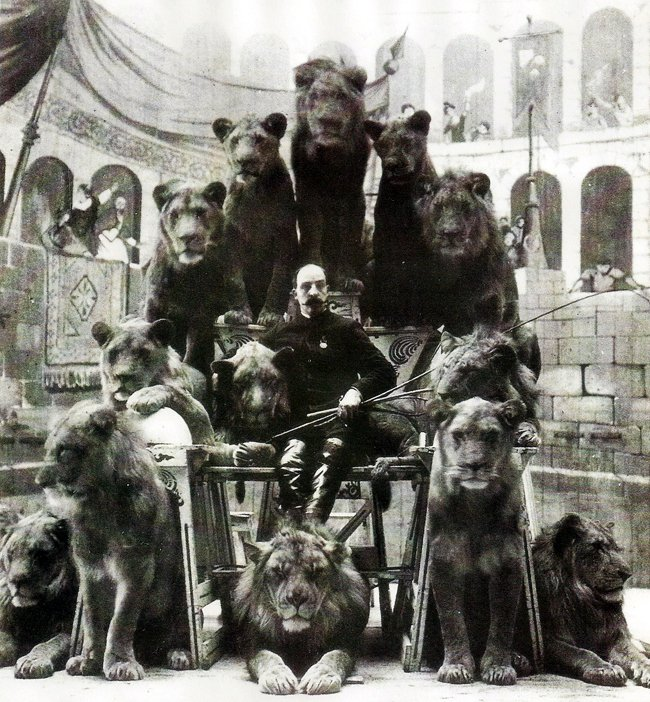
Daniel, the Lion Tamer

Daniel 6:22-23, ESV

I am rather frustrated with myself. I confess I haven’t read Daniel in years, and I’ve chosen to rectify this. Lately I’ve busted through this book and discovered some wonderful stuff. I guess chapter 6 has become my favorite.

A couple of things stick out.

Daniel was an incredibly faithful man, praying three times a day. He was true-hearted who served each king with the gifts God had given him. I like him a lot.

Daniel became the king’s favorite, the Hebrew word used means “prominent or esteemed.” He was the greatest and best there was to be found. You could say that he was the finest man in the kingdom.

Daniel knew how to lead and direct others. We read that he oversaw 120 chief overseers. I suspect he knew a thing or two about good leadership. Daniel understood his work, and it seems that he instinctively knew what good government required.

But Daniel was a victim of jealousy. A concerted effort, carefully planned and directed was meant to destroy him. Although the leaders of this rebellion could find nothing to accuse him of, they resorted to trap him because he prayed to God. Faithfully and consistently.

Their plot worked. These officials, through their twisting and manipulation of the legal code, were able to sentence Daniel to death. It seems being fed to hungry lions was the penalty for “breaking the law.”

Sometimes we must choose to serve God, even if it means breaking men’s laws.

Acts 5:29

Daniel was over 90 years old when he was thrown to the lions. Even in his advanced years he kept up serving God. The passage declares that he had “an excellent spirit.”

The lions, (several I assume), were not at all interested in devouring Daniel. King Darius however was incredibly distraught over Daniel’s execution, but it seems he was forced into it. The passage tells us that the king was so distressed that he couldn’t sleep that night.

Undoubtedly, Daniel slept far better then Darius.

To be faithful to the Lord God may require us to sleep with lions, but we can be assured of the Holy Spirit’s presence with us even then. A verse in Hebrews suggests “faith” protects us from the strong jaws of the enemy. Daniel understood.

Hebrews 11:33

But yet, sometimes even the faithful will be eaten.

Sometimes the lions will devour believers. But we must trust and believe no matter what happens. Hebrews goes on to show us the extremity of the faithful. Read Hebrews 11:35-38 and you’ll understand what I mean. Being faithful can be very difficult. Bad things often happen.

*****

     Thomas Watson

alaskabibleteacher.com

Finding the Light

“Indeed, we felt that we had received the sentence of death, so that we would not trust in ourselves but in God who raises the dead.”

2 Corinthians 1:9

To be chronically ill often means living with awful frustration. We can’t do what we want, we are ‘trapped’ by a disease we never asked for, and we’re held hostage by our minds and bodies. We once had a job– a career… and our time was occupied by that. Suddenly our lives are turned upside down.

We wanted something else, anything more than being very sick.

I once was a pastor of a small church here in Alaska. I also taught Gospels, several years in a local Bible Institute. I loved ministry very much. They defined my identity and gave me purpose. I enjoyed helping people and teaching the Word. I endeavored to be faithful in the ministry. And I hope I did.

With the sudden onset of a brain tumor, followed up by a diagnosis of severe depression, my life more or less exploded. I had extensive memory loss. I knew I had to step out of the ministry. I simply could not function. It was a hard thing to leave it behind. (And I still miss it.)

My depression grew even more profound with the stillborn death of our third child just 3 days before her delivery. Things suddenly ground to a standstill as my wife and I tried to process all of this. I guess I just couldn’t understand and more or less just shut down. I was angry at God. I spent months in bed, unable to function.

Some people were true jewels.

Others were more or less mean and uncaring. (I quickly learned how to take the good with the bad.) I suppose I should have understood, but things were so tangled up inside me that I couldn’t verbalize a thing. But God knew all about me. He loved and never judged.

The post-op recovery following the tumor was an ordeal, as I had to learn many things all over again. A few years later I ended up on disability; I was unable to work, and my symptoms were so unpredictable. I dealt with profound depression and a solid dose of paranoia and fear.

I learned that meds can help, but they can’t fix the problem.

Sometimes the isolation seemed worse than the pain. We wonder why this is happening to us, and we hear lies about our worthiness or God’s goodness. Our value to others seems to be scuttled by our illness. We can feel cursed, forgotten, crippled by God, or even worse. (Maybe even irrevocably lost?)

Satan craves our spiritual destruction, and he snares unsteady souls.

I admit I have been slow to learn this– but God brings good things out of the dark. I’m embarrassed by my personal lack of acquiring all of this. Now I’m starting to learn finally, and I want His words to reflect these truths.

“We now have this light shining in our hearts, but we ourselves are like fragile clay jars containing this great treasure. This makes it clear that our great power is from God, not from ourselves.”

2 Corinthians 4:7

This light will shine, and the treasure is found in clay vessels. Brokenness only means the treasure is now seen clearly. It’s important to note–jewels lose none of their value by being surrounded by broken clay. Our weaknesses are being turned into goodness, understanding, and love for our brothers and sisters.

Troubles of many varieties will pay us a visit. Count on it.

No matter what their nature, God holds his people in place while everything else is falling apart. But for the broken believer, there is another dimension; we will finally triumph. The tragedies we’ve had to endure only supplement our faith. We will stand– because He makes us stand.

“We are pressed on every side by troubles, but we are not crushed. We are perplexed, but not driven to despair. We are hunted down, but never abandoned. We get knocked down, but we are not destroyed.”

2 Corinthians 4:8-9

alaskabibleteacher.com

Trusting in Yourself: A Parable

Luke 18:9-14

“He also told this parable to some who trusted in themselves that they were righteous and looked down on everyone else: 10 “Two men went up to the temple to pray, one a Pharisee and the other a tax collector. 11 The Pharisee was standing and praying like this about himself: ‘God, I thank you that I’m not like other people—greedy, unrighteous, adulterers, or even like this tax collector. 12 I fast twice a week; I give a tenth of everything I get.’”

13 “But the tax collector, standing far off, would not even raise his eyes to heaven but kept striking his chest and saying, ‘God, have mercy on me, a sinner!’ , 14 I tell you, this one went down to his house justified rather than the other, because everyone who exalts himself will be humbled, but the one who humbles himself will be exalted.”

He despised others. As a Pharisee he prided himself as a holy person; he stood before God and congratulated himself. I believe that self-righteousness has many levels. You can be blatant and obvious about it, or it can be subtle and hidden. But we must understand that the Father sees and knows. Notice the “all” here in Isaiah 64:6:

(Hmm. A menstrual rag? You got to be kidding!)

We often advance ourselves by demeaning those who struggle hard with their sin–there are those who see them and somehow suspect that they’re more superior. We don’t come out and say so; but we’ve arrived— but guess what— God (and scripture) knows better than this.

But we’re not dealing here with a hidden self-righteousness. The Pharisee truly believes that he is different from the tax-collector. He stands and doesn’t kneel. He feels comfortable and confident in the holy presence of God Almighty. He’s not like the others. He is sure that he’s holy.

But the tax-collector was brutally honest about himself.

He didn’t need anyone to tell him how sinful he was—he understood his own wickedness. This parable reveals God’s love for those who know that they’re twisted inside. Notice the heart of the tax-collector:

  • “He stood afar off” which showed his awareness of his separation from God.
  • “He wouldn’t even raise his eyes to heaven,” which declared his humility in the presence of God.
  • He kept “striking his chest,” which tells us of a deep pain over his sin against God.
  • He prayed, ‘God, have mercy on me, a sinner!’ This describes his desperate heart.

Both came to pray, but really, that’s all they had in common.

The Pharisee came to the temple to show off his righteousness, the tax-collector out of a terrible despair. It strikes me that the text in verse 11 says the Pharisee “began praying to himself. It seems that his prayer never really met God—he was proud and showy, and ended up doing the things God detests, (Prov. 29:23).

Things really heat up in verse 14. That’s the critical point of the entire story—“one went down to his house justified rather than the other.” Wow! What a statement. One professionally religious man, sure of his holiness, and the other a sinful sinner, who came humble and broken. One showed off his faith–boasting with a legalistic swagger. The other desperate and desolate, completely undone.

But it was the tax-man who became righteous in the eyes of God.

Humility is the foundation of the kingdom of Jesus. In Matthew 5:3-4 makes a lot of sense—to be “poor in spirit” and to “mourn” are the bedrock of a Christian’s discipleship. To be justified (made right) was a gift. He didn’t try to earn it, and there wasn’t a probationary period. The tax-collector now became righteous; the Pharisee carried his sin still inside him.

God wants us to have a broken-heart. He rejects everything else. I suppose that the question is this:

Do you truly mourn over your sin?

Psalm 34:18

Art by Eugène Burnand

The Boogeyman of the Garasenes

Mark 5:1-15, ESV

My name was Legion. I was called that by all who knew me–it was a name of repulsive darkness, horror and fear. I was possessed by demons; there were so many of them that I was given this terrible name– “Legion, 5000.” So much darkness. Wonderful, isn’t it? What little I know I will tell you now.

My days were filled with awful confusion and terror.

I ran naked among the tombs, and cut myself on the rocks. People had chained me but I found I had a demonic, super-human strength– I broke their iron bonds. I freed myself to run wild among the caves once again. No man could tame me. I was the central force of evil in this area. I was the boogeyman of the Gerasenes.

And I was completely insane.

I recall little through my times of darkness, and I suppose that was for the best. My madness permeated everything until I had become completely saturated with evil. I was controlled by demons.

Try to imagine the condensed insanity of a mental hospital crammed into one’s little mind.

That day I was on the Gerasenes’ “welcoming committee.” I ran to greet Jesus before he even got out of the boat. I remember falling at his feet. I knew instinctively who He was. He was Lord over my darkness. I suppose that deep down I knew that only He could free me.

The authority of Jesus enabled him to speak directly to my demons. I remember how they tried to negotiate their way out, and He calmly sent them into a herd of swine nearby. There were about 2000 pigs and my evil spirits left me and entered them. The pigs went berserk and then they destroyed themselves. They couldn’t handle all the evil that I had ‘bottled up’ inside me.

With Jesus’ firm and decisive command, the darkness immediately left me alone.

Suddenly I could no longer hear their vile words. I knew that I would no longer have to carry out the disgusting will of my demons. There were no voices in my head. I stood up as a free man for the first time in years. Jesus Christ had decisively intervened. I knew now that He was my Messiah and my deliverer! My liberator who was sent from God. Just for me.

Someone gave me a robe to cover up my nakedness. I sat at Jesus’ feet in wonder at what had just happened. It didn’t take long for the townspeople to arrive. They came and found me clothed and completely sane.

I suppose it was out of fear that they asked Jesus to leave the region immediately.

I only wish they understood.

When Jesus was getting into the boat I wanted to join Him. I simply had to be close. But Jesus told me no. He told me that I needed to go home to my family, and I must tell them everything. “Tell them all of the power and mercy I have had on you.” As I watched them sail away I knew that I wanted to do what He wanted.

I would now be Jesus’ ambassador to the Ten Towns. Once I was filled with incredible darkness, but now I carry the Light.

Everything that had happened to me and all that Jesus could do for them I would share. I was now His very visible witness. I shared about the power and authority of the Lord Jesus Christ over my incredible darkness. I was now a source of His light to my people. I had to witness.

My darkness was completely gone, and I couldn’t control my joy!

Lord Jesus, You completely rule the spiritual forces of darkness. Help me to remember this and assist me with my own dark issues. I want to be free from all that opposes You. I must tell others of what you’ve done for me. Amen.

alaskabibleteacher.com

A Weeping Mother

Matthew 15:21-28, ESV

My daughter had a demon living inside her. Please understand me, I love her more than life itself. It was a terrible torment to see her fall under the control of the evil one like this. Every day seemed worse than the previous, and I knew that the day would come that I would lose her completely to the dark pit.

She would be lost forever.

God knows I tried everything. There was the pagan temple to Eshmon. He was our god of healing and protection for our nation, and it was a short walk away. We made trips there to present ourselves for healing. But things got worse, not better.

When Jesus came we knew we had to meet Him.

I was desperate, at the very end of my rope. I was scared. Meeting Jesus’ disciples was the first step and it really didn’t go well at all. They protected Him, and I couldn’t get close enough to speak with Him.

So much was blocking me. I saw so many obstacles, but when your child is suffering like mine, these things mean nothing. I came to the point where I began to shout, over and over for Jesus to intervene. I was asked to stop, I ignored His followers and kept yelling.

This passage asks us to consider many heavy issues. We have questions that need answers. Why did Jesus seem so cold and harsh? What about the “dog” reference, and His seemingly reluctance to heal? What about her ethnicity as a pagan?

Did Jesus know something about the situation we don’t?

I really want to keep this post short, so I won’t try to answer these questions. But the situation is intriguing. It must be noted that Jesus, at this particular point in His ministry, is focusing on reaching the Jewish population. (But that will change in the future.)

And yet there are positive characteristics of this woman that must be considered. These need to be understood to open up this passage. Please ponder them, they put the entire situation in a different light. We see the following:

  1. Her humility
  2. Her patience
  3. Her prayer and worship
  4. Her persistence
  5. Her faith

Each of these are crucial, and Jesus saw them. Yes, we see the obstacles, but we understand her love for her demon possessed daughter that drives her into Jesus’ presence. We see her faith that won’t give up no matter the resistance she encountered.

    Corrie Ten Boom

alaskabibleteacher.com

Listen Closely to Matthew

“He went out again beside the sea, and all the crowd was coming to him, and he was teaching them. 14 And as he passed by, he saw Levi the son of Alphaeus sitting at the tax booth, and he said to him, “Follow me.” And he rose and followed him.

“And Levi jumped to his feet and went along.”

Mark 2:13-14, ESV

My name is Levi, and I once collected taxes for Rome. It was a very good living–it’s funny, but my parents chose my name– “Gift of God.” They were pious Jews who dreamed I would be more than I was. I sometimes wonder. Did they understand what Jesus was calling me to become?

As a tax collector, I was considered unclean. A very small step above a leper I guess. The Temple was off-limits for me; so I never had any sacrifice for my many sins. I carried my guilt like a heavy jacket on a hot day–some would say that God turned His back on me. I was seen as a collaborator, a betrayer of my people. I had been excommunicated forever.

Do you know what it’s like to be one of the damned?

My friends were sinners like me. In some dark way we understood each other, for we were all outcasts. Some of us were thieves, drunkards, and whores. Some of us were blind or disabled–all were undesirables. We became the community of those damned to hell.

My tax booth was situated at a crossroads, the ideal spot for collecting taxes. No one carrying goods could get by–they had to pay me first. I soon became wealthy, and unfortunately, very recognizable (which was dangerous). I had Roman guards that protected me.

There were times I wondered if that was all my life was good for, collecting coins for Rome.

Jesus was teaching near my booth one day.

I listened to Him closely. I prided myself as a good judge of character, I knew when someone was lying–my business taught me that. I immediately knew that I had never seen or heard anyone quite like Him.

Jesus quickly turned and stared directly at me. My heart stopped. I felt His eyes searching and I realized that He looked through me. He knew exactly who and what I was all about, and that unnerved me. I wasn’t seeing Him, rather it was He that saw me.

“Come, follow me.”

Suddenly I knew that all I attained in my business was a big pile of nothingness. I can never get over the shock of those words– Jesus, the Messiah wanted me. He had put His call on me, someone who was very much lost.

Why me? Who am I?

To follow wasn’t negotiable. I looked down at the silver and gold and realized they were nothing but piles of dirt. I left the coins on the table and walked away. If anything, I was sickened by my world of money.

I have never questioned that moment. What would you have done in my place but follow Him?

We had a grand going-away party that night. I of course invited all my disreputable friends. The rooms quickly filled up with whores, drunks, and the outcasts. Jesus shared many wonderful things with us. Never had anyone love us like Him.

We had never experienced this before!

Mark 2:15-17, ESV

The Pharisees were absolutely livid. They began to verbally rebuke Jesus and His disciples for setting down to eat and fellowship with us. In their minds we were the damned. My home was unclean, my family unclean–we were all filthy.

But that was not the way Jesus saw us. He loved us when nobody else would.

alaskabibleteacher.com

Photo: “Matthew, the Chosen”

Against Rulers and Forces

10 Finally, be strong in the Lord and in the strength of His might. 11 Put on the full armor of God, so that you will be able to stand firm against the schemes of the devil. 

12 For our struggle is not against flesh and blood, but against the rulers, against the powers, against the world forces of this darkness, against the spiritual forces of wickedness in the heavenly places.

Eph. 6:10-12, NASB 

Paul tells us that discerning the cosmic forces of wickedness is now critical. If we choose to ignore his words and make them optional, we will become spiritual toast. We need to hear reality. We want to be told the truth. And the truth is that we’re neck deep in spiritual alligators.

Point blank: We were each born for battle. Every believer must wear armor.

This passage in Ephesians 6 stresses that there is something sinister, an organized force, something evil, a darkness that’s focused directly on us. Verse 12 unveils to us a veritable government of wickedness. Satan leads his demons out with the intention of confusing believers and destroying holiness.

We also need to understand that human beings have a terrible knack of walking in their sin, and also by being manipulated by evil forces. Human history bears this out. We have a lousy track record. Without the Spirit we will be lost and destroyed by our own darkness.

Christians are to see life very differently than others do.

Ephesians 6 teaches us to find strength in being connected with God, which is critical to walk through in this confusing darkness. By prioritizing our relationship with Him, we can draw upon His strength and a sincere faith to navigate through all of this.

Without intimacy there is no obedience and there can be no real victory.

You must come to him humbly and holy, and sit before Him and listen, learn and love. And that is the major step in true holiness. Being controlled by Him means when you need to, you can stand and deliver damage to Satan’s kingdom.

You’ll be leading angels in this terrible battle! They have their swords drawn and are quite capable. Remember that this is a spiritual war–not physical. Your attack must be fought on your knees. And angels, they’re watching and listening to you as you pray. They are God’s messengers to protect you.

Satan presses us hard through redirection and forgetfulness of who we are.

Without the humble intimacy that can only grow on prayer and Bible reading, we will be spiritually destroyed. We need the protection of the Presence. Please don’t forget this; you need Jesus more today than yesterday. You must come closer. He will help you.

You see, your only hope is in Jesus’ strength and intimate love for you.

We must reach for our power and grab upon this intense love. We can only become strong through our intimacy with Jesus. He shields us from the spiritual corruption that swirls all around us. As we draw to Him we become mighty, as we listen closely to the Holy Spirit, we will walk in true discipleship with Jesus.

You will hear Him speak clearly to you, perhaps when you actively push to do His will than your own.

“We are a long time in learning that all our strength and salvation is in God.”

     David Brainerd

alaskabibleteacher.com

What Does God Want From You?

I plead for you not to skip this post.

“He also told this parable to some who trusted in themselves that they were righteous and looked down on everyone else: 

“Two men went up to the temple to pray, one a Pharisee and the other a tax collector. 11 The Pharisee was standing and praying like this about himself: ‘God, I thank you that I’m not like other people—greedy, unrighteous, adulterers, or even like this tax collector. 12 I fast twice a week; I give a tenth of everything I get.’”

13 “But the tax collector, standing far off, would not even raise his eyes to heaven but kept striking his chest and saying, ‘God, have mercy on me, a sinner!’”

Luke 18:9-13

He despised others. As a Pharisee, he prided himself as a holy person; he thought he stood before God accepted and pure. He congratulated himself over this. I’m starting to see that self-righteousness has many levels. You can be blatant and obvious about it, or perhaps it might be more subtle and hidden. (Many believers like it hidden.)

We have to understand that God sees all and our hearts and minds are continuously inspected by the Holy Spirit. God sees our hearts as we see the faces of our friends. Any presence of pride or the absence of humility is automatically rejected by our heavenly Father.

In the Bible, it’s quite clear that being humble and admitting our sins and flaws are the best way to counteract any kind of puffed up pride. But for some reason, we often don’t realize when our selfishness and ego is getting in the way. It often comes very, very subtle. Tricky maybe.

Humility is a quality that cannot be acquired or maintained permanently.

Humility is not an accomplishment. There are no spiritual medals given for humility and brokenness. It’s not once you’re done. We must find humility every single day. Every morning, when my feet hit the floor, it’s something that requires my daily effort and practice. But it’s scary, because I’m starting to see that God’s precious grace is ultimately nullified by my pride.

The right kind of heart is broken and humble every single morning.

The Pharisee believes he is better than the tax-collector, and he now stands confidently before God. He thinks he is holy and superior to others. He really believes he has spiritually arrived.

But the tax-collector was brutally honest about himself. He understood the presence of God.

He didn’t need anyone to tell him how sinful he was–he knew his own wickedness. Jesus’ story reveals God’s love for those who know that they’re twisted up inside and lost. But let’s look closer at the heart of the tax-collector:

  • “He stood afar off,” which showed his awareness of his separation from God.
  • “He wouldn’t even raise his eyes to heaven,” which declared his humility in the presence of a holy God.
  • He kept “striking his chest,” which tells us of a deep pain over his sin against God.
  • He prayed, ‘God, have mercy on me, a sinner!’ This describes his desperate heart.

Both men came to pray, but to be really honest, that’s all they had in common.

The Pharisee came to the temple to declare his righteousness, the tax-collector came out of a terrible despair. It strikes me that the text in verse 11 says the Pharisee, “began praying to himself.” It seems that his prayer never really met God–all he was proud and showy, and he was only doing those things God hates (Prov. 29:23).

But it was the tax-man who became righteous in the eyes of God.

Humility is the foundation of the kingdom of Jesus. Matthew 5:3-4, makes a lot of sense to me. To be “poor in spirit” and to “mourn” has now become the solid bedrock of a Christian’s discipleship. To be justified (made right) is a gift. No one can earn salvation. The tax-man could only hold out his empty cup and hoped that God would fill it. Maybe that’s our beginning point.

But suddenly the tax collector is now considered righteous, while the Pharisee left the temple unchanged, and unforgiven.

“We had long known the Lord without realizing that meekness and lowliness of heart should be the distinguishing feature of the disciple.”

    Andrew Murray

When I crawl out of bed in the morning I start all over again. I realize I am nothing, I deserve nothing. I can only cling to the grace of my Father.

God wants us to have a broken heart and it’s apparent He rejects everything else. I suppose that there are questions I must ask myself: Am I really poor in spirit? Do I really mourn over my sin? Am I broken or am I subtly proud of myself? I must ask myself these questions.

“This is the Lord’s declaration. I will look favorably on this kind of person: one who is humble, submissive in spirit, and trembles at my word.”

Isaiah 66:2, CSB

Art by Eugène Burnand

alaskabibleteacher.com

A Legion of Demons

Mark 5:1-15

They came to the other side of the sea, to the region of the Gerasenes. As soon as he got out of the boat, a man with an unclean spirit came out of the tombs and met him. He lived in the tombs, and no one was able to restrain him anymore—not even with a chain— because he often had been bound with shackles and chains, but had torn the chains apart and smashed the shackles. No one was strong enough to subdue him. Night and day among the tombs and on the mountains, he was always crying out and cutting himself with stones.

6 When he saw Jesus from a distance, he ran and knelt down before him. And he cried out with a loud voice, “What do you have to do with me, Jesus, Son of the Most High God? I beg you before God, don’t torment me!” For he had told him, “Come out of the man, you unclean spirit!”

“What is your name?” he asked him.

“My name is Legion,” he answered him, “because we are many.” 10 And he begged him earnestly not to send them out of the region.

11 A large herd of pigs was there, feeding on the hillside. 12 The demons begged him, “Send us to the pigs, so that we may enter them.” 13 So he gave them permission, and the unclean spirits came out and entered the pigs. The herd of about two thousand rushed down the steep bank into the sea and drowned there.

14 The men who tended them ran off and reported it in the town and the countryside, and people went to see what had happened. 15 They came to Jesus and saw the man who had been demon-possessed, sitting there, dressed and in his right mind; and they were afraid.

I had so many demons inside me, people called me Legion. I ruled the spiritual world of the Garasenes. People were afraid of me, of what I would do to them. Believe me, they knew. I was a living nightmare, their boogeyman. My days was filled with awful confusion and terror.

And I was completely insane.

I can recall little through my darkness, and I suppose that was for the best. My madness permeated everything. My life had become completely saturated with evil. What little I know I will tell you.

Try to imagine the condensed insanity of a mental hospital crammed into one’s little brain.

That day, I was on the Gerasenes’ “welcoming committee.” I ran to greet Jesus before he even got out of the boat. I remember falling at His feet. I knew instinctively who He was. He was the Lord over my darkness. I suppose that deep down I knew that only He could free me.

The authority of Jesus enabled him to speak directly to my demons. I remember how they tried to negotiate their way out, but with His total authority over darkness, He calmly sent them into a herd of swine nearby.

There were about 2,000 pigs, and when my evil spirits left me, they entered them. The pigs went berserk, squealing and running. I was told later that they destroyed themselves. They couldn’t handle all the evil that I had ‘bottled up’ inside me.

With Jesus’ firm and decisive command, the darkness immediately left me alone.

Suddenly, I could no longer hear the demon’s vile words. I knew that I would no longer have to carry out their disgusting will. There were no longer voices in my head. I stood up as a free man, now walking in the light. Jesus Christ had decisively intervened.

Someone gave me a robe to cover up my nakedness. I sat at Jesus’ feet in a wonderful daze at what had just happened, and it didn’t take long for the townspeople to arrive. They came and found me clothed and completely sane. I suppose it was out of fear that they asked Jesus to leave the region immediately.

I only wish they understood who He really was.

When Jesus was getting into the boat I wanted to join Him. I simply had to be close to Him. But Jesus told me no. He told me that I needed to go home to my family, and I must tell them everything. “Tell them all of the power and mercy I have had on you.” As I watched them sail away I knew that I wanted to do what He asked.

I would now be Jesus’ ambassador to the Ten Towns.

I explained to them everything that had happened to me and all that Jesus could do. I was now His very visible witness. I shared about the power and authority of the Lord Jesus Christ over my incredible darkness. I was now a source of His light to my people.

I had to witness to the others, and it would be my joy to do so.

Lord Jesus, You completely rule the spiritual forces of darkness. Help me to remember this and assist me with my own dark issues. I want to be free from all that opposes You. I must tell others of what you’ve done for me. Amen.

alaskabibleteacher.com

Was Judas Forgiven?

And Jesus said, “Father, forgive them, for they know not what they do.”

Luke 23:34

From the cross Jesus spoke this. He was being executed in an extreme way, crucifixion was a terrible way to die. Roman soldiers surrounded the cross, and yet Jesus asked the Father to forgive them. They would not be guilty, but forgiven for what they were doing to Him.

But what about Judas?

How broad was Jesus’ statement? Did Jesus grant Judas absolution from this sin of betrayal when He said this? There’s far too many questions, and it’s good to think these things through. Was there forgiveness for this man of treachery?

“Then Satan entered into Judas called Iscariot, who was of the number of the twelve.” (Luke 22:3, ESV.) Perhaps this verse should become our entry point. It’s apparent that Judas was being controlled by the evil one. Something (or someone) took possession of him at this point. It seems astonishing that this happened at the special moment of the Lord’s Supper.

At this point Judas sought out the chief priests.

Judas offered to turn Jesus in, and it seems that money was given, perhaps to encourage Judas to commit himself to follow through. We read that Jesus was “troubled in His spirit.” It seems that this had to do with the impending betrayal.

So what was the early Judas like? Was he an authentic disciple? It seems he was called like the others. He listened to Jesus’ teaching and saw most of the miracles. Later he was sent out to proclaim the “good news.” Apparently, he teamed up with another disciple, miracles were seen.

“Judas heard all of Christ’s sermons.”

Thomas Goodwin

I can’t verify this yet, but each of the 12 called Jesus “Lord,” but only Judas called Jesus “rabbi.” Perhaps this points to a problem Judas has identifying the ministry of Jesus. There would be a kiss commonly given by a disciple, but was it real?

Judas seemed to have problems with money. Apparently Jesus decided that he was to be the treasurer of His followers. This was a problem for Judas. It’s clear that he stole money from that was entrusted to Jesus’ ministry.

Yet I believe Judas would be forgiven of these things if he only asked.

There are a few other things we really must consider. Did Jesus forgive Judas? The Romans and the Jewish leaders were forgiven by Jesus from the cross. But there was never any indication that Judas was forgiven for his betrayal. It seems that Judas carried his sin which ended up in suicide.

Both Peter and Judas betrayed their Lord.

And yet I have to believe that they were not the same. Somehow Peter’s denial would find a way to be forgiven. And even though it seems very painful, Peter would be restored. But Judas took his own life. It was his choice. Simon Peter felt remorse. Judas was overcome with guilt and chose death instead of seeking forgiveness.

I’m completely convinced that we will not see Judas in heaven.

I say that cautiously. I hardly ever understand the mind and heart of God. His compassion is everlasting. Who am I to decide these things? But it seems to me that when he sold Jesus for 30 pieces of silver, he was really selling himself.

“While I was with them, I kept them in your name, which you have given me. I have guarded them, and not one of them has been lost except the son of destruction, that the Scripture might be fulfilled.”

John 17:12

This verse seems to clarify much about Judas. We understand Jesus’ care and love for each of His disciples; yet we see a pronouncement of judgement against the person who would betray Him. It seems that Judas convinced himself that he could not be forgiven. His awful suicide declared he was beyond grace. Judas decided he would hang himself, committing himself to the rope rather than accepting any kind of forgiveness.

Sobering, isn’t it?

“Judas Iscariot was not a greatly wicked person, just a common money-lover, and like most money-lovers, he did not understand Christ.”

A.W. Tozer