Finding the Light

“Indeed, we felt that we had received the sentence of death, so that we would not trust in ourselves but in God who raises the dead.”

2 Corinthians 1:9

To be chronically ill often means living with awful frustration. We can’t do what we want, we are ‘trapped’ by a disease we never asked for, and we’re held hostage by our minds and bodies. We once had a job– a career… and our time was occupied by that. Suddenly our lives are turned upside down.

We wanted something else, anything more than being very sick.

I once was a pastor of a small church here in Alaska. I also taught Gospels, several years in a local Bible Institute. I loved ministry very much. They defined my identity and gave me purpose. I enjoyed helping people and teaching the Word. I endeavored to be faithful in the ministry. And I hope I did.

With the sudden onset of a brain tumor, followed up by a diagnosis of severe depression, my life more or less exploded. I had extensive memory loss. I knew I had to step out of the ministry. I simply could not function. It was a hard thing to leave it behind. (And I still miss it.)

My depression grew even more profound with the stillborn death of our third child just 3 days before her delivery. Things suddenly ground to a standstill as my wife and I tried to process all of this. I guess I just couldn’t understand and more or less just shut down. I was angry at God. I spent months in bed, unable to function.

Some people were true jewels.

Others were more or less mean and uncaring. (I quickly learned how to take the good with the bad.) I suppose I should have understood, but things were so tangled up inside me that I couldn’t verbalize a thing. But God knew all about me. He loved and never judged.

The post-op recovery following the tumor was an ordeal, as I had to learn many things all over again. A few years later I ended up on disability; I was unable to work, and my symptoms were so unpredictable. I dealt with profound depression and a solid dose of paranoia and fear.

I learned that meds can help, but they can’t fix the problem.

Sometimes the isolation seemed worse than the pain. We wonder why this is happening to us, and we hear lies about our worthiness or God’s goodness. Our value to others seems to be scuttled by our illness. We can feel cursed, forgotten, crippled by God, or even worse. (Maybe even irrevocably lost?)

Satan craves our spiritual destruction, and he snares unsteady souls.

I admit I have been slow to learn this– but God brings good things out of the dark. I’m embarrassed by my personal lack of acquiring all of this. Now I’m starting to learn finally, and I want His words to reflect these truths.

“We now have this light shining in our hearts, but we ourselves are like fragile clay jars containing this great treasure. This makes it clear that our great power is from God, not from ourselves.”

2 Corinthians 4:7

This light will shine, and the treasure is found in clay vessels. Brokenness only means the treasure is now seen clearly. It’s important to note–jewels lose none of their value by being surrounded by broken clay. Our weaknesses are being turned into goodness, understanding, and love for our brothers and sisters.

Troubles of many varieties will pay us a visit. Count on it.

No matter what their nature, God holds his people in place while everything else is falling apart. But for the broken believer, there is another dimension; we will finally triumph. The tragedies we’ve had to endure only supplement our faith. We will stand– because He makes us stand.

“We are pressed on every side by troubles, but we are not crushed. We are perplexed, but not driven to despair. We are hunted down, but never abandoned. We get knocked down, but we are not destroyed.”

2 Corinthians 4:8-9

alaskabibleteacher.com

God’s Word is Not a Cudgel

Ephesians 4:29, ESV

In the spring of 1987 I was working with SOS Ministries in San Francisco. Our ministry house was on Sycamore in the Mission, a really rough place. There was ten of us and we were committed ourselves to street evangelism throughout the city. When I wasn’t on the street our in-house writing/printing took up a lot my time.

Vicky was our ministry secretary. She was young, outgoing, smart and a very good administrator. She was a whiz taking care of the office–and us. She was a vital part of the house. She was pretty much irreplacable.

Sometimes though we would clash, but never in a bad way.

But after time it seemed all I could only hear from her was criticism. And I began to get really angry. Our relationship grew testy over time and things began to fester inside of me. It’s funny, but now it was inconsquential.

But one day there was one of those moments I would regret even now after all these years. I had misconstrued that she was criticizing me. Whenever I was in the office it seemed she had it in for me.

I decided I must correct her. I believed she was way out of line it was up to me to set her straight.

“Vicky, I have a word for you, from God! Read Judges 16:16.

As she grabbed her Bible and read the verse I could see the tears well up in her eyes. And I had used the Word of God like a cudgel, beating her with a billy club. I had bludgeoned her with a Bible verse.

What can I say? The memory of doing that has always stuck with me. I had wounded her spirit intentionally. Now the Father has forgiven me, I know that–but the lesson I learned has stuck with me through 30 years of ministering God’s Word.

“People who think they are religious but say things they should not say are just fooling themselves. Their “religion” is worth nothing.”

James 1:26, NCV

This quote drives this home:

     James H. Aughey

I really must warn you, if you’re hurting your brothers and sisters by speaking foolishness, the Father will deal with you. Sometimes harshly. Now there is definitely room to correct, but I suggest for every second of time you speak, you need to spend twenty minutes in real prayer, for them and for yourself.

You don’t discern to expose sin. You discern to pray and intercede. I think this is a good “rule of thumb” for us all.

alaskabibleteacher.com

Our Servant King Teaches Us

servant-king

Mark 10:44

I’m processing something right now.

I suppose its implications could turn everything upside down,’ at least for me anyway. Some scientists have postulated that our planet is due for a complete magnetic switchover. This is when the north becomes south and vice versa. My issues at this moment are not quite that cosmic.

At this moment there are over 7,000,000,000 people living on planet earth.

(That’s seven billion.)

Sometimes I wonder if many of my issues come from not seeing this. I’m merely one drop in a vast sea of people. It also seems that there’s an intoxication of success when we become increasingly confused over ‘who’ we really are.

We think it’s about our efforts, maybe our giftedness. Perhaps it’s pride that drives us, even among mature Christian believers. But this is not the way of our Master. It’s unbecoming of a disciple.

3 “Don’t be selfish; don’t try to impress others. Be humble, thinking of others as better than yourselves. Don’t look out only for your own interests, but take an interest in others, too. You must have the same attitude that Christ Jesus had.”

Philippians 2:3-5

Jesus wasn’t driven like we seem to be.

We think we need to be more assertive, at least the Christian version of it, and push our way to the front. However, Jesus’ message and teaching were all about emptying Himself of being God and becoming a servant of servants. This is the arresting fact we fail to consider–

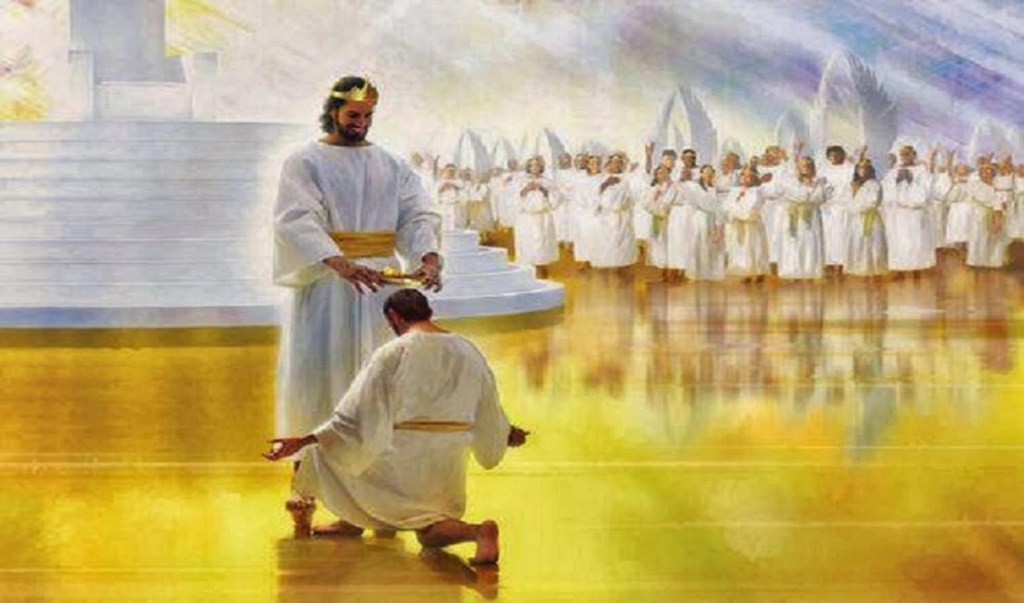
Jesus did all of this while wearing a towel, not a crown.

“Jesus, knowing that the Father had given all things into His hands, and that He had come from God and was going to God, rose from supper and laid aside His garments, took a towel and girded Himself. After that, He poured water into a basin and began to wash the disciples’ feet.”  

John 13:3-5

He could have just done a ‘teaching’ on servanthood and I’m reasonably certain it would have been more than sufficient. But instead, Jesus put ‘skin on His words’ and actually got down on His knees to wash dirty feet. His disciples freaked out when they saw him do this.

It was something they could never forget.

“You must have the same attitude that Christ Jesus had.

Though he was God,
    he did not think of equality with God
    as something to cling to.
Instead, he gave up his divine privileges;
    he took the humble position of a slave
    and was born as a human being.
When he appeared in human form,
    he humbled himself in obedience to God
    and died a criminal’s death on a cross.

Philippians 2:5-8, ESV

How can we not do this? This is a hard question to ask, but to be perfectly honest, does our discipleship include emptying ourselves daily? Can we find peace and fulfillment by becoming an unknown believer? An unknown, but only to God? Is this what we’re missing in becoming Christlike? These are very hard questions.

“Humility is perfect quietness of heart, It is to expect nothing, to wonder at nothing that is done to me, to feel nothing done against me. It is to be at rest when nobody praises me, and when I am blamed or despised.”

It is to have a blessed home in the Lord, where I can go in and shut the door, and kneel to my Father in secret, and am at peace as in a deep sea of calmness, when all around and above is trouble.”   

Andrew Murray

Our discipleship will always short-circuit itself in the presence of pride.

A Very Terrible Blindness

As he was walking along, he saw a man blind from birth.

“Master,” his disciples asked him, “why was this man born blind? Was it a result of his own sins or those of his parents?”

“Neither,” Jesus answered. “But to demonstrate the power of God. All of us must quickly carry out the tasks assigned us by the one who sent me, for there is little time left before the night falls and all work comes to an end. But while I am still here in the world, I give it my light.”

Then he spat on the ground and made mud from the spittle and smoothed the mud over the blind man’s eyes, and told him, “Go and wash in the Pool of Siloam” (the word Siloam means “Sent”). So the man went where he was sent and washed and came back seeing!

John 9:1-7

This man had been blind from birth.

I can’t even imagine what blindness would be like. The blind man probably couldn’t imagine having sight. He probably didn’t have a dream-life either–that requires having seen images (a dog, a tree, a mean person) and this wasn’t available to him. He never saw the color red, or saw a mountain.

I suppose we can only imagine what blindness to this degree would be like.

Somehow I’ve come to an idea that this represents fallen men–we’re spiritually blind to the workings and truths of Jesus’ Kingdom. It seems a pretty good explanation of each of us–“blind from birth.” But when you’re blind spiritually you haven’t the slightest of what is real and taking place around you.

     Andrew Murray

Also notice the response of the disciples who first met this unfortunate man. They don’t see his needs, rather, they want to know the theology behind this. Perhaps that’s how we respond much of the time–we don’t see the needs, we only want to know the reasons. We’re not wise or discerning enough to see what’s really really going on.

Perhaps this is how we operate as immature Christians.

We don’t engage the need, but rather we like having good theology over understanding true passion. It’s easy to philosophize–it’s hard to get down and serve and really love others.

If we really don’t love needy people, we re probably not following Jesus.

It’s funny but Jesus declares Himself to be the light of the world while speaking to the man who is born blind. And it’s also funny that just like there was physical blindness there is a blindness of the Spirit by the disciples–I think it’s even worse.

Third, we discover the gentle mercy that Jesus has when He meets needy people. Now the Lord does accommodate His followers, but not at the expense of engaging the need of the moment. Jesus is full of compassion–most especially when He meets broken people–and as His followers, we must grasp this.

Perhaps good theology isn’t the primary calling of Jesus’ followers.

As I mature in Christ I’m learning (slowly) that people are His real focus. He has come, not to theologise or philosophize, but to meet needs! Sure the reasons why become clearer, but that really isn’t Jesus’ primary goal. I suspect that people will never have impeccable theology.

Classes in systematic theology are really good, but I believe soup kitchens are better.

The blind man is profoundly healed, and Jesus’ love and desire to restore this man is ‘front and center.’ The Lord’s methodology is interesting. Spit and mud, wiped on the blind man’s eyes. In Genesis 1-2 we discover that God made man out of dirt and dust of the ground. Perhaps what He has done here mirrors that work.

And it’s also important to understand that Jesus never performs the exact same healing in the exact same way. For some reason He ‘tailors’ His work to the individuals deepest need. I suppose He doesn’t want us to grab a hold of a formula, as that’s what we want to have.

The story is primarily about a blind man’s healing. It also speaks to the spiritual darkness that afflicts many.

We really must understand this, and we need to understand the tremendous mercy and power of God to both heal and restore. The Lord wants to give you real sight, true spiritual discernment. He really wants this.

There’s a ton more here we can grab, but I suppose there isn’t time. This is merely my take on John 9.

The Spirit of the Lord is upon me; he has appointed me to preach Good News to the poor; he has sent me to heal the brokenhearted and to announce that captives shall be released and the blind shall see, that the downtrodden shall be freed from their oppressors, and that God is ready to give blessings to all who come to him.”

Luke 4:18

alaskabibleteacher.com

The Whips of Jesus

John 2:14-17, NCV

 “In the Temple he found people selling cattle, sheep, and doves. He saw others sitting at tables, exchanging different kinds of money. 15 Jesus made a whip out of cords and forced all of them, both the sheep and cattle, to leave the Temple. He turned over the tables and scattered the money of those who were exchanging it. 16 Then he said to those who were selling pigeons, “Take these things out of here! Don’t make my Father’s house a place for buying and selling!”

17 When this happened, the followers remembered what was written in the Scriptures: “My strong love for your Temple completely controls me.”

He really did use a whip. The text tells us that Jesus carefully took some cords and made a whip by intertwining them. What can I say? I’m amazed at His response to what He saw happening in the Temple. Jesus saw deeply saddened Him to the point that there wasn’t anything else He could do.

It appears that there are three distinct whips in the N.T. that we should take into consideration.

  1. The one Jesus carefully braided to “cleanse the Temple.” (John 2:25.)
  2. The one used on Jesus’ back as part of our atonement. (Isaiah 53:4-6.)
  3. The one that believers experience in the ways God disciplines us as His children. (Heb. 12:6.)

All three are important to see. All three have their own meaning. The first one: The Temple is finally clean. The second one: He was punished for me. The third one: He intervenes in my life to make me a holy person.

The third whip is my focus here. He intends to sanctify us by correction. This discipline is the way Jesus separates us from our sin. We’re being disciplined in order to become holy people. Hebrews 12 explains the process.

“If ye endure chastening, God dealeth with you as with sons; for what son is he whom the father chasteneth not? But if ye be without chastisement, whereof all are partakers, then are ye bastards, and not sons.

Hebrews 12:7-8, KJV

God’s intention isn’t to inflict punishment upon us. His correction isn’t a way by which we make amends for our transgressions. It’s crucial to remember that Jesus has already taken upon Himself the full weight of our sins, fully satisfying any debt. He absorbed it all.

God, in His role as a loving father, corrects and guides us with deep affection.

It’s important to note that God’s methods of discipline do not involve any form of “spiritual child abuse” whatsoever. His love is extraordinarily good, it never wavers, never turns into something evil. He patiently works His will, using loving and healing hands.

“For the moment all discipline seems painful rather than pleasant, but later it yields the peaceful fruit of righteousness to those who have been trained by it.”

Hebrews 12:11, ESV

God has corrected me a 1000 times throughout my 40 years of following Him.

Not with a leather whip mind you, but a braided spiritual cord of correction. What He saw taking place in the marketplace of “me,” (my temple), brings Jesus grief and sorrow. I’m the temple of the Holy Spirit, and He fully intends to make me pure inside. Hebrews 12 tells me what to expect as a son. I need to be corrected.

It’s good to ponder this.

Isaiah 53:5, (context. 4-7)

Yes, a “whip” will be used, but cautiously, even though it may hurt us. Jesus will never intentionally correct you beyond what you can handle.

These three whips are vital, they educate us about the Lord’s efforts. They help us to comprehend and experience God’s workings. As much as we’re able, we must embrace them.

God’s corrections are our instructions; His lashes our lessons, and His scourges our schoolmasters.

     James H. Aughey

alaskabibleteacher.com

We Were Born to Serve

We Were Born to Serve Others

“When a servant comes in from plowing or taking care of sheep, does his master say, ‘Come in and eat with me’? No, he says, ‘Prepare my meal, put on your apron, and serve me while I eat. Then you can eat later.’” 

And does the master thank the servant for doing what he was told to do? Of course not. 10 In the same way, when you obey me you should say, ‘We are unworthy servants who have simply done our duty.’”

Luke 17:7-10

After years of ministry— this particular passage has slowly become one of my favorites. The path I’ve walked has been challenging, and it seems to me that I haven’t done it very well at all. I’ve been a fool much of the time, and yet, if anything, God has held me firmly in place. I haven’t always been faithful. But He has.

I used to kill rattlesnakes when I lived in Mexico. (You might say it was my hobby.) But it demanded a certain cautiousness, and lesson #1 was this–you never, ever take your eyes off of the snake–no matter what. We must approach ourselves that carefully. Our hearts are desperately wicked. We must understand this.

“I am more afraid of my own heart than of the pope and all his cardinals. I have within me the great pope, self.

    Martin Luther

Please let me explain what I’m thinking.

The Lord Jesus tells us one of those stories of his. This parable is one of his best. It makes a lot of sense, and it resonates within me. It tells me that I must watch myself, lest I forget the idea behind this passage. I’m His slave and not deserving some kind of special treatment.

Jesus’ parable explains our duty as His servant.

It seems that after a hard day’s work, a slave still needed to prepare his master’s dinner. No matter how much he toiled out in the fields, he had a duty to serve his master in this way; and it does seem unfair–we live in a land “where all men are created equal.”

But this is how the God’s Kingdom works.

We get dirty, we toil hard, and we sweat under the hot sun. We dream of a glass of cold lemonade (with ice), and a cool shower when we quit the fields. But that isn’t the way it works. Yes, Jesus gives his laborers rest–but the work continues.

The work goes on, even when God buries his workers. Hopefully, the next generation will continue my almost humble efforts, and his work in his fields will continue. But, in the meantime I must “watch” myself carefully, and do his will out in his fields.

Just as a servant knows that he must first obey his master in all things, so the surrender to an implicit and unquestionable obedience must become the essential characteristic of our lives.

Andrew Murray

Yes, it’s a foreign concept, and we can’t really relate–we either skip its message, or apply it to others. Jesus uses it quite adroitly, the servant works for his master; completely, exclusively. A slave who has no rights of his own. We serve and obey our Master.

Any desire for promotion, pleasure, riches, or fame will quickly make one a servant of the Beast. And, I’m afraid, that is exactly what many of today’s pastors and preachers have become.

    Chuck Baldwin

Straining at Your Oars


“He saw the disciples straining at the oars because the wind was against them.”

Mark 6:48

It’s good to know that Jesus sees our labor and effort.  He truly understands all that concerns us, and He perceives every issue that matters most to us.  Attentive and keenly aware He comes to our boat.  It’s quite common for us to think that he isn’t aware, and we may feel that He’ll pass us by without a word.  But that is not the case at all.

The Greek word for “against them” is ἐναντίος, and it means “opposed as an adversary, hostile, antagonistic.” I suppose that explains much to a believer who sees the wind doing awful things; that which is savage and difficult and contrary.

But Jesus watches over us, all the time. He is completely aware of you. 

He knows all about our battle, the fight we have with our flesh, the difficulty we have with the challenging people in our lives. I often struggle to steer my boat. Jesus knows when and why I labor like I do.  And He doesn’t condemn me.

The disciples were straining very hard to keep the boat afloat. 

Every oar was being used and every man had his seat.  They must work together.  Some were frantically bailing, and a couple gripped the tiller. Considerable effort was being expended but to no avail.  The wind pushed harder against them.  This is perplexing.  If you remember, they’re simply trying to obey the command of Jesus to cross the sea. 

Why do things have to be so difficult?

I’m intrigued by believers who expect sunshine, blue sky, and red roses because they are doing God’s will.  They don’t seem to think through the issues of conflict and challenge, weakness and weariness.

“It is necessary to go through many hardships to enter the kingdom of God.”

Acts 14:22

To do God’s will often means that there will be a headwind directly at us.


The seas will become impossible, and we may even be driven back.  But special comfort comes when we realize we’re being watched.  Jesus is doing constant surveillance on us, and He sees our toil on the oars. He comes to us, walking on the water.

Even in our storm, our hearts can rejoice.

“Lo, I am with you always, even to the end of the age”

Matthew 28:20


Listen Closely to the Rich Young Ruler

Mark 10:17-22

As he was starting out on a trip, a man came running to him and knelt down and asked, “Good Teacher, what must I do to get to heaven?”

18 “Why do you call me good?” Jesus asked. “Only God is truly good! 19 But as for your question—you know the commandments: don’t kill, don’t commit adultery, don’t steal, don’t lie, don’t cheat, respect your father and mother.”

20 “Teacher,” the man replied, “I’ve never once broken a single one of those laws.”

21 Jesus felt genuine love for this man as he looked at him. “You lack only one thing,” he told him; “go and sell all you have and give the money to the poor—and you shall have treasure in heaven—and come, follow me.”

22 Then the man’s face fell, and he went sadly away, for he was very rich.

My name is inconsequential. I suppose all you must know of me is I tried to keep God’s Law and that I was very wealthy. Many believed that being rich was evidence that God approved of me. Of that, I wasn’t too sure. I kept the Law out of fear I suppose, and at times I just knew it wasn’t quite enough.

As I studied I began to realize that riches weren’t going to make me righteous. There was enough Scripture in me to let me know that it wasn’t enough. The prophets, especially Isaiah spoke about the deadliness of wealth, but there was one verse in Proverbs that really disturbed me:

“Your riches won’t help you on Judgment Day; only righteousness counts then.”

This verse and all of the others were the cause of many a sleepless night.

I was tormented by the reality of standing before God with nothing but my money to cover me. Coming under God’s righteous judgment haunted me. I thought of it day and night. I was terrified of being damned. My own righteousness wasn’t enough, and I knew it.

I heard about Jesus (and who hasn’t)–some were claiming that he was the Messiah. He was at least a wonderful teacher and many said he worked miracles. Just perhaps he had answers for me. I hoped so, but I needed to know. It was my questions that drove me to find him.

And finding him was easy–I just followed the crowd.

I went ahead of his retinue of followers. I knelt in his path and waited. I must know what he thought. When he stood before me I asked the question that had haunted me my whole life–“Good Teacher, what must I do to get eternal life?”

Being a good Jew he answered my question with a question. It now seems that he wanted me to see what really mattered. I answered him with my “righteous” commitment to the Law of Moses. I did what was important–at least that’s what I thought. But still, in spite of all that, I felt no security and no real peace.

Jesus looked straight at me, and I knew deep down that he loved me.

But oh those words, His words really disturbed me. He told me that I only lacked one thing, that I must sell everything and distribute the money to the poor. Only by doing that would discover riches in heaven. And only then could I truly follow him.

And that was the thing I could never do.

I went away grieved. If he had asked for anything else I would have done it. You see, my wealth was my real obstacle. Deep down I suddenly knew that everything I possessed was now my stumbling block. It was my idol, my golden calf, and it was a sacrifice that I could never make.

I’ve come to realize now, over my many years, that when I do finally stand before God, I will have nothing to save me. Jesus invited me to follow, and I didn’t.

And that my friend meant I would die in my sin.

That Which is Far Better.

Luke 10:38-41, NCV

“While Jesus and his followers were traveling, Jesus went into a town. A woman named Martha let Jesus stay at her house. 39 Martha had a sister named Mary, who was sitting at Jesus’ feet and listening to him teach. 40 But Martha was busy with all the work to be done. She went in and said, “Lord, don’t you care that my sister has left me alone to do all the work? Tell her to help me.”

41 “But the Lord answered her, “Martha, Martha, you are worried and upset about many things. 

42 Only one thing is important. Mary has chosen the better thing, and it will never be taken away from her.”

My name is Martha and I’m Jesus’ friend. My home was one of His favorite places to stay–a refuge for Him whose life was so busy. I joyfully opened it for Him, and for His disciples. And when Jesus came I went all out, I wanted the best for Him and that meant there were always things to do. Is that really a bad thing?

The kitchen was verging on bedlam–lamb, cucumbers, figs, and so on. Roasting and slicing, and of course I had bread in the oven. All of this was requiring constant attention, and I remember not being able to keep up. To be honest, It was a bit much.

I wanted things to be perfect for Jesus.

I admit I took occasional peeks at Him, He was teaching in my living room after all. I just brought in some bowls of figs and raisins as an appetizer and guess what, I found my sister Mary sitting with the men listening to Jesus and asking questions. It was than I started to get a little ticked off.

I was really, really getting irritated with her.

There was so much to do and I didn’t have her help. The more I thought of Mary the more frustrated I got. I suspect she didn’t understand all that had to be done. All or her priorities were messed up–she simply didn’t understand her role as a hostess, and to sit with the men was terribly wrong.

She really didn’t understand her place.

Yes, I was having issues with my sister. It all came to a head when I had brought out another bowl of figs, and then I tried to graciously interrupt the Lord’s teaching. I wanted Him to tell her the place was with me in the kitchen. “Tell her to help me.”

Instead, it was Jesus who corrected me. I still remember Jesus’ words. And I honestly wasn’t expecting this..

“Martha, Martha, you are worried and upset about many things.”

Was I really that transparent? Of course He understood, but it cut me to the quick. I had become another lesson to everyone present. I realize now that the real issue was with my attitude, and not with the work. Yes, I was bothered and upset but I know now that it’s those things that were the real problem.

Only one thing is important. Mary has chosen the better thing, and it will never be taken away from her.”

I suddenly knew that He was right. Jesus was in my home, and all I could do was to get frustrated and angry. I thought my work would please Him, and after all, wasn’t really all that important? Didn’t He deserve my best efforts? Surely all my work meant something to Him?

My younger sister Mary was being praised. It seems she was becoming my example and I was being gently rebuked. but suddenly all I realized, and that all I was doing, all my work and my effort, really wasn’t what Jesus wanted. The problem wasn’t her problem, it was me all a long!

I only wanted to serve Him, but I guess that wasn’t what He really wanted.

To be sure all I was becoming far too critical and resentful of my sister Mary, and yet I had forgotten that my real place was at Jesus’ feet, listening and learning. That’s what Jesus really wanted, and somehow I had forgotten that. I had lost Him in all my busy-ness.

The work could wait, and now I understand that my true place was with Jesus.

Martha’s frustration is typical of those who diligently serve with good intent, but forget to also sit at Jesus’ feet. “The Martha spirit says, if the work is done, is not that all? The Mary spirit asks whether Jesus is well pleased or not? All must be done in his name and by his Spirit, or nothing is done.”

C.H. Spurgeon