Refusing to Give Up

Luke 18:1-8

“Now he told them a parable on the need for them to pray always and not give up. “There was a judge in a certain town who didn’t fear God or respect people. And a widow in that town kept coming to him, saying, ‘Give me justice against my adversary.’”

“For a while he was unwilling, but later he said to himself, ‘Even though I don’t fear God or respect people, yet because this widow keeps pestering me, I will give her justice, so that she doesn’t wear me out by her persistent coming.’”

“Then the Lord said, “Listen to what the unjust judge says. Will not God grant justice to his elect who cry out to him day and night? Will he delay helping them?”

8 “I tell you that he will swiftly grant them justice. Nevertheless, when the Son of Man comes, will he find faith on earth?”

This parable deals with heavy-duty prayer—not the weak watered-down stuff. But rather something that’s bold and confident. Jesus teaches us to intensify our prayers. There are parallels here with the woman from Canaan. We see Jesus seemingly ignore a seeker (Matthew 15:21-28, Message). I guess that bothers me somewhat. But he wants her faith to grow.

Jesus uses the word “unjust” to accentuate the story to his listeners. It more or less creates a tension where true faith can be seen up close. Back in the Old Testament we read of Jacob refusing to let go of the angel (Gen.32:22-25). We see Rachel who demanded children, “or else I die,” (Genesis 30:8). Both prevailed even when confronted with difficult situations.

“Don’t give up” in verse 1 explains this passage.

Discouragement is a frontal assault on a believer’s faith. Satan uses different tactics, but attacking ones faith is his specialty. Whenever Satan sees faith, he attacks. He absolutely hates your relationship with the Father. He will turn you against him if he can. We are told that our faith must become a shield when he tries to assault us, (Ephesians 6:16).

It seems that to me that some believers refuse to wear their armor. They don’t realize how vulnerable they really are.

This parable is clear. Often God seems to be distant and unconcerned, but that isn’t true, and yet Satan insists that it is. As believers we’re told to press the father about our need. Repeatedly, we’re told that God is very much aware of us, he only wants to build our faith—to make it strong. He uses Satan’s assault on us to magnify the fathers glory.

The widow is a case in point. She demands that the judge listen to her case, and finally he relents. Her insistence is finally rewarded. He realizes that this widow isn’t going away. She’s starting to give him a headache, and she is very persistent. Her faith is stronger than his reluctance.

Our faith needs to be exercised. It’s very much like working out in a gym.

Weights are used, and once you’ve mastered one level, it’s increased. It may sound like a cliche, but God won’t give you anymore than you can handle, our faith isn’t much different. Sometimes we’ll sweat and strain spiritually, but we must understand that our faith has to be strengthened. We never seem to arrive.

You must understand that our faith will be tried, but that isn’t a bad thing. If God withdraws, then we must pursue. If he doesn’t answer we must crank it up. Like the widow we need to persevere; we must not give up. This is how your faith grows. Hebrews 11 declares what faith looks like when it’s wrapped up in flesh and bone.

“For everyone who asks receives, and the one who seeks finds, and to the one who knocks, it will be opened.”

Luke 11:10

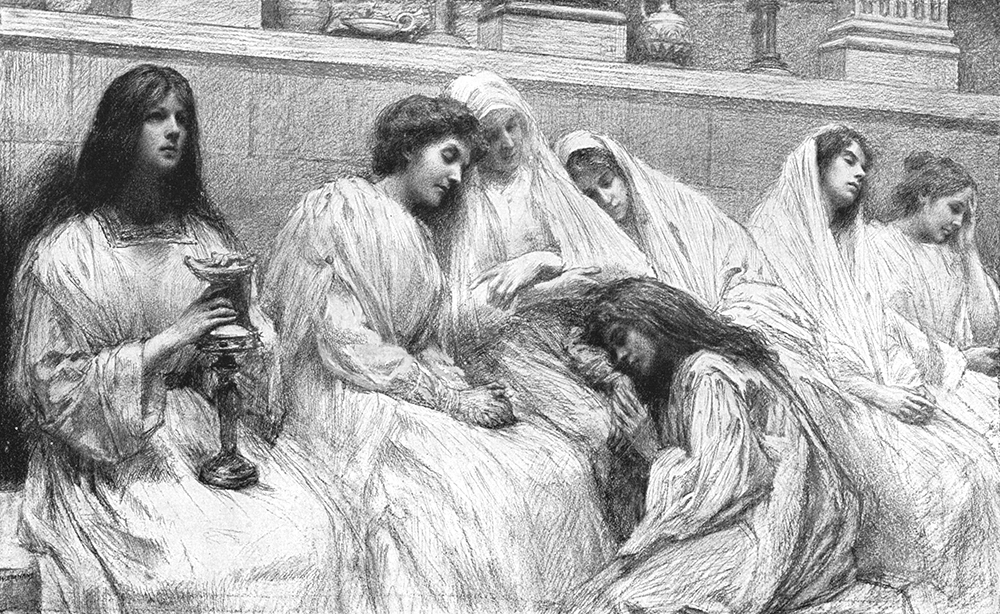
Art by Eugène Burnand

The Holy Club

John 8:31

Being a disciple of Jesus is serious business. We’re learning to walk in His footsteps, and we do this through God’s grace and mercy. It takes discipline, and that can be hard. In 1729 a group of Christian believers started meeting at Oxford University with the intention of becoming more accountable in their walk.

They became known as the “Holy Club.”

Here are 22 questions they asked themselves in their private times with Jesus.

  1. Am I consciously or unconsciously creating the impression that I am better than I really am? In other words, am I a hypocrite?
  2. Am I honest in all my acts and words, or do I exaggerate?
  3. Do I confidentially pass on to another what was told to me in confidence?
  4. Can I be trusted?
  5. Am I a slave to dress, friends, work, or habits?
  6. Am I self-conscious, self-pitying, or self-justifying?
  7. Did the Bible live in me today?
  8. Do I give it time to speak to me everyday?
  9. Am I enjoying prayer?
  10. When did I last speak to someone else about my faith?
  11. Do I pray about the money I spend?
  12. Do I get to bed on time and get up on time?
  13. Do I disobey God in anything?
  14. Do I insist upon doing something about which my conscience is uneasy?
  15. Am I defeated in any part of my life?
  16. Am I jealous, impure, critical, irritable, touchy, or distrustful?
  17. How do I spend my spare time?
  18. Am I proud?
  19. Do I thank God that I am not as other people, especially as the Pharisees who despised the publican?
  20. Is there anyone whom I fear, dislike, disown, criticize, hold a resentment toward or disregard? If so, what am I doing about it?
  21. Do I grumble or complain constantly?
  22. Is Christ real to me?

“We have suffered from the preaching of cheap grace. Grace is free, but it is not cheap. People will take anything that is free, but they are not interested in discipleship. They will take Christ as Savior but not as Lord.”

    Vance Havner

I sincerely hope that this blesses you.

Loving His Throne

“A Christian is not a person who believes in his head the teachings of the Bible. Satan believes in his head the teachings of the Bible! A Christian is a person who has died with Christ, whose stiff neck has been broken, whose brazen forehead has been shattered, whose stony heart has been crushed, whose pride has been slain, and whose life is now mastered by Jesus Christ.” 

-John Piper

Philippians 3:20, MSG

It seems to me that the purpose of our life is not to find our freedom. It’s really meant to find our Master.


But the idea of being a slave to anyone is repugnant. We chafe at this, and yet man was never meant to be separated from the Lordship of Jesus. We’re instructed repeatedly with the New Testament idea that “our life is not our own”  Over and over God proclaims Himself as the King.


That troubles us somewhat.

Not so much when life is fairly good, granted, but in those hard moments when a decision must be made between enjoying the titillating “lusts of the flesh,” or accepting the fruits of the Spirit. This is one of those “lordship moments.” They come and go, and they show us exactly who we are.


If you’re really going to be authentic–a legitimate and real disciple, then you must determine who is going to be in charge, and this isn’t one of those casual decisions. Your decision must become a settled issue.


You must securely fix the throne in your heart and spirit.

The thief on the cross knew salvation, he was promised an eternity with God simply by faith. But I submit to you that he had put himself under the Lordship of Jesus, simply by recognizing the sign, “the King of the Jews.” I believe he saw and understood its implications. Jesus was King! He knew and understood.


This is a very hard word for some, but so many of our personal issues hinge on this.


I know this first-hand. It is a monumental struggle. You must admit to not only having Jesus as your Savior, but you also must put your life under His total Lordship.  You need to pick up your cross daily in order to follow.  You need to learn how to kneel.


I’ve chosen a depiction of Jesus on His throne to open up this post–it’s done on purpose, even if it’s an artist’s take.  I simply want you to understand the supreme call He has on your life. Here’s Bob Dylan, and he nails this idea down:


But you’re gonna have to serve somebody, yes indeed
You’re gonna have to serve somebody
Well, it may be the devil or it may be the Lord
But you’re gonna have to serve somebody


You must learn, here and now, how to kneel before the Sovereign King

His Joy is Yours Now

Nehemiah 8:10, Amplified

The people of God are grieving; they are filled with sorrow. They are fully aware of their sin, and understand how awful they have become. They’re overwhelmed, and can’t really accept what God was doing.

Nehemiah and Ezra have their hands full.

Grief often turns into depression. Joyless living opens us to the pressures of Satan, and he tries to manipulate us to do his work. Now this is a terrible thing, and it’s also a sad way to live. Nehemiah understands what is happening.

Sometimes our emotions drive us, and we can see nothing but our sin. Our hearts are filled with melancholy and introspection. They closed their hearts to thankfulness and joy. Instead they wept, they could see little hope when Ezra read the Word from the pulpit.

Galatians 5:22 tells us that the Holy Spirit is residing within–it’s called “fruit” and it grows in the heart of an obedient believer who has submitted himself to God. It is not just a good attitude. Joy is never contingent on circumstances.

A few things to remember.

Joy is the evidence that He lives inside us. 

  1. We need a devotional life.
  2. Known sin must be renounced and forsaken.
  3. We must abandon the “works of the flesh.” (Gal. 5:19-20) 
  4. We must ask Him to fill us with His Spirit.
  5. We must learn how to worship authentically.

A key for me, I want to emphasize this, as I’ve finally seen this in my own discipleship– I need to pursue Jesus, and not joy itself. If I think that I will find joy apart from knowing Him, is wrong and perhaps a bit dangerous.

I will end this with something that must be thought through. I hope you will.

RC Sproul

Do You Belong in the Fellowship of Pain?

The hands of a leper

“In one of the villages, Jesus met a man with an advanced case of leprosy. When the man saw Jesus, he bowed with his face to the ground, begging to be healed. “Lord,” he said, “if you are willing, you can heal me and make me clean.”

Luke 5:12, NLT

The Bible text reveals a man who is desperate.  His leprosy has advanced; he is covered with it from ‘head-to-toe.’ He’s an outcast now, completely infected by something he never asked for; he is ‘unclean’ and completely without hope. There is no treatment, the doctors can do nothing.

The leper knows that without the touch of Jesus, he’ll never be healed. 

He knows it; he doesn’t need to be convinced by anyone over the complete hopelessness of his condition. He is lost. And yet he has heard that Jesus can do incredible miracles. Could it be that Jesus can heal his sickness? The leper comes and falls on his knees before the Lord, with his face in the dirt. This man is completely broken; he has no hope, except for Jesus. What else can he do?

Our diseases differ, but our lives have been completely changed by our pain. We all have this in common. 

Our pain and darkness vary. Some hurt more, some less. But we’ve all come to the place where we no longer have illusions of somehow being made whole. Whenever we meet, I think there should be a secret handshake or a password. We all share a comradeship— we’re all part of the same community.  We’re a broken club of tired and decidedly unclean misfits.

We belong to the fellowship of pain.

Lying in the dirt, we start to believe the unbelievable.  Our faith doesn’t activate our healing, as much as it simply guides us to Jesus. We can kneel, and perhaps that’s all we need to do. His presence drives away the fear, the doubt, and the pain. He’s come, and somehow we begin to hope for mercy. Only he can carry us through this.

In times past I’ve struggled with deep dark depression. I’ve had to take meds.  But when I come into Jesus’ presence, all my melancholy is driven out. He comes and I start to hope again.  Am I a stellar example of perfect discipleship?  I think not. But isn’t about us becoming “angels,” perhaps it’s more about us learning how to kneel, and to allow Jesus to touch our hearts.

You must do this, repeatedly.

“The power of the Church is not a parade of flawless people, but of a flawless Christ who embraces our flaws.”

“The Church is not made up of whole people, rather of the broken people who find wholeness in a Christ who was broken for us.”   

–Mike Yaconelli

alaskabibleteacher.com

Modern Idolatry, Plain and Simple

“The human heart is an idol factory.”

John Calvin

The definition of idolatry, according to Webster, is “the worship of idols or excessive devotion to, or reverence for some person or thing.” Idolatry is real, and it’s really a challenge to the believer, and it’s seldom mentioned today. In almost 40 years of following Jesus, I honestly can’t remember one real sermon on idolatry. That’s sad.

In fact, one of the first commandments given by God is in Exodus 20:3, “You shall have no other gods before me.” This has never been rescinded. It’s not obsolete or old-fashioned. The unredeemed human heart remains a factory of idolatry. Nothing has changed.

“An idol is anything that replaces the one, true God. The most prevalent form of idolatry in Bible times was the worship of images that were thought to embody the various pagan deities.”

So what is modern idolatry –what does a modern idol look like?

To help clear that up, Nicholas McDonald wrote a letter to you from the perspective of your very own, personal idol. (The last line is definitely a whopper.)

Hello. I am an idol.

Don’t be afraid, it’s just me. I notice you’re turned off by my name: “Idol.”

It’s okay. I get that a lot.

Allow me to rename myself.

I’m your family.

Your bank account.

Your sex life.

The people who accept you.

Your career.

Your self-image.

Your ideal spouse.

Your law-keeping.

I’m whatever you want me to be.

I’m what you think about while you drive on the freeway.

I’m your anxiety when you lay your head on the pillow.

I’m where you turn when you need comfort.

I’m what your future cannot live without.

When you lose me, you’re nothing.

When you have me, you’re the center of existence.

You look up to those who have me.

You look down on those who don’t.

You’re controlled by those who offer me.

You’re furious at those who keep you from me.

When I make a suggestion to you, you’re compelled.

When you cannot gratify me, I consume you.

No—I cannot see you, or hear you, or speak back to you.

But that’s what you like about me.

No—I am never quite what you think I am.

But that’s why you keep coming back.

And no—I don’t love you.

But I’m there for you, whenever you need me.

What am I?

I think you know by now.

You tell me.

I hope this helps. And I hope God gives you understanding.

alaskabibleteacher.com

He’s Inside of You

Ephesians 3:14-18

Prayer often does what preaching can’t. Some need a reminder. This idea of being “rooted and grounded in love” is crucial to growing up Christians. And it most often happens when the preacher is driven to his knees by a sticky situation.

After over 30 years I’m starting to see that my teaching has certain limits, but prayer on the other hand, always drives discipleship home.

You must settle on this spiritual fact, only a disciple can make a disciple. Too many preachers are believers themselves who don’t have a real prayer life. They end up using the pulpit (and the worship) as their sole ‘means of support.’ I can guess you can see how tragic this becomes.

A prayer meeting is almost unheard of lately, but I still believe that there are small groups of Christians who believe that both doctrine and prayer are God’s way of growing us up into His image. These two must be blended before real growth can begin.

“Strengthened with power through his Spirit in your inner being.”

Prayer is Paul’s way of building up the Ephesian church. In my personal opinion, he was locked up in a Roman prison for a couple of good reasons–the first is that he would discover he could disciple at a distance. And second that his prayer was an exceptional way to build the Church. Paul starts to understand this, and he rediscovers a new way to pray.

Paul’s prayer becomes a tool of considerable force.

Ephesians 3 papyrus from c. 275 A.D.

from wikipedia.org

The “inner being” is what he’s aiming at, and it’s Paul’s way of touching the heart of anyone the Holy Spirit is dealing with. Mr. Dry Eyes will never reach  the hearts that the Father is working in. Rather Mr. Crying Tears does the Father’s work. It’s not impeccable logic or great theology that completes the work, but the deep, deep cry of the heart.

So that Christ may dwell in your hearts through faith—that you, being rooted and grounded in love,

The immense power is Jesus living inside of us. Faith is God’s own key that He gives. Love is our root; it helps us grow. It gives us stability which is critical living in a confused and fallen world.

 Sadhu Sundar Singh

How to Die Well

“Even though I walk through the valley of the shadow of death, I will fear no evil, for you are with me; your rod and your staff, they comfort me.”

Psalm 23:4, ESV

“Precious in the sight of the Lord is the death of his saints.”

Psalm 116:15

“Death is like my car. It takes me where I want to go.” 

Pastor John Piper

Our generation simply doesn’t know how to die well.  There are many conflicting messages and attitudes which have steered us away from the reality of dying.  Much of it is the natural development of unbelief.  Our pop culture develops this and gives it momentum.  We are trying to convince ourselves that “death is impossible, my life will not end.”  But we’re escaping into a delusion. And it only intensifies as we age. 

We are running from what is real.

There is a Latin phrase,  Ars moriendi  (“The Art of Dying”) which the Church practiced in past generations.  In the past, Christians would be buried as close as possible to a Church building.  Many would be interred within the very walls of the Church.  The understanding was that the dead were part of the congregation.  That there was only a thin veil that stood between the living and the dead.  

The dead didn’t just vanish. They still live. We just don’t see them.

Our generation is confused.  We have forced death to wear a mask.  We insist on a significant camouflage to hide the reality of sickness and death.  No one really ever talks about it, and so no instructions are given on how to die well. So we don’t, and we die poorly–often in ICUs. We die sedated, separated and unable to process dying. We never help our families process it. 

For many, the fear of dying is intense and paralyzing.  

It’s time for the Church to step up and guide us to our next step.  Our pastors and elders have got to prepare us to die well.  It is a part of being a disciple.  It is discipleship, and dying is inclusive.  We need somebody to prepare us for the inevitable and the certainty that is approaching us.  I need someone that will help me face my own death.

You know what?  No one escapes.  

And the reality of that drives some of us mad, or addicted, or psychotic.  The idea of filling a casket up for forever is incomprehensible.  We cannot live with this sick idea of dying.  It disturbs us on the deepest level possible.  It is completely evil.

Psalm 23 has been pure comfort and healing for generations.  And it is an excellent starting point for us.  Verse 4 develops the idea of traversing death.  The writer has incredible insight of passing through death.  This verse alone is worth billions of dollars in gold.

Psalm 23 has been pure comfort and healing for generations.  And it is an excellent starting point for us.  Verse 4 develops the idea of traversing death.  The writer has incredible insight of passing through death. Psalm 23 has made me a very wealthy man.  His Word has become my rich treasure.

“Some day you will read in the papers that D.L. Moody of East Northfield, is dead. Don’t you believe a word of it! At that moment I shall be more alive than I am now; I shall have gone up higher, that is all, out of this old clay tenement into a house that is immortal- a body that death cannot touch, that sin cannot taint; a body fashioned like unto His glorious body.”

    D.L. Moody

But God…

But God, being rich in mercy, because of the great love with which he loved us, even when we were dead in our trespasses, made us alive together with Christ — by grace you have been saved.”

(Ephesians 2:4–5)

But God. Short words with a powerful meaning, used over 4100 times in the Bible (every 7 verses). It’s used to imply intervention and change, typically a holy interruption of some kind. This verse in Ephesians 2 describes the Father getting involved in a tangible way.

We were terribly lost–actually the Bible says, “dead.”

But He is rich in love and mercy, and it’s grace (and only grace] that makes us alive. Now we’re not reformed or rehabilitated. These are good words, but the verse describes a resurrection–a revivification. The dead live!

Jesus actually resurrects each believer.

“But God.” Joseph learned that “all things work together for good.” His brothers cruelty sold him into slavery and even though he endured prison, he would become the prime minister of Egypt. After many years his wicked brothers come before him. Revenge? Not on your life.

“As for you, you meant evil against me, but God meant it for good in order to bring about this present result, to preserve many people alive.

Genesis 50:20

Let God have His way with you. Acknowledge His sovereignty by allowing Him to interrupt when He wants to. He is active in our lives. Having resurrected us from the dead, the Holy Spirit becomes actively involved in our lives (and He brings us grace and beauty).

If you do this, I expect great things for you.

“My flesh and my heart may fail, But God is the strength of my heart and my portion forever.”

Psalm 73:26


Lower Seat Christians

Luke 14:7-11

Choose your seat carefully. In Jesus’ day, there was a definite seating order to a wedding feast. It wasn’t first come, first served. There was a strict protocol, where one’s importance mattered. Honored people got honorable seats–close to the front as possible. Average people got average spots; but no one wanted be at the bottom, having to sit at the “kids table.”

Jesus was watching, and what he saw was a spiritual principle of His Kingdom.

Jesus often teaches out of the things we encounter–real life events. Spiritual truth often hits us from those things we actually see. If you want to know what God is doing in your life, all you need to do is look around at the “practical” things, and start to see the spiritual lessons inside them. We learn from real-life. That’s how he often teaches us, he combines the Word with what we’re experiencing.

Our natural inclination is to move higher up.

We often think that we’re deserving, and so we take our “rightful” positions. That’s the way humans think. We all want to sit in the best possible place, and so we end up wheedling our way up front. We can fall into the subtle trap of self-promotion. But that’s not how discipleship works.

Jesus corrects, advising us to take the lowest place. I think verse 11 is the key to figuring out this seating arrangement. We’re starting to see a physical situation become a spiritual lesson. There’s much to learn. Here’s verse 11 in the Amplified version:

“For everyone who exalts himself will be humbled [before others], and he who habitually humbles himself (keeps a realistic self-view) will be exalted.”

Verse 14, Amplified Bible

This translation injects some realism into our lives, especially in how we see ourselves. It’s something quite foundational. It lays down a principle that is always true in his Kingdom (1 Peter 5:6). If we don’t accept and implement this, we’ll suffer a definite deficiency in our discipleship. It stunts the growth of many believers. And that is tragic.

The whole scene lays out how life in the spirit really works, and it seems terribly paradoxical.

Our human logic asserts that deliberately choosing the lesser is foolish, things really don’t work that way. We think (falsely), that we’ll only advance by asserting ourselves. But Jesus, quite aptly, clarifies the ways of the Kingdom–true maturity will only come if we decide to take the lowest place.

“Humble yourselves before the Lord, and he will exalt you.”

James 4:10