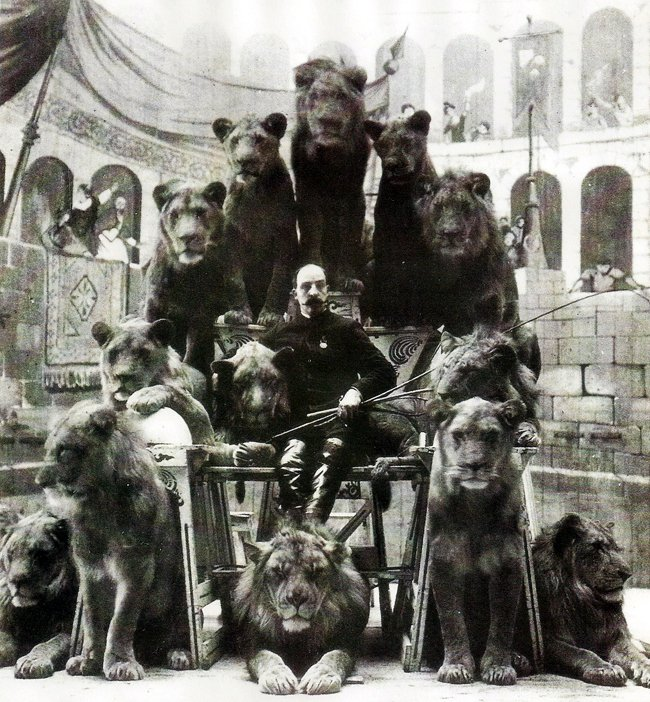
Daniel, the Lion Tamer

Daniel 6:22-23, ESV

I am rather frustrated with myself. I confess I haven’t read Daniel in years, and I’ve chosen to rectify this. Lately I’ve busted through this book and discovered some wonderful stuff. I guess chapter 6 has become my favorite.

A couple of things stick out.

Daniel was an incredibly faithful man, praying three times a day. He was true-hearted who served each king with the gifts God had given him. I like him a lot.

Daniel became the king’s favorite, the Hebrew word used means “prominent or esteemed.” He was the greatest and best there was to be found. You could say that he was the finest man in the kingdom.

Daniel knew how to lead and direct others. We read that he oversaw 120 chief overseers. I suspect he knew a thing or two about good leadership. Daniel understood his work, and it seems that he instinctively knew what good government required.

But Daniel was a victim of jealousy. A concerted effort, carefully planned and directed was meant to destroy him. Although the leaders of this rebellion could find nothing to accuse him of, they resorted to trap him because he prayed to God. Faithfully and consistently.

Their plot worked. These officials, through their twisting and manipulation of the legal code, were able to sentence Daniel to death. It seems being fed to hungry lions was the penalty for “breaking the law.”

Sometimes we must choose to serve God, even if it means breaking men’s laws.

Acts 5:29

Daniel was over 90 years old when he was thrown to the lions. Even in his advanced years he kept up serving God. The passage declares that he had “an excellent spirit.”

The lions, (several I assume), were not at all interested in devouring Daniel. King Darius however was incredibly distraught over Daniel’s execution, but it seems he was forced into it. The passage tells us that the king was so distressed that he couldn’t sleep that night.

Undoubtedly, Daniel slept far better then Darius.

To be faithful to the Lord God may require us to sleep with lions, but we can be assured of the Holy Spirit’s presence with us even then. A verse in Hebrews suggests “faith” protects us from the strong jaws of the enemy. Daniel understood.

Hebrews 11:33

But yet, sometimes even the faithful will be eaten.

Sometimes the lions will devour believers. But we must trust and believe no matter what happens. Hebrews goes on to show us the extremity of the faithful. Read Hebrews 11:35-38 and you’ll understand what I mean. Being faithful can be very difficult. Bad things often happen.

*****

     Thomas Watson

alaskabibleteacher.com

The Brother and 5080.4 Miles

21 “So that you also may know how I am and what I am doing, Tychicus the beloved brother and faithful minister in the Lord will tell you everything. 

22 I have sent him to you for this very purpose, that you may know how we are, and that he may encourage your hearts.”

Ephesians 5:21-22

There is so much here that communicates Paul’s heart. He’s laid out a ton of theology, and now he ends his heavy letter with this final benediction or blessing. These final verses are not doctrine. Instead they’re more like God’s ‘open window’ directly to the Ephesian’s heart.

Just imagine yourself as a believer living in Ephesus. Reading the letter we should see ourselves there (albeit 2000 years removed). This belongs to you as much as it belonged to the churches in Asia Minor. Please, own it.

You need to see this. It changes our walk from the 1st century to the 21st century.

This letter belongs to you personally. Ephesians is your letter from ‘home.’ So dear one, make it yours, for you are the Holy Spirit’s audience, and you’re very much loved!

Tychicus has been chosen to carry this letter 5,000 miles to the Ephesians.

The journey itself was over 5,000 miles from Rome to Ephesus, walking by Roman roads. (It would be a long trip, longer than walking from San Francisco to Boston!) It was difficult and could be dangerous, but the letter Titus carried was important. It would be painstakingly copied and then sent to all the churches in Asia Minor.

(https://cloudofwitnesses.org.uk/studies/tychicus)

Tychicus is mentioned 6 times in the NT.

He was a gospel ‘veteran’ who ministered with Paul in various places in the Roman empire. It appears he was friends with Timothy, who was the young pastor of the church in Ephesus. Tychicus was someone whom Paul trusted implicitly. After all, he was carrying Paul’s heart in his backpack.

Tychicus was 100% loyal, brave, and completely reliable. I think Paul had confidence that he would do everything necessary to make sure this letter would get through. We find he was able to do this. And you and I, well, we owe a spiritual debt to this faithful man who went the distance for us.

We can skim through this passage and never really see Tychicus at all.

Tychicus seems to have no real preaching ability, but he is called “beloved” and “faithful” in verse 21. In verse 22 he is called a “brother” and a “minister.” That word for minister is διάκονος, deacon and it means “a servant of a king” or a “waiter of tables.” I believe that reveals someone who is a minister to the needy (which is no small thing).

Paul closes his letter with a benediction.

In verses 23-24, we read that the blessing is given to the church. He pronounces “peace, love, and faith.” Paul speaks out of God’s heart to the Ephesians, and as a leader, he is conveying God’s own blessing. A proper benediction that originates from the Lord is hardly just a nicety, something free and easy. You must understand, a pastor’s blessing is powerful.

“Grace be with all who love our Lord Jesus Christ with love incorruptible.”

(verse 24)

alaskabibleteacher.com

The Real Glory of the Real Jesus

Mark 9:2-8, ESV

“And after six days Jesus took with him Peter and James and John, and led them up a high mountain by themselves. And he was transfigured before them, and his clothes became radiant, intensely white, as no one on earth could bleach them. And there appeared to them Elijah with Moses, and they were talking with Jesus. 

“And Peter said to Jesus, “Rabbi, it is good that we are here. Let us make three tents, one for you and one for Moses and one for Elijah.” For he did not know what to say, for they were terrified.” 

And a cloud overshadowed them, and a voice came out of the cloud, “This is my beloved Son; listen to him.” And suddenly, looking around, they no longer saw anyone with them but Jesus only.”

I could go a hundred different ways with this passage. After much thought (disorganized most of the time) I’ve decided to go with the following. I know deep down how deficient it is, and I know you have much to add to it, which is very good.

But what I do understand I give to you.

The more I try to process Mark 9 the more I see things that are wildly significant. What happened there was radical, and I realize that I still don’t have a solid grip on it, and if I did I know deep down it’d change my life.

  • James, John, and Peter. Why these three? Some have suggested that these particular disciples were the ones who desperately needed to see what was going to happen. That’s very possible. Perhaps they were the weakest, and maybe they needed to see the real Jesus in His glory. My personal view is that these three wrote books, epistles. Maybe Jesus understood this, and gave them this earth-shaking experience?
  • The impact on Peter was profound. “”For we did not follow cleverly devised stories when we told you about the coming of our Lord Jesus Christ in power, but we were eyewitnesses of his majesty. 17 He received honor and glory from God the Father when the voice came to him from the Majestic Glory, saying, “This is my Son, whom I love; with Him, I am well pleased.”  We ourselves heard this voice that came from heaven when we were with him on the sacred mountain.” (2 Peter 1:16-18).
  • Toward the end of Peter’s life he couldn’t shake the Transfiguration and what he witnessed there. He recalled the “glory” but it seems it was the voice that was the most profound. It was that voice that completely altered his life and ministry. (Notice that he mentions it twice in verse 18.)
  • The Greek word for “transfigured” is metamorphosis. (Like a butterfly coming out of a cocoon.) Jesus wasn’t put in some spiritual “spotlight,” rather the glory that was seen was coming from inside Him. We see that He was God and Jesus revealed Himself clearly as God. The three disciples who were witnesses seem to struggle with exactly what took place. They use human analogies and images to try to explain to us what they saw.
  • The word “terrified” is the word phobia. Could it be that our encounter with God could go to that extreme? Could we be that we could be terrified in His presence? Does that fit into our theology? You need to decide if it’s significant or not.
  • And what about Moses and Elijah? Most feel that each represented the Law and the Prophets. I must point out that both had ministered from the top of mountains before? But notice, even though Jesus emanated extreme glory, these two did not. Also, the arrival of these two reinforces the real world of life after death. Both Moses and Elijah were very much alive!
  • The “human” part of Jesus was temporarily set aside. We know that Jesus was fully man, but here we see Him as He really is–fully and completely God. What a revelation! The three disciples were profoundly touched. Seeing the power and glory of the Creator of the universe on the top of the mountain altered their lives and changed their ministry.
  • John would write his Gospel and three letters. James wrote the first book in the NT. Peter is credited with the Gospel of Mark and his two books. They “knew” exactly who Jesus was! They had become fully convinced and needed no theological explanation. They finally understood!

So much more should be considered.

What I’ve written today is so incomplete–I feel a little foolish putting this down in this post. But yet I’m actively praying for you that this might add to your understanding. The Transfiguration is profound. It certainly needs to be internally processed by every real believer. And for those who don’t know Jesus yet, I hope you can understand exactly who He is to us who believe.

“In the beginning was the Word, and the Word was with God, and the Word was God.  He was with God in the beginning.  Through him all things were made; without him, nothing was made that has been made.  In him was life, and that life was the light of all mankind.  The light shines in the darkness, and the darkness has not overcome it.”

John 1:1-4, NIV

alaskabibleteacher.com

Our King and Our Master

A Kings Crown and the Crown of Thorns


A Christian is a person who has died with Christ, whose stiff neck has been broken, whose brazen forehead has been shattered, whose stony heart has been crushed, whose pride has been slain, and whose life is now mastered by Jesus Christ.”

–John Piper

No longer do I call you servants, for a servant does not know what his master is doing; but I have called you friends, for all things that I heard from My Father I have made known to you.”

John 15:15

It seems that the purpose of life is not to find our freedom. It’s really meant to find our Master.

Yes, the idea of being a slave to anyone is repugnant. We chafe at this, and yet man was never meant to be separated from the Lordship of Jesus. We’re instructed repeatedly with the New Testament idea that “our life is not our own”  Over and over God proclaims Himself as the King.

That troubles us somewhat.

Not so much when life is fairly good, granted, but in those hard moments when a decision must be made between enjoying the titillating “lusts of the flesh,” or accepting the fruits of the Spirit. This is one of those “lordship moments.” They come and go, and they show us exactly who we are.

If you’re really going to be authentic–a legitimate and real disciple, then you must determine who is going to be in charge, and this isn’t one of those casual decisions. Your decision must become a settled issue.

You must securely fix it in your heart.

The thief on the cross knew salvation, he was promised an eternity with God simply by faith. But I submit to you that he had put himself under the Lordship of Jesus, simply by recognizing the sign, “the King of the Jews.” I believe he saw and understood its implications. Jesus was King! He knew and understood.

This is a very hard word for some, but so many of our personal issues hinge on this.

I know this first-hand. It is a monumental struggle. You must admit to not only having Jesus as your Savior, but you also must put your life under His total Lordship.  You need to pick up your cross daily in order to follow.  You need to learn how to kneel.

I’ve chosen a crown to open up this post–it’s done on purpose.  I simply want you to understand the supreme call He has on your life. Here’s Bob Dylan, and he nails this idea down:

But you’re gonna have to serve somebody, yes indeed
You’re gonna have to serve somebody
Well, it may be the devil or it may be the Lord
But you’re gonna have to serve somebody


You must learn here and now how to kneel before the Sovereign King


alaskabibleteacher.com

Nothing More Than a Child

A song for going up to worship. Of David.

Psalm 131

The Christian who is struggling should become a reader of the Psalms. We must remind ourself of this need to study through them, repeatedly. For believers, Psalm 131 is mandatory, and this is a great place to start.

This particular psalm is unique, and incredibly insightful.  It begins its work in us right at the start; the superscription.  “A song for going up to worship,” and it strikes me that a work must happen inside of my heart.  It is a preparation that will take me higher, and it helps me see God more clearly from a new vantage point. 

Verse 1 states the certain issue we have; it is called ‘pride.’  What David says seems to be a very arrogant and audacious thing to say.  There is a truism that you think you’re humble, you’re not.  To claim you are suddenly liberated from pride, knowing ears perk up.  It is almost always a sign of danger.

😁

Take it at face value, David states that he has a real contentment with his limitations and weaknesses.  It appears that he has been freed from the vicious cycle of needing to be the center of everything. He sings of his ignorance, and weakness. David goes public with his self-flattery. He knows that if he really wants to ascend he must descend.

And it must happen continuously.

Some make themselves spiritually sick by the deep dark quest to be important.  In verse 2, we connect with some astonishing imagery.  A baby!  I am like a little child being held by my mom. It’s not an issue of sophistication, but simplicity. You must choose to do this.

The word for weaned isn’t a newborn here. Rather in Hebrew it denotes a small toddler.

A weaned child no longer needs his mom’s milk. He doesn’t fuss, or nuzzle his mother’s breast, demanding his food.  The child no longer receives his nourishment this way. 

This is a significant step into maturity. To me, verse 2 is the centerpiece of Psalm 131.  OK, let’s apply this spiritually.  There was a time when it was necessary for me to have my mother’s milk. I screamed and would throw a terrible tantrum if she didn’t feed me from her breast.  I would starve if she didn’t give me her milk.

For all practical purposes, it seems we use God to get what we need.  But we grow, and become mature. David is saying that we need to emulate his example. 

Now we can come into God’s presence– just to be with Him.

That’s all.  So simple.  As a child, we just want to be where He is at.  We have no ulterior motives, there is no manipulation.  We seek His face, not what is in His hands. If we rightly connect the dots, we find that we land right back to that opening superscription

“A song for going up to worship.

This is an amazing concept of true adoration– the real kind.  As a struggler, more a rascal than Christlike, I must start at the beginning– again, and again, and again. I can only do this if I become a little boy again. 

I finally start to realize that I must renounce my selfish ambition and silly pride. Polished people won’t understand, they never will.

Matthew 11:25

alaskabibleteacher.com

Like the Stars Forever and Ever and Ever

“And those who are wise shall shine like the brightness of the sky above; and those who turn many to righteousness, like the stars forever and ever.”

Daniel 12:3, ESV

“But we all, with unveiled face, beholding as in a mirror the glory of the Lord, are being transformed into the same image from glory to glory, just as from the Lord, the Spirit.”

2 Corinthians 3:18, NASB

In my teenage years, my mom and I attended a series of services in a Christian commune.  (This would’ve been in 1972 -73.)  They all lived in a single house and had started a Christian rock and roll band. (They were pretty good too.) And they knew how to pray.

I was impressed with what I saw. 

When they gathered together for worship, they began to ‘glow.’  I would stare at them as they became ‘illuminated.’ I had never seen anything like this before.  The presence of Jesus was there making Himself known in the hearts of His disciples.

I had been given eyes to see the supernatural.

Since then I have heard many testimonies of that same dynamic at work.  Confessing believers engaged in prayer and worship, have their countenance changed while in the Lord’s presence.  Peace, joy and confidence shines through them in a profound way.  Their physical appearance is altered, and they unconsciously proclaim ‘a peace that passes understanding.’ 

I can’t really explain it in any other way.

Since I became a Christian in 1982, I have retained those images in my thinking.  I’m now very aware of the “witnessing presence’ of Jesus in the lives of His people.  And scripture itself, on several occasions, points to this wonderful dynamic in action in the lives of consecrated believers.

When the light comes, it can’t help but transform those of us in darkness.  Our faces, hearts, and countenances change. We’re the human vessels for peace and joy (especially knowing our sins are forgiven).


The prophet Daniel talks about ‘shining like a star.’ I don’t think this really sinks in. Perhaps the ‘here and now’ seems all we can handle.

‘Shining like a star’ isn’t possible in the mechanics of normal life as an unbeliever (at least for any real length of time).  That simply can’t be manufactured.  The only possible answer is the Christian’s faith.  Namely, that Jesus Christ who is indwelling every believer, reflects His presence out into a dark world.

“O worship the Lord in the beauty of holiness” Psalm 96:9. Perhaps that beauty is more tangible than we think. I’ve always interpreted this as holy believers that shine (or glow) with His presence.

A few winters ago I was out walking on the Alaska Bible Institute campus.  Twilight was quickly settling in, and 20-30 yards ahead I saw a child’s sled left in a snow pile.  In the monochromatic world of an Alaskan winter, that ‘shining’ sled glowed and couldn’t be missed.

I believe that you and I who bear His presence become fluorescent to certain people. 

But we can’t conjure it up on our own. His activity in our hearts makes us astonishingly conspicuous.  We can’t hide His presence (even if we sin). We have been irrevocably changed by the Spirit’s residence.  We have become ‘glow-in-the-dark’.

Perhaps this is how it supposed to work?

Matthew 5:14

alaskabibleteacher.com

Please Let the Children Come

Luke 18:15-17, ESV

We were wrong. I suppose we were trying to maximize Jesus’ ministry. We were there to give Him some much ‘needed’ organization. We simply felt that Jesus’ time was our concern, and we as His disciples wanted Him to connect with those who really mattered. We kept people out and let others in.

But the parents were bringing their children to be blessed by Jesus.

“It was the custom for mothers to bring their children to some distinguished Rabbi on the first birthday that he might bless them.”

William Barclay

We had far more important stuff that needed to be done.

Jesus’ ministry was for adults. There were lepers, demon-possessed, paralyzed, tax-collectors all waiting for His ministry. Somehow we overlooked the needs of little children. Again, we were wrong, misguided, and ignorant of the walk of the true believer.

Jesus made it clear that these children needed to be the focus of our ministry. Our efforts were not to be centered on adults, rather it was misguided thinking on our part to let this happen. We wanted to focus on Jesus’ ministry on those we thought were important.

These little ones kept getting in the way.

And sure enough, Jesus explained to us what we were missing. Children were to become our focus. They were the ones who we were to emulate and esteem. The radical thing to us was understanding that these ‘little ones’ were that significant. This was a powerful jolt, and not at all what we expected.

“Let these children alone. Don’t get between them and me. These children are the kingdom’s pride and joy. Mark this: Unless you accept God’s kingdom in the simplicity of a child, you’ll never get in.”

Luke 18:16-17, The Message

This rocked our world! It was nothing less than another strange thought from our Teacher. Accepting this wasn’t easy, but Jesus was crystal clear. We dare not think otherwise, and yet it was against all we thought we understood.

Jesus understood that childlikeness was the only way we could enter His Kingdom.

Up to now, we assumed that maturity meant something like sophistication. It was all about right thinking and good theology. That was what God was looking for. We assumed that being simple wasn’t quite what Jesus wanted from us. Rather we believed the opposite.

Children were now to be our examples. Their simpleness was to be our guide–it was the Kingdom of God’s doorway into true discipleship.

Who would have guessed?

Beth Moore

alaskabibleteacher.com

Against Rulers and Forces

10 Finally, be strong in the Lord and in the strength of His might. 11 Put on the full armor of God, so that you will be able to stand firm against the schemes of the devil. 

12 For our struggle is not against flesh and blood, but against the rulers, against the powers, against the world forces of this darkness, against the spiritual forces of wickedness in the heavenly places.

Eph. 6:10-12, NASB 

Paul tells us that discerning the cosmic forces of wickedness is now critical. If we choose to ignore his words and make them optional, we will become spiritual toast. We need to hear reality. We want to be told the truth. And the truth is that we’re neck deep in spiritual alligators.

Point blank: We were each born for battle. Every believer must wear armor.

This passage in Ephesians 6 stresses that there is something sinister, an organized force, something evil, a darkness that’s focused directly on us. Verse 12 unveils to us a veritable government of wickedness. Satan leads his demons out with the intention of confusing believers and destroying holiness.

We also need to understand that human beings have a terrible knack of walking in their sin, and also by being manipulated by evil forces. Human history bears this out. We have a lousy track record. Without the Spirit we will be lost and destroyed by our own darkness.

Christians are to see life very differently than others do.

Ephesians 6 teaches us to find strength in being connected with God, which is critical to walk through in this confusing darkness. By prioritizing our relationship with Him, we can draw upon His strength and a sincere faith to navigate through all of this.

Without intimacy there is no obedience and there can be no real victory.

You must come to him humbly and holy, and sit before Him and listen, learn and love. And that is the major step in true holiness. Being controlled by Him means when you need to, you can stand and deliver damage to Satan’s kingdom.

You’ll be leading angels in this terrible battle! They have their swords drawn and are quite capable. Remember that this is a spiritual war–not physical. Your attack must be fought on your knees. And angels, they’re watching and listening to you as you pray. They are God’s messengers to protect you.

Satan presses us hard through redirection and forgetfulness of who we are.

Without the humble intimacy that can only grow on prayer and Bible reading, we will be spiritually destroyed. We need the protection of the Presence. Please don’t forget this; you need Jesus more today than yesterday. You must come closer. He will help you.

You see, your only hope is in Jesus’ strength and intimate love for you.

We must reach for our power and grab upon this intense love. We can only become strong through our intimacy with Jesus. He shields us from the spiritual corruption that swirls all around us. As we draw to Him we become mighty, as we listen closely to the Holy Spirit, we will walk in true discipleship with Jesus.

You will hear Him speak clearly to you, perhaps when you actively push to do His will than your own.

“We are a long time in learning that all our strength and salvation is in God.”

     David Brainerd

alaskabibleteacher.com

Walls Don’t Work Anymore

36 As they were talking about these things, Jesus himself stood among them, and said to them, “Peace to you!” 37 But they were startled and frightened and thought they saw a spirit. 

38 And he said to them, “Why are you troubled, and why do doubts arise in your hearts? 39 See my hands and my feet, that it is I myself. Touch me, and see. For a spirit does not have flesh and bones as you see that I have.” 

40 And when he had said this, he showed them his hands and his feet. 41 And while they still disbelieved for joy and were marveling, he said to them, “Have you anything here to eat?” 42 They gave him a piece of broiled fish, 43 and he took it and ate before them.

Luke 24:36-43, ESV

In the most thrilling moments of a story, there are instances when the true essence of the events becomes crystal clear. Luke’s narrative brilliantly captures that exhilarating sensation. Picture this: Jesus, triumphantly risen from the depths of death, enters the room with a burst of energy that electrifies everyone present. It must have been one of those extraordinary instances where words simply fall short, and experiencing it firsthand is the only way to truly grasp its profound impact.

“Frightened” and “terrified”–it seems it takes two words to describe this spooky experience. 

Everyone was terrified; they were convinced that Jesus must be a ghost. They all panicked and tried to run to the nearest exit, but then realized that the door was still locked!

Oh boy, Jesus must have had a good chuckle over this one! I mean, imagine being a human and seeing your disciples, all stooped and scared, trying to approach you like a bunch of timid puppies. It’s like trying to get a dog to come to you when it’s so terrified it’s peeing on the floor! I bet Jesus couldn’t help but smile and think, “What a hilarious sight!”

They slowly encircle Jesus and as they come, I have to believe He’s amused. He has survived a very brutal cross, and walked through hell. And, He has risen from the dead.

He is laughing from the pure joy of one who has endured the worst of a very real hell.

Jesus emerged unscathed on the opposite end, a testament to his invincibility. His arrival has undoubtedly filled him with undeniable joy, surrounded by beloved companions. In his triumphant resurrection, he defied all odds and accomplished the unimaginable, evoking a cascade of profound emotions, a mingling of laughter and tears.

I believe each of us has walls. 

Walls can provide a sense of security and protection, both physically and emotionally. People often feel the need for boundaries and walls to feel safe. This is similar to how disciples found safety in numbers and the walls around them. They were afraid, and so they hid themselves.

Jesus insists on penetrating our walls.  He’s overcoming much resistance and delusions. And then suddenly we come ‘face-to-face’ with the dead person who’s now alive. He is “The King of Kings and the Lord of Lords.

Behold, behold! Witness the magnificent display of unadulterated resurrection power—a force unparalleled in the vast expanse of the universe. Its brilliance eclipses the sun, its might surpasses that of the mightiest atomic bomb. Prepare to be astounded, for this power knows no bounds!

It’s funny, when Moses prostrated himself before the Lord’s glory, he changed.  Not only that, but he had to take precautions to cover his face when he returned to camp. These disciples however have just seen the glory of God first-hand.

As His disciples, we must be prepared for any eventuality.  Jesus can and will burst into our homes, and into our very lives.  Can you hear him laugh?  When he comes, nothing really is the same again.  He loves his disciples too much to leave them in a dark stuffy room.  They have work to do.

The resurrected Jesus is coming for you!

“Here I am! I stand at the door and knock. If you hear my voice and open the door, I will come in and eat with you, and you will eat with me.”

Revelation 3:20, NCV

alaskabibleteacher.com

The Whips of Jesus

John 2:14-17, NCV

 “In the Temple he found people selling cattle, sheep, and doves. He saw others sitting at tables, exchanging different kinds of money. 15 Jesus made a whip out of cords and forced all of them, both the sheep and cattle, to leave the Temple. He turned over the tables and scattered the money of those who were exchanging it. 16 Then he said to those who were selling pigeons, “Take these things out of here! Don’t make my Father’s house a place for buying and selling!”

17 When this happened, the followers remembered what was written in the Scriptures: “My strong love for your Temple completely controls me.”

He really did use a whip. The text tells us that Jesus carefully took some cords and made a whip by intertwining them. What can I say? I’m amazed at His response to what He saw happening in the Temple. Jesus saw deeply saddened Him to the point that there wasn’t anything else He could do.

It appears that there are three distinct whips in the N.T. that we should take into consideration.

  1. The one Jesus carefully braided to “cleanse the Temple.” (John 2:25.)
  2. The one used on Jesus’ back as part of our atonement. (Isaiah 53:4-6.)
  3. The one that believers experience in the ways God disciplines us as His children. (Heb. 12:6.)

All three are important to see. All three have their own meaning. The first one: The Temple is finally clean. The second one: He was punished for me. The third one: He intervenes in my life to make me a holy person.

The third whip is my focus here. He intends to sanctify us by correction. This discipline is the way Jesus separates us from our sin. We’re being disciplined in order to become holy people. Hebrews 12 explains the process.

“If ye endure chastening, God dealeth with you as with sons; for what son is he whom the father chasteneth not? But if ye be without chastisement, whereof all are partakers, then are ye bastards, and not sons.

Hebrews 12:7-8, KJV

God’s intention isn’t to inflict punishment upon us. His correction isn’t a way by which we make amends for our transgressions. It’s crucial to remember that Jesus has already taken upon Himself the full weight of our sins, fully satisfying any debt. He absorbed it all.

God, in His role as a loving father, corrects and guides us with deep affection.

It’s important to note that God’s methods of discipline do not involve any form of “spiritual child abuse” whatsoever. His love is extraordinarily good, it never wavers, never turns into something evil. He patiently works His will, using loving and healing hands.

“For the moment all discipline seems painful rather than pleasant, but later it yields the peaceful fruit of righteousness to those who have been trained by it.”

Hebrews 12:11, ESV

God has corrected me a 1000 times throughout my 40 years of following Him.

Not with a leather whip mind you, but a braided spiritual cord of correction. What He saw taking place in the marketplace of “me,” (my temple), brings Jesus grief and sorrow. I’m the temple of the Holy Spirit, and He fully intends to make me pure inside. Hebrews 12 tells me what to expect as a son. I need to be corrected.

It’s good to ponder this.

Isaiah 53:5, (context. 4-7)

Yes, a “whip” will be used, but cautiously, even though it may hurt us. Jesus will never intentionally correct you beyond what you can handle.

These three whips are vital, they educate us about the Lord’s efforts. They help us to comprehend and experience God’s workings. As much as we’re able, we must embrace them.

God’s corrections are our instructions; His lashes our lessons, and His scourges our schoolmasters.

     James H. Aughey

alaskabibleteacher.com