Under the Knife

John 15:2, ESV

 “Dead wood is worse than fruitlessness, for dead wood can harbor disease and decay…God removes the dead wood from his church and disciplines the life of the believer so that it is directed into fruitful activity.”

Merrill C. Tenney

It takes a sharp eye and a sharper knife to do the Father’s work of cutting.  He slices to the quick, and all that is not useful falls to the ground.  The vine must produce grapes, and every bit of “grape-energy” needs to be used productively. Fruitlessness will be cursed, sterility is condemned. This is a hard choice to make.

I want to encourage you though–fruitless believers can possibly become fruitful ones. 

Understand, the vine dresser isn’t attacking the vine with his knife.  He is not malicious or vengeful.  All that He does is for the good of the vine.  He is motivated to produce fruit.  That is what He thinks about as he cuts away the dead branches.

Pruning and fruit are concepts that we vacillate over, some days we understand and other days we don’t.  After over 40 years, I’ve heard every “John 15 sermon” known to man.  And most of the time I turn down my spiritual hearing aid. That is tragic–I listen, but I don’t listen.

I need to grapple with this imagery.  If I don’t, bad things are bound to happen.

For years I have asked God to “show me His ways.” I’d like to believe that this understanding of pruning has changed me.  I would like to think that I have attained a clearer view of wisdom.  This pruning business is all well and good.  But being sanctified by the knife is decidedly unattractive and uncomfortable.

I grew up in the northwoods of Wisconsin and wondered if the trees that were designated with a ‘red X’ understood that they were the ones to be cut down by the lumbermen. I wondered if these trees that were marked with spray paint understood what was up? (Maybe they felt special with their new found prestige?)

You will be pruned!

I completely and absolutely declare this to you. (It’s one of those “thus says the Lord” moments.) Pieces of your life are earmarked to be lopped off. You will probably not understand why and you will chafe at what is coming.

The Christian life is as much about subtraction as it’s about addition.

He will cut you and you’ll think you’re dying. But I assure you, Jesus loves you, and all that He does is for your good. He trims you to bring you true life.

There is simply no other way He can work.

“And if it be painful to bleed, it is worse to wither. Better be pruned to grow than cut up to burn.”

John Trapp

It Gets Even Better

I just saw a t-shirt. “It gets better,” and inside me something connected, it resonated. If there is something like spiritual mirth and laughter, I could barely contain myself. I wanted to shout and dance, but being an old man I knew I had to take extra Advil if I did. (Besides I was in Safeway.)

Romans 8:18

 The last 20 years are something I’d rather forget and erase. It seems I’ve been hit with just about everything awful you can imagine. After each incident I find myself thinking, “finally, it’s done,” but no, it’s not really done, there’s more coming. I’m smiling as I write these words. “But no, it’s not.” Ha!

Being slammed over and over has created within me a special longing for my real home. When I ponder the eternity of heaven the knots of this life begin to unravel, and I see life as it really is. You see present day life is quite temporary, and these many issues will be forgotten.

The Apostle is remarkably clear about this.

“Neither count my life dear unto myself, so that I might finish my course with joy,” is Paul’s take on his life’s issues. To finally complete all of the moments–and do it with joy, is his goal. Crossing the tape triumphantly is the hope of the staggering believer. And it is mine.

My pain is just for a simple singular moment, but eternity is time on steroids.

It is forever and ever and ever and ever.

On my end, the exchange I make is hardly perfect. I turn in my “sawdust” and get gold in return, and who can turn this trade down? My ugliness becomes eternal beauty and who can resist such a deal? These terrible things that hurt me so badly carry an everlasting weight of glory.

Brother, please believe this. Yes, I know, it hurts.

The Greek word “worthy” in verse 18 can be translated “having weight” which suggests a heaviness or burden that must be carried. But even so, it’s temporary. It enters but passes, even though at the moment it seems forever. You carry it for a moment–but that is all. and it’s done.

I look, and gaze into eternity, and laugh in joy.

Breaking Down the Door

Luke 11:5-8

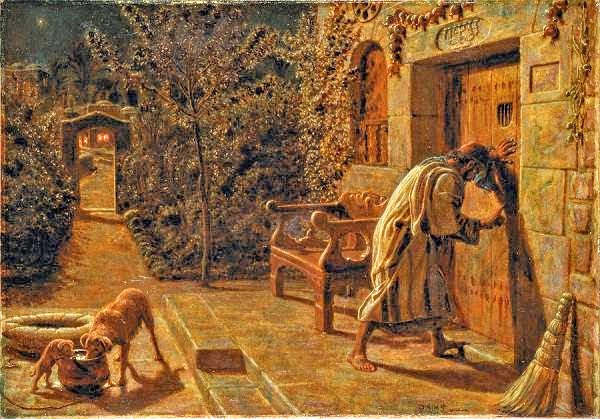
This parable is known by some as “the Importunate Neighbor.” That’s an excellent description. Importunate is defined as being persistent, especially to the point of annoyance or intrusion. It’s tenacious and stubborn–not giving up even when being ignored, and that describes what’s happening here.

What immediately proceeds this parable is Luke’s version of the Lord’s prayer, which the disciples requested. They wanted to understand the methods and mechanics of praying–perhaps the Pharisee’s prayers weren’t quite up to snuff–they wanted more; and they insisted that Jesus instruct them.

The disciples wanted to do prayer right.

A typical Jewish home had sleeping quarters (one room!) located on a raised platform. A ladder was used to access that level (which could be crowded, sometimes two to a bed.) Often their livestock were brought inside. And when it was time to get up, everyone got up. That explains the homeowner’s reluctance to give bread to his neighbor. To get up, light a lamp, wasn’t a solitary affair.

He’s obviously unenthusiastic to make that effort.

The word used here to explain the neighbor actions is ἀναίδεια “anaídeia,” which is only used once–it’s translated as impudence, shamelessness, audacity or chutzpah. It’s a Greek word that explains the knocker’s rudeness. He won’t stop. He knocks and pounds until he gets his bread. Not having bread for his guests is unheard of, for it violates all kinds of convention.

The unwritten law of Jewish hospitality demanded action. 

This is part of Jesus’ view on prayer. It means we must be inappropriate sometimes–even to the point were we are being rude.

Immediately following this parable (the very next thought) are the following instructions:

“So I say to you, ask, and it will be given to you. Seek, and you will find. Knock, and the door will be opened to you. 10 For everyone who asks receives, and the one who seeks finds, and to the one who knocks, the door will be opened.”

Luke 11:9-10

Perhaps it’s this intensity that’s lacking.

We “pray” but don’t insist. We desire but don’t demand. Maybe it takes a certain shamelessness to make prayer work. Jesus emphasizes a necessary attitude to praying God’s way. It’s never automatic, but in this parable we see words that move the Father’s heart, and loosen his hand. In Jesus’ teaching, prayer means effort.

It means spiritual work. He wants us to know this. It is important.

“There is neither encouragement nor room in Bible religion for feeble desires, listless efforts, lazy attitudes; all must be strenuous, urgent, ardent. Flamed desires, impassioned, unwearied insistence delight heaven. God would have His children incorrigibly in earnest and persistently bold in their efforts. Our whole being must be in our praying.”

    E.M. Bounds

f

Thorns for the Whore

“Therefore I will hedge up her way with thorns,
    and I will build a wall against her,
    so that she cannot find her paths.”

Hosea 2:6

A holy prophet is told to marry a prostitute–sounds crazy I know, but this union was intentionally commanded by God. It served to announce to Israel the present condition of their hearts, (1:2). In God’s eyes, Israel was nothing more than a spiritual whore. They would now be forced to grapple with this truth.

Her name was Gomer, and the prophet was Hosea.

The truth is sometimes a very hard thing. God has a bellyful of Israel’s prostitution, the nation has repeatedly went astray, they’re full of sin and idolatry. What else can God do to break this ‘spell’ and get their attention?

O.K. So why this hedge of thorns?

  • This hedge was initiated by God Himself
  • It was not vindictive; it wasn’t meant to destroy
  • Sin will never satisfy those in a covenant relationship with Him
  • Repentance was the goal God wanted to see
  • It’s function was to resist their sin and idolatry
  • This hedge was to bring Israel back into a right relationship with Himself

Imagine being restrained by the Lord in this way. Spiritual handcuffs and fetters and anything else that would restrict you from sin. He loves you and as a believer you belong to Him exclusively. He will discipline you if you persist in your sin. (But that is a good thing.)

He does this out of an everlasting love that’s forever loyal to you.

The very next verse (v. 7) is the response of Israel to being hedged in. It seems to be doing what He intends it to do. The ‘block’ seems to be working. (This sounds a bit like the “prodigal son.”)


“She shall pursue her lovers
    but not overtake them,
and she shall seek them
    but shall not find them.
Then she shall say,
    ‘I will go and return to my first husband,
    for it was better for me then than now.’

Hosea 2:7

When you receive Jesus as your Savior you now belong exclusively to Him. That covenant is far more than eternal life. It also means that He is fully and irrevocably committed Himself to making you a holy person. He disciplines when you persist in sin. But it’s done out of love.

Some have suggested praying the hedge of thorns over straying children or family. Perhaps that’s what is necessary. Pastors and elders could intercede for wandering believers using the same example found in Hosea 2. I believe God hears us as we pray.

“We often learn more of God under the rod that strikes us than under the staff that comforts us.”

   Stephen Charnock

Finding the Pearl

“Again, the kingdom of heaven is like a merchant looking for fine pearls. When he found one of great value, he went away and sold everything he had and bought it.”

Matthew 13:45-46

A different perspective.

The central issue seems to be of value. The pearl was magnificent. This merchant had never seen one like this. It gleamed in his hands, and he knew he must have it. It wasn’t an option, he had to buy it. His response–sell everything to the highest bidder (of course) and buy it.

The Lord Jesus loves each of us intensely.

Rather the people who make up the body. He loves everyone, but he’s crazy about his people. I have a shirt, and I’ll wear it sometimes when I feel like it could touch someone, it says “Jesus Loves You, but I’m His favorite.” I know it’s funny, but maybe it’s true? I know that he loves me–crazy-like. And I love that He loves, even me.

We’re His pearls.

His blood, and His cross was the purchase price. That’s what it took. When we truly believe we acknowledge that we are His now. He paid for us, completely.

Jesus sees, and he must have us. So he comes, and pays the price, he sells it all just to possess us. He now owns us. We know that there is nothing remarkable about us, for we understand our own sinfulness, we really see that we’re spiritually evil all of the time. The theologians call it “the depravity of man.” (Ecclesiastes 9:3; Job 15:14-16; Matthew 15:19).

But our faith in Him changes everything! We have been bought off the slave block of sin. We have been chosen.

“Therefore I endure everything for the sake of the elect.”

2 Timothy 2:10

We realize that we are the elect as believers when we put our faith in what Jesus did for us. Believe me, that’s not what I feel or sense about myself. But it’s what He sees, and He desperately wants me to be his own–and I don’t know why he would do such a thing. It makes no sense to me at all.

God’s love has reasons which reason cannot understand.


p

Needing His Cross Daily

We live in this place.

I confess that peace has never been really high on my list. Love, joy, kindness, and even goodness are clear priorities. Peace… not so much. Until I find out it’s not there. And then I get frantic by its absence and scrambling look for it with bewilderment.

Sometimes I don’t understand why God still loves me. At times like this anxiety eats at me. I beat myself up by my last failure. The guilt of my latest sin grows until it looms larger than the blood that saved me. Sometimes I suppose, religious people seem to have the most neurosis.

I’m afraid that we are taking the ‘present tense’ out of the Gospel.

The past tense is preferable to us as we find it easier to ‘manage’ our Christian life. We like to make check marks on our list. [Church attendance– check. Baptism– check. Bible study– check.] I think it gives me a definite feeling of ‘maturity.’

But these things matter little without intimacy with Jesus Christ.

I certainly haven’t arrived, and it seems at times I’m still the hideous sinner I always was. I cannot pretend otherwise, even with a spiritual truckload of cosmetics at my disposal. I know, I’ve tried. And I’m still ‘ugly.’ I do know forgiveness, and I do walk in its wonderful light (by grace).

I read Luther 30 years ago. (And Bonhoeffer would say something similar.)

“When our Lord and Master Jesus Christ said, ‘Repent,’ he willed the entire life of believers to be one of repentance.”

Martin Luther

This is the first of his 95 Theses nailed to the door of the Castle Church in Wittenberg, Germany. And there is a present tense here we can’t ignore about these declarations. I don’t just repent over smoking, beer drinking, fornication, or hypocrisy, once and done. But my entire way of living is to be one of repenting. To repent everyday opens the door to a true grace-filled discipleship.

“All of the Christian life is repentance. Turning from sin and trusting in the good news that Jesus saves sinners aren’t merely a one-time inaugural experience but the daily substance of Christianity. The gospel is for every day and every moment. Repentance is to be the Christian’s continual posture.”

John Piper

Luther’s last words, on his deathbed, was found written on a scrap of paper stuck in his coat, “We are beggars! This is true.” Even after thirty years, he was only echoing his first thesis.

It seems dear ones, we are to live at the foot of the cross.

The Absolute Danger in Exalting Yourself

Now he told a parable to those who were invited, when he noticed how they chose the places of honor, saying to them, “When you are invited by someone to a wedding feast, do not sit down in a place of honor, lest someone more distinguished than you be invited by him, and he who invited you both will come and say to you, ‘Give your place to this person,’ and then you will begin with shame to take the lowest place. 

10 But when you are invited, go and sit in the lowest place, so that when your host comes he may say to you, ‘Friend, move up higher.’ Then you will be honored in the presence of all who sit at table with you. 11 For everyone who exalts himself will be humbled, and he who humbles himself will be exalted.”

Luke 14:7-11, ESV

Choose your seat carefully. In Jesus’ day, there was a definite seating order to a wedding feast. It wasn’t first come, first served. There was a strict protocol, where one’s importance mattered.

Honored people got honorable seats–close to the front as possible. Average people got average spots; but no one wanted be at the bottom, having to sit at the “kids table.”

Jesus was watching, and he what he saw was a spiritual principle of his Kingdom.

Jesus often teaches us out of the things we encounter.

Truth often hits us from those things we actually see. If you want to know what God is doing in your life, all you need to do is look around at the practical things, and start to see the spiritual lessons inside them. We learn from real-life. That’s how he often teaches us, he combines the Word with what we’re experiencing.

Our natural inclination is to move higher up.

We think that we’re deserving, and so we take our rightful positions. That’s the way humans think. We all want to sit in the best possible place, and so we end up wheedling our way up front. We can fall into the subtle trap of self-promotion. But that’s not how discipleship works.

Jesus corrects, advising us to take the lowest place.

I think verse 11 is the key to figuring out this seating arrangement. We’re starting to see a physical situation become a spiritual lesson. There’s much to learn. Here’s verse 11 in the Amplified version:

For everyone who exalts himself will be humbled [before others], and he who habitually humbles himself (keeps a realistic self-view) will be exalted.”

Luke 14:11

This particular translation injects some realism into our lives, especially in how we see ourselves. It’s quite foundational. It lays down a principle that is always true in his Kingdom (1 Peter 5:6). If we don’t accept and implement this, we’ll suffer a definite weakness in our discipleship. It stunts the growth of many believers. And that is tragic.

The whole scene lays out how life in the spirit really works, and it seems paradoxical.

Our human logic asserts that deliberately choosing the lesser is foolish, things really don’t work that way. We think, (falsely,) that we’ll only advance by asserting ourselves. But Jesus, quite aptly, clarifies the ways of the Kingdom.

True maturity will only come if we decide to take the lowest place.

James 4:10

alaskabibleteacher.com

Ponder the Word

“But his delight is in the law of the Lord, and on his law he meditates day and night.”

Psalm 1:2

In Psalm 1:2 the Hebrew word for meditation is hagah. In this Psalm we have a contrast between the blessed and the “not-so-blessed,” and it commands that as Jesus’ followers that we process the reality of this to become blessed by our Father.

In Psalm 1:1 the word blessed is used, and actually just in the book is Psalms alone blessed is used 51 times. The word has a very simple and concise meaning: “to be happy.” I really don’t think we can minimize how important it is to be happy.

In 1:2 we read hagah or meditate. That Hebrew word is a little bit more complicated and it seems more nuanced than “blessed.”

Hagah, or meditate means:

  • to chew a cud like a cow
  • to growl like a lion who is eating an antelope
  • to moan or groan
  • to talk to oneself, or mutter or whisper
  • finally, it can mean to muse or imagine

Yeah, it’s an interesting word and I suppose all of these meanings are to be factored into meditation [hagah]. It seems that these five definitions shape the different meanings that go into our understanding.

Using the above definitions, this is how it might look:

  1. sometimes I regurgitate the word like a cow chewing its cud
  2. at times I attack it like a lion
  3. I moan and groan as I wrestle with it, seeking for a handhold
  4. thinking about the passage I talk to myself about its meaning
  5. I imagine being there, sometimes it’s like I’m a “fly-on-the-wall”

When we come to God’s words, the Bible, we are required to assimilate all that the Holy Spirit graciously gives. When He gives us something from the Word we must apply it to ourselves. You can do this through any of the 5 definitions I’ve given.

The Holy Spirit is the One who ignites His Word into our hearts.

Joshua 1:8, ESV

alaskabibleteacher.com

The Children Are Our Examples

 Now they were bringing even infants to him that he might touch them. And when the disciples saw it, they rebuked them. 16 But Jesus called them to him, saying, “Let the children come to me, and do not hinder them, for to such belongs the kingdom of God. 17 

Truly, I say to you, whoever does not receive the kingdom of God like a child shall not enter it.”

Luke 18:15-17

Again we were wrong (like usual it seems). I guess that we were trying to maximize Jesus’ ministry. We meant well, but He needed organization. So that was now our “ministry.” We simply felt that Jesus’ time was our concern, and as His disciples we wanted Him to connect with those who really mattered.

The parents were bringing their children to be blessed by Jesus.

“It was the custom for mothers to bring their children to some distinguished Rabbi on the first birthday that he might bless them.”

William Barclay

Jesus made it clear that these children needed to be the focus of our ministry. Our efforts were not to be centered on adults, rather it was misguided thinking that we direct Jesus’ work to be focused and redirected. These little ones were in the way.

Up to now, Jesus’ work was for adults. Or so we thought.

There were lepers, demon-possessed, paralyzed, tax-collectors all waiting for His ministry. Somehow we overlooked the needs of little children. Again, we were wrong, misguided, and ignorant of the walk we were called to.

Trust me on this–we believed otherwise. Up to now, we assumed that maturity meant sophistication. It was all about right thinking and good theology–it was these things God was looking for. We assumed that being simple wasn’t quite what Jesus wanted from us. Rather we believed the opposite.

And sure enough, Jesus explained what we were missing.

Children were to become our focus. They were the ones who we were to emulate and esteem. The radical thing to us was understanding that these ‘little ones’ were that significant.

“Let these children alone. Don’t get between them and me. These children are the kingdom’s pride and joy. Mark this: Unless you accept God’s kingdom in the simplicity of a child, you’ll never get in.”

Luke 18:16-17, The Message

This was like a 2×4 across the head! It was nothing less than another radical thought from our Teacher. And trust me, this wasn’t easy, but Jesus was crystal clear. We dare not think otherwise, but believing this was against all we thought the Kingdom was.

Jesus explained that childlikeness was the only way we could enter His Kingdom.

Children were now to be our examples. Their simplicity was to be our guide. Their simple innocence was how we were to see ourselves. You have no idea how extreme this was to us.

This was the Kingdom of God’s doorway into true discipleship. We carried this lesson for the rest of our lives. It was something we passed on to our disciples.

“Part of the exquisite beauty of salvation is its simplicity. Any man, woman, or child can come to Christ with absolutely nothing to offer Him but simple faith-just as they are. Salvation requires nothing more than childlike faith–believing that Jesus Christ died for my sins and accepting His gift of Salvation.”

Beth Moore

alaskabibleteacher.com

You Just Won the Lottery!

Matthew 13:44

From rags to riches. We like that kind of story, the newspaper boy turned into a publisher, C.E.O. This parable, only a single verse is almost the same thing. A poor man is walking through a field and viola! He finds a treasure chest, and it’s packed full of golden coins, diamonds, and emeralds.

He looks around, and seeing no one, he re-buries it. (After all, when you accidentally discover a treasure chest, you must take certain precautions.)

And a key I suppose is the word “joy.”

And that really isn’t something we really know–unless something wonderful happens to us of course. He has joy, he can’t believe it. I think he was a bit dazed by it all, and he must of walked in an unreal sort of bubble. After all, these things never really happen.

It’s sort of like finding you’ve got the winning numbers of the lottery–you just won $50,000,000!

It’s this kind of unreal “luck” that this guy knows what he must do. Now the owner of the field owns everything, including the chest. The finder realizes he can’t just sneak the chest off to his home–there would be too many questions. (Where did a poor guy like you get a gold coin?) His neighbors would figure it out. And besides, he would be a thief. There has to be a better way.

Suddenly he has an idea. If he sells everything he has, he probably could buy that field. And then everything that was there would be rightfully his. Selling all isn’t a problem, he knows that whatever he gives up is nothing close to the treasure in the field.

The reader should understand two things about the treasure that you find:

  • It’s about Jesus–the Bible is constantly aware of him, and his presence is seen in every chapter and book. He’s the treasure we find, knowing him, is the most valuable thing a person can ever have (by far). “The one who believes in the Son has eternal life, but the one who rejects the Son will not see life; instead, the wrath of God remains on him” (John 3:36).

To be his disciple demands we give everything else up.

We sell it all to get spiritual riches. There’s a “field” that we find that is worth everything, and the only way we can have the treasure is by giving up everything. There really isn’t any other way.

“You must keep all earthy treasures out of your heart, and let Christ be your treasure, and let Him have your heart.”

    Charles Spurgeon

alaskabibleteacher.com