“He saw the disciples straining at the oars because the wind was against them.”
Mark 6:48
It’s good to know that Jesus sees our labor and effort. He truly understands all that concerns us, and He perceives every issue that matters most to us. Attentive and keenly aware He comes to our boat. It’s quite common for us to think that he isn’t aware, and we may feel that He’ll pass us by without a word. But that is not the case at all.
The Greek word for “against them” is ἐναντίος, and it means “opposed as an adversary, hostile, antagonistic.” I suppose that explains much to a believer who sees the wind doing awful things; that which is savage and difficult and contrary.
But Jesus watches over us, all the time. He is completely aware of you.
He knows all about our battle, the fight we have with our flesh, the difficulty we have with the challenging people in our lives. I often struggle to steer my boat. Jesus knows when and why I labor like I do. And He doesn’t condemn me.
The disciples were straining very hard to keep the boat afloat.
Every oar was being used and every man had his seat. They must work together. Some were frantically bailing, and a couple gripped the tiller. Considerable effort was being expended but to no avail. The wind pushed harder against them. This is perplexing. If you remember, they’re simply trying to obey the command of Jesus to cross the sea.
Why do things have to be so difficult?
I’m intrigued by believers who expect sunshine, blue sky, and red roses because they are doing God’s will. They don’t seem to think through the issues of conflict and challenge, weakness and weariness.
“It is necessary to go through many hardships to enter the kingdom of God.”
Acts 14:22
To do God’s will often means that there will be a headwind directly at us.
The seas will become impossible, and we may even be driven back. But special comfort comes when we realize we’re being watched. Jesus is doing constant surveillance on us, and He sees our toil on the oars. He comes to us, walking on the water.
Even in our storm, our hearts can rejoice.
“Lo, I am with you always, even to the end of the age”
As he was starting out on a trip, a man came running to him and knelt down, and asked, “Good Teacher, what must I do to get to heaven?”
18 “Why do you call me good?” Jesus asked. “Only God is truly good! 19 But as for your question—you know the commandments: don’t kill, don’t commit adultery, don’t steal, don’t lie, don’t cheat, respect your father and mother.”
20 “Teacher,” the man replied, “I’ve never once broken a single one of those laws.”
21 Jesus felt genuine love for this man as he looked at him. “You lack only one thing,” he told him; “go and sell all you have and give the money to the poor—and you shall have treasure in heaven—and come, follow me.”
22 Then the man’s face fell, and he went sadly away, for he was very rich.
My name is inconsequential. I suppose all you must know of me is I tried to keep God’s Law and that I was very wealthy. Many believed that being rich was evidence that God approved of me. Of that, I wasn’t too sure. I kept the Law out of fear I suppose, and at times I just knew it wasn’t quite enough.
As I studied I began to realize that riches weren’t going to make me righteous. There was enough Scripture in me to let me know that it wasn’t enough. The prophets, especially Isaiah spoke about the deadliness of wealth, but there was that one verse in Proverbs that really disturbed me:
“Your riches won’t help you on Judgment Day; only righteousness counts then.”
(Proverbs 11:4.)
This verse (and all of the others) were the cause of many a sleepless night.
I was tormented by the reality of standing before God with nothing but my money to cover me. Coming under God’s righteous judgment haunted me. I thought of it day and night. I was terrified of being damned. My own righteousness wasn’t enough, and I knew it.
I heard about Jesus (and who hasn’t), and some were boldly claiming that he was the Messiah. He was at least a wonderful teacher and many said he worked powerful miracles, and perhaps he had answers for me. I hoped so, but I needed to know. It was my questions that drove me to find him.
And finding him was easy–I just followed the crowd.
I got ahead of everybody. I knelt in his path and waited. I must know what he thought I should do. When he stood before me I asked the question that had haunted me my whole life–“Good Teacher, what must I do to get eternal life?”
Jesus looked right at me. I knew deep down that he loved me.
But oh those words, his words really disturbed me. He told me that I only lacked one thing, that I must sell everything and distribute the money to the poor. Only by doing that would I discover riches in heaven. And only then could I truly follow him.
But that was the thing I couldn’t do.
It was my idol, my golden calf, and it was a sacrifice that I could never make.
I’ve come to realize now, over my many years, that when I do finally stand before God, I will have nothing to save me. Jesus invited me to follow, and I couldn’t and I didn’t.I won’t.
And that my friend, means I will die unforgiven.
“For what shall it profit a man, if he shall gain the whole world, and lose his own soul?”
“One of the criminals who were hanged railed at him, saying, “Are you not the Christ? Save yourself and us!” 40 But the other rebuked him, saying, “Do you not fear God, since you are under the same sentence of condemnation? 41 And we indeed justly, for we are receiving the due reward of our deeds; but this man has done nothing wrong.” 42 And he said, “Jesus, remember me when you come into your kingdom.”
And he said to him, “Truly, I say to you, today you will be with me in paradise.”
The pain was incredible, but I know that deep down I deserved to die. But not like this. Never like this. I was almost out of my mind with fear. What they were about to do to me was terrifying.
You must understand that I was just a common thief. I had stolen a loaf of bread when I was eight years old and that’s how it all got started for me. It more or else got bigger and easier. I knew how to steal and I was quite good at it. I was Jacob, the master thief!
When I was finally caught, they had sentenced me to die.
I supposed it was inevitable. I fault no one but myself, I knew what I was getting into. As I dragged my beam up to Golgotha, it was really strange but I suddenly remembered a verse from the scripture and it really did unsettle me.
“Cursed is everyone who hangs on a tree.”
It’s a terrible thing to die this way. There were three of us, nailed to the wood and lifted up between heaven and earth. Jesus was nailed to the middle cross, not that it really mattered; all three of us were going to die today. Many hope for a simple and easy death, maybe in their sleep–but that’s not going to happen to us.
The third man could only mock, he was afraid, and I suppose he just echoed those Pharisees who didn’t really understand. But I knew better. I knew who this other man was, I had heard all the stories. Deep down I knew that this man on the center cross was the Messiah.
A crowd had gathered to watch us die. The Romans in their wonderful ingenuity had made a sign that they nailed above Jesus’ head, and it declared to everyone that Jesus was “the king of the Jews.” Even as he was dying, they found a way to malign him and to stir-up the crowd.
The other man being crucified continued to mock Jesus, and it infuriated me.
Why I defended him I don’t know for sure.
But I understood. He was being murdered out of envy and jealousy. He didn’t deserve to die like this, but the powers that be hated him, and who can confront these religious men without becoming a victim. Jesus had repeatedly crossed the line, so now they were now putting him to death. It seemed evil was really winning today.
I saw the soldiers throwing dice for Jesus’ clothes. He was now being mocked by them as well, even as he was dying on a brutal cross.
But all of a sudden it all made perfect sense, he really was the Messiah, and these bastards were killing him. Crucifixion was starting to work on me now. I began to choke on my words, and it was getting hard to breathe.
“Jesus… please remember me. When your Kingdom comes, please let me be a part of it.”
And as beaten as he was, he managed to turn and look directly at me. They had whipped and brutalized him, and yet he was still aware. His words were whispered now, but I understood. “I promise that today you will be with me in paradise.”
I was starting to spasm again, but the horror of death had left me. Some time had passed, and I could hear his breathing stop. But for the first time, I had peace. They used a spear on Jesus, but he was already dead.
The soldiers now came to the two of us, and they were carrying an ax to break our legs. It all had to do with the coming festival, and the Pharisees wanted us dead. When they swung that ax I knew pain that I could never describe. My own death came quickly after that.
I was suddenly standing in paradise, whole and complete.
Someone was standing before me. He was shining I remember, and I knew he was powerful; stronger, and he was more glorious than anyone I had ever met. It was crazy but somehow I knew that he was an angel and he had been sent to meet me. It’s funny, but I realized that somehow I really did belong. Me–a dirty rotten thief.
Jesus had promised me, he had pronounced me righteous, me of all people.
I suddenly had a joy that I could never explain. I really was a part of the Kingdom that was beyond anything I had ever known. And all I can really say about this was that I was privileged to die with him. That is all I could claim. I simply believed him and asked if somehow I could be part of his eternal rule.
I simply asked and you know what, He gave me everything.
And so, I’ll see you in heaven.
Cover Art: “Christ on the Cross between Two Thieves,” by Peter Paul Rubens
O Lord, my heart is not lifted up; my eyes are not raised too high; I do not occupy myself with things too great and too marvelous for me. 2 But I have calmed and quieted my soul, like a weaned child with its mother; like a weaned child is my soul within me.
Psalm 131:1-2, ESV
To be humble [Hebrew, anavah] means that we recognize our boundaries. We will not advance by stepping beyond what God has ordained for us. We learn to be content with the present. Humility is not thinking less of yourself, but thinking of yourself less. It puts others first.
In Psalm 131 we begin the walk into “anavah.” We’re brought by God into a place where we understand who we really are. Our lives are not characterized by self-promotion, but rather serving God and advancing others before ourselves.
The image is one of being a weaned child resting on a mother’s chest. We have no agenda, there is nothing that we must do, but just relax on Him.
Seeing a weaned baby is one who no longer needs its mother’s milk. There’s no fussing or grasping for nourishment, rather he’s simply content to rest in his mother’s warm embrace.
To practice true humility, or the Hebrew word “anavah,” it is to renounce ambition in all its insidious forms. As Jesus’ disciples we follow Him with our cross. That cross puts the end of our old life. And we die daily. And it is obvious to all.
“And since I, your Lord and Teacher, have washed your feet, you ought to wash each other’s feet. I have given you an example to follow. Do as I have done to you.”
“We had long known the Lord without realizing that meekness and lowliness of heart should be the distinguishing feature of the disciple.”
15 “When they had finished breakfast, Jesus said to Simon Peter, “Simon, son of John, do you love me more than these?” He said to him, “Yes, Lord; you know that I love you.” He said to him, “Feed my lambs.”
16 He said to him a second time, “Simon, son of John, do you love me?” He said to him, “Yes, Lord; you know that I love you.” He said to him, “Tend my sheep.”17 He said to him the third time,”
“Simon, son of John, do you love me?” Peter was grieved because he said to him the third time, “Do you love me?” and he said to him, “Lord, you know everything; you know that I love you.” Jesus said to him, “Feed my sheep.'”
Peter’s denial was public one, and it was important that his restoration be public as well. It may come as a shock, but Peter needed to do this–even though it was a grief to him (verse 17.) He needed to do this to heal properly. It was also a clear testimony to the others that he was completely restored.
Repeatedly in this passage, love gets linked to service.
(Can you see this, it’s important that you do.) The Lord asks Peter if he really loved him, and most likely it was a solemn affair, not something trivial or casual. The word used is ἀγαπάω, “agape”–this is the type of love that God has for people. It’s an all-powerful love, one that gives 110%.
The third time the word for love is different though, the word used is φιλέω, “philo”–this is a type of love that a man has for others, a brotherly kind of love. Something good, but not quite agape love.
Each time Jesus uses agape to Peter, Peter responds with philo.
Peter responds, but he’s fixated on the brotherly type of love. I don’t mean to be confusing here, but every time Jesus uses agape to Peter, Peter responds with philo. It’s as if Peter is struggling with loving Jesus wholeheartedly. Perhaps Peter was ashamed of his denial. But to his credit he was honest.
Service is now connected to agape love.
Love can’t be seen unless it has a physical aspect. Love can’t be abstract, a vague feeling, or a hazy concept–it has to be seen by others. Jesus’ sheep (and lambs) must be fed, and watched over. This is now Peter’s call to ministry.
This is Jesus’ ministry as well.
Apparently there is plenty of this kind of work to go around! Isaiah prophesied about Jesus’ work in Isa. 40:11. This now becomes Peter’s work as well.
“He will tend his flock like a shepherd; he will gather the lambs in his arms; he will carry them in his bosom, and gently lead those that are with young.”
Whether or not Peter was the first “pope” is debatable. But it’s clear that Jesus focused on Peter. And isn’t it just like him to turn our failings into victories. Peter’s denial was now his ministry to others. It dealt with the pride issue, which disrupts true ministry to His flock.
“And I will give you shepherds after my own heart, who will feed you with knowledge and understanding.”
Jeremiah 3:15
God uses broken things. It takes broken soil to produce a crop, broken clouds to give rain, broken grain to give bread, broken bread to give strength. It is the broken alabaster box that gives forth perfume. It is Peter, weeping bitterly, who returns to greater power than ever.
When Jesus saw her weeping, and the Jews who had come with her also weeping, he was deeply moved in his spirit and greatly troubled. 34 And he said, “Where have you laid him?” They said to him, “Lord, come and see.” 35 Jesus wept. 36 So the Jews said, “See how he loved him!”
Jesus Raises Lazarus
38 Then Jesus, deeply moved again, came to the tomb. It was a cave, and a stone lay against it. 39 Jesus said, “Take away the stone.” Martha, the sister of the dead man, said to him, “Lord, by this time there will be an odor, for he has been dead four days.” 40 Jesus said to her, “Did I not tell you that if you believed you would see the glory of God?”
So they took away the stone. And Jesus lifted up his eyes and said, “Father, I thank you that you have heard me. 42 I knew that you always hear me, but I said this on account of the people standing around, that they may believe that you sent me.” 43 When he had said these things, he cried out with a loud voice, “Lazarus, come out.” 44 The man who had died came out, his hands and feet bound with linen strips, and his face wrapped with a cloth.
Jesus said to them, “Unbind him, and let him go.”
My name is Lazarus and I was a special “friend” of Jesus. We liked being with each other, and my sisters Mary and Martha also enjoyed fellowshipping with Him. Whenever He passed through Bethany, Jesus always had an open invitation to visit.
What’s it like to be dead? Many ask me this, and I suppose they want to understand, and I don’t blame them. To me, it seemed like a very deep sleep–but I didn’t dream. Those who look for any special insight, will not find it from me. And yet, I am His witness. He has incredible power over death.
I heard Him call my name.
It pierced through everything with an authority I’d never heard before. I had been laid in my tomb for 4 days and my physical body had begun to putrefy. When they rolled the stone away the terrible smell of death lay heavy in the air.
I was tightly bound in cotton wraps and sticky spices had been applied to my body. Mary and Martha had objected to Jesus’ attempt. As I looked back I realize that their actions were justified. After all, who can give life when one is very much dead. And not only dead but well on the way on to decay. The smell wafted from my tomb.
I had heard His shout, and it was then death was reversed.
My heart and brain began to work again. When I came to I found that I was lying on a stone table and tightly wrapped in the clothes of the dead. I managed to sit up, and I shuffled toward the light that had entered the tomb by the stone that covered the door.
When Jesus saw me I believe that He was laughing. He gave the command to the shocked bystanders, He commanded them to unwrap me. I suppose that then I realized I was now in the land of the living. I can’t explain what had happened, But my grave clothes were unwrapped.
There were many that day that became believers.
Many had attested that I was most certainly dead, after all, they had attended my funeral. Some had observed that I had been slathered in the sticky ointment–fragrant spices. And a few were witnesses to see the stone rolled in place.
There were some who simply didn’t (or wouldn’t) believe.
There were the Pharisees and the Sadducees who wanted me dead hoping to nullify my witness and my resurrection from the dead. I had become an embarrassment to them, a constant reminder that Jesus had defeated death.
Their hatred of Jesus’ ministry was only strengthened. My own resurrection proved His authority and power over even death. I was a walking and breathing miracle that they refused to accept. It got so bad that the religious leaders wanted to kill me because so many believed in my resurrection. I was a living witness to many.
Yes, I know that I’ll die again. But I’m not afraid anymore.
“He alone can believe in immortality who feels the resurrection in him already.“
3 Then the scribes and the Pharisees brought a woman caught in adultery, making her stand in the center. 4 “Teacher,” they said to him, “this woman was caught in the act of committing adultery. 5 In the law Moses commanded us to stone such women. So what do you say?” 6 They asked this to trap him, in order that they might have evidence to accuse him.
Jesus stooped down and started writing on the ground with his finger. 7 When they persisted in questioning him, he stood up and said to them, “The one without sin among you should be the first to throw a stone at her.” 8 Then he stooped down again and continued writing on the ground. 9 When they heard this, they left one by one, starting with the older men. Only he was left, with the woman in the center. 10 When Jesus stood up, he said to her, “Woman, where are they? Has no one condemned you?”
11 “No one, Lord,” she answered.
I remember how Jesus defended me. I had been led through the crowds. The temple was filled with people who were there for the festival. It was a time of joy and feasting, but not for me. Definitely not for me.
The temple police escorted me to Jesus. I was now the focus of everyone’s attention. I felt dirty and ashamed. Standing there I could feel the lustful looks from the Pharisees; but there was something else as well, a look from Jesus that I had never seen before. There was compassion there, something quite extraordinary.
I’m ashamed, I committed adultery, I had slept with another man who wasn’t my husband.
I was to be stoned, to have hard rocks thrown at me by “holy” men. The Law had pronounced my guilt, and I knew how I was to be punished. And I deserved it. Yet the man who I slept with was never charged, he escaped and it was I that would be put to death. I didn’t blame him.
My shame was now public knowledge–everyone knew, the Pharisees made sure of that.
They only put me front and center to test Him.
These men who brought me had ulterior motives, they desperately hoped Jesus would stumble. I think they wanted to prove once and all to the crowds that were watching that Jesus really wasn’t the Messiah. They wanted to trap him.
Jesus seemed to understand the implications of this satanic effort.
Only Rome had the power of execution, and yet the Mosaic Law declared that I was to die. I stood waiting, expecting the worst. What else could I do?
It’s funny, but Jesus understood all of this. He seemed to look right through this theological trick, and He responded in a way that really shocked everyone. He never spoke, but bowed low and began to write in the dirt with his finger. Amidst their vicious accusations, they pressed their case.
Jesus bent down again, and he wrote some more.
I never knew what he wrote–but I had to believe it must have been something that revealed the sin in the hidden hearts of the men who were accusing me. In that moment, they quickly dropped the case against me. They all filed out, one by one, in dramatic fashion. I now stood alone with Jesus.
And Jesus looked directly at me.
I was still afraid, but it was strange, I felt a wave of peace as well. I quietly waited, not knowing what He was going to say to me. I suppose I half expected the worst.
Yes, he did confront me. But He wanted me to acknowledge that those accusing men had left. I saw it and understood. Jesus was asking me to believe that I was now really free. But then he wanted me to understand something that seemed quite crucial.
“Neither do I condemn you,” said Jesus. “Go, and from now on do not sin anymore.”
That dear one was a powerful moment. He set me free with the understanding that He did not condemn me. But my freedom from judgement came with a catch–sort of. I knew then that my sin must be renounced. My freedom came with a price. But knowing I was completely released, meant I was now a free woman.
At that moment I understood completely.
“God pardons like a mother, who kisses the offense into everlasting forgiveness.”
“He also told this parable to some who trusted in themselves that they were righteous and looked down on everyone else: 10 “Two men went up to the temple to pray, one a Pharisee and the other a tax collector. 11 The Pharisee was standing and praying like this about himself: ‘God, I thank you that I’m not like other people—greedy, unrighteous, adulterers, or even like this tax collector. 12 I fast twice a week; I give a tenth of everything I get.’”
13 “But the tax collector, standing far off, would not even raise his eyes to heaven but kept striking his chest and saying, ‘God, have mercy on me, a sinner!’ 14 I tell you, this one went down to his house justified rather than the other, because everyone who exalts himself will be humbled, but the one who humbles himself will be exalted.”
He despised others. As a Pharisee he prided himself as a holy person; he stood before God and congratulated himself. I believe that self-righteousness has many levels. You can be blatant and obvious about it, or it can be subtle and hidden. But we must understand that the father sees and knows. Notice the “we all” here in Isaiah 64:6–
“We are all like one who is unclean, all our so-called righteous acts are like a menstrual rag in your sight. We all wither like a leaf; our carry us away like the wind.”
(Hmm. Is that what He sees? A menstrual rag? You got to be kidding!)
We often advance ourselves by demeaning those who struggle hard with their sin–there are those who see and somehow know that they’re superior. We don’t come out and say so; but we’ve arrived— but guess what— God (and scripture) tell us something radically different.
But we’re not dealing here with a hidden self-righteousness. The Pharisee truly believes that he is special. He stands and doesn’t kneel. He feels comfortable and confident in the holy presence of God Almighty. He’s not like the others. He is sure that he’s holy.
Look though, the tax-collector was being brutally honest.
He didn’t need anyone to tell him how sinful he was—he understood his own wickedness. Jesus’ story reveals God’s love for those who know that they’re twisted inside. Notice the heart of the tax-collector:
“He stood afar off” which showed his awareness of his separation from God.
“He wouldn’t even raise his eyes to heaven,” which declared his humility in the presence of God.
He kept “striking his chest,” which tells us of a deep pain over his sin against God.
He prayed, ‘God, have mercy on me, a sinner!’ This describes his desperate heart.
These both came to pray, but that is all they had in common.
The Pharisee came to the temple to show off his righteousness, the tax-collector out of a terrible despair. It strikes me that the text in verse 11 says the Pharisee “began praying to himself.” It seems that his prayer never really met God—he was proud and showy, doing the things God hates (Prov. 29:23).
Things really came obvious in verse 14. That’s the critical point of the entire story—“one went down to his house justified rather than the other.” Wow! What a statement. One professionally religious man, sure of his holiness, the other a sinful sinner, who came humble and broken. One showed off his faith—boasting with a legalistic swagger. The other desperate and desolate, completely undone.
But it was the tax-man who became righteous in the eyes of God.
Humility is the foundation of the kingdom of Jesus. In Matthew 5:3-4 makes a lot of sense—to be “poor in spirit” and to “mourn” are the bedrock of a Christian’s discipleship. To be justified (made right) was a gift. He didn’t try to earn it, and there wasn’t a probationary period. The tax-collector now became righteous; the Pharisee carried his sin.
God wants us to have a broken-heart. He rejects everything else. I suppose that the question is this:Do you mourn over your sin?
“The Lord is near the brokenhearted; he saves those crushed in spirit
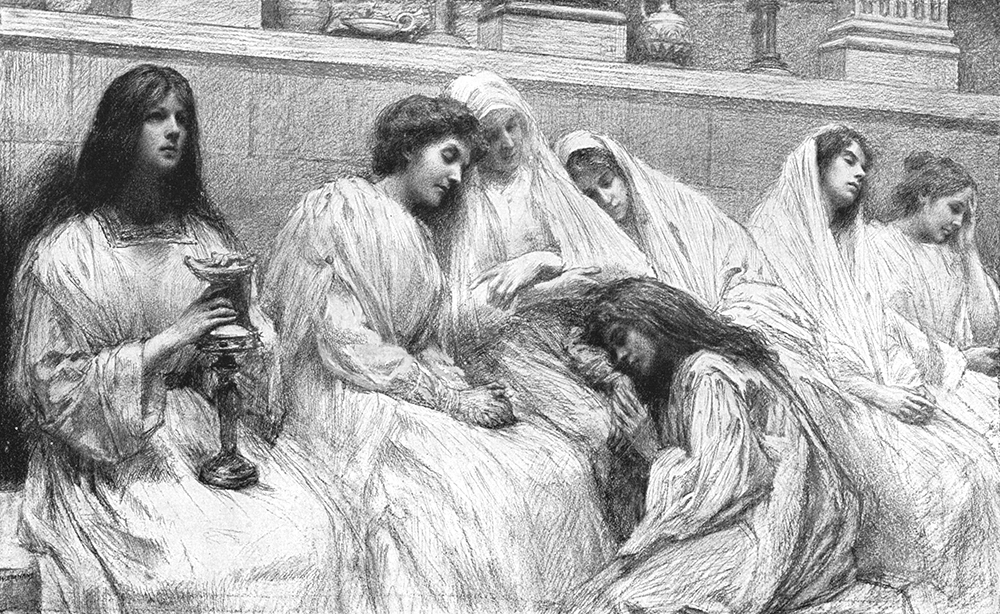
“At that time the kingdom of heaven will be like ten virgins who took their lamps and went out to meet the groom. 2 Five of them were foolish and five were wise. 3 When the foolish took their lamps, they didn’t take oil with them; 4 but the wise ones took oil in their flasks with their lamps. 5 When the groom was delayed, they all became drowsy and fell asleep.
6 “In the middle of the night there was a shout: ‘Here’s the groom! Come out to meet him.’
7 “Then all the virgins got up and trimmed their lamps. 8 The foolish ones said to the wise ones, ‘Give us some of your oil, because our lamps are going out.’
9 “The wise ones answered, ‘No, there won’t be enough for us and for you. Go instead to those who sell oil, and buy some for yourselves.’
10 “When they had gone to buy some, the groom arrived, and those who were ready went in with him to the wedding banquet, and the door was shut. 11 Later the rest of the virgins also came and said, ‘Master, master, open up for us!’“
12 “He replied, ‘Truly I tell you, I don’t know you!’“
13 “Therefore be alert, because you don’t know either the day or the hour.“
There were three stages in every ancient Jewish wedding.
Engagement–when fathers got together to make sure that it would be a good match.
Betrothal—a ceremony in which formal promises were made by the lovers.
Marriage—a surprise arrival, usually a year later, by the groom at the home of the woman.
Each was incredibly important. There couldn’t be any short-cuts; one just didn’t jump into this. It wasn’t a Las Vegas approach to just getting hitched. This parable was an extension of the previous verses in Matthew 24:36-51 and had to do with being prepared.
We can extract this from the third step of marriage. The groom would show up at night, and torches were used to light their way, (apparently the flashlight hadn’t been invented yet). Within Jesus’ parable was the idea of suddenness or surprise.
But no one knew exactly when the groom would show up.
Hence there is an emergency feel to this story. The text states in verse 5:
“Five of them were foolish and five were wise.”
The story hinges on this sentence. Readiness is the issue here. Everything of any significance must take on the sudden arrival of the groom’s entourage. The virgins, apparently, would go out to meet him—the torches mingling their light, and drive out any darkness. (It seems that 10 was the acceptable number for a proper rabbinical ceremony).
The problem was that only 1/2 of them were ready. It’s interesting to note that everyone was sleeping. Obviously, that didn’t mean anything for it was the availability of “oil” that would make the difference. The idea was a surprise visit.
The oil was the key. And for us, it represents the Holy Spirit.
Sleep is not the whole issue here, but being prepared is. Five girls were foolish, they were simply not ready. They realized their error and tried to finagle oil from the others, but ultimately that would short everyone in their group. There was an idea that a trip to the local oil merchant would work. It was an idea anyway.
But it was already too late!
The door was closed. The five simply missed it. They stood outside knocking and calling, but they didn’t enter in on time. Reading between the lines, I sense they were desperate. Verse 12 is meant to penetrate and reveal the price of tolerating spiritual sloth.
“He replied, ‘Truly I tell you, I don’t know you!’“
The purpose of this parable is the ending line that stresses alertness in a society that dulls everything. The temptation is to act like you’re spiritually aware when you’re not. It’s one of our greatest sins. We assume our lamps are lit when the reality is that our oil (the Holy Spirit) is running close to zero. When our sloth gets mixed with hypocrisy it’ll surely destroy us.
We’re snoring our way to spiritual death.
We must resist slumber and slothfulness. Jesus asserts that his virgins must be prepared and ready for his coming. We must be ready, we must—the price of our unreadiness is high indeed.
“Take care of giving up your first zeal; beware of cooling in the least degree. Ye were hot and earnest once; be hot and earnest still, and let the fire which once burnt within you still animate you. Be ye still men of might and vigor, men who serve their God with diligence and zeal.”
“Unless we are thoroughly convinced that without Christ we are under the eternal curse of God, as the worst of His enemies, we shall never flee to Him for refuge.”
Buried in the Old Testament we discover the idea of the Cities of Refuge.
They speak profoundly to our situation and bring real hope to those who struggle. Six places of safety were given to protect those who accidentally killed another person— maybe an ax head flew and hit someone, and they died as a result.
God told Joshua to establish cities of protection where one could be safe from an avenger. There were six of them, three on the east side of the Jordan river, and three on the west. The cities covered Israel; each was spread out intentionally so they were always close.
That city became a place of asylum for those guilty of manslaughter.
As believers, we know that we’ve committed crimes against God and other people. The burden we carry threatens to undo us. Satan (and his minions) want to destroy us—and honestly, we deserve it. We are essentially spiritual ‘criminals’ who have hurt others and damaged ourselves in the process.
Outside the city, we’re vulnerable—but inside those walls we find safety.
Those who have killed others are protected. If we venture outside, we find our adversary who is waiting. Scripture tells us that we must stay cloistered there until the current high priest dies. Upon his death, we’re released and may leave the city walls.
For broken believers, the whole concept rings true.
The text speaks for itself, and there is spiritual logic in all of this. We see parallels here that speak to our condition. We’ve messed up big time. We also carry issues that the enemy can attack. Depression, bipolar, trauma, and even thoughts of committing suicide— can be a fundamental part of our lives.
I must tell you that safety is found only in the Savior.
Finding God and abiding in him is our place of safety. His walls protect us, Jesus is our high priest, who never dies; that means we need to stay with him, permanently. I like Hebrews 6:18, LB:
“Now all those who flee to him to save them can take new courage when they hear such assurances from God; now they can know without a doubt that he will give them the salvation he has promised them.”
For us especially, we often have problems with the doctrine of assurance of salvation. Our enemy works overtime to accuse us (Rev.12:10). We’re his targets and the lies of many demons assault us. We can, at times, wonder if we’re really saved. We wonder if we are really forgiven, and we doubt our salvation. Satan’s efforts can be constant and crippling.
I encourage you to think this over and pray about this.
















 Alaska Bible Teacher