21 Then Jesus went out from there and departed to the region of Tyre and Sidon. 22 And behold, a woman of Canaan came from that region and cried out to Him, saying, “Have mercy on me, O Lord, Son of David! My daughter is severely demon-possessed.”
23 But He answered her not a word. And His disciples came and urged Him, saying, “Send her away, for she cries out after us.” 24 But He answered and said, “I was not sent except to the lost sheep of the house of Israel.”
25 Then she came and worshiped Him, saying, “Lord, help me!”
26 But He answered and said, “It is not good to take the children’s bread and throw it to the little dogs.”27 And she said, “Yes, Lord, yet even the little dogs eat the crumbs which fall from their masters’ table.”
28 Then Jesus answered and said to her, “O woman, great is your faith! Let it be to you as you desire.” And her daughter was healed from that very hour.
Matthew 15:21-28, ESV
My daughter had a demon living inside her. Please understand me, I love her more than life itself. It was a terrible torment to see her fall under the control of the evil one like this. Every day seemed worse than the previous, and I knew that the day would come that I would lose her completely to the dark pit.
She would be lost forever.
God knows I tried everything. There was the pagan temple to Eshmon. He was our god of healing and protection for our nation, and it was a short walk away. We made trips there to present ourselves for healing. But things got worse, not better.
When Jesus came we knew we had to meet Him.
I was desperate, at the very end of my rope. I was scared. Meeting Jesus’ disciples was the first step and it really didn’t go well at all. They protected Him, and I couldn’t get close enough to speak with Him.
So much was blocking me. I saw so many obstacles, but when your child is suffering like mine, these things mean nothing. I came to the point where I began to shout, over and over for Jesus to intervene. I was asked to stop, I ignored His followers and kept yelling.
This passage asks us to consider many heavy issues. We have questions that need answers. Why did Jesus seem so cold and harsh? What about the “dog” reference, and His seemingly reluctance to heal? What about her ethnicity as a pagan?
Did Jesus know something about the situation we don’t?
I really want to keep this post short, so I won’t try to answer these questions. But the situation is intriguing. It must be noted that Jesus, at this particular point in His ministry, is focusing on reaching the Jewish population. (But that will change in the future.)
And yet there are positive characteristics of this woman that must be considered. These need to be understood to open up this passage. Please ponder them, they put the entire situation in a different light. We see the following:
Her humility
Her patience
Her prayer and worship
Her persistence
Her faith
Each of these are crucial, and Jesus saw them. Yes, we see the obstacles, but we understand her love for her demon possessed daughter that drives her into Jesus’ presence. We see her faith that won’t give up no matter the resistance she encountered.
“Faith sees the invisible, believes the unbelievable, and receives the impossible.“
“And those who are wise shall shine like the brightness of the sky above; and those who turn many to righteousness, like the stars forever and ever.”
Daniel 12:3, ESV
“But we all, with unveiled face, beholding as in a mirror the glory of the Lord, are being transformed into the same image from glory to glory, just as from the Lord, the Spirit.”
2 Corinthians 3:18, NASB
In my teenage years, my mom and I attended a series of services in a Christian commune. (This would’ve been in 1972 -73.) They all lived in a single house and had started a Christian rock and roll band. (They were pretty good too.) And they knew how to pray.
I was impressed with what I saw.
When they gathered together for worship, they began to ‘glow.’ I would stare at them as they became ‘illuminated.’ I had never seen anything like this before. The presence of Jesus was there making Himself known in the hearts of His disciples.
I had been given eyes to see the supernatural.
Since then I have heard many testimonies of that same dynamic at work. Confessing believers engaged in prayer and worship, have their countenance changed while in the Lord’s presence. Peace, joy and confidence shines through them in a profound way. Their physical appearance is altered, and they unconsciously proclaim ‘a peace that passes understanding.’
I can’t really explain it in any other way.
Since I became a Christian in 1982, I have retained those images in my thinking. I’m now very aware of the “witnessing presence’ of Jesus in the lives of His people. And scripture itself, on several occasions, points to this wonderful dynamic in action in the lives of consecrated believers.
When the light comes, it can’t help but transform those of us in darkness. Our faces, hearts, and countenances change. We’re the human vessels for peace and joy (especially knowing our sins are forgiven).
The prophet Daniel talks about ‘shining like a star.’ I don’t think this really sinks in. Perhaps the ‘here and now’ seems all we can handle.
‘Shining like a star’ isn’t possible in the mechanics of normal life as an unbeliever (at least for any real length of time). That simply can’t be manufactured. The only possible answer is the Christian’s faith. Namely, that Jesus Christ who is indwelling every believer, reflects His presence out into a dark world.
“O worship the Lord in the beauty of holiness” Psalm 96:9. Perhaps that beauty is more tangible than we think. I’ve always interpreted this as holy believers that shine (or glow) with His presence.
A few winters ago I was out walking on the Alaska Bible Institute campus. Twilight was quickly settling in, and 20-30 yards ahead I saw a child’s sled left in a snow pile. In the monochromatic world of an Alaskan winter, that ‘shining’ sled glowed and couldn’t be missed.
I believe that you and I who bear His presence become fluorescent to certain people.
But we can’t conjure it up on our own. His activity in our hearts makes us astonishingly conspicuous. We can’t hide His presence (even if we sin). We have been irrevocably changed by the Spirit’s residence. We have become ‘glow-in-the-dark’.
Perhaps this is how it supposed to work?
“You are the light of the world. A city on top of a hill can’t be hidden.”
10 Finally, be strong in the Lord and in the strength of His might. 11 Put on the full armor of God, so that you will be able to stand firm against the schemes of the devil.
12 For our struggle is not against flesh and blood, but against the rulers, against the powers, against the world forces of this darkness, against the spiritual forces of wickedness in the heavenly places.
Eph. 6:10-12, NASB
Paul tells us that discerning the cosmic forces of wickedness is now critical. If we choose to ignore his words and make them optional, we will become spiritual toast. We need to hear reality. We want to be told the truth. And the truth is that we’re neck deep in spiritual alligators.
Point blank: We were each born for battle. Every believer must wear armor.
This passage in Ephesians 6 stresses that there is something sinister, an organized force, something evil, a darkness that’s focused directly on us. Verse 12 unveils to us a veritable government of wickedness. Satan leads his demons out with the intention of confusing believers and destroying holiness.
We also need to understand that human beings have a terrible knack of walking in their sin, and also by being manipulated by evil forces. Human history bears this out. We have a lousy track record. Without the Spirit we will be lost and destroyed by our own darkness.
Christians are to see life very differently than others do.
Ephesians 6 teaches us to find strength in being connected with God, which is critical to walk through in this confusing darkness. By prioritizing our relationship with Him, we can draw upon His strength and a sincere faith to navigate through all of this.
Without intimacy there is no obedience and there can be no real victory.
You must come to him humbly and holy, and sit before Him and listen, learn and love. And that is the major step in true holiness. Being controlled by Him means when you need to, you can stand and deliver damage to Satan’s kingdom.
You’ll be leading angels in this terrible battle! They have their swords drawn and are quite capable. Remember that this is a spiritual war–not physical. Your attack must be fought on your knees. And angels, they’re watching and listening to you as you pray. They are God’s messengers to protect you.
Satan presses us hard through redirection and forgetfulness of who we are.
Without the humble intimacy that can only grow on prayer and Bible reading, we will be spiritually destroyed. We need the protection of the Presence. Please don’t forget this; you need Jesus more today than yesterday. You must come closer. He will help you.
You see, your only hope is in Jesus’ strength and intimate love for you.
We must reach for our power and grab upon this intense love. We can only become strong through our intimacy with Jesus. He shields us from the spiritual corruption that swirls all around us. As we draw to Him we become mighty, as we listen closely to the Holy Spirit, we will walk in true discipleship with Jesus.
You will hear Him speak clearly to you, perhaps when you actively push to do His will than your own.
“We are a long time in learning that all our strength and salvation is in God.”
36 As they were talking about these things, Jesus himself stood among them, and said to them, “Peace to you!” 37 But they were startled and frightened and thought they saw a spirit.
38 And he said to them, “Why are you troubled, and why do doubts arise in your hearts? 39 See my hands and my feet, that it is I myself. Touch me, and see. For a spirit does not have flesh and bones as you see that I have.”
40 And when he had said this, he showed them his hands and his feet. 41 And while they still disbelieved for joy and were marveling, he said to them, “Have you anything here to eat?” 42 They gave him a piece of broiled fish, 43 and he took it and ate before them.
Luke 24:36-43, ESV
In the most thrilling moments of a story, there are instances when the true essence of the events becomes crystal clear. Luke’s narrative brilliantly captures that exhilarating sensation. Picture this: Jesus, triumphantly risen from the depths of death, enters the room with a burst of energy that electrifies everyone present. It must have been one of those extraordinary instances where words simply fall short, and experiencing it firsthand is the only way to truly grasp its profound impact.
“Frightened” and “terrified”–it seems it takes two words to describe this spooky experience.
Everyone was terrified; they were convinced that Jesus must be a ghost. They all panicked and tried to run to the nearest exit, but then realized that the door was still locked!
Oh boy, Jesus must have had a good chuckle over this one! I mean, imagine being a human and seeing your disciples, all stooped and scared, trying to approach you like a bunch of timid puppies. It’s like trying to get a dog to come to you when it’s so terrified it’s peeing on the floor! I bet Jesus couldn’t help but smile and think, “What a hilarious sight!”
They slowly encircle Jesus and as they come, I have to believe He’s amused. He has survived a very brutal cross, and walked through hell. And, He has risen from the dead.
He is laughing from the pure joy of one who has endured the worst of a very real hell.
Jesus emerged unscathed on the opposite end, a testament to his invincibility. His arrival has undoubtedly filled him with undeniable joy, surrounded by beloved companions. In his triumphant resurrection, he defied all odds and accomplished the unimaginable, evoking a cascade of profound emotions, a mingling of laughter and tears.
I believe each of us has walls.
Walls can provide a sense of security and protection, both physically and emotionally. People often feel the need for boundaries and walls to feel safe. This is similar to how disciples found safety in numbers and the walls around them. They were afraid, and so they hid themselves.
Jesus insists on penetrating our walls. He’s overcoming much resistance and delusions. And then suddenly we come ‘face-to-face’ with the dead person who’s now alive. He is “The King of Kings and the Lord of Lords.
Behold, behold! Witness the magnificent display of unadulterated resurrection power—a force unparalleled in the vast expanse of the universe. Its brilliance eclipses the sun, its might surpasses that of the mightiest atomic bomb. Prepare to be astounded, for this power knows no bounds!
It’s funny, when Moses prostrated himself before the Lord’s glory, he changed. Not only that, but he had to take precautions to cover his face when he returned to camp. These disciples however have just seen the glory of God first-hand.
As His disciples, we must be prepared for any eventuality. Jesus can and will burst into our homes, and into our very lives. Can you hear him laugh? When he comes, nothing really is the same again. He loves his disciples too much to leave them in a dark stuffy room. They have work to do.
The resurrected Jesus is coming for you!
“Here I am! I stand at the door and knock. If you hear my voice and open the door, I will come in and eat with you, and you will eat with me.”
“He also told this parable to some who trusted in themselves that they were righteous and looked down on everyone else:
“Two men went up to the temple to pray, one a Pharisee and the other a tax collector. 11 The Pharisee was standing and praying like this about himself: ‘God, I thank you that I’m not like other people—greedy, unrighteous, adulterers, or even like this tax collector. 12 I fast twice a week; I give a tenth of everything I get.’”
13 “But the tax collector, standing far off, would not even raise his eyes to heaven but kept striking his chest and saying, ‘God, have mercy on me, a sinner!’”
Luke 18:9-13
He despised others. As a Pharisee, he prided himself as a holy person; he thought he stood before God accepted and pure. He congratulated himself over this. I’m starting to see that self-righteousness has many levels. You can be blatant and obvious about it, or perhaps it might be more subtle and hidden. (Many believers like it hidden.)
We have to understand that God sees all and our hearts and minds are continuously inspected by the Holy Spirit. God sees our hearts as we see the faces of our friends. Any presence of pride or the absence of humility is automatically rejected by our heavenly Father.
In the Bible, it’s quite clear that being humble and admitting our sins and flaws are the best way to counteract any kind of puffed up pride. But for some reason, we often don’t realize when our selfishness and ego is getting in the way. It often comes very, very subtle. Tricky maybe.
Humility is a quality that cannot be acquired or maintained permanently.
Humility is not an accomplishment. There are no spiritual medals given for humility and brokenness. It’s not once you’re done. We must find humility every single day. Every morning, when my feet hit the floor, it’s something that requires my daily effort and practice. But it’s scary, because I’m starting to see that God’s precious grace is ultimately nullified by my pride.
The right kind of heart is broken and humble every single morning.
The Pharisee believes he is better than the tax-collector, and he now stands confidently before God. He thinks he is holy and superior to others. He really believes he has spiritually arrived.
But the tax-collector was brutally honest about himself. He understood the presence of God.
He didn’t need anyone to tell him how sinful he was–he knew his own wickedness. Jesus’ story reveals God’s love for those who know that they’re twisted up inside and lost. But let’s look closer at the heart of the tax-collector:
“He stood afar off,” which showed his awareness of his separation from God.
“He wouldn’t even raise his eyes to heaven,” which declared his humility in the presence of a holy God.
He kept “striking his chest,” which tells us of a deep pain over his sin against God.
He prayed, ‘God, have mercy on me, a sinner!’ This describes his desperate heart.
Both men came to pray, but to be really honest, that’s all they had in common.
The Pharisee came to the temple to declare his righteousness, the tax-collector came out of a terrible despair. It strikes me that the text in verse 11 says the Pharisee, “began praying to himself.” It seems that his prayer never really met God–all he was proud and showy, and he was only doing those things God hates (Prov. 29:23).
But it was the tax-man who became righteous in the eyes of God.
Humility is the foundation of the kingdom of Jesus. Matthew 5:3-4, makes a lot of sense to me. To be “poor in spirit” and to “mourn” has now become the solid bedrock of a Christian’s discipleship. To be justified (made right) is a gift. No one can earn salvation. The tax-man could only hold out his empty cup and hoped that God would fill it. Maybe that’s our beginning point.
But suddenly the tax collector is now considered righteous, while the Pharisee left the temple unchanged, and unforgiven.
“We had long known the Lord without realizing that meekness and lowliness of heart should be the distinguishing feature of the disciple.”
When I crawl out of bed in the morning I start all over again. I realize I am nothing, I deserve nothing. I can only cling to the grace of my Father.
God wants us to have a broken heart and it’s apparent He rejects everything else. I suppose that there are questions I must ask myself: Am I really poor in spirit? Do I really mourn over my sin? Am I broken or am I subtly proud of myself? I must ask myself these questions.
“This is the Lord’s declaration. I will look favorably on this kind of person: one who is humble, submissive in spirit, and trembles at my word.”
“They came to the other side of the sea, to the region of the Gerasenes. 2 As soon as he got out of the boat, a man with an unclean spirit came out of the tombs and met him. 3 He lived in the tombs, and no one was able to restrain him anymore—not even with a chain— 4 because he often had been bound with shackles and chains, but had torn the chains apart and smashed the shackles. No one was strong enough to subdue him. 5 Night and day among the tombs and on the mountains, he was always crying out and cutting himself with stones.“
6When he saw Jesus from a distance, he ran and knelt down before him. 7 And he cried out with a loud voice, “What do you have to do with me, Jesus, Son of the Most High God? I beg you before God, don’t torment me!” 8 For he had told him, “Come out of the man, you unclean spirit!”
9 “What is your name?” he asked him.
“My name is Legion,” he answered him, “because we are many.” 10 And he begged him earnestly not to send them out of the region.
11 A large herd of pigs was there, feeding on the hillside. 12 The demons begged him, “Send us to the pigs, so that we may enter them.” 13 So he gave them permission, and the unclean spirits came out and entered the pigs. The herd of about two thousand rushed down the steep bank into the sea and drowned there.
14 The men who tended them ran off and reported it in the town and the countryside, and people went to see what had happened. 15 They came to Jesus and saw the man who had been demon-possessed, sitting there, dressed and in his right mind; and they were afraid.
I had so many demons inside me, people called me Legion. I ruled the spiritual world of the Garasenes. People were afraid of me, of what I would do to them. Believe me, they knew. I was a living nightmare, their boogeyman. My days was filled with awful confusion and terror.
And I was completely insane.
I can recall little through my darkness, and I suppose that was for the best. My madness permeated everything. My life had become completely saturated with evil. What little I know I will tell you.
Try to imagine the condensed insanity of a mental hospital crammed into one’s little brain.
That day, I was on the Gerasenes’ “welcoming committee.” I ran to greet Jesus before he even got out of the boat. I remember falling at His feet. I knew instinctively who He was. He was the Lord over my darkness. I suppose that deep down I knew that only He could free me.
The authority of Jesus enabled him to speak directly to my demons. I remember how they tried to negotiate their way out, but with His total authority over darkness, He calmly sent them into a herd of swine nearby.
There were about 2,000 pigs, and when my evil spirits left me, they entered them. The pigs went berserk, squealing and running. I was told later that they destroyed themselves. They couldn’t handle all the evil that I had ‘bottled up’ inside me.
With Jesus’ firm and decisive command, the darkness immediately left me alone.
Suddenly, I could no longer hear the demon’s vile words. I knew that I would no longer have to carry out their disgusting will. There were no longer voices in my head. I stood up as a free man, now walking in the light. Jesus Christ had decisively intervened.
Someone gave me a robe to cover up my nakedness. I sat at Jesus’ feet in a wonderful daze at what had just happened, and it didn’t take long for the townspeople to arrive. They came and found me clothed and completely sane. I suppose it was out of fear that they asked Jesus to leave the region immediately.
I only wish they understood who He really was.
When Jesus was getting into the boat I wanted to join Him. I simply had to be close to Him. But Jesus told me no. He told me that I needed to go home to my family, and I must tell them everything. “Tell them all of the power and mercy I have had on you.” As I watched them sail away I knew that I wanted to do what He asked.
I would now be Jesus’ ambassador to the Ten Towns.
I explained to them everything that had happened to me and all that Jesus could do. I was now His very visible witness. I shared about the power and authority of the Lord Jesus Christ over my incredible darkness. I was now a source of His light to my people.
I had to witness to the others, and it would be my joy to do so.
Lord Jesus, You completely rule the spiritual forces of darkness. Help me to remember this and assist me with my own dark issues. I want to be free from all that opposes You. I must tell others of what you’ve done for me. Amen.
“But I am like a green olive tree in the house of God. I trust in the steadfast love of God forever and ever.”
Psalm 52:8
In Psalm 52 we read of David’s run-in with Doeg, a very bad man, (a mass murderer actually). But David, hearing about the slaughter of 85 innocent priests doesn’t respond in hatred, rather he sits down and writes this song of contemplation which we know as Psalm 52.
It isn’t something written out of wrath and vengeance rather the word that begins his writing is “maskil” which implies– enlightenment, or something reflective, thoughtful, discerning. He sat down and considered Doeg’s awful evil, and by doing this was able to understand own heart as well.
The first is Doeg’s vicious atrocity, and the condemnation that it incurs, (v.v. 1-7). The second was David’s own commitment to following God, and understanding his own place in a very evil world, (v.v. 8-9).
Rather than castigate himself for being discovered in Nob–a circumstance which directly led to the mass murder of these priests (and their families). We find that David does not blame himself. He could have, but he didn’t. Rather he thoughtfully, and carefully, detailed his own “observations” of the whole sordid matter.
David could easily have destroyed himself with guilt and grief. He didn’t.
He chose not to play the losing game of ‘what if.’ He instead would be like a green olive tree rooted himself in the holy temple and into the protective presence of God. David knew he would destroy himself if he didn’t place himself there. It was a deliberate decision.
It would keep himself sane.
It seems to me that trees work heavily into David’s own theology and that this is how he sees his relationship with God. He’s planted and therefore able to survive terrible trials. He shows us how to survive and thrive.
His roots would need to go very deep though.
David’s thoughtful imagery is himself as an olive tree planted in God’s presence.
I believe knowing this is the antidote to the poison of guilt. Perhaps we should follow his example?
“They are like trees planted along a riverbank, with roots that reach deep into the water. Such trees are not bothered by the heat or worried by long months of drought. Their leaves stay green, and they never stop producing fruit.”
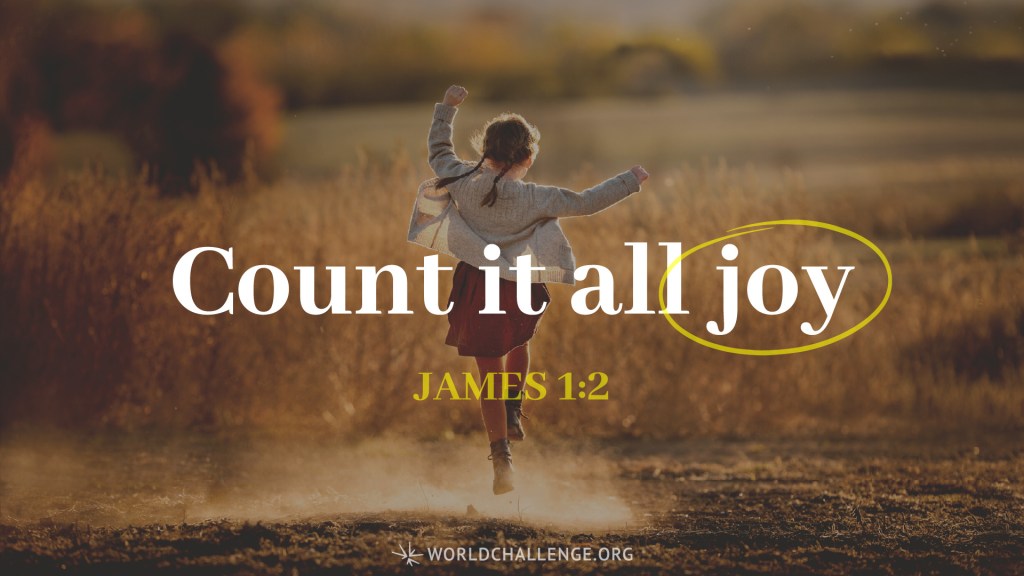
“Count it all joy, my brothers, when you meet trials of various kinds, 3 for you know that the testing of your faith produces steadfastness.”
James 1:2-3, ESV
“There is no circumstance, no trouble, no testing, that can ever touch me until, first of all, it has gone past God and past Christ, right through to me. If it has come that far, it has come with a great purpose.”
“All joy,” (verse 2) is a fantastic thought. It stresses a joy that becomes militant, something powerful and significant. “All joy,” surpasses “some joy” or even “occasional joy.” Instead it’s a joy that remains joy even when tired and weak. It will only shine brighter in the darkness.
Jewels, diamonds, and pearls are typically displayed on a black background.
This reveals their brilliance and value. In the same way darkness should only encourage us to be deliberately brighter than our surroundings. We must understand that we shine only because He makes us shine. There is a divine incandescence that awaits every believer who feels the need or desire for more of God.
God’s special nearness is available to each believer, especially those in the heat of the furnace. He is close to those who want Him, and there is nothing will stand in His way. The Lord cherishes and treasures the seeking heart. There is nothing that can detour the believer’s yearning after their Father. Your faith must be purified, and this is never optional.
Name your trial, then turn it to God in prayer.
Leave it alone and refuse to carry it no further. It’s now the Lord’s concern. Simply watch for the deliverance to come. When God sees your heart, He will lavish Himself out on you. He delights to see your faith becoming solid and real.
We never choose to suffer, rather we choose His will. We must do so whether we suffer or not.
Trust Him.
“God, who foresaw your tribulation, has specially armed you to go through it, not without pain but without stain.”
On a dirt road in the middle of a wide field stood a beautiful carriage, something on the order of a stagecoach but all edged in gold and with beautiful carvings. It was pulled by six large chestnut horses: two in the lead, two in the middle and two in the rear. But they were not moving, they were not pulling the carriage, and I wondered why. Then I saw the driver underneath the carriage on the ground on his back just behind the last two horses’ heels working on something between the front wheels on the carriage. I thought, “My, he is in a dangerous place; for if one of those horses kicked or stepped back, they could kill him, or if they decided to go forward, or got frightened somehow, they would pull the carriage right over him.”
But he didn’t seem afraid for he knew that those horses were disciplined and would not move till he told them to move. The horses were not stamping their feet nor acting restless, and though there were bells on their feet, the bells were not tinkling. There were pom-poms on their harness over their heads but the pom-poms were not moving. They were simply standing still and quiet waiting for the voice of the Master.
THERE WERE TWO YOUNG COLTS IN THE FIELD
As I watched the harnessed horses I noticed two young colts coming out of the open field and they approached the carriage and seemed to say to the horses: “Come and play with us, we have many fine games, we will race with you, come catch us.” And with that the colts kicked up their heels flicked their tails and raced across the open field. But when they looked back and saw the horses were not following they were puzzled. They knew nothing of the harnesses and could not understand why the horses did not want to play. So they called to them: “Why do you not race with us? Are you tired? Are you too weak? Do you not have strength to run? You are much too solemn, you need more joy in life.” But the horses answered not a word nor did they stamp their feet or toss their heads.
But they stood, quiet and still, waiting for the voice of the Master.
Again the colts called to them: “Why do you stand so in the hot sun? Come over here in the shade of this nice tree. See how green the grass is? You must be hungry, come and feed with us, it is so green and so good. You look thirsty, come drink of one of our many streams of cool clear water.” But the horses answered them not so much as a glance but stood still waiting for the command to go forward with the King.
COLTS IN THE MASTER’S CORRAL
And then the scene changed and I saw lariat nooses fall around the necks of the two colts and they were led off to the Master’s corral for training and discipline. How sad they were as the lovely green fields disappeared and they were put into the confinement of the corral with its brown dirt and high fence. The colts ran from fence to fence seeking freedom but found that they were confined to this place of training. And then the Trainer began to work on them with His whip and His bridle. What a death for those who had been all their lives accustomed to such a freedom!
They could not understand the reason for this torture, this terrible discipline. What crime had they done to deserve this? Little did they know of the responsibility that was to be theirs when they had submitted to the discipline, learned to perfectly obey the Master and finished their training. All they knew was that this processing was the most horrible thing they had ever known.
SUBMISSION AND REBELLION
One of the colts rebelled under the training and said, “This is not for me. I like my freedom, my green hills, my flowing streams of fresh water. I will not take any more of this confinement, this terrible training.” So he found a way out jumped the fence and ran happily back to the meadows of grass. I was astonished that the Master let him go and went not after him. But He devoted His attention to the remaining colt. This colt though he had the same opportunity to escape decided to submit his own will and learn the ways of the Master. The training got harder than ever but he was rapidly learning more and more how to obey the slightest wish of the Master and to respond to even the quietness of His voice. And I saw that had there been no training, no testing, there would have been neither submission nor rebellion from either of the colts. For in the field they did not have the choice to rebel or submit, they were sinless in their innocence. But when brought to the place of testing and training and discipline, then was made manifest the obedience of one and the rebellion of the other. And though it seemed safer not to come to the place of discipline because of the risk of being found rebellious, yet I saw that without this there could be no sharing of His glory, no Sonship.
INTO THE HARNESS
Finally this period of training was over. Was he now rewarded with his freedom and sent back to the fields? Oh no. But a greater confinement than ever now took place as a harness dropped about his shoulders. Now he found there was not even the freedom to run about the small corral for in the harness he could only move where and when his Master spoke. And unless the Master spoke he stood still.
The scene changed and I saw the other colt standing on the side of a hill nibbling at some grass. Then across the fields, down the road came the King’s carriage drawn by six horses. With amazement he saw that in the lead, on the right side, was his brother colt now made strong and mature on the good corn in the Master’s stable. He saw the lovely pom-poms shaking in the wind, noticed the glittering gold bordered harness about his brother, heard the beautiful tinkling of the bells on his feet — and envy came into his heart. Thus he complained to himself: “Why has my brother been so honored, and I am neglected? They have not put bells on MY feet nor pom-poms on MY head. The Master has not given ME the wonderful responsibility of pulling His carriage, has not put about ME the gold harness. Why have they chosen my brother instead of me?” And by the Spirit the answer came back to me as I watched: “Because one submitted to the will and discipline of the Master and one rebelled, thus has one been chosen and the other set aside.”
A FAMINE IN THE LAND
Then I saw a great drought sweep across the countryside and the green grass became dead, dry, brown and brittle. The little streams of water dried up, stopped flowing, and there was only a small muddy puddle here and there. I saw the little colt (I was amazed that it never seemed to grow or mature) as he ran here and there across the fields looking for fresh streams and green pastures finding none. Still he ran, seemingly in circles, always looking for something to feed his famished spirit. But there was a famine in the land and the rich green pastures and flowing streams of yesterday were not to be had. And one day the colt stood on the hillside on weak and wobbly legs wondering where to go next to find food and how to get strength to go. It seemed like there was no use, for good food and flowing streams were a thing of the past and all the efforts to find more only taxed his waning strength.
Suddenly he saw the King’s carriage coming down the road pulled by six great horses. And he saw his brother, fat and strong, muscles rippling, sleek and beautiful with much grooming. His heart was amazed and perplexed, and he cried out: “My brother where do you find the food to keep you strong and fat in these days of famine? I have run everywhere in my freedom, searching for food, and I find none. Where do you in your awful confinement find food in this time of drought? Tell me, please, for I must know!” And then the answer came back from a voice filled with victory and praise: “In my Master’s House there is a secret place in the confining limitations of His stables where He feeds me by His own hand and His granaries never run empty and His well never runs dry.” And with this the Lord made me to know that in the day when people are weak and famished in their spirits in the time of spiritual famine that those who have lost their own wills and have come into the secret place of the most High into the utter confinement of His perfect will shall have plenty of the corn of Heaven and a never ending flow of fresh streams of revelation by His Spirit. Thus the vision ended.
INTERPRETATION OF THE VISION
“Write the vision, and make it plain upon tables, that he may run that readeth it,” (Habakkuk 2:2). “Harness the horses; and get up, ye horseman,” (Jeremiah 46:4). I am sure that many of you who can hear what the Spirit saith to the Church have already seen what God was showing in the vision. But let me make it plain. Being born into the Family of God feeding in the green pastures and drinking of the many streams of the unfolding revelation of His purposes is fine and wonderful. But it is not enough. While we were children, young and undisciplined, limited only by the outer fence of the Law that ran around the limits of the pastures (that kept us from getting into the dark pastures of poison weeds) He was content to watch us develop and grow into young manhood, spiritually speaking.
But the time came to those who fed in His pastures and drank at His streams, when they were to be brought into discipline or “child-training” for the purpose of making them mature Sons. Many of the children today cannot understand why some of those who have put on the harness of God cannot get excited by the many religious games and the playful antics of the immature. They wonder why the disciplined ones run not after every new revelation or feed on every opportunity to engage in seemingly “good and profitable” religious activities. They wonder why some will not race with them in their frantic efforts to build great works and great and notable ministries. They cannot understand the simple fact that this Company of saints is waiting for the voice of the Master and they do not hear God in all this outward activity.
They will move in their time when the Master speaks. But not before, though many temptations come from the playful colts. And the colts cannot understand why those who seemingly appear to have great abilities and strength are not putting it to good use. “Get the carriage on the road,” they say, but the disciplined ones, those in God’s harness, know better than to move before they hear the voice of the Master. They will move in their time with purpose and great responsibility.
And the Lord made me to know that there were many whom He had brought into training who had rebelled against the discipline, the chastising of the Father. They could not be trusted with the great responsibility of mature Sonship so He let them go back to their freedom, back to their religious activities and revelations and gifts. They are still His people, still feeding in His pastures, but He has set them aside from the great purposes for this end of the age. So they revel in their freedom feeling that they were the Chosen Ones with the many streams of living water not knowing that they have been set aside as unfit for His great work in this end of the age.
He showed me that though the chastising seemeth grievous for the time and the discipline hard to endure yet the result with all the glory of Sonship is worth it all and the glory to follow far exceeds the suffering we endure. And though some lose even their lives in this training yet they will share alike in the glory of His eternal purposes. So faint not saints of God for it is the Lord that doth bring thee into confinement and not thine enemy. It is for thy good and for His glory so endure all things with praises and thanksgiving that He hath counted thee worthy to share His glory!
Fear thou not the whip in His hand for it is not to punish thee but to correct and train thee that thou mightest come into submission to His will and be found in His likeness in that hour. Rejoice thou in thy trials in all thy tribulations and glory thou in His cross and in the confining limitations of His harness for He hath chosen thee and He hath taken upon Himself the responsibility of keeping thee strong and well fed. So lean thou upon Him and trust not in thine own ability and thine own understanding. So shalt thou be fed and His hand shall be upon thee and His glory shall overshadow thee and shall flow through thee as it goes forth to cover the earth. Glory to God! Bless the Lord! He’s wonderful! Let Him be Lord of your life, friends, and complain not at that which He bringeth to pass in your life.
Bill Britton served as Vice President of Pinecrest Bible Training Center for the first three years of its existence and was a great blessing in helping to establish the work at Pinecrest.
A comment–
I first connected with this message in 1984, by a man named, Bob Mumford. As a young Christian, the allegory “nailed” me. What did I want for my life? I had to make some decisions. I sincerely wanted to follow the Father through this process. And this hasn’t changed in almost 40 years.
For more of these and other messages: Bill Britton P.O. Box 707 Springfield, Missouri 65801-0707. This is a faith ministry, made possible by members of the Body of Christ. Not copyrighted, may be translated or reprinted without further permission. All messages are free as the Lord provides.
“The heart is deceitful above all things And it is extremely sick; Who can understand it fully, and know its secret motives?”
Jeremiah 17:9, Amplified
“The Lord observed the extent of human wickedness on the earth, and he saw that everything they thought or imagined was consistently and totally evil.”
Genesis 6:5
The Bible in its tremendous insight, never once makes humans out to be wonderful creatures. I think we would all volunteer to be that way. But we are not. Rather the opposite is quite true. We are manipulators, rascals, liars and sinners.
There is not a single iota of evidence that we can become exceptionally kind, loving and holy people in any sense of the word.
Somehow we generate a lot of self-deceit.
We trick our own hearts into believing that we are such noble people. We ignore evidence that would convict us otherwise. The prophet spoke to his generation in Jeremiah 17. He would speak directly to people who thought they were true and good. Jeremiah called this a lie, a serious miscalculation, especially when the opposite was true!
This is not the way “to win friends and influence people.” So many pastors, priests, elders, and leaders have a desire deep down to be acceptable and relevant. But God says, we are rascals, tricksters, phonies. Something inside is sick. There can be no human remedy. We simply cannot become religious enough to surmount our profound sin. Pride and selfishness opposes God and harms others.
As a boy living in Northern Wisconsin, on a farm somewhat, we found one of our dogs killing chickens. He was a nice dog, quite friendly and very gentle. But when he started in on the chickens my dad decided to intervene. One of the dead chickens was recovered. My father wired that dead chicken to our dogs neck, nice and tight. That dog wore that rotting chicken for several weeks. Finally the dog laid down, foaming and tongue lolling, eyes rolled back. He was profoundly sick. So Dad cut off the decaying remains.
The SPCA would have a fit. But that dog would never again chase a chicken, or even think of killing one. But even so, our sin is disgusting to God. We just seem to do evil without considering Him or others we effect. It’s all about us, as we think we can just skate through this “problem” without any issues. But Jeremiah tells us we are rotting inside.
We all carry around a dead chicken. I must tell you the truth, you’re terminally ill. You are quite sick, in the most essential part of you.
But Jesus died to free you. He’s the only One who can.
“Our life is full of brokenness – broken relationships, broken promises, broken expectations. How can we live with that brokenness without becoming bitter and resentful except by returning again and again to God’s faithful presence in our lives.”
–Henri Nouwen
We are a broken lot of confused people, and we have never solved the mystery of our own iniquity. In those rare, fleeting times we step into clarity, we are ashamed and disturbed by what we see. Our awful sin needs a wonderful Savior. Jesus does what we could never do.
Jesus died to free us from death. He has come to cut us free from our spiritual evil.
He has died to destroy our sin. But there is much more. He gives us real life–eternal life. His life!
“Come now, let us reason together, says the Lord: though your sins are like scarlet, they shall be as white as snow; though they are red like crimson, they shall become like wool.”










 Alaska Bible Teacher
