David and Goliath, Reloaded

Physically there was no comparison. 

Goliath was almost 10 feet tall, a warrior since birth–we read of his armor–he was like a Sherman tank. And David was just a very small, skinny boy–nothing more.

Young David stood and looked at Goliath face-to-face. (If it’s been awhile, you can read of this encounter in 1 Samuel 17.) My guess is that Goliath preened and strutted into the field of battle, and the boy David was stepping up for his very first try at hand-to-hand combat. David is called a “youth” in Hebrew, which means anyone from infancy to adolescence.

And that’s when Goliath begins to blaspheme loudly. Perhaps that’s what giants do best.

He boasts. He mocks.  He believes he is superior, and his arrogance seems to know no bounds.  In his mind the center of the universe is the Philistine army, and he is their champion. He is contemptuous of everything else–physical or spiritual.

Essentially all you need to know is that Goliath is a human wood chipper. 

Everyone who has faced him has been destroyed.  No one has ever survived. But he has never met David before. And Goliath knows nothing of the living God. It amazes me, but David never backs down, his reaction to the ‘human mountain’ of Goliath was to run directly at him. 

“As the Philistine moved closer to attack him, David ran quickly toward the battle line to meet him.  Reaching into his bag and taking out a stone, he slung it and struck the Philistine on the forehead. The stone sank into his forehead, and he fell facedown on the ground”.

1 Sam. 17:48

Many of us face our giants. They come with many names, some are called guilt, pride, doubt, or despair and lust. And they come with many other names as well.

Satan our enemy has marched out on the field of battle, arrogant and supremely confident of his ultimate triumph over us. I suppose that should terrify us. Over the years we’ve been indoctrinated to accept sin’s control, and our inevitable slavery–with a spirit of timidity.

We’ve been rightly told that there are enemies that can destroy us.

As believers we are especially hated in the spiritual world of darkness. Our destruction is inevitable in the mind of the evil one.  Satan still expects to win over your soul, but Jesus stands as our advocate shielding you. I believe you are saved because He really did die for you.

Our own particular favorite demonic ‘monster’ is real and brutal. 

Yet so many believers are intimidated, listening, and then surrendering to the boasting of the giant.  The warfare dimension gets nullified, and soon becomes irrelevant.  Despair reaches us and has the full intention of taking total control. It’s never satisfied with just a little bit.

David ran to the battle–to face the giant who was standing right in front of him. 

He passed through the dark intimidation and influence to approach Goliath.  There was no doubt to cloud his mind.  David took a spiritually aggressive position, he took on the fear, and then ran directly at the giant Goliath.  His spirit was untouchable. This is the boy who wrote Psalm 23.

Some of us stare down our giants repeatedly, over and over.

As believers, we might struggle.  We can turn our hearts over to despair.  Sometimes we actually make ourselves available to the enemy’s workings. When we do this the enemy spreads his influence to others through us. And any confidence we might have through faith is dissolved into doubt and confusion. 

But the victory we have in Christ allows us liberty, through the Blood of Him who defeats our own Goliath of despair. We can run into the battle. We fight our giant, but we’re never defeated.

     Thomas Watson

“But thanks be to God, who gives us the victory through our Lord Jesus Christ.”

1 Corinthians 15:57, ESV

alaskabibleteacher.com

Your Heavy Load

Matthew 11:28-29, Amplified Bible

He is inviting us.

Jesus requests our presence in one simple statement, “come to Me.” This phrase must be our starting point. It’s how you begin daily. If you’re His disciple, it’s imperative that you obey. But this concept is nuanced, it has profound meanings.

“All who are weary.” Each of us carries a heavy load. Sin has weight, whether we believe it or not. When I start to see this, I really begin my discipleship. Apart from Jesus’ invitation I will try to carry this heaviness on my own. This is called “religion,” and it’s a bad thing.

“My guilt overwhelms me—
    it is a burden too heavy to bear.”

Psalm 38:4

“I will give you rest.” It’s His gift, given to each believer. It isn’t earned, you don’t deserve it. His heart is for you to “rest.” The original Greek word often means “to refresh, or to cease your work.” Every true disciple knows this, and understands that Jesus rather laying a terrible burden on us, takes it off.

We must understand our calling.

Another burden (His own burden), is now given to us. It’s Jesus’own weight shared with believers. But it’s a restful burden that gives joy and peace. There are no longer sweaty religious rules, but authentic rest. Real discipleship is now based on love, not duty.

To follow Him in obedience is the happy delight of every disciple. When you are in love with Him the rigors of obedience have little weight.

 Oswald Chambers

“For I am gentle and humble in heart,” is His nature. He always acts this way, it is who Jesus is. This is how He behaves to each of us. It becomes the very essence of how He relates to human beings, always gentle and completely humble. Sometimes we add things that obscure this, and we see Jesus in our own particular image. (Maybe that’s a way of defining idolatry?)

And finally--“and you will find rest for your souls.” Again, the Greek here is quite instructive: rest, “cessation of any motion, or labor.” My walk, following Him, isn’t working harder, but being in a joyful rest. God’s saints aren’t called to sweat, but walk in the sureness of the presence of Jesus inside them.

Life can be awfully hard. Trials come and we get overwhelmed.

The joyful rest is only a slice of what heaven will be like. If joy and peace are a wonder now, just you wait, our future holds promises of a continual awareness of Him in our new bodies. This fallen world will be completely remade. Sin, sadness and Satan will be no more.

“And me? I plan on looking you full in the face. When I get up, I’ll see your full stature and live heaven on earth.”

Psalm 17:15, MSG

We See So Little

Job 26:14

Job’s suffering has led him to this point. He realizes how little he understands God. I guess pain can have a powerful effect on how we see things. Job has learned the immensity of God.

In verse 14 he speaks about the “outskirts” the word in Hebrew means the mere edge, or fringe. One translation of this verse reads like this: “These are only a few of the things that God does. We only know about a few small things. If he used all of his power, we could never understand.

“That being the case, let’s consider God’s capacity for just a moment. He’s not only “high capacity”, He’s “infinite capacity.” He never sleeps or slumbers. He is perfect in all His abilities. There isn’t a single thing that He doesn’t know, and there is no one more powerful than Him. And unlike humans who can only be in one place at one time, He is everywhere at the same time. This is amazing, and just like the Psalmist said in Psalm 113, “Who is like the Lord our God?” The answer, very simply, is no one.”

John Piper

“For now we see in a mirror dimly, but then face to face. Now I know in part; then I shall know fully, even as I have been fully known.” (1 Cor. 13:12)

I’m thinking about Moses who asked to see God’s glory. Moses was called “the friend of God,” but he wanted to see more. God’s response was that He couldn’t because it would kill Moses. But provision was made for him to see the backside of God as Moses was in a cleft of a rock. (Exodus 33.)

The Bible doesn’t reveal it all. But we’re given enough. Job told us that only the outer fringes can be seen by men and women. We see His periphery, but we must understand our limits. We’re told that we will see Him someday–but not yet. But at the moment of death, we will see Him.

The Lord Jesus came to show us the Father. “In [Christ] all the fullness of deity dwells bodily.” When we see Jesus we see the Father. Reading the Gospels we are encountering God, because Jesus reveals Him fully.


“He is the radiance of the glory of God and the exact imprint of his nature, and he upholds the universe by the word of his power.” 

Hebrews 1:3

Romans 11:33

alaskabibleteacher.com

Finding the Pearl

“Again, the kingdom of heaven is like a merchant looking for fine pearls. When he found one of great value, he went away and sold everything he had and bought it.”

Matthew 13:45-46

A different perspective.

The central issue seems to be of value. The pearl was magnificent. This merchant had never seen one like this. It gleamed in his hands, and he knew he must have it. It wasn’t an option, he had to buy it. His response–sell everything to the highest bidder (of course) and buy it.

The Lord Jesus loves each of us intensely.

Rather the people who make up the body. He loves everyone, but he’s crazy about his people. I have a shirt, and I’ll wear it sometimes when I feel like it could touch someone, it says “Jesus Loves You, but I’m His favorite.” I know it’s funny, but maybe it’s true? I know that he loves me–crazy-like. And I love that He loves, even me.

We’re His pearls.

His blood, and His cross was the purchase price. That’s what it took. When we truly believe we acknowledge that we are His now. He paid for us, completely.

Jesus sees, and he must have us. So he comes, and pays the price, he sells it all just to possess us. He now owns us. We know that there is nothing remarkable about us, for we understand our own sinfulness, we really see that we’re spiritually evil all of the time. The theologians call it “the depravity of man.” (Ecclesiastes 9:3; Job 15:14-16; Matthew 15:19).

But our faith in Him changes everything! We have been bought off the slave block of sin. We have been chosen.

“Therefore I endure everything for the sake of the elect.”

2 Timothy 2:10

We realize that we are the elect as believers when we put our faith in what Jesus did for us. Believe me, that’s not what I feel or sense about myself. But it’s what He sees, and He desperately wants me to be his own–and I don’t know why he would do such a thing. It makes no sense to me at all.

God’s love has reasons which reason cannot understand.


p

The Dark and Theological Niceties

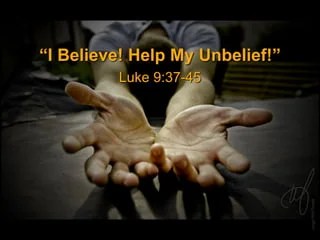
“On the next day, when they had come down from the mountain, a great crowd met him. 38 And behold, a man from the crowd cried out, “Teacher, I beg you to look at my son, for he is my only child. 39 And behold, a spirit seizes him, and he suddenly cries out. It convulses him so that he foams at the mouth, and shatters him, and will hardly leave him. 40 And I begged your disciples to cast it out, but they could not.” 41 Jesus answered, “O faithless and twisted generation, how long am I to be with you and bear with you? Bring your son here.” 

42While he was coming, the demon threw him to the ground and convulsed him. But Jesus rebuked the unclean spirit and healed the boy, and gave him back to his father. 43 And all were astonished at the majesty of God.”

Luke 9:37-43

All of this takes place immediately after Jesus’ transfiguration. He has shown Himself to be God, wrapped tightly into manhood–He’s fully and completely the Word made flesh. He is the Creator, and He is holding the universe together. Who really can fathom this?

Full of power, but also completely covered with incredible compassion. He meets this desperate man, a man who is carrying incredible weight, a burden that had taken over his life. Jesus steps into a theological circus, after all, the Scribes had shown up, and the disciples were disputing with them. The terrible need of the demonized boy had been forgotten.

The disciples had tried to free him, they really had.

But between the gathering crowd and the arguing Scribes, they were overwhelmed. His disciples were completely out of their element. Defeated, they didn’t know what to do. (Isn’t this a description of much of today’s church? Maybe?)

Sometimes we as the Church can only stress theological niceties.

Often we look beyond the awful needs around us. We rather argue with each other rather than love. We prefer to debate rather than meet the incredible pain around us. How sad is this? We constantly meet terrible pain, and we choose to reside in some strange theological bubble of our own making.

When Jesus comes down from glory on the mountain, He immediately faces off with a desperate man and a demonized son. This father is terribly overwhelmed–the disciples had made a try (or two) and yet couldn’t free the boy. The demons had ignored their efforts and laughed at attempts to free him. These demons decided to stay inside this boy. The disciples can do nothing about it.

But when Jesus shows up, all hell breaks loose, quite literally.

There is amazing power here. Jesus, already shown to be God on the mountain top, now declares His authority over the ugliness of the darkness. He’s been unleashed and absolutely demolishes the works of Satan. He dismantles the evil and decisively frees the boy.

And all were astonished at the majesty of God.”

We can link this power to what we’ve seen on the mountain top–His Words are powerful enough to hold the world in place! He is the Almighty One that has chosen to walk shoulder-to-shoulder with us. He pushes against the darkness and sets us free.

“But have we Holy Spirit power – power that restricts the devil’s power, pulls down strongholds and obtains promises? Daring delinquents will be damned if they are not delivered from the devil’s dominion. What has hell to fear other than a God-anointed, prayer-powered church?”

   Leonard Ravenhill

alaskabibleteacher.com

“I Kept You From Sinning”

Genesis 20:6

This is called restraining grace, the doctrine that teaches that God intervenes to prevent sin from happening.

Both the pagan king Abimelech and the patriarch Abraham have problems. One wants to add Sarah to his harem (lust), and the other pretends that Sarah isn’t his wife, but his sister (cowardice).

The dream:

Abimelech goes to bed and has a “God dream.” The Lord threatens him with death for taking another man’s wife. King Abimelech protests and pleads for his life. (Dreams were significant in Genesis.)

God relents and to Abimelech’s credit the Lord understands that this was done from a clear conscience. It seems that Abraham’s spinelessness has given the wrong idea about Sarah. She isn’t his sister, but his wife!

There are some interesting issues here. Not only is the king prevented from sinning here, but we see the lengths God went to protect Abraham and Sarah’s marriage. They were to be the parents of the nation of Israel. God would see to that.

There are real consequences to our sin. We will reap what we sow (Galatians 6:7), but God’s grace protects the believer who desires to be Christ-like. He is a shield to the man who runs to Him.

It probably happens more than you realize. I’ve found that there is a still, small voice that speaks to the Spirit-filled believer. Sometimes we ignore it and sometimes we obey it, but it’s there. It’s meant to guide us.

Our conscience is the “sheriff” of our souls. It’s our compass.

It seems that little is said about conscience anymore, but it’s imperative that you recognize it. Conscience tells you whether something is right or wrong. It’s our guide and must be closely watched over. It can become seared and clouded–it can be defiled. But it also can be purified and made holy.

Our conscience knows this. It’s a spiritual fact.

Ligonier.org

For further study: Psalm 12:7; Proverbs 11:6; Proverbs 13:6; 1 Peter 3:12.

alaskabibleteacher.com

The Thief on the Cross Speaks

Luke 23:39-43

“One of the criminals who were hanged railed at him, saying, “Are you not the Christ? Save yourself and us!” 40 But the other rebuked him, saying, “Do you not fear God, since you are under the same sentence of condemnation? 41 And we indeed justly, for we are receiving the due reward of our deeds; but this man has done nothing wrong.” 

42 “And he said, “Jesus, remember me when you come into your kingdom.” 43 And he said to him, “Truly, I say to you, today you will be with me in paradise.”

The pain was incredible, but I know that deep down I deserved to die. But not like this. Never like this. I was almost out of my mind with fear. What they were doing to me was terrifying.

You must understand that I was a common thief. I had stolen a loaf of bread when I was eight years old and that’s how it all got started for me. It more or else got bigger and easier. I knew how to steal and I was quite good at it. I was Jacob, the master thief!

When I was finally caught, they sentenced me to die. I supposed it was inevitable. I fault no one but myself as I knew what I was getting into. As I dragged my beam up to Golgotha, it was really strange but I suddenly remembered a verse from the scripture and it really did unsettle me.

(Gal. 3:13, ESV)

It’s a terrible thing to die this way. There were three of us, nailed to the wood and lifted up between heaven and earth. Jesus was nailed to the middle cross, not that it really mattered; all three of us were going to die today.

Many hope for an easy death, maybe in their sleep–but that’s not going to happen to us.

The third man could only mock, he was afraid, and I suppose he just echoed those Pharisees who didn’t really understand. But I knew better. I knew who this other man was, I had heard all the stories. Deep down I knew that this man on the center cross was the Messiah.

A crowd had gathered to watch us die. The Romans in their wonderful ingenuity had made a sign that they nailed above Jesus’ head, and it declared to everyone that Jesus was “the king of the Jews.” Even as he was dying, they found a way to malign him and irritate the crowd.

The other man being crucified continued to mock Jesus, and it infuriated me.

Why I defended him I don’t know for sure.

But I understood. Jesus was murdered out of the envy and jealousy of the Pharisees. He didn’t deserve to die like this, but He was hated, and who can confront these religious men without becoming a victim. Jesus had repeatedly crossed the line, so now they were now putting him to death. It seemed evil was really winning today.

I saw the soldiers throwing dice for Jesus’ clothes. He was now being mocked by them as well, even as He was dying on a brutal cross.

But all of a sudden it all made perfect sense.

He really was the Messiah, and these bastards were killing him. Crucifixion was starting to work on me now. I began to choke on my words, and it was getting hard to breathe.

“Jesus… please remember me. When your kingdom comes, please let me be a part of it.”

And as beaten as He was, He managed to turn and look directly at me. They had whipped and brutalized Him, and yet He was still aware. His words were whispered now, but I understood. “I promise that today you will be with me in paradise.”

I was starting to spasm again.

But the horror of death had left me. Some time had passed, and I could hear his breathing stop. But for the first time, I had peace. They used a spear on Jesus, but he was already dead.

The soldiers now came to the two of us, and they were carrying an ax to break our legs. It all had to do with the coming festival, and the Pharisees wanted us dead. When they swung that ax I knew a pain that I could never describe. My own death came quickly after that.

I was suddenly standing in paradise, whole and complete, and loved.

Someone was standing before me. He was shining, and I knew he was powerful; stronger, and He was more glorious than anyone I had ever met. It was crazy but somehow I knew that it was the Lord Jesus. He had come to meet me. It’s funny, but I realized that somehow I really did belong. Me–a dirty rotten thief.

Jesus had promised me, pronouncing me righteous, me of all people. I suddenly had a joy that I could never explain. I really was a part of the Kingdom that was beyond anything I had ever known. I believed him and asked if somehow I could be part of his eternal rule.

I simply asked and He gave me everything.

“I am going to heaven just like the thief on the cross who said in that final last moment: “Lord remember me.”

Billy Graham

alaskabibleteacher.com

Cover Art: “Christ on the Cross between Two Thieves,” by Peter Paul Rubens

Hineni, “Here I am”

The life of Moses is a wonderful story. When he was a young man he met God in a common shrub. He was shepherding a flock for his father-in-law. Then something quite extraordinary happened. He saw a bush on fire.

“When the Lord saw that he turned aside to see, God called to him out of the bush, “Moses, Moses!” And he said, “Here I am.”

Exodus 3:4, ESV

God would call Abraham, Issac, Jacob, Joshua. And there was also Samuel and Isaiah. In the book of Acts Paul heard Jesus call him on the Damascus road. And they all responded with one Hebrew word– hineni.

“Here I am.”

God is never silent. He still speaks to each believer. He calls out to us, and hineni must be our response. Yes, walking in faith can be hard, but each one has been summoned. I believe this is true. Each of us is valuable in God’s eyes–“You were bought with a price.”

How are you going to respond to this?

Hineni is a dangerous word. Ask the disciples. When Jesus called them to follow they had no idea how turbulent and troublesome life would become. Each believer gets a cross. And each will know grace and peace.

“And calling the crowd to him with his disciples, he said to them, “If anyone would come after me, let him deny himself and take up his cross and follow me.”

Mark 8:34

There’s grace given to everyone who can really say, hineni, “Here I am.” I have known that there is joy in my journey, a kindness that has no bottom, a love that surpasses every pinnacle. I’m loved that much.

“Christianity without discipleship is always Christianity without Christ.”

    Dietrich Bonhoeffer

alaskabibleteacher.com

When Water Became a Sidewalk

Matthew 14:24-31

Peter is speaking:

It was the dead of night–the fourth watch, sometime between 3-6 a.m. The crossing was going all wrong, the water and wind were contrary, and we were exhausted. We had worked hard and made little headway. I seldom have seen anything like this, and the waves were pounding our boat. We had no idea how long we could keep this up.

Someone shouted and started pointing. We all looked, and quickly came to the realization that it was Jesus–but that was impossible. It had to be His “ghost.” He was walking on water, calming striding toward us. As absurd as it seems now, we believed that. After all, what we were all seeing defied reason. No way, it was impossible!

As He got closer to our boat when it shouted to us.

We all knew Jesus’ voice—and He was telling us not to be afraid, He understood our fear and He wanted us to know that we were in God’s hands. Our terror got mixed up in skepticism. After all, it had been a long day and this just doesn’t happen. Besides we knew that Jesus was left back in Gaiilee.

I don’t know why to this day where my courage came, but I needed to be with Jesus. Maybe it was curiosity, maybe it was more than that. Somewhere I came up with this wild idea that if He was really Jesus then He could allow me to walk on the water. I know that seems bizarre, but my “faith” in Him was greater than anything else.

Jesus told me to join Him.

So guess what? I stepped out of the boat.

The water was as solid as if I were walking on land! I couldn’t figure that out, it was impossible. Completely unbelievable. I saw the waves and felt the wind–My eyes shifted from Jesus and it was then I began to sink. The water was becoming water, and I began to sink.

“Jesus, save me!”

If there was any lesson that cry moved the heart of Jesus. Perhaps that’s what has shaped my ministry today. The cry of desperation has become an integral part of my walk. At that moment I realized that is my best prayer. “Master, save me!” I use it a lot. Especially when I’m “sinking.”

Jesus grabbed me.

I was pulled up and out of the water to safety. He gently spoke a rebuke–a kind word of instruction and direction. But I learned something.

Following Jesus is a supernatural walk.

It can’t be done in any other way. And you must get out of the safety of the boat, which must come at His invitation. He wasn’t angered by my unbelief, but I believe He was encouraged by my faith, and the lesson was clearly understood by the disciples still in the boat.

The steps of faith fall on the seeming void, but find the rock beneath.

    John Greenleaf Whittier

alaskabibleteacher.com

The Extraordinary Breath of Jesus

“Jesus said to them again, “Peace be with you. As the Father has sent me, I also send you.” 22 After saying this, he breathed on them and said, “Receive the Holy Spirit. 23 If you forgive the sins of any, they are forgiven them; if you retain the sins of any, they are retained.”

John 20:21-23 (19-23)

This is the second “peace be with you” in this passage. So why the duplication of this peace proclamation? The disciples are sequestered and scared in the upper room (v. 19; and Luke 24:36. Having peace is being emphasized–the disciples were afraid of the Pharisees, but they were also undone by Jesus’ surprise visit.

Peace was definitely a precious commodity for them.

Jesus gives his disciples a mission to do, and they must be as ‘familiar’ with Jesus just as Jesus is with God. The disciples had followed him for three years–seeing incredible miracles, and hearing profound teaching, they’re ready, they just need power.

In track and field, there’s a relay race where a baton is passed from runner to runner, and maybe that’s how it’s working here? We see the same idea in John 17:18.

The baton has now been passed to the disciples.

The breath of the risen Jesus is necessary (and yes, he’s breathing.) What went down here, I don’t know exactly. But Jesus recognizes that his 12 followers will need this to do his work. Also, we might consider Adam in Genesis 2:7 where God’s breath brought him to life, which is pretty awesome when you think of the parallels.

The Holy Spirit energizes these men to do this new work.

The disciples were pretty much observers, but now they are to take up the ‘mantle’ of Jesus’ work. This is a definite duplication, which connects with the idea of one seed producing many others (John 12:24.) That’s how the Kingdom will come to people.

Verse 23 intrigues me. It seems that our life comes from the breath of Jesus. And it’s the Holy Spirit that gives both power and the authority that’s needed to function like Jesus. We now have the ability to pronounce forgiveness to the new believer, and yet that doesn’t seem a function of the Church today.

I wonder why this is so?

This entire passage is a real humdinger for Bible students. But it clearly declares the Churches new role as we follow in his footsteps. Disciples are to do exactly what Jesus does–with his breath and authority–filled with the Holy Spirit. We have a mission.

If we neglect these things we’re going to fall flat on our face.

“The work of Jesus for His disciples on resurrection Sunday gives an ongoing pattern for His work among His people. Jesus wants to continue this fourfold ministry of assurancemission, the Holy Spirit and authority to His people today.”

From David Guzik’s website