I have to admit, I never really appreciated the depth of Psalm 23:5. I supposed that “He anoints my head with oil” was simply just figurative language for something nice. Poetic. I never knew this definite parallel until recently. But David completely understood and was able to understand the full ministry of the Shepherd.
“You prepare a table before me in the presence of my enemies; you anoint my head with oil; my cup overflows.”
Psalm 23:5, ESV
I recently read this and suddenly I understood.
“Sheep can get their head caught in briers and die trying to get untangled. There are horrid little flies that like to torment sheep by laying eggs in their nostrils which turn into worms and drive the sheep to beat their head against a rock, sometimes to death. Their ears and eyes are also susceptible to tormenting insects.”
So the shepherd anoints their whole head with oil.
“Then there is peace. That oil forms a barrier of protection against the evil that tries to destroy the sheep. Do you have times of mental torment? Do the worrisome thoughts invade your mind over and over? Do you beat your head against a wall trying to stop them? Have you ever asked God to anoint your head with oil?”
He has an endless supply!
His oil protects and makes it possible for you to fix your heart, mind, and eyes on Him today and always! There is peace in the valley! May our good good Father anoint your head with oil today so that your cup overflows with blessings! God is good and He is faithful!!”
How much do you love Jesus? This parable looks at the heart of the believer, the person who has been incredibly forgiven of everything–past, present and future. And it’s here we see a woman whose heart is broken by her sin, and she discovers Jesus’ grace, and tremendous mercy.
“A certain moneylender had two debtors. One owed five hundred denarii, and the other fifty. 42 When they could not pay, he cancelled the debt of both. Now which of them will love him more?” 43 Simon answered, “The one, I suppose, for whom he cancelled the larger debt.” And he said to him, “You have judged rightly.”
44 “Then turning toward the woman he said to Simon, “Do you see this woman? I entered your house; you gave me no water for my feet, but she has wet my feet with her tears and wiped them with her hair. 45 You gave me no kiss, but from the time I came in she has not ceased to kiss my feet. 46 You did not anoint my head with oil, but she has anointed my feet with ointment.”
47 “Therefore I tell you, her sins, which are many, are forgiven—for she loved much. But he who is forgiven little, loves little.”
Luke 7:40-47
Jesus has been invited to Simon’s home. He’s a Pharisee, and at this point they haven’t quite banded together to attack Jesus, it seems that there were still some Pharisees who were true seekers.
The text jumps right in and we see Jesus reclining at a table (the Jewish people didn’t use chairs–pillows were used instead.) At a feast like this people who weren’t officially invited could come in to stand in the back and listen in on the conversation. (That seems awkward.)
Suddenly a woman enters the room.
She’s described as “a woman of the city,” which is a code word for “a sinner, or a harlot.” (Let your imagination roll that one around.) She comes with a definite purpose, for she brings a jar of quite expensive perfume with her.
The passage reveals that she’s on her knees, weeping on Jesus’ feet, and rubbing her tears with her hair, and pouring out the perfume. She’s kissing his feet. She’s obviously a broken person—someone who knows who Jesus is, and who understands who she is, and how deep sin has destroyed her.
At this point Simon is deeply offended, and probably embarrassed by what’s happening. But he also assumes that Jesus isn’t who he’s saying he is. “How dare does this man let an unclean person even touch Him!” But Jesus understands everything. His parable is short (just two verses) and it’s directed at Simon; and it’s a no-brainer.
The interpretation is obvious: the man who owes the most will love the most.
Jesus accentuates Simon’s breach of protocol. The Lord deftly explains the entire situation and Simon is busted. He’s put on the spot and Jesus has made his point. It’s all so obvious. The essence of the story is clear. How much do you love the Master?
Do you truly fathom how much sin Jesus has forgiven you?
(Or maybe you’re a Simonite?)
Perhaps you’re someone who doesn’t quite accept what’s real? The Bible tells us repeatedly that no one is righteous. No one. Scripture has a very low opinion of the righteousness of men. (That should shatter your thinking.)
“But we are all as an unclean thing, and all our righteousnesses are as filthy rags; and we all do fade as a leaf; and our iniquities, like the wind, have taken us away.”
Isaiah 64:6, KJV
The Hebrew word for “filthy rags” is extremely graphic–literally it means “a menstruating cloth.” It was something that a woman used before Tampax came along. How very descriptive. Do we even have the slightest idea what that means? Are our good deeds that bad?
Yes they are. Isaiah announces that’s exactly how God sees our best attempts to find acceptance apart from grace. It often seems we try to please Him by doing the best we can, but that isn’t sufficient. We always fall short and mess up.
How does understanding this change our discipleship? I’ll let you be the judge on this on this one.
“He loved us not because we are lovable, but because He is love.”
Body piercing has become pretty much acceptable just in the last ten years.
Studs are placed in a hole or piercing to make a permanent decoration. I have seen a fair amount of it, and I think that a stud in the tongue has got to be the most intrusive. (I recently read of a young girl who died after her tongue was pierced from an infection).
There is “body piercing” in scripture. In Deuteronomy 15:12-18, slaves who are being set free by their master after six years of service, could, if they loved and were loved by their master, could choose to remain a slave to him.
“But if your slave says to you, “I don’t want to leave you,” because he loves you and your family and has a good life with you,17 stick an awl through his ear into the door; he will be your slave for life. Also do this to a female slave.”
Deuteronomy 15:12-18
This was a decision that required elders to act as witnesses. It was significant as well as completely binding. I like to think of the ceremony to be kind of a cross between a wedding and a circumcision. (Sounds fun, huh?!)
The slave would be led to a doorpost and the master would take an awl, and push it through his ear lobe. This designated the slave to be forever “owned” by a specific master. Herein lies a picture of the Christian.
Many times in the New Testament we are called to be servants (slaves) of Christ.
Peter, Paul, James, and Jude referred to themselves as “bond servants of Jesus Christ” in their epistles. This is not a forced servitude. It’s a choice made in love!
There are many believers who have done the same, they have fallen in love with their Savior. They do not plan on a life apart from Him. So spiritually they have gone to the doorpost, the awl is pushed through their ear, and they are marked from that point on.
Although the ear was pierced physically in the Old Testament, a different kind of piercing takes place in the New. In Romans 6:16 we read,
“Surely you know that when you give yourselves like slaves to obey someone, then you are really slaves of that person. The person you obey is your master. You can follow sin, which brings spiritual death, or you can obey God, which makes you right with him.”
Romans 6:16, (NCV)
When the prodigal son returned home from the far country he fell before his father and humbly ask, “make me your servant.” (Luke 15:19,21) He, in essence, was saying to the father, “pierce my ear.” The father made him a son, but the attitude of the son’s heart had changed to the heart of a servant. So it must be with us. Only then will we live a “pierced ear” life, revealing to all that we are servants of Jesus Christ!
“Savior, I know Thou hast allowed me absolute liberty, to serve Thee, or to go my own way. I would serve Thee forever, for I love my Master. I will not go out free. Mark my ear, Lord, that it might respond only to Thy voice.”
21 “So that you also may know how I am and what I am doing, Tychicus the beloved brother and faithful minister in the Lord will tell you everything.
22 I have sent him to you for this very purpose, that you may know how we are, and that he may encourage your hearts.”
Ephesians 5:21-22
There is so much here that communicates Paul’s heart. He’s laid out a ton of theology, and now he ends his heavy letter with this final benediction or blessing. These final verses are not doctrine. Instead they’re more like God’s ‘open window’ directly to the Ephesian’s heart.
Just imagine yourself as a believer living in Ephesus. Reading the letter we should see ourselves there (albeit 2000 years removed). This belongs to you as much as it belonged to the churches in Asia Minor. Please, own it.
You need to see this. It changes our walk from the 1st century to the 21st century.
This letter belongs to you personally. Ephesians is your letter from ‘home.’ So dear one, make it yours, for you are the Holy Spirit’s audience, and you’re very much loved!
Tychicus has been chosen to carry this letter 5,000 miles to the Ephesians.
The journey itself was over 5,000 miles from Rome to Ephesus, walking by Roman roads. (It would be a long trip, longer than walking from San Francisco to Boston!) It was difficult and could be dangerous, but the letter Titus carried was important. It would be painstakingly copied and then sent to all the churches in Asia Minor.
“Travelers journeyed in convoy, sometimes hiring soldiers to protect them from robbers who preyed on the unsuspecting. Roman roads made things somewhat easier but still, walking, perhaps hiring a donkey or paying for passage on a merchant’s ship. Travel was for the brave and the strong.”
He was a gospel ‘veteran’ who ministered with Paul in various places in the Roman empire. It appears he was friends with Timothy, who was the young pastor of the church in Ephesus. Tychicus was someone whom Paul trusted implicitly. After all, he was carrying Paul’s heart in his backpack.
Tychicus was 100% loyal, brave, and completely reliable. I think Paul had confidence that he would do everything necessary to make sure this letter would get through. We find he was able to do this. And you and I, well, we owe a spiritual debt to this faithful man who went the distance for us.
We can skim through this passage and never really see Tychicus at all.
Tychicus seems to have no real preaching ability, but he is called “beloved” and “faithful” in verse 21. In verse 22 he is called a “brother” and a “minister.” That word for minister is διάκονος, deacon and it means “a servant of a king” or a “waiter of tables.” I believe that reveals someone who is a minister to the needy (which is no small thing).
Paul closes his letter with a benediction.
In verses 23-24, we read that the blessing is given to the church. He pronounces “peace, love, and faith.” Paul speaks out of God’s heart to the Ephesians, and as a leader, he is conveying God’s own blessing. A proper benediction that originates from the Lord is hardly just a nicety, something free and easy. You must understand, a pastor’s blessing is powerful.
“Grace be with all who love our Lord Jesus Christ with love incorruptible.”
36 As they were talking about these things, Jesus himself stood among them, and said to them, “Peace to you!” 37 But they were startled and frightened and thought they saw a spirit.
38 And he said to them, “Why are you troubled, and why do doubts arise in your hearts? 39 See my hands and my feet, that it is I myself. Touch me, and see. For a spirit does not have flesh and bones as you see that I have.”
40 And when he had said this, he showed them his hands and his feet. 41 And while they still disbelieved for joy and were marveling, he said to them, “Have you anything here to eat?” 42 They gave him a piece of broiled fish, 43 and he took it and ate before them.
Luke 24:36-43, ESV
In the most thrilling moments of a story, there are instances when the true essence of the events becomes crystal clear. Luke’s narrative brilliantly captures that exhilarating sensation. Picture this: Jesus, triumphantly risen from the depths of death, enters the room with a burst of energy that electrifies everyone present. It must have been one of those extraordinary instances where words simply fall short, and experiencing it firsthand is the only way to truly grasp its profound impact.
“Frightened” and “terrified”–it seems it takes two words to describe this spooky experience.
Everyone was terrified; they were convinced that Jesus must be a ghost. They all panicked and tried to run to the nearest exit, but then realized that the door was still locked!
Oh boy, Jesus must have had a good chuckle over this one! I mean, imagine being a human and seeing your disciples, all stooped and scared, trying to approach you like a bunch of timid puppies. It’s like trying to get a dog to come to you when it’s so terrified it’s peeing on the floor! I bet Jesus couldn’t help but smile and think, “What a hilarious sight!”
They slowly encircle Jesus and as they come, I have to believe He’s amused. He has survived a very brutal cross, and walked through hell. And, He has risen from the dead.
He is laughing from the pure joy of one who has endured the worst of a very real hell.
Jesus emerged unscathed on the opposite end, a testament to his invincibility. His arrival has undoubtedly filled him with undeniable joy, surrounded by beloved companions. In his triumphant resurrection, he defied all odds and accomplished the unimaginable, evoking a cascade of profound emotions, a mingling of laughter and tears.
I believe each of us has walls.
Walls can provide a sense of security and protection, both physically and emotionally. People often feel the need for boundaries and walls to feel safe. This is similar to how disciples found safety in numbers and the walls around them. They were afraid, and so they hid themselves.
Jesus insists on penetrating our walls. He’s overcoming much resistance and delusions. And then suddenly we come ‘face-to-face’ with the dead person who’s now alive. He is “The King of Kings and the Lord of Lords.
Behold, behold! Witness the magnificent display of unadulterated resurrection power—a force unparalleled in the vast expanse of the universe. Its brilliance eclipses the sun, its might surpasses that of the mightiest atomic bomb. Prepare to be astounded, for this power knows no bounds!
It’s funny, when Moses prostrated himself before the Lord’s glory, he changed. Not only that, but he had to take precautions to cover his face when he returned to camp. These disciples however have just seen the glory of God first-hand.
As His disciples, we must be prepared for any eventuality. Jesus can and will burst into our homes, and into our very lives. Can you hear him laugh? When he comes, nothing really is the same again. He loves his disciples too much to leave them in a dark stuffy room. They have work to do.
The resurrected Jesus is coming for you!
“Here I am! I stand at the door and knock. If you hear my voice and open the door, I will come in and eat with you, and you will eat with me.”
I see a people dancing along a long, straight road. Their voices form a chorus of praise to the king who gave his life to set them free.
Along the road there are lots of little stalls and shops. They are all arranged in such a way that the dancers can look inside and see all the thrilling goods and shining things for sale. The salesmen are also turned towards the throngs of people and have exciting offers: ”Take a thing now, pay later!” ”Have a look around!”, ”Come, satisfy and fulfill all your dreams!”. Beautiful clothes of the latest fashion. Sparkling jewels. Delicious foods as far as the eye can see. But strange things were also for sale. High positions. Power. Glory. Bodies.
Entrances were made to walk into, but not to find one’s way out. The shelves in the shops lead you into alleys, backstreets and sidetracks. And there, people live in darkness.
Some people in the jubilant parade get curious and stop at the sight of something interesting. Others take a few steps further in. Still others try on different things and even start shopping, but some of them soon regret it all and find their way back to the parade. Because they have seen something far better than every tempting thing trying to get their attention.
They have their eyes fixed on the destination: the horizon far ahead, the shining bright sun with sunbeams shining on the road they are walking on. They know that it gives far more joy and deeper peace than anything the world has to offer. You can tell it by their looks!
Those still living in darkness now and then see the light in their faces and repent. Sometimes greedy salesmen can see their sincerity and are drawn to them. People are caught up by the whirl of happiness and leave all their possessions behind. Even those whose families want to stay on, still choose to leave. Some dancers have to endure mockery, beatings and persecution from those who remain, since they love darkness. But it rarely keeps the dancers from continuing. For the light carries them!
And it does not stop there. The people are not just dancing for themselves. The light that they are receiving wants to shine into the darkest backstreets. And so many dancers let themselves be led there. Once there, they share their plasters, their food and drink and their shoes with all those in need. They chant out stories of what they have seen and experienced and invite those listening to dance with them. Whenever someone joins them, they are met with rejoicing. And all around them beauty is bursting forth where beauty has not been seen before, life is born from what used to be dead and darkness is driven away by light.
We all have terrible scars
The parade consists of all kinds of people: women and men, rich and poor. But they are all broken. They all have scars – some have many scars and others just a few scars and they long for the complete healing. Some are heavily burdened, while others have let go of their burdens along the way, received lighter clothing from above and so can dance more quickly and easily. But the most important thing is not how fast one can move but in what direction. If you try a move that has not been given to you, one which is too difficult or too fast, you are in danger of stumbling and falling.
But if you stay on the road, there is always strength to get up. Indeed, sometimes you need help, even a lot of help. Hands reach out, eyes see and ears listen. The wind caresses cheeks, opens lungs and breathes in new life. And when you raise your eyes once more, you can brush off the dirt.
Love is what most of all characterizes them. It sets their hearts on fire and encourages them to give their lives for each other. It shapes them into one people under one and the same king, one family with one and the same Father, one temple for one and the same Spirit, one bride to one and the same Christ.
————
Found this article that I thought would bless you. It’s such an encouragement. (I wish I’d written it.) 🙂
In the book of Genesis we find the story of Leah and her sister Rachel. Let’s start by saying two daughters of Laban have become Jacob’s wives. We must step into Genesis 29 to see more.
Jacob longs for Rachel. She is his “soul mate” and because he’s in love, but the customs and technicalities of the day somehow get by him. Because of this, he will have to deal with Laban’s subtle trickery, where his daughters get swapped, and we must sort out the customs of that day to really understand.
Let’s just say that Laban’s deception creates a huge crisis for everyone.
Throughout his life deception has been Jacob’s besetting sin. But now he’s the recipient. When we see a deceiver like Jacob gets deceived, that can’t be all bad. Call it karma, kismet, fate; he deals with it. “As you sow, so will you reap.”
Jacob is so in love with Rachel that he works for seven years for the right to marry her. This may be a bit outrageous. But we really must weigh these issues. I believe Jacob really is a monogamist at heart and he has no real love for Leah.
He can only see that one girl that he is crazy about, his true love, Rachel.
But you know, it’s Leah that I tend to think about. Her own issues are unique. Genesis 29 explains it a bit cryptically,
“Leah’s eyes were weak, but Rachel was beautiful in form and appearance.”
Genesis 29:17
You need to know that there is some confusion by commentators about the “weak eyes.” Others who look at the original Hebrew find the words to be vague. Some take it as she is very near-sighted, or even cross-eyed. Others think that this is a polite way of saying she really wasn’t pretty. I think I can gain from these different interpretations.
But to be honest, I think I might understand Leah.
She is wounded, and life requires that she live as unwanted. She is a woman of tragedy and broken hopes and dreams. She will always live as a reject. At best, she will always be a distant second, and perhaps scorned and neglected for this.
I conclude that Leah is the champion for the second best, those challenged by weakness.
Her life seems a long tragedy and very full of sadness. For the next 30-40 years she will always be a cast-off, someone who has been broken by life’s bitter vagaries. She’s a fellow struggler and a survivor.
Her sad life is similar to us who have to fight so hard over our own illness or handicaps. For some, addiction is an issue. We never choose this path. I believe darkness has many forms.
ButI have no idea what her problem was.
I do know but she must’ve been challenged by this weakness. I understand this. My own life has been topsy turvy and a hard struggle at times. I survived a massive brain tumor and I have a paralyzed right arm. I have no balance and must use a cane. I can no longer drive.
For those who are confined to a wheelchair, or must use a cane, or who deal with a physical or mental illness, Leah should be our hero. For those who have been betrayed by addiction, or who have felt rejected through a bitter divorce, Leah speaks to us.
She is for every loser and for failures of all stripes. But through all of our setbacks and messes, we must realize that God does love us– even as we weep.
Our pain always has a purpose in God’s kingdom. Always.
“One of the main ways we move from abstract knowledge about God to a personal encounter with him as a living reality is through the furnace of affliction.”
Prayer can often be just a nice religious duty, that makes us feel warm and fuzzy. But such prayer does not suit a disciple who is tired of religion and is seeking authenticity. There are few models who can be our guides.
That is one of the reasons why we need elders in our fellowships; they have been through so much, they can anchor us to all that is real. As elders, they probably had lessons in prayer.
We often will theologically play on the periphery, and cleverly deceive others and ourselves. My own heart gets pretty creative as I display self-righteousness. (I should win an Academy Award as ‘best actor.’) But Jesus insists on us becoming real. You might say that really is the prayer that touches his heart.
When you talk with Jesus, do you truly talk to Him?
Do you have a real awareness that you are really talking with Him?
Is it the real you that fellowships with the ‘real’ God?
The following is an excerpt from A Diary of Private Prayer, by the Scottish theologian, John Baillie, 1886-1960:
Eternal Father of my soul, let my first thought today be of You, let my first impulse be to worship You, let my first speech be Your name, let my first action be to kneel before You in prayer.
For Your perfect wisdom and perfect goodness:
For the love with which You love mankind:
For the love with which You love me:
For the great and mysterious opportunity of my life:
For the indwelling of your Spirit in my heart:
For the sevenfold gifts of your Spirit:
I praise and worship You, O Lord.
Yet let me not, when this morning prayer is said, think my worship ended and spend the day in forgetfulness of You. Rather from these moments of quietness let light go forth, and joy, and power, that will remain with me through all the hours of the day;
Keeping me chaste in thought:
Keeping me temperate and truthful in speech:
Keeping me faithful and diligent in my work:
Keeping me humble in my estimation of myself:
Keeping me honorable and generous in my dealings with others:
Keeping me loyal to every hallowed memory of the past:
Keeping me mindful of my eternal destiny as a child of Yours.
4 “You are as beautiful as Tirzah, my darling, as lovely as Jerusalem, as majestic as troops with banners. 5 Turn your eyes from me; they overwhelm me. Your hair is like a flock of goats descending from Gilead. 6 Your teeth are like a flock of sheep coming up from the washing. Each has its twin, not one of them is missing.
Song of Solomon 6:4-6. NIV
Her beauty stuns him.
He’s completely overwhelmed and totally undone, he’s looking for words to describe her. He chooses metaphors that we really don’t get and descriptions that seem a little odd. But the emotions of the human heart haven’t changed.
Love is still love, and beauty is still beautiful.Even if our words have changed.
He chooses concepts that we understand–words like beautiful, darling, lovely and majestic. But we really don’t understand the nouns–Tirzah, Jerusalem, and troops carrying banners (and that’s just verse 4!) And yet that’s how he communicates his love to her.
But we do get verse 5, at least in the first half.
“Turn your eyes on me; they overwhelm me.” Love still does funny things to each one of us–but “eyes” still convey love. When we’re really in love we obviously see the outward, but true love sees the inward too.
I think that love can pierce the heart like nothing else.
Again, the descriptions are funny, and believe me–they get stranger–goats, smelly sheep, and having a mouthful of teeth!? And yet he carefully weaves these ideas that still have concepts that are vaguely relatable, but still, I have to admit, they are hysterical. If I tell my wife that her hair is like a “flock of goats” she is liable to punch me.
The metaphors may be outdated, but the ideas behind them are not. We still understand real-life concepts like beauty, love, and true sight. These are concrete–they still ring true today. Time has not diminished them. They are bedrock solid.
But notice, it’s the eyes that get him.
He sees her eyes, and that’s all it takes–they overwhelm him. A person’s eyes can often reveal the person that’s really inside, which is something we can’t really hide.
Can Jesus see your loving gaze?
The Song of Solomon lover sees her love, and I really believe that Jesus does see the love that a believer has for him. Often we make love a one-way deal. God loves me (John 3:16). That is true–I know that God loves me, that is indisputable. But, do we really ever return his love?! maybe, he’s overcome by my gaze at him? Is that heretical?
His descriptions are funny, and believe me–they do get stranger–goats, sheep, and a mouthful of teeth!? And yet he carefully weaves these ideas that still have concepts that are vaguely relatable, but still, I have to admit, they are hysterical. (If I tell my wife that her hair is like a “flock of goats” she is liable to punch me).
But notice, it’s the eyes that get him.
He sees her eyes, and that’s all it takes–they overwhelm him. A person’s eyes still reveal love and kindness, they can reveal the person that’s really inside, which is something we can’t really hide.
Can Jesus see your loving gaze?
(I want to change. Help me Lord Jesus!)
He sees her love, and I really believe that Jesus does see the love that a believer has for him. Often preachers make love a one-way deal. God loves me (John 3:16). That is true–I know that God loves me, that is indisputable. But, do we really ever return his love? Just maybe, he’s overcome by my gaze at him? Is that heretical?
38 “Why are you troubled?” he asked them. “And why do doubts arise in your hearts? 39 Look at my hands and my feet, that it is I myself! Touch me and see, because a ghost does not have flesh and bones as you can see I have.” 40 Having said this, he showed them his hands and feet. 41 But while they still were amazed and in disbelief because of their joy, he asked them, “Do you have anything here to eat?”
He isn’t a ghost, a hallucination, or some sort of fabrication of hopeful desires. He’s real! As real as you or I–solid, flesh and blood, and real bones. That may seem like a small thing, but it reveals to the disciples (and us) so much. When his resurrection happened, it didn’t alter Him or change his physical attributes. The disciples were floored when the solid Jesus showed up to be with them.
It was a late Sunday evening.
The doors were shut tight, and the eleven were hiding out there–scared and wallowing in doubt. That’s a lousy mixture. Jesus doesn’t knock on the door, he just pops right into their gathering. That must of been a bit of a shake-up in itself. I know I would have freaked. (And I would’ve taken a serious look at that door.)
At the core, they couldn’t believe that he was real. Maybe a ghost, His spirit, or something else? I’m fairly certain that even if this “man” was really Jesus, it would, maybe be something mystical or ethereal. He wouldn’t be flesh anyway. That was a real stretch for them–and me too.
If it was really true, it meant that physical things are really spiritual.
What I mean by that earth was now combined with heaven. Jesus, the King of the known universe–the One who sits on the throne–is solidly human. Concrete and quite tangible. He’s not a vague kind of spirit, but he’s just like like us. Finally, something physical!
Let’s not get confused about this; I think it’s a critical point. Eternity will not be a vague and misty reality–nebulous and celestial. It’s now quite relatable. When Jesus walks with you on the golden paths of his heaven, you’ll not be walking with a ghost. He’ll be as you and I are right now. He’ll be real. You’ll be real.
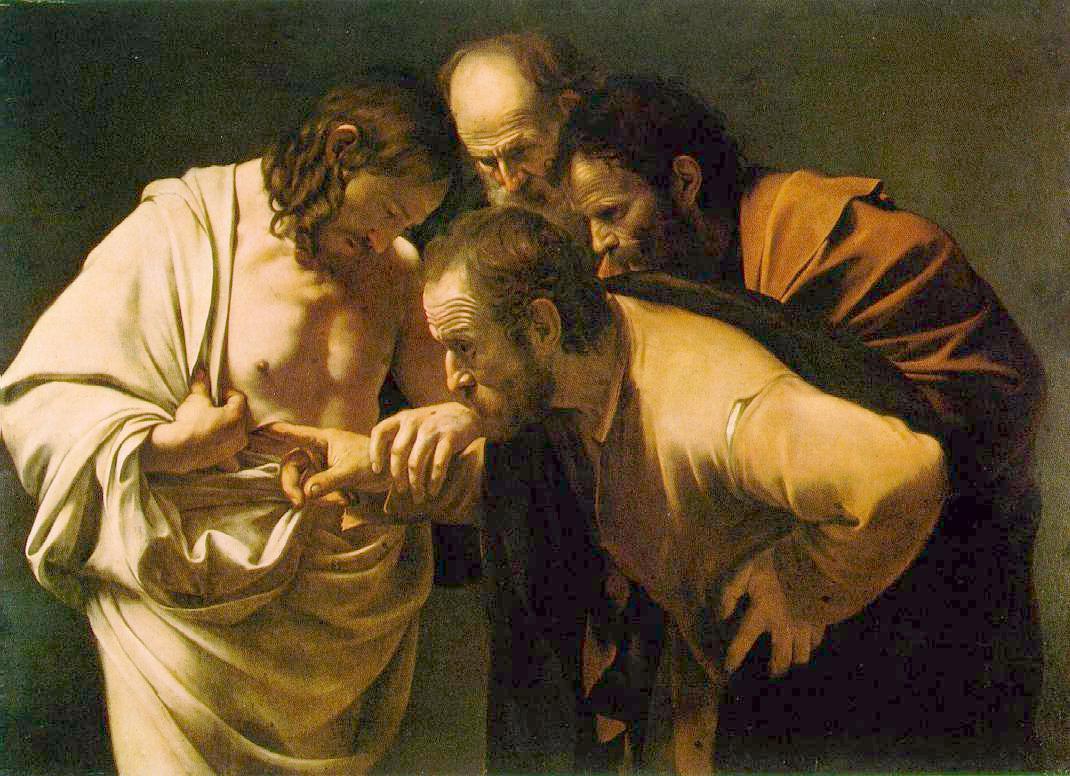
You’ll be able to touch him. And if you really want to you can stick your finger into his wounds (verse 40.) I love what this solid Jesus told Thomas in John 20:27:
“Then he said to Thomas, “Put your finger here and look at my hands. Reach out your hand and put it into my side. Don’t be faithless, but believe.
This should shatter any misconceptions you might have. Thomas had real doubts, and instead of getting rebuked, Jesus invites Thomas to discover His reality of himself. This is really quite profound when you think of it. I’m so glad that this happened, I needed to hear it for myself.
I may be a very silly preacher and writer, but that’s the way I see it.
A light shining in this heart of darkness A new beginning and a miracle Day by day the integration Of the concrete and the spiritual















 Alaska Bible Teacher