Others May, You Cannot

If God has called you to be really like Jesus, He will draw you into a life of crucifixion and humility, and put upon you such demands of obedience, that you will not be able to follow other people, or measure yourself by other Christians, and in many ways He will seem to let other good people do things which He will not let you do.

Other Christians and ministers who seem very religious and useful, may push themselves, pull wires, and work schemes to carry out their plans, but you cannot do it; and if you attempt it, you will meet with such failure and rebuke from the Lord as to make you sorely penitent.

Others may boast of themselves, of their work, of their success, of their writings, but the Holy Spirit will not allow you to do any such thing, and if you begin it, He will lead you into some deep mortification that will make you despise yourself and all your good works.

Others may be allowed to succeed in making money, or may have a legacy left to them, but it is likely God will keep you poor, because He wants you to have something far better than gold, namely, a helpless dependence on Him, that He may have the privilege of supplying your needs day by day out of an unseen treasury.

The Lord may let others be honored and put forward, and keep you hidden in obscurity, because He wants you to produce some choice, fragrant fruit for His coming glory, which can only be produced in the shade. He may let others be great, but keep you small. He may let others do a work for Him and get the credit for it, but He will make you work and toil on without knowing how much you are doing; and then to make your work still more precious, He may let others get the credit for the work which you have done, and thus make your reward ten times greater then Jesus comes.

The Holy Spirit will put a strict watch over you, with a jealous love, and will rebuke you for little words and feelings, or for wasting your time, which other Christians never seem distressed over. So make up your mind that God is an infinite Sovereign, and has a right to do as He pleases with His own. He may not explain to you a thousand things which puzzle your reason in His dealings with you, but if you absolutely sell yourself to be His love slave, He will wrap you up in a jealous love, and bestow upon you many blessings which come only to those who are in the inner circle.

Settle it forever, then, that you are to deal directly with the Holy Spirit, and that He is to have the privilege of tying your tongue, or chaining your hand, or closing your eyes, in ways that He does not seem to use with others. Now when you are so possessed with the loving God that you are, in your secret heart, pleased and delighted over this peculiar, personal, private, jealous guardianship and management of the Holy Spirit over your life, you will have found the vestibule of Heaven.

I Couldn’t Follow Him

Mark 10:17-22

As he was starting out on a trip, a man came running to him and knelt down, and asked, “Good Teacher, what must I do to get to heaven?”

18 “Why do you call me good?” Jesus asked. “Only God is truly good! 19 But as for your question—you know the commandments: don’t kill, don’t commit adultery, don’t steal, don’t lie, don’t cheat, respect your father and mother.”

20 “Teacher,” the man replied, “I’ve never once broken a single one of those laws.”

21 Jesus felt genuine love for this man as he looked at him. “You lack only one thing,” he told him; “go and sell all you have and give the money to the poor—and you shall have treasure in heaven—and come, follow me.”

22 Then the man’s face fell, and he went sadly away, for he was very rich.

My name is inconsequential. I suppose all you must know of me is I tried to keep God’s Law and that I was very wealthy. Many believed that being rich was evidence that God approved of me. Of that, I wasn’t too sure. I kept the Law out of fear I suppose, and at times I just knew it wasn’t quite enough.

As I studied I began to realize that riches weren’t going to make me righteous. There was enough Scripture in me to let me know that it wasn’t enough. The prophets, especially Isaiah spoke about the deadliness of wealth, but there was that one verse in Proverbs that really disturbed me:

“Your riches won’t help you on Judgment Day; only righteousness counts then.”

(Proverbs 11:4.)

This verse (and all of the others) were the cause of many a sleepless night.

I was tormented by the reality of standing before God with nothing but my money to cover me. Coming under God’s righteous judgment haunted me. I thought of it day and night. I was terrified of being damned. My own righteousness wasn’t enough, and I knew it.

I heard about Jesus (and who hasn’t), and some were boldly claiming that he was the Messiah. He was at least a wonderful teacher and many said he worked powerful miracles, and perhaps he had answers for me. I hoped so, but I needed to know. It was my questions that drove me to find him.

And finding him was easy–I just followed the crowd.

I got ahead of everybody. I knelt in his path and waited. I must know what he thought I should do. When he stood before me I asked the question that had haunted me my whole life–“Good Teacher, what must I do to get eternal life?”

Jesus looked right at me. I knew deep down that he loved me.

But oh those words, his words really disturbed me. He told me that I only lacked one thing, that I must sell everything and distribute the money to the poor. Only by doing that would I discover riches in heaven. And only then could I truly follow him.

But that was the thing I couldn’t do.

It was my idol, my golden calf, and it was a sacrifice that I could never make.

I’ve come to realize now, over my many years, that when I do finally stand before God, I will have nothing to save me. Jesus invited me to follow, and I couldn’t and I didn’t. I won’t.

And that my friend, means I will die unforgiven.

“For what shall it profit a man, if he shall gain the whole world, and lose his own soul?”

Mark 8:36, KJV

alaskabibleteacher.com

When You See a Limping Believer

Crutches at the Table

“David asked, “Is there no one still left of the house of Saul to whom I can show God’s kindness?” Ziba answered the king, “There is still a son of Jonathan; he is crippled in both feet.”‘ 

 2 Samuel 9:3, NIV 

This crippled man was named Mephibosheth.  He was injured by the actions of a nurse;  she dropped him as she was trying to escape the palace (2 Sam. 4:4).  It was not of Mephibosheth’s doing, but someone else made a mistake, and it totally and irrevocably changed his life.

He would always be disabled.

If you haul out your old musty commentaries, you’ll find that Mephibosheth’s name means, “shame.” Perhaps a casual ‘disdain’ would be how people treated him. But David was a different sort of king (as kings go), and he elevates Mephibosheth to the feasting table.

King David wants to include him!

Interesting. I believe that there are a great many people like Mephibosheth.  They’ve been injured by someone else’s stumbling.  It seems we pass these things on to each other.  And the lameness we inflict may not be physical.  It may be spiritual or emotional.  Sometimes we injure others without knowing what we have really done to them.

Jesus made some powerful statements about people who injure others.  

Some of the most vicious and evil woundings that are done are usually on a moral or spiritual level.  People can heal physically over time, but the wounds of the spirit are incredibly devastating.  When someone harms us on this level it can completely undo us, for a lifetime. (And perhaps, maybe forever).

We are capable of much evil.  We affect others in ways we don’t understand.  We need to seek God’s grace right now; we cannot allow ourselves the luxury of diminishing or minimizing what we have done. A vital point to consider: We cannot go on crippling others without injuring ourselves.

Wounded people wound. But healed people can often become healers themselves.

We can read of King David’s truly majestic treatment of Mephibosheth in 2 Samuel 9. He actively blessed him, and perhaps that is the proactive action we ought to take. We must make the effort– to bless others.

As a king, this was a very minor incident. Hardly worth recording in the lofty affairs of state. But as a man–to restore Mephibosheth, was definitely one of his greatest decisions. Kindness and gentleness should always be a key part of someone who is in authority, especially over others.

There’s another concept here– we discover something that is profoundly true about us in Paul’s letter to the Church in Ephesus.  It’s here, in 1:5, that we see that God our Father, acts like David, and receives Mephibosheth; just like God receives us to Himself. We find that we’re adopted, loved, and held, and we get a prime place at the table!

We may use crutches, but we walk by faith. And that may be the greatest lesson in this portion of scripture–and the most profound experience we can have as believers.

Ephesians 1:5, NLT

alaskabibleteacher.com

Listening to Brennan Manning

Here are several quotes written by Brennan Manning. They’re definitely thought-provoking and should be prayed through. I think they’re worth considering. If you like them great, if not that’s ok too.

“The gospel declares that no matter how dutiful or prayerful we are, we can’t save ourselves. What Jesus did was sufficient.”

“When we wallow in guilt, remorse, and shame over real or imagined sins of the past, we are disdaining God’s gift of grace.”

“God loves you unconditionally, as you are, and not as you should be because nobody is as they should be.”

“I could more easily contain Niagara Falls in a teacup than I can comprehend the wild, uncontainable love of God.”

“In my experience, self-hatred is the dominant malaise crippling Christians and stifling their growth in the Holy Spirit.”

“The splendor of a human heart that trusts it is loved unconditionally gives God more pleasure than Westminster Cathedral, the Sistine Chapel, Beethoven’s “Ninth Symphony”, Van Gogh’s “Sunflowers”, the sight of 10,000 butterflies in flight, or the scent of a million orchids in bloom. Trust is our gift back to God, and he finds it so enchanting that Jesus died for love of it.”

“Those who have the disease called Jesus will never be cured.”

“The men and women who are truly filled with light are those who have gazed deeply into the darkness of their own imperfect existence.”

“God loves us as we are…not as we ought to be, because we are never going to be as we ought to be.”

“The ragamuffin gospel reveals that Jesus forgives sins, including the sins of the flesh; that He is comfortable with sinners who remember how to show compassion; but that He cannot and will not have a relationship with pretenders in the Spirit.”

“The North American Church is at a critical juncture. The gospel of grace is being confused and compromised by silence, seduction, and outright subversion. The vitality of the faith is being jeopardized. The lying slogans of the fixers who carry religion like a sword of judgment pile up with impunity. Let ragamuffins everywhere gather as a confessing Church to cry out in protest. Revoke the licenses of religious leaders who falsify the idea of God. Sentence them to three years in solitude with the Bible as their only companion.”

“When I get honest, I admit I am a bundle of paradoxes. I believe and I doubt, I hope and get discouraged, I love and I hate, I feel bad about feeling good, I feel guilty about not feeling guilty. I am trusting and suspicious. I am honest and I still play games. Aristotle said I am a rational animal; I say I am an angel with an incredible capacity for beer.”

alaskabibleteacher.com

Listen to Him

“Jesus told this simple story, but they had no idea what he was talking about.

John 10:6

For context: 10:7-18

What a joy can be found in the Shepherd’s care, and to hear his voice. Nothing really can match this wonder. We follow as he leads. The voice is an integral part of this passage and the foundation of authentic discipleship. You really can’t walk with him unless you hear him. We belong to him. We’re his flock that he keeps and provides for.

John 10:1-6

Amazing. He knows our name! That’s the intimacy found in these verses. We’re never forgotten and he will never overlook us. To think otherwise is slander and an attack on his present-day ministry. Jesus is our good shepherd. He always will be.

“Intimacy with God comes in whispers, not shouts.”

     Woodrow Kroll

He sometimes whispers, and this world can’t hear him. To be perfectly honest, my ‘busy-ness’ silences him. I suppose that the real issue isn’t with him, but with myself.

“And after the earthquake, there was a fire, but the Lord was not in the fire. And after the fire, there was the sound of a gentle whisper.”

1 Kings 19:12

The gentle whisper to a man afraid. This fits the Father’s m.o. He doesn’t speak through a windstorm, earthquake, or fire. He chooses to speak very quietly, and that’s a problem for me. In the original Hebrew, the word for “whisper” can be translated as calm, silence, or something gentle. He speaks this way if only we shut up for a little while.

If we are to recognize God’s voice, we must belong to Him. We hear His voice when we spend time in Bible study and quiet contemplation of His Word. The more time we spend intimately with God and His Word, the easier it is to recognize His voice and His leading in our lives.

The flock hears the shepherd, and it’s that voice that breaks through our cluttered-up life. We can hear, and it’s that communication that encourages us to walk through life—one day at a time. Just today. That’s all you must do.

There are so many other voices. You must ignore them.

So many are speaking, so many want us to hear and follow them. But in reality, they want us to leave the Shepherd and his flock behind. But we can’t allow this, we must learn to listen to him alone.

    Elisabeth Elliot

Art by Eugène Burnan

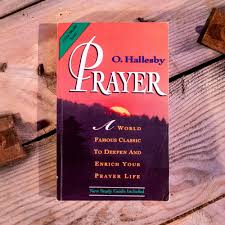
On Authentic Prayer, the “Hallesby 23”

“The Hallesby 23” — Some Words About Prayer

Compiled by Bryan Lowe

I really want to bless you today on the subject of simple prayer. I recall reading O. Hallesby way back in my Bible school days. Back then, it was assigned reading for a class, but today it is a close treasure. Here are 23 quotes I pulled together.

1) Helplessness is the real secret and the impelling power of prayer.

2) Helplessness becomes prayer the moment that you go to Jesus and speak candidly and confidently with him about your needs. This is to believe.

3) A humble and contrite heart knows that it can merit nothing before God, and that all that is necessary is to be reconciled to one’s helplessness and let our holy and almighty God care for us, just as an infant surrenders himself to his mother’s care.

4) Listen, my friend! Your helplessness is your best prayer. It calls from your heart to the heart of God with greater effect than all your uttered pleas. He hears it from the very moment that you are seized with helplessness, and He becomes actively engaged at once in hearing and answering the prayer of your helplessness.

5) When we go to our meeting with God, we should go like a patient to his doctor, first to be thoroughly examined and afterwards to be treated for our ailment. Then something will happen when you pray.

6) When you enter your secret chamber, take plenty of time before you begin to speak. Let quietude wield its influence upon you. Let the fact that you are alone assert itself. Give your soul time to get released from the many outward things. Give God time to play the prelude to prayer for the benefit of your distracted soul.

7) Jesus is moved to happiness every time He sees that you appreciate what He has done for you. Grip His pierced hand and say to Him, “I thank Thee, Saviour, because Thou has died for me.” Thank Him likewise for all the other blessings He has showered upon you from day to day. It brings joy to Jesus.

8) Jesus wills of His own accord to come into us and, in His own power, to deal with our needs. It is not necessary for us to constrain Him by our prayers to take an interest in us.

10) When prayer is a struggle, do not worry about the prayers that you cannot pray. You yourself are a prayer to God at that moment. All that is within you cries out to Him. And He hears all the pleas that your suffering soul and body are making to Him with groanings which cannot be uttered.

11) If God does not give you something you ask for, wait on Him. He will speak with you tenderly and sympathetically about the matter until you yourself understand that He cannot grant your prayer.

12) As impossible as it is for us to take a breath in the morning large enough to last us until noon, so impossible is it to pray in the morning in such a way as to last us until noon. Let your prayers ascend to Him constantly, audibly or silently, as circumstances throughout the day permit.

13) By prayer we couple the powers of heaven to our helplessness, the powers which can capture strongholds and make the impossible possible.

14) My praying friend, continue to make known your desires to God in all things. … Let Him decide whether you are to receive what you ask for or not.

15) (Notice carefully every word here.) It is not our prayer which draws Jesus into our hearts. Nor is it our prayer which moves Jesus to come in to us. All He needs is access. He enters in of His own accord, because He desires to come in. To pray is nothing more involved than to let Jesus into our needs, and permitting Him to exercise His own power in dealing with them. And that requires no strength. It is only a question of our wills. Will we give Jesus access to our needs?

16) The air which our body requires envelops us on every hand. The air which our souls need also envelops all of us at all times and on all sides. God is round about us in Christ on every hand, with his many sided and all-sufficient grace. All we need to do is to open our hearts.

17) You can use your time to no better advantage than to pray whenever you have a moment, either alone, or with others, while at work, at rest, or walking down the street! Anywhere!!

18) As white snow flakes fall quietly and thickly on a winter day, answers to prayer will settle down upon you at every step you take, even to your dying day. The story of your life will be the story of prayer and answers to prayer.

19) Pray a little each day in a childlike way for the Spirit of prayer. If you feel that you know, as yet, very little concerning the deep things of prayer and what prayer really is, then pray for the Spirit of prayer. There is nothing He would rather do than unveil to you the grace of prayer.

20) Prayer is a fine, delicate instrument. To use it right is a great art, a holy art.There is perhaps no greater art than the art of prayer. Yet the least gifted, the uneducated and the poor can cultivate the holy art of prayer.

21) Our prayer life will become restful when it really dawns upon us that we have done all we are supposed to do when we have spoken to Him about it. From the moment we have left it with Him, it is His responsibility.

22) We should say to God as we mingle with our dear ones each day, “God, give them each Thy blessing. They need it, because they live with me, and I am very selfish and unwilling to sacrifice very much for them, although I do love them.”

23) Prayer can assume very different forms, from quiet, blessed contemplation of God, in which eye meets eye in restful meditation, to deep sighs or sudden exclamations of wonder, joy, gratitude or adoration.

————————————————————–

Ole Hallesby, 1879-1961

Ole Kristian O. Hallesby was a Lutheran pastor who taught at the Free Faculty of Theology from 1909 to 1952.

He was an outspoken opponent of the Nazi occupation of Norway and was for a time detained at a concentration camp.

Hallesby wrote over 60 books, mostly on theology and ethics, but is known for his devotional writings. His book on prayer is one of the best written on the subject.

Thinking Out Hard Things

To follow Him can be really hard. There doesn’t seem to be any contingency plans for any who are looking to escape such a drastic call. Jesus either is, or He isn’t our Lord. “Do you also want to leave?” This is a question that will be asked to every disciple–sometimes0once, and sometimes repeatedly.

There are these crystalline moments when I must make a decision. Will I take up my cross and go with Him? There doesn’t seem to be any room in Jesus’ band for ‘almost’ disciples. That scares me sometimes.

Today’s cross is waiting for me. I’m afraid at times that I won’t be able to take the next step as a true follower. Am I just fooling myself?

All of heaven seems to stand on tiptoe to see what I’m going to do next.

Who am I really?

Being obedient to Jesus is far from easy. We must have His Spirit.

“After this, many of his disciples left. They no longer wanted to be associated with him. Then Jesus gave the Twelve their chance:

“Do you also want to leave?”

“Peter replied, “Master, to whom would we go? You have the words of real life, eternal life. We’ve already committed ourselves, confident that you are the Holy One of God.”

John 6:66-69, The Message

“It is indeed praiseworthy for a believer to consecrate his life to the Lord, but he must never do so lightly or thoughtlessly. Before committing your life in service to God today, count the cost, for “No man, having put his hand to the plough, and looking back, is fit for the kingdom of God” (Luke 9:62).”

    Woodrow Kroll

Image from Wikipedia, verses are from The Message Bible by Eugene Peterson.

Real Life Humility

Jesus was watching, and he what he saw was a spiritual principle of his Kingdom.

Jesus often teaches out of the things we encounter–real life events. Spiritual truth often hits us from those things we actually see. If you want to know what God is doing in your life, all you need to do is look around at the “practical” things, and start to see the spiritual lessons inside them. We learn from real-life. That’s how he often teaches us, he combines the Word with what we’re experiencing.

Our natural inclination is to move higher up. We often think that we’re deserving, and so we take our “rightful” positions. That’s the way humans think. We all want to sit in the best possible place, and so we end up wheedling our way up front. We can fall into the subtle trap of self-promotion. But that’s not how discipleship works.

Jesus corrects, advising us to take the lowest place. I think verse 11 is the key to figuring out this seating arrangement. We’re starting to see a physical situation become a spiritual lesson. There’s much to learn. Here’s verse 11 in the Amplified version:

“For everyone who exalts himself will be humbled [before others], and he who habitually humbles himself (keeps a realistic self-view) will be exalted.”

This translation injects some realism into our lives, especially in how we see ourselves. It’s something quite foundational. It lays down a principle that is always true in his Kingdom (1 Peter 5:6). If we don’t accept and implement this, we’ll suffer a definite deficiency in our discipleship. It stunts the growth of many believers. And that is tragic.

The whole scene lays out how life in the spirit really works, and it seems terribly paradoxical.

Our human logic asserts that deliberately choosing the lesser is foolish, things really don’t work that way. We think, (falsely,) that we’ll only advance by asserting ourselves. But Jesus, quite aptly, clarifies the ways of the Kingdom–true maturity will only come if we decide to take the lowest place.

James 4:10

A Glowing Witness

The more I have read the Bible and studied the life of Jesus, the more I have become convinced that Christianity spreads best not through force but through fascination.

Shane Claiborne

I believe in evangelism. Right after Bible college I joined SOS Ministries as a full-time evangelist. I was there for three years living in a ministry house in the Mission district. We did high-visibility street work, preaching and leading teams to various parts of the City. This was in the 1980s and the City was pretty challenging.

I was primarily a street preacher and a team leader.

San Francisco is a city of 800,000 people. The work was intense. I remember once I was leading a Church team on Haight-Ashbury, and I was punched in the face by a backslidden Christian who strenuously objected to the Gospel being preached. I tried to respond in humility and kindness, even though I thought my nose was broken. (It wasn’t.)

Over the years I have come to see that the most powerful witness is a joyful and loving character that’s submitted to Christ.

Walking through the dusty roads and journeying into the small villages of Judea we read of the incredible hold that Jesus had on the hearts of men. They were fascinated by Him. People came face to face with God’s presence and it grabbed them. They traveled great distances to meet Him.

“And all the people were amazed, and said, “Can this be the Son of David?”

Matthew 12:23; see also Luke 5:26

As we submit to His Spirit we begin to understand this same amazing dynamic. It’s not us, it’s Him. And it will always be Him. The fruits of His presence are becoming very visible. Jesus is living inside of us!

“But the fruit of the Spirit is love, joy, peace, patience, kindness, goodness, faithfulness, 23 gentleness, self-control; against such things there is no law.”

Galatians 5:22-23

I remember visiting a Christian commune in the early 70s. I was a young believer with a ton of questions. I recall the peace, humility, and joy I saw on the faces of these brothers and sisters. I instinctively knew that I was encountering Jesus. And it shook me in a good way, a deeply supernatural way.

Please do not remove the presence of Jesus from your evangelism.

If you ask me, I will tell you. Jesus is still fascinates, and it’s His residence in you that still touches people. Evangelism is far more than the ability to recite facts and good arguments. It’s something far more.

And yet I still believe in high visibility evangelism. God’s word must be proclaimed openly and without compromise. But 40 years have passed now,and I have come to see that our faith spreads best through our example.

Perhaps He must be seen as well as to be heard?

“Soon we shall be up there with Christ. God did not mean us to be happy without Him; but God would first have us to be witnesses for Him down here, to hold out as much light as we can.”

    G.V. Wigram

What Jesus Wants Us to Know About God

14 After he had spent everything, a severe famine struck that country, and he had nothing. 15 Then he went to work for one of the citizens of that country, who sent him into his fields to feed pigs. 16 He longed to eat his fill from the pods that the pigs were eating, but no one would give him anything. 17 When he came to his senses, he said, ‘How many of my father’s hired workers have more than enough food, and here I am dying of hunger! 18 I’ll get up, go to my father, and say to him, “Father, I have sinned against heaven and in your sight. 19 I’m no longer worthy to be called your son. Make me like one of your hired workers.”’ 

20 So he got up and went to his father. But while the son was still a long way off, his father saw him and was filled with compassion. He ran, threw his arms around his neck, and kissed him. 21 The son said to him, ‘Father, I have sinned against heaven and in your sight. I’m no longer worthy to be called your son.’

22 “But the father told his servants, ‘Quick! Bring out the best robe and put it on him; put a ring on his finger and sandals on his feet. 23 Then bring the fattened calf and slaughter it, and let’s celebrate with a feast, 24 because this son of mine was dead and is alive again; he was lost and is found!’ So they began to celebrate.

Luke 15:14-24

Sometimes, when reading this we diminish this parable to a really nice story, but nothing more. It comforts us. It’s so evocative after all, but somehow it never enters our spiritual hearts like it’s meant to. We may mentally assent but we do not absorb what it really says.

Luke 15 is magnificent in the deepest sense of the word.

Now if the Bible was a mountain range, then this would be Mt. Everest.

Our Father runs to us because He sees our desperate hearts. His joy can’t be explained but only received. It’s just the way He is.

Just perhaps it will take an eternity to understand this simple parable? If so, we should get started now.

There are just three characters here in Luke 15:14-24: there’s the Father, the son, and the elder brother–and each plays an integral part. The prodigal is the main character, yet the father is the main focus. The son is a wastrel, a good-for-nothing rascal who blows his father’s inheritance on parties, booze, and prostitutes. He lives for the moment, he seeks pleasure in those things which will come very close to destroying him.

But haven’t we all done that?

The father represents God, who represents the loving patriarch of the parable. He’s the one who has turned over the prodigal’s portion of the inheritance. To a degree I suppose he has funded the prodigal’s descent into depravity, and yet it was the son who decided to go crazy. The father is certainly not to blame.

But nevertheless, in this story, the father is the main character. Not the prodigal.

His actions are very difficult to grasp. God behaves outrageously, and His character is difficult to understand or fathom. (After all, who acts this way?) Granted we think our earthly fathers might do this for us–but even that may be a stretch for some. Yet this parable describes how God feels about sinners.

He is passionately in love with sinners.

The mysteries of this parable explain who God is, and His love for nasty varmints like us. We are His Church, and yet we still need to come home. Again.

And we serve a running God.w

“Jesus wants to make it clear that the God of whom he speaks is a God of compassion who joyously welcomes repentant sinners into his house.”

Henri J.M. Nouwen, Return of the Prodigal Son

(My favorite painting. Rembrandt’s painted this in 1669. I know that that was done long ago, but I enjoy seeing and reacting to what he did. I’m always blessed.)

alaskabibleteacher.com