There can be no resurrection power without crucifixion weakness. There can be no power unless you die to self, taking up your personal cross. Many are frustrated by this. This teaching is not fully understood or really preached.
“If anyone would come after me, let him deny himself and take up his cross and follow me.”
Crosses hurt, for they are a way of dying to self, plain and simple. Every spirit-filled believer must die to his agenda. If you want a resurrected life, overcoming sin and death, you must carry your cross. Death comes first, and then is resurrection. There is freedom to all who obey.
Simply put, there’s no other way for you to be holy but a cross.
Whether you’re struggling with a physical ailment (think pain), or a mental illness (also pain), you still must carry a cross. Our issues can be formidable, I understand, but you’re not exempt from the terms of discipleship. All must follow Jesus.
Jesus fully understands Calvary. He recognizes agony. His pain was real. I believe that He knows this intimately. I also think Jesus understands our weakness and confusion. His grace meets every believer. No matter if they struggle and stumble. The Spirit teaches us. All who really come are redeemed.
I think He understands our reluctance and hesitation.
I want to follow Him. I’m pretty sure that you do too (you’re reading this which tells me something). So what cross are you called to carry? They seem to be custom made–designed uniquely for you. But it’s also true that others have been tempted, just like you.
Your cross must be deliberately chosen.
It’s often a path of brokenness and humility. It may involve shame and pain–a reproach to those who can’t understand. But if you take it up you can expect the world to belittle you. If they abused Jesus, you can count on them belittling you.
Avoiding your cross means you have been conformed to what the world thinks, and that’s an awful place to be. You really can diminish your cross without doing harm to your spiritual walk. Honestly, there is not another way.
His resurrection power is given to those who have already expired. Struggles with sin and doubt often evaporate when He abides in you. He’s the power given to overcome. He’s the only one who can give it to you.
“To take up the cross of Christ is no great action done once for all; it consists in the continual practice of small duties which are distasteful to us.”
You may struggle with this and I hear you. This is not an easy word. I don’t know if I’ve given this topic justice, but I pray that I’ve touched the heart of Jesus. I stress that’s a hard word, but I think it’s true.
But you must tell yourself of the gift of joy and peace that is found by carrying your cross.
“The cross of Christ is the sweetest burden that I ever bore; it is such a burden as wings are to a bird, or sails to a ship, to carry me forward to my harbor.”
If God has called you to be really like Jesus, He will draw you into a life of crucifixion and humility, and put upon you such demands of obedience, that you will not be able to follow other people, or measure yourself by other Christians, and in many ways He will seem to let other good people do things which He will not let you do.
Other Christians and ministers who seem very religious and useful, may push themselves, pull wires, and work schemes to carry out their plans, but you cannot do it; and if you attempt it, you will meet with such failure and rebuke from the Lord as to make you sorely penitent.
Others may boast of themselves, of their work, of their success, of their writings, but the Holy Spirit will not allow you to do any such thing, and if you begin it, He will lead you into some deep mortification that will make you despise yourself and all your good works.
Others may be allowed to succeed in making money, or may have a legacy left to them, but it is likely God will keep you poor, because He wants you to have something far better than gold, namely, a helpless dependence on Him, that He may have the privilege of supplying your needs day by day out of an unseen treasury.
The Lord may let others be honored and put forward, and keep you hidden in obscurity, because He wants you to produce some choice, fragrant fruit for His coming glory, which can only be produced in the shade. He may let others be great, but keep you small. He may let others do a work for Him and get the credit for it, but He will make you work and toil on without knowing how much you are doing; and then to make your work still more precious, He may let others get the credit for the work which you have done, and thus make your reward ten times greater then Jesus comes.
The Holy Spirit will put a strict watch over you, with a jealous love, and will rebuke you for little words and feelings, or for wasting your time, which other Christians never seem distressed over. So make up your mind that God is an infinite Sovereign, and has a right to do as He pleases with His own. He may not explain to you a thousand things which puzzle your reason in His dealings with you, but if you absolutely sell yourself to be His love slave, He will wrap you up in a jealous love, and bestow upon you many blessings which come only to those who are in the inner circle.
Settle it forever, then, that you are to deal directly with the Holy Spirit, and that He is to have the privilege of tying your tongue, or chaining your hand, or closing your eyes, in ways that He does not seem to use with others. Now when you are so possessed with the loving God that you are, in your secret heart, pleased and delighted over this peculiar, personal, private, jealous guardianship and management of the Holy Spirit over your life, you will have found the vestibule of Heaven.
“No one who puts his hand to the plow and looks back is fit for the kingdom of God.”
Luke 9:62 (context, vv. 57-62)
Every disciple has his plow. Sometimes it’ll be obvious, everyone sees it; other times it’ll be buried deep inside, and no one knows. A plow is a perfect word to describe exactly what the Holy Spirit is doing–and its descriptive of the determination of a disciple who is slowly learning how to follow.
When you’re trying to grow-up you’ll grasp this foundational lesson. You have to be single-minded and really focused to stay moving ahead. You cannot look behind at what has been done. You can’t turn around to admire your work, rather we look at the tree that is keeping us lined up with Jesus.
You will sweat and get tired. Your full effort is needed to keep the plow in the hard earth. You aren’t pushing, the oxen is pulling, but you’re the one who weighs it down while keeping your furrow relatively straight. It’s harder than it looks. (Thank God for the modern tractor.)
In case the plowman starts to look back, his plow line would become crooked. If that happens, the field he is plowing will not yield a full harvest. A good plowman has learned he must hold on. In following Jesus, we are to keep our eyes on Him, and never let our minds and hearts wander away. (Hebrews 12:1-2.)
“To keep our hand on the plow while wiping away the tears–THAT is Christianity.”
-Watchman Nee
To follow means looking and moving forward. We must understand this–it’s the very essence of walking a path. We’re walking out the journey. Sometimes we feel Jesus’ joy as His follower, but occasionally we won’t. We’re learning to understand it more and more. But no matter what, we keep putting heel-to-toe. We are followers after all.
Jesus lived this; He steadfastly set His face to go to Jerusalem (Luke 9:51).
“To learn strong faith is to endure great trials. I have learned my faith by standing firm amid severe testings.”
“In one of the villages, Jesus met a man with an advanced case of leprosy. When the man saw Jesus, he bowed with his face to the ground, begging to be healed. “Lord,” he said, “if you are willing, you can heal me and make me clean.”
Luke 5:12, NLT
The Bible text reveals a man who is desperate. His leprosy has advanced; he is covered with it from ‘head-to-toe.’ He’s an outcast now, completely infected by something he never asked for; he is ‘unclean’ and completely without hope. There is no treatment, the doctors can do nothing.
The leper knows that without the touch of Jesus, he’ll never be healed.
He knows it; he doesn’t need to be convinced by anyone over the complete hopelessness of his condition. He is lost. And yet he has heard that Jesus can do incredible miracles. Could it be that Jesus can heal his sickness? The leper comes and falls on his knees before the Lord, with his face in the dirt. This man is completely broken; he has no hope, except for Jesus. What else can he do?
Our diseases differ, but our lives have been completely changed by our pain. We all have this in common.
Our pain and darkness vary. Some hurt more, some less. But we’ve all come to the place where we no longer have illusions of somehow being made whole. Whenever we meet, I think there should be a secret handshake or a password. We all share a comradeship— we’re all part of the same community. We’re a broken club of tired and decidedly unclean misfits.
We belong to the fellowship of pain.
Lying in the dirt, we start to believe the unbelievable. Our faith doesn’t activate our healing, as much as it simply guides us to Jesus. We can kneel, and perhaps that’s all we need to do. His presence drives away the fear, the doubt, and the pain. He’s come, and somehow we begin to hope for mercy. Only he can carry us through this.
In times past I’ve struggled with deep dark depression. I’ve had to take meds. But when I come into Jesus’ presence, all my melancholy is driven out. He comes and I start to hope again. Am I a stellar example of perfect discipleship? I think not. But isn’t about us becoming “angels,” perhaps it’s more about us learning how to kneel, and to allow Jesus to touch our hearts.
You must do this, repeatedly.
“The power of the Church is not a parade of flawless people, but of a flawless Christ who embraces our flaws.”
“The Church is not made up of whole people, rather of the broken people who find wholeness in a Christ who was broken for us.”
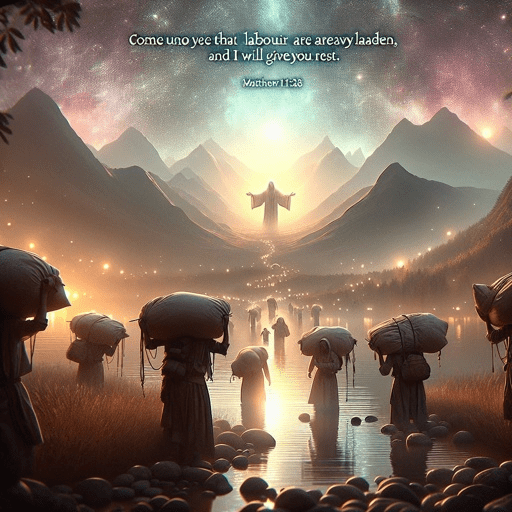
“Come to Me, all who are weary and heavily burdened [by religious rituals that provide no peace], and I will give you rest [refreshing your souls with salvation]. 29 Take My yoke upon you and learn from Me [following Me as My disciple], for I am gentle and humble in heart, and you will find rest (renewal, blessed quiet) for your souls.”
Matthew 11:28-29, Amplified Bible
He is inviting us.
Jesus requests our presence in one simple statement, “come to Me.” This phrase must be our starting point. It’s how you begin daily. If you’re His disciple, it’s imperative that you obey. But this concept is nuanced, it has profound meanings.
“All who are weary.” Each of us carries a heavy load. Sin has weight, whether we believe it or not. When I start to see this, I really begin my discipleship. Apart from Jesus’ invitation I will try to carry this heaviness on my own. This is called “religion,” and it’s a bad thing.
“My guilt overwhelms me— it is a burden too heavy to bear.”
Psalm 38:4
“I will give you rest.” It’s His gift, given to each believer. It isn’t earned, you don’t deserve it. His heart is for you to “rest.” The original Greek word often means “to refresh, or to cease your work.” Every true disciple knows this, and understands that Jesus rather laying a terrible burden on us, takes it off.
We must understand our calling.
Another burden (His own burden), is now given to us. It’s Jesus’own weight shared with believers. But it’s a restful burden that gives joy and peace. There are no longer sweaty religious rules, but authentic rest. Real discipleship is now based on love, not duty.
To follow Him in obedience is the happy delight of every disciple. When you are in love with Him the rigors of obedience have little weight.
“It never cost a disciple anything to follow Jesus; to talk about cost when you are in love with anyone is an insult.”
“For I am gentle and humble in heart,” is His nature. He always acts this way, it is who Jesus is. This is how He behaves to each of us. It becomes the very essence of how He relates to human beings, always gentle and completely humble. Sometimes we add things that obscure this, and we see Jesus in our own particular image. (Maybe that’s a way of defining idolatry?)
And finally--“and you will find restfor your souls.” Again, the Greek here is quite instructive: rest, “cessation of any motion, or labor.” My walk, following Him, isn’t working harder, but being in a joyful rest. God’s saints aren’t called to sweat, but walk in the sureness of the presence of Jesus inside them.
Life can be awfully hard. Trials come and we get overwhelmed.
The joyful rest is only a slice of what heaven will be like. If joy and peace are a wonder now, just you wait, our future holds promises of a continual awareness of Him in our new bodies. This fallen world will be completely remade. Sin, sadness and Satan will be no more.
“And me? I plan on looking you full in the face. When I get up, I’ll see your full stature and live heaven on earth.”
Body piercing has become pretty much acceptable just in the last ten years.
Studs are placed in a hole or piercing to make a permanent decoration. I have seen a fair amount of it, and I think that a stud in the tongue has got to be the most intrusive. (I recently read of a young girl who died after her tongue was pierced from an infection).
There is “body piercing” in scripture. In Deuteronomy 15:12-18, slaves who are being set free by their master after six years of service, could, if they loved and were loved by their master, could choose to remain a slave to him.
“But if your slave says to you, “I don’t want to leave you,” because he loves you and your family and has a good life with you,17 stick an awl through his ear into the door; he will be your slave for life. Also do this to a female slave.”
Deuteronomy 15:12-18
This was a decision that required elders to act as witnesses. It was significant as well as completely binding. I like to think of the ceremony to be kind of a cross between a wedding and a circumcision. (Sounds fun, huh?!)
The slave would be led to a doorpost and the master would take an awl, and push it through his ear lobe. This designated the slave to be forever “owned” by a specific master. Herein lies a picture of the Christian.
Many times in the New Testament we are called to be servants (slaves) of Christ.
Peter, Paul, James, and Jude referred to themselves as “bond servants of Jesus Christ” in their epistles. This is not a forced servitude. It’s a choice made in love!
There are many believers who have done the same, they have fallen in love with their Savior. They do not plan on a life apart from Him. So spiritually they have gone to the doorpost, the awl is pushed through their ear, and they are marked from that point on.
Although the ear was pierced physically in the Old Testament, a different kind of piercing takes place in the New. In Romans 6:16 we read,
“Surely you know that when you give yourselves like slaves to obey someone, then you are really slaves of that person. The person you obey is your master. You can follow sin, which brings spiritual death, or you can obey God, which makes you right with him.”
Romans 6:16, (NCV)
When the prodigal son returned home from the far country he fell before his father and humbly ask, “make me your servant.” (Luke 15:19,21) He, in essence, was saying to the father, “pierce my ear.” The father made him a son, but the attitude of the son’s heart had changed to the heart of a servant. So it must be with us. Only then will we live a “pierced ear” life, revealing to all that we are servants of Jesus Christ!
“Savior, I know Thou hast allowed me absolute liberty, to serve Thee, or to go my own way. I would serve Thee forever, for I love my Master. I will not go out free. Mark my ear, Lord, that it might respond only to Thy voice.”
Today I’m thinking about the rich young ruler in Matthew 19:16-26. The passage is tragic and disturbing. These verses detail an encounter with Jesus by a man who couldn’t give up his wealth. He could not become a disciple.
“When the young man heard this he went away sorrowful, for he had great possessions.”
I would like to suggest something.
Perhaps riches aren’t the real point? Yes, I definitely believe that having wealth is inherently dangerous to wannabe disciples; it’s what this passage is all about. And it’s obvious that this man couldn’t give up his money to follow Jesus. But what if the issue for us isn’t about personal wealth; what if it’s envy, lust, selfishness or pride?
Sinful behavior of any kind effectively blocks the call and purpose of our lives.
No matter what it is. No matter what sin that stands in the way of true discipleship. Yes, it could be wealth. But it may be 1000 other sins (take your pick, there’s plenty). Hebrews 12 tells us that there is “the sin that so easily ensnares us.” Perhaps there is that one particular sin is one that traps us, over and over?
Jesus puts His hand on our lives, He calls us to love Him supremely. I like to think that loving Jesus is our energy source–He’s the nuclear core of our discipleship. His presence gives us the power to live and love. A sustained first love for Jesus propels us into the true reason of a disciple’s existence.
Perhaps it’s a daily surrender? Sin must be renounced every day. Jesus must always be the disciple’s first choice.
My most cherished sin would destroy me if it wasn’t for His grace and kindness.
Wealth, of course was this rich, young ruler’s sin. But don’t forget that there are many issues we could add. Lots of different sins that are getting in the way of being an actual follower. It’s a choice, and God’s power is always ready for you.
So who or what do we love most?
“Whoever loves father or mother more than me is not worthy of me, and whoever loves son or daughter more than me is not worthy of me.”
On a dirt road in the middle of a wide field stood a beautiful carriage, something on the order of a stagecoach but all edged in gold and with beautiful carvings. It was pulled by six large chestnut horses: two in the lead, two in the middle and two in the rear. But they were not moving, they were not pulling the carriage, and I wondered why. Then I saw the driver underneath the carriage on the ground on his back just behind the last two horses’ heels working on something between the front wheels on the carriage. I thought, “My, he is in a dangerous place; for if one of those horses kicked or stepped back, they could kill him, or if they decided to go forward, or got frightened somehow, they would pull the carriage right over him.”
But he didn’t seem afraid for he knew that those horses were disciplined and would not move till he told them to move. The horses were not stamping their feet nor acting restless, and though there were bells on their feet, the bells were not tinkling. There were pom-poms on their harness over their heads but the pom-poms were not moving. They were simply standing still and quiet waiting for the voice of the Master.
THERE WERE TWO YOUNG COLTS IN THE FIELD
As I watched the harnessed horses I noticed two young colts coming out of the open field and they approached the carriage and seemed to say to the horses: “Come and play with us, we have many fine games, we will race with you, come catch us.” And with that the colts kicked up their heels flicked their tails and raced across the open field. But when they looked back and saw the horses were not following they were puzzled. They knew nothing of the harnesses and could not understand why the horses did not want to play. So they called to them: “Why do you not race with us? Are you tired? Are you too weak? Do you not have strength to run? You are much too solemn, you need more joy in life.” But the horses answered not a word nor did they stamp their feet or toss their heads.
But they stood, quiet and still, waiting for the voice of the Master.
Again the colts called to them: “Why do you stand so in the hot sun? Come over here in the shade of this nice tree. See how green the grass is? You must be hungry, come and feed with us, it is so green and so good. You look thirsty, come drink of one of our many streams of cool clear water.” But the horses answered them not so much as a glance but stood still waiting for the command to go forward with the King.
COLTS IN THE MASTER’S CORRAL
And then the scene changed and I saw lariat nooses fall around the necks of the two colts and they were led off to the Master’s corral for training and discipline. How sad they were as the lovely green fields disappeared and they were put into the confinement of the corral with its brown dirt and high fence. The colts ran from fence to fence seeking freedom but found that they were confined to this place of training. And then the Trainer began to work on them with His whip and His bridle. What a death for those who had been all their lives accustomed to such a freedom!
They could not understand the reason for this torture, this terrible discipline. What crime had they done to deserve this? Little did they know of the responsibility that was to be theirs when they had submitted to the discipline, learned to perfectly obey the Master and finished their training. All they knew was that this processing was the most horrible thing they had ever known.
SUBMISSION AND REBELLION
One of the colts rebelled under the training and said, “This is not for me. I like my freedom, my green hills, my flowing streams of fresh water. I will not take any more of this confinement, this terrible training.” So he found a way out jumped the fence and ran happily back to the meadows of grass. I was astonished that the Master let him go and went not after him. But He devoted His attention to the remaining colt. This colt though he had the same opportunity to escape decided to submit his own will and learn the ways of the Master. The training got harder than ever but he was rapidly learning more and more how to obey the slightest wish of the Master and to respond to even the quietness of His voice. And I saw that had there been no training, no testing, there would have been neither submission nor rebellion from either of the colts. For in the field they did not have the choice to rebel or submit, they were sinless in their innocence. But when brought to the place of testing and training and discipline, then was made manifest the obedience of one and the rebellion of the other. And though it seemed safer not to come to the place of discipline because of the risk of being found rebellious, yet I saw that without this there could be no sharing of His glory, no Sonship.
INTO THE HARNESS
Finally this period of training was over. Was he now rewarded with his freedom and sent back to the fields? Oh no. But a greater confinement than ever now took place as a harness dropped about his shoulders. Now he found there was not even the freedom to run about the small corral for in the harness he could only move where and when his Master spoke. And unless the Master spoke he stood still.
The scene changed and I saw the other colt standing on the side of a hill nibbling at some grass. Then across the fields, down the road came the King’s carriage drawn by six horses. With amazement he saw that in the lead, on the right side, was his brother colt now made strong and mature on the good corn in the Master’s stable. He saw the lovely pom-poms shaking in the wind, noticed the glittering gold bordered harness about his brother, heard the beautiful tinkling of the bells on his feet — and envy came into his heart. Thus he complained to himself: “Why has my brother been so honored, and I am neglected? They have not put bells on MY feet nor pom-poms on MY head. The Master has not given ME the wonderful responsibility of pulling His carriage, has not put about ME the gold harness. Why have they chosen my brother instead of me?” And by the Spirit the answer came back to me as I watched: “Because one submitted to the will and discipline of the Master and one rebelled, thus has one been chosen and the other set aside.”
A FAMINE IN THE LAND
Then I saw a great drought sweep across the countryside and the green grass became dead, dry, brown and brittle. The little streams of water dried up, stopped flowing, and there was only a small muddy puddle here and there. I saw the little colt (I was amazed that it never seemed to grow or mature) as he ran here and there across the fields looking for fresh streams and green pastures finding none. Still he ran, seemingly in circles, always looking for something to feed his famished spirit. But there was a famine in the land and the rich green pastures and flowing streams of yesterday were not to be had. And one day the colt stood on the hillside on weak and wobbly legs wondering where to go next to find food and how to get strength to go. It seemed like there was no use, for good food and flowing streams were a thing of the past and all the efforts to find more only taxed his waning strength.
Suddenly he saw the King’s carriage coming down the road pulled by six great horses. And he saw his brother, fat and strong, muscles rippling, sleek and beautiful with much grooming. His heart was amazed and perplexed, and he cried out: “My brother where do you find the food to keep you strong and fat in these days of famine? I have run everywhere in my freedom, searching for food, and I find none. Where do you in your awful confinement find food in this time of drought? Tell me, please, for I must know!” And then the answer came back from a voice filled with victory and praise: “In my Master’s House there is a secret place in the confining limitations of His stables where He feeds me by His own hand and His granaries never run empty and His well never runs dry.” And with this the Lord made me to know that in the day when people are weak and famished in their spirits in the time of spiritual famine that those who have lost their own wills and have come into the secret place of the most High into the utter confinement of His perfect will shall have plenty of the corn of Heaven and a never ending flow of fresh streams of revelation by His Spirit. Thus the vision ended.
INTERPRETATION OF THE VISION
“Write the vision, and make it plain upon tables, that he may run that readeth it,” (Habakkuk 2:2). “Harness the horses; and get up, ye horseman,” (Jeremiah 46:4). I am sure that many of you who can hear what the Spirit saith to the Church have already seen what God was showing in the vision. But let me make it plain. Being born into the Family of God feeding in the green pastures and drinking of the many streams of the unfolding revelation of His purposes is fine and wonderful. But it is not enough. While we were children, young and undisciplined, limited only by the outer fence of the Law that ran around the limits of the pastures (that kept us from getting into the dark pastures of poison weeds) He was content to watch us develop and grow into young manhood, spiritually speaking.
But the time came to those who fed in His pastures and drank at His streams, when they were to be brought into discipline or “child-training” for the purpose of making them mature Sons. Many of the children today cannot understand why some of those who have put on the harness of God cannot get excited by the many religious games and the playful antics of the immature. They wonder why the disciplined ones run not after every new revelation or feed on every opportunity to engage in seemingly “good and profitable” religious activities. They wonder why some will not race with them in their frantic efforts to build great works and great and notable ministries. They cannot understand the simple fact that this Company of saints is waiting for the voice of the Master and they do not hear God in all this outward activity.
They will move in their time when the Master speaks. But not before, though many temptations come from the playful colts. And the colts cannot understand why those who seemingly appear to have great abilities and strength are not putting it to good use. “Get the carriage on the road,” they say, but the disciplined ones, those in God’s harness, know better than to move before they hear the voice of the Master. They will move in their time with purpose and great responsibility.
And the Lord made me to know that there were many whom He had brought into training who had rebelled against the discipline, the chastising of the Father. They could not be trusted with the great responsibility of mature Sonship so He let them go back to their freedom, back to their religious activities and revelations and gifts. They are still His people, still feeding in His pastures, but He has set them aside from the great purposes for this end of the age. So they revel in their freedom feeling that they were the Chosen Ones with the many streams of living water not knowing that they have been set aside as unfit for His great work in this end of the age.
He showed me that though the chastising seemeth grievous for the time and the discipline hard to endure yet the result with all the glory of Sonship is worth it all and the glory to follow far exceeds the suffering we endure. And though some lose even their lives in this training yet they will share alike in the glory of His eternal purposes. So faint not saints of God for it is the Lord that doth bring thee into confinement and not thine enemy. It is for thy good and for His glory so endure all things with praises and thanksgiving that He hath counted thee worthy to share His glory!
Fear thou not the whip in His hand for it is not to punish thee but to correct and train thee that thou mightest come into submission to His will and be found in His likeness in that hour. Rejoice thou in thy trials in all thy tribulations and glory thou in His cross and in the confining limitations of His harness for He hath chosen thee and He hath taken upon Himself the responsibility of keeping thee strong and well fed. So lean thou upon Him and trust not in thine own ability and thine own understanding. So shalt thou be fed and His hand shall be upon thee and His glory shall overshadow thee and shall flow through thee as it goes forth to cover the earth. Glory to God! Bless the Lord! He’s wonderful! Let Him be Lord of your life, friends, and complain not at that which He bringeth to pass in your life.
Bill Britton served as Vice President of Pinecrest Bible Training Center for the first three years of its existence and was a great blessing in helping to establish the work at Pinecrest.
A comment–
I first connected with this message in 1984, by a man named, Bob Mumford. As a young Christian, the allegory “nailed” me. What did I want for my life? I had to make some decisions. I sincerely wanted to follow the Father through this process. And this hasn’t changed in almost 40 years.
For more of these and other messages: Bill Britton P.O. Box 707 Springfield, Missouri 65801-0707. This is a faith ministry, made possible by members of the Body of Christ. Not copyrighted, may be translated or reprinted without further permission. All messages are free as the Lord provides.
A message for younger Christians going into ministry.
“Before God can commit a ministry into a person’s hands they must submit themselves to the discipline of the Lord letting Him truly be the Lord of their entire lives. We have long since dealt with the question of open sin but now God is dealing with the inward rebellion of our own wills.”
On a dirt road in the middle of a wide field stood a beautiful carriage, something on the order of a stagecoach but all edged in gold and with beautiful carvings. It was pulled by six large chestnut horses: two in the lead, two in the middle, and two in the rear. But they were not moving, they were not pulling the carriage, and I wondered why. Then I saw the driver underneath the carriage on the ground on his back just behind the last two horses’ heels working on something between the front wheels of the carriage. I thought, “My, he is in a dangerous place; for if one of those horses kicked or stepped back, they could kill him, or if they decided to go forward, or got frightened somehow, they would pull the carriage right over him.”
But he didn’t seem afraid for he knew that those horses were disciplined and would not move till he told them to move. The horses were not stamping their feet nor acting restless, and though there were bells on their feet, the bells were not tinkling. There were pom-poms on their harness over their heads but the pom-poms were not moving. They were simply standing still and quiet waiting for the voice of the Master.
THERE WERE TWO YOUNG COLTS IN THE FIELD
As I watched the harnessed horses I noticed two young colts coming out of the open field and they approached the carriage and seemed to say to the horses: “Come and play with us, we have many fine games, we will race with you, come catch us.” And with that, the colts kicked up their heels flicked their tails, and raced across the open field. But when they looked back and saw the horses were not following they were puzzled. They knew nothing of the harnesses and could not understand why the horses did not want to play. So they called to them: “Why do you not race with us? Are you tired? Are you too weak? Do you not have the strength to run? You are much too solemn, you need more joy in life.” But the horses answered not a word nor did they stamp their feet or toss their heads. But they stood, quiet and still, waiting for the voice of the Master.
Again the colts called to them: “Why do you stand so in the hot sun? Come over here in the shade of this nice tree. See how green the grass is? You must be hungry, come and feed with us, it is so green and so good. You look thirsty, come drink of one of our many streams of cool clear water.” But the horses answered them not so much as a glance but stood still waiting for the command to go forward with the King.
COLTS IN THE MASTER’S CORRAL
And then the scene changed and I saw lariat nooses fall around the necks of the two colts and they were led off to the Master’s corral for training and discipline. How sad they were as the lovely green fields disappeared and they were put into the confinement of the corral with its brown dirt and high fence. The colts ran from fence to fence seeking freedom but found that they were confined to this place of training. And then the Trainer began to work on them with His whip and His bridle. What a death for those who had been all their lives accustomed to such freedom!
They could not understand the reason for this torture, this terrible discipline. What crime had they done to deserve this? Little did they know of the responsibility that was to be theirs when they had submitted to the discipline, learned to perfectly obey the Master, and finished their training. All they knew was that this processing was the most horrible thing they had ever known.
BUT YOU MUST UNDERSTAND THERE WAS SUBMISSION AND REBELLION
One of the colts rebelled under the training and said, “This is not for me. I like my freedom, my green hills, my flowing streams of fresh water. I will not take any more of this confinement, this terrible training.” So he found a way out jumped the fence and ran happily back to the meadows of grass. I was astonished that the Master let him go and went not after him. But He devoted His attention to the remaining colt. This colt though he had the same opportunity to escape decided to submit his own will and learn the ways of the Master.
The training got harder than ever but he was rapidly learning more and more how to obey the slightest wish of the Master and to respond to even the quietness of His voice. And I saw that had there been no training, no testing, there would have been neither submission nor rebellion from either of the colts. For in the field they did not have the choice to rebel or submit, they were sinless in their innocence. But when brought to the place of testing and training and discipline, then was made manifest the obedience of one and the rebellion of the other. And though it seemed safer not to come to the place of discipline because of the risk of being found rebellious, I saw that without this there could be no sharing of His glory, no Sonship.
INTO GOD’S HARNESS
Finally, this period of training was over. Was he now rewarded with his freedom and sent back to the fields? Oh no. But a greater confinement than ever now took place as a harness dropped about his shoulders. Now he found there was not even the freedom to run about the small corral for in the harness he could only move where and when his Master spoke. And unless the Master spoke he stood still.
alaskabibleteacher.com
For more of these and other messages: Bill Britton P.O. Box 707 Springfield, Missouri 65801-0707. This is a faith ministry, made possible by members of the Body of Christ. Not copyrighted, may be translated or reprinted without further permission. All messages are free as the Lord provides
“Come to me, all who labor and are heavy laden, and I will give you rest. 29 Take my yoke upon you, and learn from me, for I am gentle and lowly in heart, and you will find rest for your souls. 30 For my yoke is easy, and my burden is light.”
Matthew 11:28-30, ESV
To be honest, this passage has yet to be fully processed by me. Sometimes I understand, but then I forget. Because of this, this post is preaching to me, and if you decide to bail on reading this that’s ok. I write because I truly believe that these things are possible. I don’t always put this passage in action. I ask for your forgiveness.
Jesus issues an invitation to His listeners that’s earth-shaking. He sets Himself is far above the rule of the Pharisees; these declarations can’t be explained away. Jesus puts Himself as the only one that brings true peace. That’s pretty arrogant, especially if it’s wrong.
But it’s really a false statement. Jesus bursts though this confusion, and life eternal is what He carries to each believer.
The Pharaeses have long ago decided the Law was the the Mosaic yoke that kept the people in line. Jesus taught otherwise.
“Come to Me.”
I suppose the operative word here is “Me.” Jesus Christ is the exclusive giver of peace and strength. He must be acknowledged as the believer’s complete focus–He is a man, not a religious set of rules and regulations. When we decide to follow Jesus it puts us at odds with legalism.
“All who labor and are heavy laden, and I will give you rest.“
Interesting, the Greek word for labor means “exhausted or toiling.” The word for heavy laden has the idea of someone who is fully loaded, carrying a pile, it also has the implication of having spiritual anxiety.
All means everyone–not a select few, nor those who think that they’re doing all right on their own. “Labor and heavy laden”. Both words describe those who carry burdens, and who have backs that are bending because of a difficult load. I believe that they’re those who struggle with defeat and failure.
The rest He gives is profound. And notice the word “give.” His desire is to free us, and that dear one is a gift, it’s not earned or achieved. The word “rest” means to refresh or to make calm.
“Take my yoke upon you, and learn from me,“
We lay down our cares, concern, and all spiritual anxiety and to receive another kind of weight–His yoke. Jesus also calls us to another burden. We are called to “learn” from Him.
In training oxen, a wise farmer has the new, weaker one to be yoked with the one who is older. They are to be trained properly pull the plow. The older one teaches the younger.
Two things I ask that you consider:
We are learners. A student discovers that his teacher’s lessons can be challenging. I remember trying to grasp Geometry. I went around and around trying to understand. The teacher was patient, and she made an effort to communicate. In the same way the Holy Spirit works to share heavenly truths to me. One of His titles is “Teacher.”
The Lord deeply desires to release me from my “spiritual anxiety.” Perhaps I offend Him everytime I pick my sinful burden up. I do this fairly often. But He promises us we’ll have we’ll have a spiritual victory if we choose to follow Him.
“For I am gentle and lowly in heart, and you will find rest for your souls.”
“Gentle.” and “Lowly in heart.” This is how He explains Himself to us, which is pretty much opposite of what we think Jesus is. Somehow when we forget the yoke, sin and Satan muddles our thinking, and we often walk out our spiritual anxiety. This is incredibly exhausting, and our fear grows and we try hide it.
I suppose to be yoke-less opens us up to everything religious effort has to offer.
The Greek for “rest” is defined as an intermission or cessation of any activity, rest or recreation. It’s good word rhat when we become quiet; outward and inward. That seems to be opposite of what we think we must do. Often we ratchet up our activity to somehow show the Father that we deserve His love.
“For my yoke is easy, and my burden is light.”
What Jesus offers us is His own yoke of unconditional love. He replaces out heavy burden with His gentle weight. The yoke of Jesus replaces the burden of legalism. What He gives is of no comparison to what we think we might understand.
The yoke of Jesus is fairly easy. It’s meaning in the original is wonderful. It means something that’s mild or pleasant. Jesus’ gift of a yoke replaces our spiritual anxiety. We don’t walk in the constant fear of our failure to measure up.
“Easy” and “light” is the very nature of His yoke of discipleship.
Following Him shouldn’t be grueling or hard, and yet we stilldon’t grasp this .What Jesus offers is our chance to become real. He wants us to share His yoke, but it’s not hard. Yes, we must forsake everything to be one of His followers, but Jesus offers us far more than we ever dreamed.













 Alaska Bible Teacher