Braided Up With God Himself

wait_bench_ocean

“Yet those who wait for the Lord
Will gain new strength;
They will mount up with wings like eagles,
They will run and not get tired,
They will walk and not become weary.”

Isaiah 40:31

The particular word “wait” is a force to be reckoned with. It’s not used passively in the Scriptures. It does not mean to be apathetic or lazy. Sometimes we wait in line at the grocery store, or maybe we’re waiting for a phone call. We regularly wait all the time, we don’t even realize it.

The Hebrew word for ‘wait’ is special. It’s qāvâ. It means, ‘to bind together by twisting.’

It will sometimes mean to work like a fisherman who repairs his nets to get them ready for tomorrow’s task.

(There are always holes to mend after a long night’s work.)

When I truly wait on God, I realize that I’m actually repairing myself for His heart and for His work.

  • Seeing His face
  • Hearing His voice
  • Keeping pace with Him, whether He moves or doesn’t

It’s a fascinating way of describing something, isn’t it? Sometimes, when we think of waiting only in the context of the English language, it can become a frustrating delay. This often causes us to miss out on the true meaning of ‘wait’.

I strongly believe that the Holy Spirit wants us to understand this. Sadly, we are often held back by our own definitions, rather than embracing the definitions found in God’s Word.

“The LORD is good to those who WAIT for him,
to the soul who seeks him.”

Psalm 27:14

For those of us who are sick – in body or mind – being told to “wait on the Lord” can be difficult to accept. It’s common for us to feel frustrated with this because we don’t fully grasp the true meaning of ‘waiting.’ We get close to understanding it, but we never quite reach that simple word.

“WAIT for the LORD;
be strong, and let your heart take courage;
WAIT for the LORD!”

Psalm 27:14

He is now the strong cord I am braided into. (Perhaps this is how He imparts strength to His people?) We need this, and the Lord is quite eager to lead us into this new kind of intimacy.

“The LORD is good to those who WAIT for him,
to the soul who seeks him.”

Lamentations 3:25

The promise in Isaiah 40:31 talks about getting new strength, like an eagle’s wings, a holy energy. This verse is important for us, we need this kind of strength right now. I just want to inspire you during your prayer time to become consciously and purposefully connected to the Lord.

It’s only then can we can put our nets back together again.

    G. Campbell Morgan

alaskabibleteacher.com

Are You Living in Awe?

“The heavens declare the glory of God,
    and the sky above proclaims his handiwork.”

Psalm 19:1

“Earth’s crammed with heaven, And every common bush afire with God; But only he who sees, takes off his shoes, The rest sit round it and pluck blackberries.”

Elizabeth Barrett Browning

In some odd way, our lives seem to be always getting interrupted by God, and if we’re alert, it can happen a lot. We have a built in need to see the invisible, and the work of the Creator. Our night sky here in Alaska is pretty much unreal. I see stars that others can’t, and the northern lights here are remarkable.

But probably the most incredible night skies were in Mexico while camping. I remember laying on the beach seeing the Milky Way on full display. It seemed there were  more stars than ever before. It was the work of God’s hands.

It was completely overwhelming.

I started to tremble and shake. I got up and ran to our tent. I simply couldn’t handle the incredible universe without some kind of a buffer. I was completely undone and reduced to a quivering speck of dust. I tried to tell my wife what had just happened but I couldn’t. I was too scrambled inside. I couldn’t speak. I couldn’t explain what just happened.

Years later I came to understand that I experienced was called awe.

It was something much more common a few generations ago. There’s a kind of existential crisis which we side-step in these more modern times. We rarely contemplate the night sky, mostly because we can’t see it. It’s called light pollution. Our man-made lights make it impossible to see God’s stars.

We seldom, if ever, have seen “fire in a bush.”MINOLTA DIGITAL CAMERA

It seems we have traded our awareness of an authentically Almighty God, and in turn, we get to pick all blackberries we can haul. We reason it out and feel we have made a better bargain. But when we diminish the created world, we shouldn’t be surprised if we find that we have become spiritual paupers.

Maybe we should start to see those things that are invisible to our naked eye?

Each of us has the opportunity right now to see the spiritual world that swirls around us. Why should we wait for heaven to see these things? Ask our Father to reveal His glory now in this present moment. Learn to see that which can’t be seen, but by faith.

  “When I look at your heavens, the work of your fingers,
    the moon and the stars, which you have set in place,
what is man that you are mindful of him,
    and the son of man that you care for him?”

Psalms 8:3-4

Rediscovering the Feet of Jesus

A terrific study is finding the people who fell at Jesus’ feet. Tucked in the Gospels you’ll find stories of those who despair. You’ll also see them come to Jesus in brokenness and humility, without any other recourse. I call these the “people of the feet.”

They came to Jesus because they had no hope otherwise. They were people who were hopeless and wretched, they had long ago run out of options. They came to Jesus, falling down in front of Him. They were all people of the feet.

They were men and women who were truly desperate.

Now when Mary came to where Jesus was and saw him, she fell at his feet, saying to him, “Lord, if you had been here, my brother would not have died.”

John 11:32

One of the classic scenes in the Gospels is when Mary meets Jesus after her brother’s death. She doesn’t understand Jesus’ delay, Lazarus has been very ill and Jesus could have healed him. She is grieving and confused. But she only has one posture and one place in her heart to be– at the feet!

There are some common characteristics that feet-finders have:

  • A great need that can’t be met without His touch
  • To understand one’s true condition–humility, brokenness
  • To beg for a healing, for self or family
  • To honor Jesus as the Messiah
  • To be more receptive to His teaching, to understand Him
  • To become a witness to others (although it does seem secondary)

The following 3 verses are just a small selection of those who fell at Jesus feet.

“And great crowds came to him, bringing with them the lame, the blind, the crippled, the mute, and many others, and they put them at his feet, and he healed them.”

Matthew 15:30

“But immediately a woman whose little daughter had an unclean spirit heard of him and came and fell down at his feet.“

Mark 7:25

“Then people went out to see what had happened, and they came to Jesus and found the man from whom the demons had gone, sitting at the feet of Jesus, clothed and in his right mind.”

Luke 8:35

But there are several other instances where people came to sit at Jesus’ feet:

  • Mark 5:22-23, Jairus, a leader in the local synagogue
  • Luke 7:37-38, a sorrowing mother for her daughter
  • Luke 8:41, also Jairus
  • Luke 10:39, Mary, when Jesus was teaching
  • John 11:32, Mary, meeting Jesus entering Bethany
  • John 12:3, Mary, with her perfume
  • Revelation 1:17, John to express what he was seeing (also 19:10)

In every case we find people consciously coming and kneeling at the feet of the Lord Jesus. It was a deliberate action that came from their hearts. Each had a terrible need, and each was without hope.

It’s the end of religion if you’re a feet-finder. No more facades, no more treadmills. Instead your heart forever changes.

Formality and religious politeness are jettisoned. Brokenness and true humility takes their place. A foot-finder is no longer operating on spiritual niceties. Religion is comfortable, noble, and respectable, but it cannot heal or change people deeply.

Feet-finders know that they need Jesus desperately and will go to any length just to be touched by Him. They defy what is conventional and proper. They are not what we call respectable. You can find them at the feet of Jesus. They are feet-finders. Foot-finders weep, kneel, beg, shout. Too many tears and maybe some snot.

Hardly decent to religious people.

Are you really that desperate yet? Have you seen your need, and do you realize how lost you would be without His healing touch?

Often when I do pray, I sometimes think of the woman who was unclean. She speaks to me about approaching Jesus. I see myself in a crushing crowd of people, and I’m reaching out just to touch the hem of His robe. I know only Jesus can stop my own uncleanness. (Matthew 9.)

I’m convinced only Jesus can make me clean and whole.

I’ve tried to be holy and acceptable to Him. But I felt like a juggler, trying to keep my balls in the air all at the same time, and I could never pull it off. So I tried again and again. I was the unofficial master of religious effort.

But I found my rightful place at His feet. It’s where I belong. I love Him.

I’m not ashamed to be found kneeling.

Spiritual Sloth

Matthew 25:1-13

“At that time the kingdom of heaven will be like ten virgins who took their lamps and went out to meet the groom. Five of them were foolish and five were wise. When the foolish took their lamps, they didn’t take oil with them; but the wise ones took oil in their flasks with their lamps. When the groom was delayed, they all became drowsy and fell asleep.

“In the middle of the night there was a shout: ‘Here’s the groom! Come out to meet him.’

“Then all the virgins got up and trimmed their lamps. The foolish ones said to the wise ones, ‘Give us some of your oil, because our lamps are going out.’

“The wise ones answered, ‘No, there won’t be enough for us and for you. Go instead to those who sell oil, and buy some for yourselves.’

10 “When they had gone to buy some, the groom arrived, and those who were ready went in with him to the wedding banquet, and the door was shut. 11 Later the rest of the virgins also came and said, ‘Master, master, open up for us!’

12 “He replied, ‘Truly I tell you, I don’t know you!’

13 “Therefore be alert, because you don’t know either the day or the hour.

There were three stages in every ancient Jewish wedding.

  • Engagement–when fathers got together to make sure that it would be a good match.
  • Betrothal—a ceremony in which formal promises were made by the lovers.
  • Marriage—a surprise arrival, usually a year later, by the groom at the home of the woman.

Each was incredibly important. There couldn’t be any short-cuts; one just didn’t jump into this. It wasn’t a Las Vegas approach to just getting hitched. This parable was an extension of the previous verses in Matthew 24:36-51 and had to do with being prepared.

We can extract this from the third step of marriage. The groom would show up at night, and torches were used to light their way, (apparently the flashlight hadn’t been invented yet). Within Jesus’ parable was the idea of suddenness or surprise.

But no one knew exactly when the groom would show up.

Hence there is an emergency feel to this story. The text states in verse 5:

Five of them were foolish and five were wise.”

The story hinges on this sentence. Readiness is the issue here. Everything of any significance must take on the sudden arrival of the groom’s entourage. The virgins, apparently, would go out to meet him—the torches mingling their light, and drive out any darkness. (It seems that 10 was the acceptable number for a proper rabbinical ceremony).

The problem was that only 1/2 of them were ready. It’s interesting to note that everyone was sleeping. Obviously, that didn’t mean anything for it was the availability of “oil” that would make the difference. The idea was a surprise visit.

The oil was the key. And for us, it represents the Holy Spirit.

Sleep is not the whole issue here, but being prepared is. Five girls were foolish, they were simply not ready. They realized their error and tried to finagle oil from the others, but ultimately that would short everyone in their group. There was an idea that a trip to the local oil merchant would work. It was an idea anyway.

But it was already too late!

The door was closed. The five simply missed it. They stood outside knocking and calling, but they didn’t enter in on time. Reading between the lines, I sense they were desperate. Verse 12 is meant to penetrate and reveal the price of tolerating spiritual sloth.

“He replied, ‘Truly I tell you, I don’t know you!’

The purpose of this parable is the ending line that stresses alertness in a society that dulls everything. The temptation is to act like you’re spiritually aware when you’re not. It’s one of our greatest sins. We assume our lamps are lit when the reality is that our oil (the Holy Spirit) is running close to zero. When our sloth gets mixed with hypocrisy it’ll surely destroy us.

We’re snoring our way to spiritual death.

We must resist slumber and slothfulness. Jesus asserts that his virgins must be prepared and ready for his coming. We must be ready, we must—the price of our unreadiness is high indeed.

“Take care of giving up your first zeal; beware of cooling in the least degree. Ye were hot and earnest once; be hot and earnest still, and let the fire which once burnt within you still animate you. Be ye still men of might and vigor, men who serve their God with diligence and zeal.”

    Charles Spurgeon

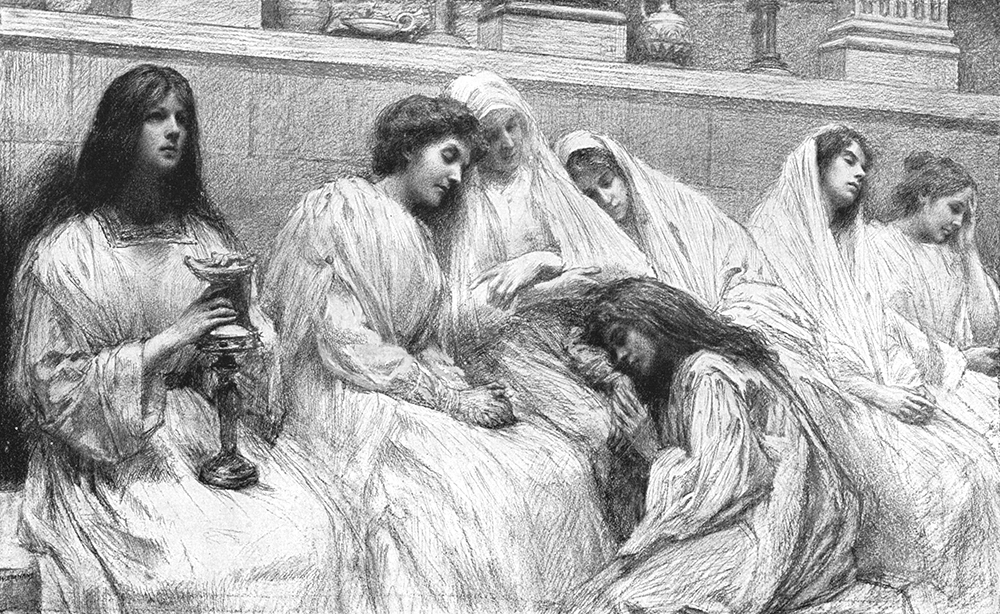
Art by Eugène Burnan

Repairing Your Nets

“Yet those who wait for the Lord
Will gain new strength;
They will mount up with wings like eagles,
They will run and not get tired,
They will walk and not become weary.”

Isaiah 40:31, NASB

The word “wait” used here is powerful. It’s an awesome word, never used casually in the Hebrew scriptures. It does not mean to be uncaring or idle. Sometimes we wait in line at the grocery store, or maybe we’re waiting for a phone call. We wait all the time, and often, we don’t even realize it.

The Hebrew word for ‘wait’ is special. It’s qāvâ. It means, ‘to bind together by twisting.’ It’s an active word.

It sometimes means to work like a fisherman repairing his nets to get them ready for tomorrow’s catch.

(There are always holes to mend after a long night’s efforts.)

When we wait spiritually, repairing our nets, the following should be used. Much of this can be done in prayer.

  • Calming ourselves, setting aside everything that doesn’t fit
  • Reading His word
  • Seeing His face
  • Hearing His voice
  • Keeping pace with Him, whether He moves (or doesn’t)

Fixing our nets is a cool way to describe our journey, right? Sometimes, when we think about waiting, we usually only think about it in English, and that can be annoying. It often stops us from truly understanding the true meaning of ‘wait’.

I strongly believe that the Holy Spirit wants us to understand the concept of being closely connected to Him. Sadly, we are often held back by our own definitions, rather than embracing the definitions found in God’s Word.

“The LORD is good to those who WAIT for him,
to the soul who seeks him.”

Psalm 27:14

Sometimes we are instructed by someone to “wait on the Lord.” This instruction can be challenging and we are unsure exactly how we should do it. It’s usual for us to simply show agreement through a smile and a nod. We never completely grasp the essence of that word.

He becomes my source of power that comes from waiting.

He is now the sturdy bond that I am intertwined with. (Maybe this is how He gives strength and power to His people?) We must listen to this, and the Lord is very enthusiastic about guiding us into this fresh form of closeness.

The promise in Isaiah 40:31 talks about receiving new strength, like an eagle’s wings, a holy energy. This verse is important for us, especially today; we need this kind of strength right now. We need to repair our nets as often as we can.

“Waiting for God is not laziness. Waiting for God is not going to sleep. Waiting for God is not the abandonment of effort. Waiting for God means, first, activity under command; second, readiness for any new command that may come; third, the ability to do nothing until the command is given.”

    G. Campbell Morgan

alaskabibleteacher.com

Do You Belong in the Fellowship of Pain?

The hands of a leper

“In one of the villages, Jesus met a man with an advanced case of leprosy. When the man saw Jesus, he bowed with his face to the ground, begging to be healed. “Lord,” he said, “if you are willing, you can heal me and make me clean.”

Luke 5:12, NLT

The Bible text reveals a man who is desperate.  His leprosy has advanced; he is covered with it from ‘head-to-toe.’ He’s an outcast now, completely infected by something he never asked for; he is ‘unclean’ and completely without hope. There is no treatment, the doctors can do nothing.

The leper knows that without the touch of Jesus, he’ll never be healed. 

He knows it; he doesn’t need to be convinced by anyone over the complete hopelessness of his condition. He is lost. And yet he has heard that Jesus can do incredible miracles. Could it be that Jesus can heal his sickness? The leper comes and falls on his knees before the Lord, with his face in the dirt. This man is completely broken; he has no hope, except for Jesus. What else can he do?

Our diseases differ, but our lives have been completely changed by our pain. We all have this in common. 

Our pain and darkness vary. Some hurt more, some less. But we’ve all come to the place where we no longer have illusions of somehow being made whole. Whenever we meet, I think there should be a secret handshake or a password. We all share a comradeship— we’re all part of the same community.  We’re a broken club of tired and decidedly unclean misfits.

We belong to the fellowship of pain.

Lying in the dirt, we start to believe the unbelievable.  Our faith doesn’t activate our healing, as much as it simply guides us to Jesus. We can kneel, and perhaps that’s all we need to do. His presence drives away the fear, the doubt, and the pain. He’s come, and somehow we begin to hope for mercy. Only he can carry us through this.

In times past I’ve struggled with deep dark depression. I’ve had to take meds.  But when I come into Jesus’ presence, all my melancholy is driven out. He comes and I start to hope again.  Am I a stellar example of perfect discipleship?  I think not. But isn’t about us becoming “angels,” perhaps it’s more about us learning how to kneel, and to allow Jesus to touch our hearts.

You must do this, repeatedly.

“The power of the Church is not a parade of flawless people, but of a flawless Christ who embraces our flaws.”

“The Church is not made up of whole people, rather of the broken people who find wholeness in a Christ who was broken for us.”   

–Mike Yaconelli

alaskabibleteacher.com

The Shepherd’s Own Voice

John 10:1-5, ESV

 “Truly, truly, I say to you, he who does not enter the sheepfold by the door but climbs in by another way, that man is a thief and a robber. But he who enters by the door is the shepherd of the sheep. To him the gatekeeper opens. The sheep hear his voice, and he calls his own sheep by name and leads them out. When he has brought out all his own, he goes before them, and the sheep follow him, for they know his voice. A stranger they will not follow, but they will flee from him, for they do not know the voice of strangers.”

What joy can be found in the Shepherd’s care, and to hear his voice. Nothing really can match this wonder. We follow as he leads us. The voice is an integral part of this passage and the foundation of discipleship that is real.

Please understand: You really can’t walk with him unless you hear him. We belong to him. We’re his flock that he keeps and provides for.

And He knows our name!

That’s the intimacy found in these verses. We’re never forgotten and he will never overlook us. To think otherwise is slander and an attack on his present-day ministry. Jesus is our good shepherd. He always will be.

“Intimacy with God comes in whispers, not shouts.”

     Woodrow Kroll

He sometimes whispers, and yet this world can’t hear him (or they refuse to). To be perfectly honest, my ‘busy-ness’ silences Him. I suppose that the real issue isn’t with Him, but with myself.

“And after the earthquake, there was a fire, but the Lord was not in the fire. And after the fire, there was the sound of a gentle whisper.”

1 Kings 19:12

He doesn’t speak through a windstorm, earthquake, or fire. He chooses to speak very quietly, and that’s a problem for me. In the original Hebrew, the word “whisper” can be translated as “calm, something gentle.” He speaks this way if only we shut up for a little while.

If we are to recognize God’s voice, we must belong to Him. We hear His voice best when we spend time in Bible study and quiet prayer. The more time we spend intimately with God and His Word, the easier it is to recognize His voice and His leading in our lives. He’s always speaking, and we’re seldom listening.

The flock hears the shepherd, and it’s that voice that breaks through our cluttered-up life. We can hear, and it’s that communication that encourages us to walk through life—one day at a time. Just today. That’s all you must do.

There are so many other voices. Please dear one, you must ignore them.

So many are speaking, and so many want us to hear and follow them. But in reality, they want us to leave the Shepherd and his flock behind. But we can’t allow this, we must learn to listen to him alone.

alaskabibleteacher.com

Art by Eugène Burnan

A Rose in the Snow

Merry Christmas, dear ones! 

I’m looking at Christmas 1000 years from today, when He will bring us all together.  I think that we’ll all kick back, and we will try to remember Christmas, 2023.  We will most likely say, “But that was so long ago, it feels like a dream, I’m not so sure now…”

Like me, I trust your deepest hopes are pinned on an incredible grace. 

Under the tree there are gifts.  But we have been given a gift– of gifts.  It is something that ‘rocks our world’.  It’s called ‘eternal life’.  It has been given to us freely, and without any stipulations.  We’ve been ‘cut-loose’ from the tangled mass of sin.  We are now very much free.

I know I need to learn to live like a free man.

My physical and mental illnesses often trips me up. I’m saddened by my weaknesses.  But I reach out and touch this grace, I pull it in and take and make it my own.  Jesus has freed me, and I want to walk in truth, with Him—and with you.

I’m grateful for my doctors, they’re definitely a blessing. I must keep looking to my rose–my Jesus who is my Savior. I covet your prayers especially now.

Our Lord Jesus is truly a “rose in the snow.” He has come to this mean and hostile world, but He is precious and beautiful in the eyes of the faithful. I pray that you find Him flourishing in your heart.

Love to you from alaskabibleteacher!

Finding the Light

“Indeed, we felt that we had received the sentence of death, so that we would not trust in ourselves but in God who raises the dead.”

2 Corinthians 1:9

To be chronically ill often means living with awful frustration. We can’t do what we want, we are ‘trapped’ by a disease we never asked for, and we’re held hostage by our minds and bodies. We once had a job– a career… and our time was occupied by that. Suddenly our lives are turned upside down.

We wanted something else, anything more than being very sick.

I once was a pastor of a small church here in Alaska. I also taught Gospels, several years in a local Bible Institute. I loved ministry very much. They defined my identity and gave me purpose. I enjoyed helping people and teaching the Word. I endeavored to be faithful in the ministry. And I hope I did.

With the sudden onset of a brain tumor, followed up by a diagnosis of severe depression, my life more or less exploded. I had extensive memory loss. I knew I had to step out of the ministry. I simply could not function. It was a hard thing to leave it behind. (And I still miss it.)

My depression grew even more profound with the stillborn death of our third child just 3 days before her delivery. Things suddenly ground to a standstill as my wife and I tried to process all of this. I guess I just couldn’t understand and more or less just shut down. I was angry at God. I spent months in bed, unable to function.

Some people were true jewels.

Others were more or less mean and uncaring. (I quickly learned how to take the good with the bad.) I suppose I should have understood, but things were so tangled up inside me that I couldn’t verbalize a thing. But God knew all about me. He loved and never judged.

The post-op recovery following the tumor was an ordeal, as I had to learn many things all over again. A few years later I ended up on disability; I was unable to work, and my symptoms were so unpredictable. I dealt with profound depression and a solid dose of paranoia and fear.

I learned that meds can help, but they can’t fix the problem.

Sometimes the isolation seemed worse than the pain. We wonder why this is happening to us, and we hear lies about our worthiness or God’s goodness. Our value to others seems to be scuttled by our illness. We can feel cursed, forgotten, crippled by God, or even worse. (Maybe even irrevocably lost?)

Satan craves our spiritual destruction, and he snares unsteady souls.

I admit I have been slow to learn this– but God brings good things out of the dark. I’m embarrassed by my personal lack of acquiring all of this. Now I’m starting to learn finally, and I want His words to reflect these truths.

“We now have this light shining in our hearts, but we ourselves are like fragile clay jars containing this great treasure. This makes it clear that our great power is from God, not from ourselves.”

2 Corinthians 4:7

This light will shine, and the treasure is found in clay vessels. Brokenness only means the treasure is now seen clearly. It’s important to note–jewels lose none of their value by being surrounded by broken clay. Our weaknesses are being turned into goodness, understanding, and love for our brothers and sisters.

Troubles of many varieties will pay us a visit. Count on it.

No matter what their nature, God holds his people in place while everything else is falling apart. But for the broken believer, there is another dimension; we will finally triumph. The tragedies we’ve had to endure only supplement our faith. We will stand– because He makes us stand.

“We are pressed on every side by troubles, but we are not crushed. We are perplexed, but not driven to despair. We are hunted down, but never abandoned. We get knocked down, but we are not destroyed.”

2 Corinthians 4:8-9

alaskabibleteacher.com

Praying Authentically

front-prayer

Prayer can often be just a nice religious duty, that makes us feel warm and fuzzy. But such prayer does not suit a disciple who is tired of religion and is seeking authenticity. There are few models who can be our guides.

That is one of the reasons why we need elders in our fellowships; they have been through so much, they can anchor us to all that is real. As elders, they probably had lessons in prayer.

We often will theologically play on the periphery, and cleverly deceive others and ourselves.  My own heart gets pretty creative as I display self-righteousness. (I should win an Academy Award as ‘best actor.’) But Jesus insists on us becoming real. You might say that really is the prayer that touches his heart.

When you talk with Jesus, do you truly talk to Him?

Do you have a real awareness that you are really talking with Him?

Is it the real you that fellowships with the ‘real’ God?

The following is an excerpt from A Diary of Private Prayer, by the Scottish theologian, John Baillie, 1886-1960:

Eternal Father of my soul, let my first thought today be of You, let my first impulse be to worship You, let my first speech be Your name, let my first action be to kneel before You in prayer.

For Your perfect wisdom and perfect goodness:

For the love with which You love mankind:

For the love with which You love me:

For the great and mysterious opportunity of my life:

For the indwelling of your Spirit in my heart:

For the sevenfold gifts of your Spirit:

I praise and worship You, O Lord.

Yet let me not, when this morning prayer is said, think my worship ended and spend the day in forgetfulness of You. Rather from these moments of quietness let light go forth, and joy, and power, that will remain with me through all the hours of the day;

Keeping me chaste in thought:

Keeping me temperate and truthful in speech:

Keeping me faithful and diligent in my work:

Keeping me humble in my estimation of myself:

Keeping me honorable and generous in my dealings with others:

Keeping me loyal to every hallowed memory of the past:

Keeping me mindful of my eternal destiny as a child of Yours.

Through Jesus Christ my Lord, Amen.

(Taken from Richard Foster’s Devotional Classics, pp. 126-127.)