We See So Little

Job 26:14

Job’s suffering has led him to this point. He realizes how little he understands God. I guess pain can have a powerful effect on how we see things. Job has learned the immensity of God.

In verse 14 he speaks about the “outskirts” the word in Hebrew means the mere edge, or fringe. One translation of this verse reads like this: “These are only a few of the things that God does. We only know about a few small things. If he used all of his power, we could never understand.

“That being the case, let’s consider God’s capacity for just a moment. He’s not only “high capacity”, He’s “infinite capacity.” He never sleeps or slumbers. He is perfect in all His abilities. There isn’t a single thing that He doesn’t know, and there is no one more powerful than Him. And unlike humans who can only be in one place at one time, He is everywhere at the same time. This is amazing, and just like the Psalmist said in Psalm 113, “Who is like the Lord our God?” The answer, very simply, is no one.”

John Piper

“For now we see in a mirror dimly, but then face to face. Now I know in part; then I shall know fully, even as I have been fully known.” (1 Cor. 13:12)

I’m thinking about Moses who asked to see God’s glory. Moses was called “the friend of God,” but he wanted to see more. God’s response was that He couldn’t because it would kill Moses. But provision was made for him to see the backside of God as Moses was in a cleft of a rock. (Exodus 33.)

The Bible doesn’t reveal it all. But we’re given enough. Job told us that only the outer fringes can be seen by men and women. We see His periphery, but we must understand our limits. We’re told that we will see Him someday–but not yet. But at the moment of death, we will see Him.

The Lord Jesus came to show us the Father. “In [Christ] all the fullness of deity dwells bodily.” When we see Jesus we see the Father. Reading the Gospels we are encountering God, because Jesus reveals Him fully.


“He is the radiance of the glory of God and the exact imprint of his nature, and he upholds the universe by the word of his power.” 

Hebrews 1:3

Romans 11:33

alaskabibleteacher.com

Needing His Cross Daily

We live in this place.

I confess that peace has never been really high on my list. Love, joy, kindness, and even goodness are clear priorities. Peace… not so much. Until I find out it’s not there. And then I get frantic by its absence and scrambling look for it with bewilderment.

Sometimes I don’t understand why God still loves me. At times like this anxiety eats at me. I beat myself up by my last failure. The guilt of my latest sin grows until it looms larger than the blood that saved me. Sometimes I suppose, religious people seem to have the most neurosis.

I’m afraid that we are taking the ‘present tense’ out of the Gospel.

The past tense is preferable to us as we find it easier to ‘manage’ our Christian life. We like to make check marks on our list. [Church attendance– check. Baptism– check. Bible study– check.] I think it gives me a definite feeling of ‘maturity.’

But these things matter little without intimacy with Jesus Christ.

I certainly haven’t arrived, and it seems at times I’m still the hideous sinner I always was. I cannot pretend otherwise, even with a spiritual truckload of cosmetics at my disposal. I know, I’ve tried. And I’m still ‘ugly.’ I do know forgiveness, and I do walk in its wonderful light (by grace).

I read Luther 30 years ago. (And Bonhoeffer would say something similar.)

“When our Lord and Master Jesus Christ said, ‘Repent,’ he willed the entire life of believers to be one of repentance.”

Martin Luther

This is the first of his 95 Theses nailed to the door of the Castle Church in Wittenberg, Germany. And there is a present tense here we can’t ignore about these declarations. I don’t just repent over smoking, beer drinking, fornication, or hypocrisy, once and done. But my entire way of living is to be one of repenting. To repent everyday opens the door to a true grace-filled discipleship.

“All of the Christian life is repentance. Turning from sin and trusting in the good news that Jesus saves sinners aren’t merely a one-time inaugural experience but the daily substance of Christianity. The gospel is for every day and every moment. Repentance is to be the Christian’s continual posture.”

John Piper

Luther’s last words, on his deathbed, was found written on a scrap of paper stuck in his coat, “We are beggars! This is true.” Even after thirty years, he was only echoing his first thesis.

It seems dear ones, we are to live at the foot of the cross.

Covering the Sins of Others

“And don’t build an altar that requires steps; you might expose yourself when you climb up.”

Exodus 20:26

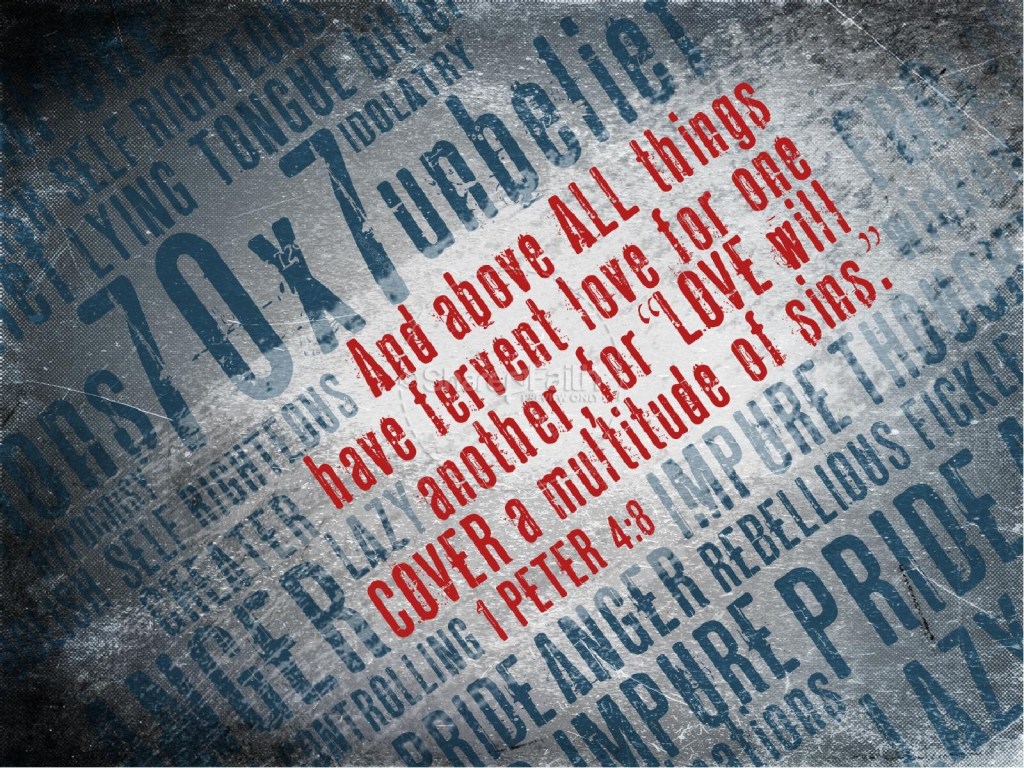
“Most important of all, continue to show deep love for each other, for love covers a multitude of sins.”

1 Peter 4:8

While I lived in the SOS Ministry house in the Mission District of San Francisco a dear brother taught me this principle.  Living in a Christian community was wonderful, but it also could be a tremendous challenge at times.  What Michael taught me allowed my understanding to grow into my own calling in the Kingdom.

The principle is this:  

Throughout the scripture “being naked, or nakedness” is always a shame.  It comes welded to the concept of being vulnerable to the sight of those who are mature.  It carries the idea of sin; it’s sin that some can see, it is hidden to most but causes terrible shame. Exposure of their nakedness seems like the worst thing that could happen.

For those who often sin, we latch onto the idea of keeping a lid on it, and being secretive about it.  We believe that people will never know.  Often sex sins, drugs, and alcohol sin, are kept hidden from the view of family and friends, and the Church. Hidden sin will never be healed by hiding it. (That’s a very common deception.)

Noah and his nakedness, Genesis 9

“Noah became a farmer and planted a vineyard. When he drank wine made from his grapes, he became drunk and lay naked in his tent. Ham, the father of Canaan, looked at his naked father and told his brothers outside. Then Shem and Japheth got a coat and, carrying it on both their shoulders, they walked backwards into the tent and covered their father.”

“They turned their faces away so that they did not see their father’s nakedness.”  

Genesis 9:20-24, (See Lev. 18).

Granted, it’s hard to process this patriarch’s gross sin. However in all fairness, Noah had lost practically everything in the flood, so perhaps we should be gentle with him.

The Church needs people who cover up the nakedness of others, people who are gentle and humble.  They would never, ever dream of making a scandal.  They are trustworthy and understand to a great degree the things that make a man or woman of God.

Mature believers will protect the open areas of others. 

They will refuse to judge or point out sins. Any discernment that’s given from God is for intercession, not for fault-finding.  They stand in the gap, shielding and protecting. And praying. This is God’s heart, and they understand.

But the issues for leadership are quite clear.

The principle of spiritual responsibility and active sin requires definite action for the health of the Church. A pastor or teacher who practices evil cannot remain in their place of authority. The standard for them is different. They have been charged for care and oversight over God’s flock.

With the ordination vows comes scrutiny. I believe special grace is given to each leader, but with that comes the commitment to following Jesus faithfully. It’s a serious call and deliberate sin invalidates that. The man may be quite gifted but can no longer be trusted to serve in their office.

I’m convinced that Paul’s epistles support this.

God’s final word on nakedness is in Revelation 3:18, and perhaps this is a good place to end this post.

alaskabibleteacher.com

Sinners Need Jesus’ Love

“And when the Pharisees saw this, they said to his disciples, “Why does your teacher eat with tax collectors and sinners?” 12 But when he heard it, he said, 

“Those who are well have no need of a physician, but those who are sick. 13 Go and learn what this means: ‘I desire mercy, and not sacrifice.’ For I came not to call the righteous, but sinners.”

Matthew 9:11-13 (context vv. 10-13)

God is not against us because of our sin, rather, He is with us against our sin. Jesus wants to eat with sinners; with us!

We barely believe this. It doesn’t make any sense at all. It’s one of those pure and astonishing grace ideas that God must reveal to each person. It’s counter-intuitive to everything we know.

Don’t look now, but Jesus, (God’s own Son), is sitting and eating with sinners!

Can we even grasp how amazing this is? His guests at the table were the awful–the nasty dregs of a nice proper society. Tax collectors who had renounced Judaism for Rome. There were the sinners who were the unacceptable. (Even the whores and the drunks showed up!) Can’t He do any better than this?

We see (or read) of the Lord who chooses to fellowship with the ungodly rather than the religious. That shakes us to the core, as it should. He loves associating with unacceptable people. That alone should floor us-and maybe scare us too.

It seems to me we’re living in this world ‘blind and dumb’ to what grace really is.

The religious Pharisees found the grace of Jesus to be unacceptable. They walked and breathed legalism. Keeping the Law was their way to be acceptable in God’s eyes. And they were now angry, or maybe somewhat mystified, by Jesus’ incredible desire to associate with evil people. But they’re misunderstanding the grace and mercy that resides in God’s heart.

Man is born broken. He lives by mending. The grace of God is glue.

–Anne Lamott

Do we seriously understand the kindness and grace of Jesus? Does it ‘saturate’ your mind and heart? Are you completely ‘marinated’ in God’s outrageous love for you, the ugly? Think about this; ‘Could it be that the Pharisees are still alive and well today?’

Eating with sinners. We read that the Pharisees objected.

Perhaps these guys were trying to attack Jesus by ‘splitting’ the disciples from Him. They wanted them to question His actions. This is Satan’s strategy.”Why does your teacher eat with tax collectors and sinners?” ‘Why’ seems to be the voice of the doubter, the offended and the ungraceful.

The ‘healthy’ don’t need any help. No doctor’s appointments are necessary. And yet Jesus chooses out the sinners” instead. You need to understand this, to be called like this is the ultimate gift. Grace for the ungraceful is unreal. It seems oddly unnatural. And yet the Father’s grace is now waiting for you. You must believe this.

What are you struggling with?

What ‘distracts you? What are you trying to do to be ‘righteous’ in God’s eyes? Do you really believe that He desperately wants to sit down and have a meal with you, just as you are?

Or are you still wallowing in shame and unworthiness?

“The bridge of grace will bear your weight, brother. Thousands of big sinners have gone across that bridge, yea, tens of thousands have gone over it. Some have been the chief of sinners and some have come at the very last of their days but the arch has never yielded beneath their weight. I will go with them trusting to the same support. It will bear me over as it has for them.”

    Charles Spurgeon

How Much Do You Love Him?

How much do you love Jesus? This parable looks at the heart of the believer, the person who has been incredibly forgiven of everything–past, present and future. And it’s here we see a woman whose heart is broken by her sin, and she discovers Jesus’ grace, and tremendous mercy.

“A certain moneylender had two debtors. One owed five hundred denarii, and the other fifty. 42 When they could not pay, he cancelled the debt of both. Now which of them will love him more?” 43 Simon answered, “The one, I suppose, for whom he cancelled the larger debt.” And he said to him, “You have judged rightly.” 

44 “Then turning toward the woman he said to Simon, “Do you see this woman? I entered your house; you gave me no water for my feet, but she has wet my feet with her tears and wiped them with her hair. 45 You gave me no kiss, but from the time I came in she has not ceased to kiss my feet. 46 You did not anoint my head with oil, but she has anointed my feet with ointment.” 

47 “Therefore I tell you, her sins, which are many, are forgiven—for she loved much. But he who is forgiven little, loves little.”

Luke 7:40-47

Jesus has been invited to Simon’s home. He’s a Pharisee, and at this point they haven’t quite banded together to attack Jesus, it seems that there were still some Pharisees who were true seekers.

The text jumps right in and we see Jesus reclining at a table (the Jewish people didn’t use chairs–pillows were used instead.) At a feast like this people who weren’t officially invited could come in to stand in the back and listen in on the conversation. (That seems awkward.)

Suddenly a woman enters the room.

She’s described as “a woman of the city,” which is a code word for “a sinner, or a harlot.” (Let your imagination roll that one around.) She comes with a definite purpose, for she brings a jar of quite expensive perfume with her.

The passage reveals that she’s on her knees, weeping on Jesus’ feet, and rubbing her tears with her hair, and pouring out the perfume. She’s kissing his feet. She’s obviously a broken person—someone who knows who Jesus is, and who understands who she is, and how deep sin has destroyed her.

At this point Simon is deeply offended, and probably embarrassed by what’s happening. But he also assumes that Jesus isn’t who he’s saying he is. “How dare does this man let an unclean person even touch Him!” But Jesus understands everything. His parable is short (just two verses) and it’s directed at Simon; and it’s a no-brainer.

The interpretation is obvious: the man who owes the most will love the most.

Jesus accentuates Simon’s breach of protocol. The Lord deftly explains the entire situation and Simon is busted. He’s put on the spot and Jesus has made his point. It’s all so obvious. The essence of the story is clear. How much do you love the Master?

(Or maybe you’re a Simonite?)

Perhaps you’re someone who doesn’t quite accept what’s real? The Bible tells us repeatedly that no one is righteous. No one. Scripture has a very low opinion of the righteousness of men. (That should shatter your thinking.)

“But we are all as an unclean thing, and all our righteousnesses are as filthy rags; and we all do fade as a leaf; and our iniquities, like the wind, have taken us away.”

Isaiah 64:6, KJV

The Hebrew word for “filthy rags” is extremely graphic–literally it means “a menstruating cloth.” It was something that a woman used before Tampax came along. How very descriptive. Do we even have the slightest idea what that means? Are our good deeds that bad?

Yes they are. Isaiah announces that’s exactly how God sees our best attempts to find acceptance apart from grace. It often seems we try to please Him by doing the best we can, but that isn’t sufficient. We always fall short and mess up.

How does understanding this change our discipleship? I’ll let you be the judge on this on this one.

“He loved us not because we are lovable, but because He is love.”

C.S. Lewis

Transformed!

Mark 10:53, ESV

God has touched you in a profound way, (at least I hope so.) Only He could’ve done this. You’re not the same person now. Just like Jesus healed blind Bartimaeus, you too can really see. The beggar becomes a follower. (Mark 10:46-53.)

So what’s next?

There is always another step to take as we follow Jesus. Everyday there is something new. Our salvation is given freely, but we discover that it’s something active–more like a flowing stream and less like a stagnant pool. If we truly have been “healed,” we’ll want to follow. And now each day is a joyous adventure.

After all, we’ve been terribly blind for a long, long time.

Bartimaeus would never be able to truly explain what had happened to him, at least not in a perfect or complete way to the others–but no matter, it really wasn’t necessary. (But I must believe he tried.) He could see!

Notice the sequence of events in verse 53

  • Jesus: “Go your own way.”
  • Bartimaeus: “..followed Him on the way.”

He was now a true follower. No longer a blind beggar, but he was now a true companion of Jesus and the “church.” He now walked with other believers in the Master’s band of disciples. (Having been blind and instantaneously given sight changed him forever.)

So what happened next?

I suspect Bartimaeus followed the Lord all the way. Although scripture doesn’t say what happened, I believe this ‘ex-blind’ man was now a visible witness to any with eyes to see. Bartimaeus became an authentic witness–God’s megaphone to the power and mercy of Jesus Christ.

To follow the One who saved us is the most wonderful adventure. Each of us comes with awful “sicknesses” and sins. Some of us were physically or mentally ill. We might have been thieves, liars and murderers–but no more. Some of us were adulterers, gay, child molesters, “perverts”–twisted and caught in our own sin. Proud, angry, selfish. Drunks and addicts. Sinners, and rebels.

(I could keep it going, after all I don’t want to miss you.) 😁

But we are now forgiven and healed; and now Jesus calls us to follow Him, every day. I believe that there is always another step. So, what happens next? I believe that there is always something.

I can’t say exactly. Each believer has a different story.

But I do know tomorrow’s life episode is going to be something fantastic, and a challenge. The fruit of the Holy Spirit is given to each who are truly being discipled to follow. The road in front of you just might be excruciatingly hard, but truly there is joy in our journey with Jesus.

“You called, You cried, You shattered my deafness, You sparkled, You blazed, You drove away my blindness, You shed Your fragrance, and I drew in my breath, and I pant for You.”

  Augustine

The Great Escape

Hidden in the Old Testament is the idea of the Cities of Refuge. They have incredible meaning for us today.

They speak profoundly to our situation and bring real hope to those who struggle. Six places of safety were given to protect those who accidentally killed another person— maybe an ax head flew and hit someone, and they died as a result.

God told Joshua to establish cities of protection where one could be safe from an avenger. There were six of them, three on the east side of the Jordan river, and three on the west. The cities covered Israel; each was spread out intentionally so they were always close.

That city became a place of asylum for those guilty of manslaughter.

As believers, we know that we’ve committed crimes against God and other people. The burden we carry threatens to undo us. Satan (and his minions) want to destroy us—and honestly, we deserve it. We are essentially spiritual ‘criminals’ who have hurt others and damaged ourselves in the process.

Outside the city, we’re vulnerable—but inside those walls we find safety.

Those who have killed others are protected. If we venture outside, we find our adversary who is waiting. Scripture tells us that we must stay cloistered there until the current high priest dies. Upon his death, we’re released and may leave the city walls.

For broken believers, the whole concept rings true.

The text speaks for itself, and there is spiritual logic in all of this. We see parallels here that speak to our condition. We’ve messed up big time. We also carry issues that the enemy can attack. Depression, bipolar, trauma, and even thoughts of committing suicide— can be a fundamental part of our lives.

I must tell you that safety is found only in the Savior.

Finding God and abiding in him is our place of safety. His walls protect us, Jesus is our high priest, who never dies; that means we need to stay with him, permanently. I like Hebrews 6:18, LB:

“Now all those who flee to him to save them can take new courage when they hear such assurances from God; now they can know without a doubt that he will give them the salvation he has promised them.”

For us especially, we often have problems with the doctrine of assurance of salvation. Our enemy works overtime to accuse us (Rev.12:10). We’re his targets and the lies of many demons assault us. We can, at times, wonder if we’re really saved. We wonder if we are really forgiven, and we doubt our salvation. Satan’s efforts can be constant and crippling.

I encourage you to think this over and pray about this.

Numbers 35 is a good place to start. That chapter is pretty clear. Look also at Exodus 21:13-14; Joshua 20:1-6; Deuteronomy 19:2-13.

Our King and Our Master

A Kings Crown and the Crown of Thorns


A Christian is a person who has died with Christ, whose stiff neck has been broken, whose brazen forehead has been shattered, whose stony heart has been crushed, whose pride has been slain, and whose life is now mastered by Jesus Christ.”

–John Piper

No longer do I call you servants, for a servant does not know what his master is doing; but I have called you friends, for all things that I heard from My Father I have made known to you.”

John 15:15

It seems that the purpose of life is not to find our freedom. It’s really meant to find our Master.

Yes, the idea of being a slave to anyone is repugnant. We chafe at this, and yet man was never meant to be separated from the Lordship of Jesus. We’re instructed repeatedly with the New Testament idea that “our life is not our own”  Over and over God proclaims Himself as the King.

That troubles us somewhat.

Not so much when life is fairly good, granted, but in those hard moments when a decision must be made between enjoying the titillating “lusts of the flesh,” or accepting the fruits of the Spirit. This is one of those “lordship moments.” They come and go, and they show us exactly who we are.

If you’re really going to be authentic–a legitimate and real disciple, then you must determine who is going to be in charge, and this isn’t one of those casual decisions. Your decision must become a settled issue.

You must securely fix it in your heart.

The thief on the cross knew salvation, he was promised an eternity with God simply by faith. But I submit to you that he had put himself under the Lordship of Jesus, simply by recognizing the sign, “the King of the Jews.” I believe he saw and understood its implications. Jesus was King! He knew and understood.

This is a very hard word for some, but so many of our personal issues hinge on this.

I know this first-hand. It is a monumental struggle. You must admit to not only having Jesus as your Savior, but you also must put your life under His total Lordship.  You need to pick up your cross daily in order to follow.  You need to learn how to kneel.

I’ve chosen a crown to open up this post–it’s done on purpose.  I simply want you to understand the supreme call He has on your life. Here’s Bob Dylan, and he nails this idea down:

But you’re gonna have to serve somebody, yes indeed
You’re gonna have to serve somebody
Well, it may be the devil or it may be the Lord
But you’re gonna have to serve somebody


You must learn here and now how to kneel before the Sovereign King


alaskabibleteacher.com

Dancing in the Streets

I see a people dancing along a long, straight road. Their voices form a chorus of praise to the king who gave his life to set them free. 

Along the road there are lots of little stalls and shops. They are all arranged in such a way that the dancers can look inside and see all the thrilling goods and shining things for sale. The salesmen are also turned towards the throngs of people and have exciting offers: ”Take a thing now, pay later!” ”Have a look around!”, ”Come, satisfy and fulfill all your dreams!”.  Beautiful clothes of the latest fashion. Sparkling jewels. Delicious foods as far as the eye can see. But strange things were also for sale. High positions. Power. Glory. Bodies.

Entrances were made to walk into, but not to find one’s way out. The shelves in the shops lead you into alleys, backstreets and sidetracks. And there, people live in darkness.

Some people in the jubilant parade get curious and stop at the sight of something interesting. Others take a few steps further in. Still others try on different things and even start shopping, but some of them soon regret it all and find their way back to the parade. Because they have seen something far better than every tempting thing trying to get their attention.

They have their eyes fixed on the destination: the horizon far ahead, the shining bright sun with sunbeams shining on the road they are walking on. They know that it gives far more joy and deeper peace than anything the world has to offer. You can tell it by their looks!

Those still living in darkness now and then see the light in their faces and repent. Sometimes greedy salesmen can see their sincerity and are drawn to them. People are caught up by the whirl of happiness and leave all their possessions behind. Even those whose families want to stay on, still choose to leave. Some dancers have to endure mockery, beatings and persecution from those who remain, since they love darkness. But it rarely keeps the dancers from continuing. For the light carries them!

And it does not stop there. The people are not just dancing for themselves. The light that they are receiving wants to shine into the darkest backstreets. And so many dancers let themselves be led there. Once there, they share their plasters, their food and drink and their shoes with all those in need. They chant out stories of what they have seen and experienced and invite those listening to dance with them. Whenever someone joins them, they are met with rejoicing. And all around them beauty is bursting forth where beauty has not been seen before, life is born from what used to be dead and darkness is driven away by light. 

We all have terrible scars

The parade consists of all kinds of people: women and men, rich and poor. But they are all broken. They all have scars – some have many scars and others just a few scars and they long for the complete healing. Some are heavily burdened, while others have let go of their burdens along the way, received lighter clothing from above and so can dance more quickly and easily. But the most important thing is not how fast one can move but in what direction. If you try a move that has not been given to you, one which is too difficult or too fast, you are in danger of stumbling and falling.

But if you stay on the road, there is always strength to get up. Indeed, sometimes you need help, even a lot of help. Hands reach out, eyes see and ears listen. The wind caresses cheeks, opens lungs and breathes in new life. And when you raise your eyes once more, you can brush off the dirt.

Love is what most of all characterizes them. It sets their hearts on fire and encourages them to give their lives for each other.  It shapes them into one people under one and the same king, one family with one and the same Father, one temple for one and the same Spirit, one bride to one and the same Christ. 

————

Found this article that I thought would bless you. It’s such an encouragement. (I wish I’d written it.) 🙂

Rooted Firmly and Deeply

“But I am like a green olive tree
    in the house of God.
I trust in the steadfast love of God
    forever and ever.”

Psalm 52:8

In Psalm 52 we read of David’s run-in with Doeg, a very bad man, (a mass murderer actually). But David, hearing about the slaughter of 85 innocent priests doesn’t respond in hatred, rather he sits down and writes this song of contemplation which we know as Psalm 52.

It isn’t something written out of wrath and vengeance rather the word that begins his writing is “maskil” which implies– enlightenment, or something reflective, thoughtful, discerning. He sat down and considered Doeg’s awful evil, and by doing this was able to understand own heart as well.

Psalm 52 has two distinct parts.

The first is Doeg’s vicious atrocity, and the condemnation that it incurs, (v.v. 1-7). The second was David’s own commitment to following God, and understanding his own place in a very evil world, (v.v. 8-9).

Rather than castigate himself for being discovered in Nob–a circumstance which directly led to the mass murder of these priests (and their families). We find that David does not blame himself. He could have, but he didn’t. Rather he thoughtfully, and carefully, detailed his own “observations” of the whole sordid matter.

David could easily have destroyed himself with guilt and grief. He didn’t.

He chose not to play the losing game of ‘what if.’ He instead would be like a green olive tree rooted himself in the holy temple and into the protective presence of God. David knew he would destroy himself if he didn’t place himself there. It was a deliberate decision.

It would keep himself sane.

It seems to me that trees work heavily into David’s own theology and that this is how he sees his relationship with God. He’s planted and therefore able to survive terrible trials. He shows us how to survive and thrive.

His roots would need to go very deep though.

David’s thoughtful imagery is himself as an olive tree planted in God’s presence.

I believe knowing this is the antidote to the poison of guilt. Perhaps we should follow his example?


“They are like trees planted along a riverbank,
    with roots that reach deep into the water.
Such trees are not bothered by the heat
    or worried by long months of drought.
Their leaves stay green,
    and they never stop producing fruit.”

Jeremiah 17:8