God’s Night Shift, Psalm 134:1-3

A song of ascents.

“Now bless the Lord,
all you servants of the Lord
who stand in the Lord’s house at night!
Lift up your hands in the holy place
and bless the Lord!

 May the Lord,
Maker of heaven and earth,
bless you from Zion.

Psalm 134:1-3

Not every Levite labored during the day. The night shift continued their work. Granted, no sacrifices were offered, but the “night priests” stood to protect the Ark, gather wood, and keep the incense burning and cleaned up the blood. But most importantly they must worship and pray for Israel.

“Servants of the Lord” is a phrase that resonates in my heart. Those words are both a comfort and a responsibility and that seems to open this passage up. We’ve got a Master, and we serve Him only. And I know and believe that worship was the main responsibility of the night watch!

“Christians believe that true worship is the highest and noblest activity of which man, by the grace of God, is capable.”

-John Stott

Worship is the central work of the disciple, it’s what we’re called to do. Evangelism, missions, and preaching are fine. But prayer and intercession must be the heartbeat of each believer. It’s the holy calling of the Church. When does the church service end? Never!

The service really gets going Monday through Saturday!

In this short Psalm, (just 3 verses!) we’re introduced to a group of Levites who are working the night shift. What they do is hidden–it’s not seen by others. They keep the fires stoked, gather wood, and patrol the walls. But more importantly, they stand and worship and intercede for Jerusalem.

No real recognition is given, and the spotlight is rarely shined on them.

They serve at night, vitally essential but seldom seen. And yet they intercede for the nation. They “bless” the Lord and the people of God. That’s their place and position. They must do this. Israel must be blessed. These night shift workers insist on it!

The church needs nursery workers and Sunday school teachers. So many are working behind the scenes. Often the deacons and elders of a church are rarely seen and seldom acknowledged. So much is concealed. Their work is a hidden one. But the Father sees.

In a church, someone has to clean the bathrooms and take out the garbage, and others will make coffee or shovel snow. They vacuum and straightened the chairs. They are the ones who collect the mail and prepare the overheads. There’s always something to do. And it’s a hidden work carried out with no one watching. No one, but God.

“It is good to give thanks to the Lord,
    to sing praises to your name, O Most High;
to declare your steadfast love in the morning,
    and your faithfulness by night,

Psalm 92:1-2

Serving at night can be a challenge, not all can lead worship or preach the sermon on Sunday morning. Those called to do those tasks serve in the day. But those who serve the Lord at night also labor, and sometimes that hiddenness behind the scenes has its own special challenges.

This may come as a surprise, but it takes as much of the Spirit to work the night shift as it does to stand behind the podium and preach the Word. I believe that this is true! These hidden ones carry out much of the ministry of the Church. Few notice, but God Himself sees them.

“They [Levites] are exhorted to fill the night with prayer and watchfulness and to let their hearts go up in blessing to Jehovah. The voice of praise should echo through the silent night and float over the sleeping city.”

Alexander MacLaren

alaskabibleteacher.com

Without Your Wound?

angel6

The subject of “the pool at Bethesda” alludes to the Thorton Wilder play, “The Angel that Troubled the Waters.” 

The play tells of a physician who comes to the pool of Bethesda, hoping to see the stir, and then be the first in the water, and healed of his debilitating depression.  An angel appears and troubles the water. Everybody at the pool hopes to be the first one in and to be healed of their disability.

An angel appears and blocks a physician at the very moment he is about to step into the pool and be healed.

angel1

Angel: “Drawback, physician, this moment is not for you.”

Physician: “Angelic visitor, I pray thee, listen to my prayer.

Angel: “This healing dear physician, is not for you.”

Physician: “Surely, surely, the angels are wise. Surely, O Prince, you are not deceived by my apparent wholeness. Your eyes can see the nets in which my wings are caught; the sin into which all my endeavors sink half-performed, cannot be concealed from you.”

Angel: “I know.”

Physician: “Oh, in such an hour was I born, and doubly fearful to me is the flaw in my heart. Must I drag my shame, Prince and Singer, all my days more bowed than my neighbor?”

Angel: Without your wound, where would your power be?” 

“It is your very sadness that makes your low voice tremble into the hearts of men. The very angels themselves, cannot persuade the wretched, and blundering children on earth, as can one human being broken on the wheels of living.

Later, the person who enters the pool first, and was healed rejoices in his good fortune, then turns to the physician before leaving and says:

“But come with me first, an hour only, to my home. My son is lost in dark thoughts. I — I do not understand him, and only you have ever lifted his mood.”

“Only an hour… my daughter… since her child has died, sits in the shadow. She will not listen to us, but she will listen to you.”

The play pierces me with this line— “Without your wound where would your power be?“ That thought causes me to look at my many weaknesses with an entirely different perspective.

Paul’s teachings offer us a powerful revelation: it is through our weaknesses that we can authentically minister to others, just as Jesus did by going to the cross. This priniple slowly permeates my understanding, and emphasizes the reasons behind my weaknesses.

Paul boldly declares that it is the very things we perceive as weak that have the potential to cultivate strength and truth within us and to others. It is my sincere hope that the ministry of alaskabibleteacher.com will impact lives by declaring this.

I hope so anyway. Please pray for me. I desperately need it.

I first encountered this excerpt in the book, “Abba’s Child: The Cry of the Heart for Intimate Belonging,” by Brennan Manning. The book is a worthy read, and worth finding if you can. The play is based on the biblical verses of John 5:1-4, however, it changes the end of the parable. The play is fictitious.

Check out Brennan Manning’s Facebook page for more info.

alaskabibleteacher.com


Spiritual Sloth

Matthew 25:1-13

“At that time the kingdom of heaven will be like ten virgins who took their lamps and went out to meet the groom. Five of them were foolish and five were wise. When the foolish took their lamps, they didn’t take oil with them; but the wise ones took oil in their flasks with their lamps. When the groom was delayed, they all became drowsy and fell asleep.

“In the middle of the night there was a shout: ‘Here’s the groom! Come out to meet him.’

“Then all the virgins got up and trimmed their lamps. The foolish ones said to the wise ones, ‘Give us some of your oil, because our lamps are going out.’

“The wise ones answered, ‘No, there won’t be enough for us and for you. Go instead to those who sell oil, and buy some for yourselves.’

10 “When they had gone to buy some, the groom arrived, and those who were ready went in with him to the wedding banquet, and the door was shut. 11 Later the rest of the virgins also came and said, ‘Master, master, open up for us!’

12 “He replied, ‘Truly I tell you, I don’t know you!’

13 “Therefore be alert, because you don’t know either the day or the hour.

There were three stages in every ancient Jewish wedding.

  • Engagement–when fathers got together to make sure that it would be a good match.
  • Betrothal—a ceremony in which formal promises were made by the lovers.
  • Marriage—a surprise arrival, usually a year later, by the groom at the home of the woman.

Each was incredibly important. There couldn’t be any short-cuts; one just didn’t jump into this. It wasn’t a Las Vegas approach to just getting hitched. This parable was an extension of the previous verses in Matthew 24:36-51 and had to do with being prepared.

We can extract this from the third step of marriage. The groom would show up at night, and torches were used to light their way, (apparently the flashlight hadn’t been invented yet). Within Jesus’ parable was the idea of suddenness or surprise.

But no one knew exactly when the groom would show up.

Hence there is an emergency feel to this story. The text states in verse 5:

Five of them were foolish and five were wise.”

The story hinges on this sentence. Readiness is the issue here. Everything of any significance must take on the sudden arrival of the groom’s entourage. The virgins, apparently, would go out to meet him—the torches mingling their light, and drive out any darkness. (It seems that 10 was the acceptable number for a proper rabbinical ceremony).

The problem was that only 1/2 of them were ready. It’s interesting to note that everyone was sleeping. Obviously, that didn’t mean anything for it was the availability of “oil” that would make the difference. The idea was a surprise visit.

The oil was the key. And for us, it represents the Holy Spirit.

Sleep is not the whole issue here, but being prepared is. Five girls were foolish, they were simply not ready. They realized their error and tried to finagle oil from the others, but ultimately that would short everyone in their group. There was an idea that a trip to the local oil merchant would work. It was an idea anyway.

But it was already too late!

The door was closed. The five simply missed it. They stood outside knocking and calling, but they didn’t enter in on time. Reading between the lines, I sense they were desperate. Verse 12 is meant to penetrate and reveal the price of tolerating spiritual sloth.

“He replied, ‘Truly I tell you, I don’t know you!’

The purpose of this parable is the ending line that stresses alertness in a society that dulls everything. The temptation is to act like you’re spiritually aware when you’re not. It’s one of our greatest sins. We assume our lamps are lit when the reality is that our oil (the Holy Spirit) is running close to zero. When our sloth gets mixed with hypocrisy it’ll surely destroy us.

We’re snoring our way to spiritual death.

We must resist slumber and slothfulness. Jesus asserts that his virgins must be prepared and ready for his coming. We must be ready, we must—the price of our unreadiness is high indeed.

“Take care of giving up your first zeal; beware of cooling in the least degree. Ye were hot and earnest once; be hot and earnest still, and let the fire which once burnt within you still animate you. Be ye still men of might and vigor, men who serve their God with diligence and zeal.”

    Charles Spurgeon

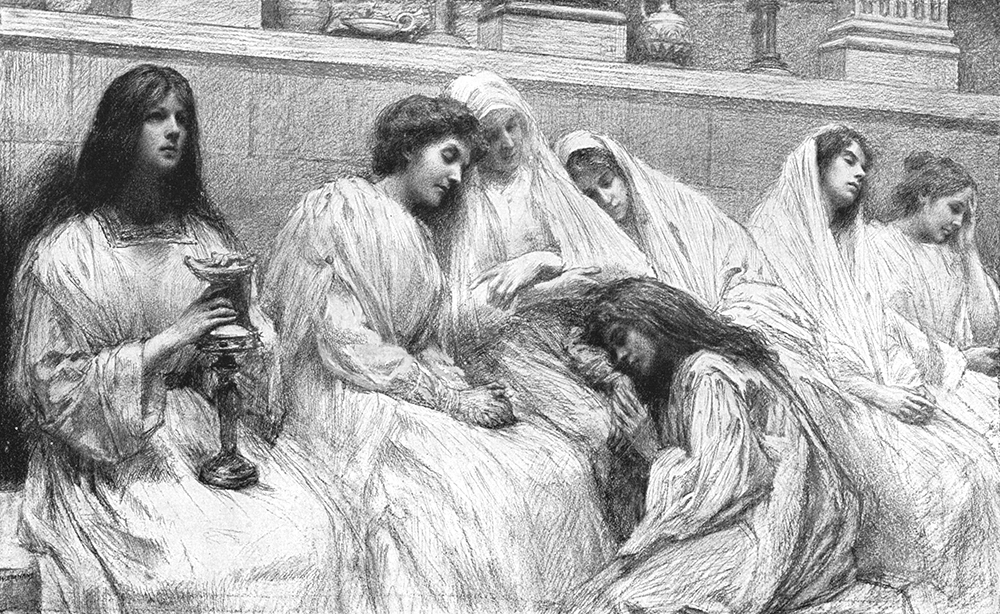
Art by Eugène Burnan

Your Heavy Load

Matthew 11:28-29, Amplified Bible

He is inviting us.

Jesus requests our presence in one simple statement, “come to Me.” This phrase must be our starting point. It’s how you begin daily. If you’re His disciple, it’s imperative that you obey. But this concept is nuanced, it has profound meanings.

“All who are weary.” Each of us carries a heavy load. Sin has weight, whether we believe it or not. When I start to see this, I really begin my discipleship. Apart from Jesus’ invitation I will try to carry this heaviness on my own. This is called “religion,” and it’s a bad thing.

“My guilt overwhelms me—
    it is a burden too heavy to bear.”

Psalm 38:4

“I will give you rest.” It’s His gift, given to each believer. It isn’t earned, you don’t deserve it. His heart is for you to “rest.” The original Greek word often means “to refresh, or to cease your work.” Every true disciple knows this, and understands that Jesus rather laying a terrible burden on us, takes it off.

We must understand our calling.

Another burden (His own burden), is now given to us. It’s Jesus’own weight shared with believers. But it’s a restful burden that gives joy and peace. There are no longer sweaty religious rules, but authentic rest. Real discipleship is now based on love, not duty.

To follow Him in obedience is the happy delight of every disciple. When you are in love with Him the rigors of obedience have little weight.

 Oswald Chambers

“For I am gentle and humble in heart,” is His nature. He always acts this way, it is who Jesus is. This is how He behaves to each of us. It becomes the very essence of how He relates to human beings, always gentle and completely humble. Sometimes we add things that obscure this, and we see Jesus in our own particular image. (Maybe that’s a way of defining idolatry?)

And finally--“and you will find rest for your souls.” Again, the Greek here is quite instructive: rest, “cessation of any motion, or labor.” My walk, following Him, isn’t working harder, but being in a joyful rest. God’s saints aren’t called to sweat, but walk in the sureness of the presence of Jesus inside them.

Life can be awfully hard. Trials come and we get overwhelmed.

The joyful rest is only a slice of what heaven will be like. If joy and peace are a wonder now, just you wait, our future holds promises of a continual awareness of Him in our new bodies. This fallen world will be completely remade. Sin, sadness and Satan will be no more.

“And me? I plan on looking you full in the face. When I get up, I’ll see your full stature and live heaven on earth.”

Psalm 17:15, MSG

The Shepherd’s Own Voice

John 10:1-5, ESV

 “Truly, truly, I say to you, he who does not enter the sheepfold by the door but climbs in by another way, that man is a thief and a robber. But he who enters by the door is the shepherd of the sheep. To him the gatekeeper opens. The sheep hear his voice, and he calls his own sheep by name and leads them out. When he has brought out all his own, he goes before them, and the sheep follow him, for they know his voice. A stranger they will not follow, but they will flee from him, for they do not know the voice of strangers.”

What joy can be found in the Shepherd’s care, and to hear his voice. Nothing really can match this wonder. We follow as he leads us. The voice is an integral part of this passage and the foundation of discipleship that is real.

Please understand: You really can’t walk with him unless you hear him. We belong to him. We’re his flock that he keeps and provides for.

And He knows our name!

That’s the intimacy found in these verses. We’re never forgotten and he will never overlook us. To think otherwise is slander and an attack on his present-day ministry. Jesus is our good shepherd. He always will be.

“Intimacy with God comes in whispers, not shouts.”

     Woodrow Kroll

He sometimes whispers, and yet this world can’t hear him (or they refuse to). To be perfectly honest, my ‘busy-ness’ silences Him. I suppose that the real issue isn’t with Him, but with myself.

“And after the earthquake, there was a fire, but the Lord was not in the fire. And after the fire, there was the sound of a gentle whisper.”

1 Kings 19:12

He doesn’t speak through a windstorm, earthquake, or fire. He chooses to speak very quietly, and that’s a problem for me. In the original Hebrew, the word “whisper” can be translated as “calm, something gentle.” He speaks this way if only we shut up for a little while.

If we are to recognize God’s voice, we must belong to Him. We hear His voice best when we spend time in Bible study and quiet prayer. The more time we spend intimately with God and His Word, the easier it is to recognize His voice and His leading in our lives. He’s always speaking, and we’re seldom listening.

The flock hears the shepherd, and it’s that voice that breaks through our cluttered-up life. We can hear, and it’s that communication that encourages us to walk through life—one day at a time. Just today. That’s all you must do.

There are so many other voices. Please dear one, you must ignore them.

So many are speaking, and so many want us to hear and follow them. But in reality, they want us to leave the Shepherd and his flock behind. But we can’t allow this, we must learn to listen to him alone.

alaskabibleteacher.com

Art by Eugène Burnan

Kissing His Feet

Luke 7:40-47

40 And Jesus answering said to him, “Simon, I have something to say to you.” And he answered, “Say it, Teacher.”

41 “A certain moneylender had two debtors. One owed five hundred denarii, and the other fifty. 42 When they could not pay, he cancelled the debt of both. Now which of them will love him more?” 43 Simon answered, “The one, I suppose, for whom he cancelled the larger debt.” And he said to him, “You have judged rightly.” 

 Then turning toward the woman he said to Simon, “Do you see this woman? I entered your house; you gave me no water for my feet, but she has wet my feet with her tears and wiped them with her hair. 45 You gave me no kiss, but from the time I came in she has not ceased to kiss my feet. 46 You did not anoint my head with oil, but she has anointed my feet with ointment. 

47 Therefore I tell you, her sins, which are many, are forgiven—for she loved much. But he who is forgiven little, loves little.”

I don’t mean to be blunt, but how much do you love Jesus? This parable looks at the heart of the forgiven believer, the person who has been incredibly forgiven for everything–all sins, past, present and future. And it’s here we see a woman whose heart is broken by her sin, and we see that she discovers Jesus’ grace, total forgiveness and tremendous mercy.

Jesus has been invited to Simon’s home.

He’s a Pharisee, “a pure one,” one who kept the Law. So far the Pharisees haven’t banded together to attack Jesus’ ministry. It seems that there were still some Pharisees who were true seekers of truth. But that’s about to change.

The text jumps right in and we see Jesus reclining at a table (the Jewish people didn’t use chairs–pillows were used instead.) At a feast like this people who weren’t officially invited could come in to stand in the back and listen in on the conversation. (How awkward.)

Suddenly a woman bursts into the room.

She’s described as “a woman of the city,” which is a code word for “a sinner, or a harlot.” (Let your imagination roll that one around.) She comes with a purpose, for she brings a jar of expensive perfume with her.

She knows what she must do.

The passage reveals that she’s on her knees, weeping on Jesus’ feet, and rubbing His feet with her hair, and pouring out the perfume. Only a harlot would undo her hair like this. She’s even kissing his feet!

She’s obviously a broken person—yet someone who knows who Jesus is.

Living in deep sin has completely destroyed her.

And at this point Simon is deeply offended, and probably embarrassed by what’s happening. But he also assumes that Jesus isn’t who he’s saying he is. “How dare does this man let an unclean person do this!” But Jesus understands everything. His parable is short and it’s a broadside directed at Simon.

The interpretation is obvious: the man who owes the most will love the most.

Jesus accentuates Simon’s breach of protocol. The Lord deftly explains the entire situation; Simon is busted. He’s put on the spot and Jesus has made his point. It’s all so obvious. The essence of the story is clear.

How much do you love the Master?

Have you really grasped how much of your sin that’s been forgiven, or maybe you’re a Simonite—someone who doesn’t quite accept God’s forgiveness? The Bible tells us repeatedly that no one is righteous. No one, and Scripture has a very low opinion of the righteousness of men.

Isaiah 64:6, KJV

The Hebrew word for “filthy” is extremely graphic.

I don’t want to offend, but it literally means “a menstruating cloth or rag.” It was something that a woman used before there was Tampax. How very clear and descriptive. Human righteousness is soiled and vulgar to God.

Will we receive God’s righteousness, or will we still try to walk in our righteous filth?

Forgiveness can come only from Him–there is no hesitation or shortage on His part. Our part is to come with loving submission and brokenness at Jesus’s feet, and to fully accept the forgiveness He offers by faith.

“Christianity happens when men and women accept with unwavering trust that their sins have been not only forgiven, but forgotten, washed away in the blood of the Lamb.”


― Brennan Manning, The Ragamuffin Gospel

alaskabibleteacher.com

The Extraordinary Breath of Jesus

“Jesus said to them again, “Peace be with you. As the Father has sent me, I also send you.” 22 After saying this, he breathed on them and said, “Receive the Holy Spirit. 23 If you forgive the sins of any, they are forgiven them; if you retain the sins of any, they are retained.”

John 20:21-23 (19-23)

This is the second “peace be with you” in this passage. So why the duplication of this peace proclamation? The disciples are sequestered and scared in the upper room (v. 19; and Luke 24:36. Having peace is being emphasized–the disciples were afraid of the Pharisees, but they were also undone by Jesus’ surprise visit.

Peace was definitely a precious commodity for them.

Jesus gives his disciples a mission to do, and they must be as ‘familiar’ with Jesus just as Jesus is with God. The disciples had followed him for three years–seeing incredible miracles, and hearing profound teaching, they’re ready, they just need power.

In track and field, there’s a relay race where a baton is passed from runner to runner, and maybe that’s how it’s working here? We see the same idea in John 17:18.

The baton has now been passed to the disciples.

The breath of the risen Jesus is necessary (and yes, he’s breathing.) What went down here, I don’t know exactly. But Jesus recognizes that his 12 followers will need this to do his work. Also, we might consider Adam in Genesis 2:7 where God’s breath brought him to life, which is pretty awesome when you think of the parallels.

The Holy Spirit energizes these men to do this new work.

The disciples were pretty much observers, but now they are to take up the ‘mantle’ of Jesus’ work. This is a definite duplication, which connects with the idea of one seed producing many others (John 12:24.) That’s how the Kingdom will come to people.

Verse 23 intrigues me. It seems that our life comes from the breath of Jesus. And it’s the Holy Spirit that gives both power and the authority that’s needed to function like Jesus. We now have the ability to pronounce forgiveness to the new believer, and yet that doesn’t seem a function of the Church today.

I wonder why this is so?

This entire passage is a real humdinger for Bible students. But it clearly declares the Churches new role as we follow in his footsteps. Disciples are to do exactly what Jesus does–with his breath and authority–filled with the Holy Spirit. We have a mission.

If we neglect these things we’re going to fall flat on our face.

“The work of Jesus for His disciples on resurrection Sunday gives an ongoing pattern for His work among His people. Jesus wants to continue this fourfold ministry of assurancemission, the Holy Spirit and authority to His people today.”

From David Guzik’s website

The Four Ways We Grow

Then he told them many things in parables, saying, “Consider the sower who went out to sow. As he sowed, some seed fell along the path, and the birds came and devoured them. Other seed fell on rocky ground where it didn’t have much soil, and it grew up quickly since the soil wasn’t deep. But when the sun came up, it was scorched, and since it had no root, it withered away.  Other seed fell among thorns, and the thorns came up and choked it. 

Still other seed fell on good ground and produced fruit: some a hundred, some sixty, and some thirty times what was sown. Let anyone who has ears listen.”

Luke 8:5-9

Jesus loved to tell stories. Each of them was packed with truth, and the people loved them. In verse 2, we see the popularity of Jesus–the people were entranced by our Lord. They followed him throughout his earthly ministry. Just imagine a preacher doing this today.

If you were his disciple back then, you had better get used to crowds.

This is all about receptivity to the Kingdom of God. It’s all about seed that is sown indiscriminately–the work of the sower isn’t assessing the ground conditions. He just throws out the insignificant seed. That’s his job, and he seems to do a bang-up job of it. He “broadcasts” the seed, reaching in his bag and spreading it evenly, and quickly.

This parable, believed to be one of his first, begins with the word, “Consider,” and really, isn’t that the needed quality one must have? In the original language it simply means, “to see.” But it’s also in the imperative–a command. Seeing isn’t really an option–may be a good word today would be, “Look!” (And using an exclamation mark!)

In some places the ground had been packed down, things were too hard. Others landed on soil, but it was only the slightest skim of dirt, which wasn’t enough to support any growth. And yet the third scattering made it into the thorns. So there was three different possibilities, which none were ideal.

But wait! There was a fourth.

Seed that landed right where it should–good soil, fertile, tilled, and ready. The first three were all wrong, but the parable isn’t given to find fault–no one was to blame. And certainly not the sower, he was merely doing what was necessary.

The parable is clearly meant to explain how the Kingdom enters our hearts.

Our lives are the soil, and we all react to the seed differently. Sometimes, there’s no response at all, and “birds” get their breakfast. Sometimes, it’s all rocky, and nothing can grow there. Some tried to grow, but thorns and thistles essentially got in the way.

There are always four responses to the words of Jesus.

There was a lot of people sitting on the beach, and all were listening. But Jesus knew deep down that his words would only touch 1 out of 4, and yet he kept sowing. He hoped for good soil, but that wasn’t a given.

In verses 9-15, Jesus had to explain this story to his disciples, who always did seem out-of-touch with these sorts of things. But I’m glad he did–Jesus, by interpreting this parable, gave us the keys that would unlock every one of his others. The seed represents God’s words. The soil is the condition of our hearts. My own heart listens and when the Word comes my heart responds in different ways. At any given time, the soil can be hard as a rock, or thorny

Jesus was never mystical or otherworldly, he didn’t cloak his words in imponderable mysteries like every other teacher longs to do. (Ego, mainly.) He didn’t want things to be an enigma, rather he wanted people to understand the ways and nature of God’s kingdom.

He wanted even the little children to get it–there were to be no secrets, only receptive hearts.

     Augustine

alaskabibleteacher.com

Finding the Light

“Indeed, we felt that we had received the sentence of death, so that we would not trust in ourselves but in God who raises the dead.”

2 Corinthians 1:9

To be chronically ill often means living with awful frustration. We can’t do what we want, we are ‘trapped’ by a disease we never asked for, and we’re held hostage by our minds and bodies. We once had a job– a career… and our time was occupied by that. Suddenly our lives are turned upside down.

We wanted something else, anything more than being very sick.

I once was a pastor of a small church here in Alaska. I also taught Gospels, several years in a local Bible Institute. I loved ministry very much. They defined my identity and gave me purpose. I enjoyed helping people and teaching the Word. I endeavored to be faithful in the ministry. And I hope I did.

With the sudden onset of a brain tumor, followed up by a diagnosis of severe depression, my life more or less exploded. I had extensive memory loss. I knew I had to step out of the ministry. I simply could not function. It was a hard thing to leave it behind. (And I still miss it.)

My depression grew even more profound with the stillborn death of our third child just 3 days before her delivery. Things suddenly ground to a standstill as my wife and I tried to process all of this. I guess I just couldn’t understand and more or less just shut down. I was angry at God. I spent months in bed, unable to function.

Some people were true jewels.

Others were more or less mean and uncaring. (I quickly learned how to take the good with the bad.) I suppose I should have understood, but things were so tangled up inside me that I couldn’t verbalize a thing. But God knew all about me. He loved and never judged.

The post-op recovery following the tumor was an ordeal, as I had to learn many things all over again. A few years later I ended up on disability; I was unable to work, and my symptoms were so unpredictable. I dealt with profound depression and a solid dose of paranoia and fear.

I learned that meds can help, but they can’t fix the problem.

Sometimes the isolation seemed worse than the pain. We wonder why this is happening to us, and we hear lies about our worthiness or God’s goodness. Our value to others seems to be scuttled by our illness. We can feel cursed, forgotten, crippled by God, or even worse. (Maybe even irrevocably lost?)

Satan craves our spiritual destruction, and he snares unsteady souls.

I admit I have been slow to learn this– but God brings good things out of the dark. I’m embarrassed by my personal lack of acquiring all of this. Now I’m starting to learn finally, and I want His words to reflect these truths.

“We now have this light shining in our hearts, but we ourselves are like fragile clay jars containing this great treasure. This makes it clear that our great power is from God, not from ourselves.”

2 Corinthians 4:7

This light will shine, and the treasure is found in clay vessels. Brokenness only means the treasure is now seen clearly. It’s important to note–jewels lose none of their value by being surrounded by broken clay. Our weaknesses are being turned into goodness, understanding, and love for our brothers and sisters.

Troubles of many varieties will pay us a visit. Count on it.

No matter what their nature, God holds his people in place while everything else is falling apart. But for the broken believer, there is another dimension; we will finally triumph. The tragedies we’ve had to endure only supplement our faith. We will stand– because He makes us stand.

“We are pressed on every side by troubles, but we are not crushed. We are perplexed, but not driven to despair. We are hunted down, but never abandoned. We get knocked down, but we are not destroyed.”

2 Corinthians 4:8-9

alaskabibleteacher.com

To Eat Yourself

A heart at peace gives life to the body, but envy rots the bones.

Proverbs 14:30

“Of the Seven Deadly Sins, anger [envy] is possibly the most fun. To lick your wounds, to smack your lips over grievances long past … to savor to the last toothsome morsel both the pain you are given and the pain you are giving back — in many ways it is a feast fit for a king. The chief drawback is that what you are wolfing down is yourself. The skeleton at the feast is you.”

Frederick Buechner

Some churches designate seven deadly sins that people practice. They are pride, greed, wrath, envy, lust, gluttony and sloth. These are also known as the “cardinal” sins. Now this type of classification or grouping seems important and useful to some. I want to examine “envy.”

Envy is a sin that each of us understands.

Envy can be defined as “a feeling of discontented or resentful longing by someone else’s possessions, or qualities.”

(Wikipedia)

It made its entrance with Cain and Abel and the first murder. We see that Cain’s offering was rejected by God, (apparently He doesn’t like veggies). Also, keep in mind that part of Adam’s sin was that the ground was cursed. And Cain had tilled and planted from a field that had been cursed already. (Genesis 4)

But Abel offered up a “blood sacrifice” which God saw as acceptable. That drove Cain nuts. He was so envious that he murdered Abel. He couldn’t handle rejection, and seeing that his brother was extolled and honored was more that he could handle.

Envy became anger which led to murder.

It might come as a surprise to you but envy is why the Pharisees murdered Jesus, “For he knew that it was out of envy that they had delivered him up.” Matthew 27:18

We’re warned repeatedly by New Testament writers to renounce the sin of envy.

“But if you harbor bitter envy and selfish ambition in your hearts, do not boast about it or deny the truth. For where you have envy and selfish ambition, there you find disorder and every evil practice. Let us not become conceited, provoking one another, envying one another.”

James 3:14, 16

I realize I can easily become an envier. (That’s a word, I looked it up.)

Selfish ambition is directly linked in the book of James to envy.

The Greek phrase for selfish ambition is often used to describe one who is full of envy. Incidentally, the word is also used as one “who is deceitfully promoting himself for public office.” (Too often I see myself as “President Bryan.”)

A Prayer for Freedom

Holy Father, I want to bind that spirit of envy that’s attempting to eat up my life. I curse it out completely in the name of Jesus, for it is more than cruelty and overwhelming fury.

I renounce it completely.You are all I want and need. I only want to be your child. I renounce envy.

Please remove it now, mighty God, along with the hatred, anger, fear, and insecurities that fuel it. In Jesus’ mighty name, Amen.

“Whenever you attempt a good work you will find other men doing the same kind of work, and probably doing it better. Envy them not.”

     Henry Drummond