So What Happened to the Church in Ephesus?

God speaks to the Church of Ephesus:

But I have this against you, that you have abandoned the love you had at first. Remember therefore from where you have fallen; repent, and do the works you did at first. If not, I will come to you and remove your lampstand from its place, unless you repent.

“Anyone with ears to hear must listen to the Spirit and understand what he is saying to the churches.

Revelation 2:4-5, 7

I ministered full-time in San Francisco, preaching and teaching in a very difficult place for three years. The sin and degradation of that city were extremely difficult. But I suppose ministering in the city of Ephesus was also quite challenging. Like San Francisco, it was full of false idols, immorality, and much sinfulness. I encountered much of this. I’ve learned firsthand about evil powers in high places.

Paul knows what the Ephesians are up against, there is an organized evil in Ephesus that could very well destroy them. Paul is on his way to Jerusalem, and in order not to miss his boat, he requests that the elders of Ephesus meet him near his port. He has an urgent warning for them. He says “goodbye” with tears, and deep concern.

“So guard yourselves and God’s people. Feed and shepherd God’s flock—his church, purchased with his own blood—over which the Holy Spirit has appointed you as leaders. 29 I know that false teachers, like vicious wolves, will come in among you after I leave, not sparing the flock. 30 Even some men from your own group will rise up and distort the truth in order to draw a following. 

31 Watch out! Remember the three years I was with you—my constant watch and care over you night and day, and my many tears for you.’

Acts 20:28-31

Keep in mind that Paul lived in Ephesus. He taught the church daily and prayed often for them for three years. Also, Apollos (a tremendous evangelist) would become a disciple there. Also, Timothy based his ministry in Ephesus.

There seems to be a slow drift away from the first love for Jesus and slippage into an unacceptable doctrine. During my own time in ministry in San Francisco, there always seemed to be resistance there, constant spiritual pressure on any attempt to stay faithful and live in purity.

In Revelation 2 an angel speaks to the church in Ephesus. His assessment wasn’t kind but yet it was accurate.

A papyrus fragment from the book of Revelation chapter 2 written to the Ephesians by John the Apostle.

Maintaining the first love in this center of wickedness and depravity wasn’t easy.

Paul was in a Roman prison when he wrote to the Ephesians. He put pen to papyrus to write down and to show God’s purpose for them. He taught and preached, he knew that they must know the intentions of God for their lives.

In Acts 20 he states a warning to the elders of the church in Ephesus. They must be aware. And for the most, they stayed true, and yet they were missing a vital and critical truth. In Revelation 2 they are nailed and we must understand. They had somehow down the line they had lost their “first love.” This happens, regularly.

Jesus must be primary to the true walk of the real believer–this isn’t optional.

This is the critical definition of an authentic Christian. We must love Him first. The Ephesians had faithfully protected against heresy. But we discover good theology without real love isn’t acceptable.

We’re called to love Him first of all.

Living in a wicked world demands a love that exceeds the norm that isn’t acceptable to “polite society.” We must go on to love Him first. What we think we know isn’t going to be enough. We must love Him. Him!

Is Jesus our first love? And what does that really mean anyway?

You really must figure this out for yourself. But, the first step is humility.

The ‘Scum’ and the Heart of Jesus

“But when some of the Jewish religious leaders saw him eating with these men of ill repute, they said to his disciples, “How can he stand it, to eat with such scum?”

Mark 2:16

There are four different types of people listed in Mark 2. This is an amazing passage that really does need a closer look. We really do must understand what Jesus did, and what He insisted we do as followers. Is there room for that? There’s something here in verse 16 which we must think about:

  • Jesus, (He’s happily eating and listening)
  • the Pharisees, (the bad guys with religious issues)
  • the disciples, (a mixed bunch of nobodies)
  • the scum, (tax-collectors, harlots, and all-around rascals)

A question is asked by the Pharisees to the disciples–perhaps these religious leaders want Jesus’ followers to see the awful ramifications of the Lord’s conduct. Perhaps the Pharisees wanted to confuse these followers. A divide and conquer strategy?

Jesus has chosen to be with outcasts.

And I believe this was a deliberate decision. Jesus wanted to fellowship, but the religious leaders were not invited. Too bad.

He is eating with these “men of ill repute.” The old KJV brings out a different take, “How is it that he eateth and drinketh with publicans and sinners?” Now, this is fascinating.

I’m encouraged by His decision. It tells me that I still have hope.

“The cumulative testimony of the four Gospels is that when Jesus Christ sees the fallenness of the world all about him, his deepest impulse, his most natural instinct, is to move toward that sin and suffering, not away from it.”


― Dane C. Ortlund, Gentle and Lowly: The Heart of Christ for Sinners and Sufferers

Do You Really Love the Master?

How much do you love Jesus? This parable looks at the heart of the believer, the person who has been incredibly forgiven of everything–past, present and future. And it’s here we see a woman whose heart is broken by her sin, and she discovers Jesus’ grace, and tremendous mercy.

“A certain moneylender had two debtors. One owed five hundred denarii, and the other fifty. 42 When they could not pay, he cancelled the debt of both. Now which of them will love him more?” 43 Simon answered, “The one, I suppose, for whom he cancelled the larger debt.” And he said to him, “You have judged rightly.” 

44 “Then turning toward the woman he said to Simon, “Do you see this woman? I entered your house; you gave me no water for my feet, but she has wet my feet with her tears and wiped them with her hair. 45 You gave me no kiss, but from the time I came in she has not ceased to kiss my feet. 46 You did not anoint my head with oil, but she has anointed my feet with ointment.” 

47 “Therefore I tell you, her sins, which are many, are forgiven—for she loved much. But he who is forgiven little, loves little.”

Luke 7:40-47

Jesus has been invited to Simon’s home. He’s a Pharisee, and at this point they haven’t quite banded together to attack Jesus, it seems that there were still some Pharisees who were true seekers.

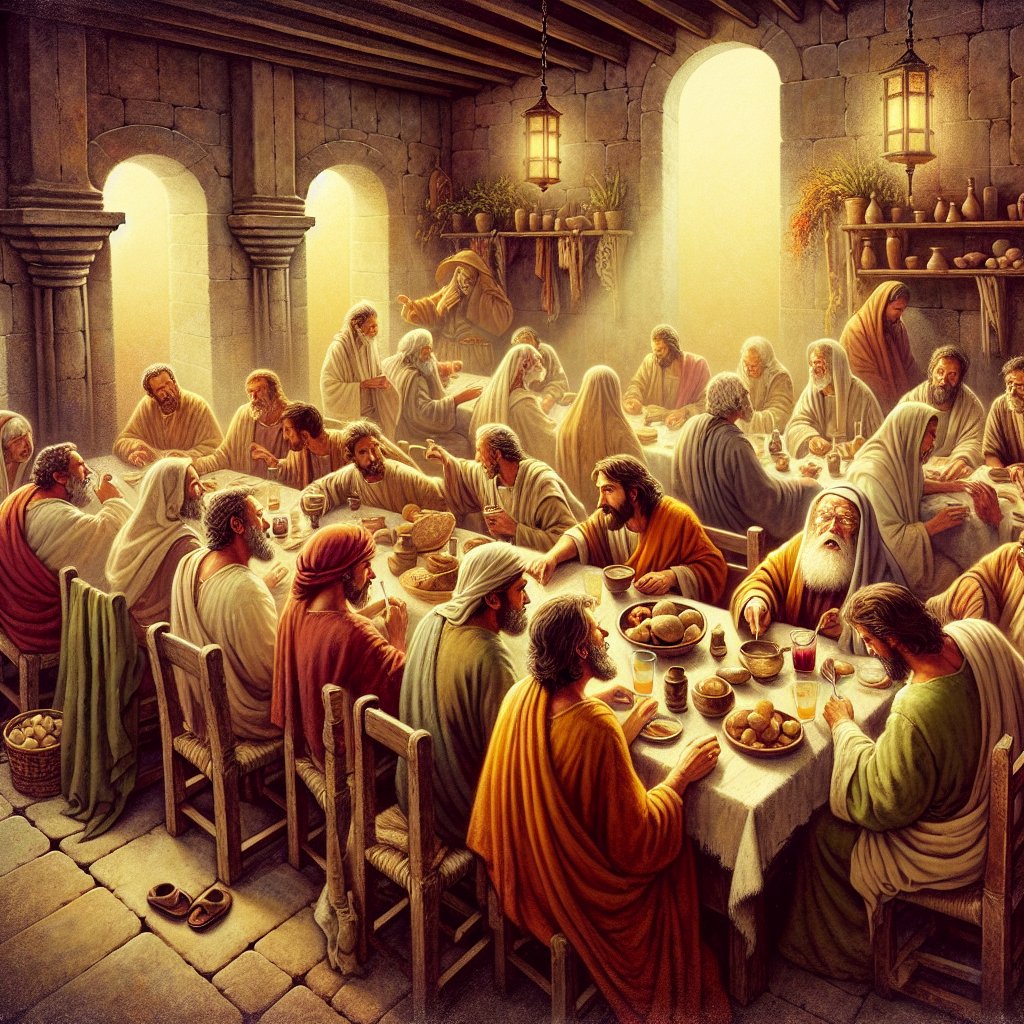
The text jumps right in and we see Jesus reclining at a table (the Jewish people didn’t use chairs–pillows were used instead.) At a feast like this people who weren’t officially invited could come in to stand in the back and listen in on the conversation. (That seems awkward.)

Suddenly a woman enters the room.

She’s described as “a woman of the city,” which is a code word for “a sinner, or a harlot.” (Let your imagination roll that one around.) She comes with a definite purpose, for she brings a jar of quite expensive perfume with her.

The passage reveals that she’s on her knees, weeping on Jesus’ feet, and rubbing her tears with her hair, and pouring out the perfume. She’s kissing his feet. She’s obviously a broken person—someone who knows who Jesus is, and who understands who she is, and how deep sin has destroyed her.

At this point Simon is deeply offended, and probably embarrassed by what’s happening. But he also assumes that Jesus isn’t who he’s saying he is. “How dare does this man let an unclean person even touch Him!” But Jesus understands everything. His parable is short (just two verses) and it’s directed at Simon; and it’s a no-brainer.

The interpretation is obvious: the man who owes the most will love the most.

Jesus accentuates Simon’s breach of protocol. The Lord deftly explains the entire situation and Simon is busted. He’s put on the spot and Jesus has made his point. It’s all so obvious. The essence of the story is clear. How much do you love the Master?

Do you fully fathom how much sin Jesus has forgiven you?

(Or maybe you’re a Simonite?)

Perhaps you’re someone who doesn’t quite accept what’s real? The Bible tells us repeatedly that no one is righteous. No one. Scripture has a very low opinion of the righteousness of men. (That should shatter your thinking.)

“But we are all as an unclean thing, and all our righteousnesses are as filthy rags; and we all do fade as a leaf; and our iniquities, like the wind, have taken us away.”

Isaiah 64:6, KJV

The Hebrew word for “filthy rags” is extremely graphic–literally it means “a menstruating cloth.” It was something that a woman used before Tampax came along. How very descriptive. Do we even have the slightest idea what that means? Are our good deeds that bad?

Yes they are. Isaiah announces that’s exactly how God sees our best attempts to find acceptance apart from grace. It often seems we try to please Him by doing the best we can, but that isn’t sufficient. We always fall short and mess up.

How does understanding this change our discipleship? I’ll let you be the judge on this on this one.

“He loved us not because we are lovable, but because He is love.”

C.S. Lewis

Listening to Brennan Manning

Here are several quotes written by Brennan Manning. They’re definitely thought-provoking and should be prayed through. I think they’re worth considering. If you like them great, if not that’s ok too.

“The gospel declares that no matter how dutiful or prayerful we are, we can’t save ourselves. What Jesus did was sufficient.”

“When we wallow in guilt, remorse, and shame over real or imagined sins of the past, we are disdaining God’s gift of grace.”

“God loves you unconditionally, as you are, and not as you should be because nobody is as they should be.”

“I could more easily contain Niagara Falls in a teacup than I can comprehend the wild, uncontainable love of God.”

“In my experience, self-hatred is the dominant malaise crippling Christians and stifling their growth in the Holy Spirit.”

“The splendor of a human heart that trusts it is loved unconditionally gives God more pleasure than Westminster Cathedral, the Sistine Chapel, Beethoven’s “Ninth Symphony”, Van Gogh’s “Sunflowers”, the sight of 10,000 butterflies in flight, or the scent of a million orchids in bloom. Trust is our gift back to God, and he finds it so enchanting that Jesus died for love of it.”

“Those who have the disease called Jesus will never be cured.”

“The men and women who are truly filled with light are those who have gazed deeply into the darkness of their own imperfect existence.”

“God loves us as we are…not as we ought to be, because we are never going to be as we ought to be.”

“The ragamuffin gospel reveals that Jesus forgives sins, including the sins of the flesh; that He is comfortable with sinners who remember how to show compassion; but that He cannot and will not have a relationship with pretenders in the Spirit.”

“The North American Church is at a critical juncture. The gospel of grace is being confused and compromised by silence, seduction, and outright subversion. The vitality of the faith is being jeopardized. The lying slogans of the fixers who carry religion like a sword of judgment pile up with impunity. Let ragamuffins everywhere gather as a confessing Church to cry out in protest. Revoke the licenses of religious leaders who falsify the idea of God. Sentence them to three years in solitude with the Bible as their only companion.”

“When I get honest, I admit I am a bundle of paradoxes. I believe and I doubt, I hope and get discouraged, I love and I hate, I feel bad about feeling good, I feel guilty about not feeling guilty. I am trusting and suspicious. I am honest and I still play games. Aristotle said I am a rational animal; I say I am an angel with an incredible capacity for beer.”

alaskabibleteacher.com

Your Heavy Load

Matthew 11:28-29, Amplified Bible

He is inviting us.

Jesus requests our presence in one simple statement, “come to Me.” This phrase must be our starting point. It’s how you begin daily. If you’re His disciple, it’s imperative that you obey. But this concept is nuanced, it has profound meanings.

“All who are weary.” Each of us carries a heavy load. Sin has weight, whether we believe it or not. When I start to see this, I really begin my discipleship. Apart from Jesus’ invitation I will try to carry this heaviness on my own. This is called “religion,” and it’s a bad thing.

“My guilt overwhelms me—
    it is a burden too heavy to bear.”

Psalm 38:4

“I will give you rest.” It’s His gift, given to each believer. It isn’t earned, you don’t deserve it. His heart is for you to “rest.” The original Greek word often means “to refresh, or to cease your work.” Every true disciple knows this, and understands that Jesus rather laying a terrible burden on us, takes it off.

We must understand our calling.

Another burden (His own burden), is now given to us. It’s Jesus’own weight shared with believers. But it’s a restful burden that gives joy and peace. There are no longer sweaty religious rules, but authentic rest. Real discipleship is now based on love, not duty.

To follow Him in obedience is the happy delight of every disciple. When you are in love with Him the rigors of obedience have little weight.

 Oswald Chambers

“For I am gentle and humble in heart,” is His nature. He always acts this way, it is who Jesus is. This is how He behaves to each of us. It becomes the very essence of how He relates to human beings, always gentle and completely humble. Sometimes we add things that obscure this, and we see Jesus in our own particular image. (Maybe that’s a way of defining idolatry?)

And finally--“and you will find rest for your souls.” Again, the Greek here is quite instructive: rest, “cessation of any motion, or labor.” My walk, following Him, isn’t working harder, but being in a joyful rest. God’s saints aren’t called to sweat, but walk in the sureness of the presence of Jesus inside them.

Life can be awfully hard. Trials come and we get overwhelmed.

The joyful rest is only a slice of what heaven will be like. If joy and peace are a wonder now, just you wait, our future holds promises of a continual awareness of Him in our new bodies. This fallen world will be completely remade. Sin, sadness and Satan will be no more.

“And me? I plan on looking you full in the face. When I get up, I’ll see your full stature and live heaven on earth.”

Psalm 17:15, MSG

Needing His Cross Daily

We live in this place.

I confess that peace has never been really high on my list. Love, joy, kindness, and even goodness are clear priorities. Peace… not so much. Until I find out it’s not there. And then I get frantic by its absence and scrambling look for it with bewilderment.

Sometimes I don’t understand why God still loves me. At times like this anxiety eats at me. I beat myself up by my last failure. The guilt of my latest sin grows until it looms larger than the blood that saved me. Sometimes I suppose, religious people seem to have the most neurosis.

I’m afraid that we are taking the ‘present tense’ out of the Gospel.

The past tense is preferable to us as we find it easier to ‘manage’ our Christian life. We like to make check marks on our list. [Church attendance– check. Baptism– check. Bible study– check.] I think it gives me a definite feeling of ‘maturity.’

But these things matter little without intimacy with Jesus Christ.

I certainly haven’t arrived, and it seems at times I’m still the hideous sinner I always was. I cannot pretend otherwise, even with a spiritual truckload of cosmetics at my disposal. I know, I’ve tried. And I’m still ‘ugly.’ I do know forgiveness, and I do walk in its wonderful light (by grace).

I read Luther 30 years ago. (And Bonhoeffer would say something similar.)

“When our Lord and Master Jesus Christ said, ‘Repent,’ he willed the entire life of believers to be one of repentance.”

Martin Luther

This is the first of his 95 Theses nailed to the door of the Castle Church in Wittenberg, Germany. And there is a present tense here we can’t ignore about these declarations. I don’t just repent over smoking, beer drinking, fornication, or hypocrisy, once and done. But my entire way of living is to be one of repenting. To repent everyday opens the door to a true grace-filled discipleship.

“All of the Christian life is repentance. Turning from sin and trusting in the good news that Jesus saves sinners aren’t merely a one-time inaugural experience but the daily substance of Christianity. The gospel is for every day and every moment. Repentance is to be the Christian’s continual posture.”

John Piper

Luther’s last words, on his deathbed, was found written on a scrap of paper stuck in his coat, “We are beggars! This is true.” Even after thirty years, he was only echoing his first thesis.

It seems dear ones, we are to live at the foot of the cross.

Kissing His Feet

Luke 7:40-47

40 And Jesus answering said to him, “Simon, I have something to say to you.” And he answered, “Say it, Teacher.”

41 “A certain moneylender had two debtors. One owed five hundred denarii, and the other fifty. 42 When they could not pay, he cancelled the debt of both. Now which of them will love him more?” 43 Simon answered, “The one, I suppose, for whom he cancelled the larger debt.” And he said to him, “You have judged rightly.” 

 Then turning toward the woman he said to Simon, “Do you see this woman? I entered your house; you gave me no water for my feet, but she has wet my feet with her tears and wiped them with her hair. 45 You gave me no kiss, but from the time I came in she has not ceased to kiss my feet. 46 You did not anoint my head with oil, but she has anointed my feet with ointment. 

47 Therefore I tell you, her sins, which are many, are forgiven—for she loved much. But he who is forgiven little, loves little.”

I don’t mean to be blunt, but how much do you love Jesus? This parable looks at the heart of the forgiven believer, the person who has been incredibly forgiven for everything–all sins, past, present and future. And it’s here we see a woman whose heart is broken by her sin, and we see that she discovers Jesus’ grace, total forgiveness and tremendous mercy.

Jesus has been invited to Simon’s home.

He’s a Pharisee, “a pure one,” one who kept the Law. So far the Pharisees haven’t banded together to attack Jesus’ ministry. It seems that there were still some Pharisees who were true seekers of truth. But that’s about to change.

The text jumps right in and we see Jesus reclining at a table (the Jewish people didn’t use chairs–pillows were used instead.) At a feast like this people who weren’t officially invited could come in to stand in the back and listen in on the conversation. (How awkward.)

Suddenly a woman bursts into the room.

She’s described as “a woman of the city,” which is a code word for “a sinner, or a harlot.” (Let your imagination roll that one around.) She comes with a purpose, for she brings a jar of expensive perfume with her.

She knows what she must do.

The passage reveals that she’s on her knees, weeping on Jesus’ feet, and rubbing His feet with her hair, and pouring out the perfume. Only a harlot would undo her hair like this. She’s even kissing his feet!

She’s obviously a broken person—yet someone who knows who Jesus is.

Living in deep sin has completely destroyed her.

And at this point Simon is deeply offended, and probably embarrassed by what’s happening. But he also assumes that Jesus isn’t who he’s saying he is. “How dare does this man let an unclean person do this!” But Jesus understands everything. His parable is short and it’s a broadside directed at Simon.

The interpretation is obvious: the man who owes the most will love the most.

Jesus accentuates Simon’s breach of protocol. The Lord deftly explains the entire situation; Simon is busted. He’s put on the spot and Jesus has made his point. It’s all so obvious. The essence of the story is clear.

How much do you love the Master?

Have you really grasped how much of your sin that’s been forgiven, or maybe you’re a Simonite—someone who doesn’t quite accept God’s forgiveness? The Bible tells us repeatedly that no one is righteous. No one, and Scripture has a very low opinion of the righteousness of men.

Isaiah 64:6, KJV

The Hebrew word for “filthy” is extremely graphic.

I don’t want to offend, but it literally means “a menstruating cloth or rag.” It was something that a woman used before there was Tampax. How very clear and descriptive. Human righteousness is soiled and vulgar to God.

Will we receive God’s righteousness, or will we still try to walk in our righteous filth?

Forgiveness can come only from Him–there is no hesitation or shortage on His part. Our part is to come with loving submission and brokenness at Jesus’s feet, and to fully accept the forgiveness He offers by faith.

“Christianity happens when men and women accept with unwavering trust that their sins have been not only forgiven, but forgotten, washed away in the blood of the Lamb.”


― Brennan Manning, The Ragamuffin Gospel

alaskabibleteacher.com

I Couldn’t Follow Him

Mark 10:17-22

As he was starting out on a trip, a man came running to him and knelt down, and asked, “Good Teacher, what must I do to get to heaven?”

18 “Why do you call me good?” Jesus asked. “Only God is truly good! 19 But as for your question—you know the commandments: don’t kill, don’t commit adultery, don’t steal, don’t lie, don’t cheat, respect your father and mother.”

20 “Teacher,” the man replied, “I’ve never once broken a single one of those laws.”

21 Jesus felt genuine love for this man as he looked at him. “You lack only one thing,” he told him; “go and sell all you have and give the money to the poor—and you shall have treasure in heaven—and come, follow me.”

22 Then the man’s face fell, and he went sadly away, for he was very rich.

My name is inconsequential. I suppose all you must know of me is I tried to keep God’s Law and that I was very wealthy. Many believed that being rich was evidence that God approved of me. Of that, I wasn’t too sure. I kept the Law out of fear I suppose, and at times I just knew it wasn’t quite enough.

As I studied I began to realize that riches weren’t going to make me righteous. There was enough Scripture in me to let me know that it wasn’t enough. The prophets, especially Isaiah spoke about the deadliness of wealth, but there was that one verse in Proverbs that really disturbed me:

“Your riches won’t help you on Judgment Day; only righteousness counts then.”

(Proverbs 11:4.)

This verse (and all of the others) were the cause of many a sleepless night.

I was tormented by the reality of standing before God with nothing but my money to cover me. Coming under God’s righteous judgment haunted me. I thought of it day and night. I was terrified of being damned. My own righteousness wasn’t enough, and I knew it.

I heard about Jesus (and who hasn’t), and some were boldly claiming that he was the Messiah. He was at least a wonderful teacher and many said he worked powerful miracles, and perhaps he had answers for me. I hoped so, but I needed to know. It was my questions that drove me to find him.

And finding him was easy–I just followed the crowd.

I got ahead of everybody. I knelt in his path and waited. I must know what he thought I should do. When he stood before me I asked the question that had haunted me my whole life–“Good Teacher, what must I do to get eternal life?”

Jesus looked right at me. I knew deep down that he loved me.

But oh those words, his words really disturbed me. He told me that I only lacked one thing, that I must sell everything and distribute the money to the poor. Only by doing that would I discover riches in heaven. And only then could I truly follow him.

But that was the thing I couldn’t do.

It was my idol, my golden calf, and it was a sacrifice that I could never make.

I’ve come to realize now, over my many years, that when I do finally stand before God, I will have nothing to save me. Jesus invited me to follow, and I couldn’t and I didn’t.

And that my friend meant I would die in my sin.

“For what shall it profit a man, if he shall gain the whole world, and lose his own soul?”

Mark 8:36, KJV

alaskabibleteacher.com

Finding the Light

“Indeed, we felt that we had received the sentence of death, so that we would not trust in ourselves but in God who raises the dead.”

2 Corinthians 1:9

To be chronically ill often means living with awful frustration. We can’t do what we want, we are ‘trapped’ by a disease we never asked for, and we’re held hostage by our minds and bodies. We once had a job– a career… and our time was occupied by that. Suddenly our lives are turned upside down.

We wanted something else, anything more than being very sick.

I once was a pastor of a small church here in Alaska. I also taught Gospels, several years in a local Bible Institute. I loved ministry very much. They defined my identity and gave me purpose. I enjoyed helping people and teaching the Word. I endeavored to be faithful in the ministry. And I hope I did.

With the sudden onset of a brain tumor, followed up by a diagnosis of severe depression, my life more or less exploded. I had extensive memory loss. I knew I had to step out of the ministry. I simply could not function. It was a hard thing to leave it behind. (And I still miss it.)

My depression grew even more profound with the stillborn death of our third child just 3 days before her delivery. Things suddenly ground to a standstill as my wife and I tried to process all of this. I guess I just couldn’t understand and more or less just shut down. I was angry at God. I spent months in bed, unable to function.

Some people were true jewels.

Others were more or less mean and uncaring. (I quickly learned how to take the good with the bad.) I suppose I should have understood, but things were so tangled up inside me that I couldn’t verbalize a thing. But God knew all about me. He loved and never judged.

The post-op recovery following the tumor was an ordeal, as I had to learn many things all over again. A few years later I ended up on disability; I was unable to work, and my symptoms were so unpredictable. I dealt with profound depression and a solid dose of paranoia and fear.

I learned that meds can help, but they can’t fix the problem.

Sometimes the isolation seemed worse than the pain. We wonder why this is happening to us, and we hear lies about our worthiness or God’s goodness. Our value to others seems to be scuttled by our illness. We can feel cursed, forgotten, crippled by God, or even worse. (Maybe even irrevocably lost?)

Satan craves our spiritual destruction, and he snares unsteady souls.

I admit I have been slow to learn this– but God brings good things out of the dark. I’m embarrassed by my personal lack of acquiring all of this. Now I’m starting to learn finally, and I want His words to reflect these truths.

“We now have this light shining in our hearts, but we ourselves are like fragile clay jars containing this great treasure. This makes it clear that our great power is from God, not from ourselves.”

2 Corinthians 4:7

This light will shine, and the treasure is found in clay vessels. Brokenness only means the treasure is now seen clearly. It’s important to note–jewels lose none of their value by being surrounded by broken clay. Our weaknesses are being turned into goodness, understanding, and love for our brothers and sisters.

Troubles of many varieties will pay us a visit. Count on it.

No matter what their nature, God holds his people in place while everything else is falling apart. But for the broken believer, there is another dimension; we will finally triumph. The tragedies we’ve had to endure only supplement our faith. We will stand– because He makes us stand.

“We are pressed on every side by troubles, but we are not crushed. We are perplexed, but not driven to despair. We are hunted down, but never abandoned. We get knocked down, but we are not destroyed.”

2 Corinthians 4:8-9

alaskabibleteacher.com

Will You Give It Up?

Today I’m thinking about the rich young ruler in Matthew 19:16-26. The passage is tragic and disturbing. These verses detail an encounter with Jesus by a man who couldn’t give up his wealth. He could not become a disciple.

“When the young man heard this he went away sorrowful, for he had great possessions.”

I would like to suggest something.

Perhaps riches aren’t the real point? Yes, I definitely believe that having wealth is inherently dangerous to wannabe disciples; it’s what this passage is all about. And it’s obvious that this man couldn’t give up his money to follow Jesus. But what if the issue for us isn’t about personal wealth; what if it’s envy, lust, selfishness or pride?

Sinful behavior of any kind effectively blocks the call and purpose of our lives.

No matter what it is. No matter what sin that stands in the way of true discipleship. Yes, it could be wealth. But it may be 1000 other sins (take your pick, there’s plenty). Hebrews 12 tells us that there is “the sin that so easily ensnares us.” Perhaps there is that one particular sin is one that traps us, over and over?

Jesus puts His hand on our lives, He calls us to love Him supremely. I like to think that loving Jesus is our energy source–He’s the nuclear core of our discipleship. His presence gives us the power to live and love. A sustained first love for Jesus propels us into the true reason of a disciple’s existence.

Perhaps it’s a daily surrender? Sin must be renounced every day. Jesus must always be the disciple’s first choice.

My most cherished sin would destroy me if it wasn’t for His grace and kindness.

Wealth, of course was this rich, young ruler’s sin. But don’t forget that there are many issues we could add. Lots of different sins that are getting in the way of being an actual follower. It’s a choice, and God’s power is always ready for you.

So who or what do we love most?

Whoever loves father or mother more than me is not worthy of me, and whoever loves son or daughter more than me is not worthy of me.”

Matthew 10:37, ESV