Under the Knife

John 15:2, ESV

 “Dead wood is worse than fruitlessness, for dead wood can harbor disease and decay…God removes the dead wood from his church and disciplines the life of the believer so that it is directed into fruitful activity.”

Merrill C. Tenney

It takes a sharp eye and a sharper knife to do the Father’s work of cutting.  He slices to the quick, and all that is not useful falls to the ground.  The vine must produce grapes, and every bit of “grape-energy” needs to be used productively. Fruitlessness will be cursed, sterility is condemned. This is a hard choice to make.

I want to encourage you though–fruitless believers can possibly become fruitful ones. 

Understand, the vine dresser isn’t attacking the vine with his knife.  He is not malicious or vengeful.  All that He does is for the good of the vine.  He is motivated to produce fruit.  That is what He thinks about as he cuts away the dead branches.

Pruning and fruit are concepts that we vacillate over, some days we understand and other days we don’t.  After over 40 years, I’ve heard every “John 15 sermon” known to man.  And most of the time I turn down my spiritual hearing aid. That is tragic–I listen, but I don’t listen.

I need to grapple with this imagery.  If I don’t, bad things are bound to happen.

For years I have asked God to “show me His ways.” I’d like to believe that this understanding of pruning has changed me.  I would like to think that I have attained a clearer view of wisdom.  This pruning business is all well and good.  But being sanctified by the knife is decidedly unattractive and uncomfortable.

I grew up in the northwoods of Wisconsin and wondered if the trees that were designated with a ‘red X’ understood that they were the ones to be cut down by the lumbermen. I wondered if these trees that were marked with spray paint understood what was up? (Maybe they felt special with their new found prestige?)

You will be pruned!

I completely and absolutely declare this to you. (It’s one of those “thus says the Lord” moments.) Pieces of your life are earmarked to be lopped off. You will probably not understand why and you will chafe at what is coming.

The Christian life is as much about subtraction as it’s about addition.

He will cut you and you’ll think you’re dying. But I assure you, Jesus loves you, and all that He does is for your good. He trims you to bring you true life.

There is simply no other way He can work.

“And if it be painful to bleed, it is worse to wither. Better be pruned to grow than cut up to burn.”

John Trapp

The Absolute Danger in Exalting Yourself

Now he told a parable to those who were invited, when he noticed how they chose the places of honor, saying to them, “When you are invited by someone to a wedding feast, do not sit down in a place of honor, lest someone more distinguished than you be invited by him, and he who invited you both will come and say to you, ‘Give your place to this person,’ and then you will begin with shame to take the lowest place. 

10 But when you are invited, go and sit in the lowest place, so that when your host comes he may say to you, ‘Friend, move up higher.’ Then you will be honored in the presence of all who sit at table with you. 11 For everyone who exalts himself will be humbled, and he who humbles himself will be exalted.”

Luke 14:7-11, ESV

Choose your seat carefully. In Jesus’ day, there was a definite seating order to a wedding feast. It wasn’t first come, first served. There was a strict protocol, where one’s importance mattered.

Honored people got honorable seats–close to the front as possible. Average people got average spots; but no one wanted be at the bottom, having to sit at the “kids table.”

Jesus was watching, and he what he saw was a spiritual principle of his Kingdom.

Jesus often teaches us out of the things we encounter.

Truth often hits us from those things we actually see. If you want to know what God is doing in your life, all you need to do is look around at the practical things, and start to see the spiritual lessons inside them. We learn from real-life. That’s how he often teaches us, he combines the Word with what we’re experiencing.

Our natural inclination is to move higher up.

We think that we’re deserving, and so we take our rightful positions. That’s the way humans think. We all want to sit in the best possible place, and so we end up wheedling our way up front. We can fall into the subtle trap of self-promotion. But that’s not how discipleship works.

Jesus corrects, advising us to take the lowest place.

I think verse 11 is the key to figuring out this seating arrangement. We’re starting to see a physical situation become a spiritual lesson. There’s much to learn. Here’s verse 11 in the Amplified version:

For everyone who exalts himself will be humbled [before others], and he who habitually humbles himself (keeps a realistic self-view) will be exalted.”

Luke 14:11

This particular translation injects some realism into our lives, especially in how we see ourselves. It’s quite foundational. It lays down a principle that is always true in his Kingdom (1 Peter 5:6). If we don’t accept and implement this, we’ll suffer a definite weakness in our discipleship. It stunts the growth of many believers. And that is tragic.

The whole scene lays out how life in the spirit really works, and it seems paradoxical.

Our human logic asserts that deliberately choosing the lesser is foolish, things really don’t work that way. We think, (falsely,) that we’ll only advance by asserting ourselves. But Jesus, quite aptly, clarifies the ways of the Kingdom.

True maturity will only come if we decide to take the lowest place.

James 4:10

alaskabibleteacher.com

You Just Won the Lottery!

Matthew 13:44

From rags to riches. We like that kind of story, the newspaper boy turned into a publisher, C.E.O. This parable, only a single verse is almost the same thing. A poor man is walking through a field and viola! He finds a treasure chest, and it’s packed full of golden coins, diamonds, and emeralds.

He looks around, and seeing no one, he re-buries it. (After all, when you accidentally discover a treasure chest, you must take certain precautions.)

And a key I suppose is the word “joy.”

And that really isn’t something we really know–unless something wonderful happens to us of course. He has joy, he can’t believe it. I think he was a bit dazed by it all, and he must of walked in an unreal sort of bubble. After all, these things never really happen.

It’s sort of like finding you’ve got the winning numbers of the lottery–you just won $50,000,000!

It’s this kind of unreal “luck” that this guy knows what he must do. Now the owner of the field owns everything, including the chest. The finder realizes he can’t just sneak the chest off to his home–there would be too many questions. (Where did a poor guy like you get a gold coin?) His neighbors would figure it out. And besides, he would be a thief. There has to be a better way.

Suddenly he has an idea. If he sells everything he has, he probably could buy that field. And then everything that was there would be rightfully his. Selling all isn’t a problem, he knows that whatever he gives up is nothing close to the treasure in the field.

The reader should understand two things about the treasure that you find:

  • It’s about Jesus–the Bible is constantly aware of him, and his presence is seen in every chapter and book. He’s the treasure we find, knowing him, is the most valuable thing a person can ever have (by far). “The one who believes in the Son has eternal life, but the one who rejects the Son will not see life; instead, the wrath of God remains on him” (John 3:36).

To be his disciple demands we give everything else up.

We sell it all to get spiritual riches. There’s a “field” that we find that is worth everything, and the only way we can have the treasure is by giving up everything. There really isn’t any other way.

“You must keep all earthy treasures out of your heart, and let Christ be your treasure, and let Him have your heart.”

    Charles Spurgeon

alaskabibleteacher.com

The Shepherd’s Own Voice

John 10:1-5, ESV

 “Truly, truly, I say to you, he who does not enter the sheepfold by the door but climbs in by another way, that man is a thief and a robber. But he who enters by the door is the shepherd of the sheep. To him the gatekeeper opens. The sheep hear his voice, and he calls his own sheep by name and leads them out. When he has brought out all his own, he goes before them, and the sheep follow him, for they know his voice. A stranger they will not follow, but they will flee from him, for they do not know the voice of strangers.”

What joy can be found in the Shepherd’s care, and to hear his voice. Nothing really can match this wonder. We follow as he leads us. The voice is an integral part of this passage and the foundation of discipleship that is real.

Please understand: You really can’t walk with him unless you hear him. We belong to him. We’re his flock that he keeps and provides for.

And He knows our name!

That’s the intimacy found in these verses. We’re never forgotten and he will never overlook us. To think otherwise is slander and an attack on his present-day ministry. Jesus is our good shepherd. He always will be.

“Intimacy with God comes in whispers, not shouts.”

     Woodrow Kroll

He sometimes whispers, and yet this world can’t hear him (or they refuse to). To be perfectly honest, my ‘busy-ness’ silences Him. I suppose that the real issue isn’t with Him, but with myself.

“And after the earthquake, there was a fire, but the Lord was not in the fire. And after the fire, there was the sound of a gentle whisper.”

1 Kings 19:12

He doesn’t speak through a windstorm, earthquake, or fire. He chooses to speak very quietly, and that’s a problem for me. In the original Hebrew, the word “whisper” can be translated as “calm, something gentle.” He speaks this way if only we shut up for a little while.

If we are to recognize God’s voice, we must belong to Him. We hear His voice best when we spend time in Bible study and quiet prayer. The more time we spend intimately with God and His Word, the easier it is to recognize His voice and His leading in our lives. He’s always speaking, and we’re seldom listening.

The flock hears the shepherd, and it’s that voice that breaks through our cluttered-up life. We can hear, and it’s that communication that encourages us to walk through life—one day at a time. Just today. That’s all you must do.

There are so many other voices. Please dear one, you must ignore them.

So many are speaking, and so many want us to hear and follow them. But in reality, they want us to leave the Shepherd and his flock behind. But we can’t allow this, we must learn to listen to him alone.

alaskabibleteacher.com

Art by Eugène Burnan

Yirah, Fear/Awe

Hebrew for Awe and Fear

Psalm 33:8, ESV

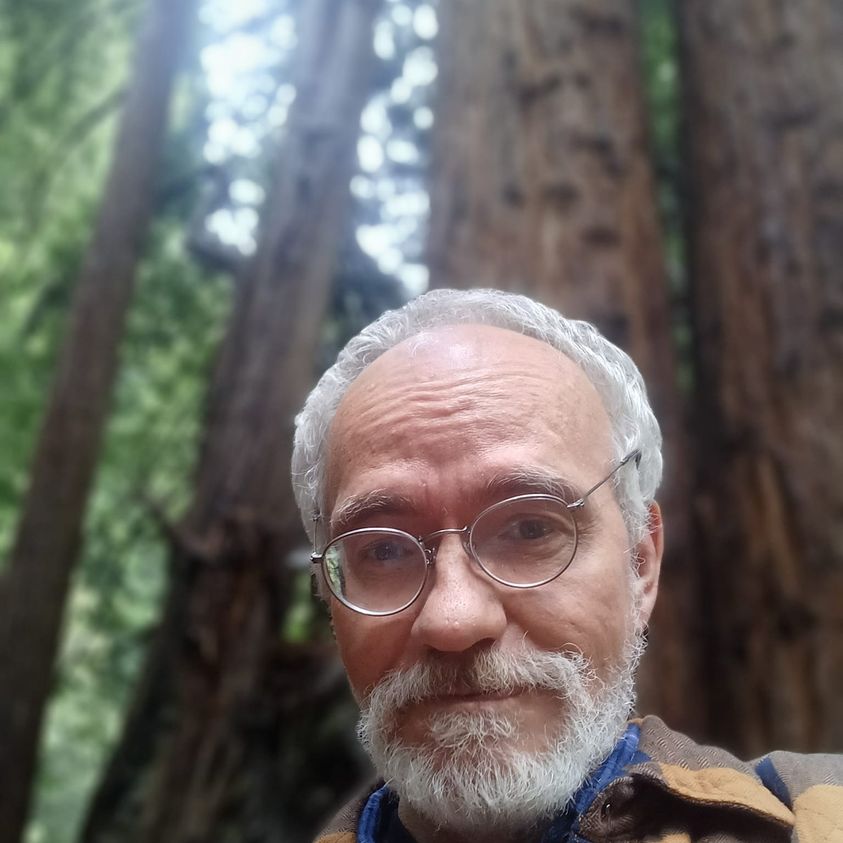
Whenever I’m in Northern California I simply have to visit the redwoods. Walking through them always directs me to the immense God who created these massive trees. Since I live in Alaska I’m also surrounded by stunning beauty: mountains, glaciers, eagles, forests and fireweed.

To truly see reality is to live in yirah.

I believe that God intentionally created the world to inspire awe in us. The complexity of creation is truly remarkable, with scientists dedicating their lives to understanding it. There is so much about the cosmos that remains beyond our comprehension, which leads us to consider how much more unfathomable its Creator must be.

Often missing from our lives and worship is yirah, or “awe, fear.”

“The fear [yirah] of the Lord is the beginning of wisdom, and the knowledge of the Holy One is insight.”

Proverbs 9:10

Three observations I need to make. These are something to consider:

  1. Believers are to teach our children the yirah of the Lord. It must be learned which implies that it’s not something natural to us. “So that they may learn to fear me all the days that they live on the earth, and that they may teach their children so.” (Deut. 4:10.)
  2. His love for us can’t be diminished by His power and might. I believe that these three are not mutually exclusive–you can’t have one without having the other. They can’t be separated. “But with you there is forgiveness, that you may be feared.” (Psalm 130:4.)
  3. Submitting to God with awe and yirah will lead you to obedience and consistency. Loving Him becomes a joy when we respect and honor in fear of our Father.

“Just as obedience to the Lord is an indication of our love for him, so is it also a proof of our fear of God.”

Jerry Bridges

alaskabibleteacher.com

The Thief on the Cross Speaks

Luke 23:39-43

“One of the criminals who were hanged railed at him, saying, “Are you not the Christ? Save yourself and us!” 40 But the other rebuked him, saying, “Do you not fear God, since you are under the same sentence of condemnation? 41 And we indeed justly, for we are receiving the due reward of our deeds; but this man has done nothing wrong.” 

42 “And he said, “Jesus, remember me when you come into your kingdom.” 43 And he said to him, “Truly, I say to you, today you will be with me in paradise.”

The pain was incredible, but I know that deep down I deserved to die. But not like this. Never like this. I was almost out of my mind with fear. What they were doing to me was terrifying.

You must understand that I was a common thief. I had stolen a loaf of bread when I was eight years old and that’s how it all got started for me. It more or else got bigger and easier. I knew how to steal and I was quite good at it. I was Jacob, the master thief!

When I was finally caught, they sentenced me to die. I supposed it was inevitable. I fault no one but myself as I knew what I was getting into. As I dragged my beam up to Golgotha, it was really strange but I suddenly remembered a verse from the scripture and it really did unsettle me.

(Gal. 3:13, ESV)

It’s a terrible thing to die this way. There were three of us, nailed to the wood and lifted up between heaven and earth. Jesus was nailed to the middle cross, not that it really mattered; all three of us were going to die today.

Many hope for an easy death, maybe in their sleep–but that’s not going to happen to us.

The third man could only mock, he was afraid, and I suppose he just echoed those Pharisees who didn’t really understand. But I knew better. I knew who this other man was, I had heard all the stories. Deep down I knew that this man on the center cross was the Messiah.

A crowd had gathered to watch us die. The Romans in their wonderful ingenuity had made a sign that they nailed above Jesus’ head, and it declared to everyone that Jesus was “the king of the Jews.” Even as he was dying, they found a way to malign him and irritate the crowd.

The other man being crucified continued to mock Jesus, and it infuriated me.

Why I defended him I don’t know for sure.

But I understood. Jesus was murdered out of the envy and jealousy of the Pharisees. He didn’t deserve to die like this, but He was hated, and who can confront these religious men without becoming a victim. Jesus had repeatedly crossed the line, so now they were now putting him to death. It seemed evil was really winning today.

I saw the soldiers throwing dice for Jesus’ clothes. He was now being mocked by them as well, even as He was dying on a brutal cross.

But all of a sudden it all made perfect sense.

He really was the Messiah, and these bastards were killing him. Crucifixion was starting to work on me now. I began to choke on my words, and it was getting hard to breathe.

“Jesus… please remember me. When your kingdom comes, please let me be a part of it.”

And as beaten as He was, He managed to turn and look directly at me. They had whipped and brutalized Him, and yet He was still aware. His words were whispered now, but I understood. “I promise that today you will be with me in paradise.”

I was starting to spasm again.

But the horror of death had left me. Some time had passed, and I could hear his breathing stop. But for the first time, I had peace. They used a spear on Jesus, but he was already dead.

The soldiers now came to the two of us, and they were carrying an ax to break our legs. It all had to do with the coming festival, and the Pharisees wanted us dead. When they swung that ax I knew a pain that I could never describe. My own death came quickly after that.

I was suddenly standing in paradise, whole and complete, and loved.

Someone was standing before me. He was shining, and I knew he was powerful; stronger, and He was more glorious than anyone I had ever met. It was crazy but somehow I knew that it was the Lord Jesus. He had come to meet me. It’s funny, but I realized that somehow I really did belong. Me–a dirty rotten thief.

Jesus had promised me, pronouncing me righteous, me of all people. I suddenly had a joy that I could never explain. I really was a part of the Kingdom that was beyond anything I had ever known. I believed him and asked if somehow I could be part of his eternal rule.

I simply asked and He gave me everything.

“I am going to heaven just like the thief on the cross who said in that final last moment: “Lord remember me.”

Billy Graham

alaskabibleteacher.com

Cover Art: “Christ on the Cross between Two Thieves,” by Peter Paul Rubens

The Giant Goliath, and Sexy Bathsheba

I have wondered about this. It strikes me that there are two giants that David encountered in his walk with God. Granted, there are many other events and people that he experienced, obviously. But there are these two that stick out:

The Goliath showdown, and the Bathsheba fiasco.

These seem to be hinges or pivot points that would change the entire course of king David’s life, and his faith in God. They’re to be an encouragement and warning to us, as both are incredibly significant.

This is a powerful chapter, for it reveals David’s spectacular faith in God. When the boy David killed Goliath it changed the entire future of Israel. One stone from his sling was all it took. Israel routed the Philistine army. David’s faith was the spark that made victory real.

David became a hero that day, and quickly ascended into Saul’s favor. It was both a military and a political development that Israel needed and king Saul welcomed it, the kingdom thrived. The boy David became the man of the hour, a national hero which everyone talked about.

I’d like to point out that David had already been anointed by Samuel to be the next king. This, combined with David’s celebrity status pushed king Saul over the edge–Saul developed a deep resentment that became insanity. David handled this adroitly, fleeing into the wilderness (with his faith) for years.

At this point David is now king and is fighting the Ammonites. The Israelites were besieging Rabbah, the capital city of that country, and it seems like it’s an intense battle. But interestingly enough, David remained in Jerusalem. (And I can’t figure out why.) David can’t sleep so he paces the rooftop and it’s then things get crazy.

David spies Bathsheba who is cleansing herself from her monthly cycle. She is a very beautiful woman, and king David inquires about her. He lusts after her which results in him more or less raping her, commiting adultery and then murdering her husband. This is all very disturbing.

When David had sex with Bathsheba it set in motion the ugliest chain of events imaginable. It seems that up to now David has taken the intiative of events, and then, after this great evil, his story shifts and for the rest of his life he becomes acted upon, a “victim.” He reacts, but doesn’t act anymore.

For the rest of his life he will struggle. All because of lust.

In 2 Samuel 12 David is confronted by a prophet for these sins. Samuel speaks with a parable that penetrates David’s heart. The king responds, “he shall restore the lamb fourfold, because he did this thing, and because he had no pity,” (v. 6). And interestingly enough, David would indeed pay fourfold. There would be four major incidents after this that he would now face.

David faced two “giants” in his walk with God. They were very different but both life altering. He killed Goliath but was not able to destroy his lust with Bathsheba.

Sometimes one “giant” is not enough. It would be nice if that was the case. David walked in victory for a period of time, but failed both himself, his family and his kingdom. Lust always is an act of the will, a deliberate decision that destroys all that it touches. David would be forgiven, but the damage was already done.

There would be dire consequences for everyone.

I believe that our giants were meant to be slaughtered. That is their function and purpose for the faithful believer. There can be no compromise. They’ll take different forms and will often approach you in peculiar ways. Paul tells us to wear God’s armor in Ephesians 6:11-18. I don’t think that protection should be taken off–you dare not only wear it only on special occasions.

Brother, sister–you must be covered all the time.

King David is a lesson for us. There is tremendous pain for us if we deliberately choose to compromise with the giants in our lives. Some of you already understand this; others will. I promise you.

    Oswald Chambers

Bryan Lowe

alaskabibleteacher.com

When Water Became a Sidewalk

Matthew 14:24-31

Peter is speaking:

It was the dead of night–the fourth watch, sometime between 3-6 a.m. The crossing was going all wrong, the water and wind were contrary, and we were exhausted. We had worked hard and made little headway. I seldom have seen anything like this, and the waves were pounding our boat. We had no idea how long we could keep this up.

Someone shouted and started pointing. We all looked, and quickly came to the realization that it was Jesus–but that was impossible. It had to be His “ghost.” He was walking on water, calming striding toward us. As absurd as it seems now, we believed that. After all, what we were all seeing defied reason. No way, it was impossible!

As He got closer to our boat when it shouted to us.

We all knew Jesus’ voice—and He was telling us not to be afraid, He understood our fear and He wanted us to know that we were in God’s hands. Our terror got mixed up in skepticism. After all, it had been a long day and this just doesn’t happen. Besides we knew that Jesus was left back in Gaiilee.

I don’t know why to this day where my courage came, but I needed to be with Jesus. Maybe it was curiosity, maybe it was more than that. Somewhere I came up with this wild idea that if He was really Jesus then He could allow me to walk on the water. I know that seems bizarre, but my “faith” in Him was greater than anything else.

Jesus told me to join Him.

So guess what? I stepped out of the boat.

The water was as solid as if I were walking on land! I couldn’t figure that out, it was impossible. Completely unbelievable. I saw the waves and felt the wind–My eyes shifted from Jesus and it was then I began to sink. The water was becoming water, and I began to sink.

“Jesus, save me!”

If there was any lesson that cry moved the heart of Jesus. Perhaps that’s what has shaped my ministry today. The cry of desperation has become an integral part of my walk. At that moment I realized that is my best prayer. “Master, save me!” I use it a lot. Especially when I’m “sinking.”

Jesus grabbed me.

I was pulled up and out of the water to safety. He gently spoke a rebuke–a kind word of instruction and direction. But I learned something.

Following Jesus is a supernatural walk.

It can’t be done in any other way. And you must get out of the safety of the boat, which must come at His invitation. He wasn’t angered by my unbelief, but I believe He was encouraged by my faith, and the lesson was clearly understood by the disciples still in the boat.

The steps of faith fall on the seeming void, but find the rock beneath.

    John Greenleaf Whittier

alaskabibleteacher.com

The Coming Train Wreck

Amos 3:7, ESV

We are witnessing something terrible.  Worldwide whole societies are being destroyed.  We’re more or less simple bystanders, there is really nothing we can do that can change the inevitable.  However, the survivors will need our assistance.  So we will wait for the inevitable crash, we pray, and anticipate a chance to bring our Savior’s love into the awful melee.

Things are accelerating far beyond what we think. 

This heightens the tension, which should make us alert and aware.  We make assumptions of the upcoming derailment which may, or may not be accurate.  But we all sense something dreadful and foreboding is approaching.

We are witnessing a train wreck.

Something disturbing is coming down.  It’s said that just before a big thunderstorm, the birds head for safety, they simply disappear.  The birds know this, and yet it seems, and yet we’re still trying to connect the dots.  We look at the skies, but yet we don’t quite understand the signs.

The crisis that is coming will stagger the unbeliever. It will certainly challenge the believer.

We must be ready ourselves.  Our viewpoint of eternity will become a much needed necessity for those who go through the devastation of the train wreck.  It’s what will pull us and others through some black and bleak times. We must prepare ourselves.

We can ask for grace, not just to help us, but to help them.

When the storm gets close, the best we can do is to head for the “storm cellar.”  As a boy, growing up in the Midwest, I have clear and distinct memories of heading for that basement shelter, with my dad and mom.  When a tornado is coming the only thing we can do is find shelter.  To choose to hide, and to take cover is both prudent and wise.

While things are collapsing, we need to find comfort in His shelter. 

His wings shelter us as believers, and we must find refuge in that precious and intimate place.  So much news is grim, and we can so easily slip into depression and despair.  We look around, but we must turn directly to these wings that cover us.  We’re protected and sheltered in that place, but only in that place.

“Those who live in the shelter of the Most High will find rest in the shadow of the Almighty.
This I declare about the Lord:
He alone is my refuge, my place of safety;
he is my God, and I trust him.”

Psalm 91:1-2

We should rest, and consciously put our own souls under His care. 

Some may look at everything and then decide to step into the storm in order to shut it down.  But brother, we can’t stop it, for it’s of the Lord.  Quite a few of the prophets in the Old Testament saw and understood what was going to happen soon, but they couldn’t do anything against Babylon or Assyria.  But with their voices they strengthened and encouraged others against an outrageous brutality.

That is something that’s going to be critically needed. It is a good thing, and it’s what we’re being called to do.

God has brought you to this particular spot. He has put you into this moment in time. You must take your place. Be alert, stay on guard. We’re put into this place by the Father.

Esther 4:14

bry-signat (1)

Leaders Who Wash Between the Toes

drsunil.com, art by Takla

He came to Simon Peter, who said to him, “Lord, do you wash my feet?” Jesus answered him, “What I am doing you do not understand now, but afterward you will understand.” Peter said to him, “You shall never wash my feet.” Jesus answered him, “If I do not wash you, you have no share with me.”

John 13:6-8 (verses 3-17)

Chapter 13 always rocks my world. I visualize this, like a fly on the wall, watching it happen–and then I replay it over, and over in my mind. It always unravels me. Why does this have to happen? What does this passage tell me about Jesus and his kingdom? (John 13). Why can’t I just walk away from it, and leave it be?

Jesus made himself a slave on purpose.

Or perhaps he was always a slave all along, and we just didn’t realize it? Foot-washers were pretty much regarded as sub-human, mindless drones who mechanically performed a necessary duty. The lowest of the low, the very least of the least. (Today they’re the burger flippers and the pool cleaners.)

But Jesus took that role on himself, he laid aside his garments and his Godhood. (They landed in a pile in the corner of the room). When he knelt down to scrub feet (making sure he got between the toes), it was Deity serving man. This God/rabbi intentionally did this, not reluctantly or halfheartedly–but carefully. Brilliantly.

He was their teacher, and custom demanded he enjoys the prerogatives of that position. But he wouldn’t, and didn’t. He mustn’t. As I stress over this, I must conclude he really was their “teacher,” but not in the way I expect. What he was doing on his knees, was instructing them in the art of loving each other.

He showed us a real leader in action.

And isn’t making disciples all about loving (and washing) someone else more than ourselves?

We get things turned around sometimes–we think that spiritual authority is moving up when it’s all about going down. We elevate our pastors and elders, maybe subconsciously–and human nature lets it happen, and then we’re amazed why our leaders struggle so.

Leaders function best when they wash between the toes.

There was a point in Jewish history when the people actually demanded that God would give them a king, instead of a judge (1 Samuel 8:5-9). God warned them that this wasn’t in his plans–but they insisted.

They had to have one, everyone else did. We still must have celebrities, and then we wonder why they short-circuit on us. Who can resist the privilege, and the limelight of the platform?

The Church was never meant to operate like this.

That’s what Jesus said. Instead, it’s we who’ve turned it upside down. It’s we who insist on turning our pastors into minor celebrities. We assert that they take on the role of a “king” (albeit, a little one maybe). Perhaps leaders who stumble and fall do so because we want them to be front and center? Who can handle the privilege and the adulation? I know I can’t.

Peter was classic Peter.

It seems that whenever he resists, he gets rebuked. He makes it quite clear that Jesus will never wash feet–that Jesus will never use a basin or towel and serve him like this. It was outrageous. Unacceptable. It didn’t fit in Peter’s personal theology. He had no room for Jesus the slave. (Perhaps he knew that to follow meant he would have to do the same thing? IDK).

Jesus still washes His people. He has not changed.

He sits us down and takes off our shoes and socks, and scrubs us clean. And we hate it. But to be washed by him is a condition of our discipleship. Every follower must be clean, and he continues his work to this day. We sin daily, even as his own, and he cleans us up–and somehow that really bothers us.

The gifts of leadership are one way of washing feet. At least that’s what our leaders were designed to do. That’s Jesus’ way of doing things. But it seems we’ve adopted Peter’s attitude, and embraced the ‘pre-king’ thinking of Israel. We need our celebrities, we want our kings. We simply can’t imagine it any other way.

“The very first thing which needs to be said about Christian ministers of all kinds is that they are “under” people as their servants rather than “over” them. Jesus made this absolutely plain. The chief characteristic of Christian leaders, he insisted, is humility not authority, and gentleness not power.”

 John Stott